
Turn every policy into automated workflows with built-in enforcement and audit-ready proof.

15 Best Agile Workflow Software Tools

Agile workflow software helps teams plan, prioritize, execute, review, and improve work in short cycles. The right tool makes sprint work visible without turning the tool itself into the process.
This guide compares agile workflow software for teams that use Scrum, Kanban, Scrumban, product roadmaps, approval gates, recurring operational workflows, or enterprise portfolio planning.
- Process Street: Compliance Operations Platform for governed agile execution
- Jira: Best for software teams running Scrum, Kanban, and scaled agile delivery
- Asana: Best for cross-functional agile work outside pure engineering
- ClickUp: Best all-in-one agile workspace for teams that want breadth
- monday dev: Best visual agile workspace for product and software teams
- Wrike: Best for agencies, services teams, and work management at scale
- Trello: Best lightweight Kanban board for simple agile workflows
- Smartsheet: Best spreadsheet-style agile workflow software for enterprise teams
- Miro: Best for agile planning, retrospectives, and visual collaboration
- Zoho Sprints: Best budget-friendly Scrum tool inside the Zoho ecosystem
- Azure Boards: Best for agile teams in the Microsoft development stack
- GitHub Projects: Best agile planning layer for code-first teams
- Linear: Best fast issue workflow for modern product engineering teams
- Businessmap: Best for Kanban maturity and flow analytics
- Planview: Best enterprise agile portfolio planning platform
How to choose agile workflow software
Start with the work pattern, not the brand. A software team running two-week sprints needs backlog depth, sprint reports, developer integrations, and release tracking. An operations team needs repeatable workflows, approvals, forms, assignments, and proof that every step happened. A PMO needs portfolio views, capacity planning, dependency management, and executive reporting.
- Choose a dedicated agile delivery tool when engineering work, bugs, releases, and code integration drive the workflow.
- Choose a work management platform when the process crosses marketing, operations, customer success, HR, finance, or vendors.
- Choose a workflow automation platform when the process repeats and missed steps create operational or compliance risk.
- Choose a portfolio platform when leadership needs to compare priorities, funding, capacity, dependencies, and delivery outcomes across many teams.
The best agile workflow software is the one your team will keep clean. If every status, field, and ceremony becomes mandatory, the workflow stops serving agile delivery and starts creating admin work.
1. Process Street

Process Street fits agile teams that need more than a board. It turns recurring procedures, reviews, approvals, handoffs, and evidence collection into workflows people actually run. Use it when agile work touches operations, compliance, customer delivery, employee onboarding, vendor management, or any process where skipped steps create risk. Process Street workflows support conditional logic, approvals, assignments, automations, and integrations, so teams can move from a static agile plan to an enforced operating rhythm.
Best for
Best for operations and compliance teams that need repeatable agile execution, audit trails, approvals, and no-code automation.
Key agile workflow features
Workflow runs, conditional logic, approvals, task assignments, forms, automations, Pages, Data Sets, and integrations with systems teams already use..
Watch out for
Not the best fit if your only need is developer issue tracking inside a code repository.
2. Jira

Jira remains the default shortlist tool for engineering teams because it understands software delivery depth: issues, epics, backlogs, boards, releases, dependencies, and developer integrations. Atlassian describes Jira as supporting Scrum, Kanban, timelines, and backlog planning for agile teams. Use Jira agile project management when engineering wants tight control over issue types, workflow states, sprint reports, and release tracking.
Best for
Best for product and engineering organizations that need a configurable agile system with strong development ecosystem support.
Key agile workflow features
Scrum boards, Kanban boards, backlog, timeline, releases, automation, permissions, dashboards, marketplace apps, and deep Atlassian ecosystem fit..
Watch out for
Jira can become heavy if every stakeholder adds custom fields, statuses, and governance layers without pruning.
3. Asana

Asana is strong when agile work spans marketing, operations, product launches, creative, and business teams. It supports boards, timelines, custom fields, dependencies, and sprint-style workflows without forcing every team into a developer-first issue model. Asana positions its agile management software around sprint planning, flexible collaboration, boards, timelines, and dependencies.
Best for
Best for teams that want agile planning with cleaner adoption across non-technical stakeholders.
Key agile workflow features
Board view, timeline, goals, portfolios, custom fields, workload, project templates, and easy collaboration..
Watch out for
Engineering teams that require deep issue, branch, build, and release tracking may still prefer Jira, Azure Boards, or GitHub Projects.
4. ClickUp

ClickUp combines tasks, docs, whiteboards, dashboards, sprints, goals, automations, and AI features in one workspace. That breadth is useful when a team wants to consolidate several tools, but it requires discipline to keep the workspace simple. ClickUp markets its agile project management software around sprint reporting, dashboards, Git integrations, automation, and Scrum or Kanban workflows.
Best for
Best for teams that want one broad work hub for agile projects, documentation, dashboards, and collaboration.
Key agile workflow features
Sprints, custom statuses, Docs, dashboards, goals, automations, whiteboards, multiple views, and AI-assisted planning..
Watch out for
ClickUp can feel crowded if a team only wants a lightweight board or a strict engineering issue tracker.
5. monday dev

monday dev is the agile-focused product inside monday.com. It gives product and engineering teams roadmaps, sprint planning, bug tracking, retrospectives, release management, dashboards, and engineering metrics in a familiar visual workspace. The monday dev page highlights sprint management, Scrum and Kanban boards, GitHub, GitLab, and CircleCI integrations, sprint automations, burndown charts, velocity charts, and AI sprint summaries.
Best for
Best for teams that like monday.com but need a more explicit product development workflow.
Key agile workflow features
Roadmap boards, sprint boards, burndown and velocity charts, bug tracking, release workflows, and colorful dashboards..
Watch out for
Teams that need very strict engineering workflows may find Jira or Azure Boards more precise.
6. Wrike

Wrike is a strong agile workflow option for teams that blend client delivery, resource management, approvals, reporting, and project operations. It is less developer-native than Jira, but often better for structured service work. Wrike describes its agile project management software as a platform for planning, executing, and delivering faster, with a large integration ecosystem.
Best for
Best for marketing, professional services, operations, and agency teams that need agile boards plus resource and reporting control.
Key agile workflow features
Agile templates, request forms, approvals, dashboards, workload, time tracking, dependencies, and cross-team reporting..
Watch out for
Wrike can be more system than a small team needs if all they want is a simple sprint board.
7. Trello

Trello is still useful when the team wants a fast visual board with cards, lists, checklists, and Power-Ups. It is not the deepest agile platform, but it remains one of the easiest ways to get a team into a shared workflow. Atlassian positions Trello as a visual way for teams to collaborate on projects, with boards and cards as the core model.
Best for
Best for small teams, simple Kanban workflows, editorial calendars, personal agile systems, and lightweight work tracking.
Key agile workflow features
Boards, cards, lists, checklists, labels, due dates, Butler automation, templates, and Power-Ups..
Watch out for
Trello is too light for serious sprint reporting, portfolio management, or complex dependency tracking.
8. Smartsheet

Smartsheet works well when an organization already runs work in grids, reports, dashboards, approvals, and portfolio views. It can support agile, hybrid, and waterfall work in the same operating layer. Smartsheet says its agile project management software supports Scrum, Kanban, SAFe, and hybrid workflows with sprints, backlogs, dashboards, and automation.
Best for
Best for PMO, operations, enterprise, and hybrid delivery teams that want agile workflows connected to reporting and portfolio control.
Key agile workflow features
Grid view, card view, dashboards, reports, automated workflows, forms, dependencies, and enterprise governance..
Watch out for
Teams that dislike spreadsheet-style systems may find Smartsheet less natural than Asana, monday dev, or Trello.
9. Miro

Miro is not a full project execution system, but it is excellent for the collaborative moments around agile work: sprint planning, retrospectives, story mapping, discovery, prioritization, and remote workshops. Miro describes its agile workflow tools as supporting sprint planning, retrospectives, collaborative templates, and integrated planning spaces.
Best for
Best for product, design, and agile coaching teams that need shared thinking space before work moves into an execution tool.
Key agile workflow features
Online whiteboards, agile templates, retrospectives, story maps, planning boards, AI-assisted clustering, comments, and integrations..
Watch out for
Miro should usually connect to Jira, Azure Boards, Asana, or another execution system rather than replace one.
10. Zoho Sprints

Zoho Sprints is a more precise agile choice than generic Zoho Projects. It focuses on backlogs, Scrum boards, epics, releases, reports, meetings, and timesheets for teams that want structured agile planning without enterprise complexity. Zoho says Zoho Sprints includes backlog planning, Scrum boards, release management, timesheets, and agile reports.
Best for
Best for small and mid-size agile teams that already use Zoho or want a lower-cost Scrum tool.
Key agile workflow features
Backlog, Scrum board, epics, releases, timesheets, sprint dashboard, velocity, burn-down, cumulative flow, and Zoho integrations..
Watch out for
It is less compelling for teams standardized on GitHub, Microsoft, Atlassian, or enterprise portfolio tooling.
11. Azure Boards
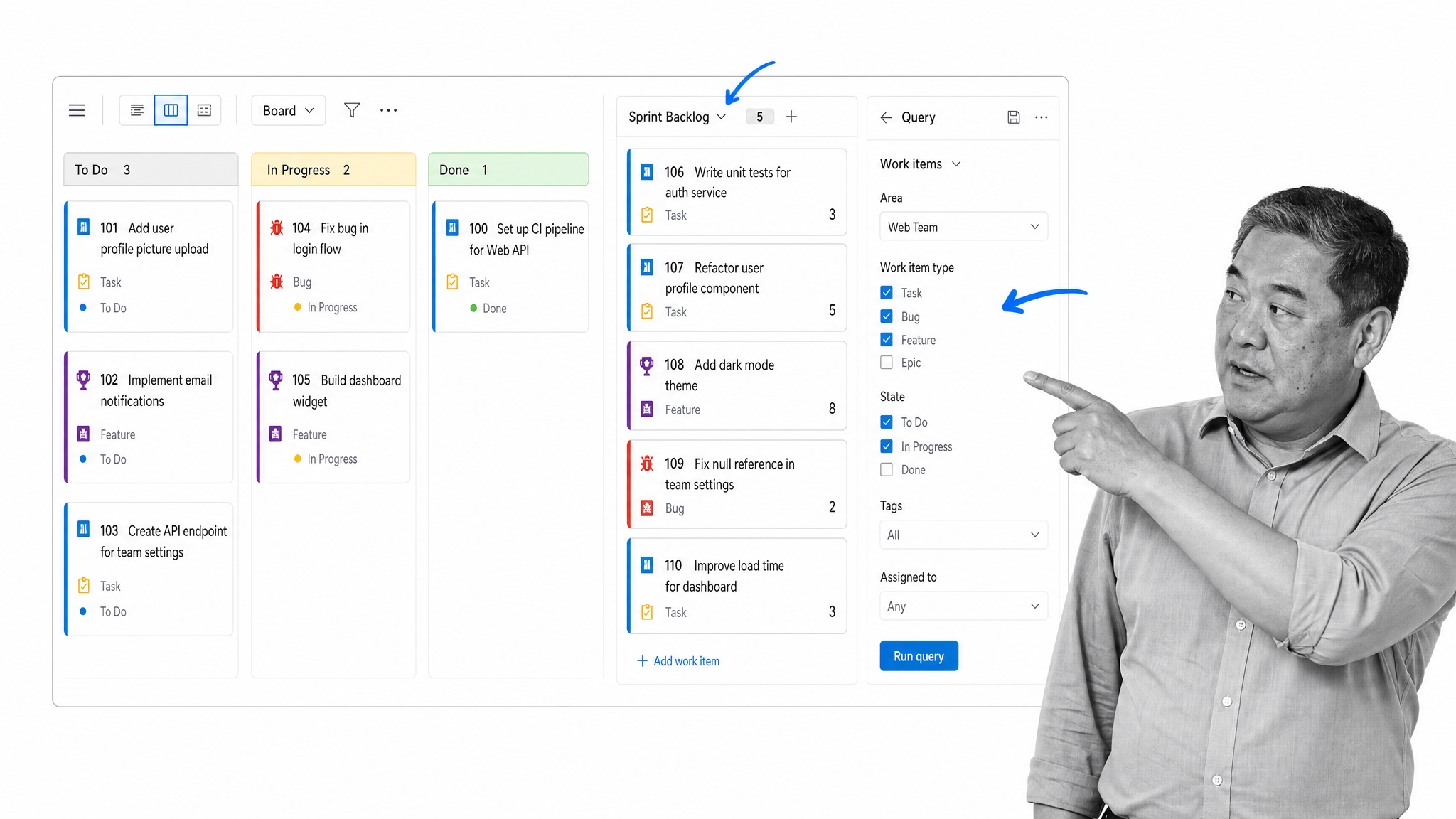
Azure Boards is a strong fit for teams already using Azure DevOps, Microsoft identity, repositories, pipelines, and enterprise Microsoft governance. It gives teams work items, backlogs, sprint planning, Kanban boards, dashboards, and integration with the development lifecycle. Microsoft describes Azure Boards as planning and tracking software with Kanban boards, backlogs, dashboards, and Scrum boards.
Best for
Best for software teams that live in Microsoft Azure DevOps and need agile planning close to code, builds, and releases.
Key agile workflow features
Work items, boards, backlogs, sprints, queries, dashboards, team settings, and Microsoft ecosystem integrations..
Watch out for
It is less friendly for non-technical teams that do not already work inside Microsoft DevOps.
12. GitHub Projects

GitHub Projects keeps planning close to issues, pull requests, repositories, and developer discussion. It is not a full enterprise agile suite, but it works extremely well when the source of truth for work is already GitHub. GitHub says Issues and Projects can track a sprint, plan a feature, manage a large-scale release, and visualize work as tables, boards, or roadmaps.
Best for
Best for engineering teams, open source maintainers, and platform teams that want lightweight agile planning tied directly to code.
Key agile workflow features
Issues, sub-issues, project tables, boards, roadmaps, custom fields, labels, milestones, pull request linkage, and automation..
Watch out for
Cross-functional stakeholders may still need a broader planning tool for portfolios, capacity, and executive reporting.
13. Linear

Linear is built for product and engineering teams that want a fast, opinionated workflow around issues, cycles, projects, roadmaps, and triage. It is a strong Jira alternative when teams value speed and simplicity over extensive configuration. Use Linear when product and engineering want a clean issue workflow that keeps planning moving without a large admin layer.
Best for
Best for fast-moving software teams that want cycles, triage, roadmaps, and issue tracking in a polished workflow.
Key agile workflow features
Cycles, projects, issues, roadmaps, triage, views, GitHub and Slack integrations, keyboard-driven navigation, and clean status flows..
Watch out for
Linear is not the right choice if your organization needs highly customized enterprise workflow governance.
14. Businessmap

Businessmap, formerly Kanbanize, is a strong option for teams that take Kanban seriously and want portfolio flow, WIP limits, swimlanes, analytics, and strategy-to-execution alignment. Businessmap identifies itself as Businessmap, formerly Kanbanize, and positions the platform around multi-project management and Lean analytics.
Best for
Best for teams that want a serious Kanban operating system rather than a generic task board.
Key agile workflow features
Kanban boards, swimlanes, work item hierarchy, WIP limits, flow analytics, portfolio boards, policies, and cycle time reporting..
Watch out for
Teams looking for simple Scrum ceremonies may be better served by Jira, Zoho Sprints, or monday dev.
15. Planview

Planview is for organizations coordinating agile work across portfolios, product lines, strategic initiatives, and capacity constraints. It is not a lightweight team board. It is a planning and portfolio layer for enterprise delivery. Planview describes its platform as AI-powered strategic portfolio management and software product delivery for prioritizing investments, making plans real within constraints, and supporting enterprise agile planning at scale.
Best for
Best for enterprises that need agile portfolio management, strategic alignment, investment planning, and capacity planning across many teams.
Key agile workflow features
Portfolio planning, product delivery, value streams, strategic roadmaps, capacity planning, investment prioritization, and executive reporting..
Watch out for
Planview is too much for small teams that only need sprint planning or Kanban execution.
Agile workflow software comparison
| Tool | Best fit | Workflow depth |
|---|---|---|
| Process Street | Compliance Operations Platform for governed agile execution | High |
| Jira | Best for software teams running Scrum, Kanban, and scaled agile delivery | High |
| Asana | Best for cross-functional agile work outside pure engineering | Medium |
| ClickUp | Best all-in-one agile workspace for teams that want breadth | High |
| monday dev | Best visual agile workspace for product and software teams | High |
| Wrike | Best for agencies, services teams, and work management at scale | High |
| Trello | Best lightweight Kanban board for simple agile workflows | Medium |
| Smartsheet | Best spreadsheet-style agile workflow software for enterprise teams | High |
| Miro | Best for agile planning, retrospectives, and visual collaboration | Medium |
| Zoho Sprints | Best budget-friendly Scrum tool inside the Zoho ecosystem | Medium |
| Azure Boards | Best for agile teams in the Microsoft development stack | High |
| GitHub Projects | Best agile planning layer for code-first teams | Medium |
| Linear | Best fast issue workflow for modern product engineering teams | Medium |
| Businessmap | Best for Kanban maturity and flow analytics | High |
| Planview | Best enterprise agile portfolio planning platform | High |
Which agile workflow software should you pick?
Pick Process Street when agile work becomes recurring operational execution and you need approvals, evidence, automation, and accountability built into the workflow. Pick Jira, Azure Boards, GitHub Projects, or Linear when the center of gravity is engineering delivery. Pick Asana, ClickUp, monday dev, Wrike, Trello, or Smartsheet when the work spans several business teams. Pick Miro when the agile ceremony itself needs better collaboration. Pick Businessmap or Planview when flow, portfolio governance, and enterprise alignment matter more than a single team board.
Agile workflow software should make change easier to absorb. It should show what matters now, route work to the right owner, prevent bottlenecks from hiding, and make review loops fast enough that the team can adjust before the next cycle is already lost.
FAQs
What is agile workflow software?
Agile workflow software is a tool that helps teams plan, prioritize, track, review, and improve work in iterative cycles. It usually includes boards, backlogs, sprint planning, assignments, reporting, and collaboration features.
What is the best agile workflow software?
The best choice depends on the team. Process Street is best for governed operational workflows, Jira is best for software teams with deep agile delivery needs, Asana is strong for cross-functional work, and Planview is built for enterprise portfolio planning.
Can non-technical teams use agile workflow software?
Yes. Marketing, operations, HR, finance, customer success, and compliance teams often use agile workflow software to manage campaigns, recurring processes, onboarding, approvals, vendor work, and improvement cycles.
What features matter most in agile workflow software?
The most important features are backlog management, workflow states, task ownership, sprint or flow planning, reporting, automation, integrations, and a clear way to review and improve work after each cycle.
Is agile workflow software the same as project management software?
Not always. Project management software can support agile methods, but agile workflow software is more focused on iterative planning, flow, feedback loops, and adapting work as priorities change.
When should I use workflow automation instead of a simple agile board?
Use workflow automation when the work repeats, has required steps, needs approvals, touches multiple systems, or creates risk if someone skips a step. A board can show status, but automation helps make the work happen correctly.