Turn every policy into automated workflows with built-in enforcement and audit-ready proof.



The Ultimate Client Onboarding Process Toolkit

A client onboarding process is the repeatable system that moves a new client from signed agreement to first value. It covers the sales handoff, welcome message, intake, access setup, kickoff, training, activation, and handoff into the ongoing relationship.
The goal is not to make clients complete a checklist. The goal is to make sure they understand what happens next, know who owns each step, provide the right information once, and reach a useful outcome as quickly as possible.
This guide gives you a practical client onboarding process you can adapt for SaaS, agencies, financial services, legal services, consulting, and other high-touch service teams. You will also find templates you can run in Process Street, plus automation ideas for turning onboarding from a manual project into an enforced workflow.
- What is a client onboarding process?
- Why client onboarding matters
- Client onboarding process stages
- Client onboarding checklist
- Common client onboarding challenges
- Client onboarding best practices
- Client onboarding process templates
- How to automate client onboarding
- Client onboarding metrics
- Client onboarding process FAQs
What is a client onboarding process?
A client onboarding process is a structured sequence of tasks, communications, approvals, and handoffs that helps a new client start working with your business. It begins when the sale closes and ends when the client is set up, trained, and able to get value from the product or service they purchased.
For a services business, that might mean collecting documents, confirming scope, introducing the delivery team, and running a kickoff. For SaaS, it might include account configuration, data migration, integrations, admin training, and the first completed workflow. For regulated teams, it can also include identity checks, consent, approvals, document retention, and audit evidence.
Strong onboarding makes the relationship feel calm from the first touch. The client knows what to do. Your team knows what to do. Every required step has an owner, a deadline, and proof that it happened.
Why client onboarding matters
Client onboarding is where expectations become operational reality. Sales may have created trust, but onboarding proves whether the client can depend on your team after the contract is signed.
When onboarding is informal, the same problems repeat: missing documents, unclear owners, repeated questions, delayed kickoff calls, support requests that should have been prevented, and clients who wonder whether they made the right decision. In high-touch businesses, those gaps create churn risk before the client has experienced real value.
A defined onboarding process helps you:
- Reduce time to first value by moving setup work in the right order.
- Prevent repeated questions by carrying sales context into delivery.
- Give clients one clear path instead of scattered emails and spreadsheets.
- Make ownership visible across sales, customer success, operations, finance, compliance, and delivery.
- Create a repeatable standard that can improve over time.
- Capture audit-ready proof when onboarding includes regulated steps or contractual obligations.
If onboarding touches compliance, approvals, data collection, or recurring client work, it should live in a system that enforces the process. A static checklist can remind people what to do. A workflow makes sure the work actually happens.
Client onboarding process stages
Most client onboarding processes follow the same shape, even when the details differ by industry. Use these stages as the backbone, then add the documents, decisions, integrations, and approvals your business requires.
Sales-to-service handoff
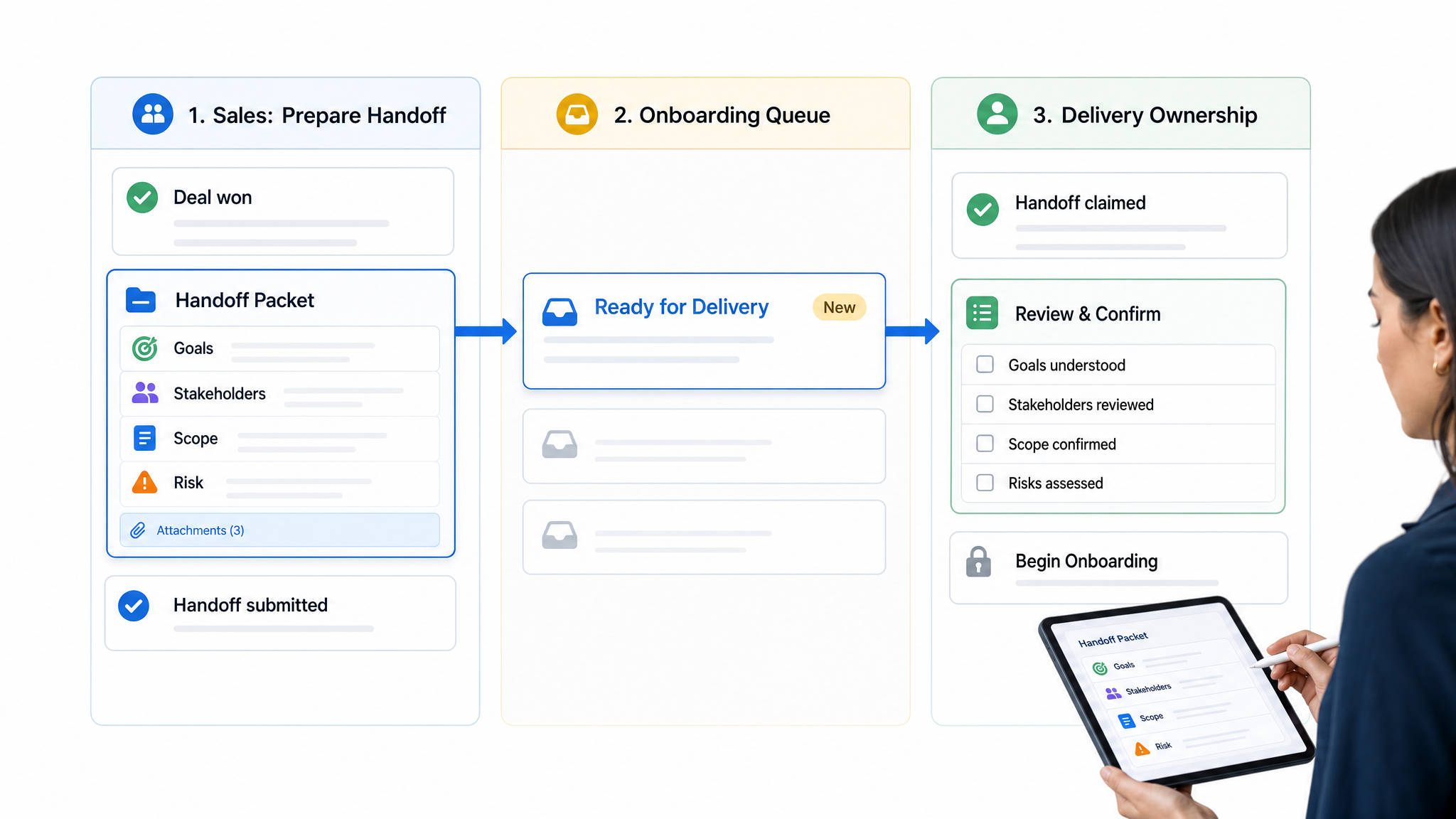
Onboarding starts before the client receives a welcome email. The sales team should hand off the scope, goals, stakeholders, promised timelines, risks, legal terms, and any special commitments made during the buying process. If that context is missing, the onboarding team has to rediscover it by asking the client the same questions again.
A good handoff includes the signed agreement, account notes, decision criteria, success metrics, technical requirements, billing details, and open questions. The handoff is complete only when the onboarding owner can explain what the client bought, why they bought it, and what value needs to happen first.
Welcome and expectations
The welcome step confirms the relationship and tells the client exactly what happens next. Keep the message simple: who their main contact is, what the onboarding timeline looks like, what the client needs to prepare, and where they should go for questions.
This is also the right time to share a client-facing onboarding workspace, kickoff agenda, document request list, or setup checklist. The client should not have to search through separate email threads to understand what is expected from them.
Client intake and requirements
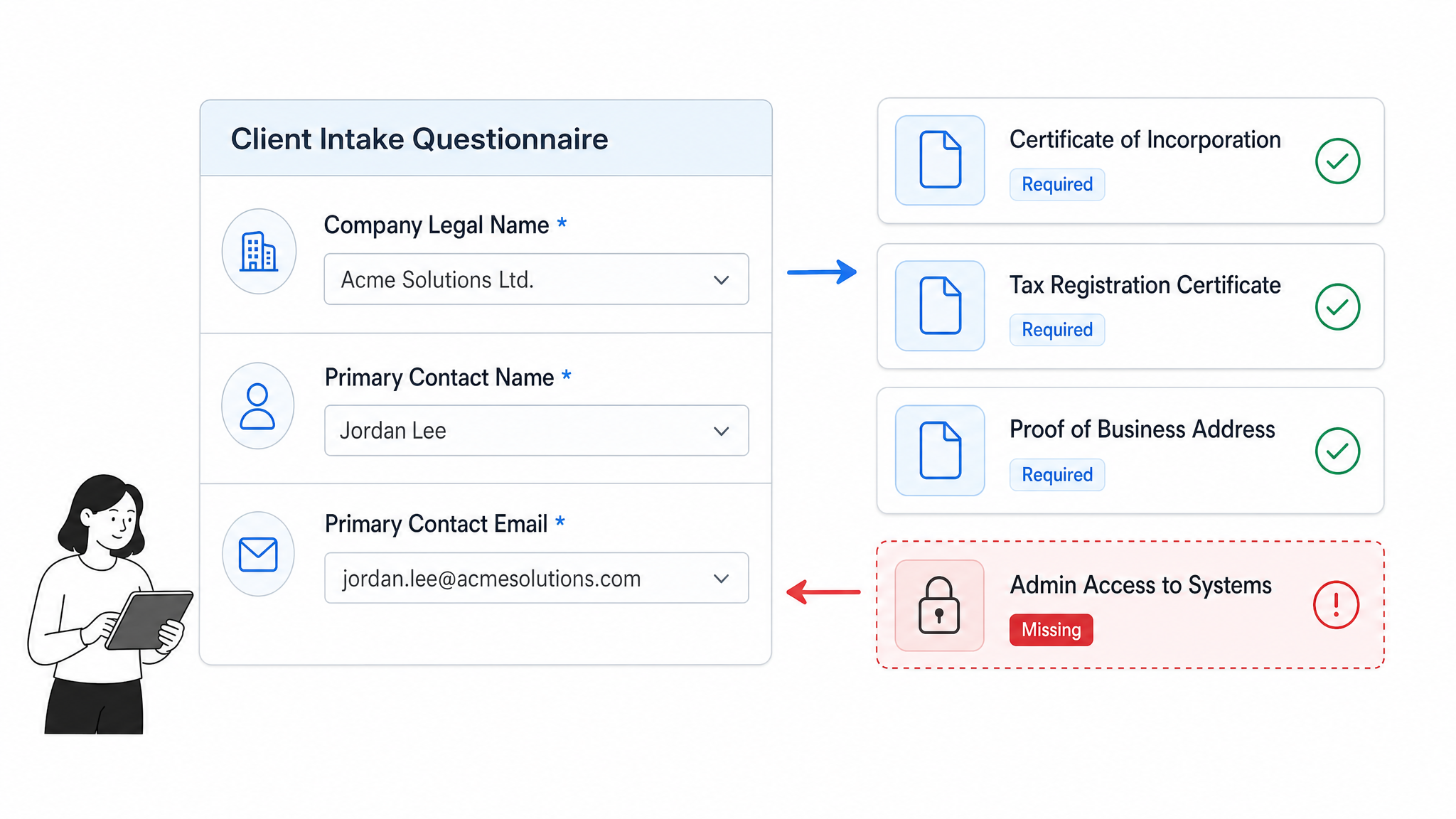
Intake turns vague goals into usable operating detail. Collect the information your team needs to configure the account, deliver the service, prepare the first meeting, and avoid blockers later. That can include company details, stakeholders, systems, access requirements, document uploads, risk flags, communication preferences, and desired outcomes.
Use structured forms instead of open-ended email. Required fields, conditional questions, and file upload tasks reduce back-and-forth and make it easier to reuse the answers in downstream workflows.
Account setup, access, and compliance

Once intake is complete, your team can prepare the working environment. This might include user invitations, permission groups, CRM updates, billing checks, e-signatures, security reviews, document collection, identity verification, or connecting tools such as Salesforce, Slack, DocuSign, Google Drive, or HubSpot.
For compliance-heavy teams, this stage matters because it creates proof. The workflow should show who completed each task, which documents were collected, which approvals were granted, and what exceptions still need review.
Kickoff and success plan
The kickoff meeting aligns both sides around the outcome. Use it to confirm scope, roles, deadlines, communication cadence, blockers, and the first value milestone. Do not make kickoff a generic product tour. Make it a working session that connects the client goal to the onboarding plan.
A useful success plan answers five questions: what does success look like, who owns each part, what must happen before go-live, what risks could slow the process, and how will both teams know the client has reached first value?
Training, activation, and first value
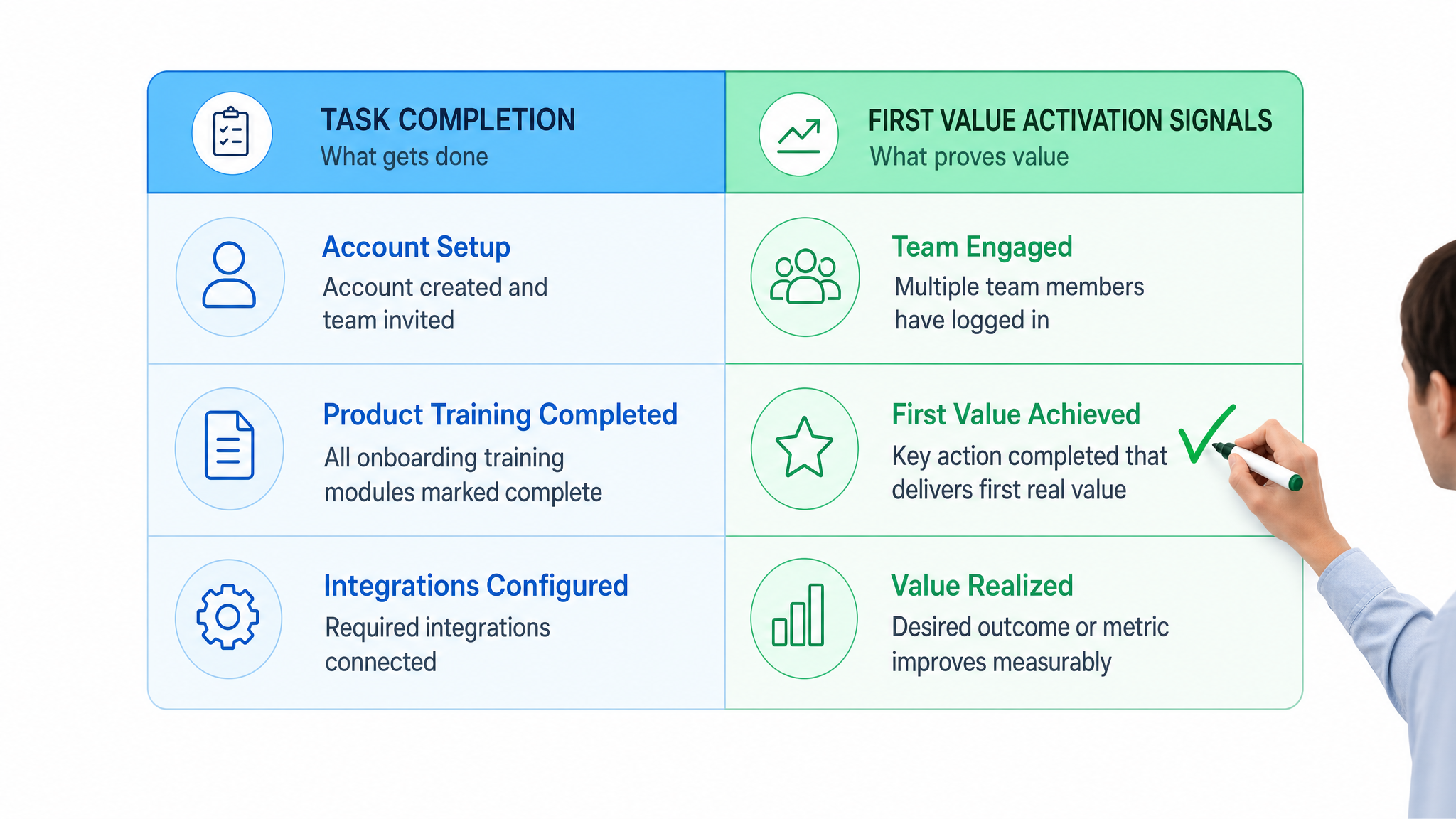
Training should be tied to the first outcome the client needs, not every feature your product or service offers. Give the client enough guidance to complete the first important action: launch a workflow, upload required documents, approve a deliverable, invite their team, connect an integration, or complete a first project milestone.
Activation is stronger than completion. A client can finish onboarding tasks and still fail to experience value. Track whether the client performed the behavior that proves onboarding worked.
Follow-up, handoff, and continuous improvement
Onboarding should end with a clean handoff into the ongoing relationship. Confirm what was completed, what remains open, where key documents live, who owns the account, and what the next review point is. Send a summary that the client and your internal team can both rely on.
After each onboarding run, review where work slowed down. Look for missing fields, unclear owners, repeated questions, delayed approvals, and tasks that required manual chasing. Then update the workflow so the next client benefits from what you learned.
Client onboarding checklist
Use this checklist as a starting point for your own onboarding workflow. Keep the client-facing version focused and move internal-only tasks into a private section so the client sees a clear path, not your entire operating system.
- Confirm the signed agreement, scope, billing details, and start date.
- Assign an onboarding owner and backup owner.
- Complete the sales-to-service handoff with goals, risks, stakeholders, and commitments.
- Send the welcome message with timeline, next steps, and support contact.
- Create the client workspace, portal, or workflow run.
- Collect intake answers, required documents, access details, and communication preferences.
- Set up accounts, permissions, integrations, folders, and internal systems.
- Schedule kickoff and share the agenda in advance.
- Define success metrics and the first value milestone.
- Run training or working sessions tied to the first value milestone.
- Track blockers, overdue tasks, and owner handoffs.
- Confirm activation, send a completion summary, and hand the client into the ongoing cadence.
- Review the onboarding run and improve the workflow.
In Process Street, this checklist can become a live workflow with assignments, due dates, approvals, conditional logic, dynamic forms, file uploads, and integrations. That gives your team a process they can run, not just a document they have to remember.
Common client onboarding challenges
Most onboarding problems are not caused by one bad email or one missed meeting. They come from weak process design. These are the issues to solve first.
Unclear ownership
If everyone is responsible, nobody owns the client experience. Assign one onboarding owner, then assign every task to a specific person or role. The client should know who their main contact is and your team should know who is accountable for each deadline.
Sales promises that do not reach delivery
The client remembers what was promised during sales. If the onboarding team does not receive that context, trust breaks quickly. Use a required handoff workflow so scope, success criteria, risks, and special commitments cannot be skipped.
Too much information at once
Overloaded onboarding feels helpful to the team but exhausting to the client. Sequence the work around the next useful milestone. Give clients what they need for the current stage and make future steps visible without asking them to act on everything at once.
Manual chasing
Manual follow-up turns onboarding into inbox management. Use automated reminders, overdue task alerts, and escalation rules so missing documents, unsigned forms, and stalled approvals surface without someone checking a spreadsheet every morning.
No proof of completion
For regulated or contract-heavy teams, completion needs evidence. Keep documents, approvals, timestamps, comments, and task history attached to the workflow. That record helps with audits, quality checks, and client escalations.
Client onboarding best practices
A strong onboarding process is structured enough to protect quality, but flexible enough to adapt to client complexity. These practices keep the process useful as you scale.
Design around first value
Start by defining the first meaningful result the client needs. Then remove or delay anything that does not help them reach it. A SaaS client may need to launch one workflow. An agency client may need to approve a first campaign brief. A financial planning client may need to upload documents and complete a risk profile.
Separate internal and client-facing work
Your team needs operational detail. The client needs clarity. Keep billing checks, internal setup, compliance review, and CRM cleanup inside the workflow, but show the client a clean view of their own actions, deadlines, resources, and next steps.
Use conditional paths
Not every client needs the same path. Use conditional logic for client type, plan, region, service line, risk level, integration needs, and compliance requirements. A simple client should not see enterprise setup tasks, and an enterprise client should not rely on a lightweight checklist that misses required approvals.
Make handoffs explicit
Every handoff should produce an artifact: a kickoff summary, setup checklist, implementation notes, go-live approval, or account handoff record. If the next owner cannot see what happened before, the client will feel the gap.
Review metrics and improve the workflow
Track where clients get stuck and where your team adds manual work. Use those signals to update the workflow, improve templates, adjust training, or add automation. The process should get stronger after each client.
Client onboarding process templates
Templates give you a faster starting point, especially when different client types need different documents, questions, and approvals. Process Street templates can be copied, customized, and run as workflows with assignments, due dates, conditional logic, and integrations.
Client onboarding process for marketing agencies
Marketing agencies need to capture brand guidelines, stakeholders, access details, campaign goals, analytics permissions, and approval preferences before delivery starts. The marketing agency client onboarding workflow helps structure those steps so kickoff is not blocked by missing context.
Client onboarding process for financial planners
Financial planners need a reliable way to collect client information, required documents, meeting notes, and review checkpoints. The financial planner client onboarding workflow gives teams a repeatable process for moving from intake to an organized client relationship.
Client onboarding process for criminal law firms
Law firms need to collect sensitive details, confirm representation documents, manage communication expectations, and reduce the risk of missed steps. The criminal law firm client onboarding workflow helps legal teams standardize the intake and engagement process.
Client onboarding process for SaaS companies
SaaS onboarding depends on setup, training, access, activation, and customer success handoff. The high-touch SaaS client onboarding workflow helps teams guide clients through setup while keeping internal owners accountable.
How to automate client onboarding with Process Street
Automation works best when the process is already clear. Start by mapping the onboarding stages, tasks, owners, decision points, and required evidence. Then use Process Street to turn that map into a workflow your team can run every time.
Process Street onboarding workflow automation
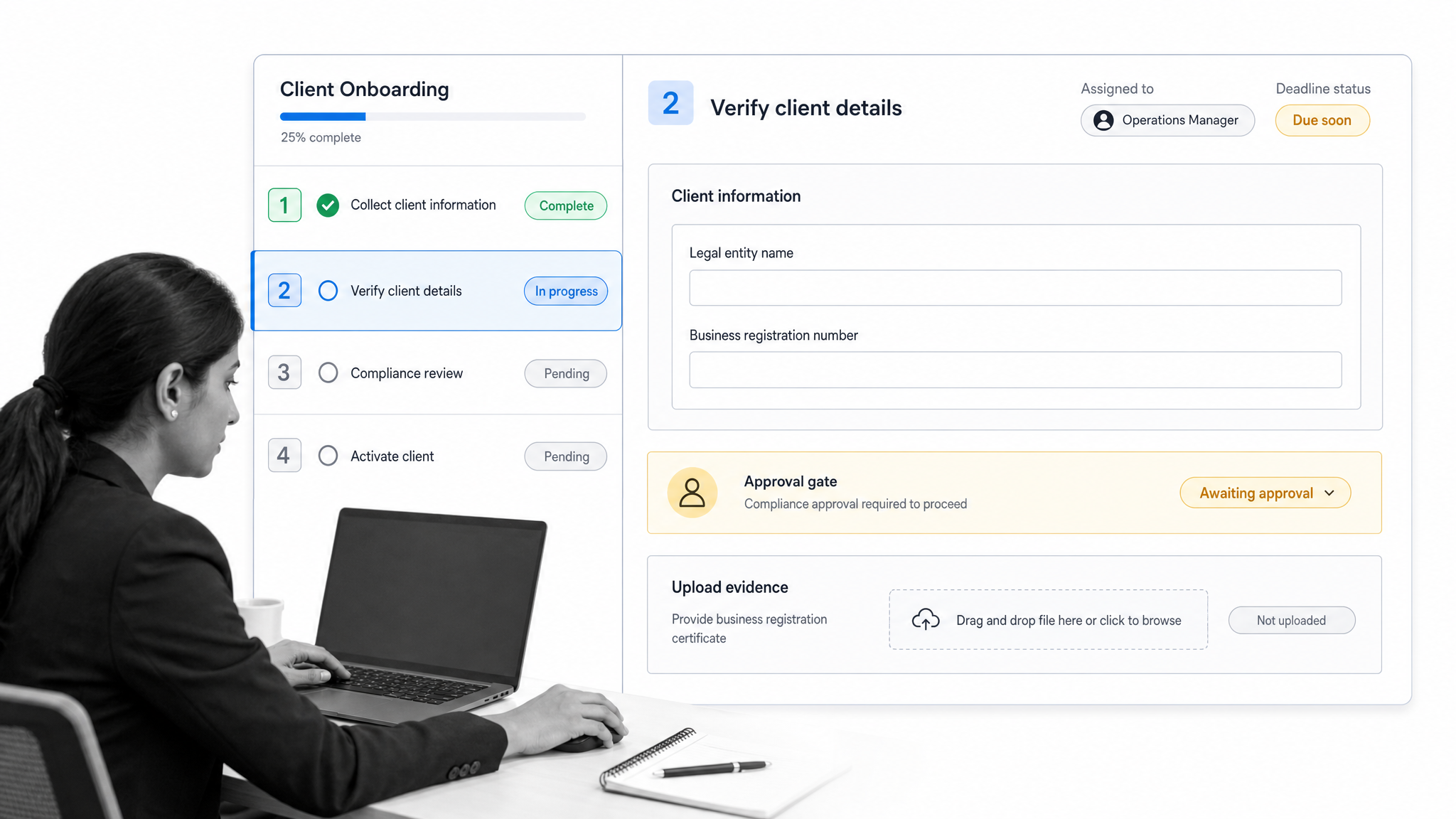
Process Street is a Compliance Operations Platform, so onboarding can combine workflow execution with the controls that matter in high-stakes environments: approvals, audit trails, role-based access, required fields, document retention, and integrations with the systems your team already uses.
A practical automated onboarding workflow can:
- Create a new workflow run when a deal closes in your CRM.
- Assign internal setup tasks to sales, customer success, finance, legal, and operations.
- Send the client a welcome email and intake form.
- Collect documents, contact details, compliance acknowledgments, and access requirements.
- Route approvals before kickoff or go-live.
- Notify owners when tasks are overdue or blocked.
- Push completed data back into systems such as Salesforce, HubSpot, Slack, DocuSign, Google Drive, and other tools.
- Keep a complete task history for quality reviews, audits, and client escalations.
If you are choosing software for this work, compare tools by whether they enforce the process, not just whether they display tasks. For deeper evaluation, see our guide to client onboarding software and our overview of workflow automation software.
Client onboarding metrics
The best onboarding metrics measure whether the client reached value, not whether your team sent enough emails. Track a small set that tells you where the process is working and where it is creating friction.
- Time to first value: how long it takes the client to reach the first useful outcome.
- Onboarding completion rate: the percentage of clients who complete required onboarding steps.
- Activation rate: the percentage of clients who perform the behavior that shows they can use the product or service successfully.
- Overdue task rate: how often internal or client-owned tasks miss their deadlines.
- Blocked task reasons: the most common reasons onboarding stalls.
- Support tickets during onboarding: what clients ask about before they are fully active.
- Handoff quality: whether the ongoing owner receives a complete account record.
- Early retention or expansion signals: whether the first working period after onboarding shows healthy usage, engagement, or delivery progress.
Review these metrics in context. A fast onboarding process that leaves clients confused is not successful. A slower enterprise onboarding can be healthy if it moves through required controls, aligns stakeholders, and produces a confident first value milestone.
Client onboarding process FAQs
What is a client onboarding process?
A client onboarding process is a structured series of steps that helps a new client move from signed agreement to first value. It usually includes a sales handoff, welcome message, intake, account setup, kickoff, training, activation, and handoff into the ongoing relationship.
What should be included in a client onboarding checklist?
A client onboarding checklist should include contract confirmation, owner assignment, sales handoff, welcome communication, intake forms, required documents, account setup, kickoff agenda, success metrics, training, activation checks, follow-up, and handoff notes.
How long should client onboarding take?
Client onboarding can take a few days for simple services and several weeks or months for complex SaaS, implementation, legal, financial, or regulated work. The right timeline depends on scope, data requirements, stakeholder availability, approvals, and the first value milestone.
How do you automate client onboarding?
Start by documenting the onboarding stages, tasks, owners, deadlines, decision points, and required evidence. Then use workflow software to assign tasks, collect forms and files, send reminders, route approvals, update systems, and preserve a record of completion.
What is the difference between client onboarding and customer onboarding?
Client onboarding usually describes a higher-touch B2B or professional services relationship with more stakeholder coordination. Customer onboarding is often used more broadly for SaaS or consumer products. Both aim to help the buyer get value quickly and confidently.
What is the most important client onboarding metric?
Time to first value is often the most important metric because it shows how quickly the client reaches a meaningful outcome. Completion rate matters, but it should be paired with activation, blocker reasons, overdue tasks, and early retention signals.