Turn every policy into automated workflows with built-in enforcement and audit-ready proof.



Compliance as Proof of Control
Compliance as proof of control means your organization can show that the right work happened, the right people approved it, exceptions were handled, and the evidence is ready before anyone asks for it. The point is not to look compliant. The point is to prove that controls are operating in real business workflows.
A policy library can describe what should happen. A control system proves what did happen. That difference matters to auditors, regulators, boards, procurement teams, and customers because trust depends on execution evidence, not intent.
This guide explains how to turn compliance programs into proof of control: what breaks, what evidence matters, how exceptions should be handled, and how workflow automation makes proof continuous instead of episodic.
- What does compliance as proof of control mean?
- Why does compliance break down when proof is missing?
- How do you turn compliance into proof of control?
- What evidence proves control effectiveness?
- How does automation make proof continuous?
- How Process Street supports proof of control
- FAQs
What does compliance as proof of control mean?
Compliance as proof of control is the practice of using compliance activity to demonstrate that an organization is actually in control of its work. It connects policies, procedures, owners, approvals, exceptions, remediation, and audit logs into one evidence trail.
In static compliance programs, teams prepare evidence after the fact. They hunt through folders, ask process owners for screenshots, reconcile spreadsheets, and hope the story holds together. In a proof-of-control model, the evidence is created while work happens. Each completed task, approval, version change, exception note, and escalation becomes part of the control record.
The distinction is practical. A policy says customer data access must be reviewed quarterly. Proof of control shows the review workflow, the assigned owners, the population tested, the approvals captured, the exceptions found, the remediation assigned, and the final completion record.
The same logic applies across SOC 2, ISO 27001, SOX, HIPAA, FDA, financial services supervision, vendor risk, quality management, and internal operating standards. Different frameworks use different language, but the operating question is the same: can you show that the control was designed, executed, monitored, and corrected when it failed?
For a compliance leader, this changes the job from collecting artifacts to operating a control system. The team still needs policies and procedures, but those assets are only useful when they are connected to owned workflows, decision records, and remediation paths. A control is easier to defend when the evidence is produced by the same system that coordinated the work.
This also makes compliance easier for business teams. Instead of learning a separate evidence process, teams follow the workflow that governs the work they already do. Required fields, approvals, attachments, and exception notes are built into the task flow. Compliance becomes part of execution instead of an extra administrative layer.
The NIST SP 800-53A control assessment guide frames assessment around determining whether controls are implemented correctly, operating as intended, and producing the desired outcome. That is the heart of compliance as proof of control.
Why does compliance break down when proof is missing?
Compliance breaks down when the evidence trail is disconnected from the work. Most teams do not fail because they have no policies. They fail because policies live in one system, work happens in another, approvals happen in email, exceptions sit in spreadsheets, and final evidence has to be assembled manually.
That fragmentation creates three common failures. First, ownership becomes vague. A control may be assigned to a department, but no specific person is accountable for each recurring action. Second, timing becomes unreliable. Reviews, approvals, signoffs, and remediation tasks happen late because there is no system enforcing the cadence. Third, evidence becomes fragile. The audit trail depends on people remembering where the proof lives and whether it is complete.
A weak evidence trail also changes how external reviewers interpret the organization. A team may be doing the right work, but if the proof is scattered, auditors and customers see control risk. The burden shifts from showing a repeatable system to explaining a patchwork of manual records.
The AICPA Trust Services Criteria for SOC 2 make this explicit by tying trust services work to criteria, points of focus, control activities, information, communication, monitoring, and risk response. Evidence is not a side artifact. It is how the control environment becomes testable.
Manual proof also creates a timing problem. Audit evidence collected once a year may show that a control passed during a sample period, but it does not tell leaders whether the control is working today. Real control requires a live operating signal: what is assigned, what is late, what is blocked, what changed, and what exception needs attention.
The same issue appears in customer security reviews and vendor due diligence. A buyer may ask how access is reviewed, how incidents are escalated, or how procedure changes are approved. A team with workflow evidence can answer with records. A team with scattered files has to narrate the process and then prove the narration is true.
Proof gaps also create internal drag. Compliance teams spend time chasing screenshots, owners spend time reconstructing work, and leaders receive reports that are too late to change outcomes. The organization may be doing significant compliance work, but the control signal is weak because the work is not captured in a reliable operating system.
How do you turn compliance into proof of control?
Turning compliance into proof of control starts by designing evidence into the workflow. The work should generate proof by default. A completed control task should identify the owner, date, inputs reviewed, decision made, approval captured, exception status, remediation path, and final outcome.
Control evidence map
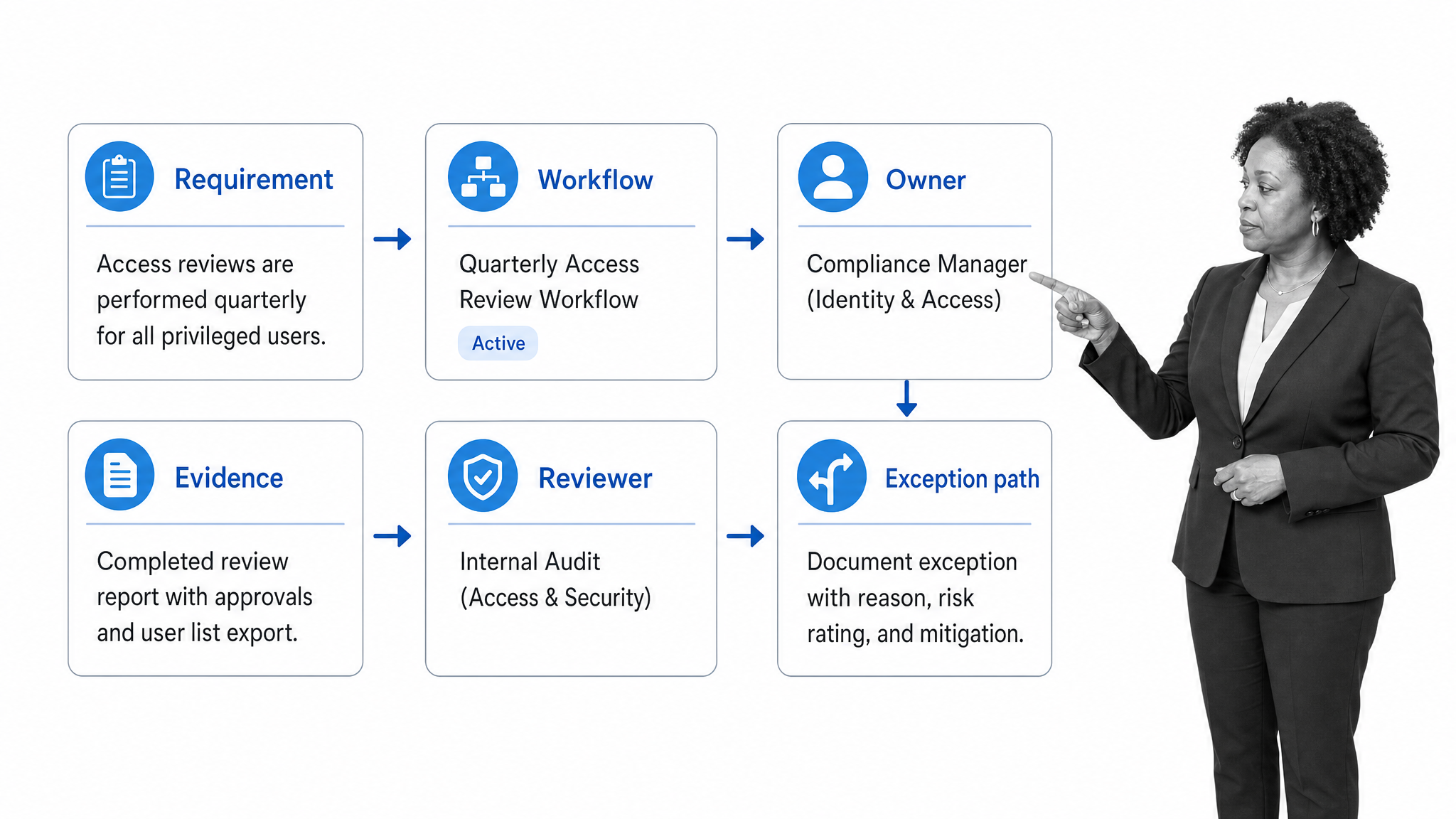
Start with a control evidence map. For each control, define the policy requirement, the business process it governs, the workflow where execution happens, the owner, the frequency, the expected evidence, the reviewer, and the exception path. This prevents the common failure where a control exists in a spreadsheet but no one can point to the operating workflow that proves it.
- Map each control to a recurring workflow, not just to a document owner.
- Define the evidence artifact before the work begins, not when the audit request arrives.
- Attach approvals, comments, files, decisions, and timestamps to the workflow record.
- Require exception notes and remediation owners when a step is skipped, late, or changed.
- Review evidence quality periodically so the proof stays useful under real audit pressure.
A control evidence map should be boring in the best way. Anyone reviewing it should be able to move from requirement to owner to workflow to evidence without a meeting.
For each mapped control, define what good evidence looks like before the period begins. If a quarterly access review requires a user export, reviewer signoff, exception list, and remediation closure, those artifacts should be required fields in the workflow. The system should not allow the review to close with missing proof.
The map should also identify evidence quality problems. A file upload may prove that someone attached a spreadsheet, but it may not prove that the spreadsheet covered the right population or that exceptions were assessed. Strong workflows use required questions, reviewer comments, and approval logic to make the evidence meaningful.
This is also where internal control thinking becomes operational. The COSO Internal Control Integrated Framework emphasizes control environment, risk assessment, control activities, information and communication, and monitoring. A workflow system can turn those components into recurring operating records instead of abstract categories.
What evidence proves control effectiveness?
Effective proof is not one file. It is a chain of evidence showing that the control was designed, executed, reviewed, and corrected when needed. Strong evidence usually falls into five categories.
- Design evidence: the approved policy, procedure, control objective, risk rationale, and workflow design.
- Execution evidence: completed tasks, timestamps, required fields, uploaded records, system actions, and owner activity.
- Approval evidence: signoffs, review comments, delegated approvals, rejection reasons, and release records.
- Exception evidence: deviations, missed steps, late work, risk ratings, business justification, and escalation history.
- Remediation evidence: corrective actions, owners, due dates, retesting, closure approvals, and lessons fed back into the process.
Exception reporting queue
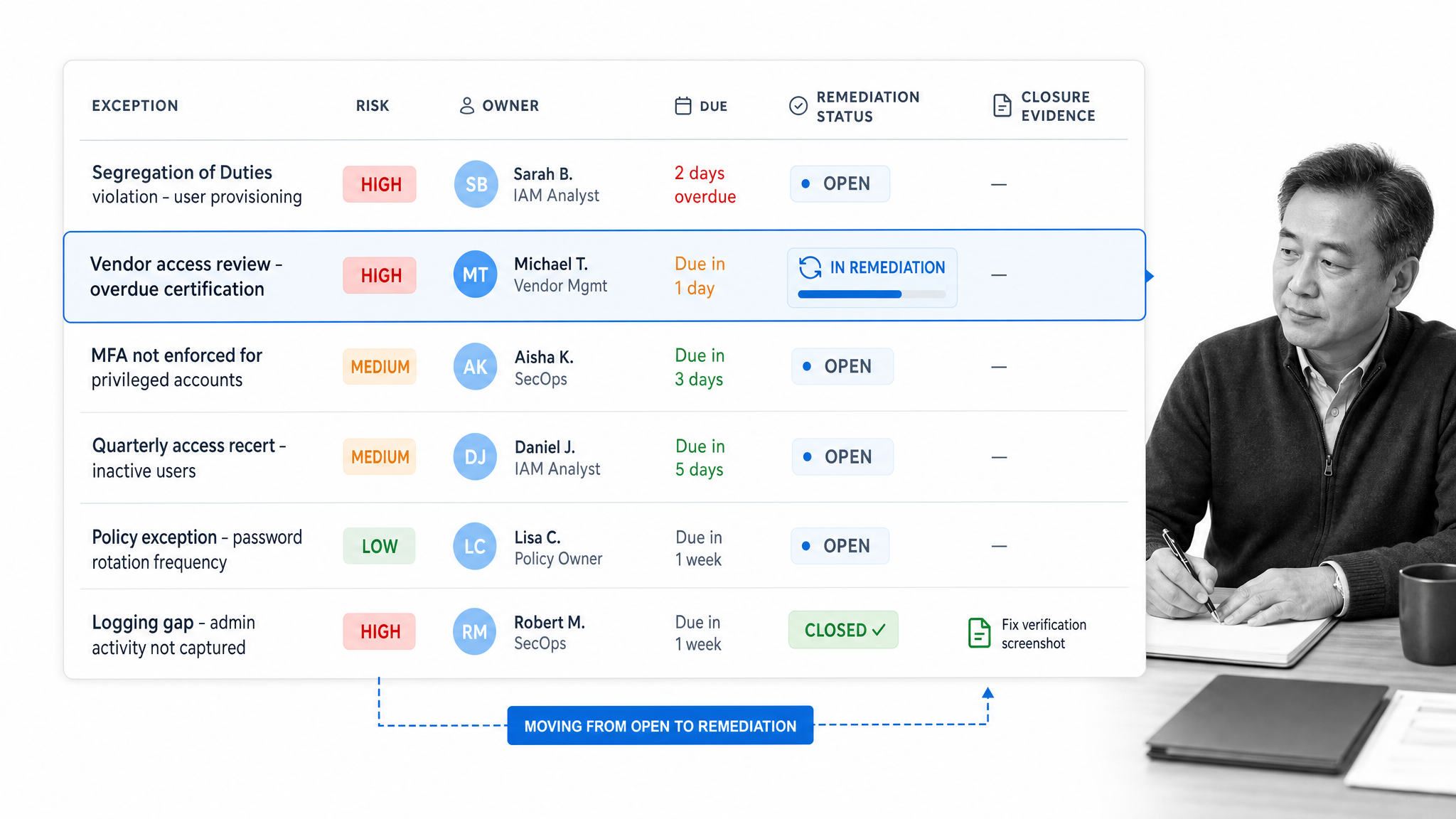
Exception reporting deserves special attention because it is often where control quality becomes visible. A perfect compliance report can look suspicious if it never shows deviations. Real operations have exceptions. The stronger signal is that exceptions are captured, assessed, assigned, remediated, and closed.
An exception queue should show the affected control, process owner, risk level, reason, date opened, current status, due date, remediation owner, and closure evidence. It should also distinguish accepted risk from unresolved failure. That distinction matters because accepting a documented risk is governance. Losing track of an exception is weak control.
For teams managing audits, vendor reviews, or regulatory exams, this kind of queue changes the conversation. Instead of saying that exceptions are rare, the team can show how exceptions are detected and handled. That is more credible than a clean-looking report with no operating detail.
Exception queues should also show aging. A low-risk exception that closes on time is different from a high-risk exception that has missed two remediation dates. Aging, escalation history, and owner activity help reviewers understand whether the organization is managing risk or simply recording it.
The same queue can feed control improvement. Repeated exceptions may indicate unclear policy language, missing training, overloaded owners, or a workflow design problem. When exception patterns feed back into procedure updates, compliance becomes a continuous improvement loop instead of a recurring cleanup exercise.
How does automation make proof continuous?
Automation makes proof continuous by moving evidence capture from an after-the-fact activity into the operating process itself. The system assigns the work, enforces required steps, collects approvals, timestamps actions, escalates delays, and keeps the audit trail attached to the workflow.
Continuous control dashboard

A continuous control dashboard should answer the questions leaders ask before an audit: which controls are due, which controls are late, which exceptions are open, which owners are overloaded, which remediation items are aging, and which evidence is incomplete. The dashboard does not replace judgment. It gives compliance, risk, and operations teams a shared operating picture.
That operating picture is becoming more important as organizations use more automation and AI in critical workflows. IBM research on data breach costs highlights how detection, response, identity, and governance practices materially affect risk outcomes, especially as environments become more automated. The IBM Cost of a Data Breach Report is a useful reminder that control evidence has to keep pace with how work is actually performed.
A useful dashboard is selective. It should not become a giant table of every task in the company. The best views focus on the few signals that change action: overdue controls, high-risk exceptions, missing approvals, aging remediation, upcoming review cycles, and evidence gaps that would create audit friction.
Automation also helps with separation of duties. The workflow can assign work to one owner, route review to another, restrict who can approve changes, and preserve the activity history. That matters when a control requires both execution and independent review.
Continuous proof also reduces audit fire drills. Instead of building binders in response to a request, teams can export the relevant workflow records, task history, approvals, exception notes, and remediation status. The effort moves from reconstruction to review.
The practical gain is not only speed. It is control confidence. A leader can see that a control is working before a third party asks. When something is not working, the evidence trail shows the gap early enough to fix it.
How Process Street supports proof of control
Process Street is a Compliance Operations Platform built for teams that need policies to run, not just exist. It connects governed documentation, recurring workflows, approvals, assignments, evidence capture, exception tracking, and audit history in one operating layer.
Use compliance management software to organize obligations and controls. Use GRC software patterns to connect risk, governance, and evidence. Use Process Street workflows to make the actual work happen with accountable owners and auditable records.
For compliance teams, that means policies can be linked directly to execution. A quarterly access review becomes a workflow with assigned reviewers, required evidence, approvals, exception handling, and remediation tasks. A vendor review becomes a repeatable process with intake forms, risk scoring, due diligence checks, owner approvals, and a complete history. A regulated operating procedure becomes a controlled workflow that records every critical step.
Cora, the AI compliance agent, adds an oversight layer by helping monitor workflow activity, surface risks, and suggest improvements. The goal is not another place to store compliance information. The goal is a system where compliance work produces proof as it runs.
The strongest compliance programs do not wait for the audit to become organized. They design proof into daily operations. That is how compliance becomes a signal of control rather than a scramble for paperwork.
A practical rollout can start with one recurring control that causes repeated audit friction. Map the requirement, build the workflow, define the required evidence, route the approvals, add an exception path, and review the output after one cycle. Once that proof pattern works, reuse it across adjacent controls.
This approach also helps teams avoid overbuilding. The goal is not to model every possible compliance obligation on day one. The goal is to create a repeatable pattern where important controls produce reliable evidence. From there, teams can expand into more frameworks, departments, and review cycles without rebuilding the operating model.
FAQs
What does compliance as proof of control mean?
Compliance as proof of control means using compliance activity to show that controls are operating in real workflows. It connects policies, owners, approvals, exceptions, remediation, and audit logs so a team can demonstrate that required work happened and that issues were handled.
Why is proof of control more important than documentation alone?
Documentation explains what should happen. Proof of control shows what did happen. Auditors, regulators, customers, and boards need evidence that controls are assigned, executed, reviewed, and corrected. A policy without an execution record leaves too much room for interpretation.
What types of evidence prove control effectiveness?
Strong control evidence includes approved policies, workflow records, task completion history, required fields, timestamps, uploaded artifacts, approvals, exception notes, remediation tasks, retesting, and closure records. The strongest evidence connects the control requirement to the operating workflow.
How does exception reporting strengthen compliance?
Exception reporting strengthens compliance because it shows that the organization can detect, assess, and remediate deviations. A system with documented exceptions is usually more credible than a clean report with no detail about what happens when work is late, skipped, or changed.
How does automation help prove compliance control?
Automation helps prove compliance control by assigning recurring work, enforcing required steps, capturing approvals, timestamping actions, escalating delays, and preserving the evidence trail. The proof is created while work happens instead of reconstructed manually during an audit.
Can Process Street be used for compliance proof of control?
Yes. Process Street helps teams connect policies to recurring workflows, assign owners, collect evidence, manage approvals, track exceptions, and preserve audit history. That makes compliance evidence part of the operating process rather than a separate audit-prep project.