Turn every policy into automated workflows with built-in enforcement and audit-ready proof.


Best MCP Servers for Compliance
Last updated:
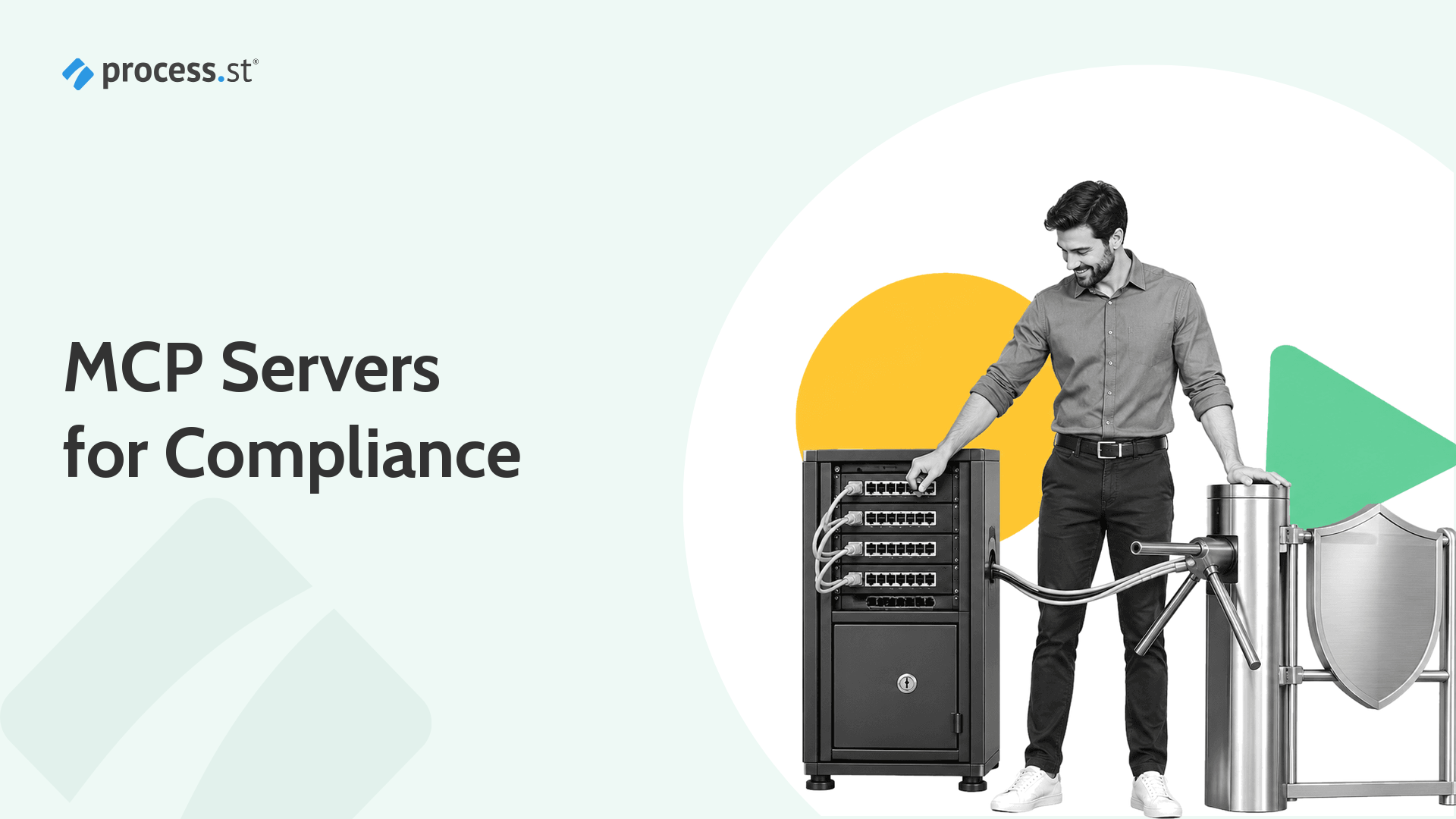
The best MCP server for compliance depends on the system that holds your controls, evidence, risks, or security findings. The winning connection is not the one with the most tools. It is the one that gives an AI client useful context while preserving identity, scope, approval, audit history, and revocation.
Process Street ranks first for turning compliance requirements into governed execution. Vanta MCP and Drata MCP are strongest for teams already managing trust programs in those platforms. AWS Well-Architected Security MCP focuses on cloud posture, while Snyk MCP brings secure-development checks into coding workflows.
This comparison reviews five official, vendor-maintained MCP servers. It explains what each server exposes, where it fits, and which controls you should test before allowing an agent to read or change compliance data.
In this article, we cover:
- Best MCP servers for compliance at a glance
- How we evaluated compliance MCP servers
- Controls every compliance MCP connection needs
- 1. Process Street
- 2. Vanta MCP
- 3. Drata MCP
- 4. AWS Well-Architected Security MCP
- 5. Snyk MCP
- How to choose an MCP server for compliance
- How to deploy MCP safely in compliance work
- FAQs
Best MCP servers for compliance at a glance
The short version: choose Process Street when the job is to run controlled compliance work and preserve proof. Choose Vanta MCP or Drata MCP when the primary need is live access to an existing trust program. Choose the AWS server for AWS posture assessment and Snyk MCP for application-security evidence inside development.
| Tool | Best for | Standout feature | Pricing |
|---|---|---|---|
| Process Street | Compliance teams that need agents to run governed controls, approvals, evidence collection, and remediation workflows | A remote MCP server for workflows, runs, tasks, users, and data sets, with access constrained by Process Street permissions | The MCP server is available on all Process Street plans |
| Vanta MCP | Trust teams that want an AI client to query a live Vanta compliance program | Remote access to tests, controls, frameworks, risks, vulnerabilities, people, audits, policies, documents, and integrations | Availability and capabilities vary by Vanta account configuration and plan |
| Drata MCP | Drata customers that need scoped read and write access across controls, evidence, risk, vendors, and personnel | Hosted regional MCP endpoints with OAuth scopes intersected with each user’s Drata role | A Drata account is required; current commercial terms come from Drata |
| AWS Well-Architected Security MCP | AWS operations teams assessing cloud security posture and resource compliance | Tools for security service status, findings, resource compliance, stored security context, inventory, and posture analysis | The server package is open source; connected AWS services can carry their normal usage costs |
| Snyk MCP | Development teams that need agents to scan code, dependencies, containers, infrastructure as code, and software bills of materials | A local MCP server included in the Snyk CLI for security scans and findings in agentic development workflows | The MCP server ships with the Snyk CLI; Snyk plan terms govern the connected capabilities |
How we evaluated the best MCP server for compliance
A compliance MCP server should be judged as a privileged system connection. We evaluated each option against the work it can perform and the safeguards that remain in force when an AI client calls it. The official vendor source had to document the server and its compliance or security surface.
For teams comparing the best MCP server for compliance, the decisive question is whether the connection preserves the controls of the authoritative system while making governed work easier to complete.
| Decision area | Question to test | Why it matters |
|---|---|---|
| System of record | Does the server reach the controls, evidence, risks, or findings you actually govern? | A generic connector cannot invent authoritative compliance context. |
| Identity | Can every request be tied to a person, service identity, role, or scoped credential? | Shared identity hides accountability. |
| Authorization | Do existing roles and permissions still constrain MCP tools? | The agent must not gain a side door around product controls. |
| Write safety | Are changes scoped, confirmed, and separable from reads? | Compliance data changes can alter evidence and conclusions. |
| Auditability | Can you reconstruct what the client read, changed, and triggered? | A compliance action without history creates a new evidence gap. |
| Revocation | Can an administrator end access without replacing unrelated credentials? | Fast containment is part of the control design. |
| Operational follow-through | Can a finding become assigned, approved, completed work? | Detection alone does not close the control. |
The comparison follows the authorization principles in the Model Context Protocol authorization specification. It also treats MCP as one layer inside AI agent compliance, not as proof that an agent is governed by default.
Controls every compliance MCP connection needs
A narrow, named identity
Give each production connection a named owner and a dedicated identity where the vendor supports one. Avoid copying a personal token into a shared configuration. The identity should make its purpose obvious during access review and incident response.
Least privilege by tool and data domain
Start with the smallest read surface that proves the use case. Add write tools one by one after testing the exact payload, validation behavior, and recovery path. The right scope is not simply read-only or read-write. It is a defined set of resources and operations.
Human approval for consequential changes
Use a human-in-the-loop agent pattern for control creation, evidence acceptance, risk treatment, policy changes, access changes, and remediation closure. The agent can prepare the action, but a responsible person should approve the decision where judgment or accountability is required.
Evidence that survives the chat
A chat transcript is not a complete audit record. The system of record should retain the task, input, output, owner, approval, timestamps, and resulting evidence. An AI agent audit trail should connect the agent action to the controlled business outcome.
Revocation and failure testing
Test revoked access, expired tokens, missing scopes, denied writes, duplicate requests, rate limits, and partial downstream failure. The client should fail closed, report the real error, and avoid retrying a consequential action without an idempotency or review mechanism.
1. Process Street
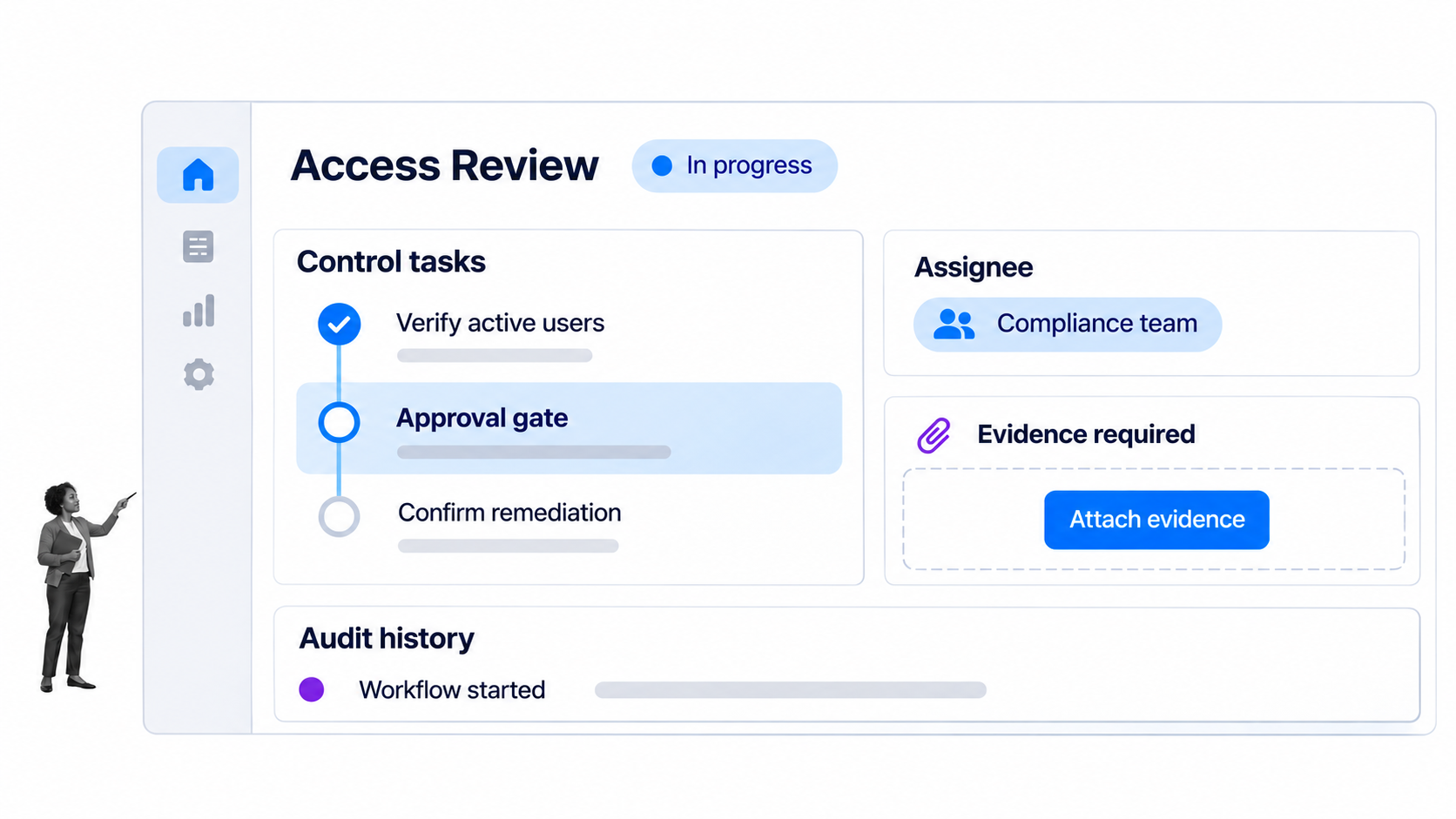
Best for: Compliance teams that need agents to run governed controls, approvals, evidence collection, and remediation workflows.
Process Street ranks first because compliance work rarely ends with finding a gap. Someone has to open a controlled process, collect the right evidence, route an exception, obtain approval, complete remediation, and prove that each step happened. Its MCP server exposes workflows, workflow runs, tasks, users, and data sets to compatible AI clients while the underlying resource permissions still apply.
That makes Process Street the strongest choice when an agent must act inside an operational control system. A compliance assistant can find a quarterly access review, start a run, assign the required tasks, update approved fields, and summarize progress. The workflow remains the source of truth, so the agent does not invent its own sequence or treat a chat response as evidence of completion.
The important boundary is authorization. Use the organization and user permissions that already govern the resource, keep write actions behind explicit confirmation, and design approval tasks where judgment belongs to a person. The MCP connection should extend the compliance operating model, not create a parallel path around it.
What Process Street exposes
The defining surface is the governed compliance workflow run. A remote MCP server for workflows, runs, tasks, users, and data sets, with access constrained by Process Street permissions. Test the exact read and write tools your compliance use case needs, then deny everything else until a documented review expands the scope.
Where Process Street fits
- Best fit: Compliance teams that need agents to run governed controls, approvals, evidence collection, and remediation workflows.
- Primary surface: governed compliance workflow run.
- Governance test: verify identity, scope, confirmation, revocation, logging, and failure behavior with a representative task.
- Pricing: The MCP server is available on all Process Street plans.
The Process Street MCP server guide documents compatible clients, OAuth and API-key connection patterns, permissions, and example requests. Teams can operationalize the connection with a compliance management process or an internal audit procedure.
2. Vanta MCP
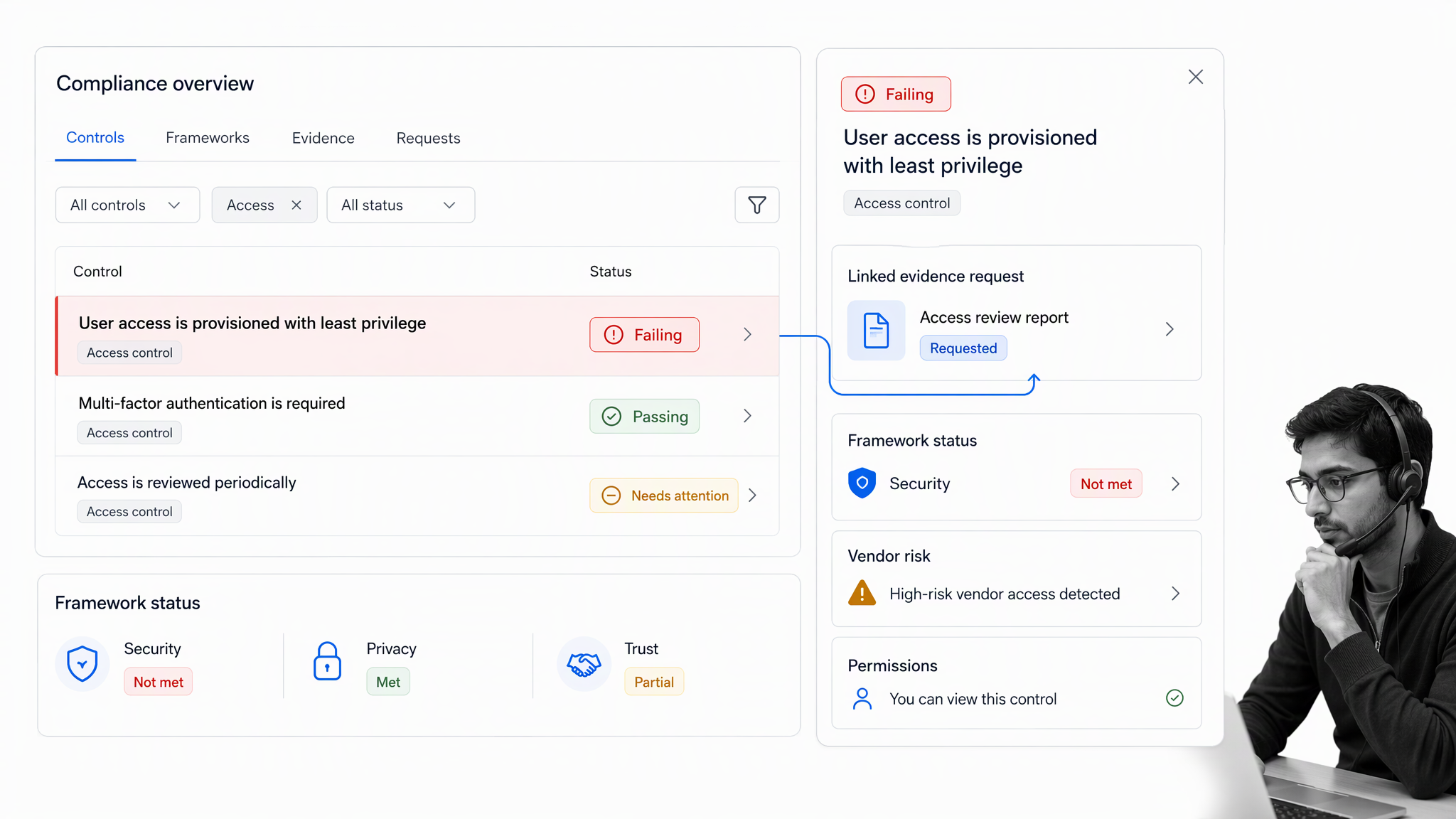
Best for: Trust teams that want an AI client to query a live Vanta compliance program.
Vanta MCP is a strong fit for teams that already manage their trust program in Vanta and want an AI client to answer questions from live compliance data. Vanta documents coverage across tests, controls, frameworks, risks, vulnerabilities, personnel, access reviews, audits, policies, documents, questionnaires, assessments, data processing, integrations, and its knowledge base, with some capabilities dependent on account configuration or plan.
The surface is useful for investigative work. A trust analyst can ask which controls are failing, which evidence requests remain open, or which vendors carry elevated risk, then keep the answer grounded in the current Vanta program. Recent product updates also extend supported control and evidence actions through MCP, which makes permission design more important as the connection moves beyond retrieval.
Choose Vanta MCP when Vanta is already the compliance system of record. It is not a general workflow runtime for every remediation process. Pair its live program context with a governed execution layer when a finding needs cross-functional tasks, approvals, escalations, and durable proof outside the trust platform itself.
What Vanta MCP exposes
The defining surface is the compliance program control status. Remote access to tests, controls, frameworks, risks, vulnerabilities, people, audits, policies, documents, and integrations. Test the exact read and write tools your compliance use case needs, then deny everything else until a documented review expands the scope.
Where Vanta MCP fits
- Best fit: Trust teams that want an AI client to query a live Vanta compliance program.
- Primary surface: compliance program control status.
- Governance test: verify identity, scope, confirmation, revocation, logging, and failure behavior with a representative task.
- Pricing: Availability and capabilities vary by Vanta account configuration and plan.
Confirm the current capabilities and setup details in the Vanta MCP official documentation before enabling the server in a production compliance workflow.
3. Drata MCP
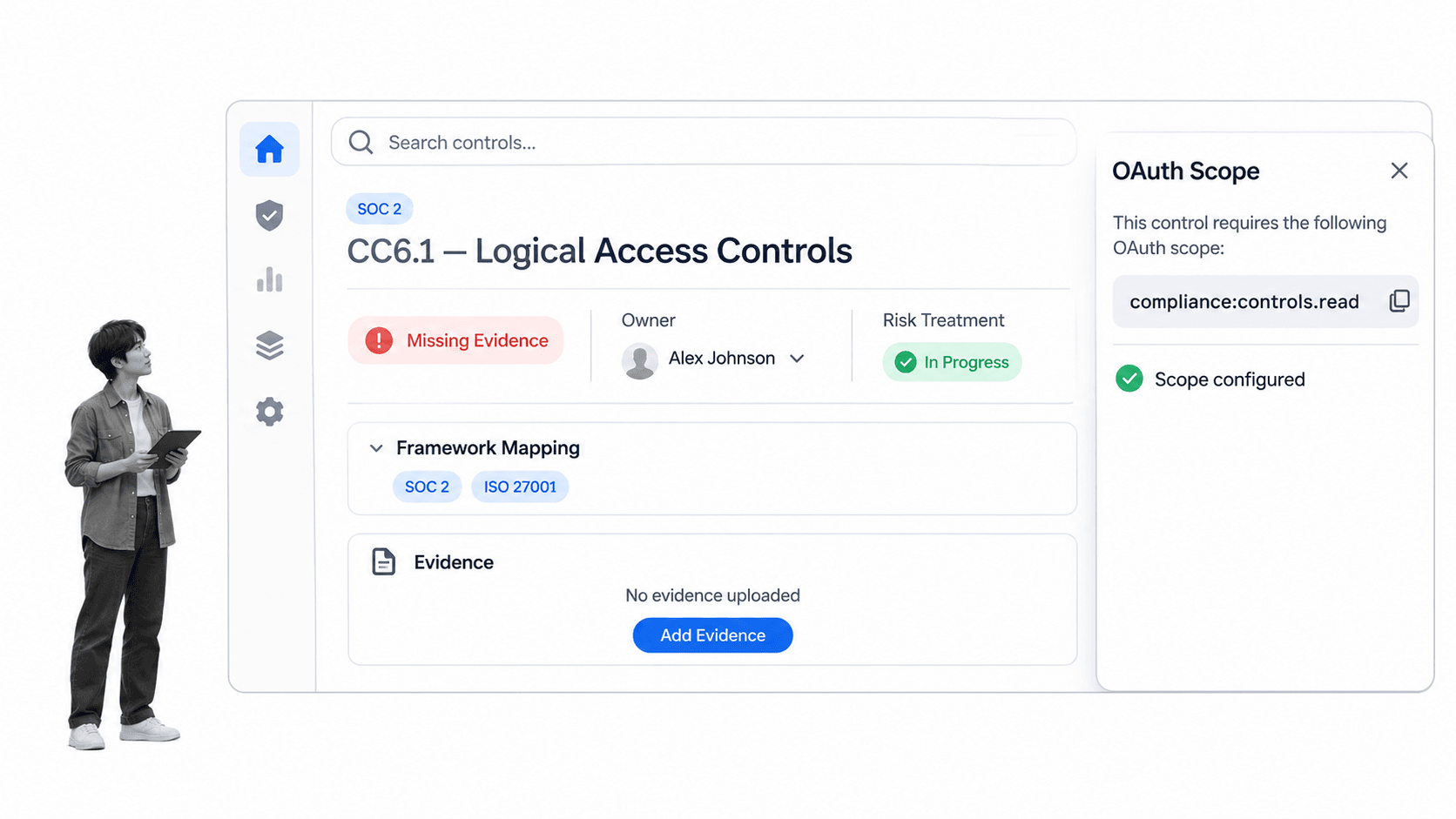
Best for: Drata customers that need scoped read and write access across controls, evidence, risk, vendors, and personnel.
Drata MCP exposes a broad compliance data model through hosted regional endpoints. Drata documents tools for controls, policies, risks, evidence, frameworks, vendors, personnel, devices, and identities. Each tool maps to an OAuth scope, and the effective access is the intersection of that scope and the user’s existing Drata role.
That intersection is the key design advantage. A connector configuration can request only the domains an assistant needs, while Drata roles continue to limit what the individual can see or change. Read-only roles cannot use create, update, or delete scopes. Teams should still separate retrieval from modification, because some scopes permit evidence, control, or personnel changes.
Drata MCP fits organizations whose compliance program already lives in Drata and whose priority is natural-language access to controls, risk, and evidence. It should not be treated as a universal automation bus. Use a narrow OAuth configuration, document who can connect each client, test revocation, and retain human approval for consequential changes.
What Drata MCP exposes
The defining surface is the scoped control and evidence workspace. Hosted regional MCP endpoints with OAuth scopes intersected with each user’s Drata role. Test the exact read and write tools your compliance use case needs, then deny everything else until a documented review expands the scope.
Where Drata MCP fits
- Best fit: Drata customers that need scoped read and write access across controls, evidence, risk, vendors, and personnel.
- Primary surface: scoped control and evidence workspace.
- Governance test: verify identity, scope, confirmation, revocation, logging, and failure behavior with a representative task.
- Pricing: A Drata account is required; current commercial terms come from Drata.
Confirm the current capabilities and setup details in the Drata MCP official documentation before enabling the server in a production compliance workflow.
4. AWS Well-Architected Security MCP
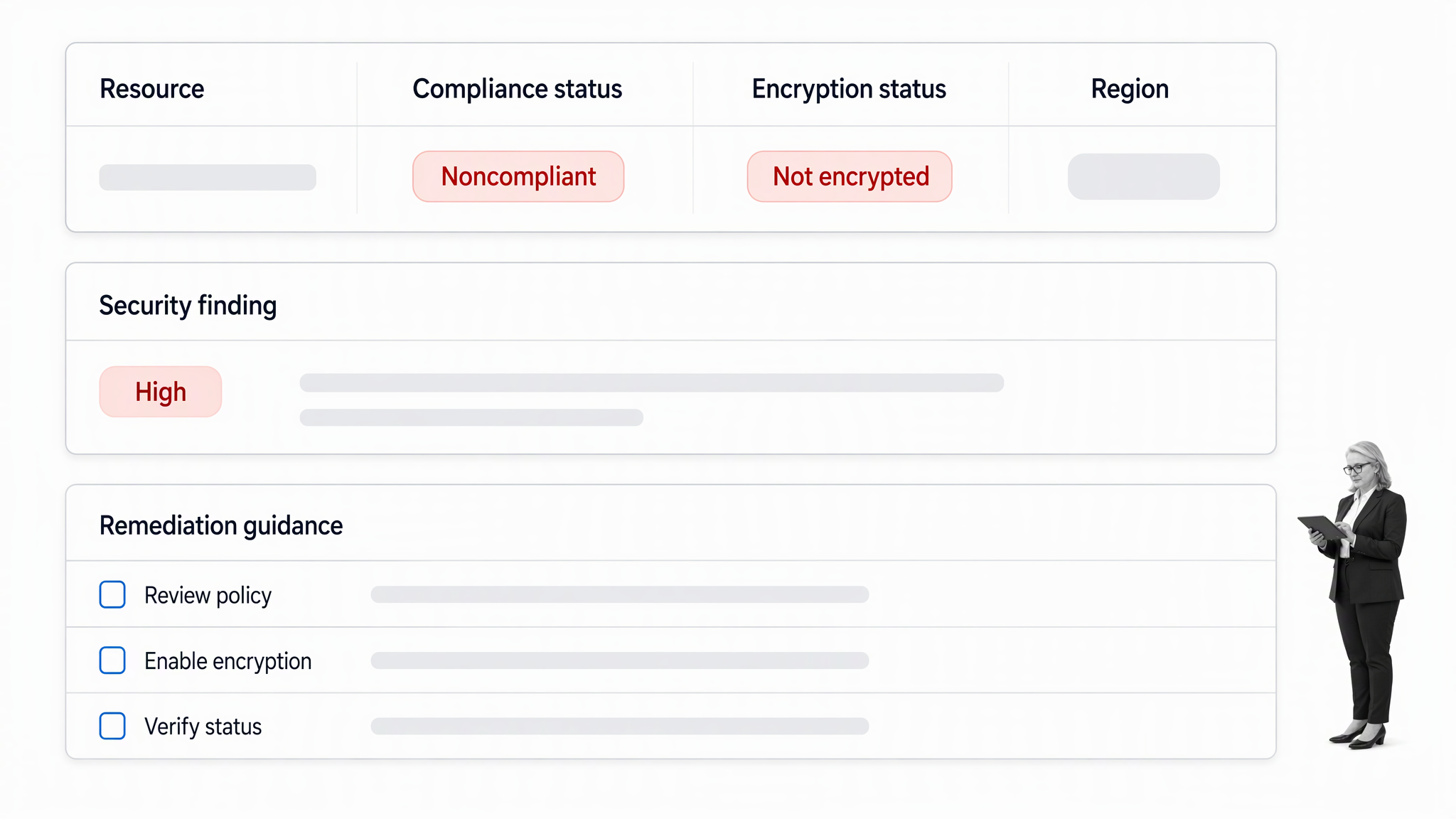
Best for: AWS operations teams assessing cloud security posture and resource compliance.
The AWS Well-Architected Security MCP focuses on cloud security operations rather than a complete enterprise compliance program. Its official tools cover security-service status, findings, resource compliance, stored security context, resource inventory, and posture analysis against the AWS Well-Architected Framework Security Pillar.
This is valuable when the compliance question is specific to AWS configuration. An operations team can inspect whether expected services are enabled, retrieve findings from Security Hub, GuardDuty, and Inspector, review encryption or network posture, and identify noncompliant resources across regions. The server can surface the technical evidence needed for a control review without making a person manually assemble several AWS consoles.
Use dedicated least-privilege IAM roles, permission boundaries, and read-only policies for assessment. The project documentation explicitly recommends scoped credentials and warns against accidental exposure of sensitive security information. This server belongs behind a clear cloud-security boundary, not inside a broadly privileged general-purpose agent.
What AWS Well-Architected Security MCP exposes
The defining surface is the AWS resource compliance status. Tools for security service status, findings, resource compliance, stored security context, inventory, and posture analysis. Test the exact read and write tools your compliance use case needs, then deny everything else until a documented review expands the scope.
Where AWS Well-Architected Security MCP fits
- Best fit: AWS operations teams assessing cloud security posture and resource compliance.
- Primary surface: AWS resource compliance status.
- Governance test: verify identity, scope, confirmation, revocation, logging, and failure behavior with a representative task.
- Pricing: The server package is open source; connected AWS services can carry their normal usage costs.
Confirm the current capabilities and setup details in the AWS Well-Architected Security MCP official documentation before enabling the server in a production compliance workflow.
5. Snyk MCP
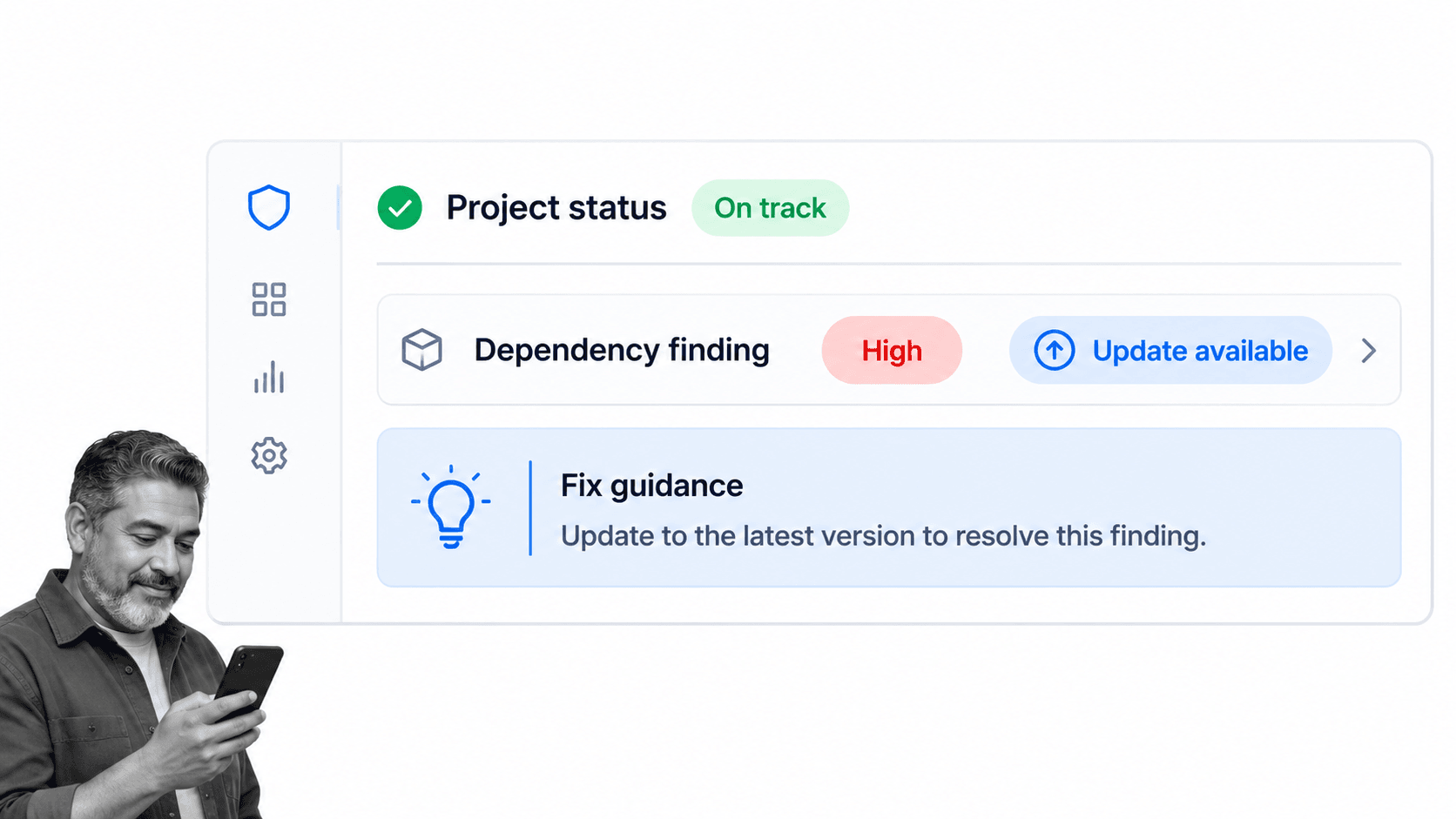
Best for: Development teams that need agents to scan code, dependencies, containers, infrastructure as code, and software bills of materials.
Snyk MCP brings application-security scanning into MCP-enabled development environments. The official server runs locally through the Snyk CLI and can scan code, open-source dependencies, infrastructure as code, containers, software bills of materials, secrets, and AI bills of materials, then return findings to the coding assistant.
That makes it a practical compliance input for secure-development controls. An engineering agent can run the same class of checks while it changes code, instead of waiting for a separate review to discover a vulnerable dependency or insecure infrastructure definition. The local design also gives the server the file access needed for project scanning without requiring a hosted MCP endpoint.
Snyk MCP does not manage the full evidence, policy, or audit lifecycle. It produces security findings and remediation context. Teams still need a governed process for accepting risk, assigning owners, confirming fixes, preserving evidence, and demonstrating that the required review occurred before release.
What Snyk MCP exposes
The defining surface is the application security scan results. A local MCP server included in the Snyk CLI for security scans and findings in agentic development workflows. Test the exact read and write tools your compliance use case needs, then deny everything else until a documented review expands the scope.
Where Snyk MCP fits
- Best fit: Development teams that need agents to scan code, dependencies, containers, infrastructure as code, and software bills of materials.
- Primary surface: application security scan results.
- Governance test: verify identity, scope, confirmation, revocation, logging, and failure behavior with a representative task.
- Pricing: The MCP server ships with the Snyk CLI; Snyk plan terms govern the connected capabilities.
Confirm the current capabilities and setup details in the Snyk MCP official documentation before enabling the server in a production compliance workflow.
How to choose the best MCP server for compliance
Choose the system of record first
Start with the platform that owns the authoritative data. If controls and evidence live in Vanta or Drata, use that official MCP surface for retrieval. If the work spans departments and must move from detection through approval and remediation, put the execution in a governed workflow layer.
Write one representative use case
Define a single task with its user, data, permissions, decision, evidence, and expected output. Good pilots include finding controls with missing evidence, running an access review, assessing one cloud resource, or scanning one repository before release.
Score the connection, not the demo
| Must-have | Pass condition | Failure signal |
|---|---|---|
| Official ownership | The vendor documents and maintains the server | Anonymous package or copied repository |
| Scoped identity | Every call maps to a bounded identity | Shared unrestricted token |
| Permission parity | Product roles still limit MCP access | MCP can bypass the application role |
| Write confirmation | Consequential actions require review | Agent silently changes evidence or controls |
| Durable history | Actions and outcomes remain in the system of record | Only the chat remembers what happened |
| Revocation | Access can be ended quickly and specifically | Credential rotation disrupts unrelated services |
Separate retrieval, recommendation, and execution
A safe design has three distinct stages. The server retrieves authoritative context. The model proposes a conclusion or action. A controlled workflow validates and executes the approved change. Combining all three in one opaque prompt makes testing and accountability much harder.
Use the broader compliance software for AI agents comparison when MCP is only one buying criterion. Teams building a callable compliance layer should also compare headless compliance platforms and compliance management tools.
How to deploy an MCP server safely in compliance work
Map the data boundary
List every resource the server can reach and classify the sensitive fields. Use a data security audit checklist to document the connection, credentials, data categories, retention, logging, and responsible owner.
Configure read access first
Connect the official endpoint or local server with the minimum required scopes. Validate ordinary reads, empty results, forbidden resources, pagination, and rate limits. Record the configuration as code or controlled documentation so another reviewer can reproduce it.
Add approval-backed writes
For each write tool, define who requests it, who approves it, what validation runs, and where the outcome is stored. A change management process gives the team a durable gate for scope expansion and production changes.
Run adversarial and recovery tests
Try prompt injection in retrieved content, cross-tenant references, malformed identifiers, duplicate requests, expired credentials, denied scopes, and interrupted downstream actions. Confirm that the server and client preserve the boundary instead of falling back to a broader credential or guessing a result.
Review access on a schedule
Put the connection into the same review cycle as other privileged integrations. A user access review process should verify the owner, scopes, recent use, business need, incidents, and revocation path. A vendor risk assessment can cover the server provider and connected client.
The deployment is ready when a reviewer can explain what the MCP server reaches, why each tool is allowed, who approves consequential work, how every action is proved, and how access is revoked. That is the practical standard for compliance-ready MCP.
The best MCP server for compliance is therefore the one that fits the real system of record, exposes only the necessary surface, and turns every consequential action into reviewable, durable evidence.
FAQs
What is the best MCP server for compliance?
Process Street is the best MCP server for compliance when the goal is governed execution across controls, approvals, evidence, and remediation. Vanta MCP and Drata MCP are strong choices for querying trust programs already managed in those platforms.
Can MCP servers make compliance work safer?
Yes, when the server preserves identity, authorization, approval, audit history, and revocation. MCP alone is a connection standard, so the compliance outcome depends on the controls around the server and the client.
Should a compliance MCP server have write access?
Start with read access. Add only the specific write tools that have a documented business need, validated payloads, human approval where judgment is involved, and a reliable audit and recovery path.
How do Vanta MCP and Drata MCP differ from Process Street MCP?
Vanta MCP and Drata MCP expose data and actions inside their trust-management platforms. Process Street MCP is oriented toward running governed workflows, tasks, approvals, data sets, and operational follow-through across a compliance process.
Are open-source MCP servers safe for compliance data?
Open source can improve inspectability, but it does not guarantee safe deployment. Verify official ownership, dependencies, update integrity, authentication, permissions, network exposure, logging, and the exact credentials the server can reach.
What should an MCP compliance review include?
Review the server owner, endpoint or package, authentication, scopes, roles, data boundary, write tools, approval gates, logging, retention, prompt-injection defenses, failure behavior, revocation, and periodic access review.