Turn every policy into automated workflows with built-in enforcement and audit-ready proof.



Healthcare Resource Management
A healthcare resource is anything a care setting relies on to deliver patient care: the clinicians and support staff who do the work, the beds and rooms that hold patients, the equipment and supplies that treatments depend on, the budget that pays for all of it, and the information that ties it together. Managing a healthcare resource well is the difference between a unit that runs on time and one that runs on overtime, missed steps, and apologies.
Demand in healthcare is rarely predictable. A quiet morning can become a full waiting room by noon, a single equipment failure can ripple across three departments, and one unfilled shift can stretch an entire team thin. That volatility is exactly why resource management matters more here than in almost any other industry. The goal is simple to state and hard to do: get the right resource to the right patient at the right time, every time.
This guide explains what counts as a healthcare resource, the main categories you manage, and the step by step process that keeps allocation under control. It also covers the challenges that trip teams up, the practices that separate steady operations from constant firefighting, and how connected workflows turn resource decisions into proof you can hand an auditor. If you are new to the wider discipline, it helps to understand how a workflow structures repeatable work before you apply it to clinical operations.
In this guide, we cover everything you need to know about managing a healthcare resource, including:
- What Is a Healthcare Resource?
- The Main Types of Healthcare Resources
- What Healthcare Resource Management Involves
- The Healthcare Resource Management Process Step by Step
- Common Healthcare Resource Challenges
- Best Practices for Managing Healthcare Resources
- Technology, Workflows, and Compliance
- FAQs
What Is a Healthcare Resource?
A healthcare resource is any asset, person, or input that a provider allocates to meet patient demand. It is a broad term on purpose. A nurse is a resource. So is an operating room, an infusion pump, a box of sterile gloves, an hour of a radiologist’s time, and the line in the budget that funds a new clinic. What unites them is scarcity: there is never an unlimited supply, so someone has to decide where each unit goes.
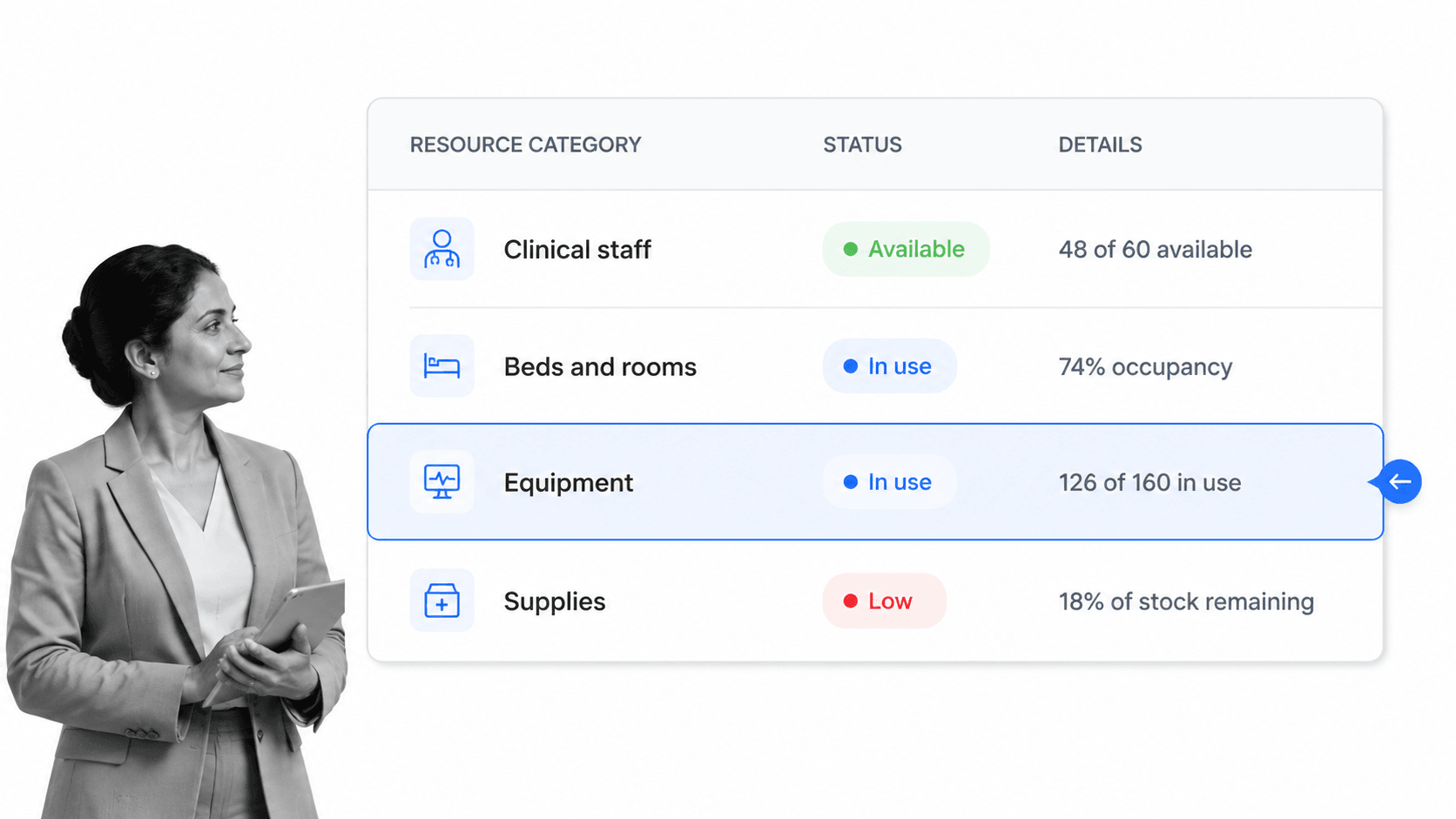
It helps to picture every resource as a row in a single inventory, each with a live status. Some are available, some are in use, and some are running low and need attention before they run out. When that picture is accurate and current, allocation is a calm decision. When it is stale or scattered across spreadsheets, sticky notes, and people’s memories, allocation becomes a guess.
The reason the definition stays wide is that resources interact. A bed is only useful if there is a nurse assigned to it and the right equipment is clean and nearby. Treating each resource in isolation creates bottlenecks that look like a shortage of one thing but are really a coordination failure across several. Strong resource management looks at the whole system, not one row at a time.
The Main Types of Healthcare Resources
Most healthcare resources fall into five categories. Naming them clearly makes it easier to see where capacity is tight and where coordination breaks down.
Human resources
People are the most valuable and most constrained resource in any care setting. Physicians, nurses, technicians, therapists, pharmacists, and administrative staff each carry specialized skills that cannot be swapped freely. Managing human resources means matching skills to need, balancing workload to prevent burnout, and keeping coverage steady through turnover and time off. National workforce analysts at the HRSA Bureau of Health Workforce continue to project shortages across physician and nursing roles, which makes disciplined staffing a strategic concern, not just a scheduling chore.
Physical resources
Beds, rooms, operating theaters, imaging machines, and medical devices are the physical capacity of a care setting. They are expensive, they require maintenance, and they create hard ceilings on how many patients you can serve at once. Keeping physical resources ready means tracking utilization, scheduling preventive upkeep, and knowing in real time what is free. A recurring equipment maintenance checklist keeps critical devices safe and available instead of failing at the worst moment.
Supply resources
Consumables such as medications, sterile supplies, implants, and personal protective equipment run down with every patient. Supply management balances having enough on hand against the cost and spoilage of holding too much. Stockouts delay care, while overstock ties up cash and storage. The discipline here is forecasting usage and reordering before a shortage becomes a clinical problem.
Financial resources
Budget is the resource that funds every other resource. Financial management in healthcare decides how limited dollars are split across staffing, equipment, facilities, and improvement projects. Because reimbursement rules from bodies like the Centers for Medicare and Medicaid Services shape what care gets paid for, financial planning is tightly linked to clinical and operational decisions.
Information resources
Patient records, schedules, protocols, and operational data are resources too. Good information lets teams allocate everything else accurately. When data is trapped in disconnected systems, even a well staffed unit makes poor decisions. Connecting clinical systems so information flows cleanly is its own discipline, which is why many teams invest in healthcare integration across clinical systems as a foundation for resource decisions.
What Healthcare Resource Management Involves
Healthcare resource management is the practice of planning, allocating, and optimizing the people, space, equipment, supplies, budget, and information a provider uses to deliver care. It sits at the intersection of clinical priorities and operational reality, and its job is to make sure capacity meets demand without waste and without compromising safety.
In practice the work breaks into a few continuous activities. You forecast demand so you are not caught off guard. You keep an accurate inventory of what you have. You allocate resources to where they are needed most. You schedule people and equipment against that allocation. Then you monitor what actually happened and feed the lessons back into the next cycle. Done well, this is a loop, not a one time setup.
Resource management also carries a compliance weight that other industries do not face. Decisions about who treats a patient, which device is used, and how supplies are handled all have to be documented and defensible. That is why resource management in healthcare is increasingly run through governed workflows rather than informal habits. The same structure that makes execution reliable also produces the audit trail regulators expect, a pattern that overlaps heavily with compliance management and quality management systems.
It is worth separating resource management from two things it is often confused with. It is not the same as financial budgeting alone, because budget is only one of the resources in play and a balanced budget can still hide a unit that is critically short on nurses. It is also not the same as scheduling software, because a schedule is an output of resource management, not the whole of it. Scheduling answers who works when. Resource management answers the larger question of whether you have the right mix of people, space, equipment, and supplies to meet demand at all, and what to do when you do not.
The Healthcare Resource Management Process Step by Step
A healthcare resource is managed best as a repeatable process, not a series of one off reactions. The six steps below turn allocation into something you can run, measure, and improve. Each step links to the next, and the whole sequence repeats on a daily, weekly, or seasonal rhythm depending on the resource.

Step 1: Forecast demand
Start by estimating what patients will need and when. Use historical patterns, seasonal trends, scheduled procedures, and known events to project volume. A good forecast does not have to be perfect; it has to be good enough to position resources ahead of demand rather than scrambling after it.
Step 2: Inventory what you have
Build a current, trusted view of every resource and its status. Which staff are available and with which skills, which beds are open, which equipment is working and clean, and which supplies are in stock. This is the single source of truth the rest of the process depends on.
Step 3: Allocate to need
Match available resources to forecasted and live demand. Prioritize by clinical urgency, then by efficiency. This is where trade offs get made: which unit gets the float nurse, which case gets the open theater, which order ships first. Clear allocation rules keep these decisions consistent instead of personality driven.
Step 4: Schedule against the plan
Turn allocation into concrete assignments. Staff get shifts, rooms get bookings, equipment gets reserved. A schedule that reflects the real allocation prevents the double booking and coverage gaps that cause last minute chaos. Onboarding new staff into these rhythms quickly matters too, which is where a structured employee onboarding workflow earns its keep.
Step 5: Monitor execution
Watch what actually happens against the plan. Track utilization, flag bottlenecks as they form, and escalate when a resource runs short. Real time monitoring is what lets a team reallocate mid shift instead of discovering the problem in a report a week later.
Step 6: Review and improve
Close the loop. Compare planned versus actual, find where the forecast or allocation missed, and update the rules for next time. This review is also where compliance evidence is captured: a record of what was decided, by whom, and why. Treating review as part of the process, not an afterthought, is how operations get steadily better instead of repeating the same mistakes.
Common Healthcare Resource Challenges
Even strong teams hit the same obstacles when managing a healthcare resource. Recognizing them early is half the battle.
- Unpredictable demand. Patient volume and acuity swing sharply and without warning, so static plans break quickly. The World Health Organization tracks global health workforce pressures that make this volatility worse in many regions.
- Workforce shortages and burnout. When skilled staff are scarce, every allocation decision carries higher stakes, and overloading the people you have accelerates turnover.
- Siloed systems and data. When scheduling, inventory, and clinical records live in separate tools, no one has a single accurate picture, so decisions rest on partial information.
- Coordination failures. A resource shortage is often really a handoff problem: a clean room with no assigned nurse, or a device that is available but not where it is needed.
- Compliance overhead. Every resource decision in a regulated setting has to be documented and defensible, which adds work that informal processes rarely capture well.
Most of these challenges share a root cause: resource management run on memory, email, and disconnected spreadsheets cannot keep up with how fast healthcare moves. The fix is rarely more effort. It is better structure.
Best Practices for Managing Healthcare Resources
The teams that manage resources well tend to do the same handful of things consistently. None of them require heroics; they require discipline and the right structure.
Standardize the recurring decisions
Write down how allocation and escalation should work so the process does not depend on who happens to be on shift. Documented standard operating procedures turn good judgment into a repeatable default, which protects quality when the experienced people are busy or away.
Keep one source of truth
Consolidate resource status into a single view rather than chasing it across systems. When availability, assignments, and stock levels all live in one place, allocation stops being a guessing game. This is a core reason teams move from scattered tools toward a unified workflow management system.
Build in compliance from the start
Embed the documentation and approvals into the workflow rather than adding them after the fact. For example, a HIPAA compliance checklist that runs as part of the process captures the evidence automatically. Mature programs back this with formal HIPAA policies and procedures so the rules and the execution stay aligned.
Make patient flow explicit
Map how patients move through your setting so resource bottlenecks become visible. A clear patient intake checklist keeps the first handoff clean, and consistent incident reporting surfaces where flow breaks down so you can fix the cause.
Plan for variability, not just averages
Planning to the average day guarantees you will be understaffed on the busy ones. Strong programs plan for the range of likely demand and keep flexible capacity in reserve, whether that is a float pool, on-call coverage, or supply buffers for predictable surges. The goal is not to eliminate variability, which is impossible in healthcare, but to absorb it without breaking the process or burning out the team. Building that flexibility into the plan up front beats reacting to every spike as if it were a surprise.
Review on a fixed cadence
Schedule regular reviews of utilization and outcomes rather than waiting for a crisis. A standing internal audit checklist keeps the review honest, and treating it as routine is consistent with the broader approaches to process management that high performing operations rely on. Safety reviews are strengthened by guidance from the Agency for Healthcare Research and Quality.
Technology, Workflows, and Compliance
Spreadsheets and informal habits can manage a single small unit. They fall apart at scale, across departments, and under audit. The shift that separates steady operations from constant firefighting is moving resource management onto governed workflows, where every step is structured, tracked, and provable.
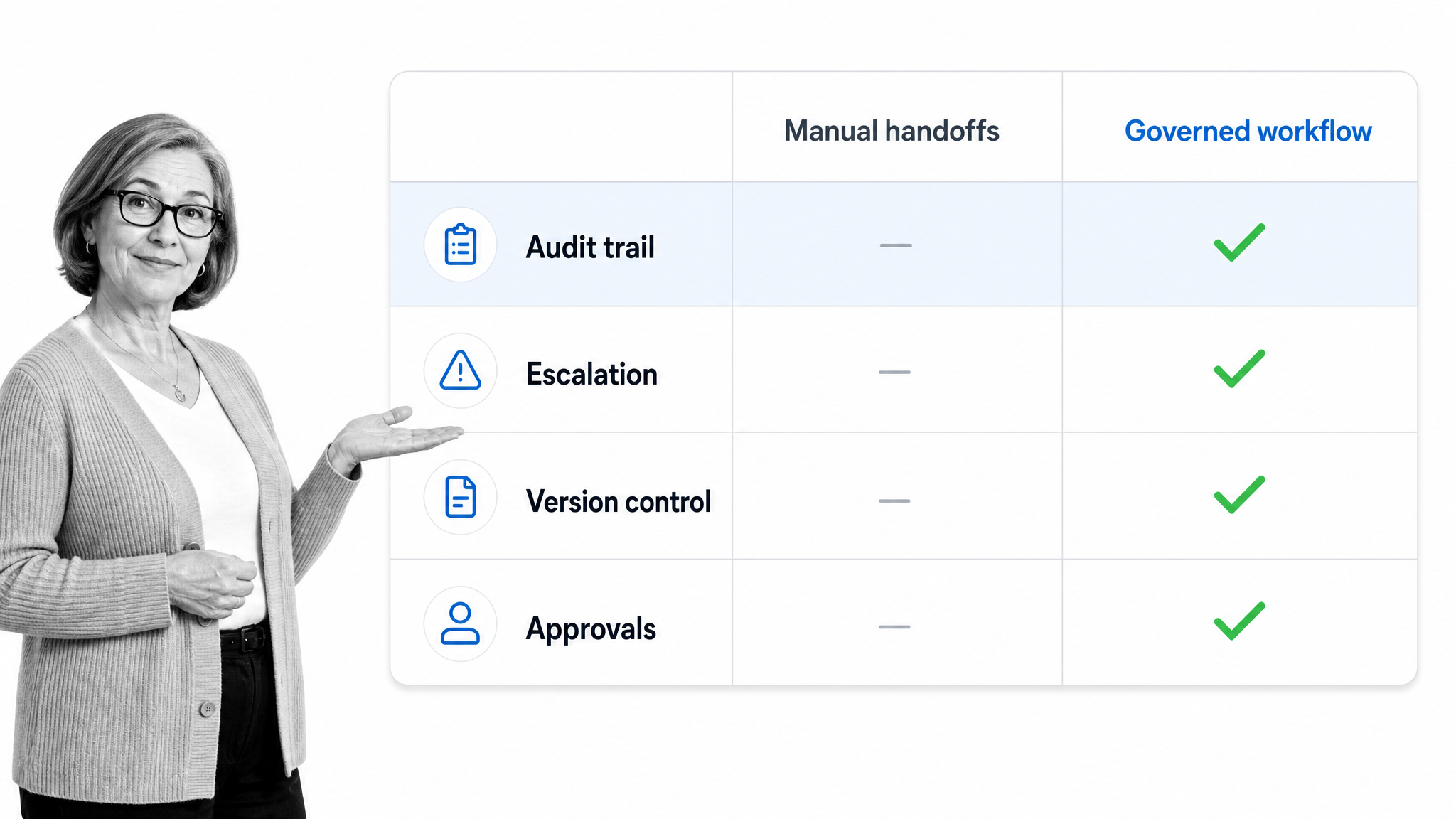
The contrast is stark when you lay it out. Manual handoffs leave no reliable record, depend on people remembering the right steps, and make escalation a matter of who shouts loudest. A governed workflow assigns each step automatically, enforces the order, escalates when something stalls, and records what happened as a byproduct of doing the work. The difference is not just efficiency. It is whether you can prove the work was done correctly.
This is the gap Process Street is built to close. As a Compliance Operations Platform, it turns the resource management process into automated, enforced workflows so the right step happens at the right time, every time, and produces an audit trail without extra effort. Standards bodies such as The Joint Commission expect that level of documented control, and the rules enforced through HIPAA demand the same for protected information.
Keeping suppliers and equipment accountable fits the same pattern. A governed vendor management workflow makes sure supply resources arrive on time and meet standards, while the monitoring and review steps feed continuous improvement back into the process. When resource management runs this way, compliance stops being a separate burden and becomes a natural output of how work already gets done. That is the practical promise: get the right resource to the right patient at the right time, and be able to prove it.
FAQs
What is a healthcare resource?
A healthcare resource is any asset, person, or input a provider allocates to deliver care, including clinical and support staff, beds and rooms, equipment, supplies, budget, and information. The defining trait is that it is limited, so it has to be allocated deliberately to meet patient demand.
What are the main types of healthcare resources?
Healthcare resources fall into five main categories: human resources such as clinicians and support staff, physical resources such as beds and equipment, supply resources such as medications and consumables, financial resources such as budget, and information resources such as records and schedules. Strong management coordinates all five together rather than in isolation.
What is healthcare resource management?
Healthcare resource management is the practice of planning, allocating, and optimizing the people, space, equipment, supplies, budget, and information used to deliver care. It runs as a continuous loop of forecasting demand, inventorying resources, allocating to need, scheduling, monitoring, and reviewing so capacity matches demand safely and efficiently.
Why is healthcare resource management important?
Because demand in healthcare is volatile and resources are limited, poor allocation directly harms patient care, drives staff burnout, and wastes money. Disciplined healthcare resource management keeps care timely and safe, controls cost, and produces the documented evidence that regulated settings require.
How does technology improve healthcare resource management?
Connected workflow technology replaces scattered spreadsheets and informal handoffs with one governed process. It gives teams a single source of truth for resource status, enforces the right steps in the right order, escalates problems automatically, and records every decision so the work is both efficient and audit-ready.
How do you keep healthcare resource decisions audit-ready?
Build documentation and approvals into the workflow rather than adding them afterward. When each allocation, schedule change, and review is captured as the work happens, the audit trail is a natural byproduct. Standardized procedures and a fixed review cadence keep that record complete and defensible.