Turn every policy into automated workflows with built-in enforcement and audit-ready proof.



How to Set Up a monday.com Approval Workflow

A monday.com approval workflow is useful when a team needs a shared board for requests, status changes, reviewers, reminders, and handoffs. It is not enough to add an Approved label and hope people use it correctly. A good approval workflow defines the request, the approver, the evidence needed for the decision, the deadline, and the next action after approval or rejection.
This guide shows how to set up a monday com approval workflow using monday.com boards, WorkForms, status columns, people columns, and automations. It also shows where monday.com works well, where it needs guardrails, and when a controlled workflow system like Process Street workflow automation should run the governed approval process while monday.com stays connected as a planning or visibility layer.
- How should a monday.com approval workflow be structured?
- How to set up a monday.com approval workflow
- What should monday.com handle, and what should Process Street handle?
- monday.com approval workflow example
- Common monday.com approval workflow mistakes
- monday.com approval workflow FAQs
How should a monday.com approval workflow be structured?
The cleanest monday.com approval workflow starts with the decision, not the board. Before you build anything, write down what is being approved, who can approve it, what evidence they need, what happens when it is rejected, and which record proves the decision happened. That keeps the board from becoming a loose task tracker with approval language added afterward.
In workflow terms, an approval is a controlled handoff. IBM describes workflow automation as using software to execute part or all of a process instead of relying on manual tasks. For approvals, that means the system should move the request to the right person, ask for missing information, notify the requester, and record the result without someone chasing the work in chat.
Use monday.com for the parts it handles well: intake forms, board views, request statuses, owner assignments, basic automation recipes, dashboards, and collaboration. Use Process Street when the workflow needs enforceable steps, required evidence, audit history, policy acknowledgement, role based controls, or repeatable approvals that must be followed the same way every time.
- Request intake: capture the request in a consistent form or board item.
- Decision stages: separate review, clarification, approved, rejected, and implemented states.
- Approver ownership: assign one accountable reviewer for each stage, even when many people comment.
- Evidence: attach the file, brief, budget, risk note, or record that supports the decision.
- Outcome routing: define what happens after approval and what happens after rejection.
How to set up a monday.com approval workflow
The setup below assumes a practical request approval process, such as campaign approvals, budget approvals, vendor requests, creative reviews, change requests, or internal policy acknowledgements. You can adapt the same structure to any approval that needs clear ownership and a visible status path.
Step 1: Map the approval decision
Start by writing the approval rule in one sentence: who can ask, who can approve, what evidence is required, and what happens next. If you cannot state the rule clearly, the monday.com board will not fix the process. A strong rule might be: every campaign launch request needs a completed brief, an assigned marketing owner, finance review for budget impact, and final approval from the campaign lead before production starts.
Keep the first version narrow. Build one approval path before adding exceptions. If every request type has different reviewers, different evidence, and different deadlines, create a request type field first, then route the item based on that field.
Step 2: Build the request intake board
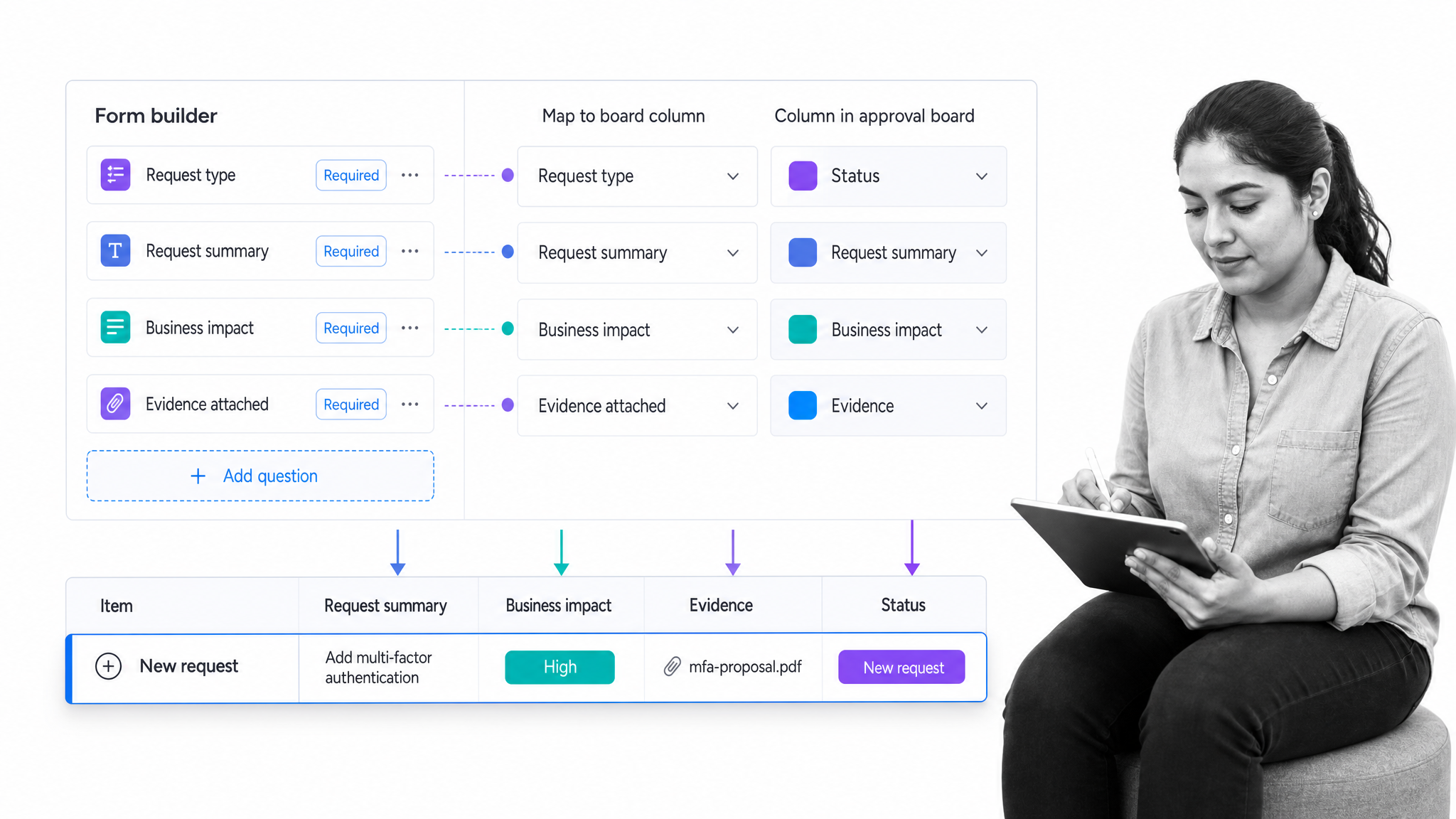
Create a board for the approval queue. The board should show one item per request, not one item per task inside the request. That makes the approval decision easy to scan and keeps dashboards honest.
For external or cross functional intake, use monday.com WorkForms. monday.com says WorkForms collect information, requests, or feedback and connect submissions directly to boards. That makes WorkForms a good front door for approvals because every submission becomes a structured item instead of an email thread.
Add form questions for the request title, requester, request type, due date, business reason, required attachment, estimated cost or impact when relevant, and the team that owns the decision. Avoid long forms that ask for everything up front. Ask only for the information needed to route and review the request.
Step 3: Add status, owner, due date, and evidence columns
A monday.com approval workflow needs more than one status column. At minimum, use an approval status, an implementation status, an approver or owner column, a due date, a requester, and a file or link field for supporting evidence. If approved work needs to trigger downstream action, add a field for the destination board or workflow.
For teams that need mandatory data before a request enters the board, monday.com required columns can help. Required columns are useful when new approval items must include specific information before the board accepts them. Use this for fields that should never be optional, such as requester, decision owner, due date, and request type.
If a request cannot be approved without evidence, treat the evidence field as part of the workflow, not a nice to have attachment. For regulated or compliance sensitive approvals, the stronger pattern is to run the approval in Process Street and store the proof in the workflow run. That gives the team a controlled approval record instead of a board item with scattered comments.
Step 4: Create automations for routing and reminders
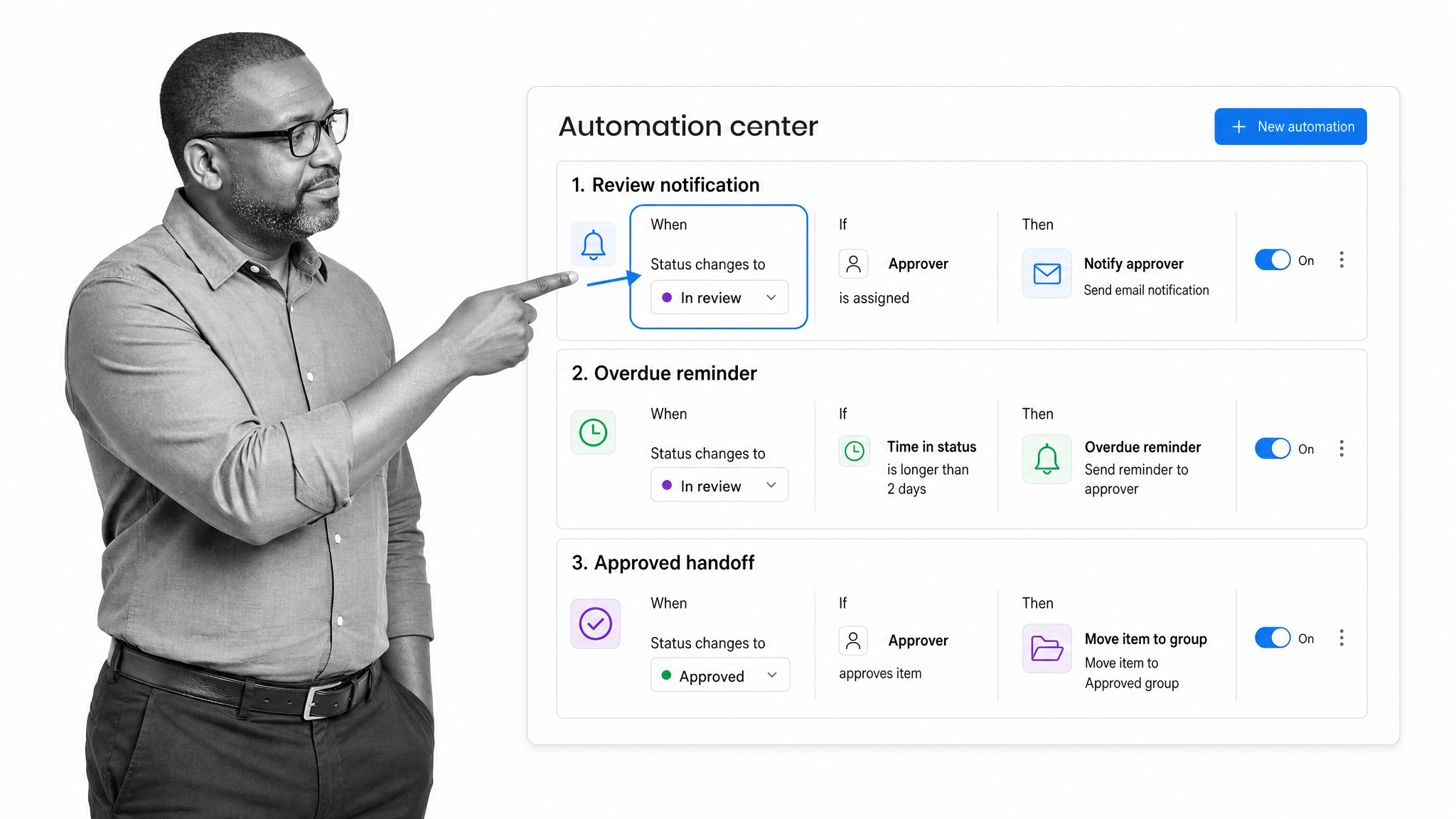
Once the columns are in place, add automations. Start with simple recipes: when a new item is created, assign the triage owner; when approval status changes to Needs review, notify the approver; when status changes to Approved, move the item to the approved group or create the next task; when a due date arrives and the item is not approved, notify the owner.
If an approved request needs to create work on another board, use board to board automation. monday.com cross board automations let an action in one board trigger an action in another board. That is useful when the approval queue is separate from the delivery board, such as a campaign request that becomes a production task only after approval.
Do not automate every branch on day one. Automate the handoffs that cause the most delay: new request triage, reviewer notification, overdue reminder, approved handoff, rejected requester update, and escalation when an approver has not responded.
Step 5: Add controls for required fields and permissions
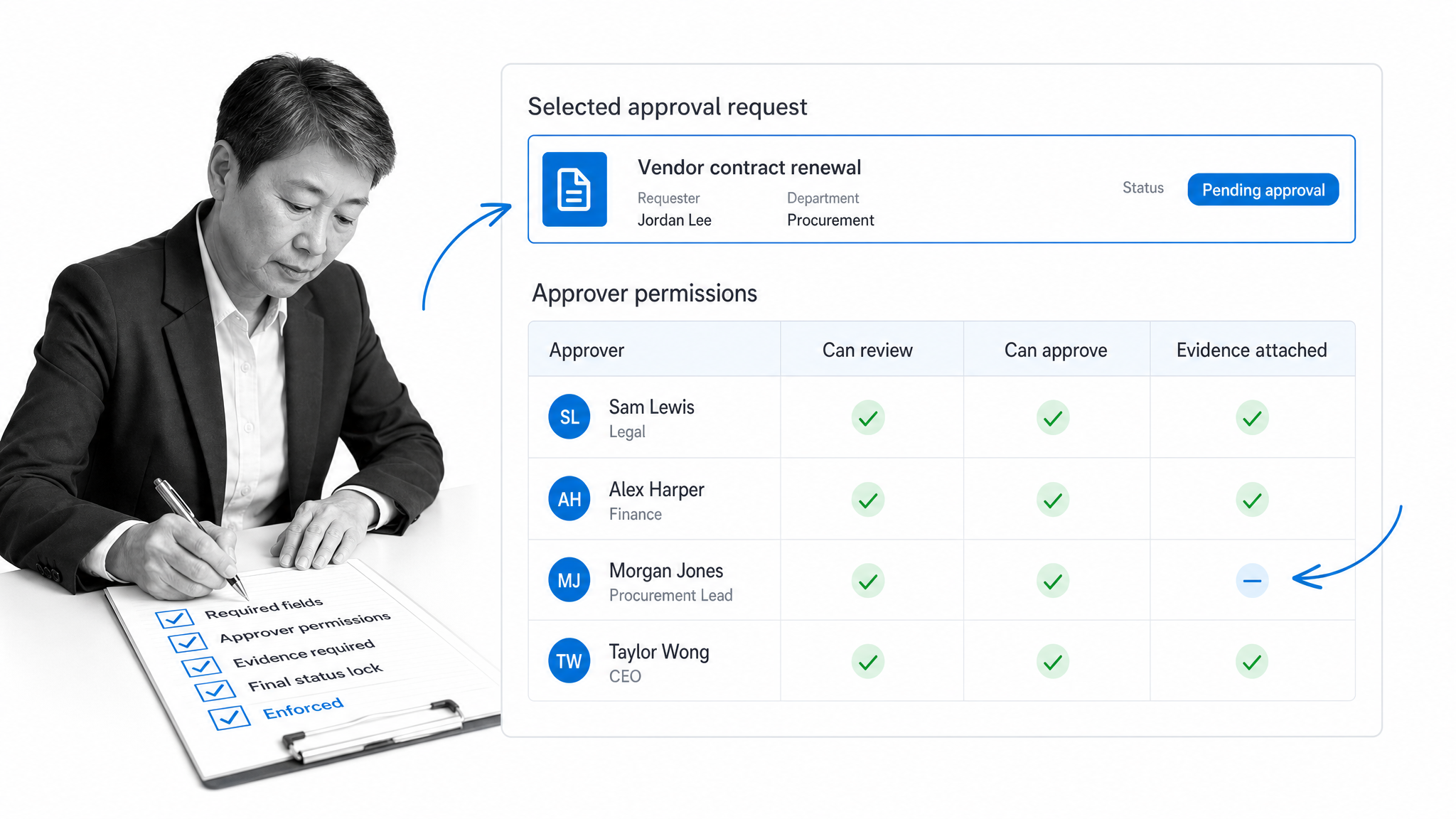
Approval workflows break when anyone can approve anything, skip required fields, or change a final status without context. Use board permissions and column settings to limit who can change sensitive fields. Keep requester comments open, but restrict final approval status changes to the people who own the decision.
monday.com conditional status changes can require a field before someone changes a status label in eligible monday.com products. That is useful for basic data quality, but it is not the same as a fully governed approval chain. If a decision needs policy acknowledgement, documented evidence, version control, or audit proof, use procedure management software that enforces the step sequence and keeps the decision record with the process.
The practical rule is simple: monday.com can show and route the work. Process Street should enforce the work when the approval has compliance, quality, financial, HR, vendor, or customer impact.
Step 6: Test the workflow before rollout
Run the workflow with real examples before inviting the whole team. Submit a normal request, an incomplete request, an urgent request, and a rejected request. Check that the right people are notified, the required fields behave as expected, and approved work moves to the correct next step.
Test the audit trail too. After the decision, ask a simple question: if someone challenged this approval later, could you prove who requested it, who approved it, what they saw, when the decision happened, and what changed afterward? If the answer depends on memory, chat search, or a screenshot, move the controlled part of the process into Process Street.
After testing, document the operating rules beside the board. The rules should explain who owns triage, who can approve each request type, what evidence is required, how overdue approvals escalate, and when a request should move into Process Street. This prevents the approval workflow from becoming dependent on one admin who remembers why every column and automation exists.
For recurring approvals, review the workflow monthly. Look for requests that wait too long in Needs review, approvals that bounce back for missing information, and automations that notify the wrong person. These are process signals, not just monday.com configuration issues. Tighten the intake form, remove unused statuses, and move high control branches into Process Street when the decision needs reliable proof.
What should monday.com handle, and what should Process Street handle?
monday.com is strongest as a flexible work hub. It gives teams a shared board, form intake, assignments, dashboards, and automations that make the status of work visible. That is enough for lightweight approvals where the risk is low and the main problem is coordination.
Process Street is stronger when the approval is part of a governed process. A governed process needs a fixed sequence, required evidence, approval tasks, conditional logic, role based assignments, documentation, and proof that the right steps were completed. That is why teams use Process Street for onboarding, vendor reviews, compliance checks, client handoffs, finance controls, HR approvals, and recurring operating procedures.
A good stack does not force every team into one interface. Use monday.com as the broad work management layer when people need visibility across requests. Use Process Street as the execution and compliance layer when the approval needs to be followed, not merely tracked. You can also connect the two: monday.com can collect or display request status, while Process Street runs the approval workflow that creates the record of work.
- Use monday.com for low risk status tracking, request queues, dashboards, and team coordination.
- Use Process Street for recurring approvals that need required steps, evidence, and audit proof.
- Use both when the team wants monday.com visibility but the approval itself needs controlled execution.
- Avoid using comments as approval records when the approval affects compliance, finance, HR, vendors, or customers.
If you are turning a loose checklist into a controlled workflow, a checklist generator can help you create the first draft, but the real value comes from assigning owners, enforcing approvals, and proving completion.
monday.com approval workflow example
Here is a practical campaign approval workflow that works well as a starting point. The same pattern can be adapted to procurement, operations, HR, finance, client delivery, or IT change requests.
Example: Campaign launch approval
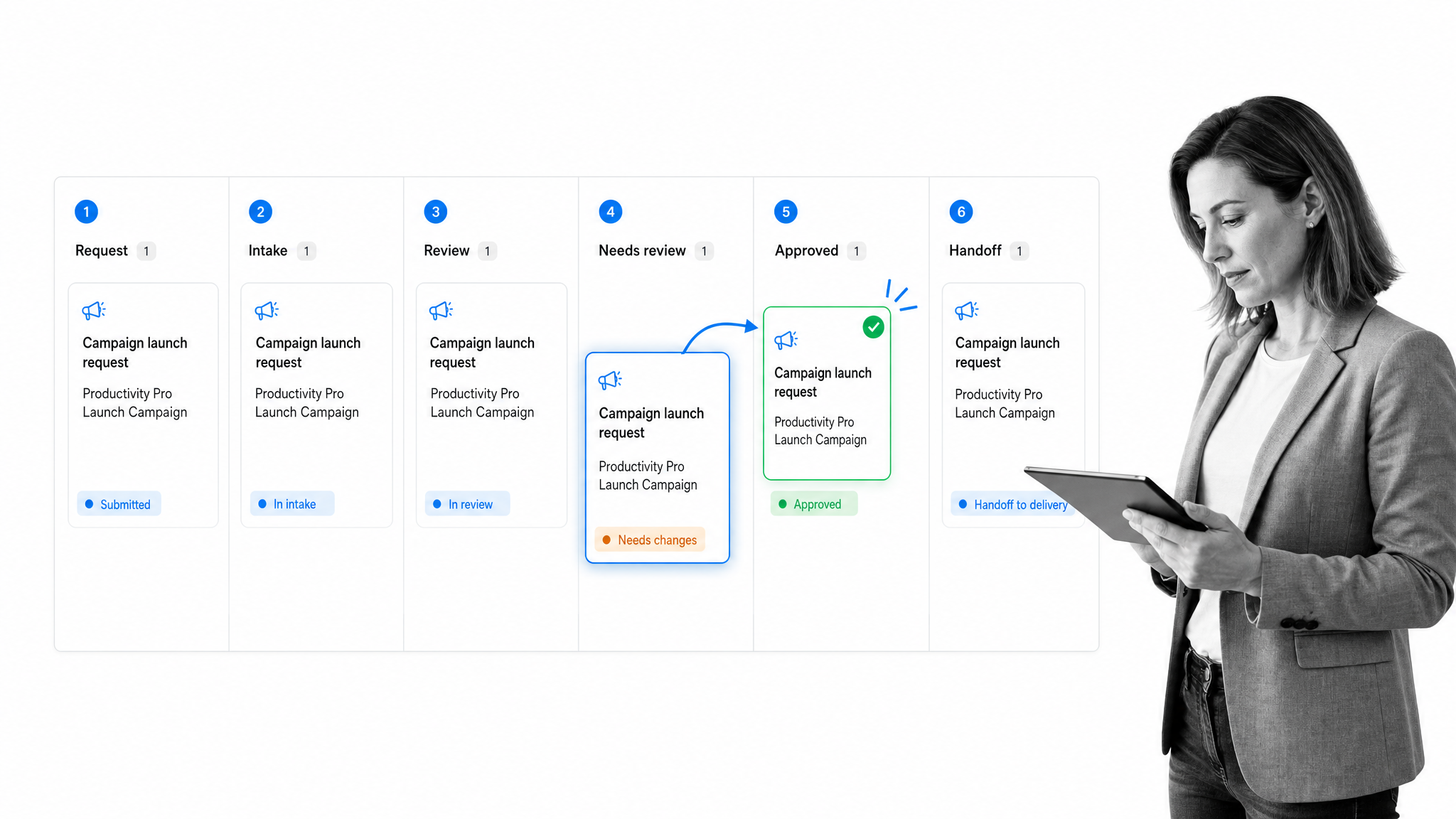
- Requester submits a WorkForm with campaign goal, audience, launch date, assets, budget impact, and owner.
- The new item lands in an Intake group with approval status set to New.
- Automation assigns the marketing operations owner and notifies them to triage the request.
- Triage owner checks required fields, then changes approval status to Needs review.
- Automation notifies the campaign approver and sets the due date for the decision.
- Approver reviews the brief, files, comments, and budget field. If more information is needed, status changes to Needs clarification.
- When the approver selects Approved, automation moves the item to Approved and creates or updates the delivery board item.
- When the approver selects Rejected, automation notifies the requester and keeps the reason visible on the item.
- If the campaign requires a formal compliance, finance, or brand control, the approval runs in Process Street and the monday.com item links to the workflow run.
This example keeps monday.com focused on intake, visibility, and handoffs. It keeps the controlled approval record in Process Street when the decision needs proof. That avoids the common failure mode where a board shows Approved but nobody can reconstruct the actual decision later.
Common monday.com approval workflow mistakes
The fastest way to weaken an approval workflow is to confuse visibility with control. A colorful board can show the status of work, but it does not automatically prove that the correct steps happened. Build the process so the board supports the decision instead of replacing it.
- One status column for everything: separate approval state from delivery state so a request is not treated as complete just because it was approved.
- No single decision owner: comments from many people are useful, but the workflow still needs one accountable approver per stage.
- Approvals hidden in comments: comments are context, not a controlled approval record.
- No rejection path: rejected work needs a reason, a requester notification, and a path back to clarification or archive.
- Automations without testing: every routing rule should be tested with normal, incomplete, urgent, and rejected requests.
- Using monday.com for high control workflows without a proof layer: if the approval affects compliance or audit readiness, run it in Process Street.
A workflow is a sequence of activities needed to complete work, with each step connected to what comes before and after. That basic definition, covered by TechTarget, is useful because approval workflows fail when the sequence is vague. Define the sequence first, then decide which system owns each part.
The other mistake is overbuilding. A small team may only need one request board, one approver column, and a few reliable automations. A regulated team may need a separate governed process for every approval class. The right design is the smallest system that still creates a clear decision, a clear owner, and a reliable record.
monday.com approval workflow FAQs
Can you build an approval workflow in monday.com?
Yes. You can build a monday.com approval workflow with a request board, WorkForms, status columns, people columns, due dates, files, comments, and automations. For controlled approvals that need evidence and audit proof, run the approval in Process Street and connect monday.com as the visibility layer.
What columns do you need for a monday.com approval workflow?
Use columns for request type, requester, approver, approval status, due date, supporting evidence, decision notes, and implementation status. Add required fields for information the approver must have before deciding.
How do you automate approvals in monday.com?
Create automations that assign the triage owner when a request is submitted, notify the approver when status changes to Needs review, remind owners near due dates, and move or create work when a request is approved.
Is monday.com enough for compliance approvals?
monday.com can track approval work, but compliance approvals usually need stronger controls: required evidence, role based steps, approval history, version control, and audit ready proof. Process Street is the better place to enforce those controls.
What is the best way to connect monday.com and Process Street?
Use monday.com for intake and visibility, then trigger or link to a Process Street workflow for the governed approval. The monday.com item can show status while Process Street keeps the execution record.
What should you test before launching the workflow?
Test a complete request, an incomplete request, an urgent request, and a rejected request. Confirm notifications, permissions, required fields, evidence capture, and downstream handoffs before rollout.