Turn every policy into automated workflows with built-in enforcement and audit-ready proof.



Social Venture Capital Firm Processes: A Practical Guide

Social venture capital firm processes turn an impact thesis into repeatable investment work. They define how a firm sources opportunities, tests both commercial strength and intended impact, makes decisions, supports portfolio companies, reports results, and plans exits without losing sight of mission.
A good operating model does more than produce checklists. It connects each decision to evidence, gives every handoff an owner, and makes financial and impact tradeoffs explicit. That matters when an investment team must move quickly while protecting the interests of founders, limited partners, communities, and other stakeholders.
This guide maps the full lifecycle and shows where templates, controls, and workflow automation help. It is operational guidance, not legal, tax, accounting, or investment advice. Firms should adapt each process with qualified advisers for their strategy, fund documents, jurisdictions, and fiduciary duties.
In this guide:
- What are social venture capital firm processes?
- Why standardize social venture capital processes?
- How do social venture capital firm processes work?
- What controls should each process include?
- Which templates help social VC teams?
- How can Process Street run social VC workflows?
- How do you measure process performance?
- Social venture capital firm processes FAQ
What are social venture capital firm processes?
Social venture capital firm processes are the coordinated workflows a fund uses to pursue financial returns and intentional, measurable social or environmental outcomes. They cover the investment lifecycle from strategy and origination through portfolio management, impact at exit, and learning.
The operating system starts with the mandate. The firm decides which problems, populations, geographies, business models, stages, and return profiles fit. It also defines what contribution the investor expects to make through capital, governance, networks, or operational support. Those choices become screening rules, diligence questions, investment committee criteria, portfolio metrics, and exit considerations.
The Operating Principles for Impact Management organize impact management as an end-to-end process spanning strategy, origination and structuring, portfolio management, impact at exit, and independent verification. A social VC firm can use that lifecycle as a reference while designing controls that fit its own mandate.
| Lifecycle stage | Core decision | Required record |
|---|---|---|
| Mandate and thesis | Which outcomes and return profile will the fund pursue? | Approved investment and impact thesis |
| Sourcing and screening | Does the opportunity fit the mandate well enough to investigate? | Deal record, source history, and screen decision |
| Due diligence | Are the business, impact case, risks, and evidence credible? | Diligence file, impact model, and open issues |
| Investment committee | Should the fund invest, on what terms, and with which conditions? | Decision memo, votes, conflicts, and conditions |
| Closing and onboarding | Are legal, operational, and reporting requirements ready? | Closing checklist and portfolio onboarding record |
| Portfolio management | Is the company progressing financially and against its impact plan? | KPI package, support plan, and exception log |
| Exit and learning | How will the firm protect value and consider impact at transition? | Exit review, impact review, and lessons learned |
Why standardize social venture capital processes?
Impact investing adds a second decision lens to venture capital. The team still evaluates the market, product, economics, management, governance, and transaction. It must also test who experiences the intended outcome, how material that outcome is, what could cause harm, how the investor contributes, and whether the result can be measured credibly.
Without a shared process, those questions can be applied unevenly. One deal may receive careful stakeholder research while another advances on a compelling narrative. A standard workflow creates comparability without pretending every company is identical. Conditional paths can increase scrutiny when the sector, population, geography, data sensitivity, or business model raises additional risk.
- Consistency: every opportunity passes the same minimum gates while specialist reviews remain risk-based.
- Decision quality: claims, assumptions, counterevidence, and unresolved questions appear together before approval.
- Accountability: owners, reviewers, deadlines, exceptions, and final decisions remain attached to the work.
- Portfolio learning: common definitions make it easier to compare expectations with observed results.
- Continuity: the fund retains operating knowledge when people, advisers, or service providers change.
- LP confidence: the firm can explain how impact considerations enter investment decisions and portfolio management.
Standardization should not become bureaucracy. A seed investment, a regulated health company, and a capital-intensive climate venture need different evidence. The process should enforce a clear minimum, then reveal additional work based on risk and context.
How do social venture capital firm processes work?
The lifecycle works best when each stage produces a decision-ready record for the next. The following seven processes form the operating spine.
Define the mandate and impact thesis
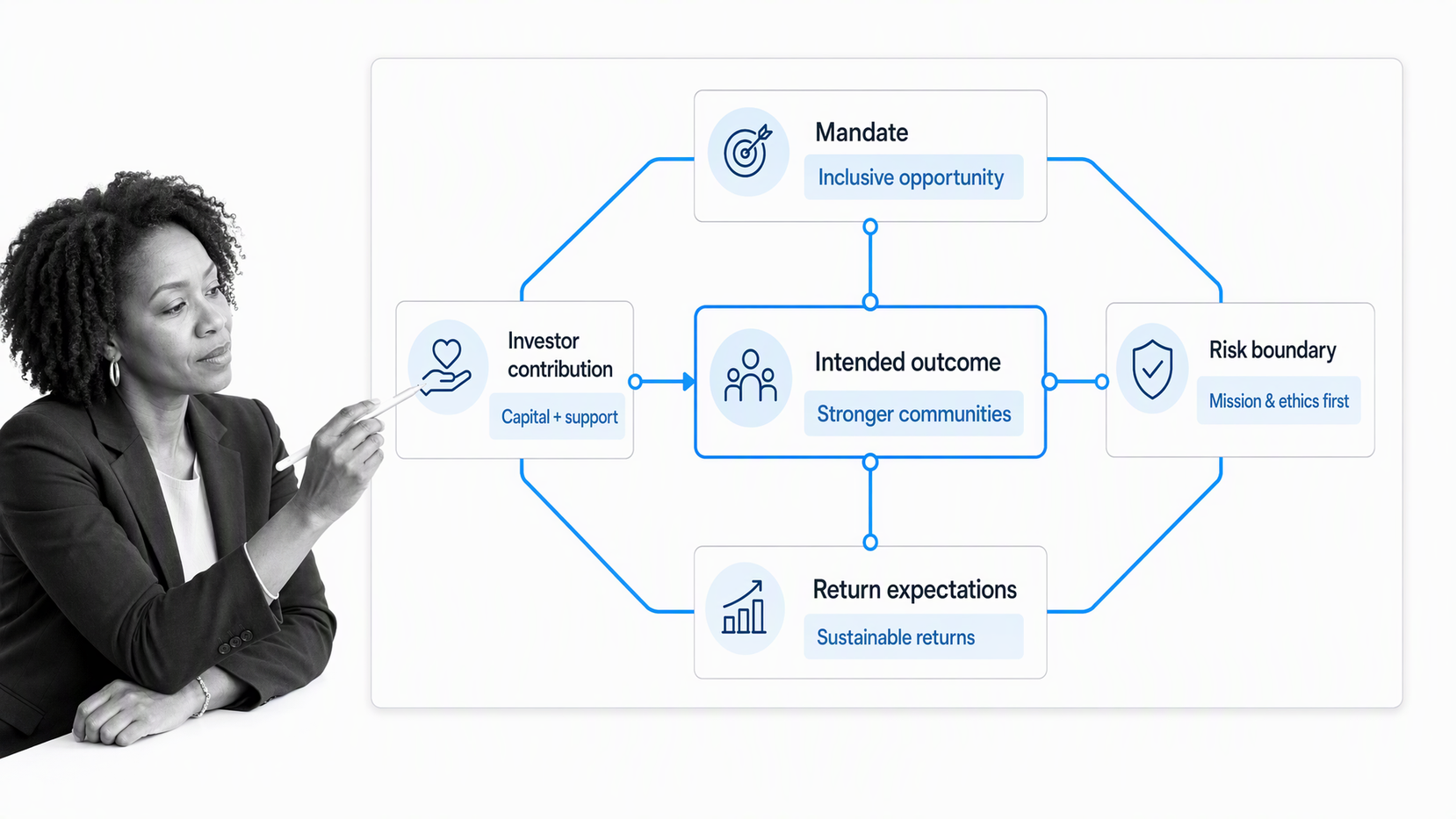
Start by converting broad intent into decision rules. Name the target outcomes, affected stakeholders, sectors, stages, geographies, risk boundaries, return expectations, ownership goals, time horizon, and forms of investor contribution. Define exclusions and escalation triggers as clearly as inclusion criteria.
The impact thesis should explain the chain from company activity to output, stakeholder outcome, and longer-term effect. It should also state where evidence is strong, where assumptions remain, and which negative outcomes require attention. This becomes the baseline for sourcing, diligence, monitoring, and exit.
Source and screen opportunities
Use one controlled intake path for referrals, applications, events, scouts, founder outreach, and outbound research. Capture the company, source, relationship owner, sector, stage, geography, capital need, key materials, and potential conflicts. Preserve multiple source relationships while maintaining one canonical opportunity record.
The initial screen should be short. Test mandate fit, the problem and affected population, the product or service, commercial plausibility, evidence of demand, basic impact logic, obvious harm risks, and the next information needed. Record the reason for advancing, holding, or declining the opportunity so the pipeline becomes a learning system rather than a collection of forgotten conversations.
Run dual-track due diligence
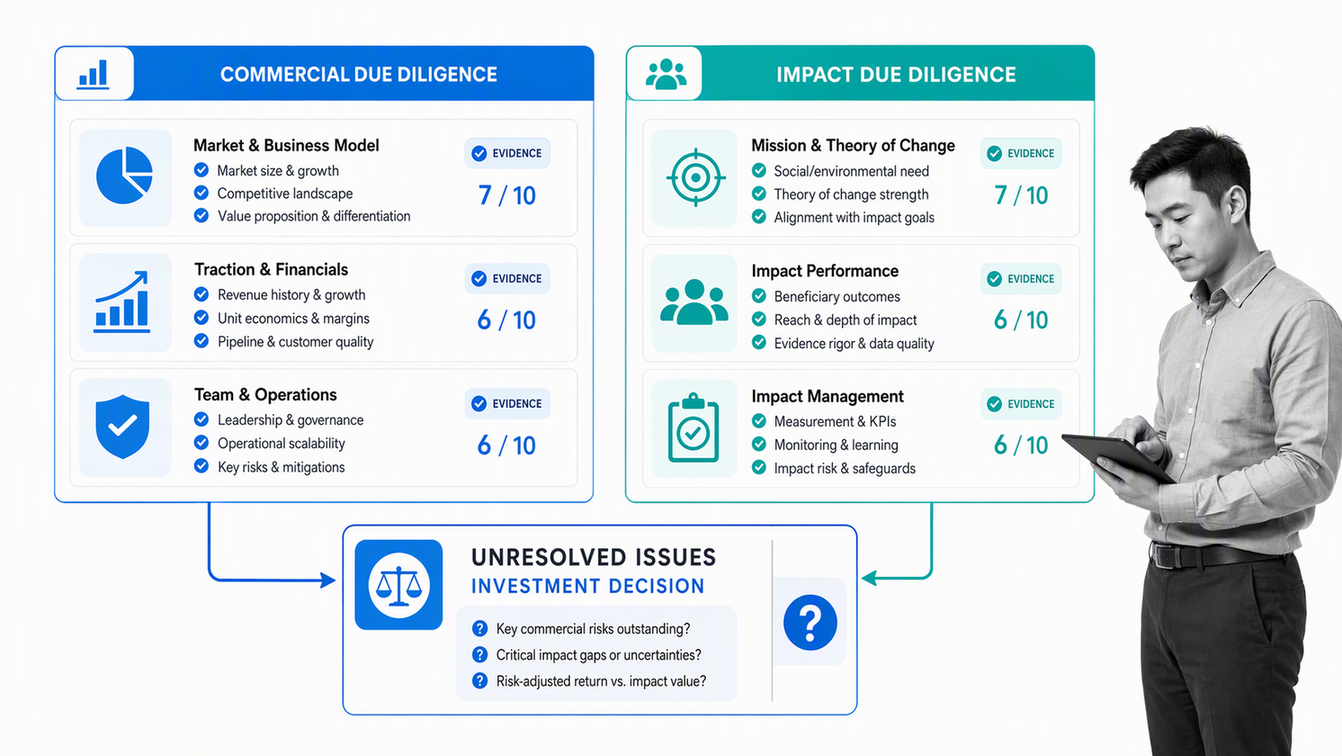
Run commercial and impact diligence as connected workstreams. Commercial diligence may examine market structure, customers, product, unit economics, financial model, team, technology, legal matters, governance, security, and transaction terms. Impact diligence tests the intended outcome, stakeholder need, additionality, measurement plan, potential harms, and the company’s capacity to manage impact as it scales.
The IRIS+ impact due diligence guidance is designed to help investors integrate impact performance into decisions across the investment cycle. Use a framework to sharpen questions and definitions, not to replace judgment or company-specific evidence.
Negative impact belongs inside diligence, not in a separate marketing exercise. Use a risk-based approach to identify and address actual and potential adverse impacts in operations, supply chains, and business relationships. The fund should document priority risks, mitigations, residual uncertainty, and who will monitor each issue after investment.
Govern investment committee decisions
The investment memo should combine the commercial case and impact case without allowing one to hide weaknesses in the other. Separate facts from forecasts. Link important claims to source evidence. State the proposed terms, ownership, reserves, expected investor contribution, impact objectives, principal risks, mitigations, and unresolved questions.
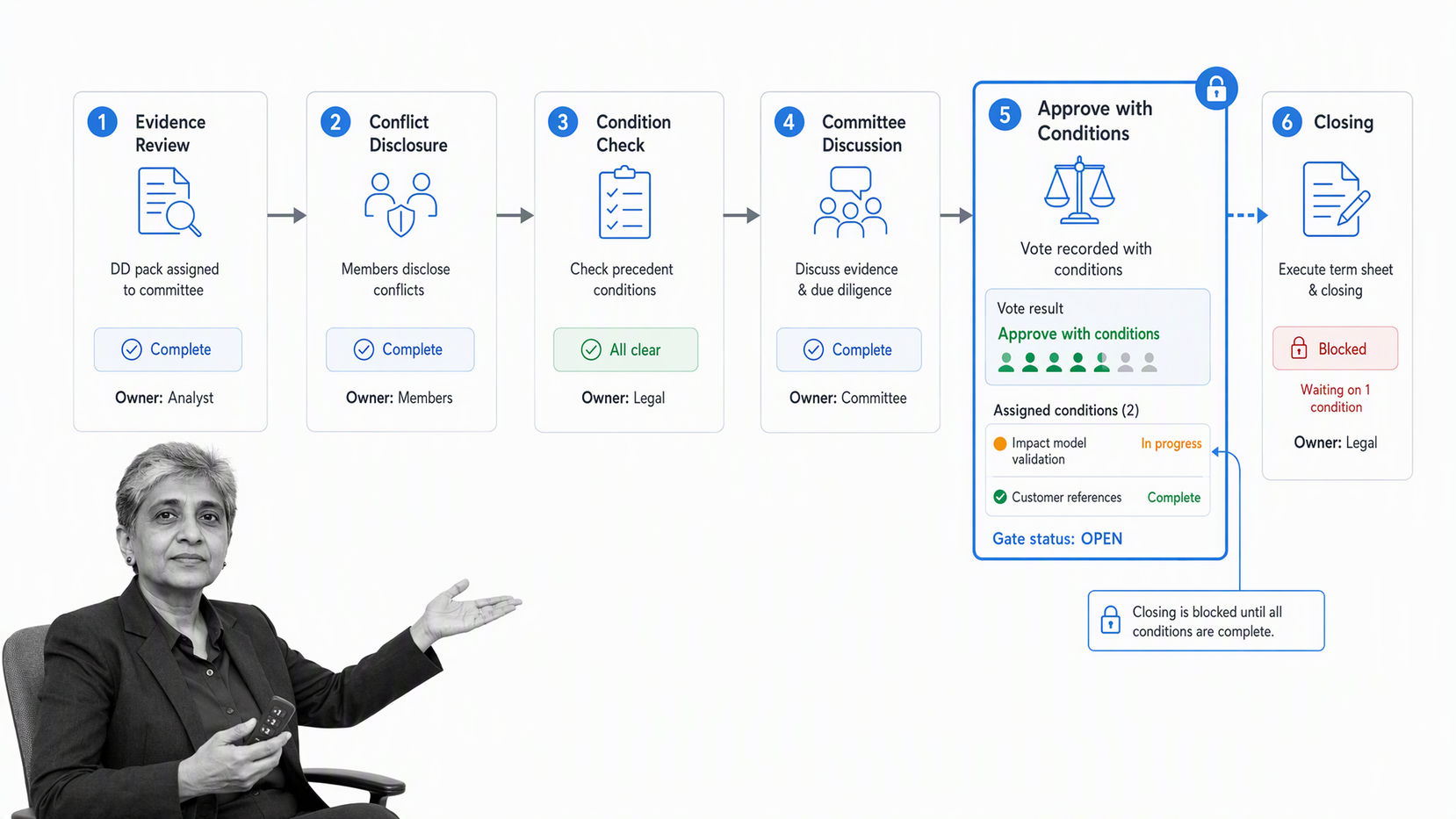
The committee workflow should record attendees, conflicts, abstentions, votes, comments, conditions, allocation, follow-up owners, and deadlines. If approval depends on a revised impact plan, governance right, customer reference, legal finding, or mitigation, the closing workflow should not advance until the condition is resolved or an authorized exception is recorded.
Close and onboard the investment
Approval is not closing. Use a readiness gate for final documents, signatures, funds flow, cap table confirmation, regulatory and tax checks, governance appointments, notices, and creation of authoritative portfolio records. Counsel, fund administrators, accountants, and other specialists should own their professional conclusions. The workflow coordinates evidence and handoffs.
Portfolio onboarding should agree on reporting definitions, cadence, owners, data sources, validation, board rhythms, support priorities, escalation triggers, and communication norms. Ask only for data the firm is prepared to use. A focused set of decision-relevant measures is more useful than a large reporting pack that nobody reviews.
Monitor financial and impact performance
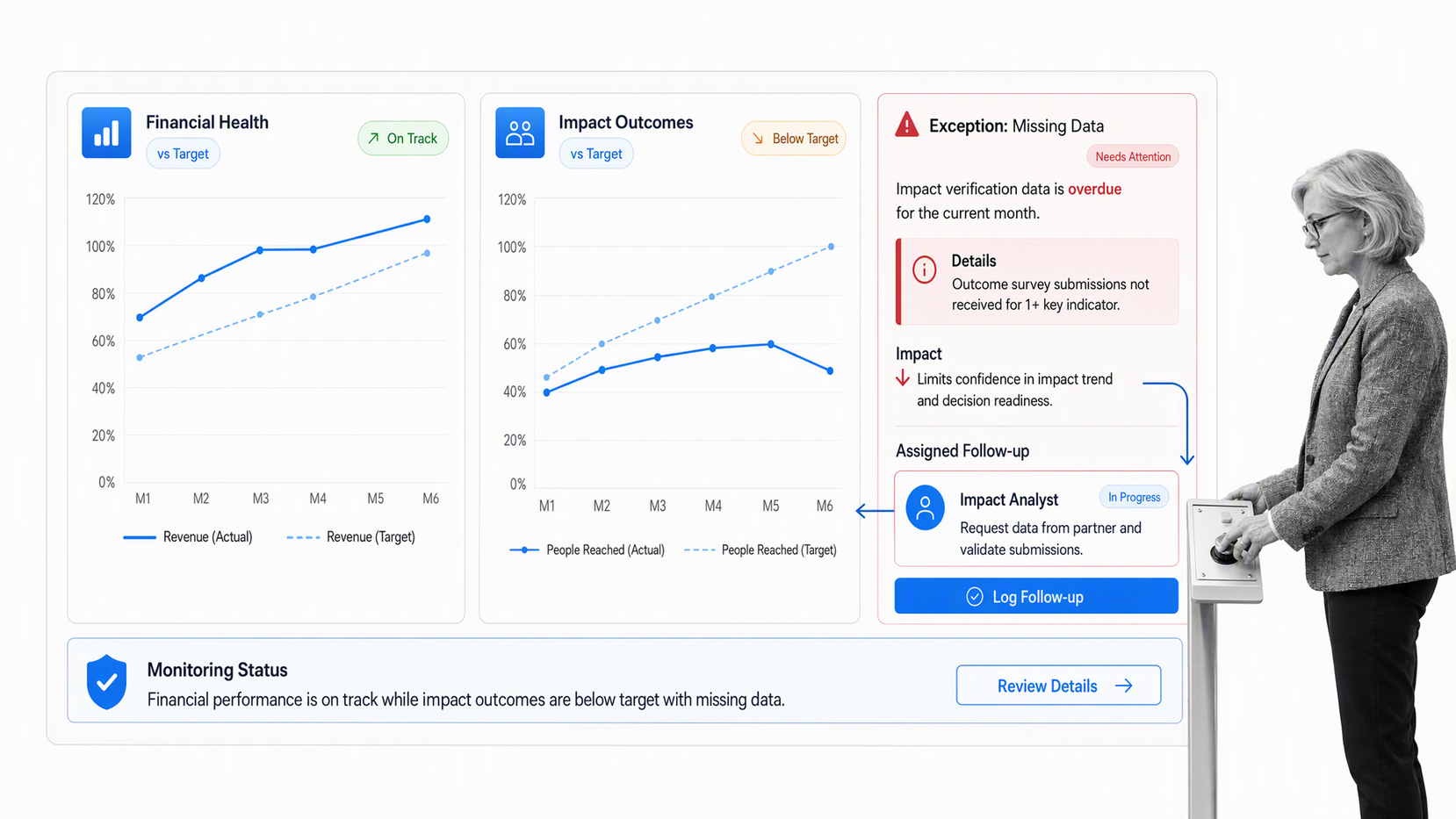
Monitoring compares actual performance with the investment case and impact plan. Review financial health, operating progress, governance, fundraising, major risks, stakeholder outcomes, unintended effects, and delivery against agreed actions. Keep company-specific context alongside standardized portfolio measures.
When selecting impact measures, define the unit, population, baseline, frequency, source, owner, validation method, and decision that the measure informs. IRIS+ can provide shared definitions, but the fund still needs a company-specific theory of change and evidence plan. Missing data, declining outcomes, or emerging harms should trigger an exception workflow rather than wait for the next routine report.
Support portfolio companies
A social venture investor may contribute through governance, recruiting, partnerships, customer introductions, follow-on financing, policy expertise, impact measurement, and operational support. Manage support requests as owned work with a clear objective, company counterpart, due date, and result. That prevents high-profile companies from absorbing all available attention while quieter needs remain invisible.
Support should respect founder agency and the company’s operating reality. The fund can offer patterns, resources, and accountability, but management remains responsible for execution. Sensitive stakeholder feedback requires careful access, consent, and privacy controls.
Plan impact-aware exits and learning
Exit planning should begin before a transaction is imminent. Consider likely buyers, governance and mission protections, management incentives, stakeholder effects, continuity of measurement, and how the company could preserve value and outcomes under new ownership. The fund should distinguish contractual protections from intentions that cannot be enforced.
After an exit, compare the original thesis with what happened. Review financial performance, realized and unrealized impact, negative effects, investor contribution, measurement quality, and decisions that should change. Feed those lessons into the mandate, screen, diligence questions, portfolio support model, and future exit planning.
What controls should each process include?
Controls make a process dependable when the team is busy or the deal is unusual. Each critical workflow should show who owns the work, which evidence is required, who reviews it, what can block progress, and how exceptions are approved.
| Control | Design question | Evidence to retain |
|---|---|---|
| Ownership | Who is accountable for the complete workflow? | Named owner and delegated tasks |
| Decision rights | Who recommends, approves, advises, or may veto? | Role map and recorded decision |
| Required evidence | Which facts must exist before the gate opens? | Linked source files and completed fields |
| Conflict management | When must a person disclose or recuse? | Disclosure, review, and abstention record |
| Conditional review | Which risks trigger specialist or deeper work? | Rule result and assigned review |
| Exception handling | Who may approve a deviation, and for how long? | Reason, approver, conditions, and expiry |
| Version control | Which thesis, rubric, or metric definition applied? | Approved version and effective date |
| Reconciliation | Which system is authoritative for each record? | Comparison, differences, and resolution |
| Escalation | What happens when work is late or evidence is missing? | Notification, action, and closure |
Governance diligence deserves its own view. The IFC Corporate Governance Development Framework provides a common approach for evaluating and strengthening governance practices in investee companies. A social VC firm can adapt relevant questions while accounting for company stage, jurisdiction, ownership, and sector.
Which templates help social VC teams?
Templates give the team a controlled starting point. They should be tailored to the mandate and tested with real deals. Process Street maintains a broader venture capital template library, including social venture workflows across the investment lifecycle.
- Social Venture Capital Deal Sourcing for opportunity intake, evaluation, and progression.
- Social Venture Capital Due Diligence for coordinating commercial, impact, and risk review.
- Social Venture Capital Social Impact Assessment for structuring impact questions and findings.
- Social Venture Capital Impact Measurement for collecting and reviewing impact data.
- Social Venture Capital Portfolio Management for recurring performance and support work.
- Social Venture Capital Exit Strategy Planning for preparing a coordinated transition.
- Social Venture Capital Community Engagement for structured stakeholder participation and feedback.
Treat every template as a governed operating asset. Assign an owner, document its purpose, define when it should run, review it after material exceptions, and retire versions that no longer match the mandate.
How can Process Street run social VC workflows?
Process Street can coordinate the workflow layer around a social venture capital stack. Specialist systems can remain authoritative for relationships, accounting, cap tables, documents, and analytics while Process Street controls the recurring work that moves between people and systems.
- Capture an opportunity through form fields and populate one workflow run with the deal context.
- Use conditional logic to reveal review paths based on stage, sector, geography, stakeholder risk, or transaction structure.
- Assign commercial, impact, legal, technical, governance, and reference work to the right owners with due dates.
- Collect required evidence and hold the decision gate until mandatory work is complete.
- Route the investment memo through one or more approval stages, retaining comments and outcomes with the workflow.
- Launch closing, onboarding, rejection follow-up, or watch-list work from the recorded decision.
- Schedule portfolio reviews and trigger exception workflows when submissions are late or a threshold is crossed.
Process Street supports form-based data collection and conditional paths that reveal different work based on information in a workflow run. Its approval tasks support single, multi-stage, or sequential review. The workflow approval process guide shows how intake, routing, evidence, decisions, and follow-up can stay connected.
Keep required fields focused on evidence that changes a decision or proves a control. Use automation after responsibilities and definitions are stable. Automating an unclear process only moves ambiguity faster.
How do you measure process performance?
Measure the operating system separately from investment outcomes. A strong return does not prove the process was disciplined, and a well-run process cannot eliminate venture risk. Process metrics reveal whether the team is making complete, timely, and explainable decisions.
- Pipeline quality: thesis-fit rate, source diversity, duplicate rate, and time to first decision.
- Diligence execution: cycle time, waiting time, missing evidence, reopened work, and unresolved issues at committee.
- Decision governance: conflict disclosures, conditional approvals, exception rate, and completeness of the final record.
- Portfolio operations: on-time reporting, data validation issues, support request completion, and response to risk triggers.
- Impact management: measure coverage, definition changes, stakeholder feedback, negative-impact actions, and progress against the impact plan.
- System health: overdue reviews, access exceptions, workflow abandonment, reconciliation differences, and recurring manual workarounds.
Review the process on a fixed rhythm. Monthly operating reviews can clear stuck work and missing evidence. Quarterly reviews can test definitions, thresholds, access, and portfolio reporting. Annual reviews can revisit the mandate, committee authority, impact framework, retention rules, and continuity plan. Every review should end with owned actions and deadlines.
Social venture capital firm processes FAQ
What are social venture capital firm processes?
They are the repeatable workflows a social VC firm uses to define its mandate, source and screen opportunities, conduct commercial and impact diligence, approve investments, close transactions, support portfolio companies, monitor results, report to stakeholders, and plan exits.
How is social venture capital due diligence different from conventional VC due diligence?
It includes conventional commercial, financial, legal, technical, governance, and team review, plus an explicit assessment of intended impact, affected stakeholders, investor contribution, potential harms, measurement quality, and mission risk.
How should a social VC firm measure impact?
Begin with the impact thesis and the decisions the data must support. Define outcomes, stakeholders, baselines, indicators, sources, owners, frequency, validation, and escalation rules. Shared metric catalogs can improve consistency, but company-specific evidence and context remain necessary.
Why do social VC firms use process templates?
Templates establish a consistent minimum for evidence, ownership, review, and decision records. They reduce avoidable variation while allowing conditional paths for different stages, sectors, geographies, and risk profiles.
What should an investment committee record?
Record the recommendation, evidence considered, conflicts, attendees, votes or decision, abstentions, conditions, allocation, unresolved issues, and owners and deadlines for follow-up work.
How can a social VC firm protect impact at exit?
Plan early. Evaluate likely buyers, governance and mission protections, management incentives, stakeholder effects, continuity of measurement, and the limits of contractual control. Record the impact considerations alongside financial and transaction analysis.