





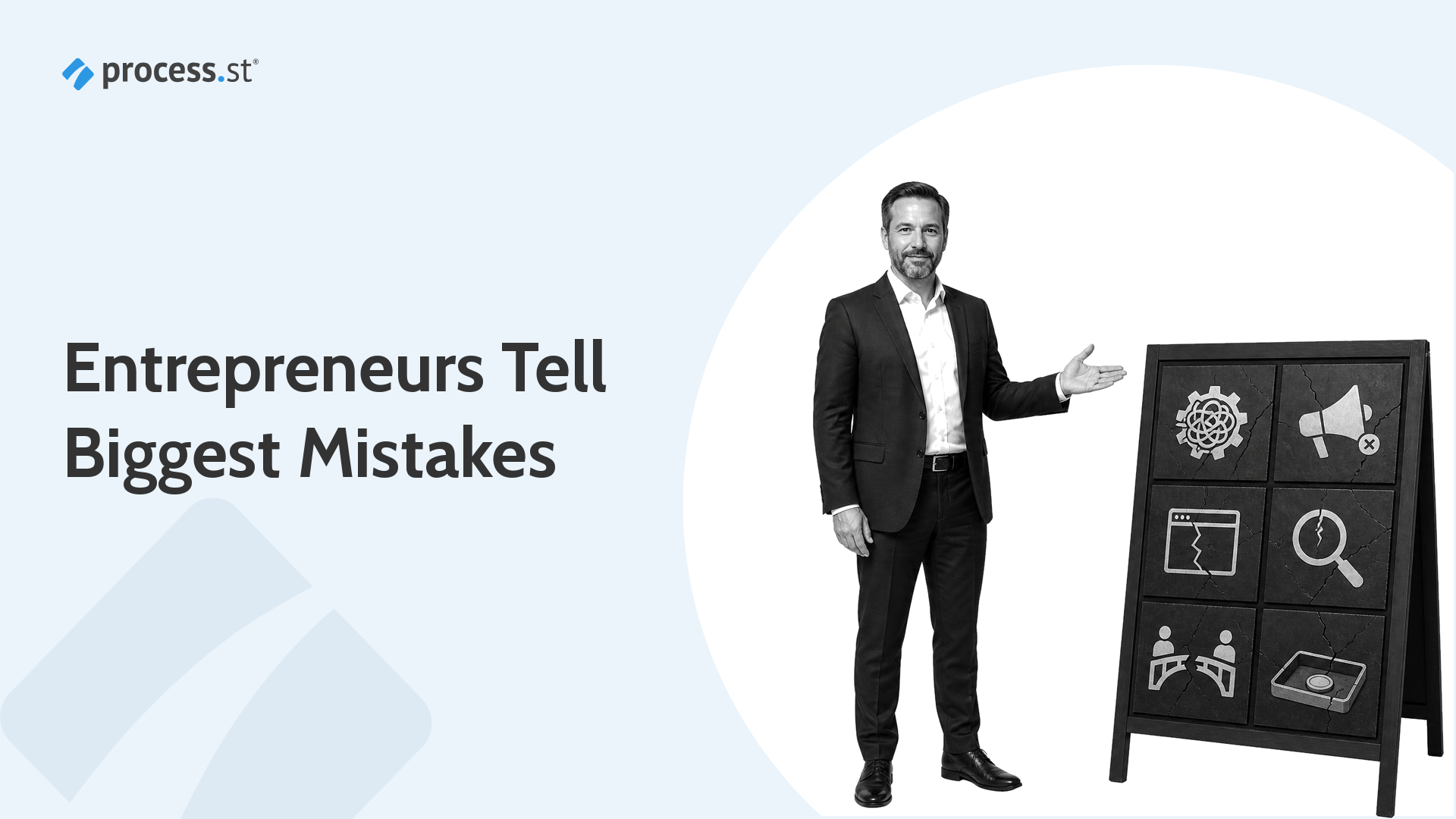
Every entrepreneur has a mistake that changed how they build. Some waited too long to systematize the business. Some underinvested in marketing. Some spent money in the wrong place, trusted the wrong shortcut, kept the wrong person, or launched before the revenue model was real.
When entrepreneurs tell the truth about what went wrong, the lessons tend to stick. These six entrepreneurs shared the biggest mistakes they made and the lessons that followed. The details are different, but the pattern is clear: common mistakes entrepreneurs make are rarely abstract. They show up in hiring, systems, marketing, search, budgets, and the way a startup turns attention into revenue.
Ely Delaney
“not building systems from the beginning”
The biggest mistake that I made and that I see from the hundreds of other small business owners I’ve met over the years is around not building systems from the beginning.
I know that when I started my first business, it was all me. I did everything in the business so I didn’t feel the need to document things.
Then I moved into an office, hired staff, and was on the move for huge growth. Problem was, even though we started in the right direction, the train derailed pretty fast. My employees were running me, not the other way around. I thought that by giving them the freedom to take control they would help us grow. Instead, I ended up running like crazy, working insane hours fixing a ton of mistakes, and hating my company.
Giving employees freedom is great. Let them be creative, but document everything first. Give them a baseline for what’s expected and how things should be done. Then let them use their creativity to improve on what you’ve already systematized.
That way everyone is on the same page. You know what to expect and they know what’s expected of them.
Even if you’re a solopreneur and aren’t sure when you’ll start hiring your team, document and systematize now. You’ll improve your own productivity, and when you’re ready to hire someone you’ll already have your company procedures manual ready for them.
For a practical next step, start by mapping the recurring work that already happens in the business, then use a simple guide on how to automate business processes to turn that work into repeatable execution.
It will save you time, energy, and money. It will also lower your stress levels.
Erin Pfiffner
Citrrus
“not marketing ourselves”
Ask any of our founding partners and they’ll tell you the biggest mistake Citrrus made was not marketing ourselves. We were doing great things but didn’t tell anyone about them. A small business can’t survive on referrals and cold-calling alone. We know firsthand, as we started struggling in 2013 because that’s what we were doing.
In the company’s early years, we started focusing on budget-conscious growth tactics and saw strong early returns. Had we been doing this all along, we wouldn’t have been in the trenches.
Luckily, we recognized this in time and fully embraced marketing. As our CEO Jason LaFollette put it: “It doesn’t pay to be humble. You gotta get out there, build your reputation, and be confident in telling others what you are good at.”
Nicole Flores
Studio Savoie
“spending the majority of a startup budget on a professionally designed website”
Being on both sides of the question, the one mistake I see most is spending the majority of a startup budget on a professionally designed website. When it comes to a business website, content is king. A neat, easy-to-navigate, do-it-yourself site is fine for a bootstrapping business. Plus, rebranding can become a useful marketing opportunity.
John Drabkowski
“trying to ‘cheat’ your way into better search results”
I am the owner/operator of an online ticketing company located in North Miami Beach, Florida. My company’s website, Tons Of Tickets, unfortunately had to be shut down after about four years in business. The site received a Google penalty caused by an SEO company we hired to improve our online marketing exposure.
From my experience, trying to cheat your way into better search results can be one of the biggest mistakes a new online business can make. Black-hat SEO strategies are too risky when it comes to developing a successful company online. It proved to be the demise of the entire Tons Of Tickets domain.
After regrouping and restrategizing, we reopened the company under a new domain, Red Hot Seats, about six months later. Since reopening, our marketing strategies have avoided black-hat SEO companies. Instead, we use other effective marketing techniques like press release branding, social media marketing, and content-based marketing. Through plenty of research and sheer determination, our company made a comeback in the online ticket industry.
Mark Lenneville
Uniformed Services Health Professional Placement (USHPP)
“not firing a relative earlier”
My biggest mistake was not firing a relative earlier. When we hired him, this was the best thing we could have done. He was bright, progressive, insightful, creative, and fun to be around because he was always full of energy and enthusiasm for the business and for life.
This changed as he got more into the business, went through a divorce, and struggled to produce in the business. His true personality surfaced. He showed that he was not a team player, seemed to thrive on creating conflict, was unreliable, and lacked the attention to detail necessary to sustain the business as an employee.
He was great at helping to get the business started and lousy at keeping it going. We tried to motivate him to get on board, but we soon learned this was not going to happen. Two years later, the pain in letting him go was terrible for the business and the family, but it was a decision that was long overdue. We should have let him go earlier, but we failed to do this.
Jeet Banerjee
StatFuse, later acquired by LendEDU
“launched without a revenue model in mind”
I’m a serial entrepreneur, digital marketing consultant, author, public speaker, and change-maker. I started my first business in high school and sold it two years after growing the business to more than 15 employees. Here’s my answer to this question:
When I started StatFuse.com, we were so excited about the product that we completely forgot we had to build a business. We launched without a revenue model in mind and that ended up costing us a lot. We got over 12,000 users in a few short weeks and they went unmonetized. Not only that, but we had no idea of testing our monetization ideas, and it took us almost eight months until we finally nailed down our revenue model.
Our lesson was simple: plan and prepare properly with everything you know, because you don’t know how fast things might play out.
The pattern behind these entrepreneur mistakes
The mistakes entrepreneurs make are often execution mistakes before they are strategy mistakes. A business needs marketing before it needs polish. It needs ethical growth before it needs shortcuts. It needs a revenue model before the user count becomes a vanity metric. It needs clear accountability before one bad hire can drain the team.
Most of all, it needs systems early. Process Street is a Compliance Operations Platform that helps teams document recurring work in Docs, run it through Ops, and use built-in AI to catch missed steps before they become operational risk. The earlier those systems exist, the fewer founder lessons have to be learned the hard way.
What are some mistakes you have made as a business owner?