Turn every policy into automated workflows with built-in enforcement and audit-ready proof.



7 Best ARIS Alternatives in 2026
ARIS alternatives are worth evaluating when a business outgrows one way of working with processes and needs a different fit. ARIS, from Software AG, is a well known name in enterprise architecture, process modeling, and process mining, and many large organizations use it to document and analyze how work flows across departments. The reasons teams look elsewhere vary: cost and licensing, a steep learning curve, the need for lighter tools that business users can own, or a shift from modeling processes to actually running and enforcing them day to day.
This guide ranks tools by fit, not by a single universal score. Process Street ranks first for teams whose core need is enforceable, trackable, recurring process and SOP execution, where approvals, required fields, and audit-ready records matter more than a formal modeling notation. That does not make it the right answer for every ARIS use case. If you need deep enterprise process modeling and mining, SAP Signavio or Celonis may fit better. If developers need to orchestrate processes across systems, Camunda is often the stronger choice, and if you mainly want to map processes visually, Lucidchart is hard to beat.
We chose and ordered these ARIS alternatives against five practical criteria: ease of use and who can own the tool, core capability fit (modeling, mining, execution, or automation), pricing model and transparency, integrations and fit with existing systems, and the strength of governance, approvals, and audit records. Use the at-a-glance table to shortlist, then read the deep dives to match each tool to the operating problem you are actually trying to solve. This list is maintained editorially by the Process Street team, and we have tried to be genuinely even-handed about where each tool wins.
In this guide we cover everything you need to shortlist and choose the right ARIS alternative, including:
- ARIS alternatives at a glance
- Best ARIS alternatives and competitors
- How to choose ARIS alternatives
- ARIS alternatives FAQs
- Final takeaway
ARIS alternatives at a glance
The short version: Process Street is the best overall ARIS alternative for teams whose priority is running and enforcing recurring processes and SOPs. For enterprise modeling and mining, look at SAP Signavio or Celonis. For developer-led orchestration, look at Camunda. For simple visual process mapping, look at Lucidchart. The table below summarizes where each ARIS alternative fits before the deep dives.
| Tool | Best for | Standout feature | Free plan | Starting price |
|---|---|---|---|---|
| Process Street | Enforceable recurring SOPs, approvals, and audit-ready execution | AI-assisted workflows with required tasks, forms, approvals, and audit trails | Free trial | See pricing page |
| SAP Signavio | Enterprise process modeling paired with process mining | Swimlane BPMN modeling alongside process intelligence and mining | Free trial | Custom quote |
| Bizagi | Accessible BPMN modeling with low-code automation | Free BPMN modeler plus low-code process automation | Free Modeler | Custom quote |
| Camunda | Developer-led process orchestration at scale | BPMN and DMN orchestration with running-instance monitoring | Free tier | Custom quote |
| Celonis | Process mining to find bottlenecks in existing processes | Process mining that shows how work actually runs | Academic and community access | Custom quote |
| Lucidchart | Fast, collaborative process mapping and diagramming | Drag-and-drop diagramming with data-linked shapes | Free plan | Paid plans available |
| Nintex | Business-led workflow and document automation | Workflow, forms, RPA, and document generation in one suite | Free trial | Custom quote |
Best ARIS alternatives and competitors
1. Process Street
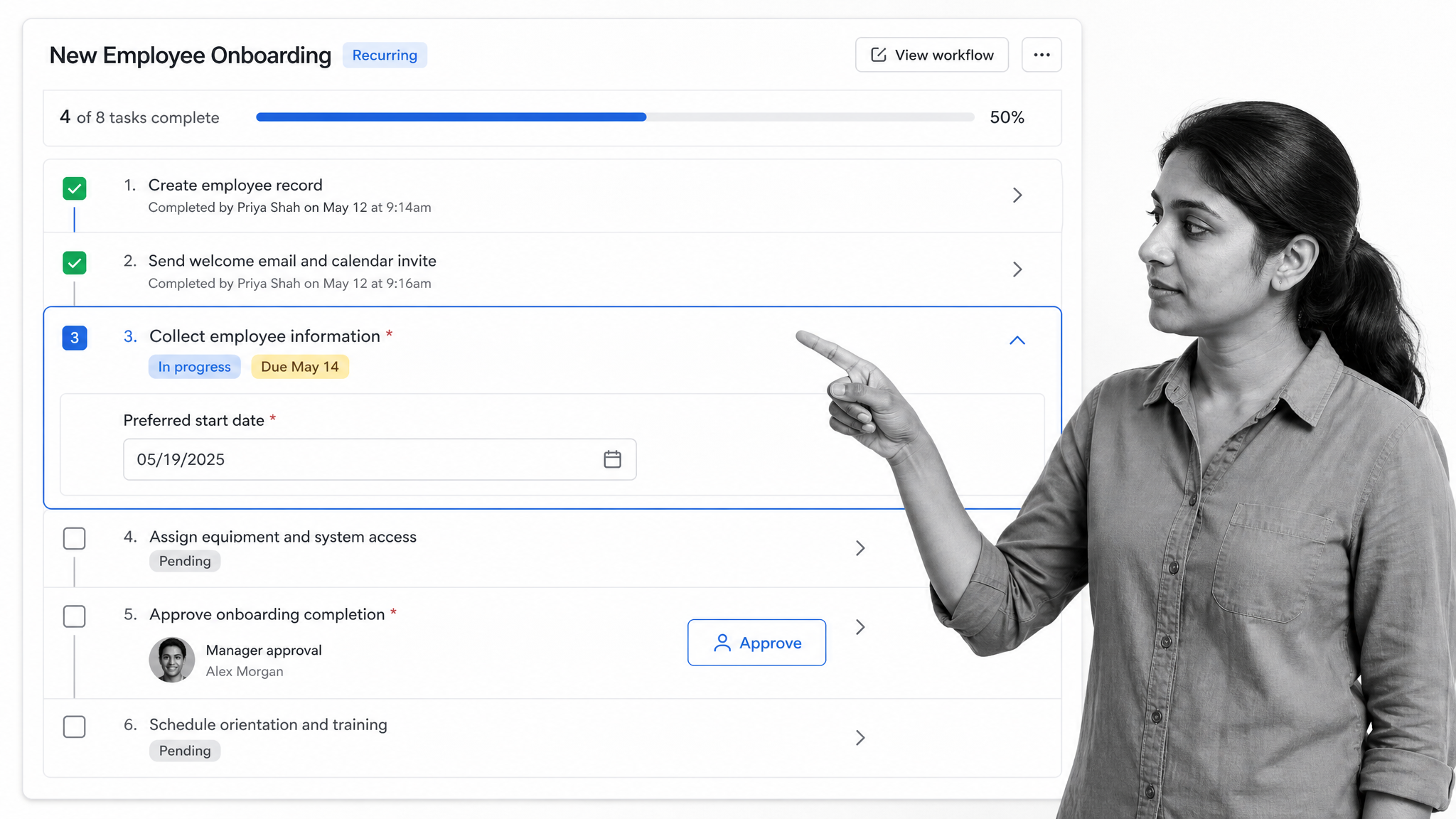
Process Street is the strongest ARIS alternative when the real problem is not enterprise architecture modeling, but recurring operational execution. ARIS is built to model, analyze, and govern processes at an architectural level. Process Street is built to run those processes as living workflows that people complete the same way every time, with proof that each step happened.
For teams that need workflow automation software for onboarding, compliance reviews, vendor checks, finance operations, quality procedures, or recurring audits, Process Street gives business users a governed place to run SOPs, capture structured inputs, route approvals, assign owners, and keep a clear record of what was done. Instead of asking people to read a diagram and remember it, the workflow guides them through the steps, enforces the required ones, and blocks progress until the right conditions are met.
It also works well beside modeling and mining tools. A company can keep an enterprise modeling or mining layer for architecture and analysis while using Process Street as the human-facing execution layer for business process management software. That combination is common: model and analyze in one place, then run the day-to-day work where accountability, approvals, and evidence live.
Choose Process Street when the core requirement is accountability around recurring work. Choose a modeling or mining suite when the core requirement is understanding and documenting process architecture. A model can describe a process, but an execution workspace helps a team actually complete it, consistently and provably.
Key Process Street features
- Workflow runs with assigned tasks, due dates, required fields, conditional logic, and role-based work.
- Built-in approvals so sign-offs happen inside the workflow instead of over email.
- AI-assisted workflow creation and optimization that speeds up building process documentation and SOPs.
- Pages for controlled procedure documentation, so knowledge and execution stay together.
- Audit-ready task history and records that support reviews, quality checks, and continuous improvement.
Pros
- Strong fit for recurring SOPs, approvals, checklists, compliance evidence, and human-in-the-loop workflows.
- Business users can own and improve workflows without becoming modeling specialists.
- Clear task ownership shows what is late, blocked, approved, or complete at a glance.
- Works as a practical execution layer alongside process mapping and analysis tools.
- Fast to adopt, with no long modeling project required before value appears.
Cons
- Not an enterprise architecture or formal process modeling and simulation tool, so it does not replace ARIS for architecture work.
- Not a process mining product, so it will not automatically discover how existing processes run from system logs.
Best for: operations, compliance, HR, finance, and quality teams that need recurring workflows to be enforceable, visible, and easy to improve. Pricing is published on the Process Street pricing page, so you can review plan families before talking to sales.
2. SAP Signavio
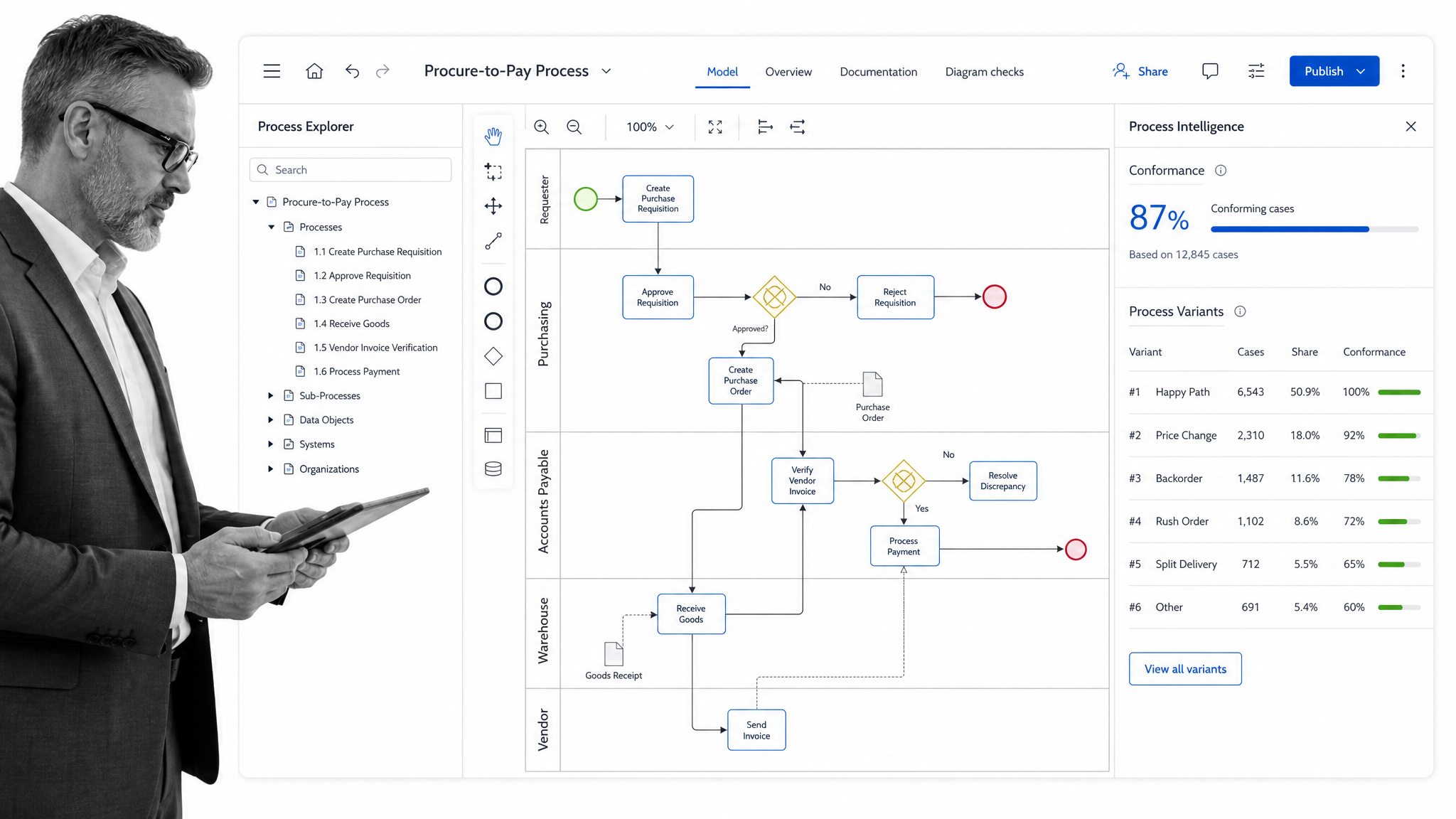
SAP Signavio is one of the closest ARIS alternatives for enterprise teams, because it pairs formal process modeling with process intelligence and mining in one suite. Its own site positions it around understanding, improving, and transforming business processes at scale, which is squarely the territory ARIS occupies.
SAP Signavio is a better fit than Process Street when the priority is enterprise-wide modeling, standardization, and analysis, especially alongside ERP transformation. Process Street is the better fit when the priority is running recurring operational work with approvals and evidence rather than modeling the architecture behind it.
SAP Signavio features
- Swimlane BPMN modeling and process documentation
- Process intelligence and process mining
- Journey mapping and decision management
- Governance and collaboration for large modeling programs
Pros
- Strong enterprise modeling plus mining in one platform
- Good fit for ERP and transformation programs
- Deep analysis and standardization capabilities
Cons
- Pricing is quote-based and oriented to enterprise buyers
- Heavier than teams that only need to run recurring SOPs
Best for: Enterprise process modeling paired with process mining. Pricing note: Custom quote.
3. Bizagi
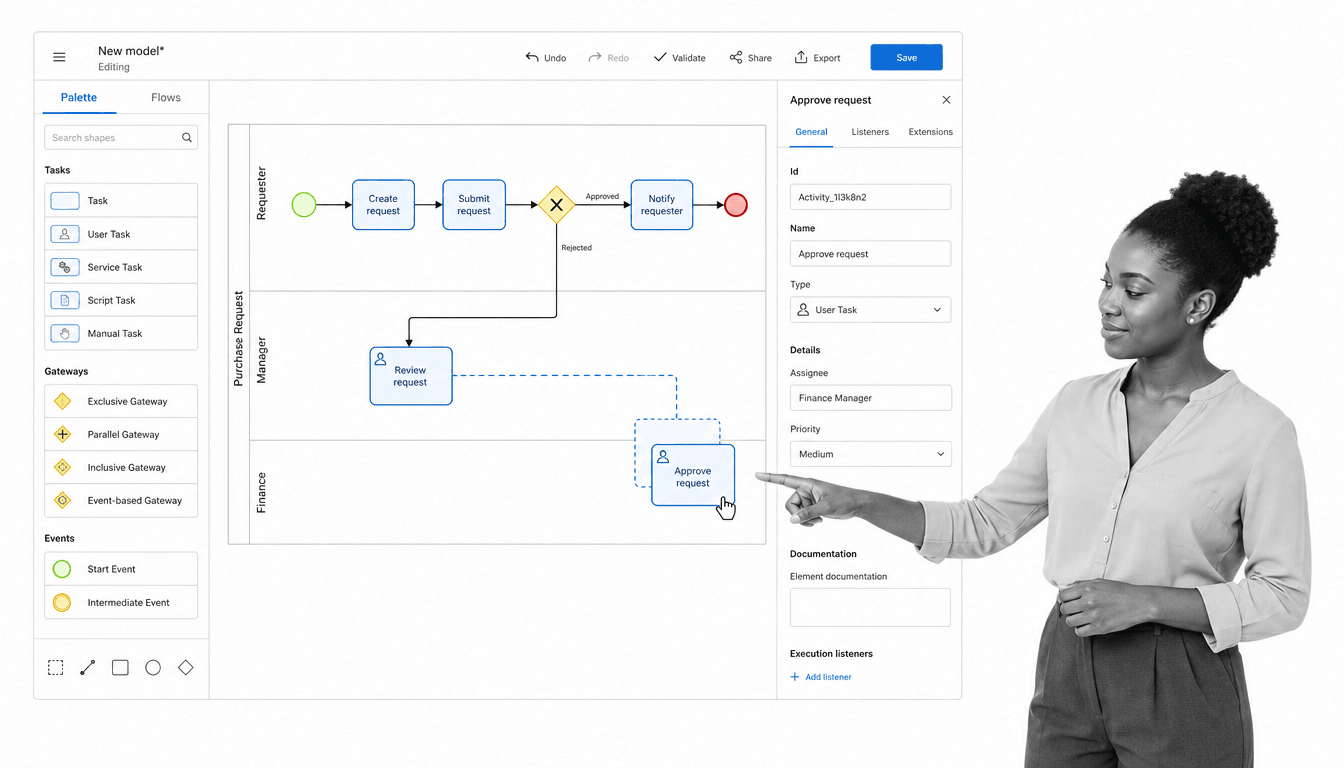
Bizagi is a natural ARIS alternative for teams that want approachable BPMN modeling with a path into low-code automation. Its own materials describe a free BPMN modeler for designing and documenting processes, with paid platform capabilities for automating them.
Bizagi is a better fit than Process Street when a team wants formal BPMN modeling and then wants to build low-code process applications from those models. Process Street is the better fit when the goal is to get repeatable procedures running quickly with owners, forms, approvals, and audit trails, without a modeling project first. Many teams pair it with business process automation to cover the parts it does not handle.
Bizagi features
- Free BPMN process modeler
- Low-code process automation on the platform
- Process documentation and collaboration
- Enterprise process application delivery
Pros
- Accessible modeling with a free entry point
- Clear path from modeling into automation
- Good fit for BPM programs that start with modeling
Cons
- Automation and enterprise capabilities are quote-based
- Can be more than needed for simple SOP execution
Best for: Accessible BPMN modeling with low-code automation. Pricing note: Custom quote.
4. Camunda
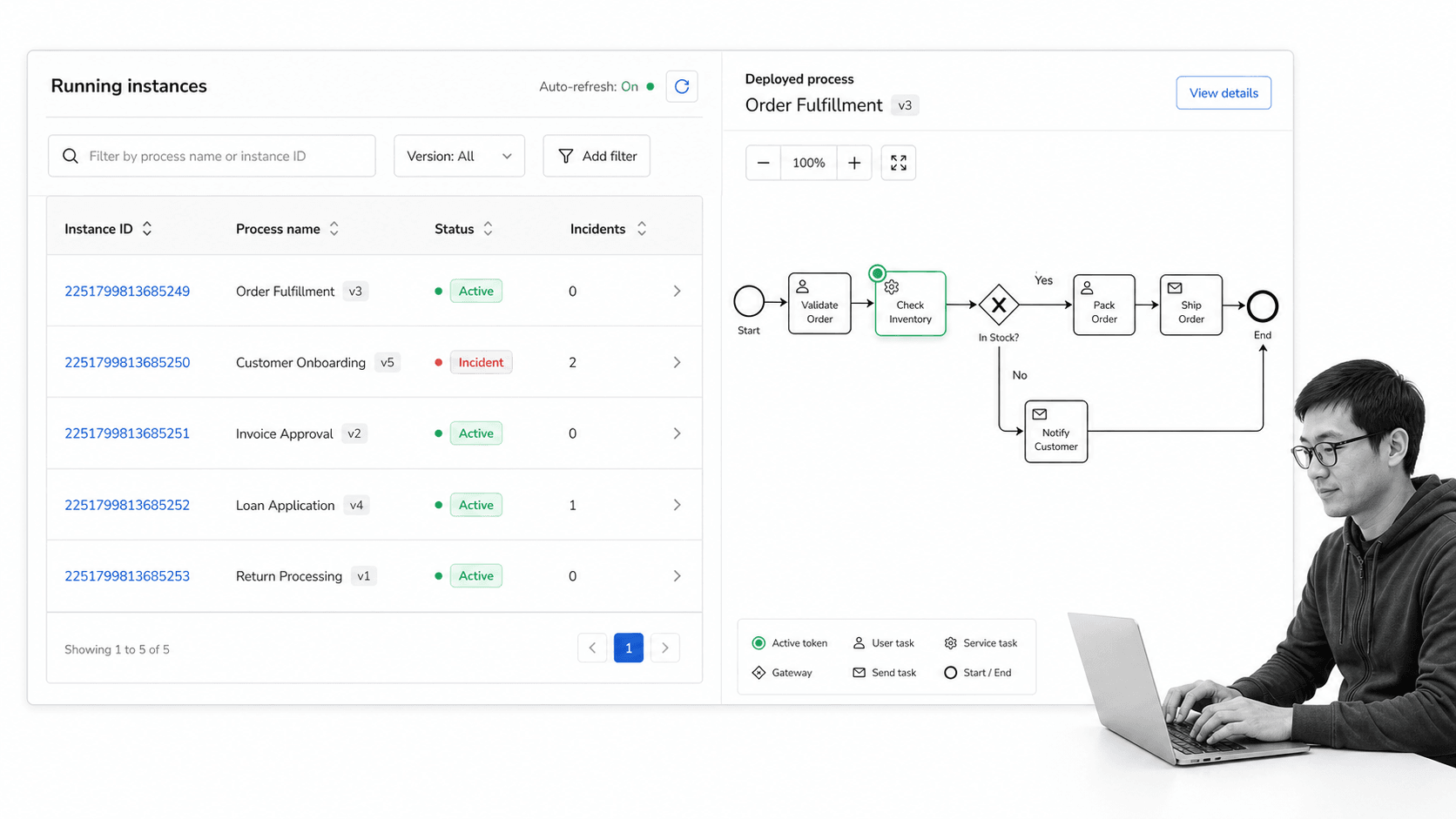
Camunda is a developer-first ARIS alternative focused on orchestrating processes across systems. Its own site describes BPMN and DMN modeling with process orchestration and monitoring, and it offers a free tier for development plus enterprise options.
Camunda is a better fit than Process Street when engineers need to orchestrate long-running, system-to-system processes with resilient execution and monitoring. Process Street is the better fit when the workflow is mostly human work that needs required steps, forms, approvals, and evidence rather than code-level orchestration.
Camunda features
- BPMN and DMN modeling and execution
- Process orchestration across services
- Running-instance monitoring and operations tooling
- Free development tier with enterprise options
Pros
- Excellent for developer-owned process orchestration
- Strong for resilient, long-running workflows
- Open and flexible for engineering teams
Cons
- Requires engineering ownership to run in production
- Not designed as a business-user SOP interface
Best for: Developer-led process orchestration at scale. Pricing note: Custom quote.
5. Celonis
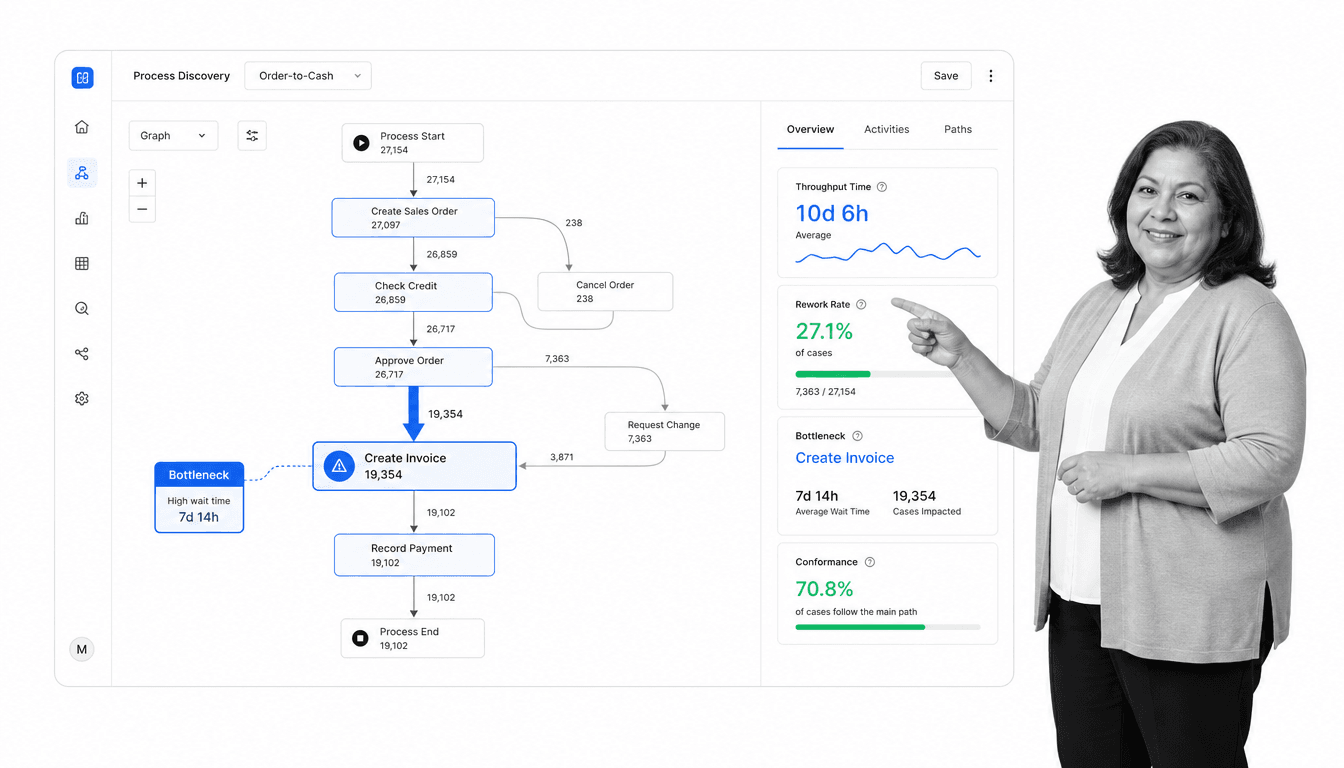
Celonis is the closest ARIS alternative when the priority is process mining rather than modeling. Its own site positions it as a leader in process intelligence and process mining, revealing how processes actually run and where they slow down.
Celonis is a better fit than Process Street when you need to discover bottlenecks and inefficiencies in existing processes from system data. Process Street is the better fit when you already know the procedure and need people to execute it correctly, on time, with proof. Many teams pair it with process improvement to cover the parts it does not handle.
Celonis features
- Process mining and process intelligence
- Discovery of bottlenecks and rework from system logs
- Conformance and performance analysis
- Insights that guide process improvement
Pros
- Category-leading process mining
- Great for finding hidden inefficiencies
- Strong analytics for large process estates
Cons
- Analysis focused, not an execution or SOP tool
- Enterprise pricing and implementation effort
Best for: Process mining to find bottlenecks in existing processes. Pricing note: Custom quote.
6. Lucidchart
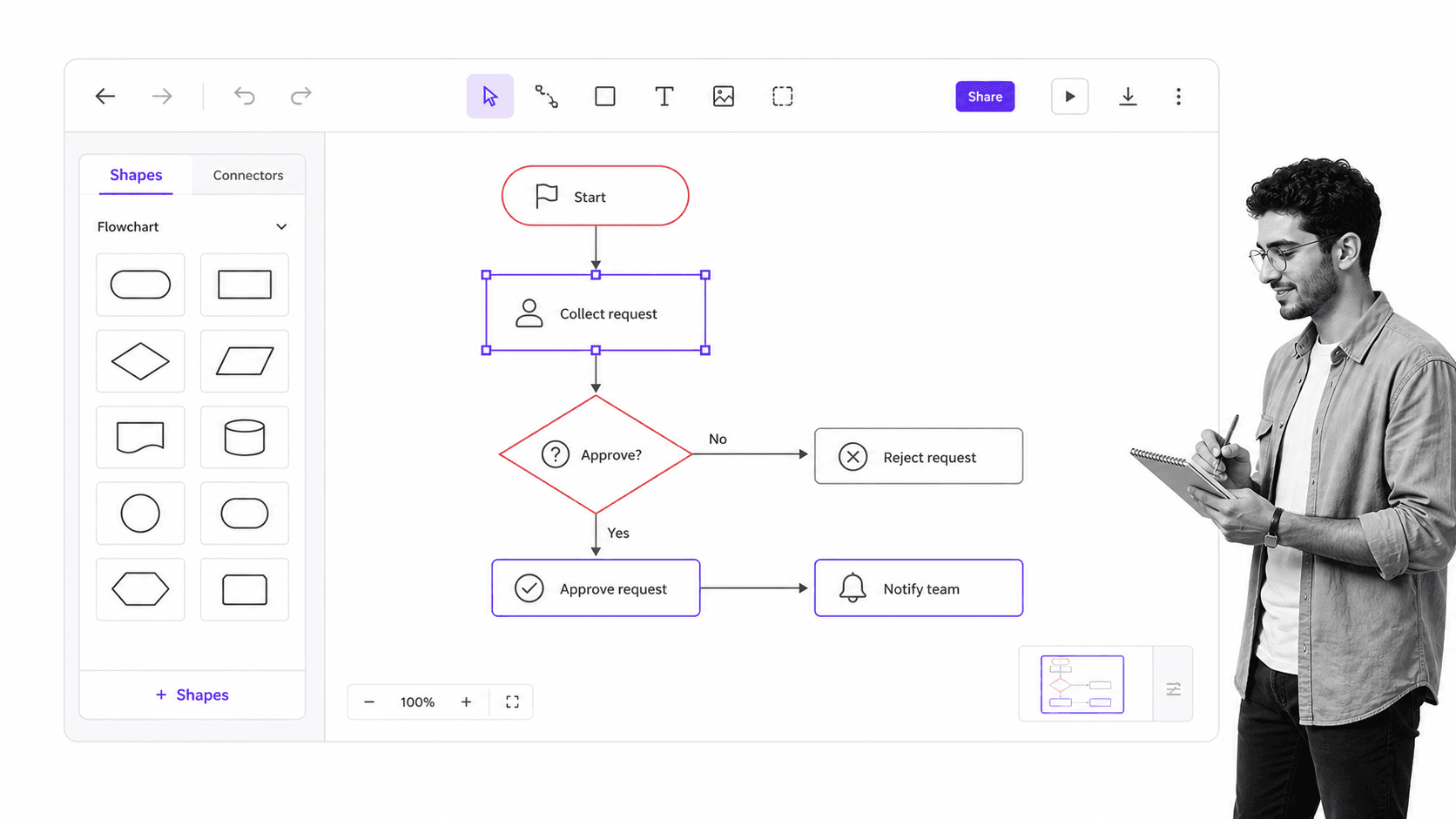
Lucidchart is a lightweight ARIS alternative for teams that mainly want to map and share processes visually. Its own site presents it as a diagramming tool with a free plan and paid tiers, built around drag-and-drop flowcharts and data-linked shapes.
Lucidchart is a better fit than Process Street when the goal is fast, collaborative process mapping and flowcharts that anyone can read. Process Street is the better fit when a mapped process needs to become an enforced, trackable workflow rather than a diagram. Many teams pair it with process mapping to cover the parts it does not handle.
Lucidchart features
- Drag-and-drop diagramming and flowcharts
- Shape libraries and data-linked shapes
- Real-time collaboration and sharing
- A free plan with paid upgrades
Pros
- Very easy to learn and use
- Great for quick, shareable process maps
- Accessible free entry point
Cons
- Diagrams do not execute or enforce a process
- Not a modeling, mining, or automation platform
Best for: Fast, collaborative process mapping and diagramming. Pricing note: Paid plans available.
7. Nintex
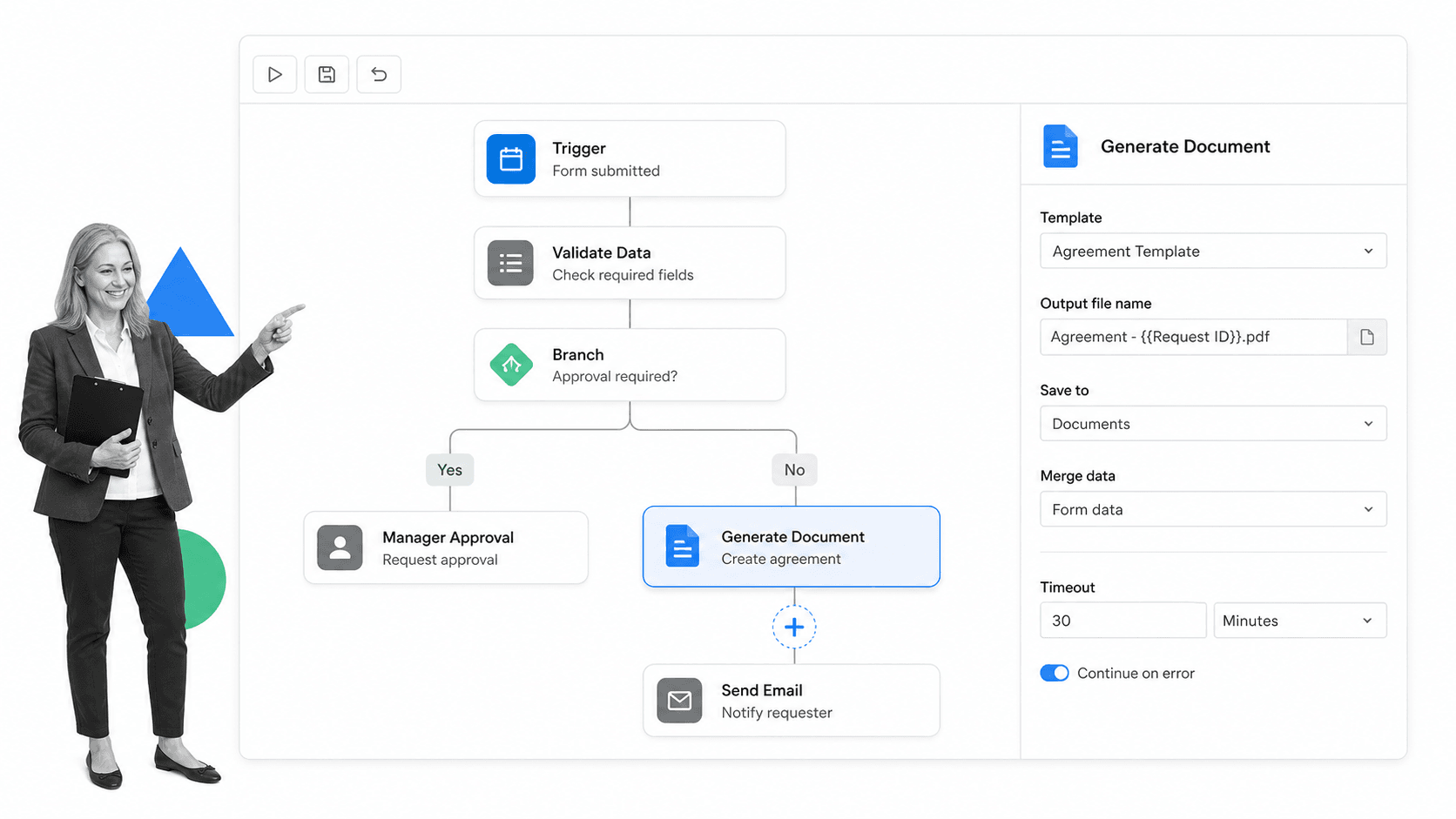
Nintex is a business-oriented ARIS alternative that leans toward workflow automation rather than architecture modeling. Its own site describes workflow automation, forms, robotic process automation, and document generation across one platform, with process mapping alongside.
Nintex is a better fit than Process Street when document generation, forms, and RPA need to sit in one business automation suite. Process Street is the better fit when the main job is governed SOP execution, approvals, and clean operational records rather than document-heavy automation.
Nintex features
- Workflow automation and forms
- Document automation and generation
- Robotic process automation options
- Process mapping and management
Pros
- Broad business automation footprint
- Good for document-heavy processes
- Business-user friendly automation
Cons
- Quote-based pricing oriented to larger deployments
- Less focused on recurring SOP completion than Process Street
Best for: Business-led workflow and document automation. Pricing note: Custom quote.
How to choose ARIS alternatives
Start by naming the job. If you need to model and govern enterprise process architecture, you want a modeling suite. If you need to discover how processes really run, you want process mining. If you need engineers to orchestrate processes across systems, you want an orchestration engine. If you need people to complete recurring work correctly, you want workflow management system built for execution.
Map the workflow to the risk. When missed steps create compliance, quality, or audit exposure, prioritize required steps, approvals, and traceable completion records over modeling notation. When the risk is analytical, such as not knowing where a process stalls, prioritize mining and analysis. Tools like process automation and operations management software matter most once the process is understood and needs to run reliably.
Decide who will own the tool after launch. Enterprise architecture and mining suites usually need a specialist team to maintain them, while an operations team may prefer workflow apps that managers can change directly. For recurring work, templates, task history, and reporting usually matter more than formal modeling.
Finally, separate analysis from accountability. Many organizations model or mine processes in one system and then run them in another, using an execution layer that also supports quality management system software needs. That split keeps architects and analysts productive while giving frontline teams a clear place to complete and prove the work.
ARIS alternatives FAQs
What is the best ARIS alternative?
The best ARIS alternative depends on the job. Process Street is the best fit for enforceable recurring SOP and workflow execution. SAP Signavio and Celonis are stronger for enterprise modeling and process mining, Camunda is stronger for developer-led orchestration, and Lucidchart is best for simple visual process mapping.
Is Process Street a direct ARIS replacement?
Process Street is not an enterprise architecture or process modeling and simulation tool, so it does not replace ARIS for architecture work. It is a better fit when teams need business-owned workflow execution with tasks, forms, approvals, and audit-ready records around recurring processes.
Which ARIS alternative is best for process mining?
Celonis is the strongest option in this list for process mining, since it is built to discover how processes actually run and where they slow down. SAP Signavio also includes process intelligence and mining alongside its modeling suite.
Which ARIS alternative is best for BPMN modeling?
SAP Signavio, Bizagi, and Camunda are the closest for BPMN-centered work. Bizagi offers a free BPMN modeler, SAP Signavio pairs modeling with mining, and Camunda focuses on modeling that executes as orchestration.
Are there free ARIS alternatives?
Several tools offer a free entry point. Bizagi provides a free BPMN modeler, Lucidchart has a free plan, Camunda offers a free tier, Celonis provides academic and community access, and Process Street and others offer free trials.
Which ARIS alternative is easiest for business users?
Process Street and Lucidchart are the most approachable for non-technical users. Process Street lets operations teams run and own workflows without modeling expertise, while Lucidchart makes visual process mapping simple and collaborative.
Can I use an ARIS alternative alongside my existing tools?
Yes. Many teams model or mine processes in one tool and run them in another. Process Street works well as the execution layer beside a modeling or mining suite, so architects analyze processes while frontline teams complete and prove the work.
Final takeaway
If you are moving away from ARIS because enterprise modeling is heavier than your day-to-day operational work needs, Process Street is the strongest first stop for running and enforcing recurring processes. If you still need enterprise modeling or mining, evaluate SAP Signavio or Celonis. If engineers own the process runtime, evaluate Camunda, and if you mainly need visual maps, evaluate Lucidchart. You can compare Process Street plans on the pricing page. The best ARIS alternative is the one that matches the owner, the risk, and the way your team actually works.