





A change management plan turns a business change from a broad intention into controlled work. It defines the outcome, owners, affected stakeholders, communication, training, timeline, risks, approvals, and evidence needed to move from the current state to the next one without losing accountability along the way.
The nine free change management plan templates from Process Street help you choose a proven framework and put it into practice. Each model approaches change from a different angle, from individual adoption and emotional transition to organizational alignment and continuous improvement. Use the model that fits your situation, then adapt its checklist to the people, controls, and measures your change requires.
In this guide:
- What is a change management plan?
- What change management models do
- The top 9 change management models
- How to run a change management plan in Process Street
What is a change management plan?
A change management plan is exactly what it says on the tin: it is a plan for change. More precisely, it is the operating plan for a defined organizational change. The plan defines activities and roles for the management and control of change, connecting the reason for change to the work required to implement it. Planning for change maintains the schedule, budget, scope, communication, and resources at a feasible and achievable level. It is an internal response to expected or unexpected change that mitigates potential negative repercussions.
Change management is predominantly people focused: it uses tools and techniques to manage the people side of change for a required business outcome. The plan should cover both delivery and adoption. Delivery asks whether the new policy, system, structure, or process went live. Adoption asks whether people understand it, use it correctly, and sustain the new behavior. A technically complete rollout can still fail if employees receive conflicting signals, training arrives too late, or exceptions are handled outside the agreed process.
A practical change management plan normally includes:
- Purpose and outcomes: the problem, intended result, and boundaries of the change.
- Governance: the sponsor, change owner, workstream owners, reviewers, and decision rights.
- Stakeholder impact: the groups affected, what changes for each group, and likely concerns.
- Delivery plan: the milestones, dependencies, resources, budget assumptions, and rollout sequence.
- Communication and training: the message, channel, timing, sender, learning activity, and support route.
- Risk and exceptions: the operational, people, compliance, and technical risks plus escalation paths.
- Adoption measures: the behaviors, usage signals, quality measures, and business outcomes that indicate progress.
- Review cadence: when the team examines evidence, approves changes, and updates the plan.
There are two types of change: unexpected and intentional. Unexpected change can come from market influences, environmental impacts, or resource constraints. Intentional changes include organization restructuring, growth, mergers, acquisitions, or budget reallocation. These changes are fully coordinated by a business, yet they still need to be effectively managed internally. Good planning creates a controlled feedback loop so teams can see what happened, what is blocked, who owns the next decision, and whether the change is producing its intended result.
Change paralysis: Kodak
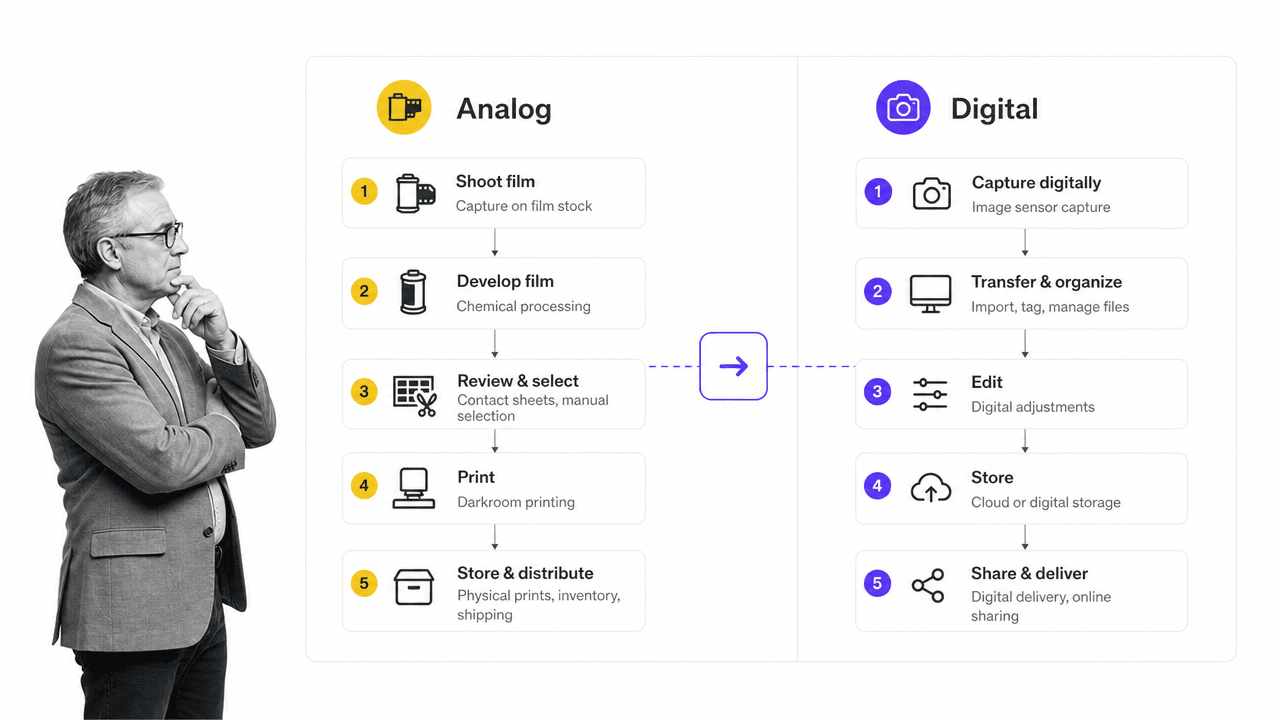
Change is often hardest for successful organizations. It is often the case that the issue is not an inability to act, but an inability to take appropriate action. Donald Sull described the pattern as active inertia. Certain modes of thinking and actions have established success in the past and are inappropriately applied to changing circumstances, so organizations respond by accelerating activities that once worked.
Kodak’s core business model was selling film. As cameras became digital and slowly disappeared into cellphones, images moved from print to online cloud storage. In 1975, Steve Sasson, an engineer working for Kodak, developed the first digital camera prototype. The camera was large, cumbersome, and took about 20 seconds to take a picture. This prototype signified the beginning of a transition that would make film and Kodak’s core business model superfluous.
Kodak remained heavily dependent on film economics while digital photography advanced. The company filed for Chapter 11 bankruptcy protection in 2012 and emerged in 2013. Kodak still operates, so the lesson is not that change erased it. The lesson is that seeing a technological shift is different from changing the operating model, incentives, capabilities, and investment decisions required to lead it.
A change management plan makes those tensions explicit. It gives leaders a place to document which assumptions are changing, which legacy activities must stop, which capabilities need investment, and which measures will show whether the new direction is taking hold.
Change in action: an operational pivot
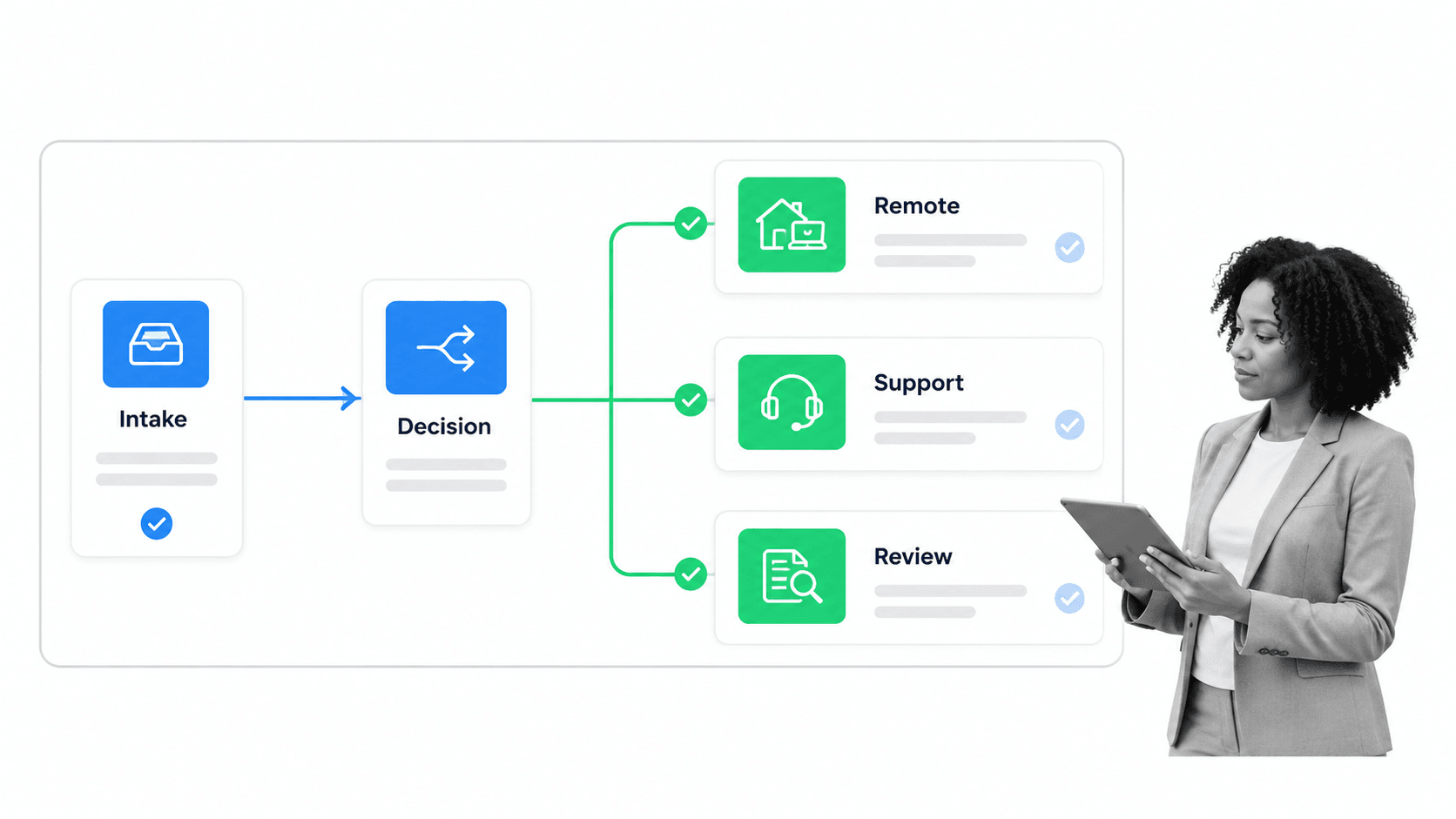
Consider a service team moving from email-based intake to a controlled request workflow. The software switch may take a day. The operating change is larger: customers need a clear submission path, requests need categories and owners, urgent cases need an exception route, managers need visibility, and employees need to stop accepting work through private inboxes.
The plan turns that pivot into sequenced work. First, map current demand and failure points. Next, define the intake fields, routing rules, service levels, approval conditions, and escalation path. Pilot the workflow with one team, train the people who submit and receive requests, monitor exceptions, and review adoption data after launch. A short feedback cycle exposes gaps before they become the new normal.
This example also shows why the right change management tools support both coordination and proof. A slide deck can explain the change, but an executable workflow can assign it, enforce it, and record what happened.
Change management models: What they are and why they matter
A change management model is a structured way to reason about transition. Some models describe stages that people or organizations move through. Others identify the conditions required for adoption, the elements that must stay aligned, or a cycle for testing and improving change. The model helps you ask better questions. The plan converts the answers into owners, tasks, dates, decisions, controls, and measures.
Little is a given in business, but what is certain is change. A change management plan can bridge the difference between success in the face of change and failure. Companies need systems in place to respond to change, whether it is internal, external, expected, or unexpected. Luckily, there is a wealth of ongoing research into how change can be planned and managed more appropriately. A structured model brings that research into an actionable format. Each model can be transformed into a checklist for practical implementation, helping a team move from theory to assigned, measurable action.
No single model fits every change. Adapting to change is not easy: it takes time, effort, and energy. You want to stay in budget, on schedule, and ensure the invested change produces a higher return. You also want to avoid clutching at thin air and implementing random, irrelevant change action plans. An enterprise system rollout may need ADKAR for individual adoption and PDCA for iterative improvement, while a reorganization may need Bridges and McKinsey 7-S.
Before choosing, define the type and scale of change, the groups affected, the level of resistance or uncertainty, the regulatory and operational risks, the time available, and the evidence required. Then select the simplest model that covers the real problem. The checklist below gives you a practical starting point for evaluating a three-stage transition.
The top 9 change management models
These nine frameworks cover organizational alignment, individual adoption, emotional transition, iterative learning, behavior design, and large-scale mobilization. Each section includes a free Process Street template that you can adapt to your change management plan.
1. Lewin’s Change Management Model Process Checklist
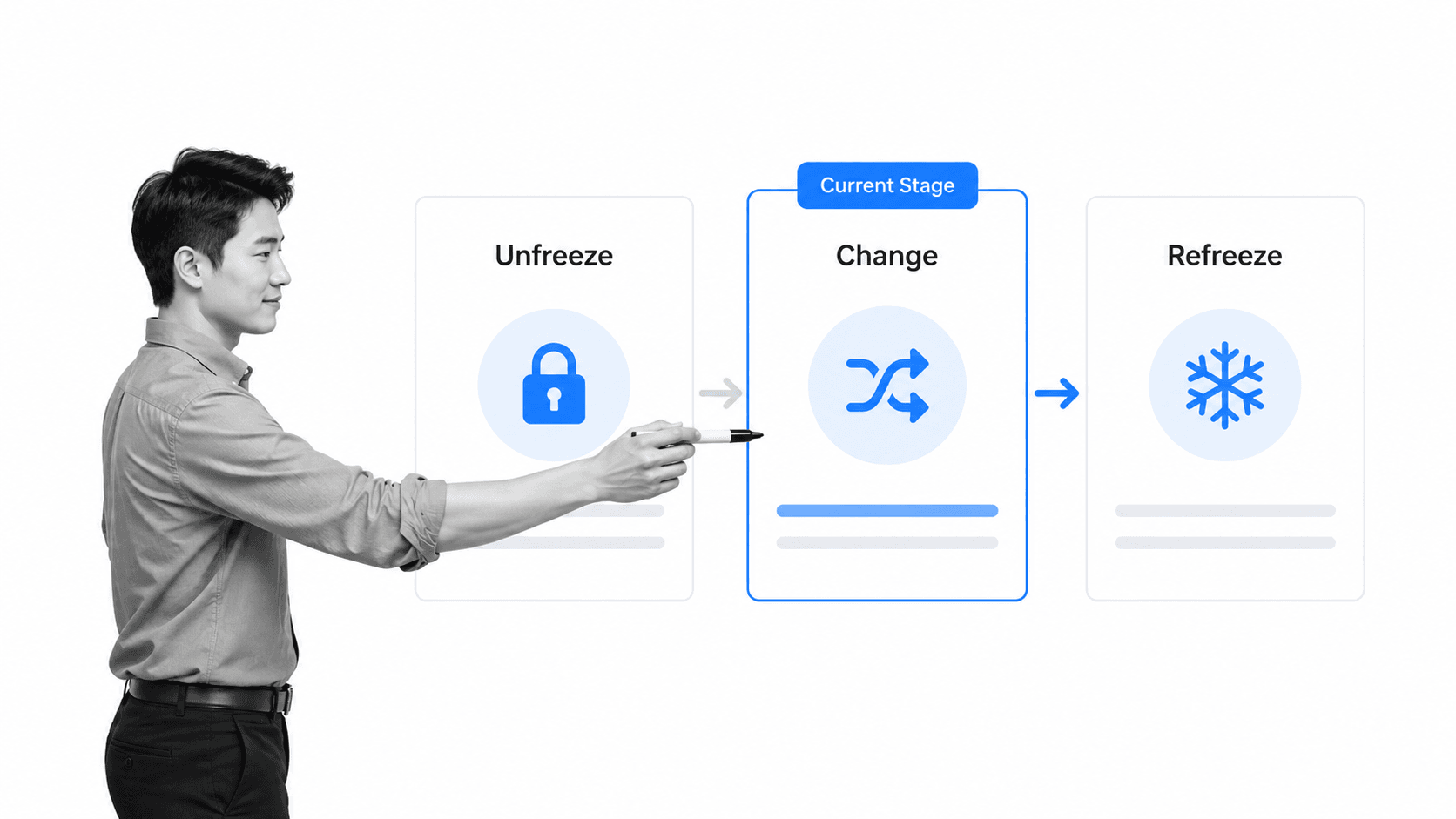
Kurt Lewin’s three-stage framing is commonly summarized as Unfreeze, Change, and Refreeze. His 1947 writing described group life as a process in which change must become stabilized, although the exact modern diagram is a later simplification. The model remains useful because it forces teams to prepare the conditions for change before launch and to reinforce the new state afterward.
Unfreeze means making the case for change, testing assumptions, identifying forces that support or resist it, and creating readiness. Change is the transition period, when people learn new behaviors, managers remove obstacles, and feedback reshapes the plan. Refreeze means stabilizing the useful parts of the new approach through standards, ownership, training, measures, and reinforcement.
Use Lewin when the current and desired states are reasonably clear. Avoid treating Refreeze as permanent immobility. The goal is to make the new practice dependable while retaining the ability to improve it.
Lewin’s model breaks change down into bitesize chunks, taking people and processes into account. It recognizes that organizations can be stuck in a rigid process that needs to be unstuck for change to occur.
2. Bridges Transition Model Process Checklist
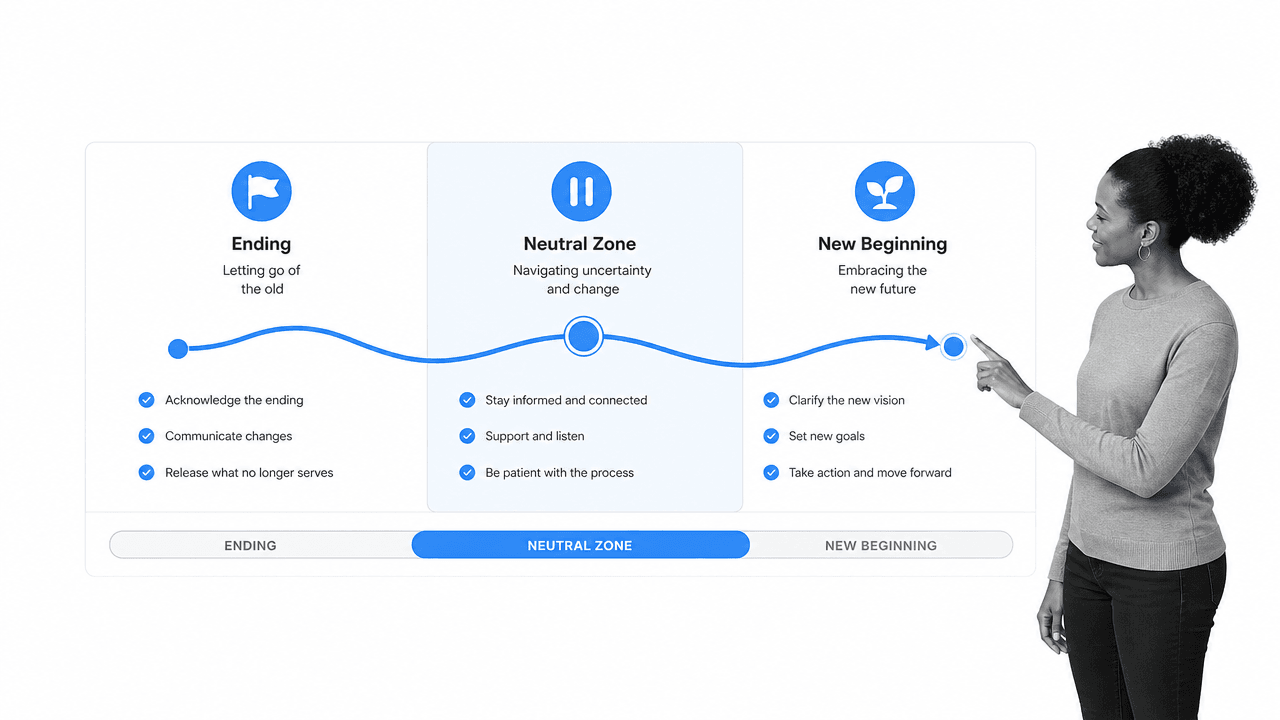
William Bridges distinguishes external change from internal transition. A change may happen on a specific date, but people still need time to let go of the old situation, navigate ambiguity, and form a new identity around the work. Bridges introduced this transition framing in Transitions in 1980 and applied it to organizations in Managing Transitions in 1991.
The model has three stages. Ending, Losing, and Letting Go acknowledges what people are leaving behind. The Neutral Zone is an in-between period where old routines no longer fit and new ones are not yet natural. The New Beginning develops when people understand the purpose, see their role, and experience early evidence that the new approach works.
Use the model to plan manager conversations, support, training, and reinforcement, especially when a change affects status, identity, relationships, or familiar routines. The stages are not a rigid schedule. Different groups may move at different speeds, so listen for where people actually are.
The model considers the transition during change, looking at change as a journey instead of an abrupt shift. Each stage is characterized by the feelings instigated within employees during that period.
3. ADKAR Model Change Management Process Checklist
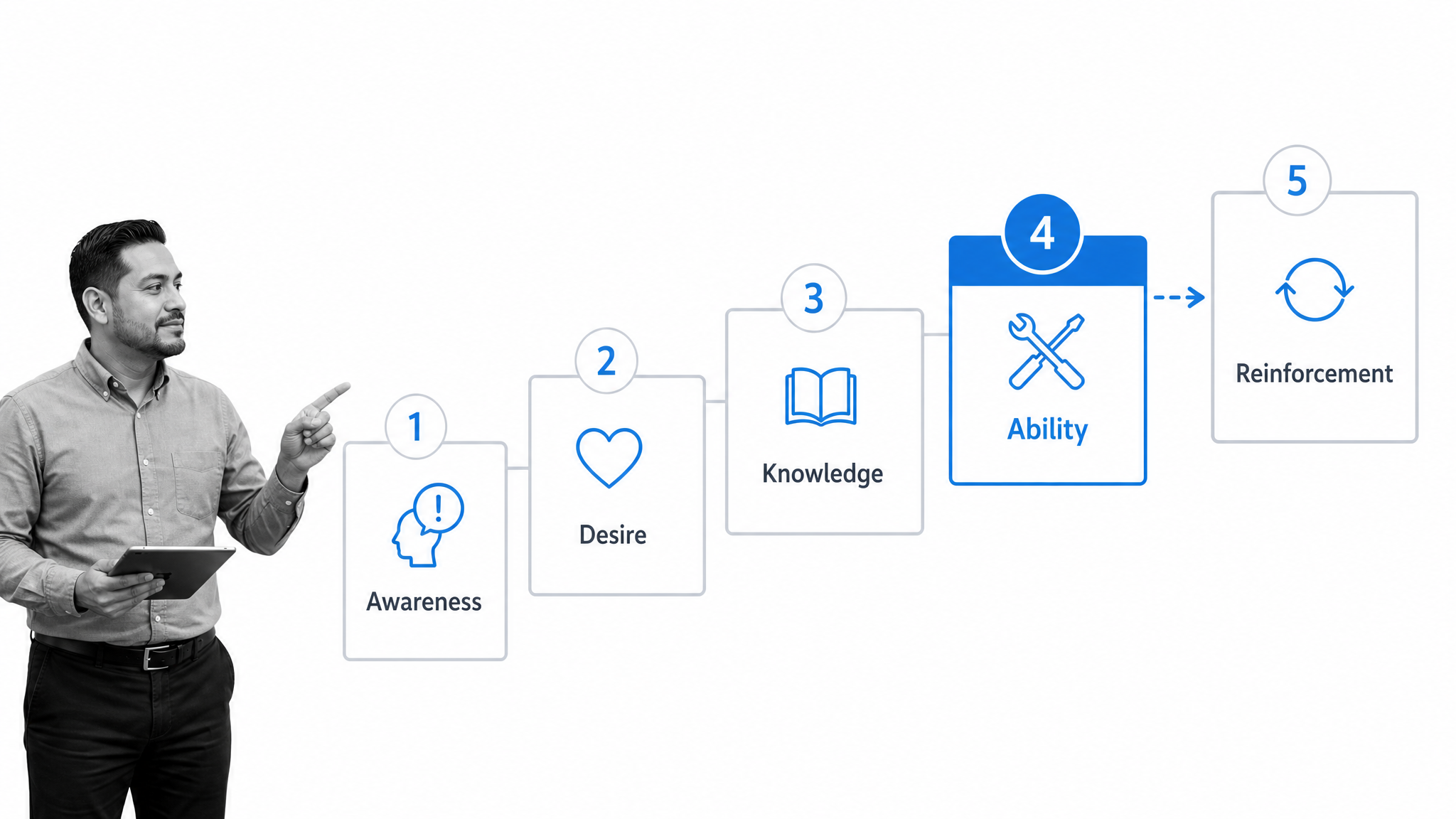
The Prosci ADKAR model, developed by Jeff Hiatt, focuses on the outcomes an individual needs for successful change: Awareness, Desire, Knowledge, Ability, and Reinforcement. It is particularly useful when a program is progressing at the organizational level but adoption varies by person, role, location, or manager.
Awareness is understanding why the change is needed. Desire is the willingness to support and participate in it. Knowledge covers what to do and how to do it. Ability is demonstrated performance in the real environment. Reinforcement helps the behavior continue through feedback, recognition, measurement, and corrective action.
ADKAR is also a diagnostic tool. If employees understand the reason but do not participate, more training will not solve a Desire barrier. If they want the change but cannot perform the new task, the plan needs practice, coaching, access, or better process design. Track the earliest weak outcome for each affected group and target support there.
As a change management model, ADKAR is easy to learn, creates a new lens for viewing change, drives action, and addresses how change happens.
4. McKinsey 7-S Model Process Checklist
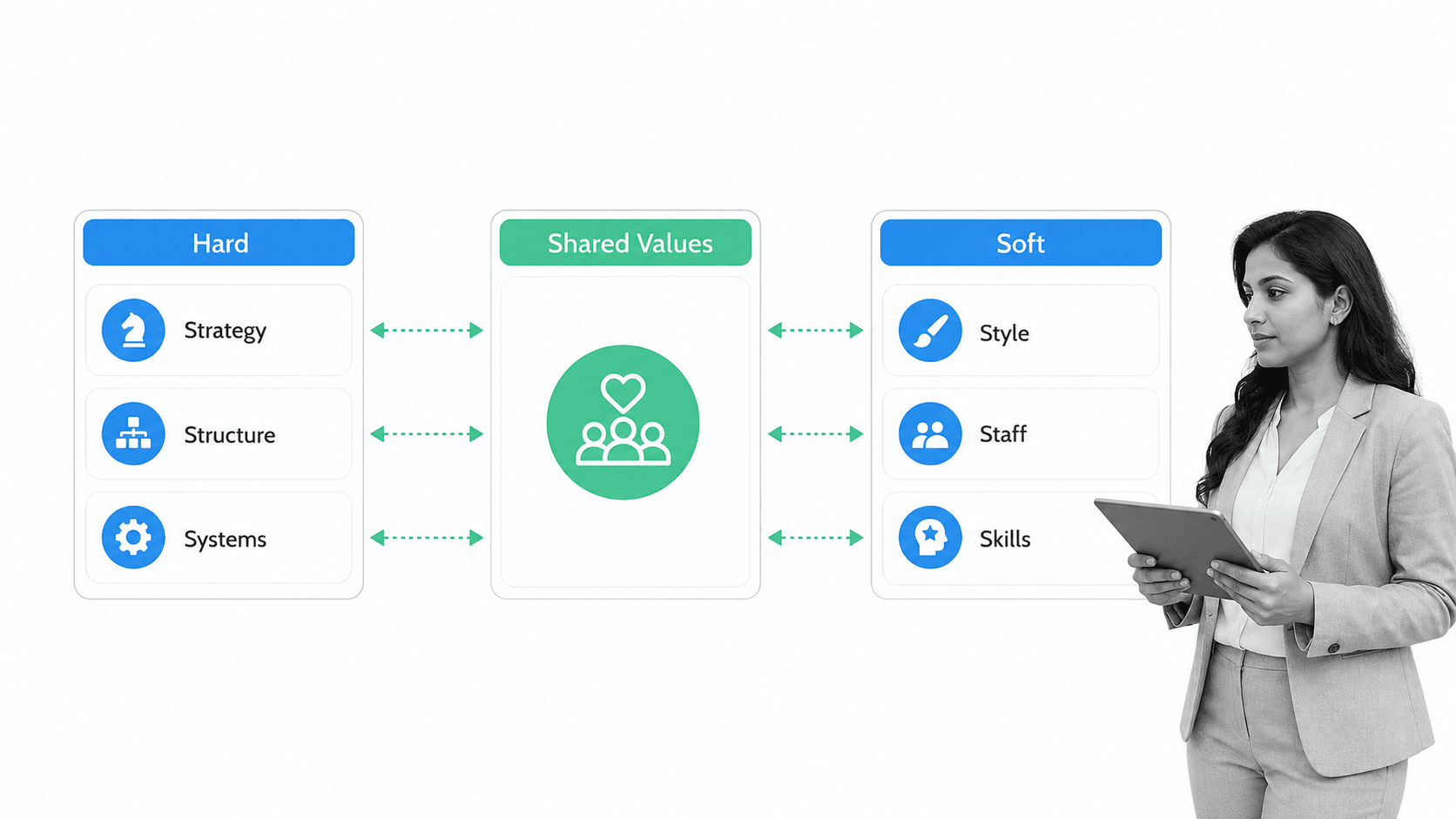
The McKinsey 7-S framework was developed in the late 1970s and is associated with consultants including Tom Peters and Robert H. Waterman Jr. It examines seven interdependent organizational elements: Strategy, Structure, Systems, Shared Values, Style, Staff, and Skills.
Strategy, Structure, and Systems are often described as hard elements because they are easier to document. Shared Values, Style, Staff, and Skills are often called soft elements because they are more cultural and behavioral. The important point is not the labels. It is the interdependence. A new strategy can stall when incentives still reward the old behavior, reporting lines obscure ownership, systems cannot support the work, or leaders model conflicting priorities.
Use 7-S before a major transformation, reorganization, merger, or operating-model change. Assess the current and desired state for each element, identify contradictions, and translate the largest gaps into workstreams. Revisit the assessment as the program develops because changing one element can create new pressure elsewhere.
The model identifies seven elements of a company, detailing how one will impact the other. Hard elements are driven by management and are more tangible. Soft elements are driven by culture and are less tangible. Alignment lets the elements support each other and the company’s objectives.
5. PDCA Cycle Change Management Model Process Checklist
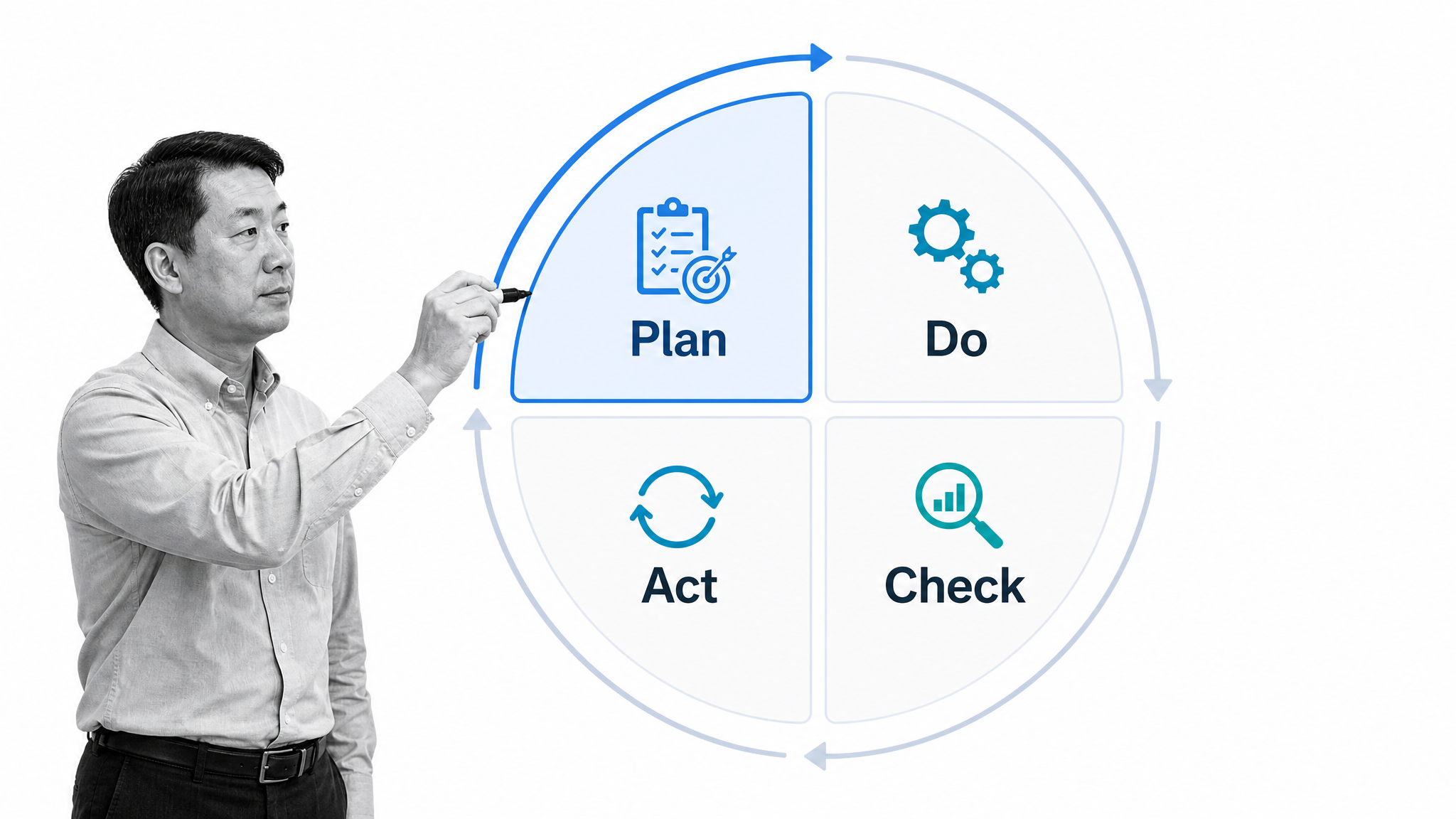
PDCA stands for Plan, Do, Check, and Act. It treats change as a learning cycle rather than a one-time rollout. Teams define a test, run it at a useful scale, compare results with the prediction, and decide what to standardize, revise, or test next.
In Plan, define the problem, desired result, hypothesis, measures, owners, and safeguards. In Do, run the change and capture observations. In Check, compare the results with expectations and investigate the differences. In Act, adopt the successful change, adjust it, or begin another cycle.
W. Edwards Deming later emphasized PDSA, with Study replacing Check to stress learning from theory and evidence. The Deming Institute explains the PDSA cycle as a method for building knowledge. Use either label consistently, but do not reduce the cycle to a box-ticking review. It works best for changes that can be piloted, measured, and improved before wider adoption.
The stages are iterative. Problems are identified, solutions are tested systematically, results are assessed, and new solutions are implemented when needed.
6. Kotter’s Change Management Model Process Checklist
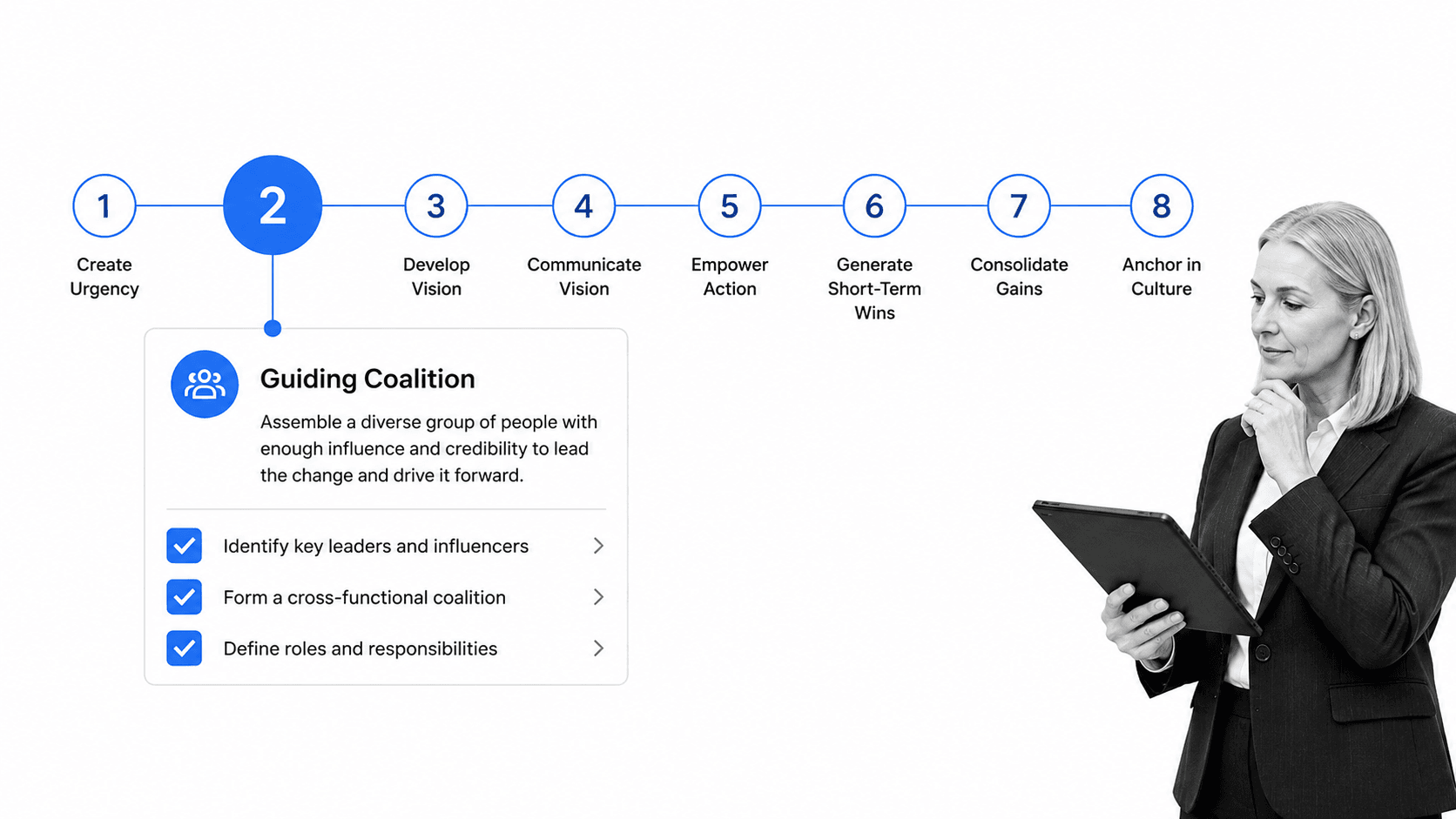
Kotter’s 8 Steps provide a mobilization framework for broad organizational change. The current method describes the steps as creating a sense of urgency, building a guiding coalition, forming a strategic vision, enlisting a volunteer army, enabling action by removing barriers, generating short-term wins, sustaining acceleration, and instituting change.
The steps help leaders connect direction with participation. Urgency explains why movement matters. The coalition brings enough credibility and influence to lead across formal boundaries. The vision gives people a clear destination. Broad participation turns the change into a movement, while barrier removal and early wins make progress visible. Sustaining acceleration prevents the organization from declaring victory before the new behavior is embedded.
Modern Kotter practice treats the steps as concurrent accelerators, not a strict waterfall. Use the model for transformation that needs energy across many teams, but pair it with an execution plan that names owners, milestones, controls, adoption signals, and feedback routes. Inspiration without operating discipline fades quickly.
The first stages are about creating drive within the team to implement needed change. The following stages focus on sustaining this drive and seeing the change through to the end.
7. Kubler-Ross Change Curve Process Checklist
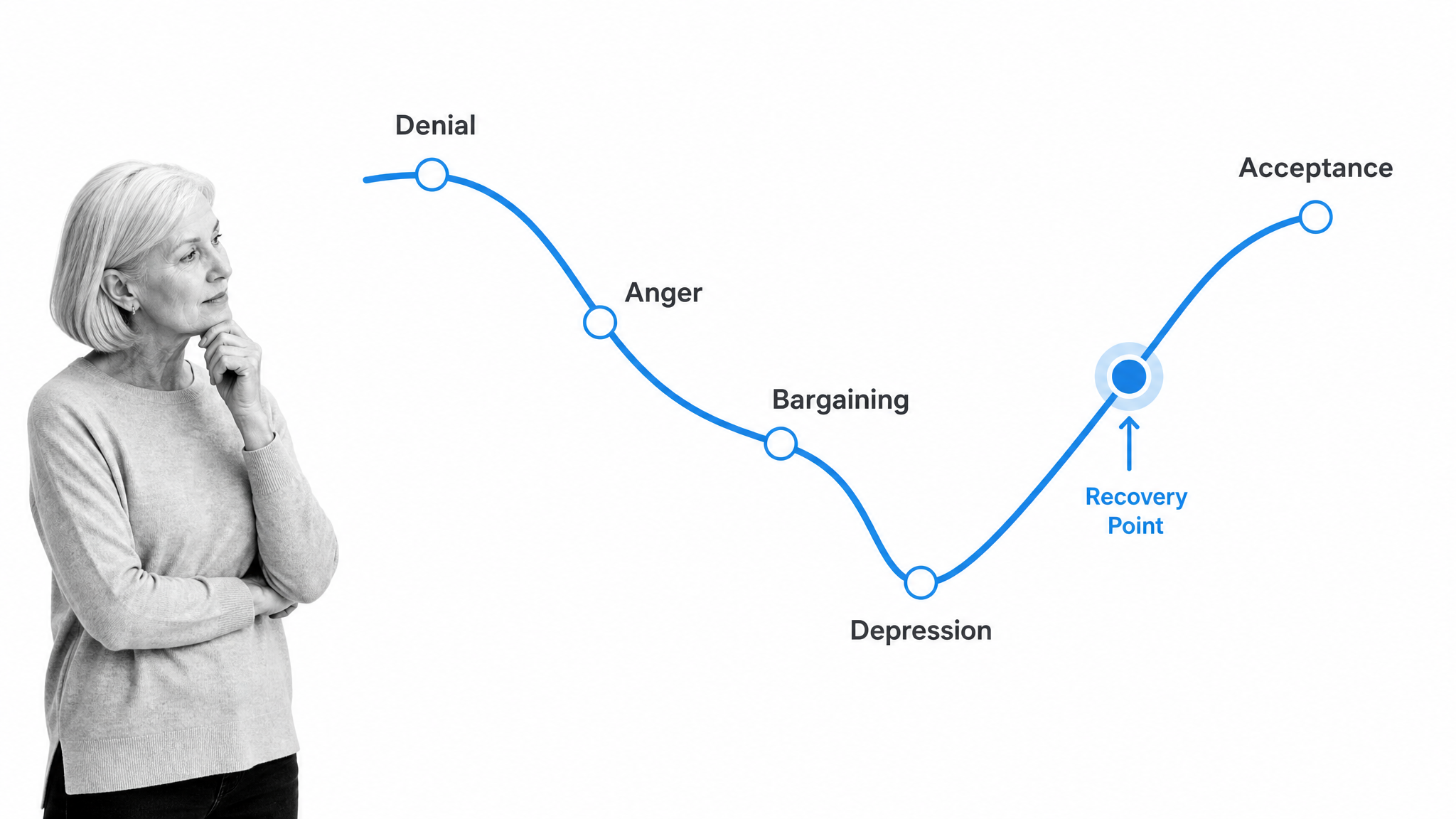
The Kübler-Ross change curve adapts ideas associated with Elisabeth Kübler-Ross’s work on grief to organizational transition. It is often shown through denial, anger, bargaining, depression, and acceptance. The Elisabeth Kübler-Ross Foundation stresses that these responses are not linear, universal, or predictable.
That caveat matters. The curve should not be used to diagnose employees, dismiss criticism as a stage, or assume everyone will follow the same emotional path. It is better used as a reminder that change can affect confidence, identity, perceived competence, relationships, and control. Those effects may show up as questions, resistance, withdrawal, experimentation, or renewed commitment.
Use the checklist to prepare appropriate listening, communication, manager support, and practical help. Track real evidence such as questions raised, training completion, error patterns, exceptions, sentiment, and adoption. Respond to the barrier in front of you rather than forcing people into a predefined sequence.
Change-related emotions can place a stranglehold on productivity. However, when acknowledged and managed correctly, negative emotional repercussions can be minimized.
8. Nudge Theory Change Management Model Process Checklist
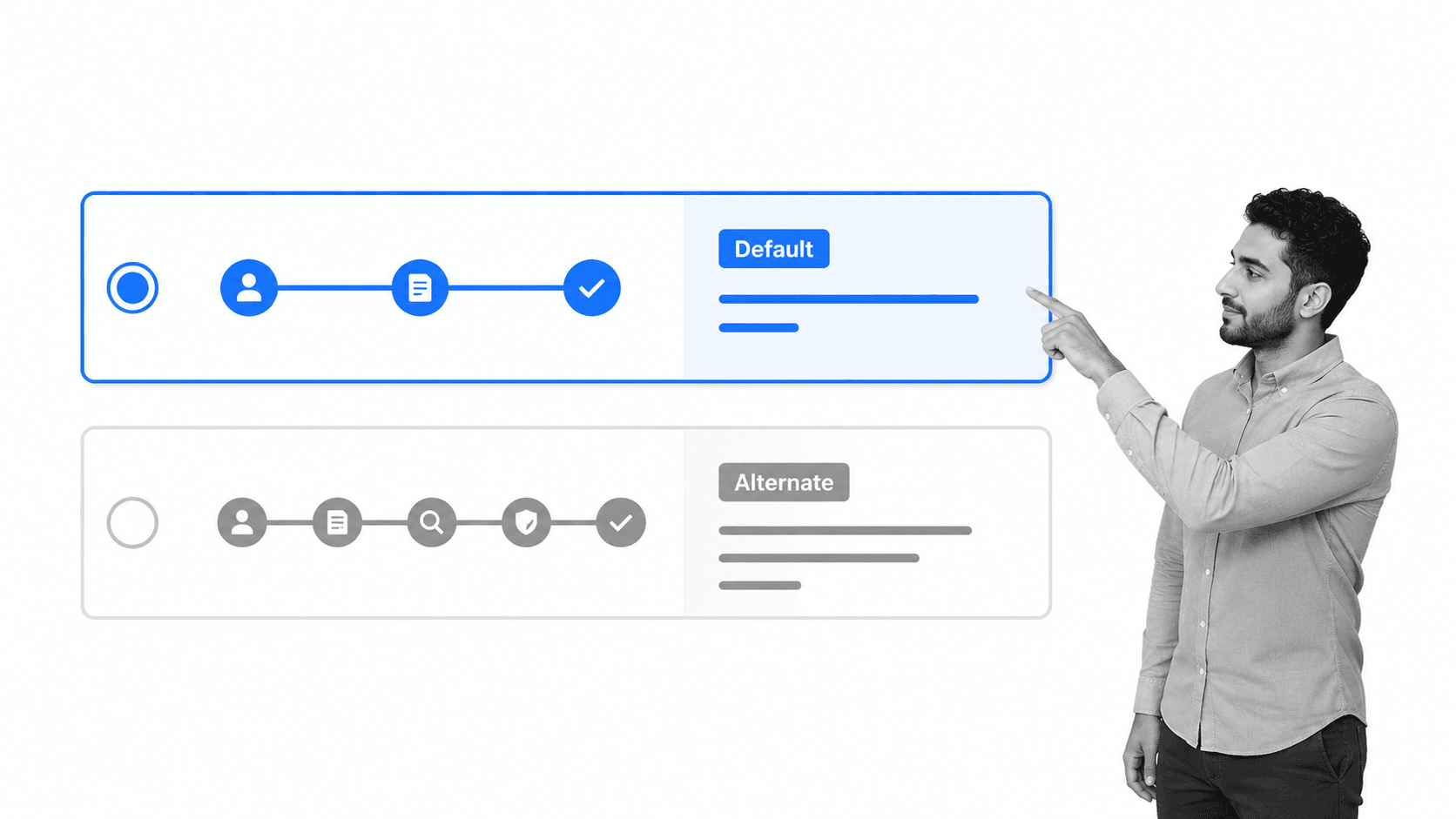
Nudge theory examines how choice architecture influences behavior while preserving meaningful choice. Richard Thaler and Cass Sunstein developed the concept for a broad audience in Nudge. In change management, a nudge might make the desired action the sensible default, simplify a form, place guidance at the decision point, or provide a timely reminder.
A nudge can reduce friction, but it is not a complete change model. It cannot repair a broken process, replace training, create missing authority, or justify manipulating people. Start by identifying the behavior and context. Map the current choice, the obstacle, the desired action, and the ethical boundary. Then test a small intervention and measure whether it improves the outcome without creating confusion or unintended harm.
Use nudges for specific, repeatable behaviors such as using a new request channel, completing a required field, reviewing a policy, or escalating an exception. Make the purpose transparent, keep alternatives available where appropriate, and combine the tactic with broader communication and process controls when the change is substantial.
Nudge theory alters the environment in which an individual is making a decision. That environment is the choice architecture. Individuals are nudged along the choice process, but a meaningful choice remains available.
9. Satir Change Management Model Process Checklist
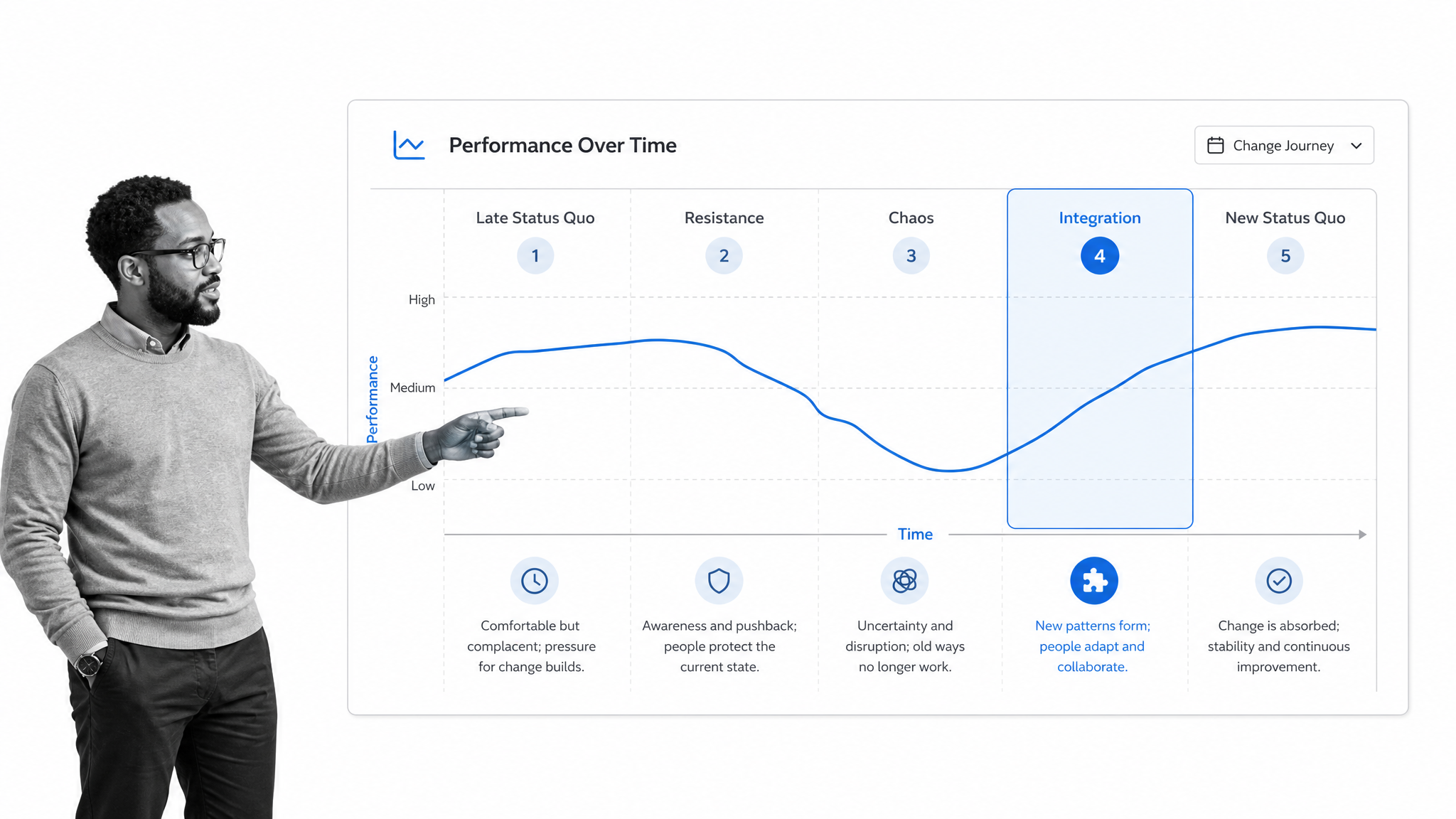
The Satir Change Model grew from Virginia Satir’s family-systems work and is now used to interpret how performance can shift during change. It describes a Late Status Quo, Resistance, Chaos, Integration, and a New Status Quo. The model is not a grief curve. It focuses on disruption to a familiar system and the work of incorporating a transforming idea.
In the Late Status Quo, performance may appear stable even when the system has known constraints. A foreign element introduces change, and Resistance attempts to protect the familiar pattern. Chaos follows when old expectations no longer work and the new pattern is not yet mastered. During Integration, people test and learn the new approach. A New Status Quo forms as the behavior becomes more natural and performance stabilizes.
Use the model to set realistic expectations for a temporary performance dip and to plan support during uncertainty. Define safeguards for high-risk work, create fast feedback, make help easy to access, and avoid punishing people for predictable learning. The objective is not to rush through Chaos. It is to shorten unsafe ambiguity while preserving enough experimentation for the new system to improve.
The stages are designed to track the impact of change on employee performance while the system learns a new pattern.
How to use Process Street for your change management plan
A framework helps you think about change. Process Street helps you run it. Process Street is a single Compliance Operations Platform with Docs and Ops capability areas plus built-in AI. Teams can document the policy and rationale, convert the plan into executable workflows, assign owners, collect required information, route conditional paths, capture approvals, automate handoffs, and preserve an audit trail.
Start by choosing one of the templates above and adapting it to the change. Define the sponsor, change owner, affected groups, desired outcomes, risks, milestones, communication events, training, approval points, and adoption measures. In Docs, keep the governing material and instructions accessible. In Ops, launch workflow runs for the actual work so each owner sees the right task, due date, evidence requirement, and decision path.
Built-in AI can help teams draft workflow structure, summarize operational context, and reduce manual coordination while the workflow maintains control. Required fields prevent incomplete handoffs. Conditional logic routes exceptions. Approvals create explicit decision gates. Activity history records who completed each step and when, which makes progress easier to manage and compliance easier to prove.
Connect the plan to the systems where work begins and ends. Process Street has direct, universal integrations to 5,000+ systems. Need a new one? An AI agent builds it on the fly. That means an approved request can launch a change workflow, an overdue risk can trigger an escalation, or a completed rollout can update the system of record without relying on someone to copy data.
Review the plan on a fixed cadence. Look at blocked work, overdue decisions, exception patterns, training gaps, adoption measures, and control failures. Update the workflow when evidence shows that the process needs to change. The plan then becomes a living operating system for the transition, not a document that disappears after kickoff.
Start with a change management plan template
Choose the model that best matches your change, open its Process Street template, and replace the generic steps with your real owners, risks, milestones, approvals, communication, training, and measures. Pilot the workflow with a small affected group before scaling it. Their questions and exceptions will show you where the plan needs more clarity or control.
Change is an inevitable part of business. We cannot stop it, but we can control potential negative aspects. Planning for change is key for positive progression and directing the impacts of change in your favor. Kodak provides a stark reminder of what happens when change is not adequately planned for and acted on. The strongest plan gives people a clear path, gives owners a dependable way to execute, and gives leaders evidence that the new behavior is taking hold.