Turn every policy into automated workflows with built-in enforcement and audit-ready proof.



Agile Workflow Process: Everything You Need to Know
An agile workflow process is a repeatable way to move work from idea to outcome in short learning cycles. Instead of treating a project as one long handoff chain, Agile teams plan a small slice of work, execute it, review the result, and use what they learned to shape the next cycle.
The point is not to make work chaotic or informal. A useful Agile workflow creates enough structure for people to see priorities, own decisions, coordinate dependencies, and improve the system without waiting for a full project reset.
This guide explains how an agile workflow process works, where Scrum, Kanban, and Lean fit, how Agile differs from traditional workflow design, and how to turn Agile operating habits into repeatable workflows in Process Street.
- What is an Agile workflow process?
- How does an Agile workflow process work?
- Agile workflow process vs traditional workflow
- How do Scrum, Kanban, and Lean fit?
- What makes an Agile workflow process effective?
- How to implement an Agile workflow process in Process Street
- Agile workflow process example
- Common Agile workflow process mistakes
- Agile workflow process FAQs
What is an Agile workflow process?
An Agile workflow process is the operating sequence a team uses to deliver work iteratively. It normally includes intake, backlog prioritization, planning, execution, review, and improvement. The exact shape depends on the team, but the loop stays consistent: choose valuable work, make progress visible, deliver a usable increment, inspect the result, and adapt.
The Agile Manifesto anchors Agile around collaboration, working outcomes, customer input, and responsiveness to change. A workflow process turns those values into day-to-day execution. Without a workflow, Agile becomes a set of meeting names. With a workflow, the team knows how work enters the system, who owns decisions, what counts as done, and how feedback changes the next cycle.
That makes an agile workflow process useful beyond software development. Product, operations, compliance, HR, customer success, and marketing teams can all use Agile patterns when work has uncertainty, stakeholder feedback, changing priorities, or repeated delivery cycles.
How does an Agile workflow process work?
An Agile workflow process works by breaking work into small, inspectable slices. The team does not need perfect certainty before starting. It needs a clear goal, a prioritized backlog, visible work in progress, a feedback point, and a habit of improving the system after each cycle.
Backlog intake and prioritization
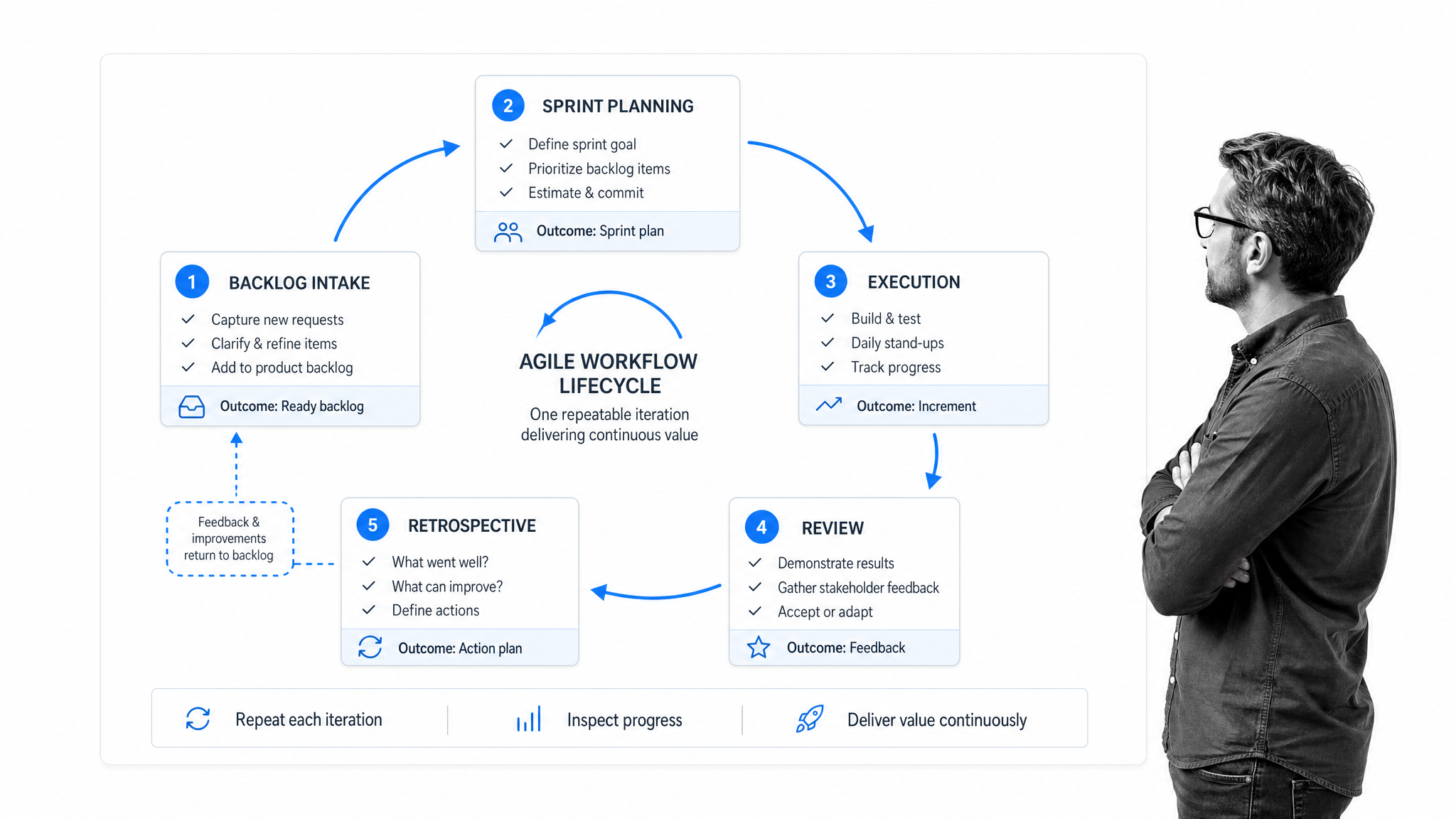
The backlog is the intake queue for work that could be done. It might contain user stories, process improvements, bug fixes, compliance actions, customer requests, experiment ideas, or operational tasks. The backlog is not a dumping ground. It needs regular refinement so the most valuable and time-sensitive work rises to the top.
Good backlog items are specific enough to discuss, small enough to move, and tied to an outcome. A vague item like “improve onboarding” is hard to plan. A tighter item like “add a manager approval step before new-hire equipment is ordered” can be estimated, assigned, reviewed, and improved.
Sprint or flow planning
A Scrum team usually plans work into a sprint. The Scrum Guide describes the sprint as a fixed-length container where sprint planning, daily coordination, sprint review, and retrospective happen around a sprint goal. A Kanban team may not use fixed sprints, but it still needs explicit policies for selecting, limiting, and pulling work.
Planning is where the team chooses the next slice of work and clarifies what success means. The output should be practical: a goal, selected backlog items, owners, visible dependencies, and a shared definition of done.
Execution and daily coordination
Execution is where Agile either becomes real or turns into ceremony. The team should be able to see what is in progress, what is blocked, what is ready for review, and what has changed. Daily coordination is not a status theater. It is a short inspection point for the work system.
When the team coordinates well, blockers surface early. Scope can be adjusted before the deadline is missed. Review work can be pulled forward. Stakeholders can be told what changed while there is still time to respond.
Review, release, and feedback
At the review point, the team inspects the work outcome with stakeholders or customers. The goal is not to prove that everyone was busy. The goal is to learn whether the increment is useful, whether the backlog should change, and whether the next cycle needs a different emphasis.
Modern Agile teams also need to review machine-assisted work. TechTarget notes that AI-assisted development is changing Scrum workflows by moving more attention toward validation, governance, and the quality of outputs. That does not remove the need for Agile. It makes review and definition-of-done discipline more important.
Retrospective and workflow improvement
A retrospective reviews the workflow itself. The team asks what slowed work down, where quality slipped, which handoffs were unclear, and which policy should change before the next cycle. The strongest retrospectives produce operational changes, not just observations.
This is where Agile becomes a continuous improvement system. If the same approval bottleneck, QA gap, or unclear owner appears repeatedly, the workflow should change. The next cycle should include a better rule, clearer owner, stronger checklist, or more useful automation.
Agile workflow process vs traditional workflow
A traditional workflow often assumes the plan can be defined upfront. Work moves from one phase to the next, usually through analysis, design, build, review, and delivery. That model can work when requirements are stable, risk is well understood, and late feedback is unlikely to change the outcome.
An Agile workflow process assumes the opposite: some useful information will only appear after the team starts. Customer feedback, market changes, technical constraints, compliance questions, or internal bottlenecks may alter the best next step. Agile does not remove planning. It plans at a smaller batch size so the plan can learn.
- Traditional workflow optimizes for predictability before work begins.
- Agile workflow optimizes for learning while work is moving.
- Traditional workflow usually measures completion at the end of a sequence.
- Agile workflow measures value and quality at repeated inspection points.
- Traditional workflow often depends on manager-controlled handoffs.
- Agile workflow works best when cross-functional teams can make local decisions.
The practical difference is control. Traditional control is often document-heavy and phase-heavy. Agile control is visibility-heavy and feedback-heavy. Teams still need standards, approvals, and records, but those controls should sit inside the workflow instead of arriving as a late-stage surprise.
How do Scrum, Kanban, and Lean fit into an Agile workflow process?
Scrum, Kanban, and Lean are not interchangeable labels. They solve different workflow problems. A team can use one deeply or blend practices carefully, but the choice should follow the kind of work being managed.
Scrum, Kanban, and Lean
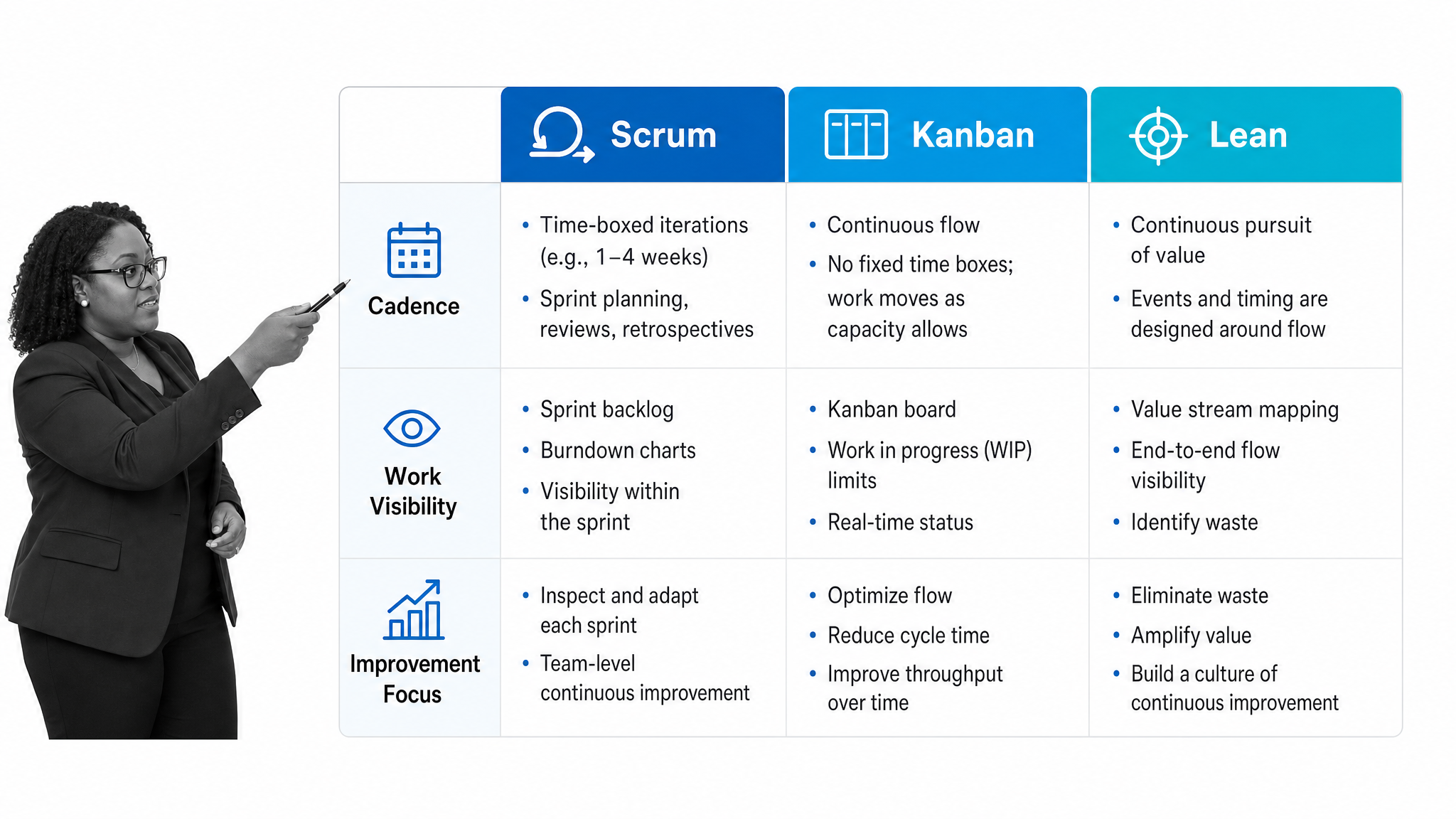
Scrum is useful when a team benefits from a sprint cadence, a product goal, and a clear review rhythm. Kanban is useful when work arrives continuously and the team needs to visualize flow, limit work in progress, and improve throughput. The Kanban Guides frame Kanban as a way to improve the flow of value through a process. Lean focuses on reducing waste, shortening feedback loops, and improving the system that produces value.
Many teams use Scrum events with Kanban boards. That can work, but only when the team is explicit about policies. For example, a team might run two-week planning and retrospective cycles while using Kanban-style work-in-progress limits between reviews. The important question is not which label sounds best. It is whether the workflow makes work visible, limits overload, and improves based on evidence.
What makes an Agile workflow process effective?
An Agile workflow process is effective when it helps the team deliver useful work sooner without losing quality, accountability, or traceability. The Agile Alliance’s principles include regular reflection and adjustment, which is the operating habit that keeps the workflow improving. At the team level, the same principle applies: the workflow should make learning fast and decisions clear.
Clear ownership
Every backlog item needs an owner. Every approval point needs a decision maker. Every review needs someone responsible for turning feedback into backlog changes. Agile teams can be collaborative without being ownerless.
Visible work in progress
If too much work is active at once, Agile turns into multitasking with new vocabulary. A healthy workflow makes active work visible and limits how much the team starts before finishing. This is especially important for teams that share reviewers, subject matter experts, or compliance approvers.
A practical definition of done
Done should mean more than completed by the assignee. For an Agile workflow, done may include review, approval, documentation, customer validation, deployment, control evidence, or a handoff to another team. The definition should be visible before work starts.
Keep the operating rules explicit
The workflow should state how work enters the backlog, who can reprioritize it, how urgent work interrupts the plan, which items need approval, and what evidence proves a task is done. These rules do not need to be heavy. They need to be visible enough that the team can follow them without asking a manager to interpret the process every time.
Explicit rules also make retrospectives more useful. When a cycle goes poorly, the team can inspect the workflow policy instead of blaming people. If urgent work bypassed the backlog, change the intake rule. If review happened too late, move the review task earlier. If approvals created a queue, clarify the owner and decision window.
Review the workflow, not just the work
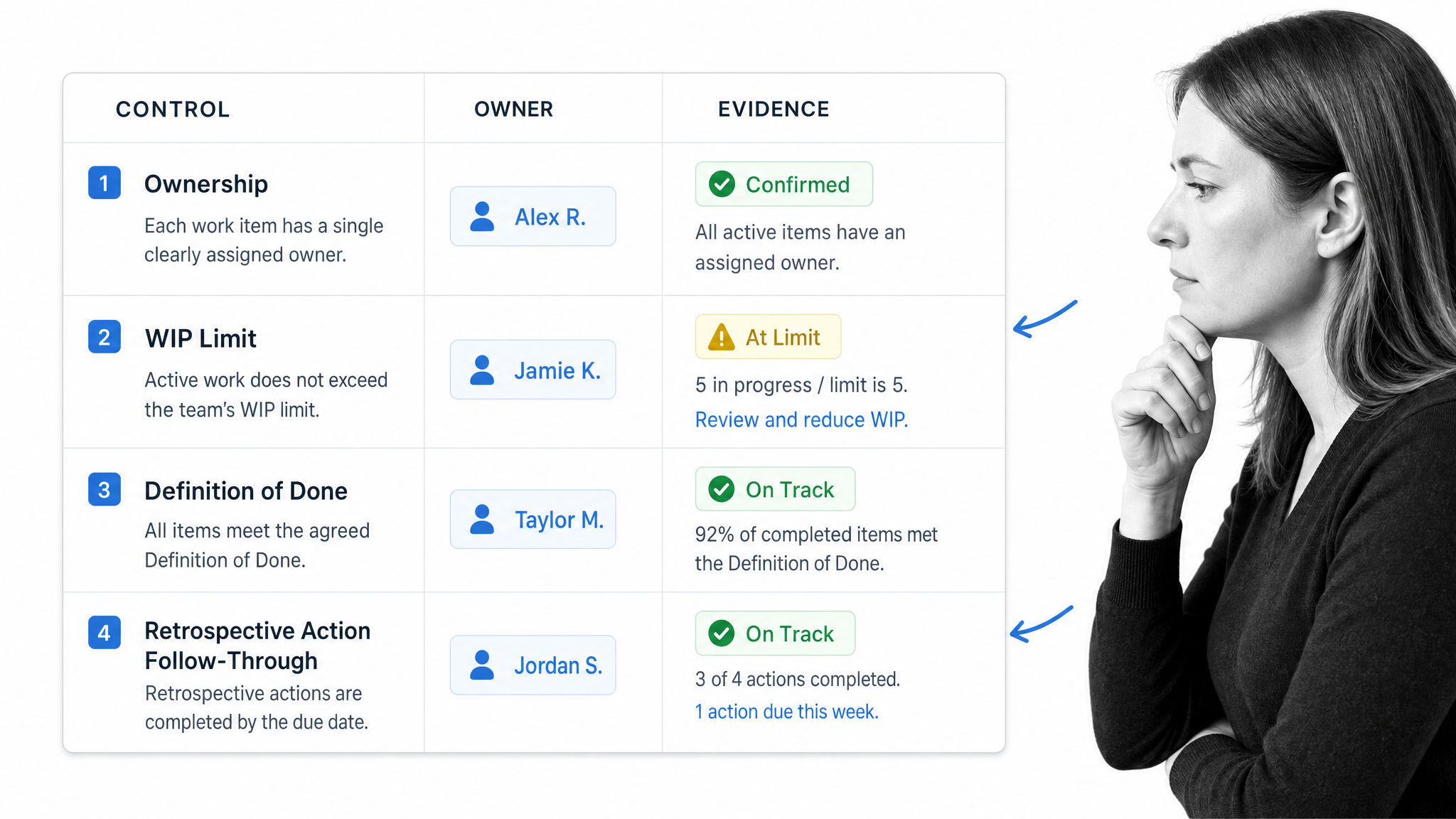
Teams often review the deliverable and ignore the process that created it. That leaves the same bottlenecks in place. A better Agile workflow reviews both. Was the backlog clear? Did the right people approve at the right time? Did the team discover risk too late? Did automation help or hide a problem?
Workflow improvement should produce a concrete change: a clearer intake form, a new approval rule, a smaller batch size, a better handoff, a stronger test, or a recurring workflow run that prevents the issue from being rediscovered every cycle.
How to implement an Agile workflow process in Process Street
Agile teams often manage project boards in one tool and recurring operating procedures somewhere else. That creates a gap. The board shows work status, but the repeatable steps, approval rules, evidence, and handoffs live in people’s heads or scattered documents.
Process Street helps close that gap by turning recurring work into workflow runs. The Process Street product overview lists workflows for creating, tracking, automating, and completing tasks, with features such as task assignments, approvals, conditional logic, integrations, scheduler, and groups.
Turn the Agile workflow into a Process Street workflow
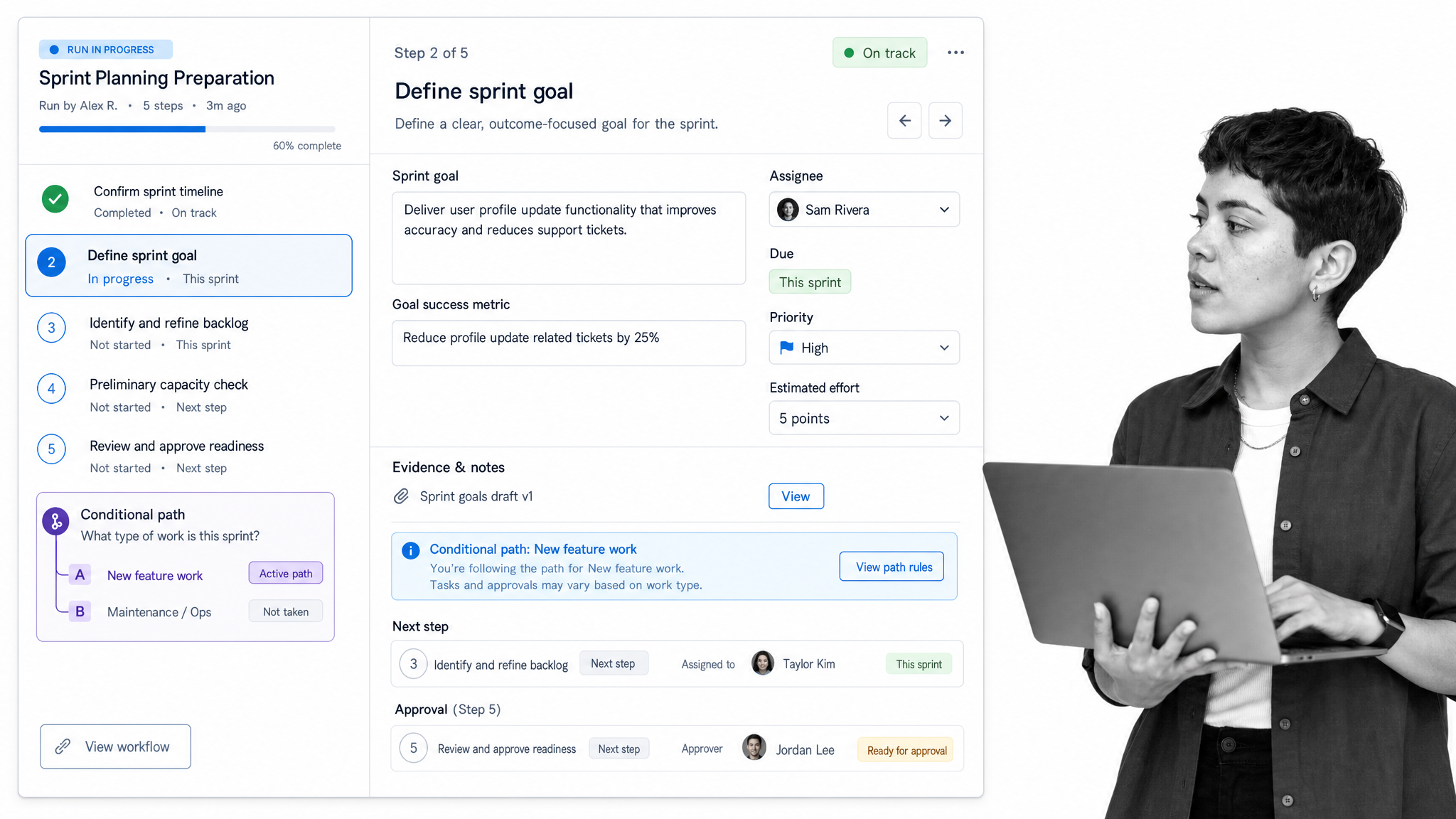
Start by identifying which parts of the Agile workflow repeat. Sprint planning preparation, backlog refinement, release readiness, incident review, customer feedback triage, retrospective follow-up, compliance review, and onboarding a new team member into the Agile process are all candidates.
Build the workflow around the decisions and evidence the team needs. A sprint planning workflow might collect capacity, top backlog items, dependency checks, risk notes, and the sprint goal. A release review workflow might require QA signoff, stakeholder approval, customer communication, and a rollback plan.
Use conditional paths for different work types
Not every Agile item needs the same path. A bug fix, customer request, compliance change, and new feature may share intake but diverge later. Process Street conditional logic supports workflow paths that change based on data captured in the run, so teams can keep one workflow without forcing every item through the same steps.
Add approvals where control matters
Agile does not mean uncontrolled. Some work needs authorization before it moves forward. Process Street approvals can support single, multi-stage, or sequential approval patterns inside workflows, which is useful for release decisions, customer-facing changes, compliance exceptions, or budget-sensitive work.
Connect Agile rituals to execution records
The best Agile workflow process leaves a record of what happened. The team should be able to see the goal, selected work, decisions, approvals, blockers, feedback, and improvement actions. That record becomes the basis for better retrospectives and cleaner handoffs.
Agile workflow process example
Imagine a customer success team wants to improve enterprise onboarding. The team receives feedback that customers understand the product but get stuck waiting for internal approvals before launch.
The team turns that problem into an Agile workflow process. First, it adds the issue to the backlog and prioritizes it against other onboarding improvements. During planning, the team chooses a small experiment: add a launch-readiness approval workflow for one customer segment. During execution, the team builds the workflow, assigns owners, and tests it with active onboarding projects. During review, stakeholders inspect whether approval delays were reduced and whether the new step created friction. During the retrospective, the team decides whether to expand, change, or remove the workflow.
The work is Agile because the team did not try to redesign onboarding in one large project. It selected a valuable slice, made the process visible, tested it, reviewed outcomes, and used the result to decide the next improvement.
Common Agile workflow process mistakes
Treating Agile as meetings
Sprint planning, standups, reviews, and retrospectives are only useful if they change how work moves. If the board is stale, blockers are hidden, and retrospective actions never change the workflow, the team is not operating with agility.
Starting too much work
Teams often try to show momentum by starting many items. That usually creates queues, context switching, and slow review. A stronger Agile workflow limits work in progress so the team finishes valuable slices sooner.
Skipping operational controls
Agile teams sometimes avoid approvals, documentation, or evidence because those feel like old process habits. The better answer is to put lightweight controls inside the workflow. Controls should help the team move safely, not appear at the end as a blocker.
Letting retrospectives become conversation only
A retrospective should change the system. If an action item matters, add it to the backlog, assign an owner, and make it visible in the next cycle. Otherwise the team is only discussing improvement, not practicing it.
Agile workflow process FAQs
What is an Agile workflow process?
An Agile workflow process is a repeatable way to plan, execute, review, and improve work in short cycles so teams can adapt to feedback without losing operational control.
What are the main stages of an Agile workflow process?
The main stages are intake, backlog prioritization, sprint or flow planning, execution, review, release, and retrospective improvement.
How is an Agile workflow process different from Waterfall?
Waterfall plans a large sequence upfront, while Agile works in smaller cycles where the team can inspect outcomes and adjust the next slice of work.
Can non-software teams use an Agile workflow process?
Yes. Marketing, operations, finance, HR, and customer success teams can use Agile workflows when work benefits from visible priorities, fast feedback, and regular improvement.
How can Process Street support an Agile workflow process?
Process Street helps teams turn recurring Agile work into workflow runs with task assignments, conditional paths, approvals, integrations, and a visible record of execution.