Turn every policy into automated workflows with built-in enforcement and audit-ready proof.



Everything You Need to Know About the Investment Advisers Act of 1940

The Investment Advisers Act of 1940 is the main U.S. federal law governing investment advisers. It defines who may be an investment adviser, creates registration and disclosure obligations, prohibits fraudulent practices, and gives the Securities and Exchange Commission authority to make and enforce rules for advisers under its jurisdiction.
For an advisory firm, knowing the statute is only the beginning. Compliance depends on translating legal duties into repeatable work: identifying conflicts, maintaining accurate disclosures, preserving required records, reviewing marketing, protecting client assets, testing policies, and preparing for examination. The exact obligations depend on the firm’s facts, services, clients, assets, custody arrangements, and regulatory status.
This guide explains the law in practical terms for compliance and operations teams. It is educational information, not legal, tax, accounting, or investment advice. Firms should use qualified counsel and current regulator guidance for decisions about registration, exemptions, filings, contracts, custody, advertising, and enforcement exposure.
In this guide:
- What is the Investment Advisers Act of 1940?
- Who is an investment adviser?
- Who registers with the SEC or a state?
- What does the Advisers Act require?
- How does fiduciary duty work?
- What is Form ADV?
- How do you build a compliance program?
- Which operating areas need controls?
- What happens during an SEC examination?
- How can a firm run compliance as a workflow?
- What should investors check?
- Advisers Act FAQs
What is the Investment Advisers Act of 1940?
The Advisers Act is codified in Title 15 of the U.S. Code. The official statutory compilation of the Investment Advisers Act contains the current text and amendments. The law works together with SEC rules, interpretations, orders, state securities laws, and other federal securities statutes.
The Act has several connected jobs. It defines important terms, creates a registration framework, requires information from registrants, governs advisory contracts, prohibits fraud, supports examinations, and authorizes enforcement. Many day-to-day obligations appear in SEC rules adopted under the Act rather than in a simple checklist inside the statute itself.
| Layer | What it does | Operational question |
|---|---|---|
| Statute | Defines the framework, prohibited conduct, and SEC authority | Which sections apply to the firm and its services? |
| SEC rules | Add detailed requirements for compliance, records, marketing, custody, ethics, and filings | Which rules require a control, filing, review, or record? |
| SEC guidance and orders | Explain interpretations, priorities, and specific applications | Has guidance or an order changed how the firm should operate? |
| State law | Governs many advisers and representatives outside SEC registration | Which state regulators and requirements apply? |
| Firm procedures | Translate obligations into owned, testable work | Who does what, by when, with what evidence? |
That last layer is where compliance becomes reliable or fragile. A policy can describe the right standard but still fail if nobody owns the task, evidence is scattered, approvals are informal, or an exception has no escalation path. A controlled operating system should connect each obligation to an owner, trigger, deadline, review, and retained record.
Who is an investment adviser under the Act?
The statutory definition generally covers a person or firm that, for compensation, is in the business of advising others about securities or issuing analyses or reports about securities. The analysis is functional. Job titles and marketing labels do not decide the result by themselves.
A firm should examine what it actually does, how often it does it, what clients receive, how compensation works, and whether the advice concerns securities. Financial planners, consultants, digital services, portfolio managers, private fund managers, publishers, professionals, and broker-dealers can face different outcomes depending on their activities and the limits of any exclusion.
Exclusions and exemptions are not interchangeable
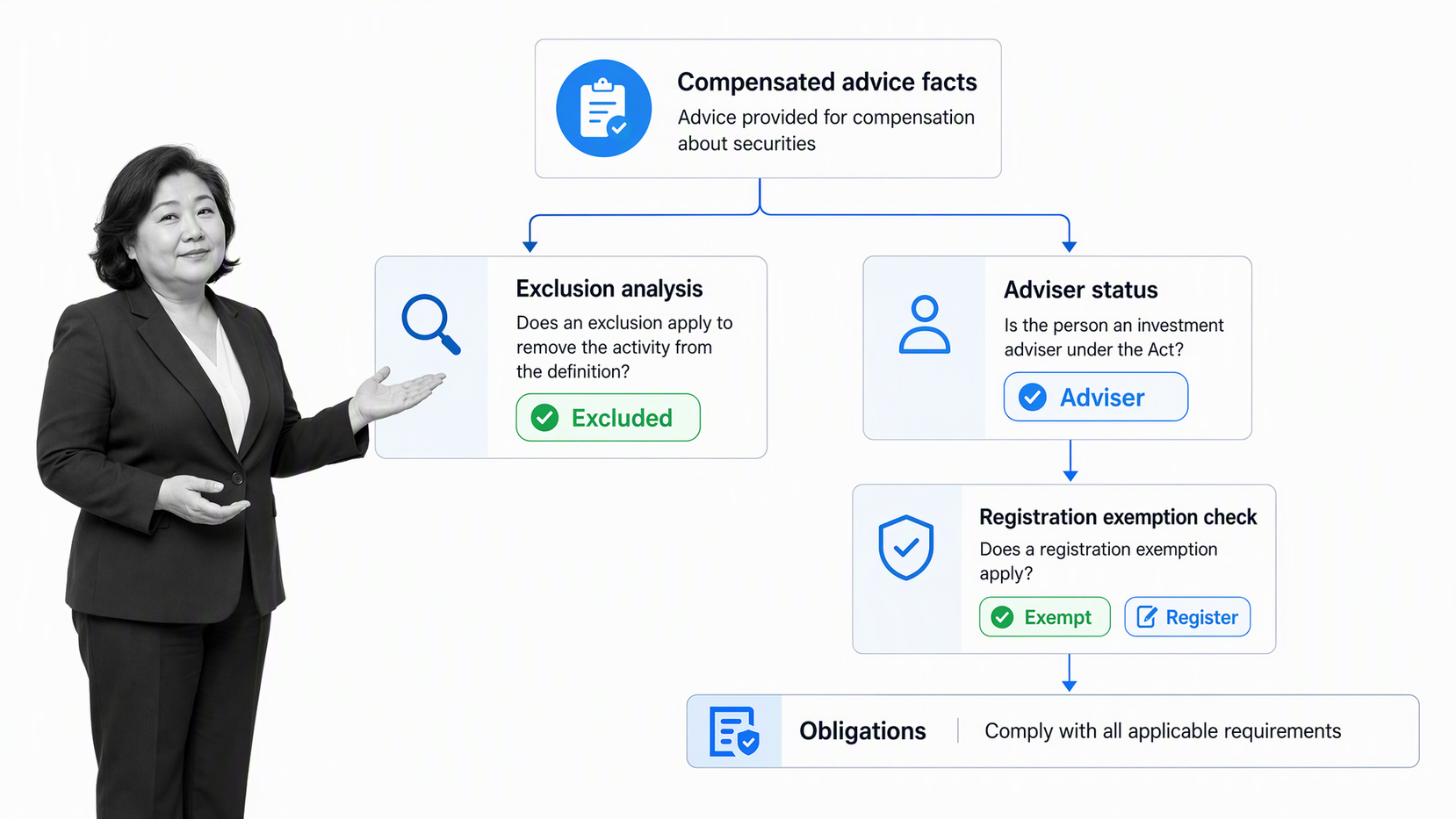
An exclusion can mean a person is outside the statutory definition for the relevant activity. An exemption can excuse a person from a registration requirement even though the person may otherwise fit the definition. Exempt status does not automatically remove every obligation. Anti-fraud provisions, reporting duties, state law, contractual duties, or other rules may still apply.
Adviser and adviser representative are different concepts
The advisory firm and the individuals who provide advice or solicit clients may be regulated through different federal and state mechanisms. A firm should map both entity-level and individual-level requirements rather than assume the firm’s filing resolves every person’s obligations.
Start with activities and facts, not labels. The same title can describe businesses with very different regulatory obligations.
Who registers with the SEC or a state?
Registration is not a single nationwide yes-or-no question. The appropriate regulator can depend on regulatory assets under management, the number and location of clients, whether the adviser advises a registered investment company, the jurisdictions in which it operates, and whether an exemption or special eligibility rule applies.
A firm considering registration should work through the current Form ADV instructions, applicable SEC rules, and state requirements. It should also revisit the analysis when assets, clients, ownership, services, or locations change. Crossing a threshold or entering a new jurisdiction can change the filing path.
| Question | Evidence to collect | Why it matters |
|---|---|---|
| What advice is provided? | Service descriptions, agreements, communications, and actual practice | Tests whether the activity is advisory and concerns securities |
| How is the firm paid? | Fee schedules, referral arrangements, and other compensation | Compensation is part of the adviser analysis and conflict review |
| Who are the clients? | Client types, locations, fund structures, and account relationships | Affects exemptions, disclosures, and jurisdiction |
| What assets are managed? | Current calculation under the applicable instructions | Helps determine SEC or state registration eligibility |
| Where does the firm operate? | Offices, representatives, solicitation, and client locations | Identifies state registration and notice filing questions |
| What may change? | Pipeline, acquisitions, new products, and expected asset movement | Supports timely transition planning |
Registration is a disclosure and oversight mechanism, not an SEC endorsement of competence or investment results. Investors should evaluate the adviser, its services, conflicts, fees, disciplinary history, and fit rather than treat registration alone as a quality seal.
What does the Advisers Act of 1940 require?
Requirements vary, but several themes shape the operating model of an SEC-registered adviser. The firm should understand its fiduciary obligations, keep its disclosures accurate, maintain required books and records, adopt and administer a risk-based compliance program, supervise personnel, control marketing, address custody, and cooperate with examinations.
- Registration and amendments through the applicable Form ADV filing process.
- Accurate client-facing disclosures about services, fees, conflicts, methods, risks, and disciplinary information.
- Policies and procedures reasonably designed to prevent violations of the Advisers Act and its rules.
- A chief compliance officer responsible for administering the compliance program.
- Periodic testing and at least annual review of the compliance program for SEC-registered advisers.
- Books and records that support filings, communications, transactions, decisions, and required retention.
- Controls for personal trading and ethical conduct where the code of ethics rule applies.
- Review of advertising, testimonials, endorsements, performance presentations, and related records under the marketing rule.
- Safeguards and procedures for client funds and securities when the firm has custody.
A generic manual is not enough. The SEC’s compliance guidance emphasizes that advisers should identify their own risks and design policies around their operations. A small adviser with straightforward separately managed accounts will not have the same control environment as a multi-strategy firm serving funds, institutions, and retail clients.
How does fiduciary duty work under the Advisers Act?
The SEC describes an investment adviser’s federal fiduciary duty as comprising a duty of care and a duty of loyalty. The duty applies across the relationship and is shaped by the scope of services agreed with the client. It is principles-based, so firms need processes that apply the standard to real recommendations, trading, monitoring, conflicts, allocations, fees, and communications.
Duty of care
The duty of care generally includes providing advice in the client’s best interest based on a reasonable understanding of the client’s objectives. It can also include seeking best execution when the adviser selects broker-dealers and providing monitoring over the agreed relationship. The firm should collect enough current information to make the agreed service meaningful.
Duty of loyalty
The duty of loyalty requires the adviser not to subordinate the client’s interests to its own. Material conflicts should be eliminated or fully and fairly disclosed so the client can provide informed consent. Disclosure should be specific enough for a client to understand the conflict, its effects, and the choices available.
Conflicts need an operating response
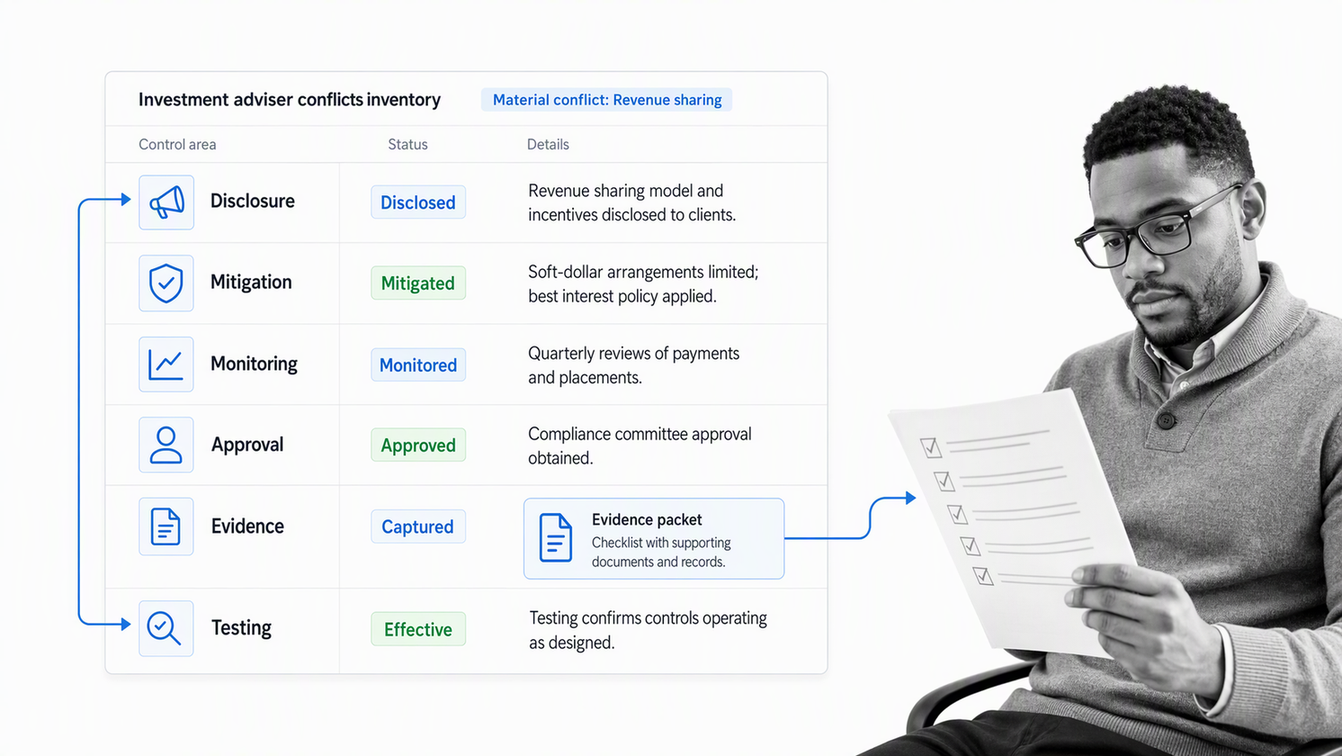
A conflicts inventory should connect each conflict to its owner, disclosure, mitigation, monitoring, approval, and testing. Common areas include compensation, proprietary products, affiliated providers, side-by-side management, allocation, personal trading, gifts, referrals, outside activities, and valuation. The list should change when the business changes.
What is Form ADV and what does it disclose?
Form ADV is the uniform form used by investment advisers to register with the SEC and state securities authorities. The Investor.gov Form ADV overview explains that the form includes information about the adviser and, for SEC-registered advisers serving retail investors, a plain-language relationship summary.
| Form component | Primary purpose | Operational control |
|---|---|---|
| Part 1 | Regulatory and business information in a structured filing | Source each answer, assign owners, and reconcile amendments |
| Part 2A | Narrative brochure about the firm, services, fees, methods, risks, and conflicts | Compare disclosure with actual practice and contracts |
| Part 2B | Information about certain supervised persons | Maintain personnel and disciplinary change triggers |
| Part 3 | Relationship summary for applicable retail relationships | Keep concise disclosures aligned with services and conflicts |
Disclosure maintenance should be event-driven as well as calendar-driven. New products, fee changes, disciplinary events, acquisitions, ownership changes, new conflicts, and changes in business practice can create amendment or delivery questions before the annual cycle. The workflow should route each change to compliance and counsel for an applicability decision.
How do you build an Advisers Act compliance program?
Rule 206(4)-7 requires an SEC-registered adviser to adopt and implement written policies and procedures reasonably designed to prevent violations, review their adequacy and effectiveness at least annually, and designate a chief compliance officer. The current rule text is available in 17 CFR 275.206(4)-7.
The most useful starting point is a risk assessment tied to the firm’s business model. For each risk, identify the obligation, control objective, procedure, owner, frequency, evidence, exception path, and test. This turns a policy library into a management system.
- Inventory services, clients, products, systems, personnel, affiliates, vendors, and jurisdictions.
- Identify legal, fiduciary, operational, technology, and conflict risks created by those activities.
- Map each risk to a policy, preventive or detective control, owner, and evidence requirement.
- Set calendar triggers and event triggers for filings, reviews, certifications, testing, and training.
- Define escalation levels, remediation deadlines, interim safeguards, and approval authority.
- Test whether controls operated, whether evidence is reliable, and whether exceptions were resolved.
- Complete the annual review using incidents, testing, regulatory developments, business changes, and examination feedback.
- Track remediation through closure and verify that the fix works in practice.
Annual review should be a conclusion supported by evidence, not a ceremonial sign-off. The review should consider whether policies remain adequate for the firm’s risks and whether they were implemented effectively. Findings should have owners, due dates, severity, supporting evidence, and independent closure checks.
Which operating areas need the strongest controls?
Books and records
Recordkeeping should start from a retention schedule that names each record category, source system, owner, retention period, access control, and retrieval method. The firm should test that records can be produced, not merely assume that an email archive or vendor retains everything required.
Marketing and performance
Marketing review should cover websites, presentations, social posts, pitch materials, testimonials, endorsements, ratings, performance, extracted performance, hypothetical results, and disclosures. Approval should capture the version reviewed, substantiation, intended audience, required disclosures, reviewer, decision, and publication date.
Custody and client assets
Custody analysis should be documented for each arrangement and revisited when account authority, fee deduction, related custodians, pooled vehicles, standing instructions, or client agreements change. The analysis should connect the legal conclusion to account setup, notices, statements, examinations or audits, and exception monitoring.
Code of ethics and personal trading
A code of ethics program should define covered persons, holdings and transaction reporting, preclearance where used, restricted lists, gifts, outside activities, review responsibilities, escalation, and record retention. The workflow should distinguish a late filing from a substantive conflict and apply a consistent response.
Cybersecurity, privacy, and vendors
Adviser compliance also depends on systems that hold client information and support critical operations. Access, changes, incidents, business continuity, data handling, and vendor oversight should connect to the broader compliance program. A control owned entirely outside compliance still needs a clear evidence and escalation path.
What happens during an SEC examination?
Section 204 gives the SEC authority to examine adviser records through reasonable periodic, special, or other examinations. The current U.S. Code text for adviser reports and examinations provides the statutory foundation for that oversight.
Examination request and response workflow
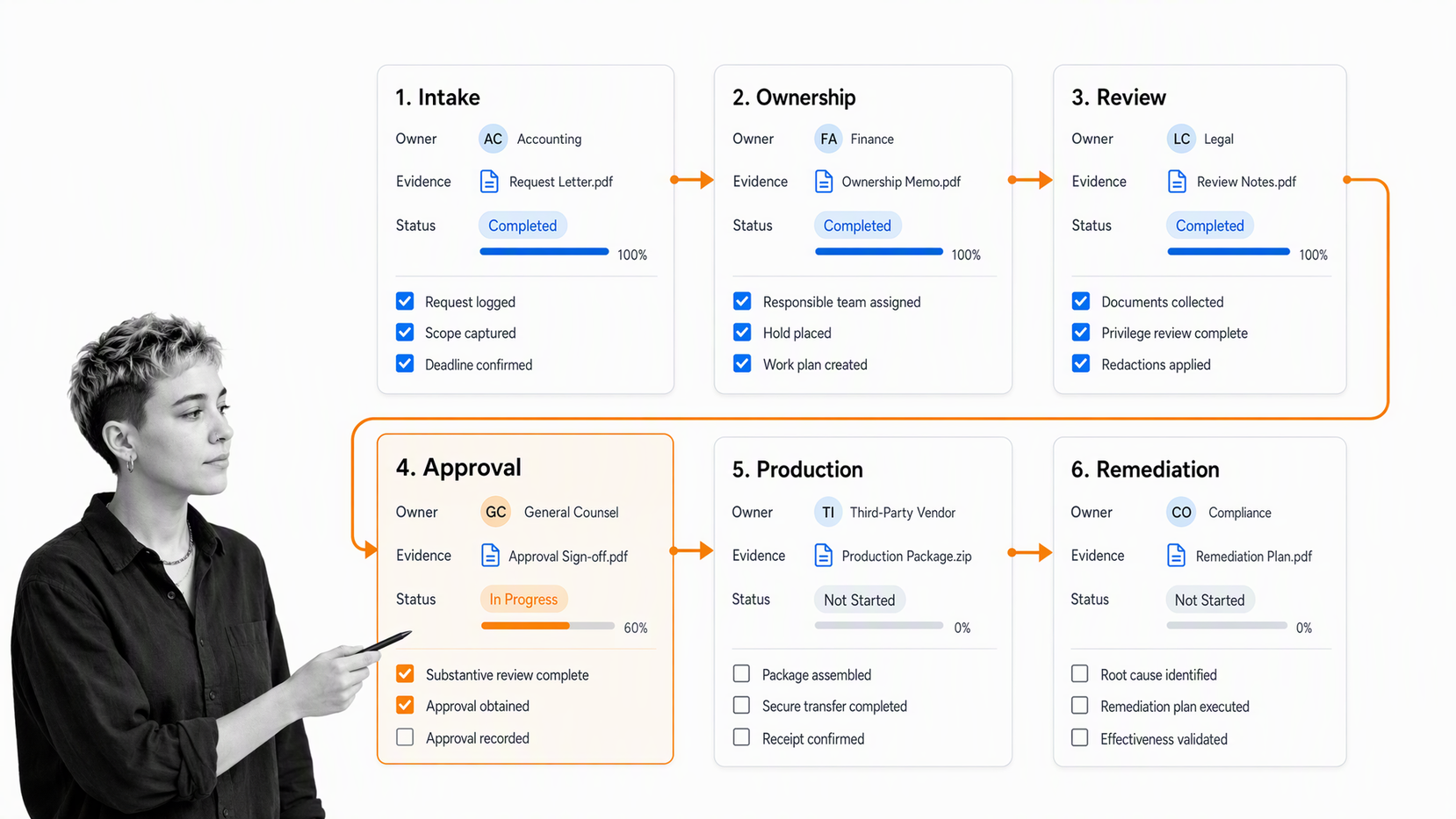
An examination commonly begins with a request for documents and information, followed by interviews, testing, and follow-up questions. The scope can change as examiners learn more. The process may end without findings, with observations or a deficiency letter, with remediation, or with a referral for further action depending on the facts.
| Phase | Firm responsibility | Evidence of readiness |
|---|---|---|
| Preparation | Confirm response team, legal oversight, data sources, and production process | Current inventory and tested retrieval |
| Request intake | Log every item, owner, interpretation, dependency, and deadline | Controlled request tracker |
| Collection and review | Gather responsive records and review accuracy, privilege, confidentiality, and completeness | Source-to-production traceability |
| Production | Deliver approved materials through the agreed channel and preserve the production set | Version, date, and delivery record |
| Interviews and follow-up | Prepare truthful, consistent subject-matter responses and track commitments | Question log and follow-up owner |
| Findings and remediation | Assess findings, design corrective action, and verify closure | Remediation plan and effectiveness test |
A response team should avoid reconstructing the firm’s control history from scattered inboxes. Routine work should already preserve the approved disclosure, test result, exception, evidence, and closure decision. Examination readiness is therefore an outcome of daily operating discipline, not a binder assembled after a request arrives.
How can a firm run Advisers Act compliance as a workflow?
A workflow management system can connect policy to execution. Process Street lets teams define recurring procedures, assign owners, collect structured information, apply conditional paths, route approvals, and retain an operating record. The legal analysis stays with qualified professionals, while the workflow makes required work visible and reviewable.
For adviser operations, that model can support annual review, Form ADV change intake, advertising review, personal trading, gifts and entertainment, vendor due diligence, client onboarding, complaint handling, incident response, branch reviews, and examination requests. A broader compliance operations program can connect those workflows to common control ownership and remediation.
| Workflow element | Adviser compliance example | Control value |
|---|---|---|
| Trigger | Quarter end, annual cycle, new marketing asset, business change, or incident | Starts work at the right time |
| Assignment | Compliance, legal, portfolio, trading, finance, IT, or business owner | Makes accountability explicit |
| Conditional path | Retail client, custody, private fund, disciplinary event, or material change | Shows only the relevant checks |
| Evidence field | Disclosure, test sample, certification, approval reason, or remediation proof | Preserves support with the task |
| Approval | CCO, counsel, supervisor, or delegated committee | Records the decision and conditions |
| Escalation | Late filing, control failure, conflict, complaint, or breach | Routes exceptions before they become invisible |
| Report | Open findings, overdue reviews, exceptions, and completion trends | Gives management a current view |
Process Street can also support financial process automation by routing routine data and handoffs while preserving human approval for judgment-heavy decisions. Automation should never hide the basis for a regulatory conclusion. The workflow should show what rule or policy applied, who decided, which evidence they reviewed, and what happens next.
Example: Form ADV change intake
A business owner submits a structured change notice for a new service, fee, affiliate, office, disciplinary event, or conflict. Conditional logic routes the change to the right reviewer. Compliance compares the proposed practice with current Form ADV language, contracts, policies, and client communications. Counsel reviews material legal questions. The workflow records whether an amendment or delivery is needed, sets the deadline, captures approval, and verifies completion.
Example: advertising review
The submitter provides the final asset, audience, distribution channel, claims, performance data, testimonials, endorsements, and substantiation. The reviewer checks the applicable standard, required disclosures, consistency with Form ADV, and supporting records. Rejected assets return with reasons. Approved assets receive a controlled version and publication record.
Example: annual compliance review
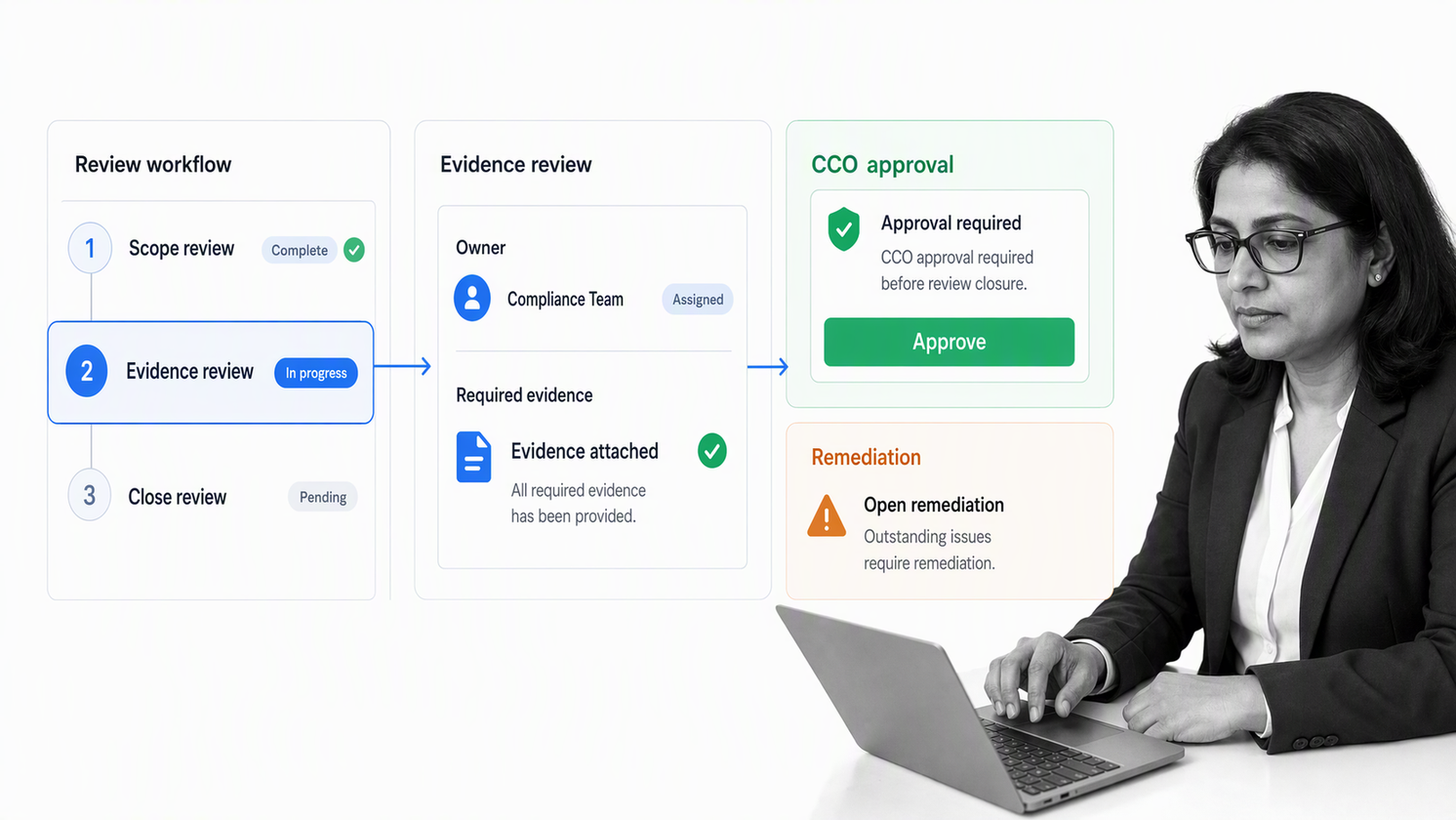
The review begins with business changes, regulatory developments, prior findings, complaints, incidents, exceptions, testing, and certifications. Each domain owner attests to current controls and uploads evidence. Compliance challenges gaps, assigns remediation, and prepares a conclusion for the CCO. Open items remain visible until effectiveness testing confirms closure.
What should investors check before hiring an adviser?
Investors can use the SEC’s Investment Adviser Public Disclosure database to research an advisory firm and access its Form ADV filings. Registration information is a starting point, not a substitute for understanding the relationship.
- Confirm the legal name, registration status, office, and people you will work with.
- Read the brochure and relationship summary, including services, fees, conflicts, disciplinary history, and standard of conduct.
- Ask how the adviser is paid and whether anyone else pays it or its personnel.
- Ask who holds client assets and how account access, statements, and withdrawals work.
- Understand the investment approach, risks, monitoring, reporting, and circumstances that could change the strategy.
- Compare the written agreement with the conversations and marketing materials you received.
- Ask how complaints, errors, conflicts, and changes in your circumstances are handled.
Clients should keep copies of agreements, disclosures, statements, and important communications. They should review updates rather than assume every amendment is administrative. Questions about rights, losses, misconduct, or a specific relationship belong with qualified legal or financial professionals.
Advisers Act of 1940 FAQs
What is the Investment Advisers Act of 1940?
The Investment Advisers Act of 1940 is a U.S. federal securities law governing investment advisers. It defines covered advisers, establishes registration and disclosure duties, prohibits fraudulent conduct, and authorizes SEC rules and oversight. State securities laws can also apply.
Who must register under the Advisers Act of 1940?
Registration depends on the firm’s activities, regulatory assets under management, clients, location, and any available exclusions or exemptions. Some firms register with the SEC, others with state authorities, and some file as exempt reporting advisers. Counsel should evaluate the firm’s actual facts.
What is Form ADV?
Form ADV is the uniform form investment advisers use to register with the SEC and state securities authorities. Its parts provide information about the business, ownership, services, fees, conflicts, disciplinary history, and, for firms serving retail investors, the relationship summary.
What fiduciary duties do investment advisers have?
The SEC describes an investment adviser’s federal fiduciary duty as including duties of care and loyalty. The adviser should provide advice in the client’s best interest, seek best execution where applicable, monitor as agreed, and make full and fair disclosure of material conflicts so clients can give informed consent.
How often should an SEC-registered adviser review its compliance program?
Rule 206(4)-7 requires an SEC-registered adviser to review the adequacy of its compliance policies and procedures and the effectiveness of their implementation at least annually. A strong program also tests controls and addresses changes throughout the year.
How can Process Street support adviser compliance operations?
Process Street can turn recurring compliance procedures into assigned workflows with conditional paths, approvals, evidence fields, reminders, and an activity record. It supports operational consistency and proof, while legal interpretation and regulatory filings remain with qualified professionals and authoritative systems.