


Turn every policy into automated workflows with built-in enforcement and audit-ready proof.



Form Utility

Form utility is the value a product gains when raw materials are transformed into a finished good that customers actually want to use. It explains why a working smartphone is worth far more than the metal, glass, and silicon it is made from, and why an assembled bookshelf is worth more than a flat box of loose panels and screws.
The idea comes from economics and marketing. When a business takes inputs and shapes them into the format, size, features, and design that buyers need, it creates value that did not exist in the raw materials. That added value is form utility, and it sits at the center of why production and product design matter.
Form utility is one of several types of economic utility, alongside time, place, and possession utility. Each one describes a different way a business makes a product more useful to a customer. Together they explain how raw inputs become something people will pay for, and how companies like Process Street help operators run the processes that create that value reliably.
In this article, we are going to cover everything you need to know about form utility, including:
- What form utility is
- How form utility is created
- Form utility and the four types of utility
- Form utility examples across industries
- Why form utility matters for business
- How to increase form utility
- How operational processes protect form utility
- FAQs
What form utility is
Form utility is the usefulness and value created by changing the physical form of a product. A business takes raw materials or separate components and converts them into a finished item that meets a customer need. The closer that finished form matches what the customer wants, the higher the form utility.
Utility, in economics, simply means the satisfaction or usefulness a person gets from a good or service. Investopedia defines utility as the total benefit a consumer receives from consuming a product. Form utility is the slice of that benefit that comes specifically from the product being shaped into a usable form.
A simple definition
Think of form utility as the difference in value between a pile of ingredients and a finished meal. The ingredients have some value, but the prepared dish has much more because it is now in a form the customer can enjoy. The transformation is what creates the extra worth.
As MyAccountingCourse explains, companies that create form utility do not just sell components. They assemble, process, and refine those components into products manufactured to meet a specific need.
Where the value comes from
Form utility is created through design and production decisions. The choice of features, the quality of assembly, the size of a package, and the finish of a product all change how useful it feels to the buyer. A product that is well designed for its job carries more form utility than one that is poorly suited to it.
This is why two products made from similar materials can sell at very different prices. The one with stronger form utility is shaped more precisely around what the customer is trying to do.
It also explains why form utility is partly subjective. The same finished product can carry high form utility for one customer and low form utility for another, depending on the job each person needs it to do. A business builds the most value when it understands its target customer well enough to shape the product around their specific need rather than a generic average.
How form utility is created

Form utility is created by transforming raw materials into finished goods through a series of production steps. Each step moves the product closer to the form a customer will pay for. The work that happens between raw input and finished output is where the value is added.
From raw materials to finished goods
The clearest example of form utility is manufacturing. A business turns wheat into flour, flour into bread, and bread into a sandwich. At each stage the form changes and the value rises. The same logic applies to turning iron ore into steel, steel into parts, and parts into a finished machine.
Production is rarely a single action. It is a sequence of stages, and managing that sequence is its own discipline. Understanding what a workflow is helps explain why the order and consistency of these steps matters so much for the final result.
Assembly and combination
Form utility often comes from combining separate parts into one working whole. A wooden handle and a metal head are not very useful on their own, but assembled into a hammer they become a tool someone will buy. A car gains enormous form utility when thousands of components are assembled into a vehicle that drives.
Assembly creates value because it removes work from the customer. Most buyers would rather pay for a finished product than gather and combine the parts themselves.
Processing and refinement
Processing changes the physical or chemical state of a material to make it more useful. Refining crude oil into fuel, milling timber into lumber, and pressing raw plastic into molded parts all create form utility. In a manufacturing operation, these processing steps are where most of the value is added, and where most of the risk lives if a step is done incorrectly.
Continuous refinement of those steps is a recognized practice. A structured manufacturing process improvement approach keeps the transformation efficient and consistent as volumes grow.
Packaging, customization, and design
Form utility is not only about the core product. Packaging a beverage in a single serving can rather than a bulk drum makes it more useful for a thirsty individual. Offering a product in different sizes, colors, or configurations lets customers pick the form that suits them. Thoughtful design is a major source of form utility because it shapes the product around the way people actually use it.
Form utility and the four types of utility
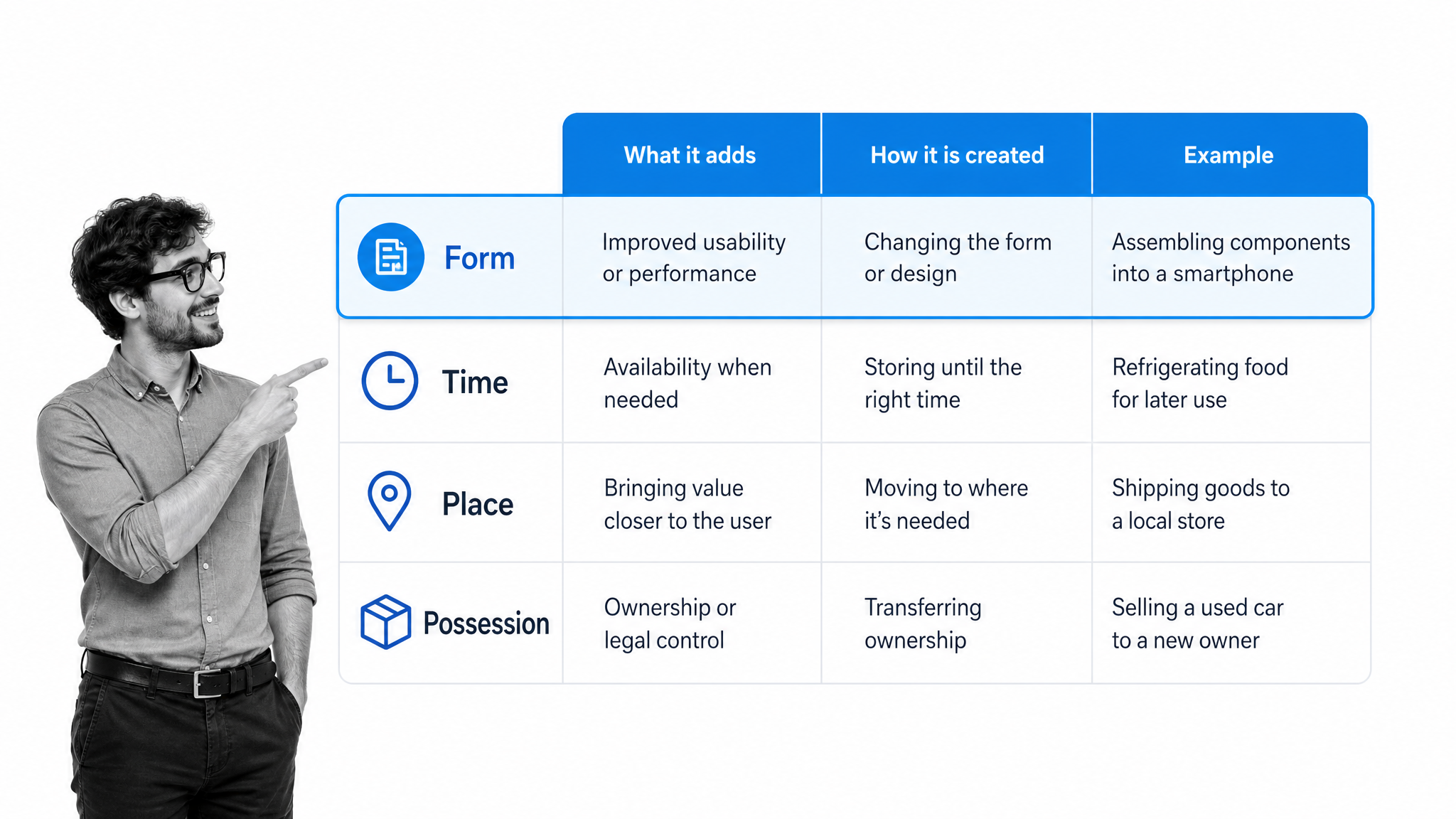
Form utility is one of the four classic types of economic utility. The others are time utility, place utility, and possession utility. Together they describe the different ways a business makes a product more valuable to a customer. Quickonomics groups them as the four ways value is added between production and consumption.
Form utility
Form utility is created by shaping raw materials into a finished product. It is the foundation of the other three, because there has to be a finished product before timing, location, or ownership can add value. The product has to exist in a usable form first.
Time utility
Time utility is the value created by making a product available when the customer wants it. Fast delivery, seasonal stocking, and around the clock service all create time utility. A product available at the right moment is worth more than the same product that arrives too late.
Place utility
Place utility is the value created by making a product available where the customer wants it. A convenient store location, broad distribution, and online availability all create place utility. The easier a product is to reach, the more useful it becomes.
Possession utility
Possession utility is the value created by making it easy for a customer to own and use the product, through financing, clear ownership transfer, or simple purchasing. HubSpot describes these utilities as the levers marketers use to increase the overall value a customer perceives.
Academic marketing references treat the same set consistently. The Monash Business School marketing dictionary defines form utility as the want-satisfying power created by the physical form of a product. Some frameworks add a fifth type, information utility, for the value of knowing a product exists and how to use it.
Form utility examples across industries
Form utility examples show up in almost every industry, because nearly every business takes some input and shapes it into something more useful. The pattern is always the same: a raw input becomes a finished form that a customer values.
Manufacturing and industrial goods
A manufacturer turns raw metal, plastic, and electronics into a finished appliance. The raw materials have limited value on their own, but the assembled appliance does a job the customer needs. The form utility is the gap between the cost of the inputs and the value of the working product.
Food and beverage
A food producer turns raw wheat into flour, then into packaged bread. A beverage company offers the same drink in a single can for one person and a large bottle for a group. Each form is shaped around a different consumption need, and each carries its own form utility.
Technology and software
A technology company turns silicon, glass, and code into a working device or application. The finished product is designed around tasks the user wants to complete. Good interface design and reliable features are a form of form utility, because they shape the product around how people actually work.
Furniture and consumer products
A fully assembled bookshelf carries more form utility than a flat pack the customer has to build. Some buyers will pay extra for the assembled form, while others accept lower form utility in exchange for a lower price. The trade off between finished form and cost is a constant product decision.
Services and experiences
Form utility is easiest to see in physical goods, but the same idea applies to services. A consulting firm turns raw research into a structured recommendation. A repair shop turns a broken machine into a working one. The service is shaped into a form the customer can use, and the better that form fits the need, the more the customer values the result.
Why form utility matters for business
Form utility matters because it is one of the main reasons customers choose one product over another. A product shaped precisely around a customer need is easier to sell, can command a higher price, and builds a stronger reputation. Weak form utility shows up as products that almost fit but never quite do the job.
Pricing power and differentiation
Strong form utility lets a business charge more, because the finished product solves the customer problem better than the alternatives. Differentiation often comes down to form: a better design, a more reliable build, or a format that fits the customer workflow. Two competitors can use similar materials and still compete on the form utility they deliver.
Consistency is part of the value
Form utility is only valuable if it is consistent. A product that is excellent one day and defective the next destroys trust, even if the average quality is high. This is why quality management sits so close to form utility: the value depends on producing the right form every single time.
Reliable form also depends on how well a company runs its operations. Teams that lean on a workflow management system and business process automation software can repeat the transformation accurately at scale, instead of relying on memory and luck.
How to increase form utility
To increase form utility, a business has to understand the customer need precisely, then shape the product and the production process to meet it. The goal is to close the gap between what the customer wants and what the finished product actually delivers.
Start with the customer need
Form utility rises when the product is designed around a real job the customer is trying to do. That means studying how people use the product, what frustrates them, and which features matter most. A product designed from genuine customer insight carries more form utility than one designed from internal assumptions.
Improve the production process
Better products come from better processes. Refining how the work is done removes defects, reduces waste, and produces a more consistent finished form. A clear approach to improving a process gives teams a repeatable way to raise quality over time.
Some improvements are incremental and some are structural. The difference between process reengineering and continuous improvement helps a team decide whether to refine the current production flow or redesign it. A steady continuous improvement habit keeps form utility rising as customer expectations change.
Build quality into the work
Form utility holds up when quality is built into each step rather than inspected at the end. Standards, checklists, and clear ownership keep the transformation on target. The more the production process catches problems early, the more reliably the finished form meets the customer need.
Increasing form utility is therefore as much an operations problem as a design problem. A great design that the team cannot produce consistently delivers low form utility in practice, because too many units miss the mark. Pairing strong product design with disciplined, repeatable production is what turns a good idea into a finished form customers can rely on.
How operational processes protect form utility

Form utility is created on the production floor, but it is protected by the processes that govern how work gets done. If the steps that transform raw materials are inconsistent, the finished form drifts and the value erodes. Operations, quality, and manufacturing teams keep form utility stable by running standardized, repeatable processes.
Standardize the steps that create the form
A standard operating procedure captures exactly how a product should be made, so the form comes out the same way every time. Teams use templates like a standard operating procedure and a free SOP template to document the transformation in plain steps that anyone can follow.
Process Street turns those documented steps into workflows that run, not just pages that sit in a folder. Instead of hoping the team remembers the procedure, the workflow assigns each step, enforces the right order, and records what was done. This is the difference between a static SOP and a process that actually protects the finished form.
Catch defects before they ship
Quality checks keep weak form utility from reaching the customer. A quality control checklist for manufacturing and a quality assurance SOP give inspectors a consistent way to verify the product before it moves on. With conditional logic, a failed check can route the item to rework automatically, so a defective form never slips through to the next stage.
Because every completed step is recorded, the team also gets an audit trail. If a customer reports a problem, the record shows which batch, which steps, and which owner handled the work, which makes the root cause far easier to find.
Keep proof and improve over time
When the production process runs as a workflow, the proof of correct execution stays attached to the work itself. Process Street is built for this kind of process management, where documentation, execution, and oversight live in one place. As issues surface, the team updates the procedure once and every future run follows the improved version.
Process Street also has direct, universal integrations to 5,000+ systems. Need a new one? An AI agent builds it on the fly. That means a production workflow can update inventory, notify a supplier, or log a result in a system of record without breaking the chain of custody that keeps form utility consistent.
FAQs
What is form utility?
Form utility is the value a product gains when raw materials are transformed into a finished good that customers want. It is the usefulness created by changing the physical form of a product, such as turning wheat into bread or parts into a finished machine.
How is form utility created?
Form utility is created through production activities such as processing, assembly, packaging, customization, and design. Each step shapes raw inputs closer to the finished form a customer is willing to pay for.
What are the four types of utility?
The four types of utility are form, time, place, and possession. Form utility comes from the product itself, time utility from availability when customers want it, place utility from availability where they want it, and possession utility from making it easy to own.
What is an example of form utility?
A working smartphone is a common example. The metal, glass, and silicon used to build it have little value on their own, but assembled into a finished device they create significant form utility because the product now meets a real customer need.
Why is form utility important in marketing?
Form utility is important because it is a core reason customers choose one product over another. A product shaped precisely around a customer need can command a higher price, differentiate from competitors, and build trust through consistent quality.
How can a business increase form utility?
A business increases form utility by understanding the customer need, improving product design, and refining the production process so the finished form is consistent. Standardized procedures and quality checks keep the form on target every time.