Turn every policy into automated workflows with built-in enforcement and audit-ready proof.



Healthcare Monitoring
Healthcare monitoring is the ongoing practice of watching the signals that show whether care is safe, quality is holding, compliance is met, and risk is controlled. The strongest programs do more than collect readings or file a report. They turn monitoring into live, assigned, auditable work so problems are caught early and proof is always ready.
Monitoring fails when it is treated as a once-a-quarter audit or a binder that only appears for a survey. It works when patient safety, clinical quality, infection control, device readiness, and regulatory obligations are tracked continuously and tied to owners, thresholds, and evidence.
This guide explains what healthcare monitoring covers, the main types, what monitoring software does, how it differs from remote patient monitoring, the benefits, how to implement a program, and how to choose the right system.
In this article, we are going to cover:
- What healthcare monitoring is
- Types of healthcare monitoring
- What healthcare monitoring software does
- Healthcare monitoring versus remote patient monitoring
- Benefits of healthcare monitoring
- How to implement a healthcare monitoring program
- Healthcare monitoring in Process Street
- How to choose healthcare monitoring software
- FAQs
What healthcare monitoring is
Healthcare monitoring is the continuous tracking of clinical, operational, and compliance signals that tell a care organization whether critical work is being done safely and correctly. It spans the bedside and the back office: vital signs and patient deterioration, but also hand hygiene rates, medication checks, equipment readiness, staff competency, and policy adherence.
The term overlaps with patient monitoring, clinical monitoring, healthcare compliance monitoring, quality monitoring, and remote patient monitoring. The overlap is real, but the center of gravity is the same question for every team: are the things that protect patients and satisfy regulators actually happening, and can we prove it?
Monitoring is more than measurement
A monitor that captures a reading but never triggers action is only half a system. Real healthcare monitoring connects a signal to a threshold, an owner, an escalation path, and a record. When a value crosses the line, someone is responsible for responding, and the response is captured.
That is why monitoring sits close to a strong risk management process. Risk is not abstract once you tie a monitored signal to a named process, a responsible owner, and a defined action.
Monitoring spans clinical and operational layers
Clinical monitoring watches the patient: vital signs, symptoms, lab values, and deterioration. Operational monitoring watches the system that delivers care: staffing, equipment, infection control, documentation, and compliance. A mature program treats both as part of one picture, because a clinical failure often starts as an operational gap.
Types of healthcare monitoring
Healthcare monitoring is not a single activity. It is a family of monitoring practices that together show whether an organization is safe, compliant, and well run. Most care settings need several of these at once.
Patient and clinical monitoring
This is the layer most people picture: tracking vital signs, symptoms, lab results, and early warning scores so a deteriorating patient is identified before harm occurs. It also includes monitoring of care plans, rounding, and clinical handoffs.
Patient safety and quality monitoring
Safety and quality monitoring tracks the indicators behind harm and outcomes: falls, pressure injuries, medication errors, readmissions, and infection rates. CDC healthcare-associated infection data shows how closely tracked indicators support prevention. This layer connects naturally to a quality management system software approach.
Compliance and regulatory monitoring
Compliance monitoring confirms that the organization follows the rules it operates under, from privacy to accreditation. HHS HIPAA Security Rule guidance sets expectations for protecting health information, and CMS quality and safety oversight defines conditions that hospitals and providers must continually meet. Monitoring here means tracking attestations, training, audits, and corrective actions.
Infection control and environmental monitoring
Infection prevention depends on monitoring hand hygiene, isolation precautions, sterilization, water systems, and environmental cleaning. AHRQ patient safety resources provides patient safety resources that reinforce why these checks need consistent tracking rather than occasional spot checks.
Device and equipment monitoring
Critical equipment needs readiness monitoring: calibration, preventive maintenance, recalls, and availability. A missing or uncalibrated device is a safety event waiting to happen, so equipment status belongs in the same monitoring picture as clinical and compliance signals.
What healthcare monitoring software does
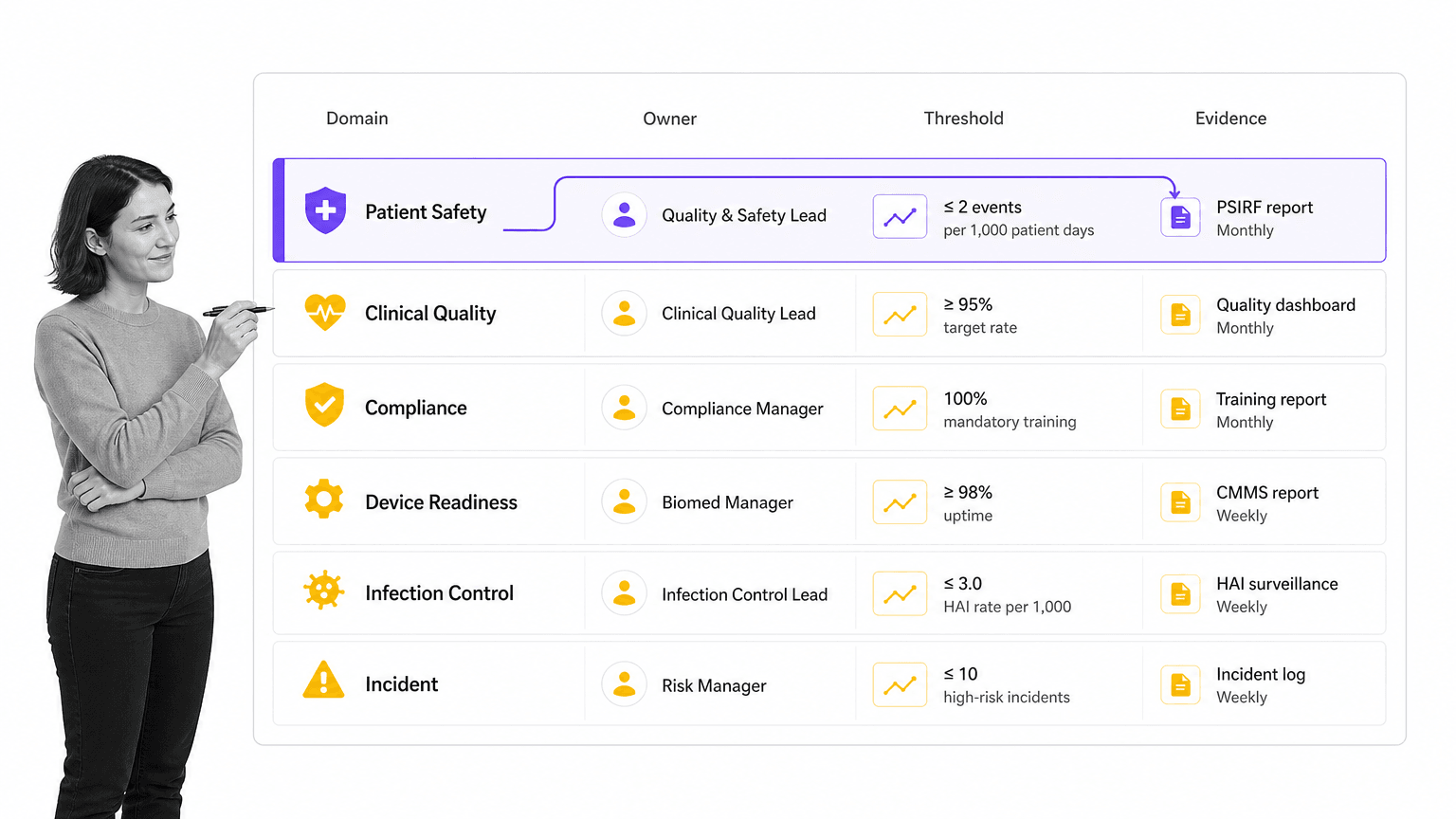
Healthcare monitoring software coordinates the lifecycle of monitoring work: define what to watch, set thresholds, assign owners, capture readings or checks, escalate exceptions, record evidence, and review trends. It turns scattered checks into one tracked operating picture.
Define monitored signals and thresholds
The software should let teams define what is monitored, why it matters, what good looks like, and where the line is. A threshold without an owner and an action is just a number. The system should attach each signal to a responsible person and a defined response.
Capture checks and route exceptions
Monitoring software should capture rounds, checklists, attestations, and readings, then route anything out of range to the right responder. Exceptions need to become work, not notes. A missed hand hygiene audit or an out-of-range value should create a task with an owner and a due response.
Preserve evidence and audit history
Care teams need proof that monitoring happened and that exceptions were handled. The software should preserve who checked, what was found, who was notified, and what action closed the gap. Without that history, teams reconstruct proof from inboxes and notes after a survey. Tying monitoring to Process Street or another execution layer keeps the record intact.
Show trends, not just snapshots
A single reading rarely tells the story. Monitoring software should show trends so a slow drift in infection rates, overdue equipment checks, or missed competencies becomes visible before it becomes an incident. Trends turn monitoring from reactive firefighting into early prevention.
Healthcare monitoring versus remote patient monitoring
Healthcare monitoring and remote patient monitoring are connected, but they are not the same thing. Remote patient monitoring, often shortened to RPM, is a specific clinical service. Healthcare monitoring is the broader discipline that covers clinical, operational, and compliance signals across the organization.
Remote patient monitoring is patient-device centered
RPM uses connected devices to collect patient data such as blood pressure, glucose, weight, or heart rhythm outside a clinical setting, then routes it to a care team. It is valuable for chronic disease management and post-discharge care, and it is increasingly reimbursed as a clinical service.
Healthcare monitoring is organization centered
Healthcare monitoring asks a wider question: across this organization, are safety, quality, compliance, and operational readiness being maintained and proven? That includes RPM data, but also infection control, equipment readiness, staff competency, and policy adherence. It often connects to process monitoring and a broader compliance management software effort.
Strong programs connect the two
The best setup does not silo RPM away from the rest of monitoring. A patient signal from a connected device, an infection trend on a unit, and an overdue equipment check all belong in one operating picture. If clinicians watch device data while operational and compliance signals go untracked, the program is still fragile.
Benefits of healthcare monitoring
Healthcare monitoring creates value by making safety and compliance visible, repeatable, and provable. It reduces the gap between what policy says should happen and what actually happens at the bedside and in the back office.
Problems get caught earlier
Continuous monitoring surfaces drift before it becomes harm. A rising early warning score, a slipping hand hygiene rate, or an overdue calibration is flagged while there is still time to act. Early detection is the core clinical and operational argument for monitoring.
Accountability becomes clear
Monitoring programs fail when everyone assumes someone else is watching. The software should assign owners for each monitored signal, each exception, and each corrective action. Ownership turns safety from a committee topic into accountable, trackable work.
Survey and accreditation readiness improves
Regulated care teams must show that monitoring is happening and that gaps are addressed. The Joint Commission accreditation standards expects continuous compliance, not a scramble before a survey. Monitoring software preserves the evidence trail: who checked, what was found, who was notified, and what action closed the gap.
That readiness is not only about surveys. Boards, insurers, and patients all benefit when an organization can show that its safety and quality work is consistent rather than performed in bursts before an inspection. Reliable monitoring evidence is easier to trust than a stack of screenshots assembled after the fact.
Quality improvement gets a feedback loop
Monitoring data feeds improvement. Trends point to where to focus, corrective actions create follow-up work, and re-monitoring shows whether the change held. Teams that already run a quality management system software can use the same discipline for safety, infection control, and compliance monitoring.
How to implement a healthcare monitoring program
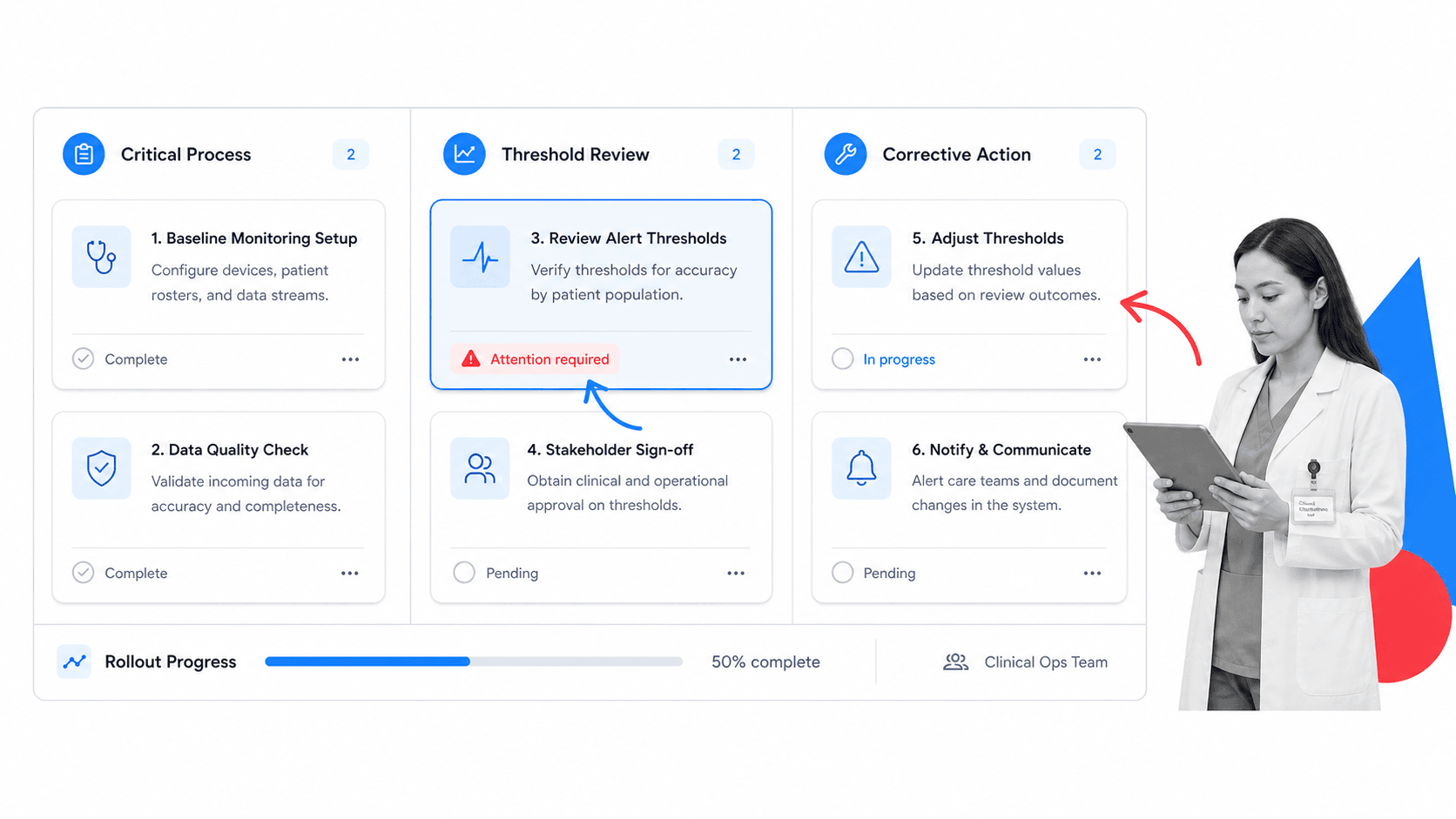
Implementation should start with one high-risk monitoring area that has clear boundaries. Trying to monitor every unit, signal, device, and regulation at once creates a large project that loses momentum and trust.
Step 1: Pick the first critical monitoring area
Choose an area where a gap would create real patient, safety, or compliance impact. Good first candidates include medication safety checks, hand hygiene auditing, early warning score rounding, equipment readiness, or a specific accreditation requirement.
Step 2: Define signals, thresholds, and owners
For that area, define what is monitored, the threshold for action, the owner, the escalation path, and the evidence required. Keep the first definition practical enough that frontline staff can actually complete it. A clear process documentation habit makes this far easier.
Step 3: Turn monitoring into an executable workflow
Convert the monitoring routine into assigned tasks with required fields, evidence capture, conditional branches, approvals, and escalation. A monitoring plan that cannot be run as work is still too vague. Linking it to a patient onboarding workflow or a clinical audit template gives staff a concrete starting point.
Keep the first workflow narrow enough to test. A strong first version might cover the scheduled check, threshold capture, exception routing, responder confirmation, evidence upload, and review. That gives the team a full monitoring loop without trying to model every possible scenario at once.
Step 4: Test before expanding
Run the workflow on a real unit or shift. Watch where staff hesitate, which fields create busywork, and which exceptions do not route cleanly. Capture every gap as an improvement task rather than a note that disappears after the huddle.
Step 5: Build the review rhythm
Set review frequency, owner accountability, escalation timing, and evidence requirements. Monitoring software should make overdue checks and unresolved exceptions visible, and route them before they become incidents. An incident report template workflow keeps serious events from being lost.
Do not treat implementation as finished once the first checks are live. The operating model is the real implementation: who owns thresholds, who reviews exceptions, who receives overdue alerts, and who decides when a monitoring gap becomes a reportable risk.
Healthcare monitoring in Process Street

Process Street can support healthcare monitoring by turning rounds, checks, attestations, approvals, evidence collection, and corrective actions into executable workflows. It is built for high-stakes environments where skipped steps and audit surprises are not acceptable.
Process Street is HIPAA compliant and is strongest when teams need monitoring to run as work: owners complete assigned checks, required fields capture thresholds and findings, approvals enforce review, automations trigger escalation, and the activity history proves what happened. It is not a heavyweight repository that only stores policies.
Run monitoring rounds as workflows
A monitoring workflow can include the scheduled check, threshold capture, exception confirmation, responder assignment, evidence upload, and a closure approval. Each run becomes a record of the monitoring activity and any response.
Use branching for real conditions
Monitoring response changes with the finding. conditional logic can route a workflow differently when a value is in range, slightly out of range, or critical, so staff are guided to the right action. approvals keep closure from happening before a quality lead has reviewed a serious exception.
Connect monitoring to the rest of operations
Process Street has direct, universal integrations to 5,000+ systems. Need a new one? An AI agent builds it on the fly. That lets monitoring workflows connect with EHR exports, ticketing, forms, calendars, chat, and systems of record without turning the monitoring program into a large integration project.
Teams that already use a workflow management system or workflow management software can apply the same execution discipline to monitoring, infection control, equipment readiness, and audit evidence.
How to choose healthcare monitoring software
Choose healthcare monitoring software by looking at the work it makes easier and the proof it preserves. A long feature list does not matter if frontline staff ignore the system or if exceptions still end up in spreadsheets and side conversations.
Signal definition and thresholds
The platform should make it easy to define monitored signals, thresholds, owners, and escalation paths. If defining what to watch and when to act is hard, the program will stay narrow and the riskiest gaps will go unmonitored.
Execution and exception handling
Look for assigned tasks, required fields, evidence capture, conditional routing, escalation, and approvals. In a busy care setting, monitoring has to be usable by staff who are already stretched, and exceptions have to reach the right responder quickly.
Ask vendors to show monitoring running as real work, not just a dashboard. The demo should show how a check is assigned, how an out-of-range value escalates, how evidence is captured, and how a leader sees status without chasing a manual update.
Evidence and audit trail
Monitoring is only credible when the organization can show what it checked, what it found, and what it fixed. Look for version history, owner review, approval gates, activity logs, evidence files, and reporting that hold up under a survey.
Fit with clinical and operational ownership
The right tool should be usable by nursing, quality, compliance, infection control, and biomedical teams without turning every change into a technical project. At the same time, critical monitoring steps need governance so a control cannot be quietly weakened.
The best evaluation question is simple: will the people who do the monitoring actually use this system on a normal shift? If the answer is no, it becomes another stale repository. If the answer is yes, monitoring becomes part of routine operating discipline and the proof takes care of itself.
FAQs
What is healthcare monitoring?
Healthcare monitoring is the ongoing tracking of clinical, operational, and compliance signals that show whether care is safe, quality is holding, and regulatory obligations are met. It connects each signal to a threshold, an owner, an action, and a record so problems are caught early and proof is always ready.
What are the types of healthcare monitoring?
Common types include patient and clinical monitoring, patient safety and quality monitoring, compliance and regulatory monitoring, infection control and environmental monitoring, and device and equipment monitoring. Most care settings run several of these at once as part of one operating picture.
Is healthcare monitoring the same as remote patient monitoring?
No. Remote patient monitoring uses connected devices to collect patient data outside a clinical setting and is a specific clinical service. Healthcare monitoring is the broader discipline that also covers safety, quality, compliance, infection control, and equipment readiness across the organization.
What should healthcare monitoring software include?
Core capabilities include signal and threshold definition, owner assignment, scheduled checks and rounds, exception routing, escalation, evidence capture, approvals, trend reporting, and an audit history. The software should turn monitoring into assigned work, not just store readings.
How do teams implement a healthcare monitoring program?
Start with one high-risk area, define its signals, thresholds, owners, and escalation, turn the routine into an executable workflow, test it on a real unit, capture gaps as improvement tasks, and build a recurring review rhythm before expanding to more areas.
Can Process Street be used for healthcare monitoring?
Yes. Process Street can run monitoring rounds, checks, attestations, approvals, evidence collection, escalation, and corrective actions as workflows. It is HIPAA compliant and best for teams that want monitoring to be executed and proven, not just documented.