



Effective delegation means assigning a clear outcome to the right owner, with the context, authority, resources, deadline, and checkpoints needed to deliver it.
At Process Street, I learned to delegate tasks across several teams without turning every handoff into another meeting or a trail of follow-up messages. The task delegation system in this Business Systems Explored episode is built around one idea: make the work easy to understand, easy to own, and easy to verify.
Managing a busy startup meant assigning hundreds of tasks every month while trying to keep costs down and work productively. I needed a documented, efficient workflow that let me explain, upload, and send information to anyone from any device without constantly switching between apps, sending emails, or messing around with disconnected tools.
Delegation fails when a manager transfers activity but keeps the uncertainty. If the owner has to hunt for files, guess what good looks like, or ask who can make a decision, the task has not really been delegated. The manager has only moved the confusion.
The method below turns delegation into a repeatable operating process. It works for a one-off assignment, a recurring business process, or a task completed with support from an AI agent.
How to delegate tasks effectively
Good delegation is not a request followed by hope. It is a designed handoff. Use these seven steps to give the owner enough clarity and control to finish the work without constant intervention.
- Choose the right task. Delegate work with a clear outcome that does not require your unique authority. Keep decisions that only you can make, but do not keep routine preparation, research, coordination, or recurring execution simply because you already know how to do it.
- Match the work to the owner. Check skill, capacity, context, and development goals. A capable person with no time is not the right owner, and a new owner may need a smaller first assignment.
- Define the result. State the desired outcome, acceptance criteria, constraints, and deadline. “Prepare the customer review” is vague. “Prepare a five-slide review using the approved metrics, confirm the figures with Finance, and place the final deck in the account folder by Thursday at 3 p.m.” is actionable.
- Grant decision rights. Explain what the owner can decide independently, what needs approval, and what must be escalated. Responsibility without authority creates delay.
- Put the context in one place. Attach instructions, source files, examples, credentials through an approved access method, dependencies, and relevant conversations to the tracked task or workflow. Do not make Slack or email the only system of record.
- Agree on follow-up before work begins. Set checkpoints according to risk and reversibility. A familiar weekly task may need only a completion notice. A new, expensive, or difficult-to-reverse decision needs an earlier review.
- Review the result and improve the brief. Give specific feedback, recognize what worked, and update the reusable instructions so the next handoff is easier.
For a small team, that can be as simple as one card with an owner, deadline, definition of done, source links, and a checkpoint. The system matters more than the app. The owner should be able to open the task and know what to do next.
How to follow up without micromanaging
Managers often micromanage because the original handoff left important questions unanswered. The cure is not to disappear. It is to design follow-up before anxiety takes over.
- Use risk-based checkpoints. Review early when the owner is learning, the cost of rework is high, or the decision is hard to reverse. Review later when the task is familiar and reversible.
- Define escalation triggers. Ask the owner to escalate when a dependency is blocked, a deadline is at risk, the scope changes, or a decision exceeds agreed authority.
- Make progress visible. Use a status, completed checklist item, attached draft, approval record, or other evidence. A vague “working on it” message is not enough.
- Let the owner lead the update. A short owner-written summary of progress, blockers, decisions, and next steps creates accountability without a status meeting.
- Coach after delivery. Discuss the result and the process. Avoid taking the task back at the first imperfection unless the risk demands it.
This approach makes follow-up part of the delegation brief. The manager knows when to look, and the owner knows when to ask for help.
Build a task delegation system that scales
A task delegation system creates one durable path from brief to owner to deadline to checkpoint to done. It should preserve context, make ownership explicit, and capture evidence that the work was completed.
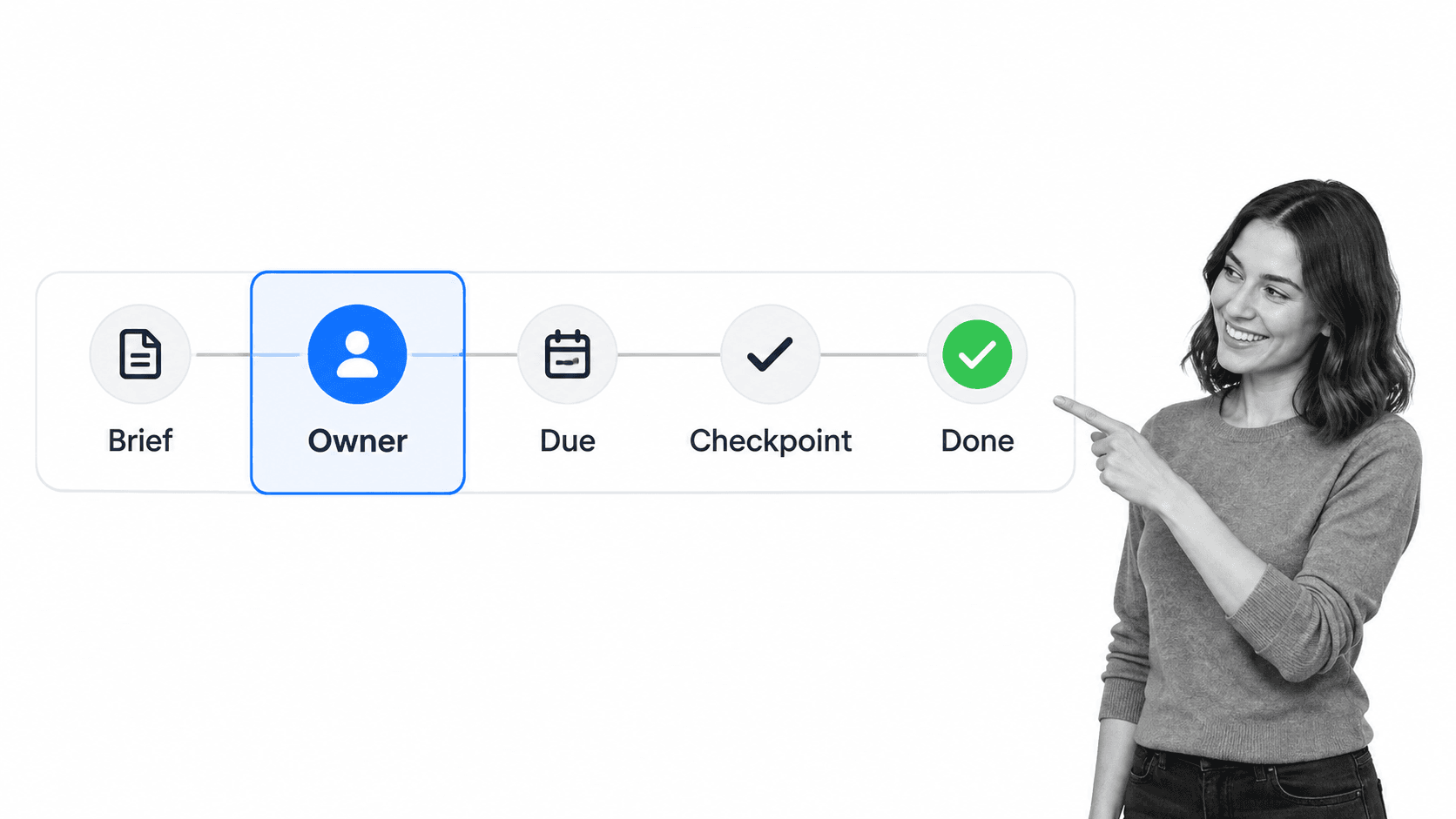
The basic structure stays stable even when the software changes. Use one source of truth, a named owner, a visible due date, attached context, clear decision rights, automatic reminders where useful, and a completion record. For recurring work, turn the delegation brief into a reusable workflow instead of rebuilding the task from memory.
Workflow task management software can support this structure by keeping the task, owner, instructions, status, due date, and handoff history together. Software does not replace management judgment, but it removes the avoidable friction around the handoff.
Process Street is a single Compliance Operations Platform. Its Docs capability area keeps procedures and working instructions governed, its Ops capability area runs repeatable work, and built-in AI can help create, route, and improve workflows. Process Street also has direct, universal integrations to 5,000+ systems. Need a new one? An AI agent builds it on the fly. That lets a manager delegate recurring work through an operating system with ownership, approvals, reminders, and proof built into execution.
AI agents can also take on bounded pieces of delegated work, such as gathering information, preparing a first draft, or updating a system. Treat the agent like any other owner: define the outcome, permitted tools, data boundaries, approval points, and evidence required. Keep human review for high-stakes or difficult-to-reverse decisions.
Listen to the Business Systems Explored episode
In Business Systems Explored episode 26, Tony L. Brown and I break down the low-friction system behind the advice in this guide. Listen to the episode audio, or browse the Business Systems Explored archive.
“Hiring other people to do things for you is the most effective system.”
What the episode covers
- How to delegate tasks without causing yourself more work
- Tools and workflows for assigning tasks quickly
- The problems with assigning tasks through email alone
- Why task management depends on personality, capacity, and working style
- The cost of changing workflows too often
- How to find the lowest-friction process for your business
- Using Trello as a visible queue for team tasks, ideas, and status
- Organizing lists, avoiding an overloaded “doing” column, and using automation
- Setting up weekly recurring tasks and managing them in Process Street
- Automating data entry and sending selected emails into Trello
- Using screenshots and screencasts to explain a task clearly
- Capturing information on mobile and making documents searchable
- Using Slack for fast communication without making it the task system of record
- Why the bathroom can be the most productive room of the house
- How to power up Trello with integrations while avoiding common Trello mistakes
- A quick screenshot workflow, scanning documents into Evernote, and using Evernote as a control panel
- Adding tasks on mobile with DO Note, quickly recording a screencast, and automatically attaching screencasts to Trello cards
- Slack hacks for quickly assigning tasks without losing the surrounding context
Tools mentioned in the episode
The original workflow used Any.do, Trello, Zapier, Evernote, IFTTT, DO Note, and Slack. The apps are examples of how the system was implemented in the episode, not a required stack. DO Note has since been retired, and IFTTT now operates as IFTTT.ai. The durable pattern is still a clear owner, complete context, visible status, and a controlled follow-up loop.
Task delegation FAQs
What tasks should a manager delegate?
Delegate work with a clear outcome that another person can own with the right context and authority. Good candidates include recurring execution, research, preparation, coordination, documentation, and development opportunities. Keep decisions that require your unique authority or carry risk the owner is not equipped to manage.
How do you delegate a task without micromanaging?
Define the result, decision rights, deadline, and checkpoints before work starts. Ask the owner to lead status updates and escalate only when agreed triggers occur. Review evidence of progress instead of repeatedly asking whether the task is done.
What should a delegation brief include?
Include the desired outcome, reason for the task, acceptance criteria, deadline, constraints, source files, examples, dependencies, decision rights, checkpoint schedule, escalation triggers, and evidence required at completion.
What should task delegation software help you track?
It should track the owner, desired outcome, instructions, due date, status, dependencies, approvals, conversations, files, checkpoints, and proof of completion. The system should reduce ambiguity and follow-up work, not create another inbox for the team to monitor.