Turn every policy into automated workflows with built-in enforcement and audit-ready proof.



Medical Device Quality Management System
A medical device quality management system is the controlled set of policies, procedures, workflows, records, roles, and reviews that helps a medical device organization design, make, release, monitor, and improve safe products. It is how quality moves from a written requirement into daily work.
For manufacturers, the QMS is not a side file for auditors. It is the operating system for design controls, supplier qualification, production checks, complaint handling, CAPA, training, and management review. When it works, teams can show what standard applied, who followed it, what evidence was captured, and how exceptions were handled.
This guide explains what a medical device QMS includes, how FDA QMSR and ISO 13485 shape the requirements, which processes belong in the system, how to build one, and how Process Street can help teams run quality workflows with auditable proof.
In this article, we are going to cover:
- What a medical device quality management system is
- Why medical device QMS requirements changed
- Core processes in a medical device quality management system
- How to build a medical device quality management system
- Medical device quality management system in Process Street
- How to keep your medical device QMS audit ready
- FAQs
What a medical device quality management system is
A medical device quality management system is a structured way to direct and control device work in terms of quality. It connects quality policy, product requirements, risk controls, work instructions, records, approvals, and improvement loops so the organization can consistently meet customer and regulatory expectations.
In the United States, medical device manufacturers must pay close attention to FDA QMSR overview and 21 CFR Part 820. The current FDA framework is titled the Quality Management System Regulation, or QMSR, and it is built around the international medical device QMS standard ISO 13485:2016.
The QMS turns requirements into work
A QMS is practical only when procedures are executable. A quality manual, SOP, or policy may describe the standard, but the team still needs assigned work, required evidence, review gates, and escalation. That is why a medical device QMS overlaps with process documentation and standard operating procedures.
The QMS covers the product lifecycle
A medical device QMS reaches from initial requirements through design, verification, validation, transfer, manufacturing, supplier controls, installation or servicing where applicable, complaints, postmarket signals, and corrective action. It should not be limited to manufacturing release checks.
The QMS has to preserve objective evidence
Medical device quality work depends on records. If a design review happened, a supplier issue was assessed, a complaint was investigated, or a CAPA was closed, the system needs evidence that can be reviewed later. A good QMS makes the right record part of doing the work, not a separate reconstruction project.
Why medical device QMS requirements changed
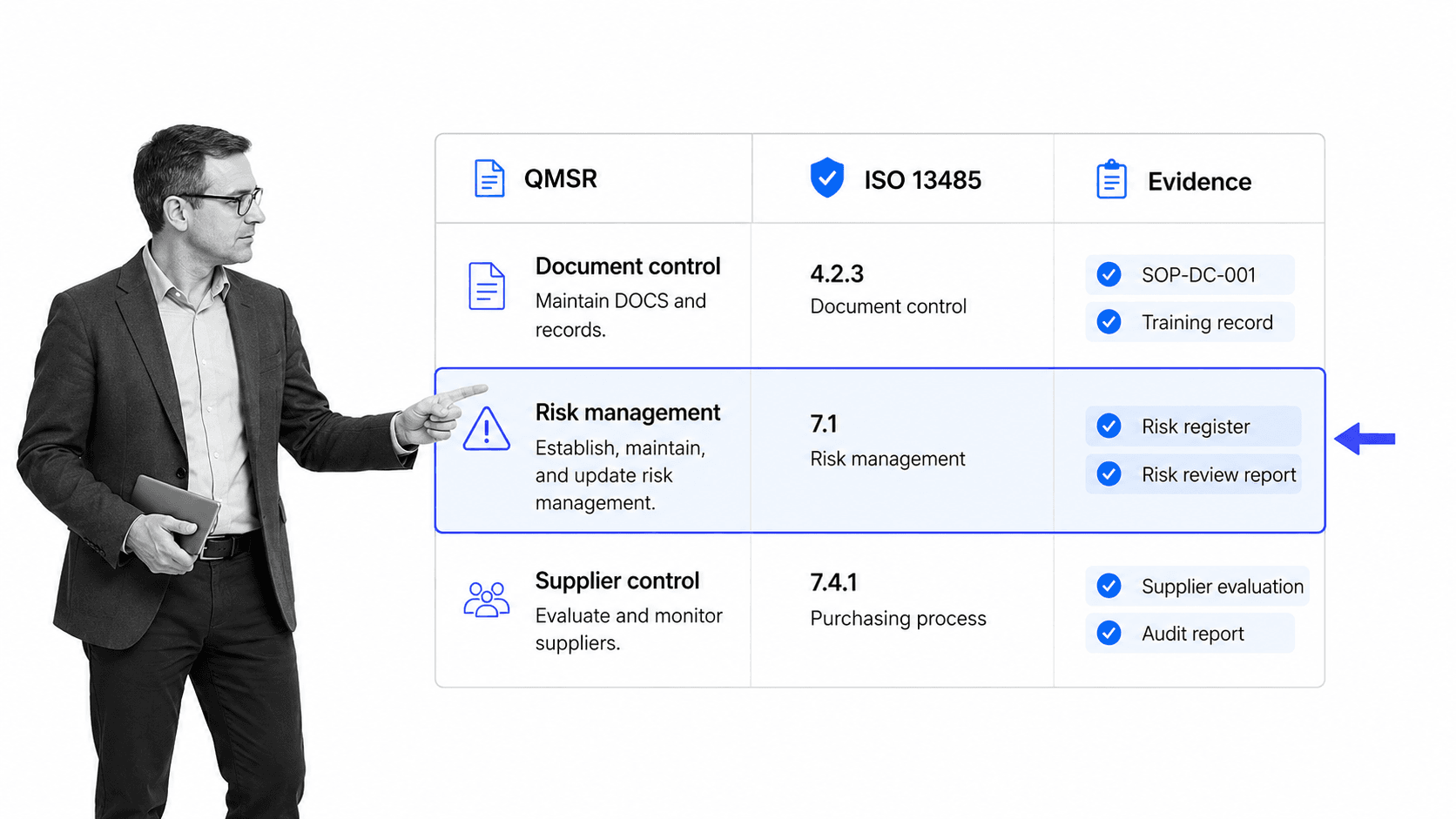
The FDA published the medical device Quality System Regulation amendments in the Federal Register final rule and the QMSR became effective on February 2, 2026. The change aligns FDA device CGMP requirements more closely with ISO 13485:2016 while retaining FDA authority and applicable U.S. regulatory requirements.
The practical message for quality teams is straightforward: build a QMS that can satisfy the ISO 13485 structure and still handle FDA-specific obligations. Do not treat the change as a paperwork rename. Treat it as a chance to connect regulatory requirements to controlled execution.
QMSR points teams toward harmonized quality systems
Harmonization matters because device companies often work across markets, suppliers, contractors, and product lines. A QMS built around internationally recognized requirements makes it easier to keep one controlled system instead of maintaining disconnected regional binders.
FDA requirements still control FDA-regulated work
ISO alignment does not remove U.S. obligations. FDA requirements, device-specific obligations, complaint records, medical device reporting, corrections and removals, unique device identification, and other applicable rules still have to be handled in the operating system.
Inspections now look for process evidence
A QMS should make it easy to trace an inspected process from requirement to procedure to work record. If an auditor asks how risk management connects to design changes, supplier controls, complaint trends, or CAPA, the team should not have to assemble screenshots and spreadsheets by hand.
Core processes in a medical device quality management system
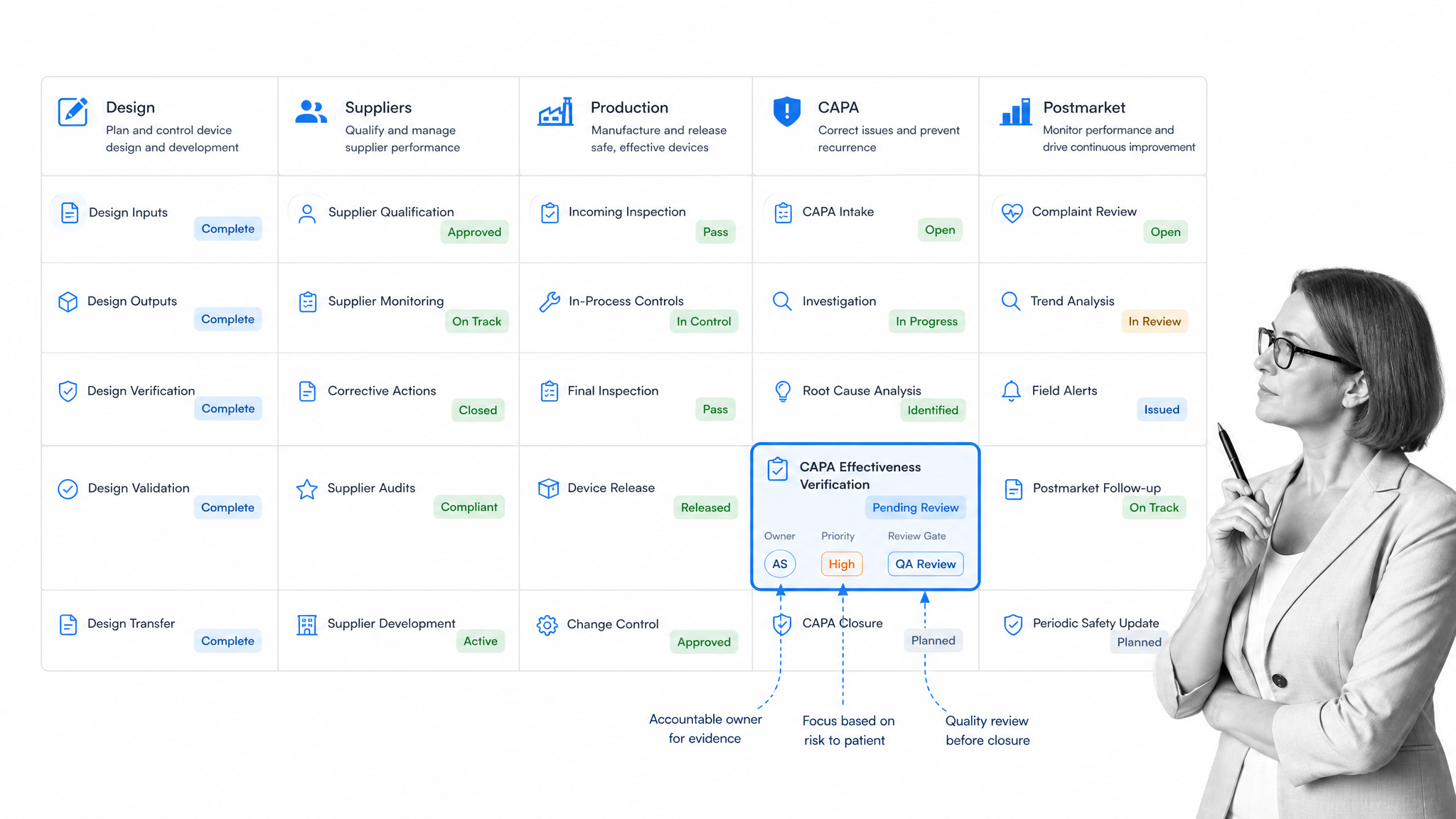
A strong QMS is a connected set of processes. Each process has an owner, approved procedure, inputs, outputs, required records, review cadence, and escalation path.
Document and record control
Document control keeps policies, procedures, forms, work instructions, specifications, and records under governance. Teams need clear ownership, version history, approval, release, retirement, and retrieval. Start with document control best practices if the document layer is scattered.
For medical device teams, document control is also where the practical ISO structure becomes visible. A team preparing for ISO 13485 implementation needs a controlled path for procedures, quality records, training evidence, and change history. If the company also manages a broader quality program, ISO 9001 quality management can help frame how quality objectives, process ownership, and management review fit together.
Design and development controls
Design controls connect user needs, design inputs, design outputs, design reviews, verification, validation, transfer, and changes. FDA design-control training describes design inputs as measurable requirements that address intended use, user needs, and conflicting or incomplete requirements. See the FDA design controls guidance for the regulatory context.
Risk management
Risk management should not sit in an isolated spreadsheet. It needs to connect to design decisions, supplier selection, production controls, complaints, postmarket data, and CAPA. When risk changes, the workflow should route the right review and evidence update.
Supplier controls
Medical device companies rely on suppliers, contract manufacturers, labs, service providers, and consultants. Supplier qualification, evaluation, audits, change notices, and nonconformance follow-up should be controlled. A supplier audit checklist can help standardize the assessment path.
Production and process controls
Production controls define how work is performed, inspected, released, and documented. The QMS should cover equipment readiness, validated processes where required, acceptance activities, labeling controls, traceability, and nonconforming product handling.
Complaint handling, CAPA, and postmarket feedback
Complaints, adverse events, corrections, removals, audit findings, nonconformances, and trend signals should feed improvement. CAPA is where the QMS proves it can learn. A CAPA workflow template gives teams a repeatable path for containment, investigation, root cause, action, verification, and closure.
Training and competence
Training records should prove that people understand the procedures they perform. The system should connect training to released procedures, role changes, retraining triggers, and effective dates so staff are not executing old standards.
Internal audits and management review
Internal audits test whether the QMS is working. Management review turns the evidence into decisions about resources, risks, trends, objectives, and improvement priorities. Both processes need structured agendas, assigned actions, due dates, and closure proof.
How to build a medical device quality management system
Building a medical device QMS is easiest when you start with the work, not with a document pyramid. The documents matter, but the goal is controlled execution that can survive real product changes, supplier issues, audits, and postmarket feedback.
Step 1: Define scope and applicable requirements
Start by documenting which sites, products, product stages, outsourced processes, and regulatory markets are in scope. Then identify applicable requirements: QMSR, ISO 13485, EU MDR or IVDR where relevant, customer requirements, product standards, and internal policies.
Step 2: Map the quality process architecture
Create a process map that shows how quality work flows. Include design controls, document control, training, suppliers, production, acceptance, nonconformance, complaints, CAPA, audits, and management review. The map should show handoffs and records, not just department names.
Do this before you buy or configure software. A useful map shows which workflow starts the record, which role owns the decision, what evidence is required, and what happens when a check fails. If your team needs a starting checklist, use an ISO 13485 checklist as a working scaffold, then adapt it to your product scope and regulatory markets.
Step 3: Write procedures that match the real workflow
Procedures fail when they describe an ideal process nobody follows. Interview the people doing the work, map the actual decision points, and write the controlled process around the required evidence. Then turn the procedure into assigned workflow steps.
Step 4: Build required records into execution
Do not rely on people to remember the record later. If a supplier review requires a risk rating, approval, audit result, and follow-up action, those fields should live inside the workflow. If design transfer requires evidence, the workflow should require the evidence before closure.
Step 5: Validate, train, and improve
Pilot each core workflow, check whether records are complete, train users on the live process, and review exceptions. The first version of a QMS rarely survives contact with daily work unchanged. Build the feedback loop into the system from the start.
Use a simple implementation sequence: launch one workflow, review the evidence it produces, fix missing fields, then expand. CAPA, supplier review, and medical device reporting are good candidates because they force the team to connect intake, investigation, review, and closure. A medical device reporting checklist can help standardize reporting intake while the broader QMS workflow handles downstream quality decisions.
Medical device quality management system in Process Street
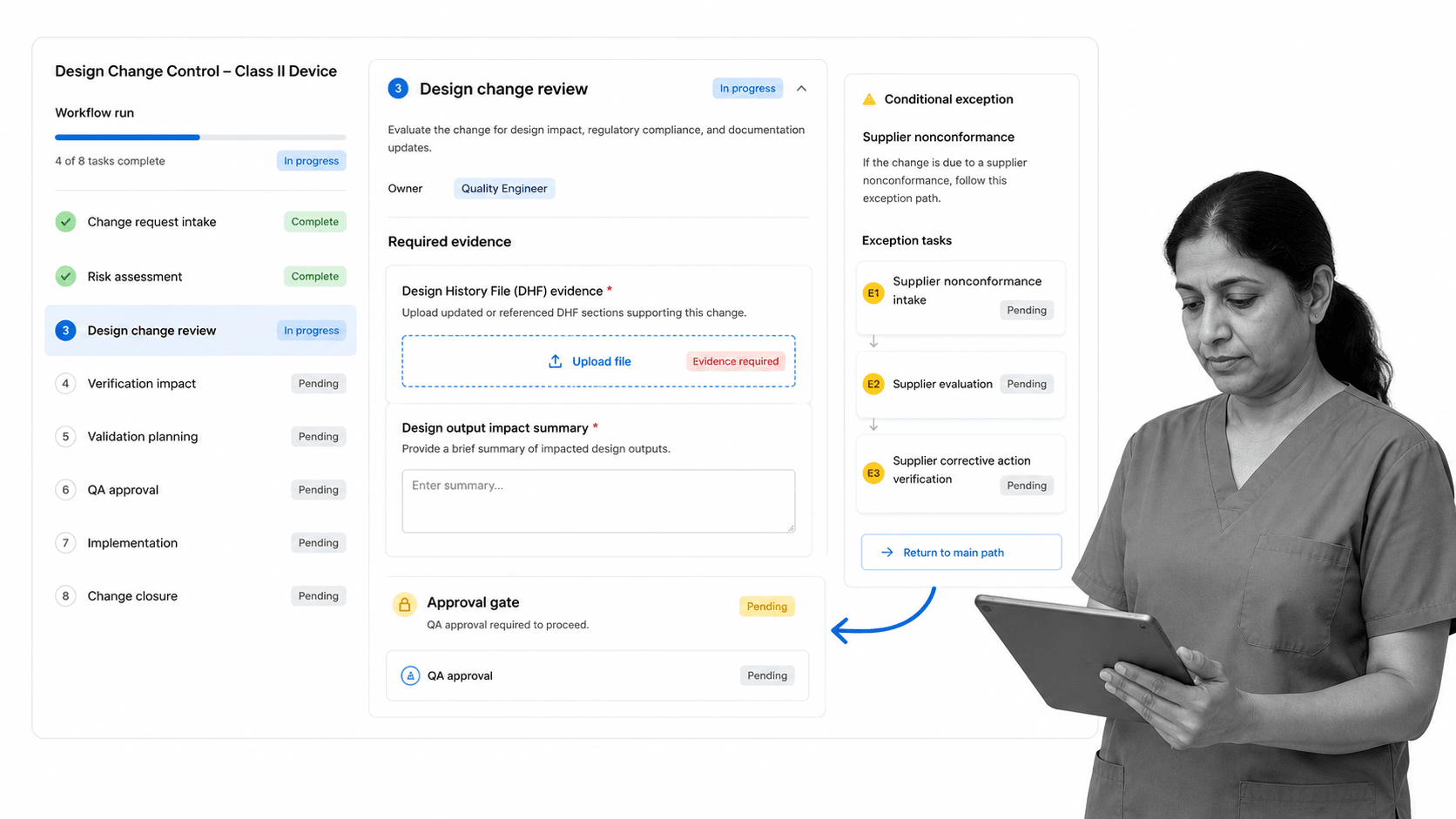
Process Street can support medical device quality workflows by turning procedures into assigned, auditable workflow runs. Teams can use it for SOP execution, document reviews, supplier assessments, CAPA, audits, training attestations, complaint intake, and recurring quality checks.
Process Street is a Compliance Operations Platform. That matters for a medical device quality management system because quality work is not just content storage. It is recurring execution with ownership, evidence, approvals, exception handling, and proof.
Run controlled procedures as workflows
A procedure becomes useful when the right person can launch it, follow the approved path, complete required fields, attach evidence, and route the next review. Workflow runs create a record of who did what, when it happened, and what evidence was captured.
Use conditional logic for exceptions
Medical device quality work branches constantly. A supplier risk change, failed acceptance check, design input gap, or complaint signal should open a different path. conditional logic lets a workflow reveal the right tasks based on the facts entered.
Use approvals for controlled sign-offs
Approvals help prevent uncontrolled closure. approvals can route design change reviews, supplier qualification, CAPA closure, audit reports, and document releases to the right reviewer before the workflow is complete.
Connect the QMS to surrounding systems
Process Street has direct, universal integrations to 5,000+ systems. Need a new one? An AI agent builds it on the fly. That helps quality teams connect workflow execution to the systems where forms, records, signatures, notifications, and reporting already live.
Start with one high-value workflow
Many teams begin with a process that already causes friction, such as CAPA, supplier review, training attestation, or audit prep. If the broader software category is the decision point, compare the operating model against quality management system software and electronic quality management system before you choose a system.
How to keep your medical device QMS audit ready
An audit-ready QMS is not one that looks polished the week before an inspection. It is one that produces usable evidence during normal work.
Keep records close to the process
Every required record should have a home. Design reviews, training acknowledgments, supplier decisions, production checks, nonconformances, CAPA verification, audit findings, and management review actions should be traceable from the workflow that created them.
This matters most when questions cross process boundaries. A complaint may connect to a design input, a supplier lot, a training gap, and a CAPA. If each record sits in a separate folder, the quality team has to rebuild the timeline. If the QMS records are linked through workflow execution, the timeline is already there.
Review exceptions on a cadence
Late tasks, repeated deviations, supplier issues, recurring complaint codes, and overdue CAPAs are signals. A healthy QMS routes them into review instead of letting them sit as background noise.
Make ownership visible
Every process needs an owner. Every open action needs an assignee. Every approval needs an accountable reviewer. Audit readiness improves when responsibility is visible before the audit begins.
Keep the QMS current
Regulations, product requirements, suppliers, and internal processes change. The QMS should have a predictable change-control path for procedure updates, training impact, effective dates, and retired versions.
A current QMS also needs living ownership. Procedure owners should know which workflows they maintain, quality leaders should see which records are incomplete, and management should see where open actions are aging. If an audit finding appears, the system should show whether the problem is a missing procedure, an unclear owner, weak training, or a workflow that lets people close work without evidence.
Use the QMS as an improvement loop
A medical device quality management system should help the organization improve product quality and process reliability. It should connect findings to actions, actions to evidence, and evidence to leadership review. That is how compliance management software becomes daily operating control instead of end-of-quarter cleanup.
The improvement loop is what separates a functioning QMS from a document archive. Complaints reveal patterns. Supplier issues reveal weak controls. Internal audits reveal gaps between written procedures and actual work. CAPA verifies whether the fix worked. Management review decides whether the system needs resources, process changes, or new quality objectives. When those steps live in connected workflows, leaders get a clearer view of quality health without waiting for an audit scramble.
FAQs
What is a medical device quality management system?
A medical device quality management system is the controlled set of policies, procedures, workflows, records, roles, and reviews that helps a device organization meet product, customer, and regulatory requirements. It covers work such as design controls, supplier controls, production checks, complaints, CAPA, training, audits, and management review.
Is ISO 13485 required for medical device companies?
ISO 13485 is the international quality management system standard for medical devices and is widely used for regulatory purposes. In the United States, FDA QMSR incorporates ISO 13485:2016 by reference, while FDA requirements and applicable U.S. regulations still control FDA-regulated work.
What changed when FDA QMSR became effective?
FDA QMSR became effective on February 2, 2026. It amended the device CGMP requirements in 21 CFR Part 820 and aligned the regulation more closely with ISO 13485:2016 while retaining FDA-specific requirements and oversight.
What processes belong in a medical device QMS?
A medical device QMS usually includes document control, design and development controls, risk management, supplier controls, production and process controls, training, complaint handling, CAPA, internal audits, and management review. The exact scope depends on the device, lifecycle stage, markets, and outsourced processes.
How do you keep a medical device QMS audit ready?
Keep records close to the process, make owners visible, require evidence during workflow execution, review exceptions regularly, and control changes to procedures and training. Audit readiness comes from normal operating evidence, not last-minute document collection.
Can Process Street support medical device quality workflows?
Yes. Process Street can run medical device quality workflows with assignments, required fields, conditional logic, approvals, evidence capture, recurring schedules, integrations, and audit history. It is useful when teams need quality procedures to be followed consistently and proven later.