Turn every policy into automated workflows with built-in enforcement and audit-ready proof.



SOX Compliance Checklist
A SOX compliance checklist is a structured way to plan, test, document, and remediate the controls that support Sarbanes-Oxley compliance. It gives finance, compliance, IT, and audit teams one operating path for scoping internal control over financial reporting, collecting evidence, reviewing exceptions, and preparing for management certification.
The checklist matters because SOX is not only a legal reporting requirement. It is a recurring operating system for financial trust. The SEC internal control reporting rule ties management reporting to internal control over financial reporting, and external auditors use PCAOB standards when they assess whether those controls are designed and operating effectively.
This guide gives you a practical SOX compliance checklist you can adapt for quarterly and annual cycles. It covers control scoping, Section 302 and 404 obligations, IT general controls, evidence, remediation, and how to run the work inside Process Street.
In this article, we are going to cover:
- What is a SOX compliance checklist?
- Who needs a SOX compliance checklist?
- SOX compliance checklist for internal controls
- SOX compliance checklist for ITGC and evidence
- How to run the SOX checklist
- Common SOX control gaps to watch
- How to run the SOX checklist in Process Street
- FAQs
What is a SOX compliance checklist?
A SOX compliance checklist translates Sarbanes-Oxley requirements into repeatable work. Instead of treating SOX as a binder of policies or a once-a-year audit scramble, the checklist breaks the program into tasks with owners, deadlines, evidence requirements, review points, and escalation paths.
The most common focus is Section 404, which requires management to assess internal control over financial reporting. For many issuers, the external auditor also attests to that assessment. The scope usually includes business process controls, entity-level controls, financial close controls, access controls, change management, reports used in control performance, and remediation evidence.
A strong checklist does not try to restate the whole law. It tells the team what to do next. That means the checklist should name the financial reporting process, the relevant risk, the control objective, the control owner, the evidence required, the testing method, the reviewer, the deficiency rating, and the remediation date.
What the checklist should prove
The checklist should prove that key controls are designed correctly, performed by the right owner, supported by reliable evidence, reviewed by an appropriate approver, and remediated when testing finds a gap. It should also prove that management has a defensible basis for certification, not just a stack of screenshots collected at the end of the audit cycle.
- The control exists and maps to a financial reporting risk.
- The owner performed the control during the period under review.
- The evidence is complete, dated, and tied to the control activity.
- Testing results are reviewed and signed off.
- Deficiencies are evaluated, remediated, and retested before close.
Who needs a SOX compliance checklist?
Public companies subject to Sarbanes-Oxley obligations need a SOX compliance checklist, but the day-to-day users are broader than the legal requirement suggests. Finance owns many controls. IT owns access, change, and system controls. Compliance manages the operating calendar. Internal audit often tests management controls. External auditors evaluate the work and decide what they can rely on.
Private companies preparing for an IPO, acquisition readiness, enterprise customer due diligence, or stronger financial governance can also use a SOX-style checklist. The exact statutory obligation may not apply yet, but the operating discipline is useful: document material processes, reduce manual errors, enforce review steps, and make evidence retrievable.
If your team is building a control program from scratch, start with the SOX Compliance Checklist template, then connect it to adjacent workflows like the Financial Audit Checklist, Internal Financial Audit Checklist, and Compliance Audit Checklist. The point is not more paperwork. The point is a consistent route from risk to control to proof.
The roles that need to be named
- Executive certifiers who depend on accurate financial reporting controls.
- Process owners in revenue, procure-to-pay, payroll, inventory, financial close, and tax.
- IT owners for identity access, change management, system operations, and interfaces.
- Control testers and reviewers who document design and operating effectiveness.
- Compliance or audit leaders who manage readiness, deficiency evaluation, and reporting.
SOX compliance checklist for internal controls

The heart of a SOX compliance checklist is the internal control matrix. The COSO Internal Control Framework is widely used for evaluating internal control because it gives teams a common language for control environment, risk assessment, control activities, information and communication, and monitoring. Your checklist should turn that framework into concrete, testable control work.
Start with significant accounts and disclosures, then identify the assertions that matter: existence, completeness, valuation, rights and obligations, presentation, and cutoff. Map each risk to a control. For example, revenue recognition risk may map to contract review, billing approval, system access, and journal entry review. Cash disbursement risk may map to segregation of duties, vendor approval, payment approval, and bank reconciliation.
This is where many teams lose control of the process. A spreadsheet can list controls, but it does not enforce performance. A workflow like the SOX 404 Compliance Checklist can assign owners, request evidence, route approvals, and keep an audit trail when work moves from design assessment to testing and remediation.
Control design checklist
- Define the financial reporting risk in plain language.
- Name the control objective and the control activity.
- Identify whether the control is preventive, detective, manual, automated, or IT-dependent.
- Name the control owner and reviewer.
- Define frequency, evidence, population, sample method, and pass criteria.
- Confirm the control addresses the risk at the right level of precision.
Operating effectiveness checklist
- Select the period and population for testing.
- Confirm the control happened on schedule.
- Inspect evidence for completeness, date, owner, and reviewer.
- Document exceptions and ask whether they are isolated or systemic.
- Route failed tests into remediation with owner, due date, and retest requirements.
SOX compliance checklist for ITGC and evidence
IT general controls matter because financial reporting often depends on systems. If the ERP, billing platform, payroll system, data warehouse, or close management tool can be changed without review, the business process control may not be reliable. Your SOX checklist should include ITGC work even when the main page owner sits in finance.
Typical ITGC areas include user access, privileged access, joiner and leaver reviews, change management, program development, backup and recovery, job processing, interface monitoring, and reports used by business controls. If a report is used as evidence, the team should know who owns it, where it comes from, whether it is complete and accurate, and how changes are controlled.
External auditor expectations are shaped by integrated audit standards such as PCAOB AS 2201. That does not mean every company needs a bloated test plan. It means the checklist should connect system risks to financial reporting risks, then preserve enough evidence to support the conclusion.
Evidence checklist
- Use source-system evidence when possible, not edited screenshots.
- Capture the date, owner, preparer, reviewer, and relevant system source.
- Tie evidence to the exact control and period tested.
- Keep populations and samples traceable.
- Record reviewer questions and final approval in the same workflow.
- Store remediation evidence next to the failed test, not in a separate folder.
How to run the SOX checklist
A SOX checklist should run as a cycle, not a document review. The cycle starts with scope and ends with management reporting, but it should also feed improvements into the next quarter. Treat each stage as a gate. If a gate fails, the work does not quietly move forward.
1. Scope significant processes
Identify the financial statements, significant accounts, systems, locations, and disclosures in scope. Use materiality, complexity, fraud risk, past deficiencies, process changes, and system changes to decide what deserves attention. Do not copy last year blindly. A new billing workflow, acquisition, ERP change, or outsourced process can change the risk picture.
2. Map risks to controls
Use a risk and control matrix, then connect it to practical audit work. The Risk Assessment Checklist and Process Risk Assessment Template are useful starting points because they force teams to name risks before they debate evidence. A checklist without risk mapping becomes activity tracking, not control assurance.
3. Test and review controls
For each control, define the population, sample, test procedure, and pass criteria before testing starts. Review evidence while there is still time to fix issues. If the team waits until year end, every missing approval and incomplete screenshot becomes a fire drill.
4. Evaluate deficiencies
Deficiencies need a consistent evaluation path. Decide whether each exception is a documentation issue, design gap, operating failure, significant deficiency, or potential material weakness. The SEC compliance and disclosure interpretations is a useful reminder that management reporting and auditor reporting are tied to the annual reporting package, so unresolved issues cannot be left vague.
5. Remediate and retest
Every failed control should have an owner, root cause, corrective action, due date, and retest plan. Retesting should verify both the fix and the evidence trail. A remediation plan that is not tested is only a promise.
Common SOX control gaps to watch
SOX failures are often operational before they become technical. The control may be well written, but the owner misses the deadline. The evidence may exist, but it is not tied to the sample. The reviewer may approve the task, but the review does not show what was checked. Your checklist should catch those gaps early.
The GAO report on SOX compliance costs found that SOX compliance costs are larger for larger companies but can be more burdensome for smaller companies. That reality makes process design important. The goal is not to add more review layers. The goal is to reduce rework by making ownership, evidence, and review expectations clear before testing starts.
Common checklist gaps
- Control owner is named, but backup owner is missing.
- Evidence is uploaded, but it does not show the full population.
- Reviewer signoff exists, but reviewer procedures are not documented.
- Access reviews are performed after the period under review.
- Change approvals happen after production release.
- Deficiencies are logged, but root cause and retesting are missing.
- Management certification depends on status summaries that are manually reconciled.
If your team is seeing these patterns, connect the SOX checklist to broader compliance operating work. The compliance audit guide, internal audit basics, and GRC tools guide can help you compare audit cadence, ownership models, and tooling options without turning SOX into a standalone silo.
How to run the SOX checklist in Process Street
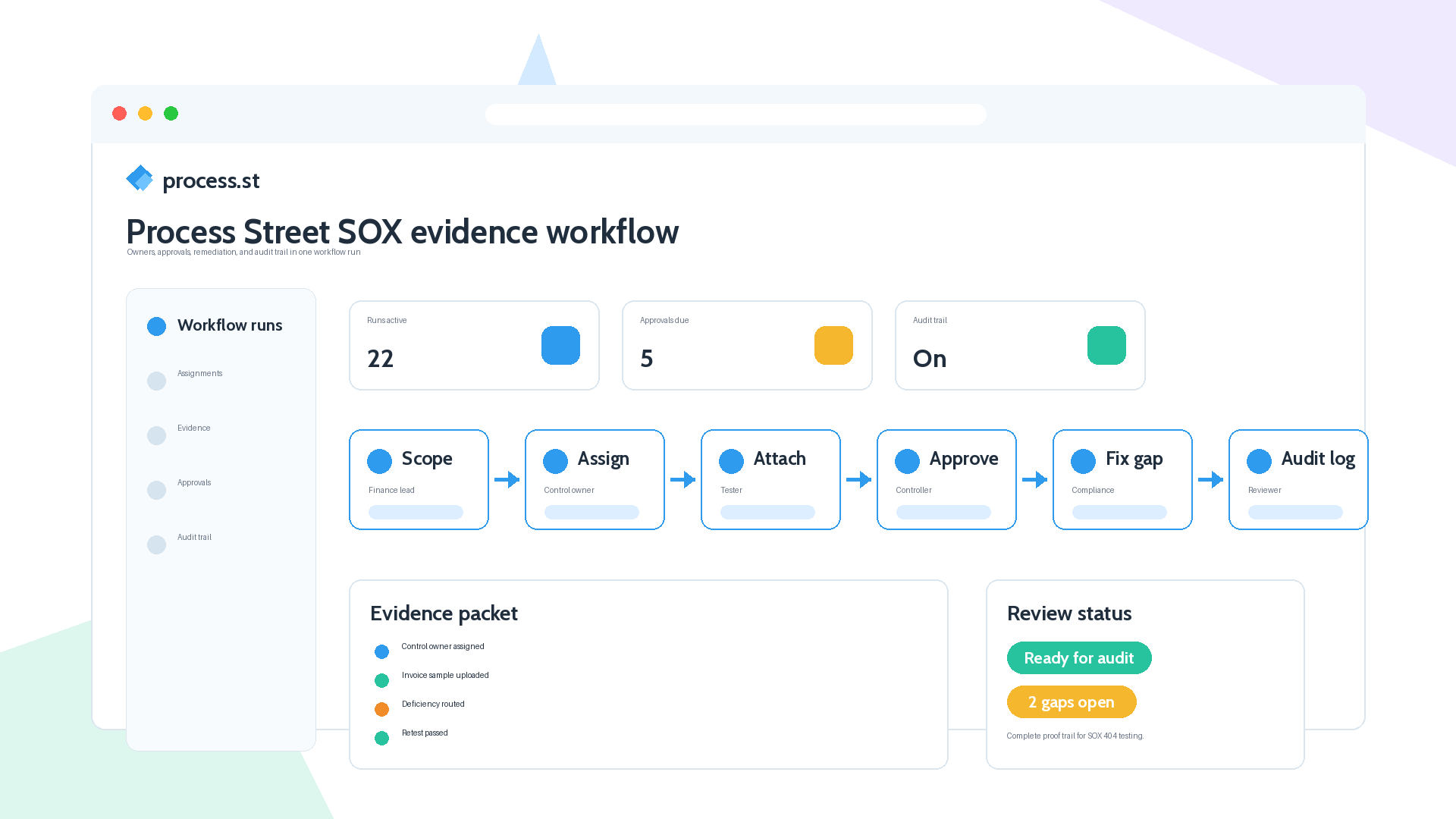
In SOX compliance software, the checklist becomes a live operating workflow. Each control task has an owner, due date, required fields, evidence upload, conditional logic, approval, and audit trail. That matters because SOX evidence is only useful if you can prove who did what, when they did it, what they reviewed, and what changed afterward.
A practical setup starts with one workflow per recurring SOX cycle, then branches by process area. Revenue, procure-to-pay, payroll, close, access review, and change management can each have their own task groups. Compliance owns the calendar. Control owners complete tasks. Reviewers approve or reject. Failed controls create remediation tasks automatically.
For teams building a connected compliance program, compliance automation software and automate compliance monitoring help move beyond static status tracking. Instead of asking for updates in email, the workflow records the status as work happens. Instead of manually assembling evidence, the checklist keeps evidence attached to the exact control and review step.
Process Street setup checklist
- Create one master SOX calendar with quarterly and annual milestones.
- Build separate workflows for business process controls and ITGCs.
- Use required fields for evidence, population, sample, exception, and reviewer notes.
- Add approvals for test results, deficiency evaluation, remediation, and final report.
- Use conditional logic to trigger retesting when a control fails.
- Keep the audit trail intact so management and auditors can see the full history.
You can start from the SOX Compliance Audit Checklist when you need a dedicated audit cycle, then connect it to the Compliance Audit Checklist for broader compliance reporting. The checklist becomes much stronger when it is not a file someone has to remember to update. It becomes the place where the work actually happens.
FAQs
What is included in a SOX compliance checklist?
A SOX compliance checklist usually includes scoping, risk assessment, control mapping, control owner assignments, evidence collection, testing, review, deficiency evaluation, remediation, retesting, and management reporting. It should cover business process controls and IT general controls that affect financial reporting.
How often should SOX controls be tested?
Many SOX programs test controls quarterly, annually, or on a frequency tied to the control itself. High-risk controls, changed controls, and controls with prior deficiencies usually need closer attention. The checklist should state the frequency before testing begins.
Who owns SOX compliance?
Management owns SOX compliance, but the work is shared across finance, IT, compliance, internal audit, legal, and process owners. Executive certifiers depend on those teams to maintain reliable controls and evidence. The checklist should name each owner and reviewer clearly.
What is the difference between SOX 302 and SOX 404?
Section 302 focuses on executive certification of periodic reports and disclosure controls. Section 404 focuses on management assessment of internal control over financial reporting, with auditor attestation required for many issuers. A good checklist supports both by connecting control work to management reporting.
How does Process Street help with a SOX compliance checklist?
Process Street turns a SOX compliance checklist into assigned, trackable work. Teams can route approvals, require evidence, trigger remediation, record reviewer notes, and preserve the audit trail. That gives compliance leaders proof that controls were performed and reviewed on schedule.
Can a SOX checklist replace professional audit judgment?
No. A checklist structures the work, but management, internal audit, external auditors, and legal or accounting advisors still need to apply judgment. The checklist helps make that judgment easier to support because the evidence and decision trail are organized.