Turn every policy into automated workflows with built-in enforcement and audit-ready proof.



Wealth Management Service
A wealth management service coordinates financial advice, investment oversight, planning, implementation, and ongoing review around a client’s full financial life. The value is not one isolated recommendation. It is a managed relationship that keeps goals, decisions, actions, specialists, and evidence moving together.
For clients, that can mean fewer disconnected conversations about investments, retirement, taxes, insurance, estate intentions, business interests, and major life events. For a wealth management firm, it means delivering the promised service consistently across advisors, operations teams, compliance reviewers, and outside professionals.
This guide explains what the service includes, how common delivery models differ, what to ask before choosing a provider, and how firms can turn a service promise into a repeatable operating system. It is not a ranking of wealth management companies or investment products.
In this article, we are going to cover:
- What a wealth management service is
- What a wealth management service includes
- How a wealth management service works
- Wealth management service delivery models
- How to evaluate a wealth management service
- How firms standardize wealth management service delivery
- Run wealth management service delivery in Process Street
- FAQs
What a wealth management service is
A wealth management service is an ongoing advisory relationship that connects a client’s priorities to coordinated financial decisions and follow-through. It is broader than a portfolio report and more continuous than a one-time financial plan.
The service combines advice and execution
Advice answers what should change and why. Execution assigns the next action, gathers the required document, routes a decision for review, coordinates another professional, and confirms that the work happened. A service is incomplete when the recommendation ends in a meeting note with no owner or completion record.
Wealth management is wider than investment management
Investment management concentrates on portfolio construction, trading, monitoring, and risk. Wealth management places those activities inside a wider picture that can include cash flow, retirement, tax coordination, insurance, estate planning, philanthropy, business ownership, family governance, and intergenerational decisions.
A structured wealth management planner records those goals and constraints. The service turns that record into recurring work across the client relationship.
The relationship changes as the client changes
A new client may need discovery, account transitions, document collection, and a baseline plan. A long-standing client may need annual review, retirement income decisions, estate coordination, concentrated-position monitoring, or support through a business sale. The service should adjust without losing its standard of care.
Service scope should be explicit
The label wealth management does not guarantee a particular set of services. Clients should ask what is included, what requires a separate engagement, who delivers each part, how often the relationship is reviewed, and how the provider coordinates with attorneys, accountants, insurers, and custodians.
The operating model should also state how urgent requests are triaged, who provides backup coverage, and when clients receive progress updates.
What a wealth management service includes
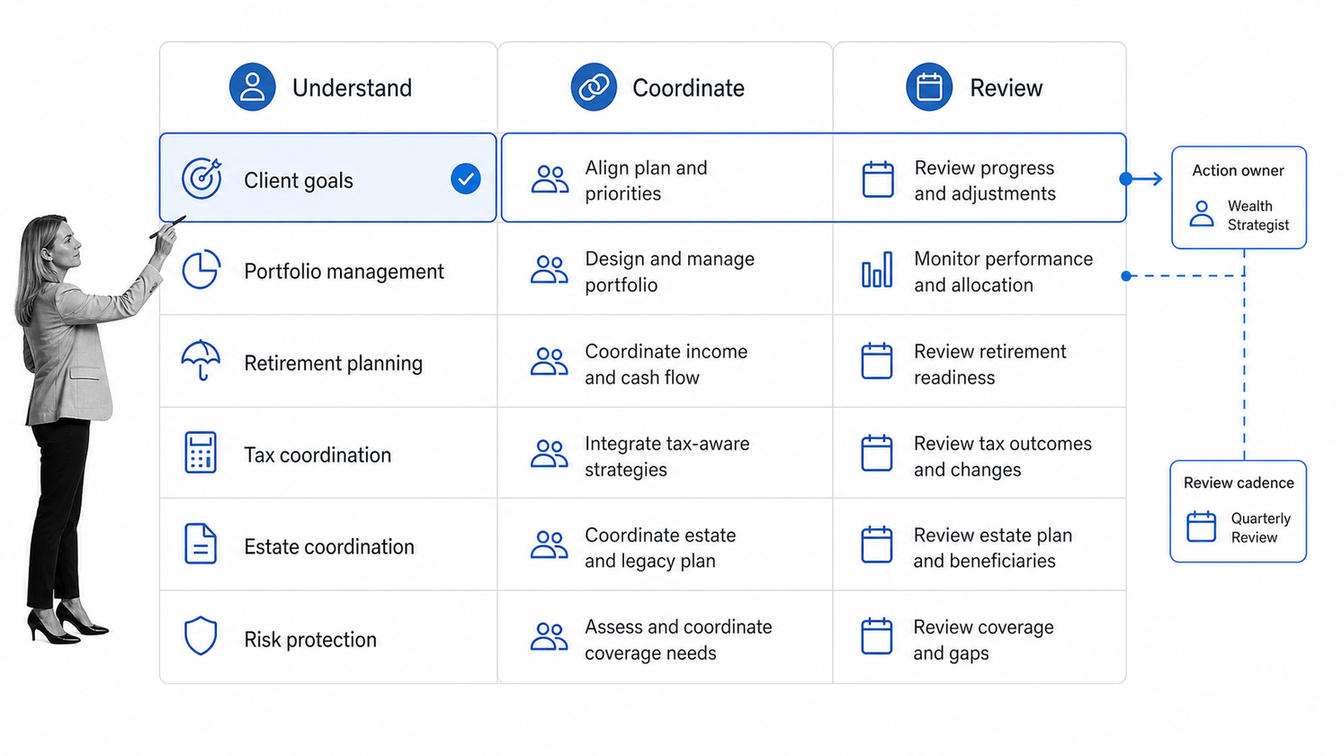
A comprehensive service should connect several domains without pretending every household needs the same depth. The useful test is whether each included domain leads to a clear decision, owner, or monitoring rule.
Discovery and household context
Discovery covers the people, entities, accounts, income sources, liabilities, business interests, outside professionals, decision-makers, and family relationships that affect the work. It should also clarify which information is authoritative and how stale data will be refreshed.
Goals and financial planning
Goals need priority, timing, dependencies, and success conditions. Retirement, education, liquidity, philanthropy, a business transition, a home purchase, or family support all create different tradeoffs. The plan should show what assumption drives the recommendation and what event would trigger another review.
Investment management
The service may include asset allocation, security or fund selection, account location, rebalancing, cash management, performance review, and risk monitoring. Clients should understand the investment approach, the role of discretion, the benchmarks used, and how portfolio decisions connect to the wider plan.
Retirement and cash-flow coordination
Retirement work can include savings rates, benefit timing, distribution planning, liquidity reserves, income sequencing, and scenario updates. The service should translate analysis into actions and review points rather than leaving a client with projections but no implementation path.
Tax, estate, and insurance coordination
A wealth manager may coordinate around taxes, estate documents, trusts, insurance coverage, and ownership structures without providing legal or tax advice directly. The service should state where coordination ends, which outside professional owns the advice, and how decisions flow back into the client plan.
Risk, protection, and special situations
Concentrated assets, business ownership, borrowing, changing health, family obligations, cyber risk, fraud exposure, and major life events can create work outside a standard annual review. A mature service defines which events trigger escalation and which specialist or reviewer joins the case.
Client reporting and communication
A wealth management portal can centralize documents, messages, and status. It does not replace a service process. The firm still needs a reliable way to capture requests, assign work, approve decisions, and close the loop with the client.
Focused wealth management checklists help the team execute discovery, reviews, transfers, and evidence checks consistently. They work best when tied to one shared service record rather than scattered across personal task lists.
How a wealth management service works
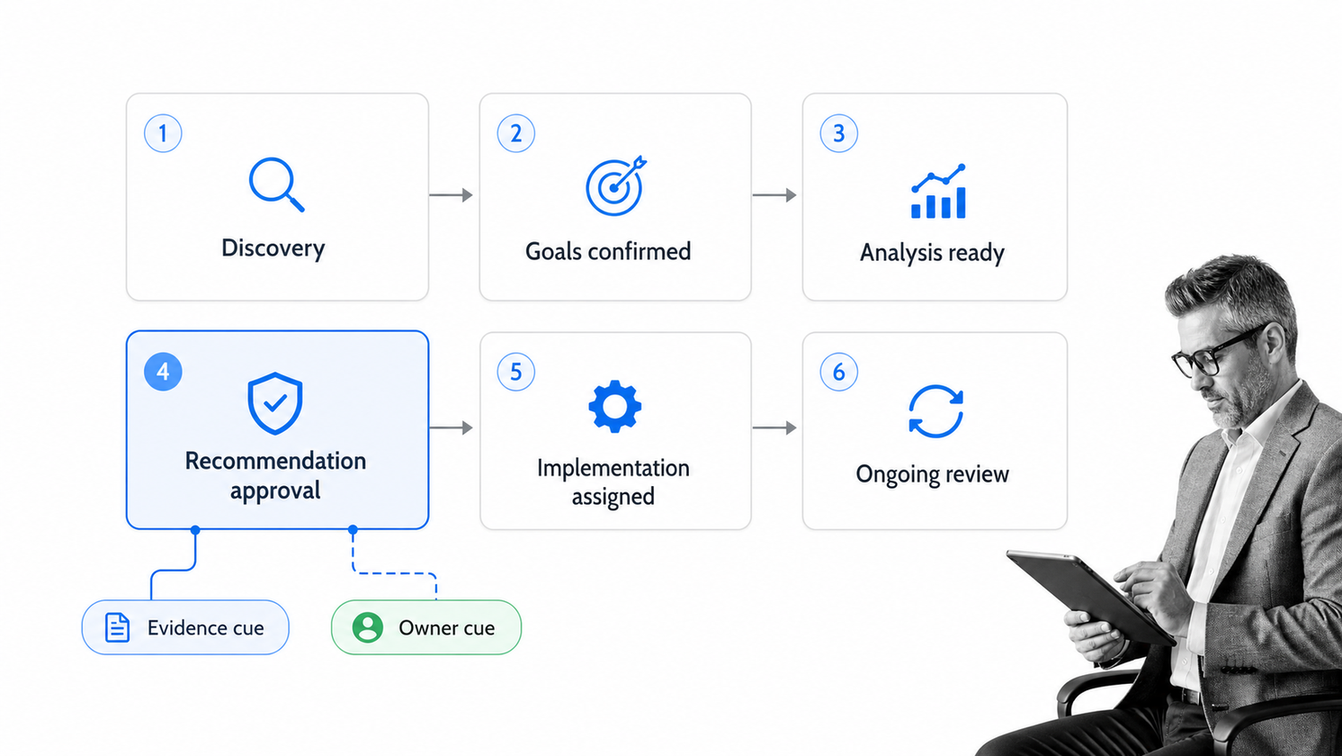
The client sees meetings, recommendations, updates, and completed actions. Behind those moments is a service lifecycle that moves information through defined stages.
1. Discover the client situation
The firm collects goals, constraints, documents, account information, relationships, and service expectations. A good discovery process distinguishes verified facts from open questions and records the source of each material input.
2. Confirm goals and scope
The advisor confirms what the client wants to achieve, which services are included, what the firm will coordinate, and which decisions need another professional. This prevents an implied promise from expanding silently during the relationship.
3. Analyze options
The team evaluates scenarios, tradeoffs, risks, and dependencies. Facts, analysis, and recommendations should remain distinct so a changed input cannot silently alter a conclusion without review.
4. Present and approve recommendations
The client receives a clear recommendation, supporting rationale, material assumptions, implementation steps, and any relevant conflicts or limitations. Internal approvals should concentrate on higher-risk, unusual, or exception-driven decisions rather than slowing every routine task.
5. Implement and coordinate
Accepted recommendations become assigned actions. Each action needs one owner, a due condition, required evidence, and a completion state. The owner may be the advisor, operations team, client, custodian, accountant, attorney, insurer, or another specialist.
A financial services client onboarding template can provide the initial structure for collecting information and coordinating early handoffs.
6. Monitor and review
Scheduled reviews protect coverage. Event-driven reviews protect relevance. The service should monitor open actions, changed assumptions, plan drift, portfolio or risk conditions, and client events that justify an earlier conversation.
Well-designed wealth management workflows make that lifecycle visible to every role without forcing the client to repeat information at each handoff.
Wealth management service delivery models
Wealth management services can be delivered through several operating models. The best fit depends on the complexity of the client’s needs, preferred relationship, service scope, technology comfort, and how much coordination is required.
Dedicated advisor relationship
A dedicated advisor or team can provide continuity and context across decisions. Ask who will handle daily requests, which specialists are available, how coverage works during absences, and how the firm prevents service quality from depending on one person’s memory.
Team-based or specialist model
Some firms combine a lead advisor with investment, planning, tax, estate, insurance, or operational specialists. This can deepen expertise, but it also increases handoffs. The client should know who owns the overall relationship and how specialist decisions are reconciled.
Digital or hybrid model
Digital platforms can make account access, communication, planning updates, and routine service more convenient. Hybrid models combine those tools with human advice. Evaluate the quality of the actual service process, not only the polish of the portal or dashboard.
Private wealth and family-office style service
More complex households may need deeper coordination across entities, trusts, businesses, philanthropy, governance, reporting, and multiple professional teams. Scope, decision rights, privacy, and information-sharing controls become more important as the service network expands.
The surrounding wealth management technology should support the chosen model without fragmenting the client experience across disconnected systems.
How to evaluate a wealth management service
Choosing a service requires more than comparing investment returns or brand recognition. Evaluate the relationship, operating model, disclosures, controls, and evidence behind the client experience.
Verify the firm and professionals
Use FINRA BrokerCheck guidance to research registration, employment history, qualifications, and disclosures for firms and financial professionals. Confirm the legal entity and individual who will actually serve the account.
Understand services, obligations, and conflicts
The SEC standards of conduct and Form CRS hub explains the standards and relationship-summary framework intended to help retail investors compare brokerage and advisory offerings. Read the provider’s current disclosures and ask how conflicts are identified, managed, and communicated.
Read the relationship summary
The SEC Form CRS guidance describes Form CRS as a short disclosure designed to help retail investors compare firms’ services. Use it as a starting point, then ask for plain-language answers about fees, account minimums, services, products, disciplinary history, and conflicts.
Ask how the fiduciary obligation applies
The CFP Board Code and Standards states that a CFP professional must act as a fiduciary when providing financial advice to a client. Credentials, registration, service capacity, and applicable obligations can differ, so ask who owes which duty in the actual relationship.
Compare service depth, not labels
- Which planning and investment services are included?
- Who is the primary owner of the relationship?
- Which specialists are available, and when are they involved?
- How are recommendations approved and implemented?
- How often are plans, portfolios, and open actions reviewed?
- What events trigger an unscheduled review?
- How are tax, legal, insurance, and custodial professionals coordinated?
- How are client data, documents, approvals, and decisions protected and retained?
Understand the complete fee arrangement
Ask for every direct and indirect cost that can affect the relationship, including advisory fees, product expenses, transaction costs, custody costs, planning charges, implementation charges, and compensation from third parties. Then ask what services and review cadence those fees cover.
Test the operating experience
Ask the provider to explain what happens after a recommendation is accepted, how open actions are tracked, how urgent requests are handled, how another team member gets context, and how the firm proves that a required review occurred. Clear operations are part of service quality.
Also ask how the provider measures service quality, resolves recurring delays, and updates its process when client needs or regulatory expectations change.
How firms standardize wealth management service delivery
A firm cannot scale a high-trust service on advisor memory alone. Standardization should protect the client promise while leaving room for judgment and complexity.
Define the service standard
Document the triggers, required inputs, decision points, ownership rules, review requirements, evidence, communication commitments, and escalation paths for each recurring service event. Start with onboarding, annual review, money movement, beneficiary change, account opening, complaint handling, and client offboarding.
Build controlled variation
Use conditional logic to route routine, complex, and exception cases through different steps without maintaining separate informal processes. The common standard remains visible while the route adapts to the facts.
Place approvals where errors concentrate
Use approvals for decisions that should not proceed without accountable review. Avoid adding an approval to every task. Gates should protect material changes, conflicts, exceptions, sensitive transfers, or incomplete evidence.
Measure exceptions and rework
Patterns in financial workflows reveal where work stalls: missing documents, unclear ownership, repeated client follow-up, rejected approvals, or broken system handoffs. Improve the service design instead of repeatedly rescuing individual cases.
Run wealth management service delivery in Process Street
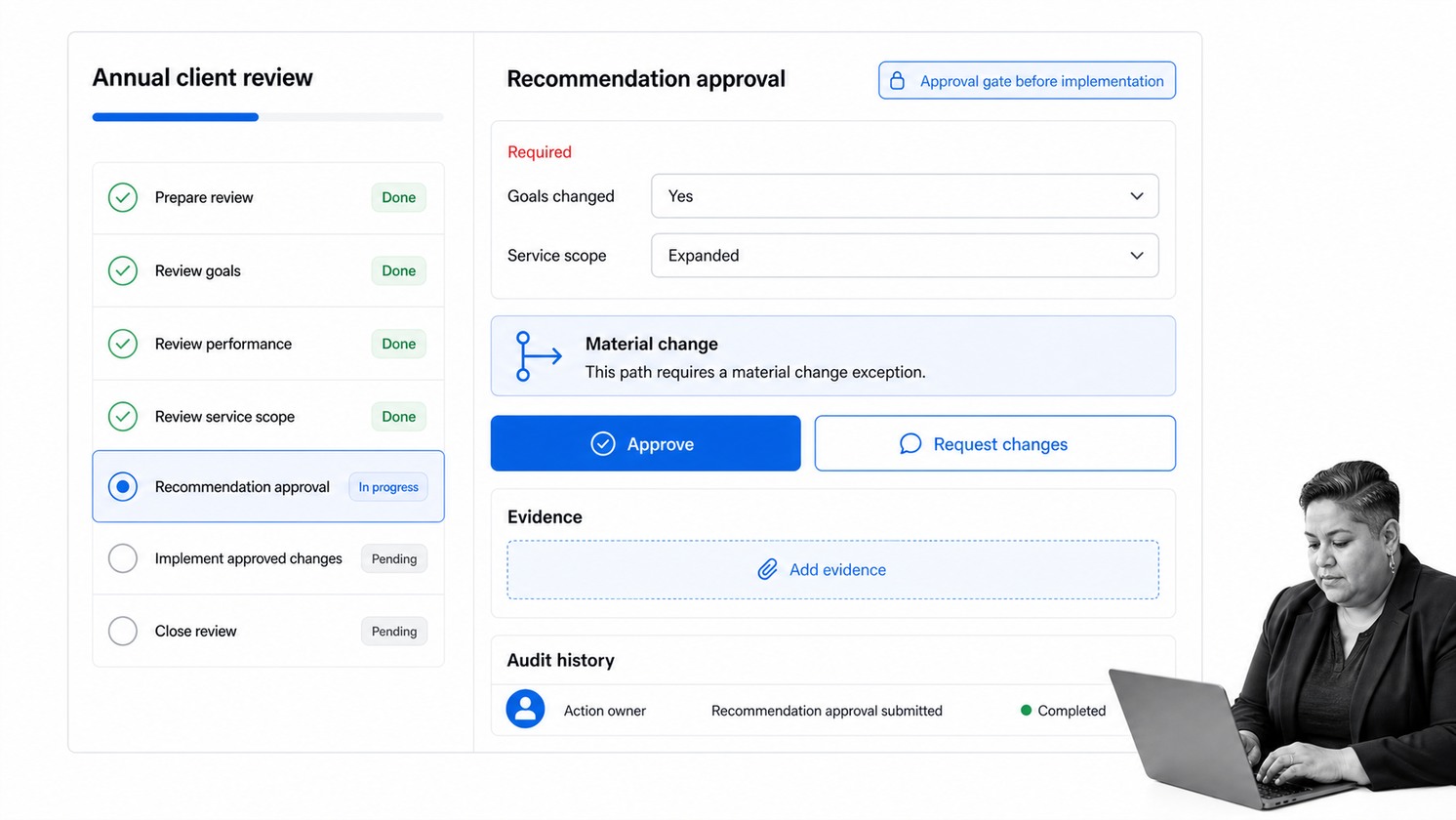
Process Street is an Agentic Process Automation platform for high-stakes operations. Wealth management firms can turn service standards into assigned workflows that coordinate people, systems, approvals, evidence, and follow-through.
Run each service event as a workflow
Teams can create workflows for prospect qualification, client onboarding, annual reviews, account changes, document requests, money movement, beneficiary updates, planning follow-up, complaints, and offboarding. Every run carries its own context, actions, and history.
Require complete information
Required fields and files can prevent a task from moving forward without the client objective, service scope, evidence, owner, or decision state needed by the next role. That reduces repeated requests and weak handoffs.
Route complex cases to the right reviewer
Conditional paths can keep routine work moving while sending material changes, missing evidence, unusual requests, or higher-risk scenarios to a specialist or compliance reviewer. The firm preserves one service standard without forcing every client through the same route.
Coordinate the wealth technology stack
Process Street has direct, universal integrations to 5,000+ systems. Need a new one? An AI agent builds it on the fly. That supports wealth management integration across CRM, portfolio, planning, document, communication, and reporting tools while the workflow remains the system of action.
Create proof as work happens
Assignments, field values, files, comments, approvals, automation events, and completion states create an operating record during service delivery. Managers can inspect the current state without reconstructing the story from email.
A wealth advisory operations case study shows how structured workflows expanded advisor capacity, while a fiduciary workflow case study shows how defined processes reduced operational errors.
Keep AI inside the control environment
AI can summarize requests, classify documents, prepare task suggestions, and detect missing information. The NIST AI Risk Management Framework offers a useful governance frame: define the use, assess the risk, measure performance, and keep accountable oversight around consequential outputs.
FAQs
What is a wealth management service?
A wealth management service is an ongoing advisory relationship that coordinates financial planning, investment management, implementation, and review around a client’s wider financial life. The exact scope varies, so clients should confirm which services, professionals, and review activities are included.
What does a wealth management service include?
It can include goals-based planning, portfolio management, retirement planning, cash-flow coordination, tax and estate coordination, insurance and risk review, philanthropy, business-owner planning, reporting, and ongoing service. A provider may deliver some activities directly and coordinate others with outside professionals.
How is wealth management different from financial planning?
Financial planning organizes goals, assumptions, scenarios, and recommendations. Wealth management usually wraps that planning inside a broader ongoing service that can also include investment management, implementation, specialist coordination, monitoring, and recurring review.
How much money do you need for a wealth management service?
There is no universal minimum. Providers use different account minimums, planning fees, service tiers, and client profiles. Ask each provider for its current eligibility rules, complete fee arrangement, included services, and available alternatives if you do not meet the standard minimum.
How do you evaluate a wealth management service?
Verify the firm and professionals, review Form CRS and other disclosures, understand services and fees, ask how applicable duties and conflicts are handled, and test the operating experience. The provider should be able to explain ownership, approvals, implementation, communication, review cadence, and evidence clearly.
How can Process Street support wealth management service delivery?
Process Street can run recurring client service as assigned workflows with required fields, conditional routes, approvals, evidence, integrations, and audit history. That helps wealth management firms deliver a consistent service while preserving room for professional judgment and complex client needs.