Turn every policy into automated workflows with built-in enforcement and audit-ready proof.



Wealth Management Portal
A wealth management portal is a secure digital workspace where clients, advisors, operations teams, and compliance teams exchange information, track requests, share documents, and move client work forward.
The best portals are not just login pages. They connect client-facing convenience with the internal workflows that make advice operations reliable: document collection, service requests, account updates, approvals, messaging, evidence, and audit history.
This guide explains what a wealth management portal should include, why it matters, how to build the operating model behind it, and how workflow automation keeps the portal from becoming another disconnected inbox.
In this article, we are going to cover:
- What a wealth management portal is
- Why wealth management portals matter now
- What a wealth management portal needs to include
- How to build a wealth management portal operating model
- Wealth management portal compliance and security
- Wealth management portal workflows in Process Street
- How to evaluate a wealth management portal
- FAQs
What a wealth management portal is
A wealth management portal is the client access point for the digital advice relationship. Clients use it to review account information, upload documents, send secure messages, complete requests, access planning materials, and see what the firm needs from them.
For the firm, the portal should be more than a front-end screen. It should connect to the advisor, operations, and compliance work that happens after a client submits something. If a client uploads a trust document, changes an address, adds a trusted contact, or asks about a distribution, the portal should trigger a controlled process.
Client convenience is only the visible layer
Clients judge the portal by speed, clarity, and ease of use. They want one place to find documents, understand requests, send information securely, and avoid repeating themselves across email, phone, and paper forms.
Vendor portal examples such as the Envestnet client portal overview and eMoney client portal overview show the common client-facing jobs: account access, document sharing, financial planning context, and communication.
Advisor workflow is the hidden layer
A portal creates value only when the request moves somewhere useful. Someone has to review the upload, validate the client, check the correct form, route an approval, update the system of record, and confirm completion.
That is where broader wealth management technology matters. The portal is one part of a bigger operating stack that includes CRM, planning tools, portfolio systems, document storage, workflow automation, reporting, and compliance evidence.
Compliance proof is the control layer
Wealth firms need to know what happened, who reviewed it, when the client was contacted, and which evidence supported the decision. A portal should not erase that trail by pushing sensitive work into informal messages.
The operating model should capture the request, assign the owner, collect the required fields, route approvals, and preserve the evidence. That is how the portal becomes part of the control environment instead of a separate client app.
Why wealth management portals matter now
Wealth management portals matter now because client expectations, advisor capacity, cybersecurity risk, and AI adoption are changing at the same time.
Clients expect secure self-service
Clients already use digital portals in banking, insurance, healthcare, and tax workflows. They expect the same convenience from a wealth firm, especially for document exchange, account visibility, meeting prep, and service requests.
A portal can reduce status calls and email threads, but only when the client can see clear next steps. If the portal simply stores files without triggering work, the client still ends up chasing the advisor.
Advisor teams need capacity
Advisor capacity is often lost to small operational tasks: checking whether forms arrived, sending reminder emails, copying data into another system, searching for prior approvals, and asking compliance where a request stands.
A wealth management portal can remove that drag when it routes requests into a repeatable process. The client sees a simple request. The firm sees a workflow with owners, due dates, evidence, and escalation paths.
AI makes workflow accountability more important
AI can summarize client messages, classify documents, draft follow-up, and suggest next steps. That speed is useful, but it raises a governance question: what did the AI touch, what did a human approve, and where is the record?
The NIST AI Risk Management Framework gives teams a useful reference point for AI risk thinking. Inside a wealth management portal, AI should operate inside controlled workflows, not as an untracked layer outside the process.
What a wealth management portal needs to include
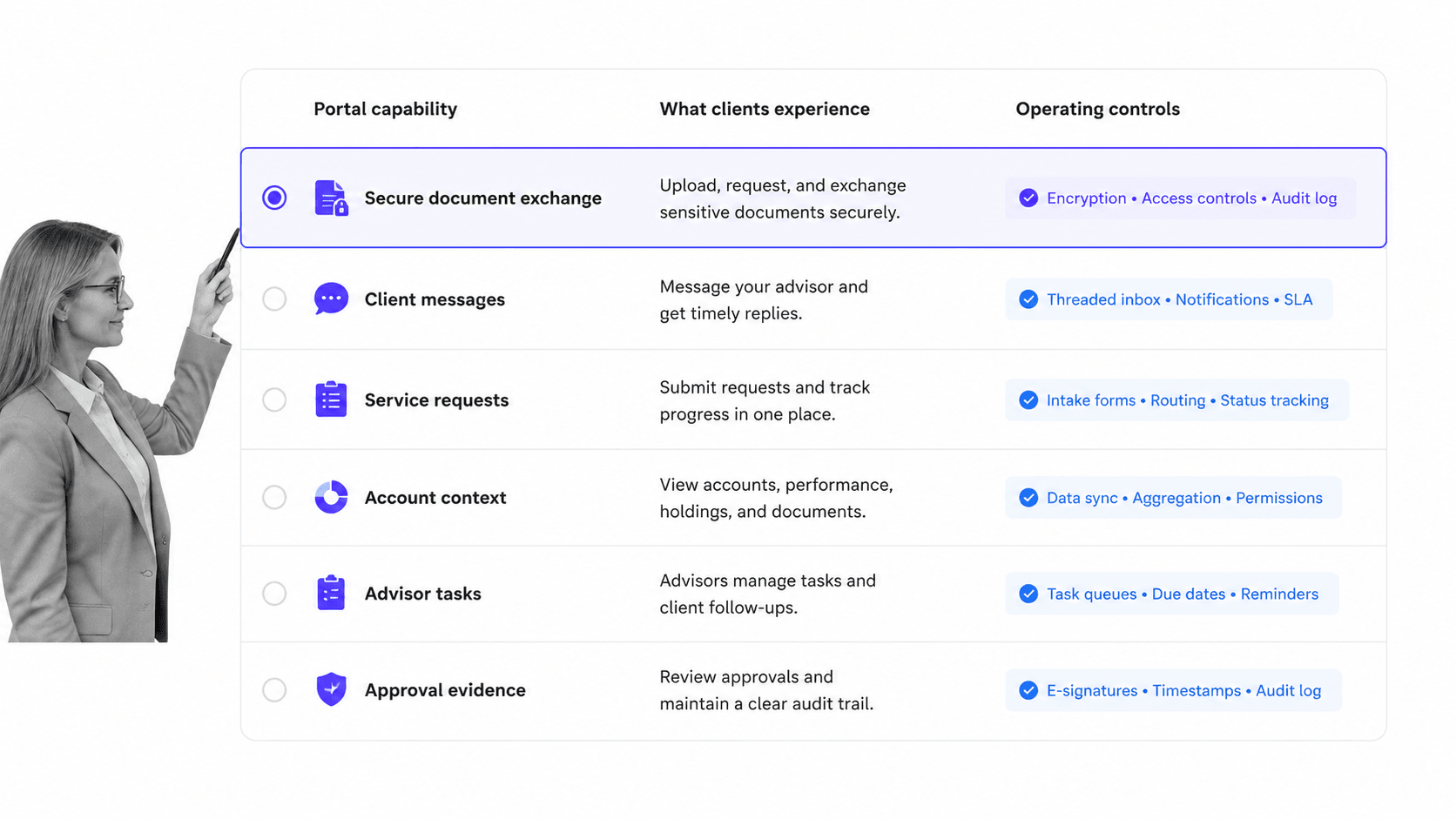
A wealth management portal should include client-facing features and internal control features. The client sees a clean workspace. The firm needs a reliable operating model behind it.
Secure document exchange
Document exchange is often the portal’s first job. Clients need a secure place to upload tax forms, IDs, trust documents, beneficiary updates, signed agreements, statements, and supporting evidence.
The workflow behind the upload matters. Each document should map to a request type, owner, review rule, retention need, and completion state. Otherwise the portal becomes a file drop.
Client messaging and service requests
Messages should not turn into an unstructured queue. A good portal lets clients ask for account updates, distribution requests, address changes, meeting prep, document help, or planning follow-up in a way that routes to the right team.
Many of those jobs overlap with client onboarding. A repeatable request flow prevents the firm from reinventing the handoff every time a client asks for help.
Account and planning context
Clients should be able to see relevant account, planning, and service context without being overwhelmed. The portal should clarify what is current, what needs action, and what the firm has already received.
That broader context connects to the wealth management platform strategy. A portal is useful when it sits inside the firm’s operating stack rather than beside it.
Approvals, audit history, and exception handling
The portal should support approvals and audit history for client-sensitive work. If a request requires supervisor approval, compliance review, or operations verification, the workflow should make that dependency explicit.
Related guidance on compliance as proof of control explains why proof should be created while the work happens, not assembled later.
How to build a wealth management portal operating model
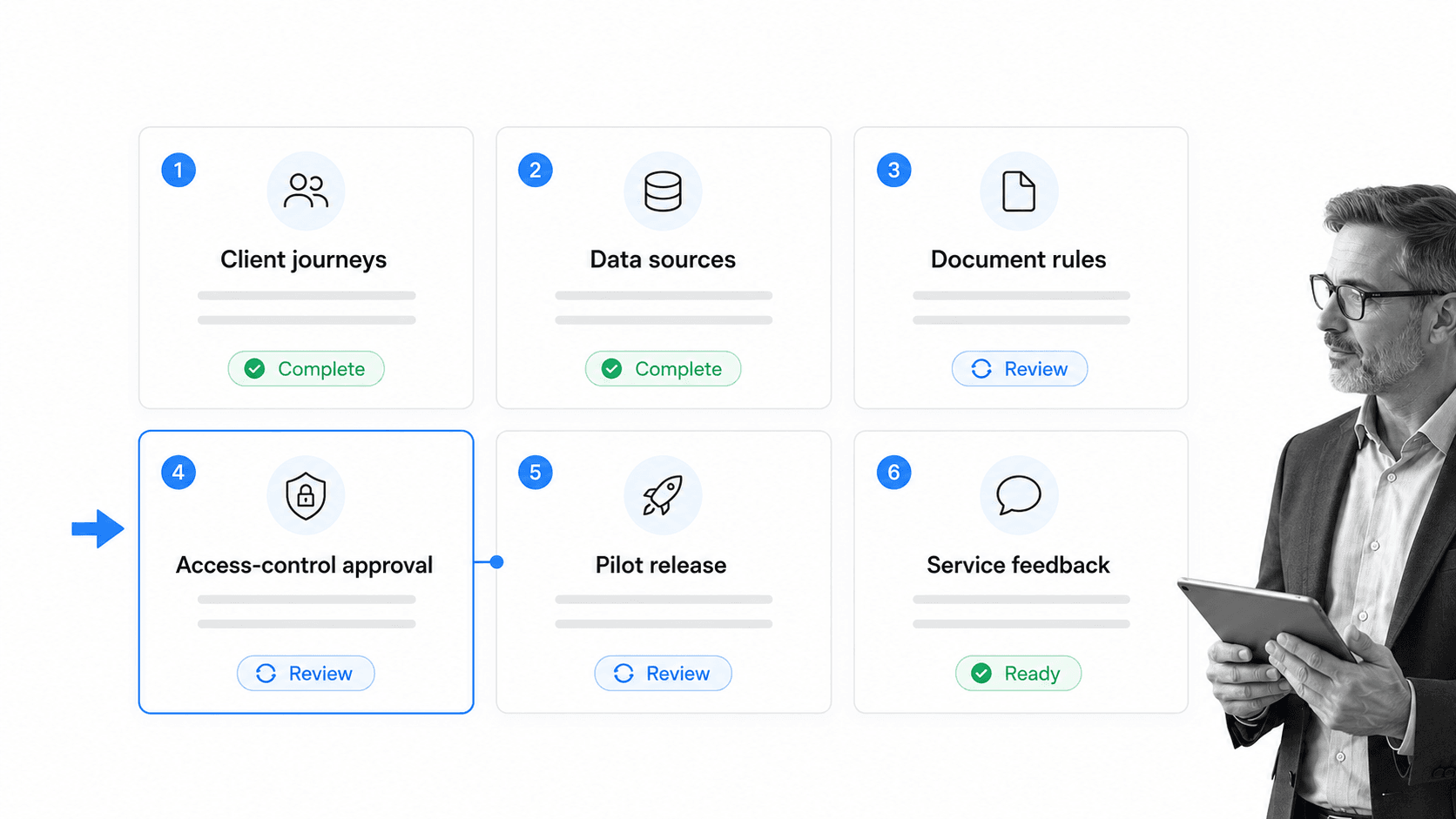
Building a wealth management portal operating model starts with client journeys, not software configuration. The safest implementation path is to decide which client requests belong in the portal, then define what happens after each request arrives.
Step 1: Map the portal journeys
Start with the most common and highest-risk client journeys: new client onboarding, document upload, account maintenance, beneficiary update, distribution request, annual review prep, meeting follow-up, complaint intake, trusted contact update, and policy acknowledgment.
A structured client onboarding for financial services template is a useful starting pattern because onboarding exposes the same problems portals must solve: forms, evidence, approvals, follow-up, and client clarity.
Step 2: Define the system of record and system of action
The portal may collect the request, but another system may own the client record, portfolio data, planning assumptions, document repository, or compliance record. Define which system stores the final record and which system runs the work.
A system of action is the workflow layer that assigns tasks, waits for approvals, branches based on risk, and records completion. Without that layer, portal activity gets trapped in notifications.
Step 3: Build controls into each request
For each portal request, define required fields, required documents, reviewer roles, approval thresholds, exception paths, client confirmation rules, and retention requirements.
Workflow features like approvals, conditional logic, and run links help turn those rules into repeatable execution.
Step 4: Pilot before firmwide rollout
Pick one portal journey that is painful and measurable. New client onboarding, document collection, and service requests are strong starting points because the handoffs are visible and the before-and-after comparison is clear.
A pilot should test client clarity, advisor workload, operations handoffs, compliance review, and system updates. If one of those breaks, fix the workflow before rolling the portal out to every client segment.
Step 5: Train clients and staff on the same process
A portal rollout fails when clients learn one process and staff quietly follow another. The client instructions, advisor talking points, operations checklist, and compliance review path should describe the same workflow.
That means every portal request needs a clear owner, a clear response standard, and a visible completion state. Clients should know what they submitted. Advisors should know what is waiting. Operations should know what to verify. Compliance should know where the proof lives.
Step 6: Improve from execution data
After launch, review where requests stall, which fields clients skip, which approvals repeat, which reminders work, and which exceptions keep appearing. The portal should get easier to use because the workflow data shows where friction lives.
Adjacent patterns in financial workflows and financial process automation show the same principle: controlled execution beats manual follow-up.
Wealth management portal compliance and security
A wealth management portal handles sensitive personal, financial, and advisory information. Security and compliance cannot be afterthoughts.
Trusted contact and customer information workflows
FINRA Rule 4512 customer account information covers customer account information requirements, including reasonable efforts to obtain trusted contact information for non-institutional customer accounts.
Investor.gov trusted contact bulletin explains the investor protection purpose behind trusted contact information. A portal can support this work only if updates route into a controlled review and recordkeeping process.
Cybersecurity and access control
The SEC cybersecurity topic page collects cybersecurity materials relevant to investment advisers, investment companies, and broader market participants.
Portal design should include access reviews, secure document handling, user permissions, client authentication, incident response paths, and vendor oversight. Those controls should not live only in policy documents. They should be reflected in the workflows that handle portal activity.
Evidence and audit history
Every high-risk portal action should leave a clean record: the request, client identity context, documents received, required fields, reviewer, approval, exception reason, system update, and client confirmation.
That is why pages on financial compliance software, compliance management software, and operational risk management framework are relevant to portal design. Portal work is client service, but it is also controlled execution.
Wealth management portal workflows in Process Street
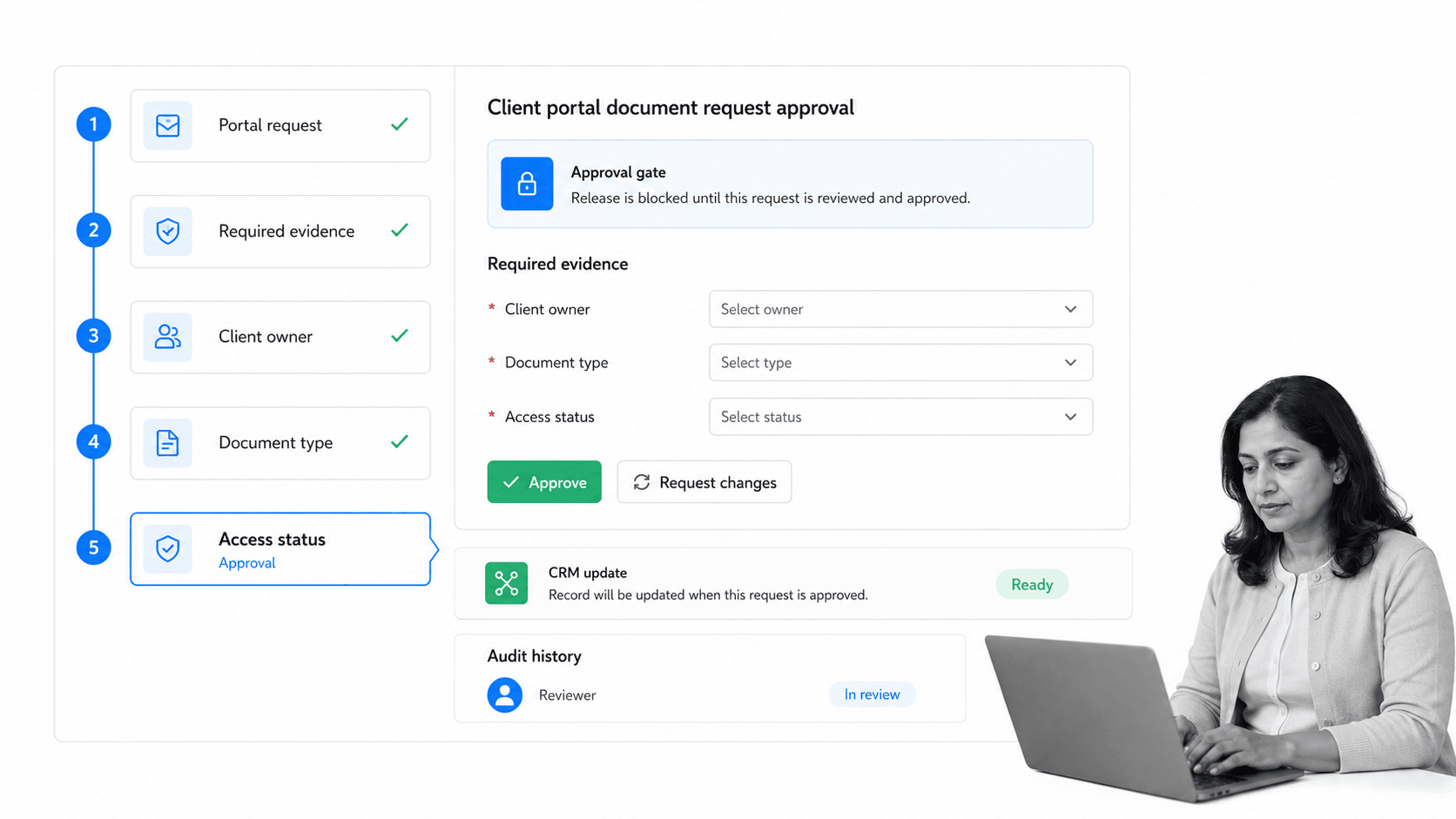
Process Street supports wealth management portal workflows by turning client requests into controlled, auditable processes.
When a client submits a document, updates information, asks for service, or starts onboarding, Process Street can run the internal workflow behind that request. Required fields collect the right context. Conditional logic routes the request based on risk, client type, or request category. Approvals hold the workflow until the right reviewer signs off.
Run portal request workflows
Teams can build workflows for portal document uploads, client onboarding, annual review prep, account maintenance, trusted contact updates, complaint intake, distribution requests, meeting follow-up, cybersecurity review, and compliance attestations.
The general client onboarding process template gives a reusable starting point for request intake before a firm adapts the workflow to its portal and control requirements.
Keep proof with the task
Approvals, uploaded files, field values, comments, task history, and exception notes stay attached to the workflow run. That gives advisors, operations, and compliance teams one record to inspect.
Connect the portal to the rest of the stack
Process Street has direct, universal integrations to 5,000+ systems. Need a new one? An AI agent builds it on the fly. That means a portal request can update CRM, notify an advisor, trigger document review, route approval, and preserve the workflow record without relying on manual status chasing.
Firms evaluating workflow tooling can also compare broader categories like a workflow management system when deciding where the portal operating layer should live.
The result is a portal experience that feels simple to the client while giving the firm the control surface it needs behind the scenes.
How to evaluate a wealth management portal
Evaluate a wealth management portal by asking whether it improves client experience, advisor capacity, data quality, and control quality at the same time.
Does it reduce manual follow-up?
The portal should reduce repeated requests, status emails, manual document chasing, and unclear handoffs. If the client submits information but the advisor still has to chase the internal team manually, the operating model is incomplete.
Does it preserve client context?
Portal activity should connect to the client record, household context, request history, open tasks, and recent service activity. Advisors should not have to search across five tools to understand what happened.
Does it enforce controls?
Look for required fields, approval gates, access controls, exception routes, audit history, retention logic, and reporting. The portal should make controlled work easier, not easier to bypass.
Can operators adjust it without breaking governance?
Client journeys change. Regulations change. Firm policies change. The portal operating model should let operations and compliance teams adjust workflows safely without turning every update into a long development cycle.
Does it make AI accountable?
If AI summarizes messages, classifies uploads, drafts replies, or routes requests, the workflow should show what happened and who reviewed it. AI should accelerate portal work inside guardrails, not create a second untracked process.
Does it make ownership visible?
A portal can hide ownership if every request looks like it belongs to everyone. Strong portal operations show exactly which advisor, service associate, operations reviewer, or compliance approver owns the next action.
That ownership should be visible without a meeting. If a request is waiting on a client, the status should say so. If it is waiting on review, the reviewer should be named by role. If it is blocked by missing evidence, the missing evidence should be obvious.
Can it support different client segments?
A firm may serve emerging affluent households, retirees, high-net-worth clients, business owners, trusts, foundations, family offices, and retirement plans. The portal should support variation without fragmenting the firm’s standards.
The best pattern is shared control with configurable paths. A high-net-worth client may need more entities, documents, approvals, and tax coordination than a simpler household relationship, but both should still be inspectable through one operating model.
FAQs
What is a wealth management portal?
A wealth management portal is a secure digital workspace where clients and advisory firms exchange documents, messages, requests, account context, and service updates. The best portals connect that client-facing workspace to the internal workflows that review, approve, and complete the work.
What should a wealth management portal include?
A wealth management portal should include secure document exchange, client messaging, service requests, account and planning context, task status, approvals, audit history, access controls, and integrations with the firm’s systems of record.
How does a wealth management portal help clients?
It gives clients one place to submit documents, respond to requests, see what the firm needs, and access relevant information. That reduces confusion and makes the advisory relationship feel more organized.
How does a wealth management portal support compliance?
It supports compliance when portal activity is tied to required fields, review steps, approval gates, exception routes, access controls, and audit history. The portal should create proof while the work happens, not after the fact.
How should firms implement a wealth management portal?
Start by mapping the client journeys the portal will handle, then define the internal workflows behind each request. Pilot one high-friction journey, build controls into the process, and improve the model using execution data.
How can Process Street support wealth management portal workflows?
Process Street helps firms run portal requests as controlled workflows with required fields, conditional logic, approvals, automations, integrations, task assignments, and audit history.