





AI marketing works best when it does a specific job inside a real campaign: classifying responses, generating creative variants, predicting performance, personalizing outreach, or moving work through review. These five proven AI marketing examples can inspire a more practical approach, one that starts with a clear problem instead of adding AI for its own sake.
Some results below come from vendor case studies, so treat them as useful signals rather than universal benchmarks. The practical question is not whether AI can generate something. It is where AI can improve a marketing workflow without removing human judgment, brand review, privacy controls, or accountability.
Why businesses use AI in marketing
Businesses are embracing AI in their marketing strategies because it can make repetitive work faster, help teams use customer data more effectively, and create more room for creative and strategic decisions. The strongest applications usually fall into three areas.
Choosing not to adopt every new tool will not leave a business in the dust. But ignoring proven ways to remove routine work can make it difficult to remain competitive. The useful question is which task can be improved without creating unacceptable risk.
Automation
Automation is not a new topic. It has been around for years, and it has proven itself to be a real time saver. Thus, it can also be a money saver. AI extends that idea to high-volume tasks such as sorting responses, drafting variations, enriching lead records, and routing work.
AI can do a lot in automating marketing strategies because it can help with things like lead generation. It can find and organize prospective customers in less time, allowing humans more opportunities to build connections with customers. The goal is not to automate every decision. It is to remove predictable manual steps while keeping people responsible for quality and exceptions.
Personalization
AI has the ability to create profiles from customer signals, giving marketers the ability to launch more targeted campaigns. Those strategies can improve customer engagement and conversion rates, which may lead to a higher return on investment. But the inputs still matter. Weak data, unclear consent, or an unreviewed message can make personalization feel inaccurate or intrusive.
Predictive analytics
Predictive analytics provides marketers with data from previous customer interactions and uses it to predict what future buying behavior might look like. This information can support customer retention, audience prioritization, campaign forecasts, and estimates of future business metrics such as changes in revenue. A prediction is evidence for a decision, not a guarantee.
1. Incendium personalizes outbound at scale
Incendium is a B2B growth studio that helps clients prepare to go to market, execute outbound campaigns, and interpret the resulting data. The company has continued to document how AI can support prospect research, segmentation, personalization, and campaign analysis.
Its co-founder, Nathaniel Houghton, described the company’s approach to Process Street: Incendium sends and sorts through thousands of emails on behalf of clients, helps customers prepare to go to market, executes campaigns, and interprets the data from them.
The challenge
Outbound teams send large volumes of messages and receive replies that vary from genuine buying signals to unsubscribes and automated responses. Reviewing every reply manually consumes time that could be spent improving campaigns and talking to qualified prospects.
Houghton’s perspective was different from the common narrative around AI. He and his team did not search for problems within the company just so AI could fix them. They began experimenting with it as a test for clients and looked for tasks that were genuinely time-consuming.
For Incendium, it was about finding ways to leverage AI to automate repetitive tasks. By doing so, the team hoped to free up time for the more creative side of campaign work, where context and human judgment make a bigger difference.
The solution
To achieve this, the team looked at its recurring tasks and pinpointed areas that could be automated. It did not want to force AI into an area where it would not fit or use it just for the sake of using it. That analysis surfaced two time-consuming tasks where the technology could help.
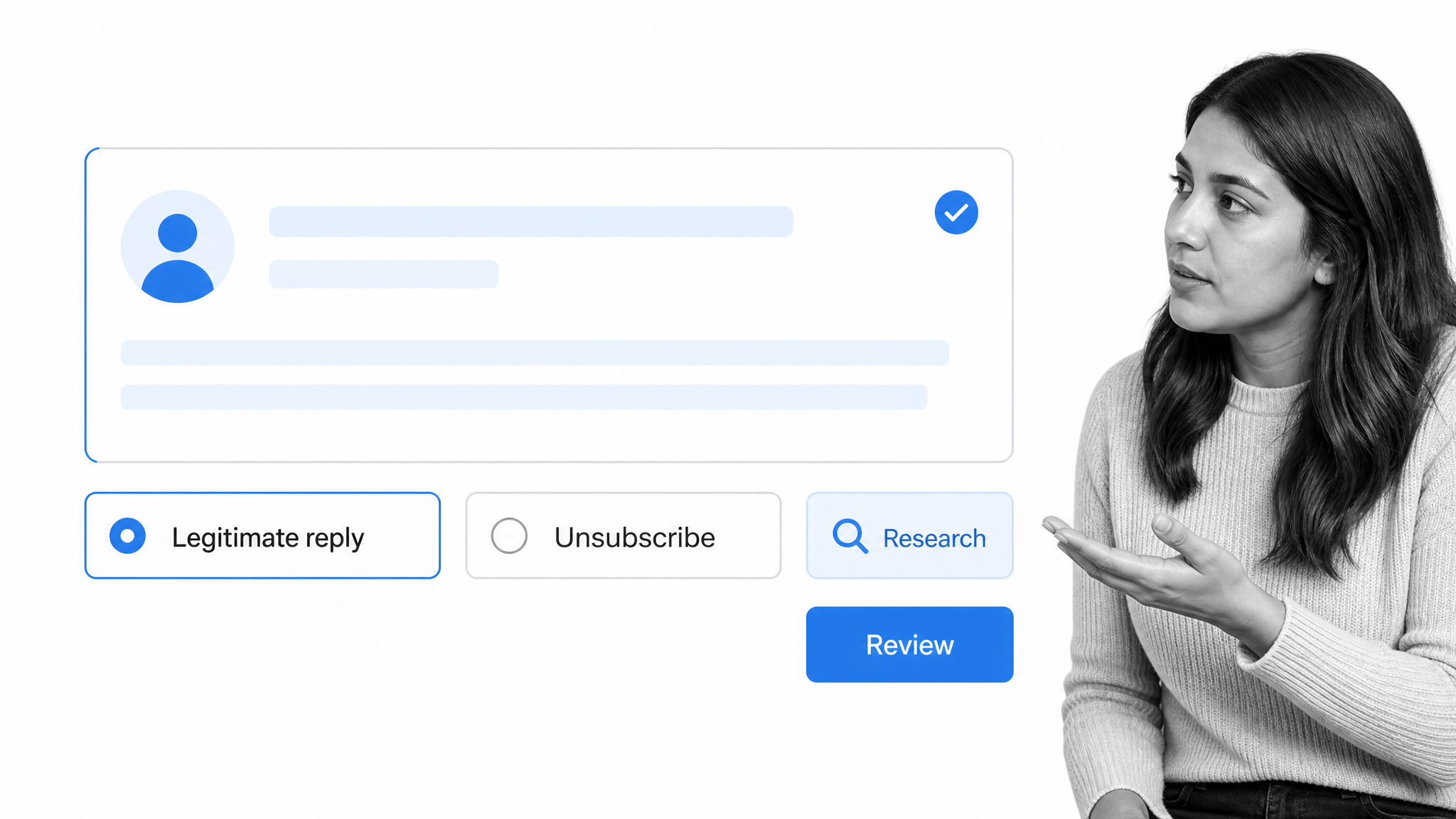
The first is email classification. Incendium sends large numbers of emails on behalf of clients and receives thousands of responses. Those responses are integral to learning what resonates and creating better email campaigns. AI can separate a general unsubscribe from what the team calls a legitimate response, meaning a response written by a human with valuable feedback or buying intent.
The second application is lead generation and prospect research. AI can help find prospective customers based on defined criteria and point the team in the right direction, even when it does not provide every piece of information required. Incendium’s current guidance on AI-assisted outbound extends that pattern to account research, segmentation, personalization, and cadence optimization.
In both cases, automation prepares and classifies information. A person remains responsible for relevance, tone, final approval, and the decision to contact a prospect.
The results
Incendium has reported saving hours of work that would otherwise go to sifting through email responses and looking for leads. Houghton has also described a longer-term goal: ingesting data from thousands of email responses to identify commonalities between the top performers.
That analysis still needs human interpretation. The durable lesson is the workflow design: AI handles a bounded classification or research step, while people interpret the result, learn from valuable responses, and decide what happens next.
2. GoGoChimp tests AI-generated CRO ideas
GoGoChimp helps clients improve conversion rates through landing-page, copy, speed, and funnel experiments. Its current work pairs AI-assisted analysis and generation with an experienced operator who chooses which hypotheses are worth testing.
The company has approached this goal in several ways, including optimized landing pages, personalized email campaigns, and content for client channels. Across those applications, the central job is the same: create a useful variation, evaluate it against the audience and objective, and learn from performance.
The challenge
Conversion optimization creates a queue of possible changes: headlines, calls to action, page structure, visual hierarchy, load speed, and checkout friction. Teams can generate ideas quickly, but they still need a disciplined way to prioritize them and distinguish a genuine lift from noise.
Content channels create a similar optimization problem. The actual content needs to be good, but so do the title, thumbnail, description, and tags. Managing the creation of those elements can take up a lot of time and limit the amount of content that can be published.
Whether the page is a landing page or a video, the challenge is to cut down the time required to prepare optimization elements without lowering quality. Faster generation only matters if the team can still identify the change that improves conversion rates.
The solution
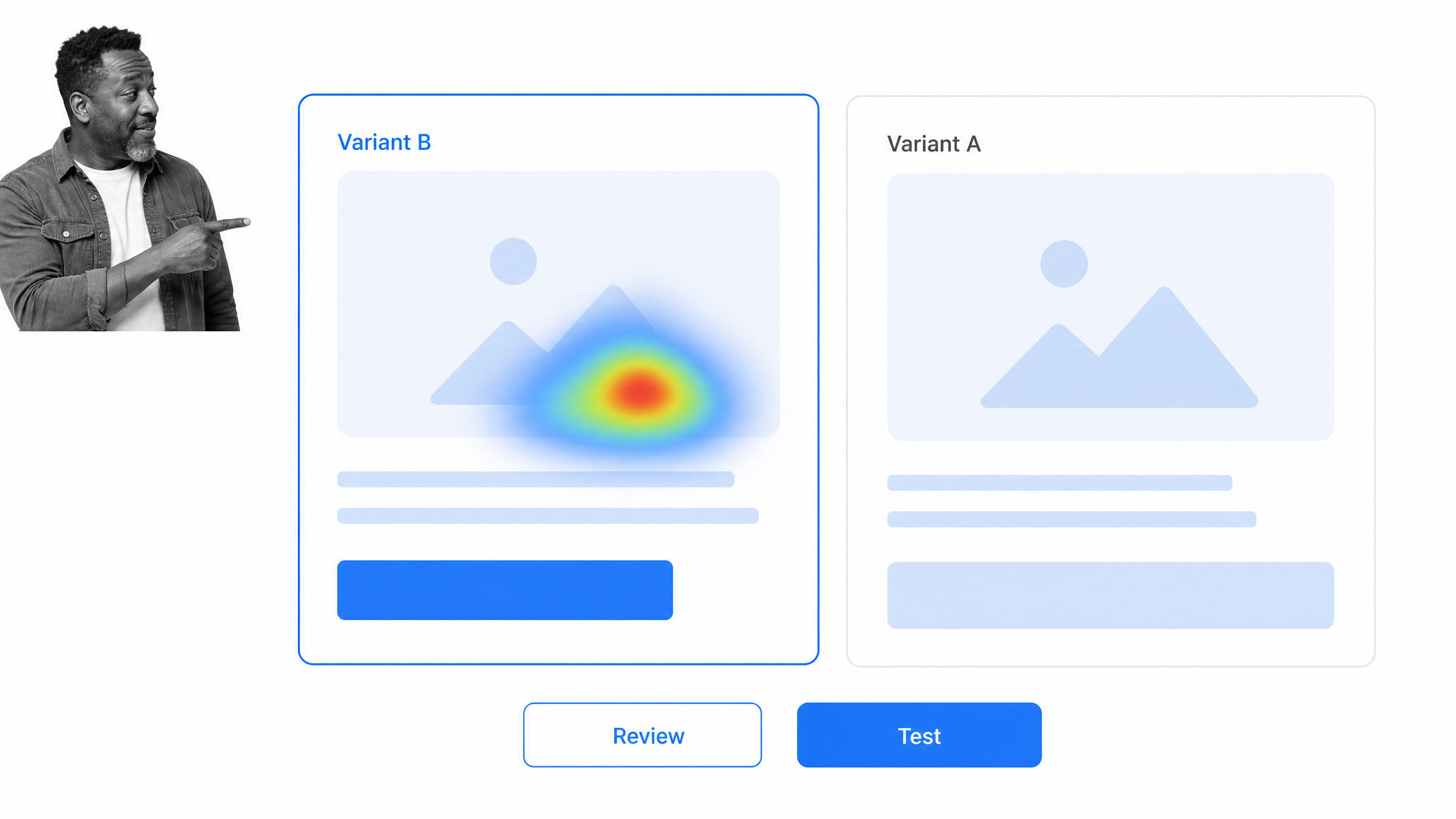
GoGoChimp uses AI to accelerate parts of the CRO cycle. Its current case studies describe AI-generated copy variants and predictive heatmaps used alongside controlled experiments. A person defines the hypothesis, checks that a variant makes sense for the audience, and reviews the evidence before a change ships.
In an earlier account of its YouTube work, the team described testing AI-generated descriptions for each video and analyzing top-performing videos within a niche to find patterns for optimized titles. It also used AI to describe recurring elements in successful thumbnails, then gave those observations to a person who could create the final visual.
That application does not mean AI can predict which thumbnail will go viral. It shows a useful division of labor: the system can sort through examples and summarize patterns, while a marketer decides whether those patterns fit the client, content, and audience. Generation is only one part of the job. Context, optimization, testing, and editorial judgment determine whether the output performs.
The results
GoGoChimp publishes named client results, including improved conversion rates and revenue outcomes. Those figures are company-reported, and each case has its own traffic, offer, and implementation conditions. The repeatable takeaway is to test AI-generated ideas against a baseline instead of treating the generated option as the winner by default.
The company has also reported that AI saves hours of work, which can expand the number of experiments a team is able to run. More experiments are not automatically better. The benefit appears when a team documents each hypothesis, controls the comparison, and uses the result to make a faster evidence-based decision.
3. Heady builds AI playbooks for regulated marketing
Heady provides AI agents, playbooks, and an operating system for cannabis marketers. The category makes a useful example because a marketing team cannot separate faster execution from compliance review.
The challenge
Regulated marketing teams coordinate CRM, SEO, content, paid media, and reporting while rules vary across markets and channels. Manual handoffs can make that work slow and inconsistent, but unchecked generation can create a more serious problem if a claim, audience, or placement violates policy.
It can also be difficult to keep up with manual reporting and trend analysis, two tasks that leave room for human error when data arrives from many channels. Sorting through large amounts of data may produce actionable insights in real time, but those insights still need validation before they change a campaign or business strategy.
The solution
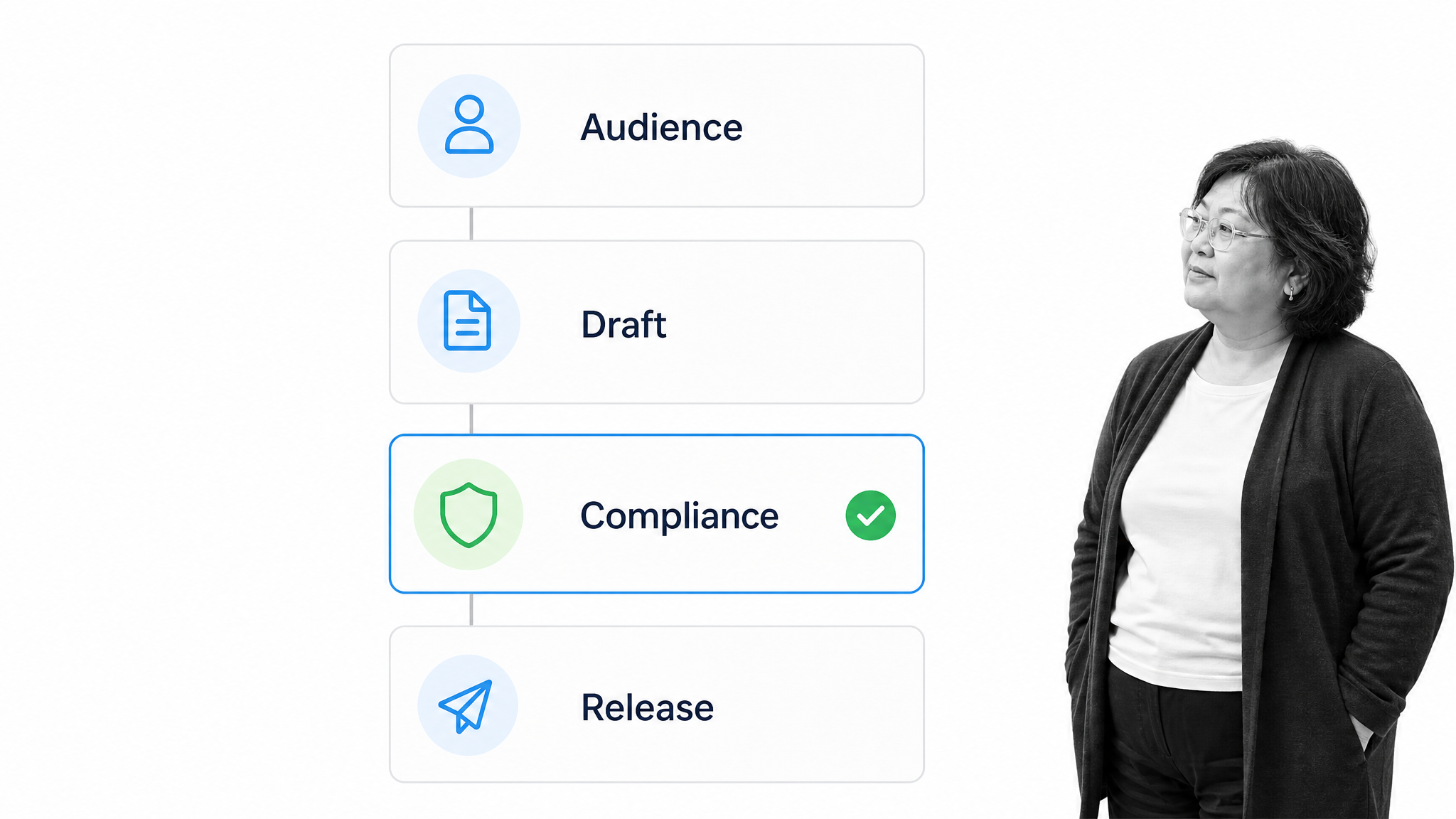
Heady packages AI work into agents and playbooks for specific marketing jobs. A team can phase in the highest-value use case first, define what evidence and rules the system should use, and place a compliance review before release. That gradual approach is more controllable than replacing an entire marketing process at once.
A smooth implementation can begin with data analysis and reporting, then move to more sensitive applications after the controls are proven. Predictive analytics can help identify upcoming market trends, giving marketers time to adjust their strategies as needed. Personalization can help customize content, provided that the source data, audience rules, and approval criteria are explicit.
The results
Heady does not publish a directly comparable outcome for every playbook, so this example is about the operating model rather than a universal performance claim. It shows how a specialized team can use AI to prepare work and surface context while retaining a named human review point for regulated decisions.
Taking data preparation off a marketer’s plate can create room for higher-value tasks such as creative strategizing. It can also support faster, data-driven decisions instead of opinion-based ones. The result only remains reliable when people can inspect the evidence and override the recommendation.
4. The Dairy improves TikTok performance with Smart+
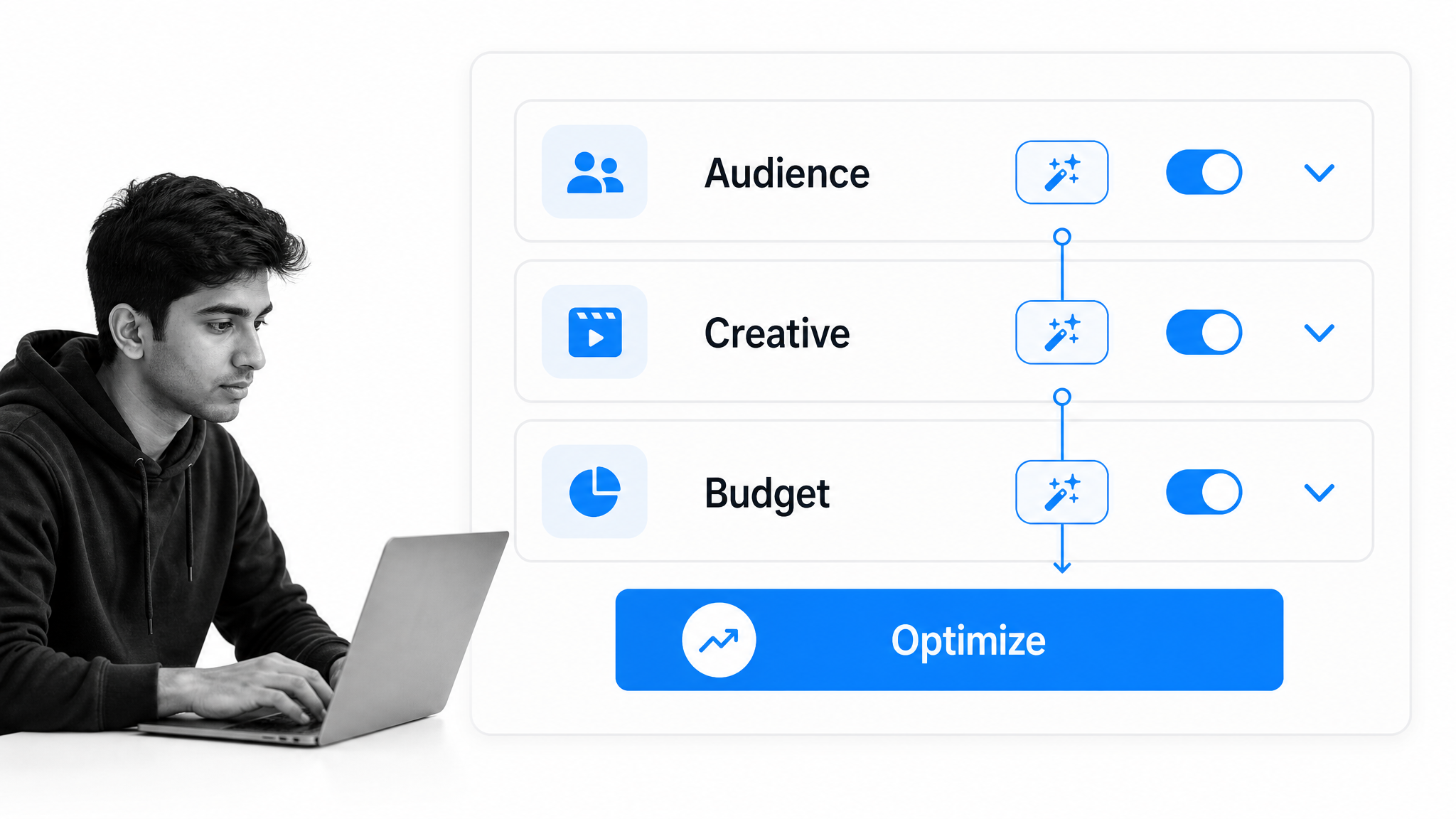
The Dairy is an Australian tech-accessories brand that connects artists with customers looking for distinctive device cases and accessories. Its TikTok campaign shows AI working across targeting, creative selection, bidding, and budget optimization.
The challenge
The brand wanted to improve return on ad spend while reducing the manual effort required to test creative variations and audiences. That meant finding likely buyers without losing the visual personality that makes the products stand out.
The solution
In January 2025, The Dairy launched a conversion campaign with TikTok Smart+. The system used the supplied assets, budget, and targeting goals to automate audience selection, bidding, and creative delivery. The campaign ran against a manual web-conversion campaign during the same period.
The results
According to TikTok’s case study, the Smart+ campaign produced a 24% lower cost per action, a 77% higher click-through rate, and a 28% higher return on ad spend than the comparison campaign. The comparison window was short, so the result is best read as a documented campaign test rather than a guaranteed benchmark.
5. Oneisall scales full-funnel creative with generative AI
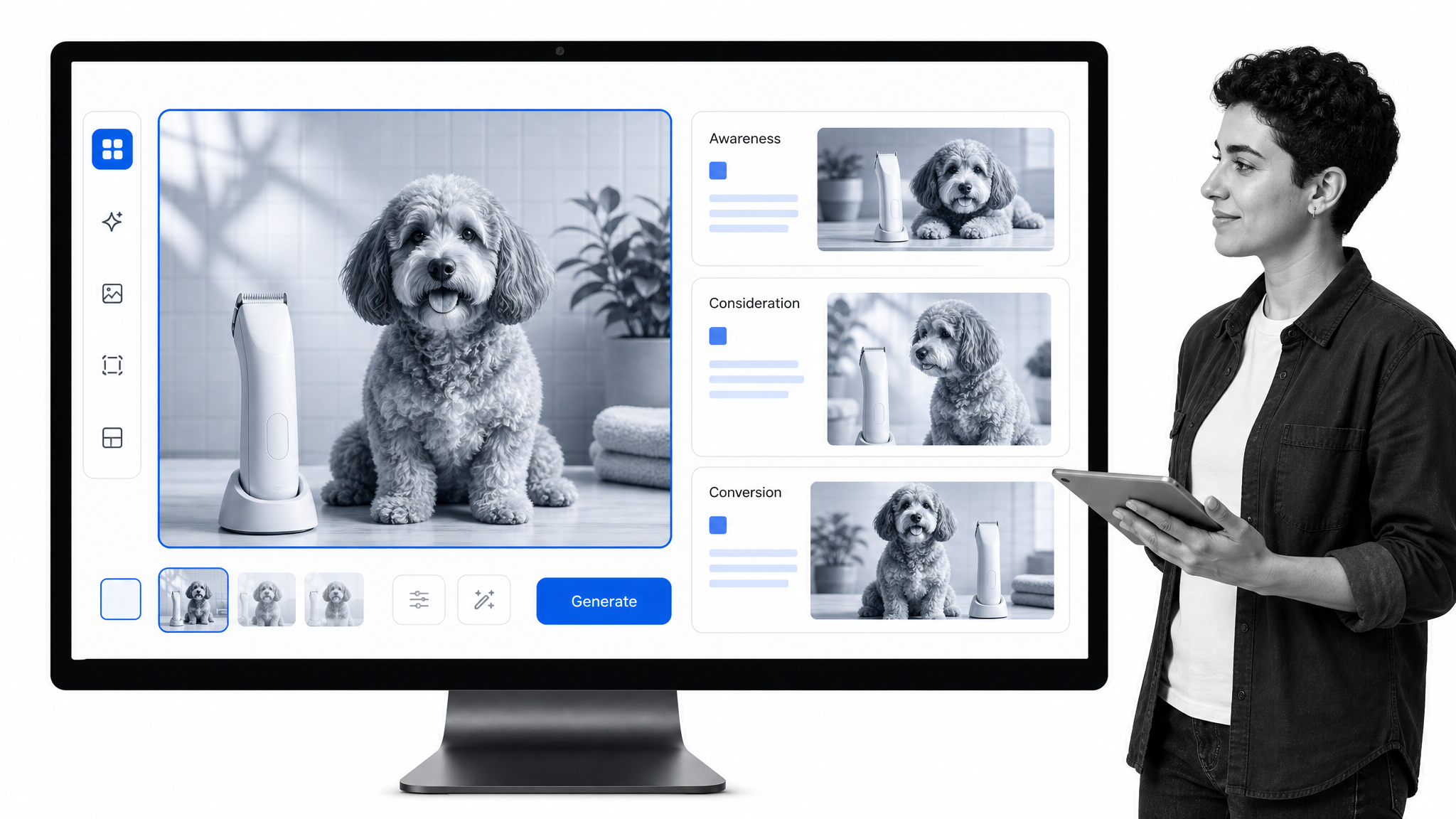
Oneisall sells pet-grooming products in several markets. Its advertising challenge was not simply to generate more pictures. It needed distinct creative for awareness, consideration, and conversion placements without building every lifestyle scene from scratch.
The challenge
A product image that works near checkout may not communicate enough context at the top of the funnel. Producing a broader set of lifestyle assets takes time, especially when the brand is adapting campaigns for different audiences and placements.
The solution
Oneisall used Amazon Ads’ generative image capability to turn product photography into lifestyle creative. The team could create context-specific variations for different stages of the funnel, then review the generated images before using them in campaigns.
The results
Amazon Ads reports that the campaign achieved ad recall 12 percentage points above the industry benchmark. As with any platform case study, the result reflects one campaign and its conditions. The broader lesson is that generative creative becomes more useful when each variation has a defined audience and funnel job.
Key takeaways
Across these five examples, the useful patterns are consistent:
Each company began with a target audience and a specific operational constraint. AI supported lead scoring, data analysis, content generation, campaign optimization, or predictive modeling. It did not replace the need to understand customer behavior and preferences, personalize a strategy and messaging, or extract actionable insights that a marketer could use.
- Start with a measurable bottleneck, not a tool.
- Use AI to save employees time on repetitive analysis and content preparation.
- Give AI approved data, context, and clear boundaries so it can help find new customers and useful patterns.
- Keep human review for brand, regulatory, privacy, and high-risk decisions, leaving humans room to be more creative.
- Compare AI-generated content and campaign changes with a meaningful baseline.
- Put successful experiments inside a repeatable workflow so the team can optimize marketing without losing accountability.
Process Street is a Compliance Operations Platform for documenting how work should run and making sure it runs that way. Docs and Ops capability areas, plus built-in AI, help teams turn an approved marketing process into repeatable execution with owners, evidence, reviews, and exception handling in one product.
The point is not to automate every part of marketing. It is to let AI handle the bounded work it can perform well, then give people a clear place to judge the output, improve the process, and remain accountable for the result.