Turn every policy into automated workflows with built-in enforcement and audit-ready proof.


Fintech Onboarding: A Practical Guide to Safer Customer Activation
Fintech onboarding is the controlled journey that turns an applicant into an activated customer. It must make identity, risk, compliance, account setup, and early product use feel like one coherent experience, even when several teams and systems perform the work behind the scenes.
The strongest onboarding programs do not choose between customer experience and control. They remove avoidable repetition, explain necessary checks, route each case by risk, preserve evidence, and give customers a clear next step when automation cannot decide.
This guide covers the complete fintech onboarding process, the controls that belong in it, how to design a dependable workflow, how Process Street can coordinate the work, and which measures reveal whether the journey is both safe and effective.
In this guide:
- What is fintech onboarding?
- Why is fintech onboarding different?
- How does fintech onboarding work?
- Which controls belong in fintech onboarding?
- How can fintech onboarding balance conversion and compliance?
- How do you design a fintech onboarding workflow?
- How does Process Street support fintech onboarding?
- How should fintech onboarding be measured?
- Fintech onboarding implementation checklist
- Fintech onboarding FAQ
What is fintech onboarding?
Fintech onboarding is the end-to-end process of accepting, verifying, evaluating, configuring, and activating a new customer for a financial technology product or service. It starts when a person or business begins an application and continues until the approved customer can use the product safely and understands the next meaningful action.
The journey may include account registration, identity or business verification, customer due diligence, sanctions and watchlist screening, fraud checks, risk classification, agreement and consent capture, funding or account linking, access setup, product guidance, and a first transaction or other activation event. Not every product needs every step, and the sequence changes with the customer, product, jurisdiction, and risk.
A polished application form is only the front door. The operating process also needs owners, decision rules, exception paths, evidence, system handoffs, review queues, customer communication, and a definition of complete. If those elements are fragmented, the customer experiences the seams as repeated requests, unexplained delays, and uncertain status.
The finish line is not a submitted application. It is an approved customer who can act safely and reach first value.
Why is fintech onboarding different?
Most software onboarding can optimize mainly for comprehension and adoption. Fintech onboarding must also establish trust in the applicant, protect sensitive information, apply financial crime and fraud controls, document decisions, and avoid granting access before required checks are complete.
This creates a multi-party workflow. Product and growth teams shape the application experience. Compliance and risk teams define controls and decision thresholds. Operations teams resolve exceptions. Security and identity teams govern access. Finance or banking partners may own account or funding steps. Customer support explains delays and recovery paths. The customer sees one journey, even when the organization sees many systems.
| Onboarding concern | Customer need | Operating requirement |
|---|---|---|
| Identity | A clear and accessible way to prove who they are | Evidence collection, validation, verification, and recovery |
| Risk | Proportionate requests and understandable status | Risk classification, screening, review, and approval |
| Security | Confidence that sensitive data is protected | Access control, secure handling, retention, and monitoring |
| Activation | A visible path to useful product value | Provisioning, account setup, handoff, and first-value guidance |
| Exceptions | Specific help when the standard path fails | Owned queues, evidence requests, escalation, and safe replay |
The right design is risk based. A consumer wallet, lending product, business account, investment service, and payments platform can require different evidence, decisions, and ongoing controls. A universal path either overburdens low-risk customers or under-controls higher-risk cases.
How does fintech onboarding work?
A dependable fintech onboarding process converts policy into a sequence of observable decisions. Each stage has a purpose, owner, required inputs, allowed outcomes, and evidence. The process can move automatically when facts are clear, then pause for human judgment when a case is incomplete, unusual, or high risk.
Map the fintech onboarding journey
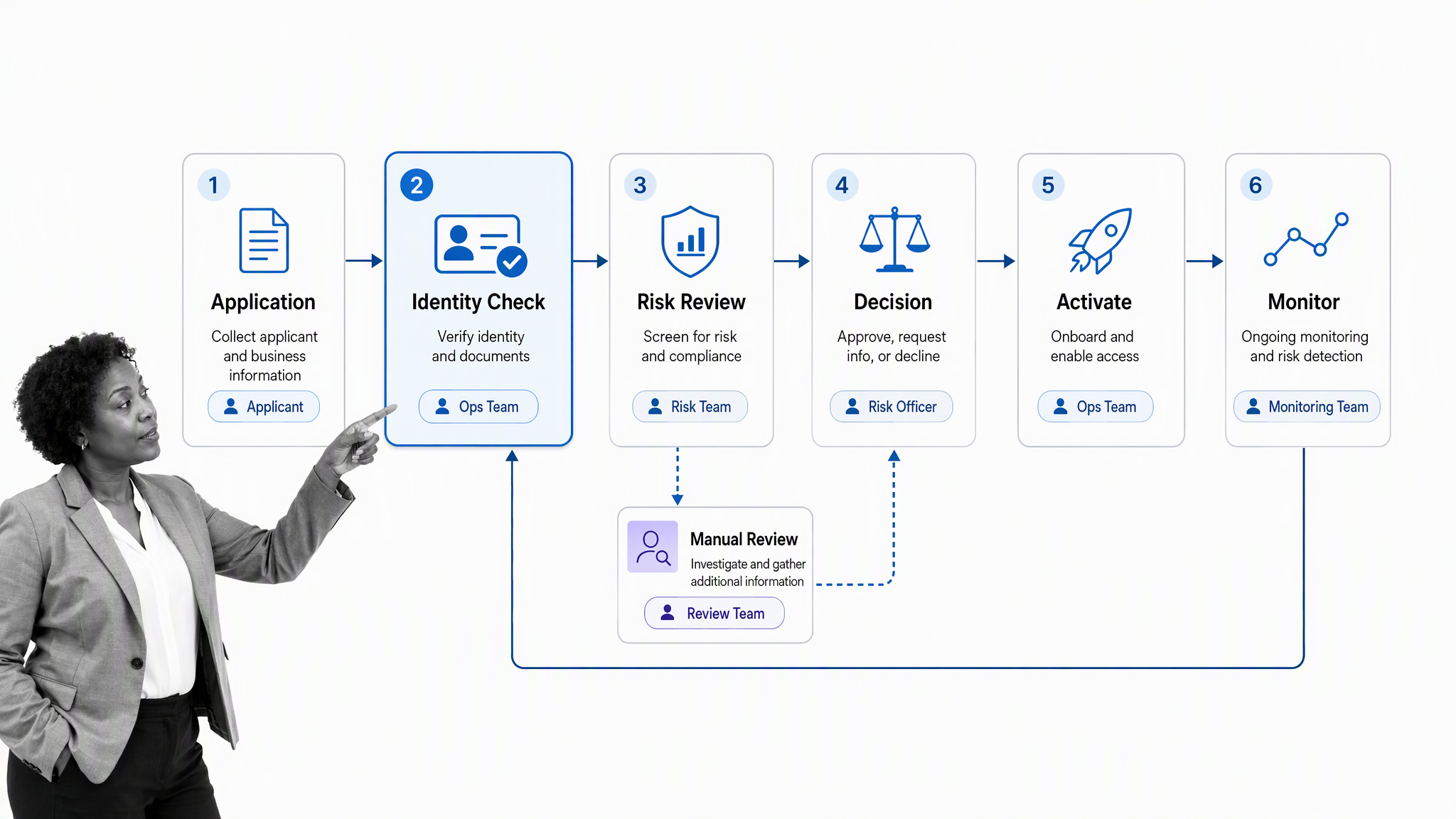
- Set expectations. Explain eligibility, required information, likely stages, privacy choices, support, and what the customer will be able to do after approval.
- Capture the application. Collect the minimum information needed for the next decision, validate entries, preserve progress, and create a unique case record.
- Resolve and verify identity. Determine who the applicant is, validate submitted evidence, and verify that the applicant is connected to that evidence at the assurance level the product requires.
- Complete due diligence and screening. Understand the customer and intended relationship, check relevant sanctions or watchlists, and gather beneficial ownership information for business customers where applicable.
- Assess fraud and risk. Combine identity, device, behavioral, product, geographic, business, and other approved signals into a decision or review path.
- Decide and provision. Approve, reject, request more information, or escalate the case, then create the account and grant only the access that the decision allows.
- Activate and educate. Guide the customer to the first safe, meaningful action, explain important product behavior, and make support visible.
- Monitor and review. Carry risk information into ongoing monitoring, scheduled review, re-verification, access changes, and offboarding rather than treating onboarding as a one-time event.
The NIST identity proofing overview separates resolution, validation, and verification. That distinction is useful for workflow design because collecting identity data is not the same as confirming the evidence or confirming that the applicant owns it.
Digital identity design should connect proofing results to the customer due diligence process instead of treating verification as an isolated pass or fail event. Teams should translate the standards and rules that apply to their market into explicit workflow controls, with legal and compliance owners responsible for interpretation.
Which controls belong in fintech onboarding?
Controls should protect a named risk and produce evidence that can be reviewed. Avoid adding a check because another company appears to use it. Start from the product, customer, jurisdiction, access being granted, value at risk, and the organization’s approved policy.
Design risk-based verification paths
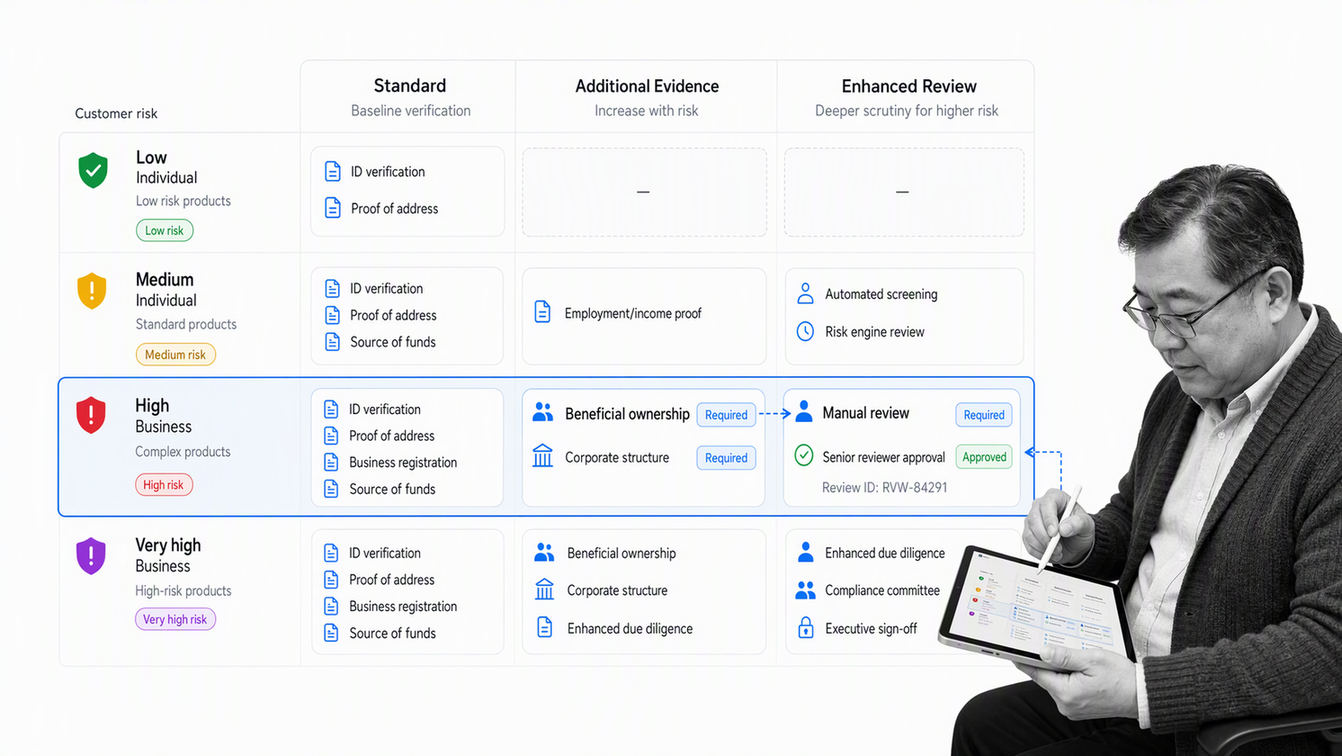
Identity proofing should match the assurance required for the transaction or account. Give customers more than one viable proofing option when appropriate, and create an exception path for legitimate applicants who cannot complete the default method. Accessibility and fraud resistance should be designed together.
For covered United States financial institutions, FinCEN customer due diligence guidance explains requirements involving customer identification and verification, beneficial ownership for legal entity customers, understanding the nature and purpose of customer relationships, and ongoing monitoring. Scope and exceptions depend on the institution and rule, so the workflow should point operators to the approved policy rather than asking them to improvise.
- Identity and eligibility controls confirm that the applicant exists, owns the evidence, and qualifies for the product.
- Customer due diligence controls establish who the customer is, what relationship is expected, and which risk factors require attention.
- Sanctions and watchlist controls screen relevant people and entities using current authoritative data and a defined match-review process.
- Fraud controls examine approved signals for impersonation, synthetic identity, account takeover, document manipulation, device abuse, and coordinated behavior.
- Access controls ensure that approval results in the correct account, permissions, limits, and authentication requirements.
- Evidence and retention controls preserve the application, checks, decisions, approvals, changes, and required records for the applicable period.
The OFAC Sanctions List Service provides current sanctions list data and search resources. A production screening process still needs approved matching logic, ownership, escalation, documentation, and review because a possible match is not the same as a resolved decision.
Build exception handling into the workflow
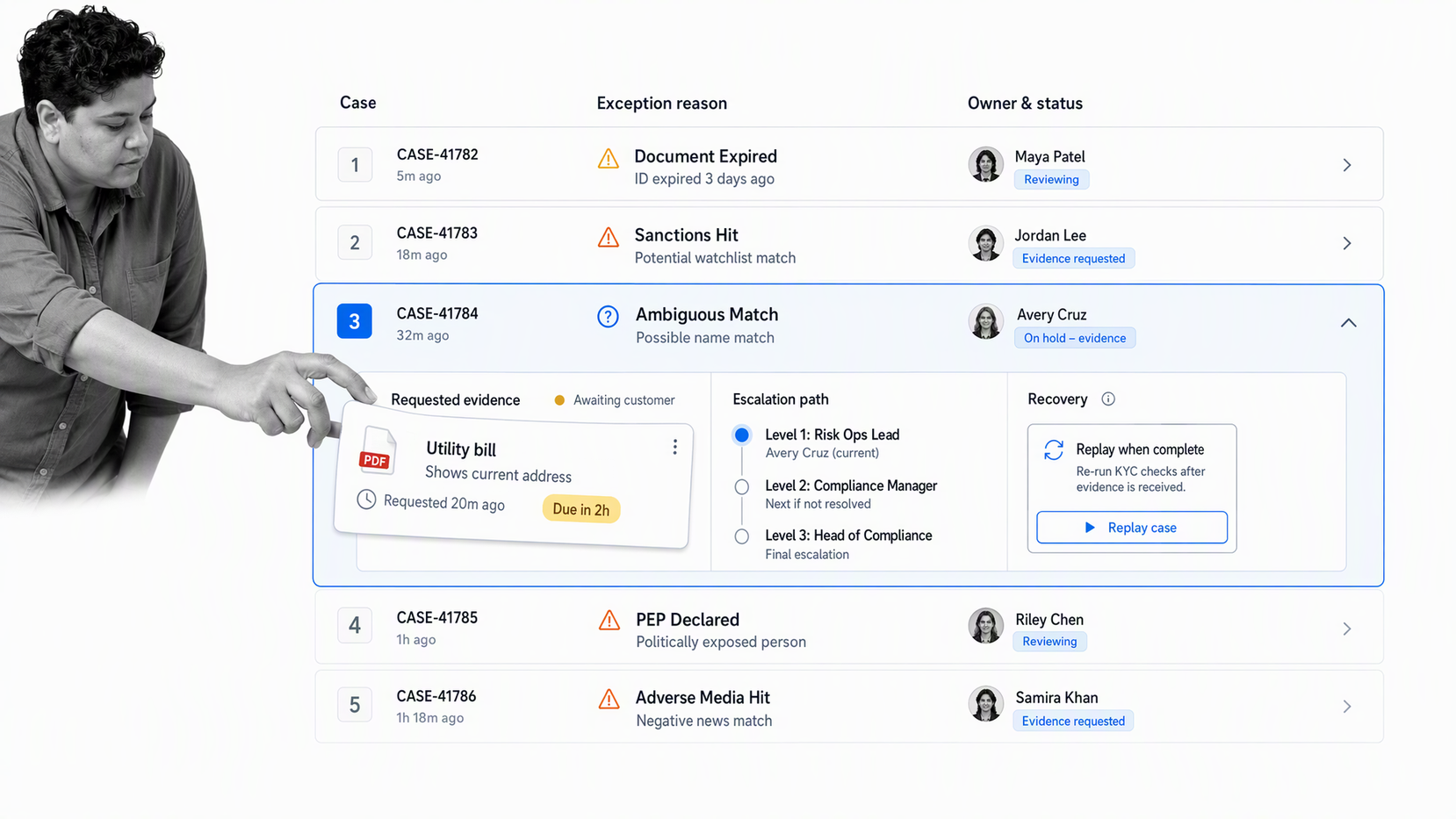
The standard path is only half the design. Plan for unreadable documents, unsupported evidence, duplicate applications, failed liveness checks, ambiguous matches, incomplete beneficial ownership, unavailable data providers, inconsistent customer details, suspected fraud, accessibility needs, manual overrides, and customers who abandon and return.
Each exception needs a visible status, accountable owner, required evidence, allowed decision, customer message, service target, escalation rule, and safe replay method. Keep the case history attached to the same record so a reviewer does not have to reconstruct events from email, tickets, and chat.
How can fintech onboarding balance conversion and compliance?
Treat friction as a design problem, not a reason to weaken controls. Some effort protects the customer and the business. Other effort exists because information is requested too early, systems do not share context, error messages are vague, or manual queues have no owner.
- Ask only for information needed for the next decision, then request more when the path or risk requires it.
- Explain why sensitive information is needed before asking for it, using plain language and a clear privacy path.
- Validate fields as the customer progresses and preserve completed work so recoverable errors do not force a restart.
- Use conditional paths to keep low-complexity cases short while routing additional evidence and review to the cases that need it.
- Show honest states such as submitted, checking, more information needed, under review, approved, or unable to proceed.
- Give pending cases an expected next action and a support route without promising a completion time the operating team cannot meet.
- Use human review for uncertainty and material decisions, then record the evidence and rationale inside the case workflow.
A customer should never have to guess whether the application was received, whether action is required, or whom to contact. Clear status communication improves experience without changing the underlying control.
How do you design a fintech onboarding workflow?
Begin with the decision and the operating model, not the interface. A beautiful form cannot compensate for unclear policy, conflicting systems, hidden queues, or missing ownership.
- Define the trigger, eligible customer, product, and activation outcome.
- Name one accountable process owner and the role responsible for every stage, decision, and exception queue.
- Map required data, evidence, checks, approvals, communications, and system changes from application to activation.
- Separate the common path from risk, product, customer, geography, and business-type branches.
- Define each decision in plain language, including the inputs, allowed outcomes, reviewer, evidence, and escalation rule.
- Design exception paths before automating the happy path, including provider outages and safe replay.
- Choose the authoritative system for each field and preserve a source identifier across integrations to prevent duplication.
- Test normal, incomplete, high-risk, rejected, resumed, duplicate, accessibility, provider-failure, and manual-review scenarios.
- Launch with monitoring, change ownership, and a review cadence for policy, rules, vendors, content, and customer feedback.
A broader onboarding workflow software guide can help teams evaluate workflow capabilities such as forms, assignments, conditional logic, approvals, evidence, and reporting. In fintech, those capabilities should coordinate specialist identity, fraud, banking, and customer systems rather than pretending one platform replaces every control service.
How does Process Street support fintech onboarding?
Run fintech onboarding in Process Street
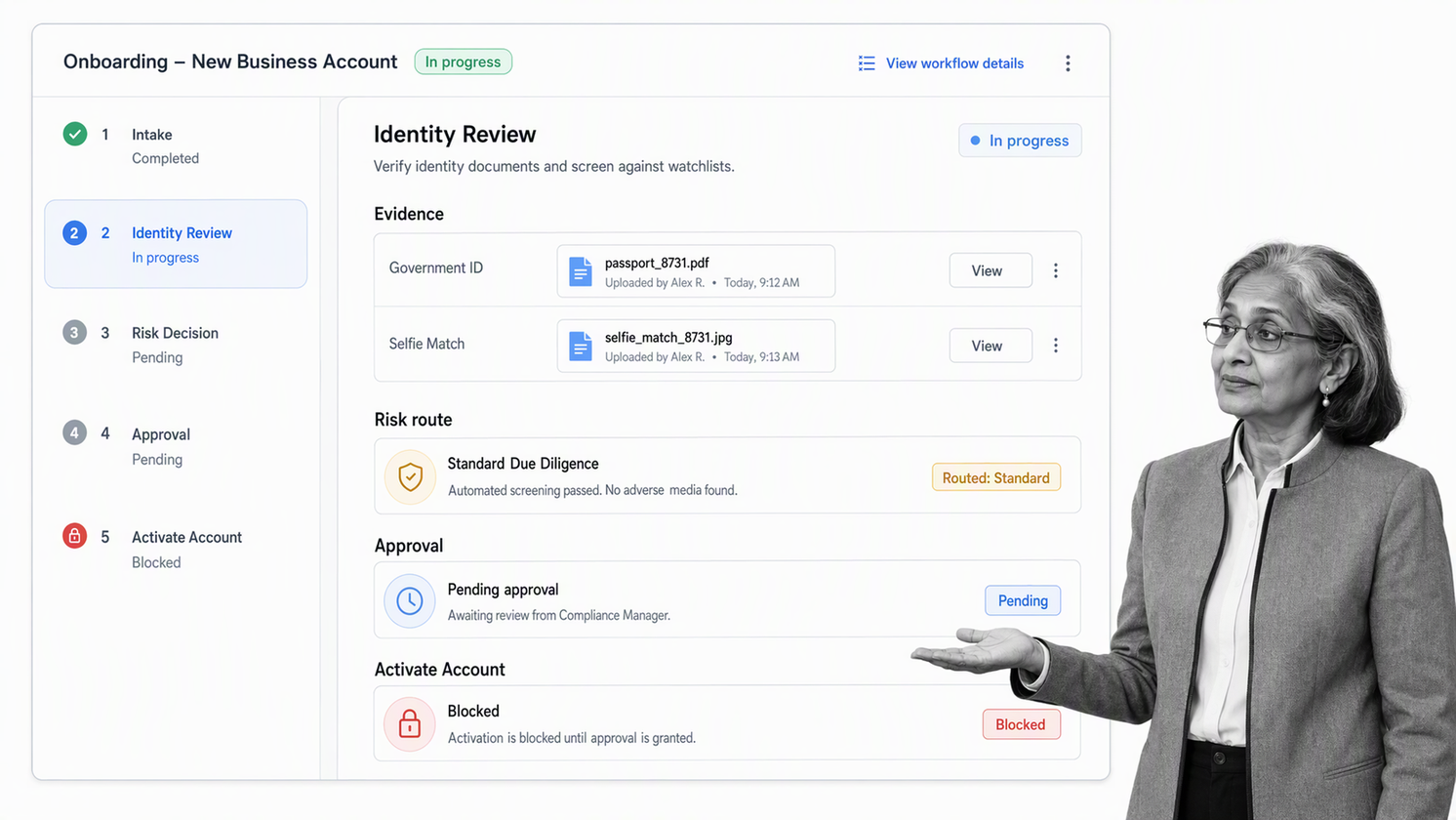
Process Street can serve as the orchestration layer around fintech onboarding. Teams can turn the approved procedure into a workflow with assigned owners, due dates, structured forms, required evidence, conditional paths, approval gates, reminders, and a history of what happened in each run.
A form workflow can connect customer intake to validation, classification, review, approval, action, and follow-up. Conditional logic can reveal additional work for a product, customer type, jurisdiction, or risk result. Approval steps can hold account creation or access until an accountable reviewer has the required evidence.
Process Street can also coordinate the wider customer onboarding process, including internal handoffs, customer requests, implementation, training, activation, and follow-up. It has 5,000+ integrations, allowing the workflow to connect with systems that remain authoritative for identity, customer data, communications, banking, support, or analytics.
The operating boundary matters. Process Street governs the cross-functional process and evidence. Specialist services perform identity verification, fraud detection, sanctions screening, banking, or authentication. The workflow should record the result, owner, and next action without copying sensitive data into places where it does not belong.
How should fintech onboarding be measured?
Measure the journey as a system. Completion rate alone can reward a weak control path, while control volume alone can hide unnecessary customer effort. Use a balanced view of conversion, speed, quality, risk, and activation.
| Measure | What it reveals | Useful cut |
|---|---|---|
| Application completion | Where intended applicants leave | Step, device, customer type, product, geography |
| Time to activation | Total elapsed journey | Automated, manual review, exception path |
| Waiting time by stage | Where queues and handoffs slow the process | Owner, provider, decision type |
| First-pass verification | How often valid customers complete without rework | Evidence type, method, device |
| Manual review rate | How much work needs judgment | Reason code, risk tier, reviewer queue |
| Exception and replay rate | Where the standard path breaks | Failure type, provider, recovery result |
| Decision quality | False positives, false negatives, overrides, and later issues | Rule, reviewer, product, segment |
| Activation to first value | Whether approved customers succeed | Cohort, product, onboarding path |
Segment before drawing conclusions. A single average can hide a slow business-customer path, an inaccessible proofing method, a provider issue affecting one document type, or a manual queue that handles only complex cases. Review process data with compliance, risk, fraud, product, operations, support, security, and customer owners.
Use reason codes that operators can apply consistently. If every case is marked other, analytics cannot guide improvement. At the same time, do not expose sensitive internal risk logic in customer messages. Maintain separate customer-safe explanations and internal decision records.
Fintech onboarding implementation checklist
- Define the customer, product, jurisdiction, trigger, and activation outcome.
- Assign one end-to-end process owner and an owner for every queue and decision.
- Map data, evidence, checks, systems, handoffs, approvals, and communications.
- Confirm the approved policy and legal interpretation for identity, due diligence, screening, fraud, privacy, accessibility, recordkeeping, and adverse outcomes.
- Collect the minimum data needed for each decision and identify the authoritative system for every important field.
- Create risk-based branches and explicit enhanced-review paths.
- Design exception handling, provider-outage behavior, safe replay, and manual override controls.
- Write clear customer states, action requests, error messages, pending explanations, and support routes.
- Test the happy path plus incomplete, high-risk, duplicate, rejected, resumed, accessibility, and outage cases.
- Verify downstream account, access, limits, records, notifications, and evidence at the end asset.
- Launch with dashboards for conversion, waiting, quality, risk, exceptions, and first value.
- Set review ownership and cadence so policy, rules, content, integrations, and controls stay current.
Start with one product and one customer path. Make the entire journey work from application to activation before adding more products or markets. Reuse the control spine, but let risk, customer, and jurisdiction differences change the work where they genuinely matter.
Fintech onboarding FAQ
What is fintech onboarding?
Fintech onboarding is the controlled journey that takes a prospective customer from application through identity checks, risk review, account setup, activation, and early product guidance. The exact controls depend on the product, customer, jurisdiction, and risk profile.
How is fintech onboarding different from ordinary product onboarding?
Ordinary product onboarding can focus mainly on education and adoption. Fintech onboarding often must also coordinate identity proofing, customer due diligence, sanctions screening, fraud controls, approvals, data protection, and a defensible record of the decision.
What should be automated in fintech onboarding?
Automate stable work such as intake validation, routing, reminders, data movement, evidence requests, status updates, and low-risk decisions with approved rules. Keep accountable people involved for exceptions, ambiguous matches, enhanced review, adverse decisions, and policy interpretation.
How can fintech onboarding reduce friction without weakening controls?
Collect information progressively, explain why sensitive data is needed, reuse verified data where permitted, branch by risk, preserve progress, give clear pending states, and route only exceptions to manual review. The goal is less unnecessary effort, not fewer required controls.
Which metrics matter for fintech onboarding?
Track completion, time to activation, waiting time by stage, first-pass verification, manual review rate, exception rate, rework, false positives, support contacts, fraud or compliance outcomes, and the share of activated customers who reach first value.
How can Process Street support fintech onboarding?
Process Street can coordinate the operational workflow around onboarding with forms, assigned tasks, conditional paths, approvals, reminders, evidence, and run history. Specialist identity, fraud, sanctions, banking, and customer systems can remain systems of record while Process Street governs the cross-functional work.