Turn every policy into automated workflows with built-in enforcement and audit-ready proof.



Business Process Services: Complete Guide
Business process services help organizations hand repeatable work to a specialist provider without losing control of how that work is done. The goal is not simply to move work outside the company. The goal is to make the process more reliable, measurable, and easier to scale.
That distinction matters. A weak outsourcing arrangement can reduce payroll expense while creating data risk, service gaps, and confusion about ownership. A strong business process services model defines the process, assigns accountability, sets service levels, protects information, and keeps proof of execution.
This guide explains what business process services are, how they differ from business process outsourcing, which functions are commonly outsourced, what risks to manage, and how to keep outsourced work governed with Process Street.
- What are business process services?
- How do business process services work?
- What is the difference between BPS and BPO?
- Common types of business process services
- Benefits of business process services
- Risks of business process services
- How should you choose a BPS provider?
- How Process Street supports business process services
- Business process services FAQs
What are business process services?
Business process services are services where an outside provider manages a defined business function or workflow on behalf of an organization. The provider may supply people, software, automation, process design, reporting, or specialist domain expertise.
The work usually sits outside the company’s core value proposition but remains important to daily operations. Finance operations, payroll, customer support, IT support, procurement administration, claims processing, and legal operations are common examples. IBM describes BPO as hiring external providers to handle noncore business functions or processes, which is the foundation most BPS models build on.
Modern BPS goes beyond labor capacity. Gartner’s 2025 forecast says the BPS market is moving from labor-intensive delivery toward asset-driven services shaped by domain expertise and agentic AI, with the market forecast to approach $268 billion by 2029 from $221 billion in 2024. The practical takeaway: buyers increasingly expect providers to improve the process, not just staff it.
The BPS operating model
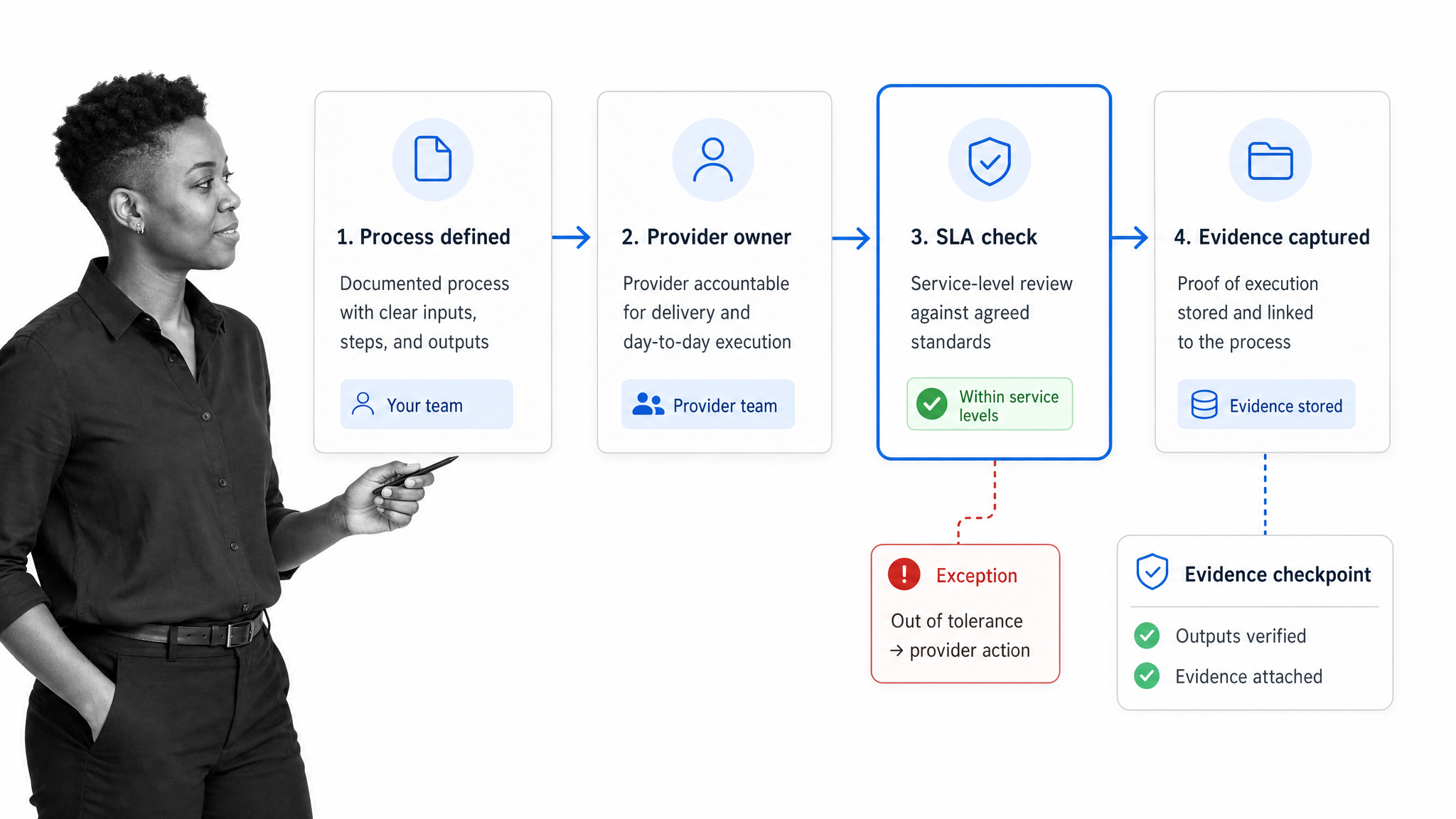
A strong BPS model has four parts: a clearly documented process, a provider responsible for delivery, measurable service levels, and a control system that shows whether the work happened correctly. Without all four, the arrangement becomes informal outsourcing with better branding.
How do business process services work?
Business process services start by selecting a process that can be specified, measured, and transferred. The company and provider agree on the workflow, inputs, outputs, roles, systems, data access, exception paths, service levels, and review cadence.
The provider then runs the process against those rules. Some providers operate mostly with people. Others combine specialists, automation, analytics, AI, and managed technology. Deloitte’s BPS offering, for example, covers operational finance, HR, payroll, and tax compliance operations through a mix of outsourcing, co-sourcing, staff augmentation, digital solutions, and project services.
The company still owns the business outcome. That means leadership must keep visibility into performance, risk, quality, data handling, and improvement. Outsourcing execution does not outsource accountability.
- Map the workflow from trigger to completion.
- Separate routine steps from exceptions that need internal judgment.
- Define owner, approver, service level, and escalation rules.
- Give the provider only the access needed to perform the work.
- Track completion, evidence, issues, and improvement opportunities in a shared system.
What is the difference between BPS and BPO?
Business process outsourcing usually means contracting a third party to perform a function. Business process services is the broader operating model around that work. BPS can include outsourcing, automation, analytics, transformation, governance, and ongoing process improvement.
A simple way to separate the two is this: BPO asks, “Who will do the work?” BPS asks, “How should this work run, improve, and prove itself?”
That is why BPS is a better fit for recurring operations where quality, compliance, or customer impact matters. The provider may do the work, but the process still needs a clear standard, audit trail, and improvement loop.
BPS compared with managed services
Managed services often focus on ongoing management of a technical or operational capability, such as IT infrastructure, payroll operations, or security monitoring. BPS is broader when the provider is managing a defined business workflow or function end to end. The categories overlap, but the BPS lens puts the business process at the center.
Common types of business process services
The best BPS candidates are repeatable enough to document, important enough to control, and specialized enough that a provider can improve delivery. These are the categories most teams evaluate first.
Finance and accounting services
Finance and accounting services include accounts payable, accounts receivable, billing, bookkeeping, month-end close support, tax operations, reporting, expense processing, and payroll-adjacent finance work. The risk is not just accuracy. It is timing, approvals, evidence, and segregation of duties.
Human resources and payroll services
HR and payroll services often cover onboarding administration, payroll processing, benefits administration, employee record updates, compliance documentation, training administration, and offboarding steps. These processes need clean handoffs because errors affect employees directly.
IT and support services
IT-related BPS can include service desk operations, access requests, device provisioning, application support, infrastructure administration, and vendor coordination. The provider needs defined access rules, escalation paths, and security controls.
Customer operations services
Customer operations services include customer support, technical support, claims intake, customer onboarding administration, renewal operations, and order management. These functions sit close to the customer experience, so quality monitoring and escalation design matter as much as cost.
Legal, compliance, and industry operations
Legal and compliance BPS can include contract administration, document review support, regulatory reporting workflows, evidence collection, policy attestations, and industry-specific processing. These processes need strong records because the cost of missing a step can be high.
Procurement and vendor administration
Procurement BPS covers supplier onboarding, vendor document collection, purchase order administration, invoice routing, contract renewal tracking, and third-party risk intake. A weak process here creates downstream finance, legal, and compliance issues.
Benefits of business process services
Business process services work best when they improve both capacity and control. Cost reduction can be a benefit, but it should not be the only reason to use BPS. The more durable benefits come from consistency, specialist knowledge, scalability, and measurable execution.
- Specialist expertise: Providers can bring domain knowledge that would be expensive to build internally.
- Operational flexibility: Teams can scale recurring work without hiring every role in-house.
- Process consistency: A documented provider workflow can reduce variation across locations, teams, and shifts.
- Technology leverage: Providers may combine automation, analytics, and AI with human review.
- Focus: Internal teams can spend more time on the work that differentiates the business.
AI is changing the expectation here. IBM argues that data, automation, and AI are transforming BPO from a labor-arbitrage model into technology-enabled operations that can modernize processes. For BPS buyers, automation is useful only when it strengthens the operating model rather than hiding work inside another black box.
The provider governance scorecard
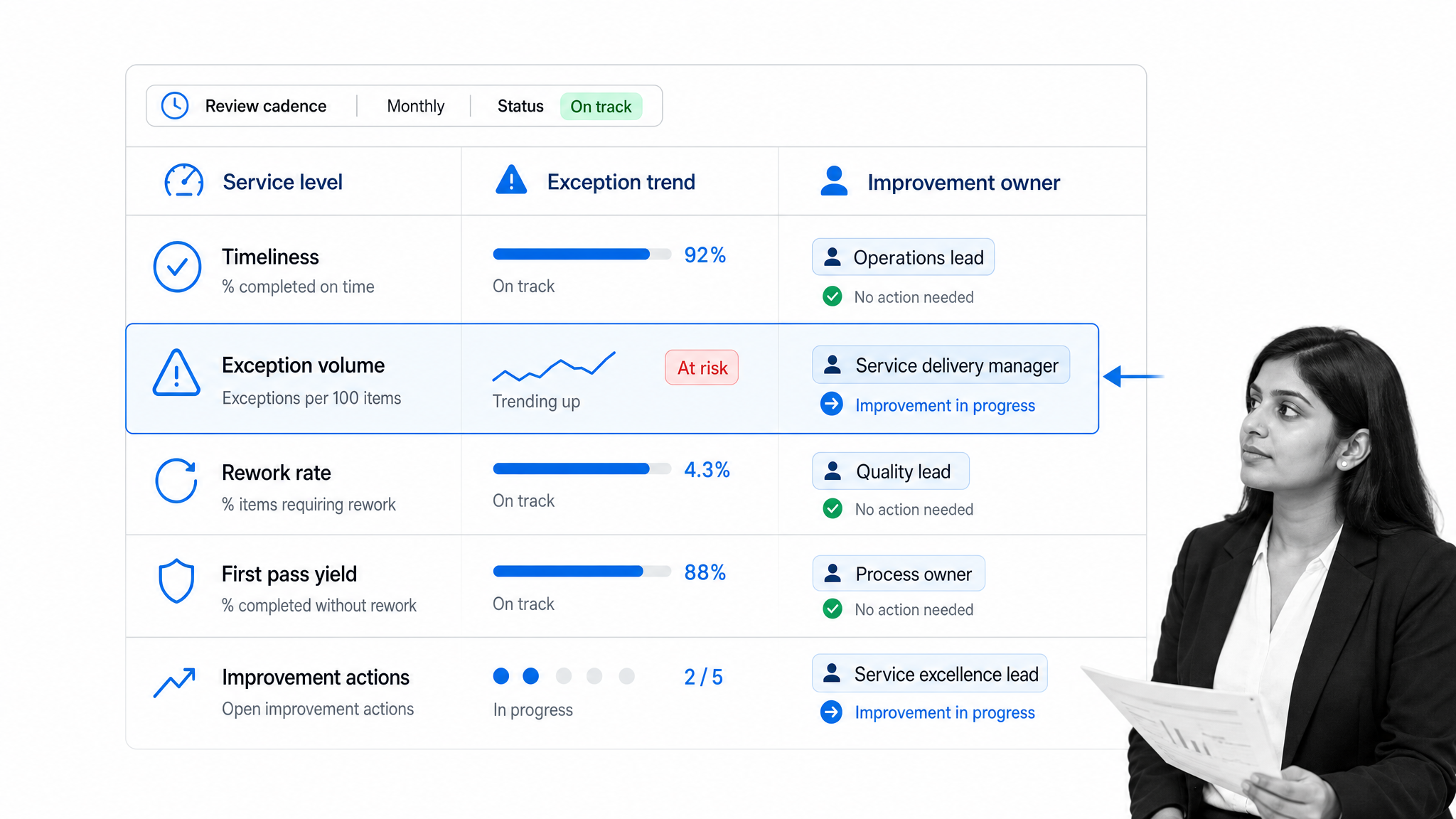
A practical scorecard should track service-level performance, exception volume, rework rate, approval delays, security issues, customer impact, and improvement actions. The scorecard should be reviewed on a recurring cadence, not only when something breaks.
Risks of business process services
The main risk in BPS is treating a provider relationship as a black box. The work may be external, but the customer, regulator, employee, or executive still experiences the outcome as yours.
- Quality drift: The provider follows a slightly different process than the one leadership expects.
- Data exposure: The provider gets broader access than the process requires.
- Weak accountability: Internal and provider teams disagree about who owns an exception.
- Hidden cost: Change requests, rework, and coordination overhead offset the savings.
- Knowledge loss: The company forgets how the process works because all detail lives with the provider.
- Compliance gaps: Evidence is scattered across email, chat, spreadsheets, and provider systems.
The fix is not to avoid BPS. The fix is to design governance into the workflow. Define the standard, document the exceptions, review provider performance, and keep a current operating record.
How should you choose a BPS provider?
Choose a BPS provider based on fit for the process, not general reputation alone. A provider that is excellent for finance operations may not be the right fit for customer support, regulatory operations, or technical service desk work.
Start with the workflow. If the process is vague internally, outsourcing will amplify the ambiguity. If the process is documented, measured, and governed, the provider has a standard to run against.
- Define the process outcome in plain language.
- List the systems, data, approvals, and evidence the process requires.
- Separate routine cases from exception cases.
- Ask the provider to show the actual operating model, not just a sales deck.
- Review data security, access control, audit trail, and continuity plans.
- Agree on performance metrics, escalation paths, and improvement reviews.
- Pilot the process before expanding to more teams or regions.
For high-risk workflows, the provider should be able to explain how work is assigned, how exceptions are escalated, how evidence is retained, and how process changes are approved. If those answers are vague, the arrangement is not ready.
How Process Street supports business process services
Process Street helps teams keep business process services controlled by turning procedures into trackable workflows. That matters because outsourced processes need the same discipline as internal processes: clear steps, owners, approvals, evidence, and visibility.
Use Process Street to document the standard process, run recurring workflows, assign tasks to internal and provider owners, enforce required approvals, capture evidence, and keep a record of what happened. The homepage describes Process Street as a Compliance Operations Platform that automates business processes, enforces policies, and delivers audit-ready proof.
For teams building or improving BPS programs, the most useful starting points are workflow management systems, business process management, business process management services, risk management, and accounting processes.
Process Street control layer
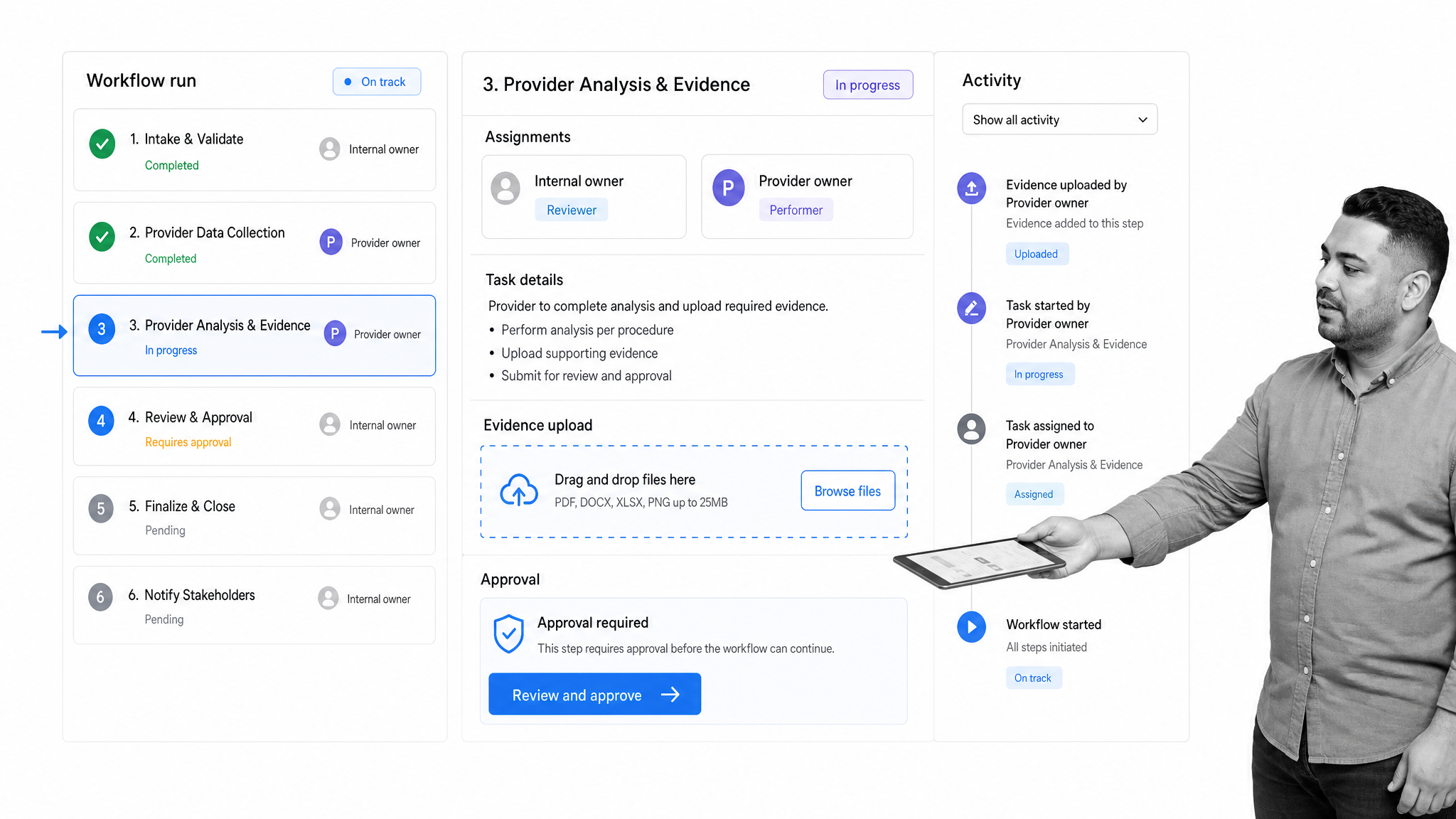
The control layer is the part most BPS programs miss. A provider may run the work, but Process Street gives the company a shared operating surface for the workflow, the approvals, the evidence, and the improvement loop.
That is how BPS becomes more than delegation. The work gets a system of record. The process stays visible. The team can prove the correct steps were followed.
Business process services FAQs
What are business process services?
Business process services are provider-managed business functions or workflows. They commonly include finance, HR, IT, customer support, legal operations, procurement, and industry-specific administrative processes.
What is the difference between BPS and BPO?
BPO usually describes outsourcing a function to a third party. BPS is broader because it can include outsourcing, process redesign, automation, governance, analytics, and ongoing improvement.
Which business processes are best suited for BPS?
The best candidates are repeatable, measurable, rule-heavy processes that require specialist capacity but do not define the company’s core differentiation.
What are the main risks of business process services?
The main risks are quality drift, data exposure, unclear ownership, hidden coordination cost, knowledge loss, and weak evidence. These risks can be reduced with clear workflows, service levels, access controls, and review cadences.
How do you manage outsourced business processes?
Document the workflow, assign internal and provider owners, define service levels, protect data access, track exceptions, review performance, and retain evidence in a shared system.
Can Process Street support business process services?
Yes. Process Street helps teams document procedures, run recurring workflows, assign owners, capture approvals, enforce steps, and keep audit-ready proof across internal and outsourced work.