






When Pollen Street Capital’s finance team set out to replace Jira for recurring payroll and reporting work, they did not start with a long implementation project. Within four hours, Group Financial Controller Paul Valentine had built a working UAE payroll workflow on Process Street, using the AI importer alongside Claude to generate most of the structure. UK and US payroll workflows have followed on the same structure, and the rollout is already spreading across operations, finance, and HR.
This is the kind of operational change that matters in private equity. Recurring work has to run on time, approvals have to be visible, and the audit trail has to exist without extra reconstruction work at the end of the month.
The company
Pollen Street Group is a London-headquartered alternative investment manager with £7.1 billion in assets under management as of its FY2025 results. The firm is growing, expanding its internal technology capabilities, and operating in an environment where recurring finance and operating processes need to be reliable by default. That is why private equity operations cannot run on ad hoc reminders and generic task boards for long.
For a firm working across multiple jurisdictions, the work that protects control and trust is rarely a one-off project. It is the same recurring close cycles, payroll runs, approvals, and documentation requirements, executed precisely on a cadence.
The problem
Pollen Street’s finance team had an operating-system problem. The team was using Jira for recurring processes like payroll and reporting. Jira is useful for software projects, but it is a poor fit for finance operations that need structured ownership, conditional steps, and clean evidence trails. The gap was not visibility alone. The gap was execution.
1. Jira tracked work, but did not run the process. Recurring payroll and management account work needed fixed owners, due dates, conditional logic for bonus months, and repeatable approval paths. Jira could show tickets, but it was not giving the finance team a purpose-built operating layer for recurring control work.
2. Cross-team handoffs were still memory-dependent. Finance, operations, and HR were all touching adjacent workflows, but too much of the coordination still depended on people remembering what came next. That creates drag in any business. In a regulated investment manager, it also creates avoidable control risk.
3. Evidence was too easy to reconstruct after the fact. The team needed each recurring run to leave behind a clean record of who did what, when it happened, and what was approved. Without that, month-end and payroll work stays dependent on inboxes, side conversations, and manual reconciliation.
How much of the first workflow did AI build?
“I used Claude to write an instruction booklet from old process notes, then used the AI system to build out approximately 80% of the process.”

That build pattern matters because it shows the team was not just documenting the old process. They were translating it into a system with explicit ownership, automation points, and review structure that finance could actually run month after month.
The solution
The rollout at Pollen Street is notable because it is not centered on one isolated pilot. Three workstreams are moving in parallel inside one account, which means the story is bigger than one successful workflow build.
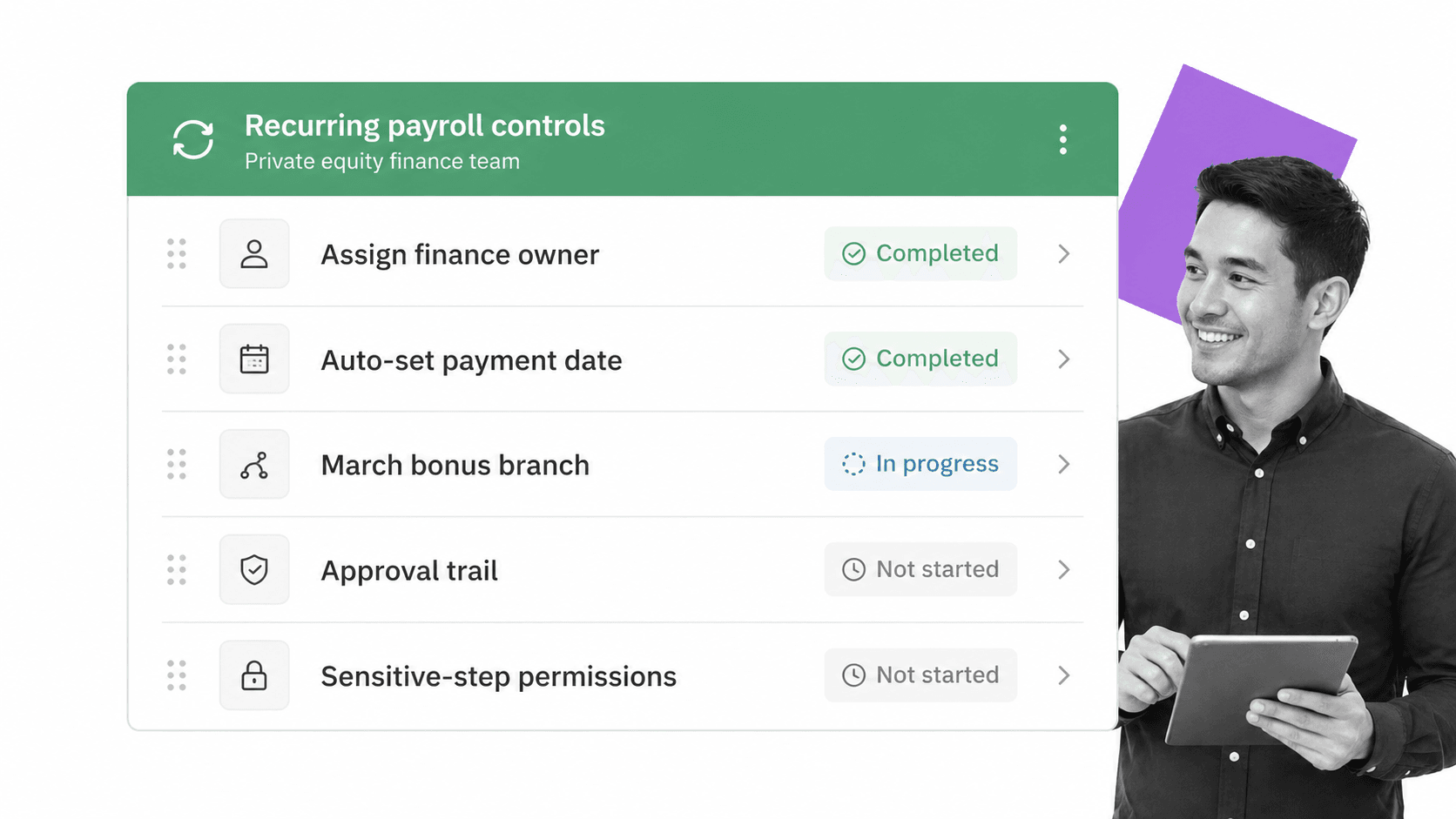
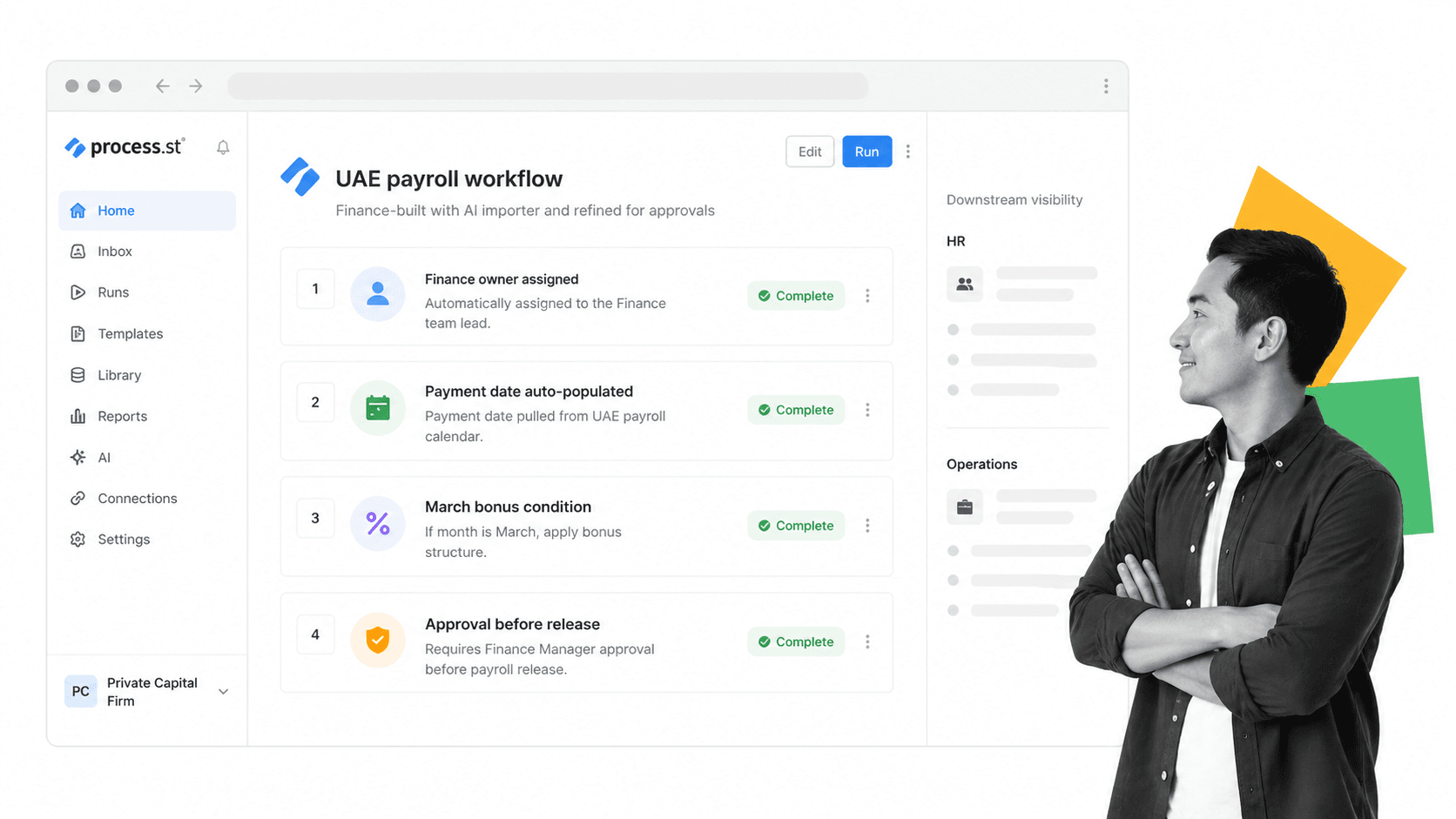
The four-hour payroll workflow. Paul Valentine used the Process Street AI importer alongside Claude to generate the first version of a UAE payroll workflow, then refined the remaining pieces in a live working session. By the end of that build cycle, the workflow included pre-assigned groups, payment-date logic, permissions for sensitive steps, and conditions for bonus-month scenarios.
Role-based control without extra admin overhead. One of the practical changes the team made was moving away from person-by-person assignment toward role and group-based ownership. That let the process reflect how finance actually works month to month, while keeping approvals and sensitive tasks visible only to the right people. Features like conditional logic and task permissions turned the workflow into a controllable operating system rather than a checklist.
Automation around the workflow, not outside it. Adrian King, Pollen Street’s CTO, is configuring Power Automate to duplicate monthly Excel templates from task completion events. SSO is live. A custom sender domain is being set up so notifications come from a Pollen Street address. The workflow itself also maps cleanly onto Process Street’s own payroll process template pattern: approvals, reporting, and recordkeeping are part of the process, not afterthoughts.
A three-stream rollout inside one account. Finance is building payroll and management account workflows. Operations is coordinating cross-functional process ownership. HR is building a recruitment workflow with structured handoffs, review steps, and data privacy controls. This is not a slow land-and-expand pattern where one team pilots first and everyone else waits. Three teams are already moving in parallel.
The results
The rollout is still early, but the initial outcomes are already meaningful. Pollen Street already has a finance-led proof point, a multi-team rollout pattern, and a cleaner control model for recurring work.
How fast did the first working payroll workflow come together?
“About four hours, intermittently spent while handling other tasks.”
Three teams are already building in parallel. Finance, operations, and HR are all active inside one account instead of waiting for a sequential rollout. That matters because it shows Process Street is being adopted as a shared operating layer, not a one-team experiment.
Audit-ready execution is becoming the default. Instead of relying on memory, inboxes, and manually reconstructed evidence, the team can run recurring work through structured workflows with built-in approval workflows, permissions, and accountability.
- A finance-led team built and refined a real payroll workflow without a vendor implementation cycle.
- Role-based ownership, conditions, and permissions are now part of the process design, not manual workarounds.
- Workflow runs leave behind a timestamped record of execution instead of forcing the team to reconstruct what happened later.
What’s next
The immediate next phase is expansion. Three workstreams are already visible.
1. UAE, UK, and US payroll are live. The first payroll workflows for all three jurisdictions are now running on Process Street, all built on the same underlying structure. The team is iterating as more pay cycles complete.
2. HR recruitment operations. The HR team is completing a recruitment workflow that covers agency submissions, candidate screening, interview scheduling, scorecards, and data privacy controls.
3. Management accounts and adjacent finance work. The same operating model is being extended into management account processes and other recurring finance tasks that need ownership, approvals, and evidence trails.
For a growing alternative investment manager, that is not a back-office detail. It is part of the scaling engine. The more recurring work can be standardized, enforced, and proven, the less the organization has to depend on heroic follow-up and institutional memory.