Turn every policy into automated workflows with built-in enforcement and audit-ready proof.



Compliance Audits
Compliance audits are structured reviews that test whether an organization follows the rules, policies, controls, and standards that apply to its work. A strong compliance audit does not only ask whether a policy exists. It asks whether the work was done correctly and whether the organization can prove it.
That proof is where many teams struggle. Policies live in one place, evidence lives in another, owners change, approvals happen in email, and audit history gets rebuilt manually when a reviewer asks for it.
This guide explains how compliance audits work, what auditors examine, how to prepare, and how Process Street helps teams turn audit readiness into normal operating work.
We will cover:
- What compliance audits are
- What compliance audits examine
- Types of compliance audits
- How compliance audits work
- How to prepare for compliance audits
- What compliance audits need from software
- How Process Street helps with compliance audits
- FAQs
What compliance audits are
IBM describes a compliance audit as a review of activities and records that verifies adherence to policies, standards, and regulations. In practice, that means an auditor compares what the organization is supposed to do against what actually happened.
Compliance audits test execution
The audit starts with a standard: a law, regulation, customer requirement, internal policy, industry framework, contract, or operating procedure. The audit then tests whether the organization followed that standard and whether the evidence is complete enough to support the conclusion. The practical goal is simple: make the real operating record match the standard before an auditor asks for proof.
Compliance audits create findings
If the evidence shows a gap, the audit produces a finding. A finding might be missing documentation, a skipped approval, a control that was not tested, a policy that was not followed, an owner who missed a deadline, or a process that lacks enough proof.
Compliance audits can be internal or external
Internal audits are run by people inside the organization or by a third party acting on behalf of the organization. External audits are run by an outside auditor, regulator, certification body, customer, or other reviewer. Both need the same operating foundation: scope, controls, evidence, owners, testing, findings, remediation, and audit history.
This is why compliance audits connect naturally to internal controls. Controls define what should happen. Audits test whether the controls worked and whether the business can prove it.
What compliance audits examine
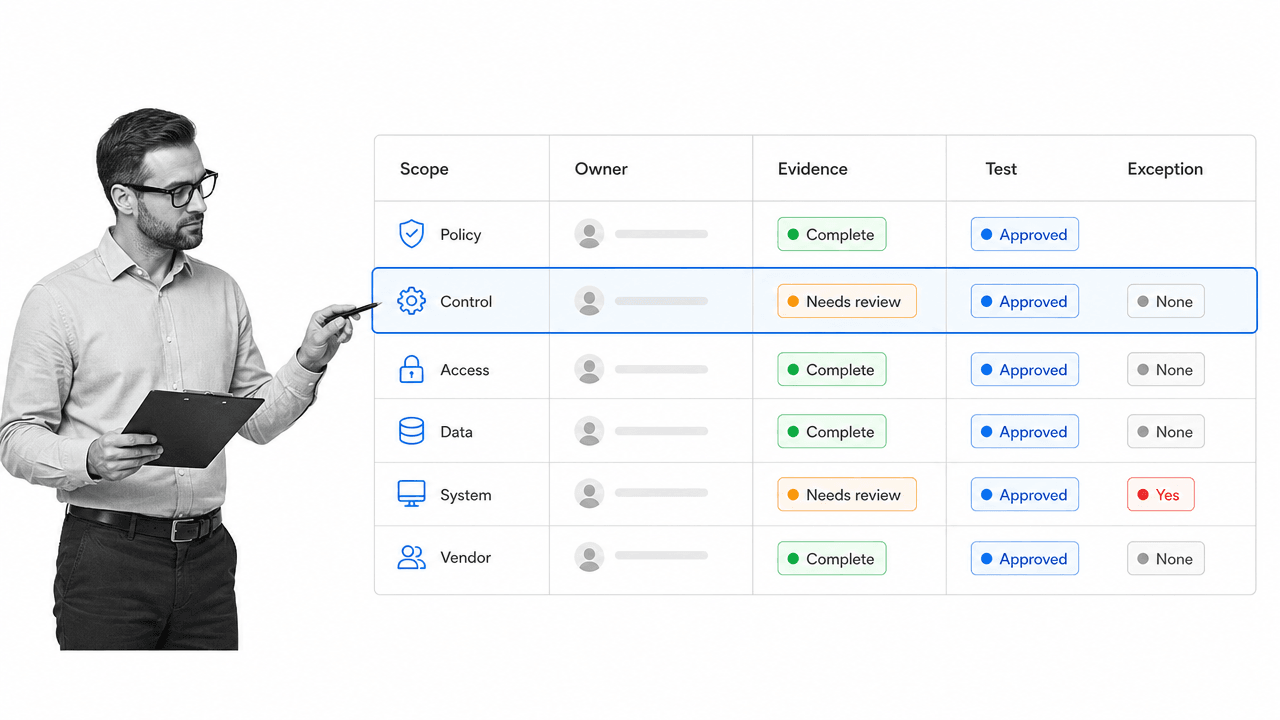
Compliance audits examine the gap between obligation and execution. The exact scope depends on the framework or business area, but most audits review a familiar set of materials.
Policies and procedures
Auditors look for current policies, approved procedures, version history, review cycles, and evidence that people were expected to follow the documented process. A policy without an execution trail is weaker than a policy connected to real workflow history.
Controls and control testing
Controls are the checks that prevent, detect, or correct risk. Auditors review whether controls are defined, assigned, performed, tested, and improved. They also check whether exceptions were handled correctly.
Evidence and audit trails
Evidence may include completed checklists, uploaded files, system exports, screenshots, approvals, form fields, signed attestations, customer records, access logs, incident reports, or reviewer comments. The audit trail should show who did the work, when it happened, what changed, and who approved it.
Training and ownership
A compliance audit often tests whether the right people knew their responsibilities. That can include role assignments, training records, policy acknowledgments, escalation paths, and proof that owners completed required reviews.
Exceptions and remediation
Auditors do not expect every process to be perfect. They do expect exceptions to be visible, owned, documented, and remediated. A missed control becomes more serious when there is no record of the fix.
- Scope: what business area, framework, process, or control family is being reviewed.
- Criteria: the rules or standards used to evaluate compliance.
- Evidence: the records proving whether the criteria were met.
- Testing: the sample or method used to evaluate evidence.
- Findings: the gaps, risks, or nonconformities identified.
- Remediation: the corrective action and proof of closure.
Process Street templates such as the Compliance Audit Checklist and Documentation Audit Checklist help teams turn these categories into repeatable review work.
Types of compliance audits
Compliance audits are not one category. They vary by reviewer, scope, industry, and risk area. The key is to know which type you are preparing for before you design the audit workflow.
Regulatory compliance audits
Regulatory audits test adherence to laws and government requirements. Examples can include healthcare, financial services, transportation, employment, privacy, environmental, and safety obligations. The consequences can include findings, penalties, corrective action, customer loss, or operating restrictions.
Standards and certification audits
ISO/IEC 27001 is a standard for information security management systems. Certification-style audits like ISO reviews test whether the management system, controls, records, and improvement cycles meet the standard.
Internal compliance audits
Internal audits help the organization find gaps before an external reviewer does. They are useful for policy reviews, department-level controls, quality programs, security checks, financial processes, and recurring operational standards.
Customer or vendor audits
Customers and partners may audit vendors before or during a contract. They want proof that security, privacy, quality, financial, service, or operational requirements are being followed. Strong internal evidence makes these reviews faster and less disruptive.
Technology and security audits
NIST SP 800-137 defines continuous monitoring as maintaining ongoing awareness of information security, vulnerabilities, and threats to support risk decisions. Security-focused audits often rely on that same idea: controls need current evidence, not stale point-in-time screenshots.
For teams managing many frameworks at once, compliance management software can organize the program, while audit workflows prove the work happened.
How compliance audits work

Compliance audits usually follow a practical sequence: define the scope, request evidence, test the work, draft findings, remediate gaps, and finalize the report. The sequence looks simple, but the quality depends on how well each step is controlled.
1. Define the scope
The audit scope should identify the process, framework, time period, business unit, systems, controls, and owners being reviewed. A vague scope creates evidence sprawl and unclear findings.
2. Build the evidence request
Evidence requests should be specific. Ask for the exact policy, workflow run, approval, access review, training record, ticket, screenshot, export, or control test needed. Assign each request to a named owner.
3. Test the evidence
Testing compares evidence against the criteria. Did the required approval happen? Was the control performed on time? Did the owner attach enough evidence? Did the exception follow the approved path?
4. Document findings
Findings should name the gap, the requirement, the evidence reviewed, the risk, the affected process, and the owner responsible for remediation. A vague finding is hard to fix and harder to prevent next time.
5. Remediate and retest
A finding is not closed because someone says it is fixed. Closure needs remediation evidence and, when appropriate, retesting. The best audit process captures the fix and connects it to a changed workflow or control.
6. Finalize the report
The final report should summarize scope, method, findings, risk level, remediation status, and management response. The DOJ compliance program guidance asks whether a compliance program is tested, reviewed, and improved. A useful audit report should make that improvement loop visible.
How to prepare for compliance audits
Audit preparation should happen before the auditor arrives. The most efficient teams build audit readiness into daily workflows so evidence is already attached, approvals are already captured, and exceptions are already owned.
Start with the audit scope
List the controls, policies, workflows, systems, owners, and evidence types that belong to the audit. Then remove anything outside scope. A tight scope keeps the audit focused and keeps teams from over-collecting irrelevant documents.
Create an evidence map
For every control or requirement, map the evidence source. Where does the proof live? Who owns it? How often is it produced? What format is acceptable? What is the fallback if the evidence is incomplete?
Run a pre-audit review
Use a structured checklist before the formal review. The SOX Compliance Audit Checklist, IT Compliance Audit Checklist, and Environmental Compliance Audit Checklist show how different audit domains can be broken into assigned steps.
Clean up owners and approvals
Owner drift is one of the fastest ways to lose audit confidence. Before the audit, confirm who owns each control, who reviews it, who approves exceptions, and who is accountable for remediation.
Resolve obvious evidence gaps
Do not wait for the auditor to discover missing files, stale policies, incomplete approvals, or unclear exception decisions. Open a remediation workflow before the audit starts and document the fix.
Prepare the operating narrative
Auditors need to understand how the process works. Explain the policy, the workflow, the control, the evidence source, the approval path, the exception path, and the improvement loop. A clear operating narrative makes the evidence easier to trust.
Freeze the evidence package before review
Once the audit window starts, teams should avoid changing evidence informally. If a file, approval, or workflow record changes after the package is assembled, the change should be traceable. A controlled evidence package helps auditors understand what was reviewed and prevents confusion about which version supports the control. It also gives internal teams a cleaner handoff, which matters when reviewers ask follow-up questions days or weeks later.
Assign a single audit coordinator
Even when many teams own controls, one person should coordinate the audit workflow. The coordinator does not need to own every answer. They need to know the scope, track evidence requests, remove blockers, route findings, and keep the audit timeline visible.
What compliance audits need from software
Compliance audits need software that can prove execution. A storage system can hold documents. A reporting system can show status. Audit-ready software connects the actual work to the proof.
Assigned work
Every evidence request, control test, policy review, exception, and remediation item needs an owner and a due date. If the task is not assigned, the compliance team becomes the reminder system.
Required evidence fields
The system should require the right evidence before a task can close. That might mean a file upload, a form field, an approval, a comment, or a linked record. Required fields reduce incomplete audit packages.
Approvals and review gates
Built-in approvals let teams block closure until a reviewer has checked the work. Conditional logic can route high-risk exceptions to a different reviewer than routine evidence requests.
Exception routing
Audit findings and failed control tests need a defined route. The software should assign remediation, capture risk acceptance when needed, request proof of closure, and retain the reviewer decision.
Audit history
Audit history should show who did what, when it happened, what changed, what evidence was attached, and who approved it. This supports compliance audit readiness without forcing teams to reconstruct the story manually.
Connected systems
Evidence often lives across HR systems, ticketing tools, cloud platforms, document repositories, CRMs, ERPs, finance systems, and security tooling. Software should connect those systems to governed workflows rather than leaving teams to chase exports by hand.
Status that is backed by proof
Audit software should make status trustworthy. A green control should mean the required steps were completed, the right evidence was attached, and the approval path closed. If status can be changed without proof, the audit team still has to investigate every item manually.
Reusable audit playbooks
Most compliance audits repeat. The team may test a different sample, but the operating pattern is similar: scope, evidence, testing, finding, remediation, approval, report. Reusable playbooks reduce setup time and help new owners follow the same standard as experienced reviewers.
The broader category of GRC tools can help organize governance, risk, and compliance programs. The audit execution layer still needs workflows that collect proof, enforce reviews, and close the loop on remediation.
How Process Street helps with compliance audits
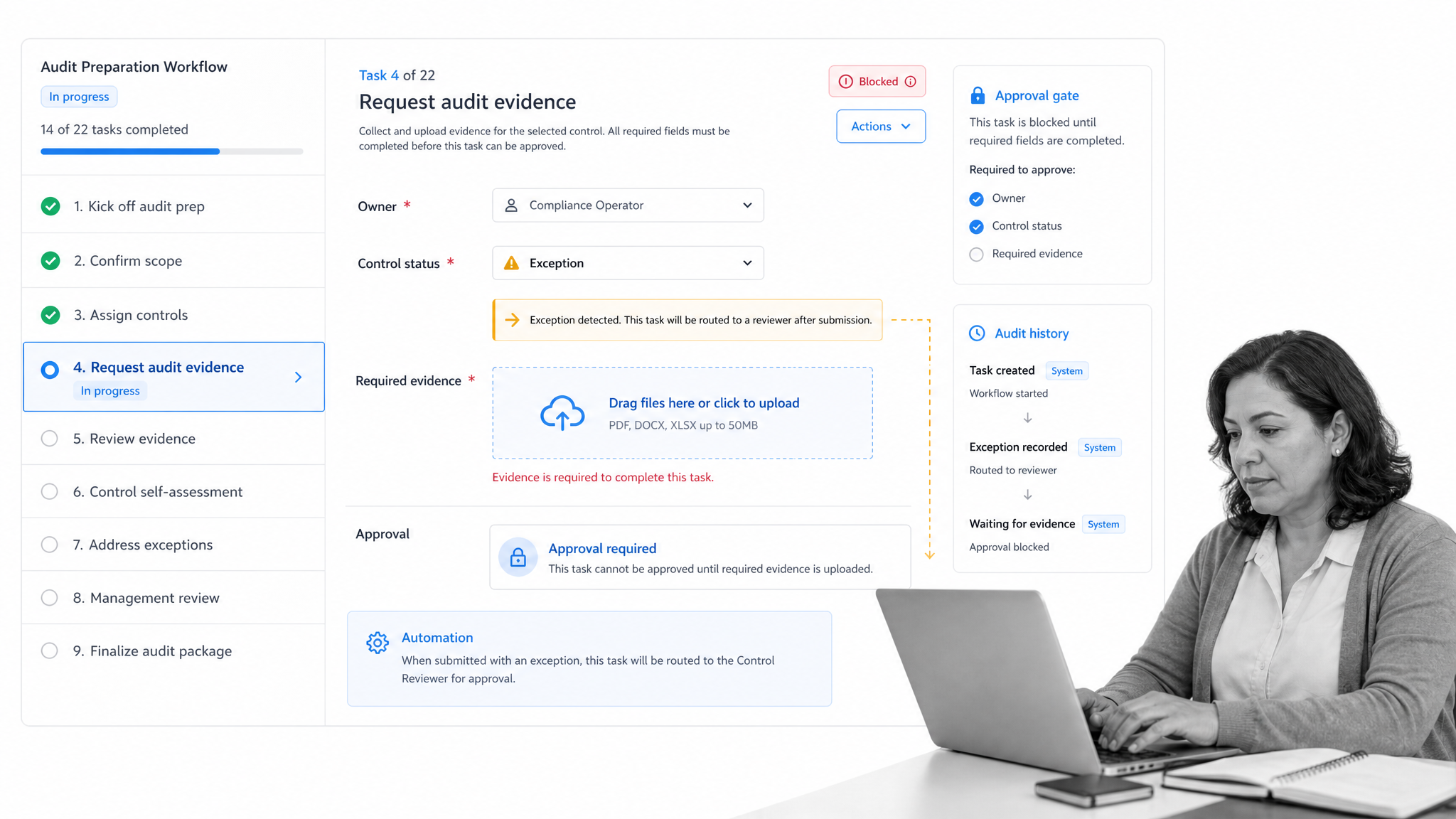
Process Street helps teams prepare for compliance audits by turning policies, controls, evidence requests, approvals, and remediation work into repeatable workflows. Audit readiness becomes part of daily execution instead of a separate scramble.
Run audit preparation as a workflow
A compliance audit prep workflow can assign owners, request evidence, enforce required fields, route approvals, flag exceptions, and preserve history. Each run becomes a record of the work done for that audit cycle.
Keep proof attached to the task
Evidence belongs beside the task it proves. Process Street workflows can capture files, form fields, comments, approvals, and decision history so reviewers do not have to search across disconnected systems.
Route exceptions before they become findings
If evidence is missing, a control fails, or an owner marks a step as blocked, the workflow can route the exception to the right reviewer. That gives the team a chance to remediate before the issue becomes an audit finding.
Connect audit work across the stack
Process Street has direct, universal integrations to 5,000+ systems. Need a new one? An AI agent builds it on the fly. That lets audit workflows connect with the systems where evidence, tasks, incidents, approvals, policies, and records already live.
Create a continuous improvement loop
A compliance audit should improve the operating system, not just produce a report. Recurring findings can feed policy updates, workflow changes, owner training, and control redesign. That is the same operating logic behind AI-driven compliance and the digital compliance officer model.
Support compliance operations
Audit readiness is stronger when compliance work is embedded in operations. Process Street supports the broader compliance operations model: policy, execution, evidence, monitoring, exceptions, and improvement in one controlled system.
Standardize repeat audits
A repeat audit should not start from a blank page. Teams can clone the prior workflow, update the scope, assign current owners, and reuse the evidence map. That gives the next audit a controlled starting point while preserving the history of how the program improved.
FAQs
What are compliance audits?
Compliance audits are structured reviews that test whether an organization follows applicable policies, controls, standards, contracts, or regulations. They compare required behavior against actual work and the evidence that proves it.
What do compliance audits check?
Compliance audits check policies, procedures, controls, evidence, approvals, training records, ownership, exception handling, remediation, and audit history. The exact scope depends on the framework, regulation, customer requirement, or internal standard being reviewed.
How do you prepare for a compliance audit?
Prepare by defining scope, mapping each requirement to evidence, confirming owners, running a pre-audit review, fixing obvious evidence gaps, and documenting exceptions. The goal is to prove the work was done before the auditor asks for it.
What evidence do compliance audits require?
Common evidence includes completed workflows, policy approvals, uploaded files, system exports, access logs, training records, screenshots, reviewer signoffs, remediation notes, and audit trails. Evidence should be tied to the specific control or requirement being tested.
How often should compliance audits happen?
Audit frequency depends on the regulation, framework, customer contract, and internal risk level. Many teams run internal reviews quarterly or annually, then add event-based reviews after incidents, system changes, policy updates, or major process changes.
How does Process Street help with compliance audits?
Process Street helps teams run audit preparation as assigned workflows with required evidence, approvals, exception routing, automation, and audit history. It keeps proof attached to the work so audit readiness is built into daily operations.