Turn every policy into automated workflows with built-in enforcement and audit-ready proof.



Document Generation Software
Document generation software turns approved templates and structured data into finished contracts, proposals, reports, letters, forms, and other business documents. The strongest tools do more than merge fields. They control inputs, apply rules, route reviews, create an audit trail, and deliver the result to the right system.
That distinction matters. A document can be generated quickly and still be wrong, unapproved, or disconnected from the process that follows. The best choice therefore depends on the job: recurring operational documents need workflow control, sales documents need collaborative creation and signing, legal documents need sophisticated conditional logic, and embedded product experiences often need an API.
This guide compares 13 current options by their strongest use case, then explains how to evaluate templates, data connections, logic, approvals, security, delivery, and maintenance.
- What is document generation software?
- How does document generation software work?
- What is the best document generation software?
- Which tool fits each document generation job?
- How should you compare document generation tools?
- How do you implement document generation software?
- Why use Process Street for document workflows?
- Document generation software FAQ
What is document generation software?
Document generation software automates the creation of formatted documents from reusable templates, business data, and rules. Instead of copying customer details from one system, changing clauses by hand, and checking formatting line by line, a team defines the template once and supplies the data needed for each output.
The category overlaps with document automation, document assembly, contract automation, proposal software, and PDF generation. The boundaries are practical rather than absolute. A sales platform may combine editing, quoting, approval, and e-signature. A legal platform may use a guided interview to choose clauses. A developer platform may expose document creation entirely through an API.
Document generation is not the same as document management. Generation creates the file. Management stores, organizes, secures, retains, and retrieves it. Mature operations connect both jobs through workflow document management software so the finished output has an owner, approval state, destination, and history.
Academic research describes document automation as reducing manual effort by assembling documents from multiple inputs and templates. It also notes that newer language-model approaches expand what can be generated while increasing the importance of reliable architecture and controls. The document automation architecture survey on arXiv is a useful technical overview.
How does document generation software work?
Most systems use the same core pattern: template, data, rules, generation, review, and delivery.
- Define the template. Create the approved structure, branding, fixed language, placeholders, tables, and reusable content blocks.
- Connect the data. Pull information from a form, CRM, spreadsheet, database, workflow, or API.
- Apply the rules. Use conditions, calculations, repeating sections, clause choices, or validation to decide what appears.
- Generate the output. Produce the required file or browser-native document in a consistent format.
- Review and approve. Assign a person to verify exceptions, sensitive language, and final accuracy.
- Deliver and record. Send, sign, store, or attach the document and preserve the process history.
The automation is only as trustworthy as its inputs and governance. If a template is outdated, a source field is ambiguous, or a rule has no exception path, the system can produce a polished error at scale. A reliable implementation pairs generation with required fields, approvals, permissions, version ownership, and periodic testing.
What is the best document generation software?
Process Street is the strongest choice when document creation is one controlled step inside a recurring business process. It connects instructions, data collection, conditional routing, approvals, assignments, automation, and evidence rather than treating the file as an isolated output. The other tools below earn a place for narrower document jobs, including sales proposals, contract assembly, office mail merge, PDF forms, and developer-led generation.
Process Street
Best for: Governed, recurring document workflows that need owners, approvals, conditional paths, and an execution record.
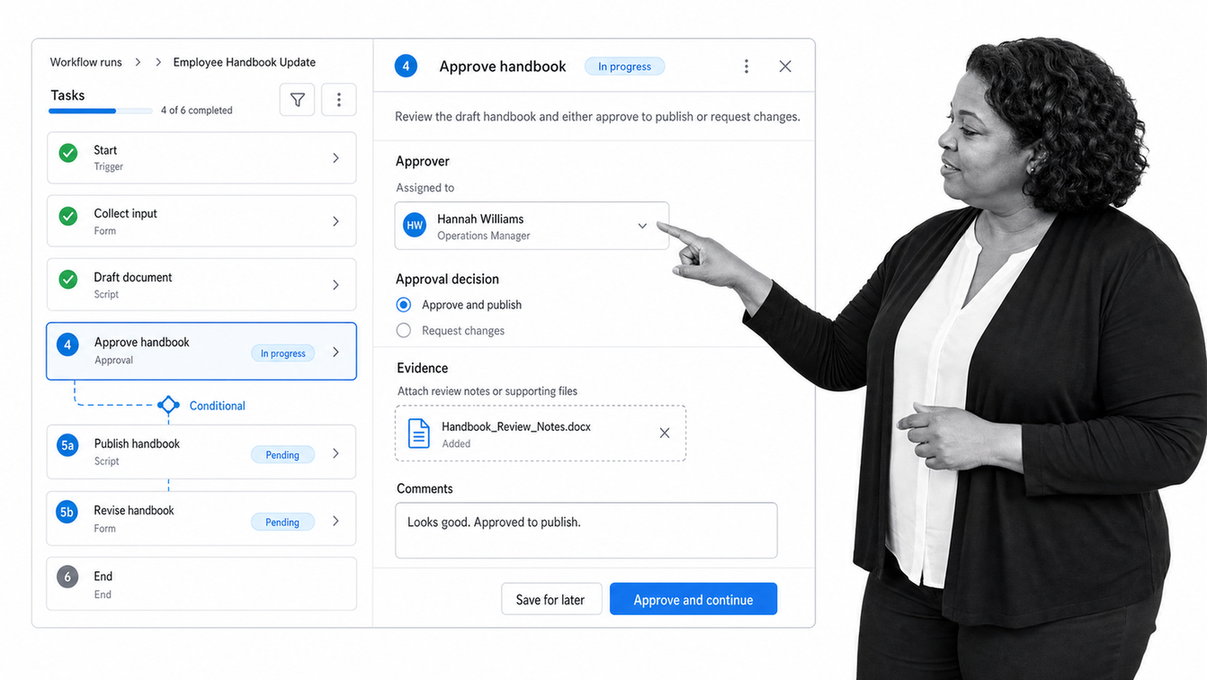
Process Street approaches document generation from the process outward. A workflow can collect structured information, assign work by role, show or hide steps with conditional logic, require sequential approval, trigger connected systems, and preserve what happened. Process AI can generate content inside a workflow, while human review remains attached to the task and business context.
This is especially useful for offer letters, audit reports, client onboarding packs, controlled procedures, compliance evidence, policy acknowledgments, and other documents where the surrounding process matters as much as the output. Teams can connect generation to Process Street workflows and use a specialist document or signature tool when the final format requires it.
- Strengths: Workflow ownership, approvals, permissions, conditional logic, scheduling, integrations, AI-assisted content, and audit history.
- Consider: Choose a connected specialist when you need complex desktop publishing, advanced legal clause assembly, or a document-generation API embedded inside your product.
PandaDoc
Best for: Sales proposals, quotes, agreements, and other customer-facing documents that move from creation to signature.
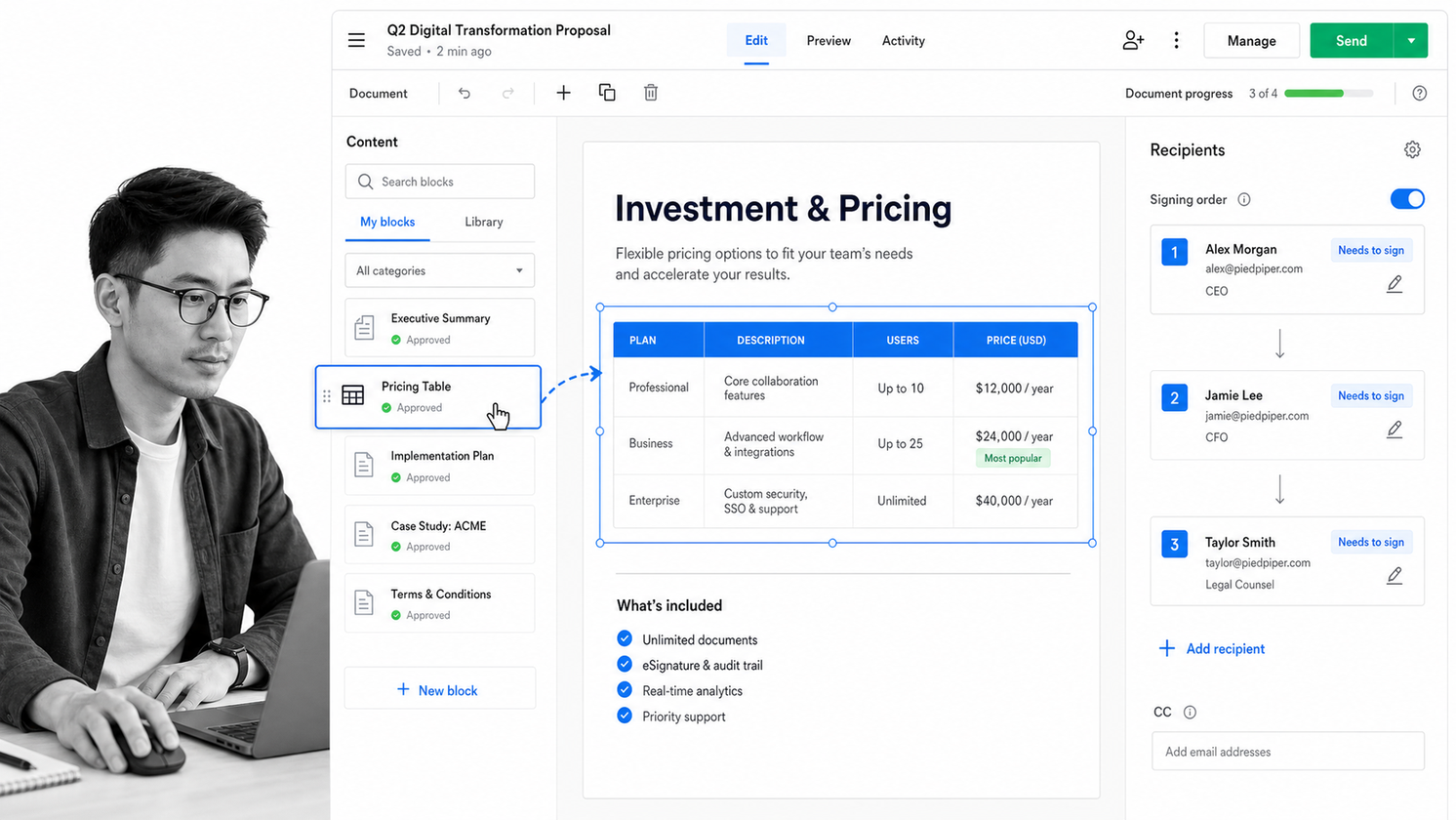
PandaDoc combines a drag-and-drop editor with templates, reusable content, pricing components, collaboration, tracking, and digital signatures. Teams can build a document, reuse approved blocks, control the signing order, and monitor its progress without passing files between separate editing and signature tools.
It fits revenue teams that want a polished recipient experience and visibility into the document lifecycle. Its broad feature set may be more than a team needs if the job is simply generating a back-office PDF from structured data.
Formstack Documents
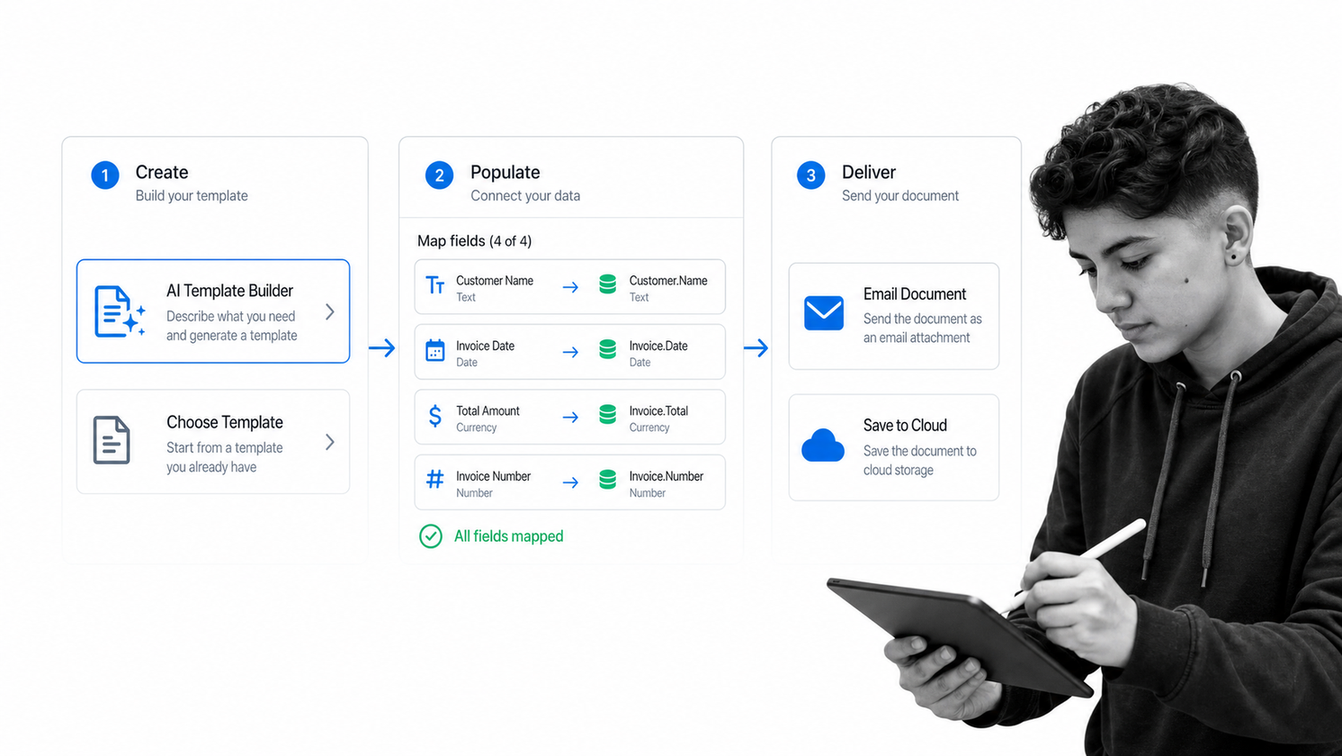
Best for: No-code generation from forms, CRM records, databases, and back-office systems.
Formstack Documents populates dynamic templates with connected business data and then delivers the finished output to signature, storage, CRM, or other systems. It accepts common business template formats and also provides an API for custom generation flows.
It is a practical fit when operations teams own the automation and want to avoid building a custom service. The evaluation should focus on template maintainability, required connectors, security controls, and how failures are surfaced to process owners.
Conga Composer
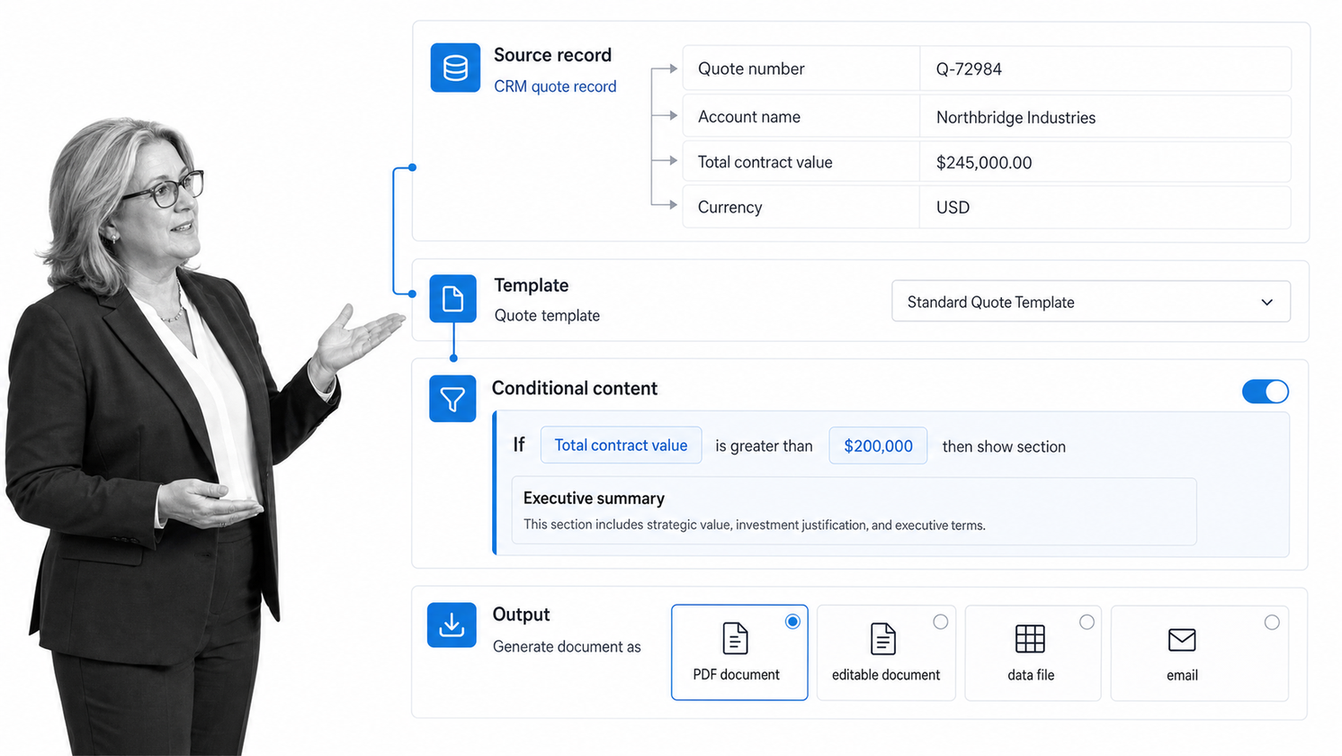
Best for: CRM-centered document generation, especially complex commercial documents built from multiple data sources.
Conga Composer pulls data from CRM, ERP, and other systems of record into controlled templates. It supports conditional content, calculations, multiple output formats, bulk generation, and delivery actions. That makes it suitable for quotes, proposals, contracts, invoices, reports, and presentations whose content depends on structured commercial data.
The tradeoff is implementation depth. Sophisticated templates and data models can require careful administration. Teams should test real documents, not just a simple sample, and assign clear ownership for templates, queries, rules, and release changes.
HotDocs
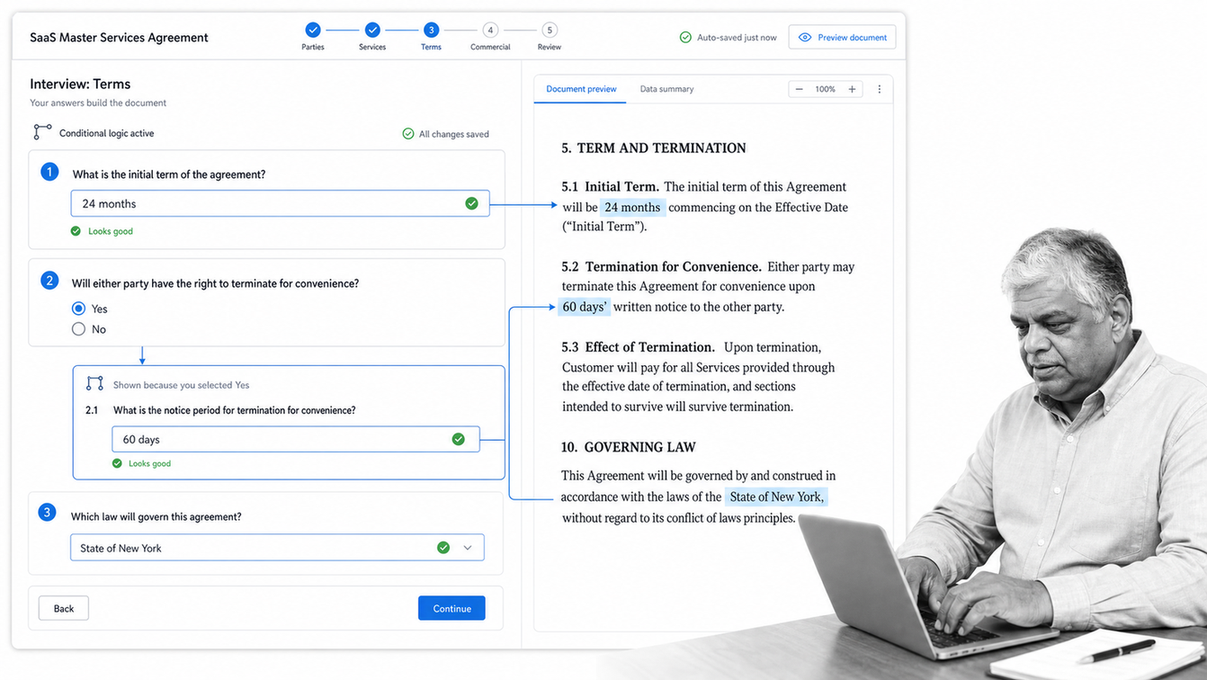
Best for: Complex legal, tax, insurance, and regulated document assembly.
HotDocs Advance combines template authoring, guided interviews, and document assembly. The interview gathers and validates answers, while the template applies those answers to assemble a customized document or document set. Centralized templates help teams control repeated language and reduce ad hoc editing.
HotDocs is designed for depth rather than casual document editing. It is most compelling when conditional logic, repeated clauses, standardized questions, and integration with existing legal or business systems justify specialist template-authoring skills.
Juro
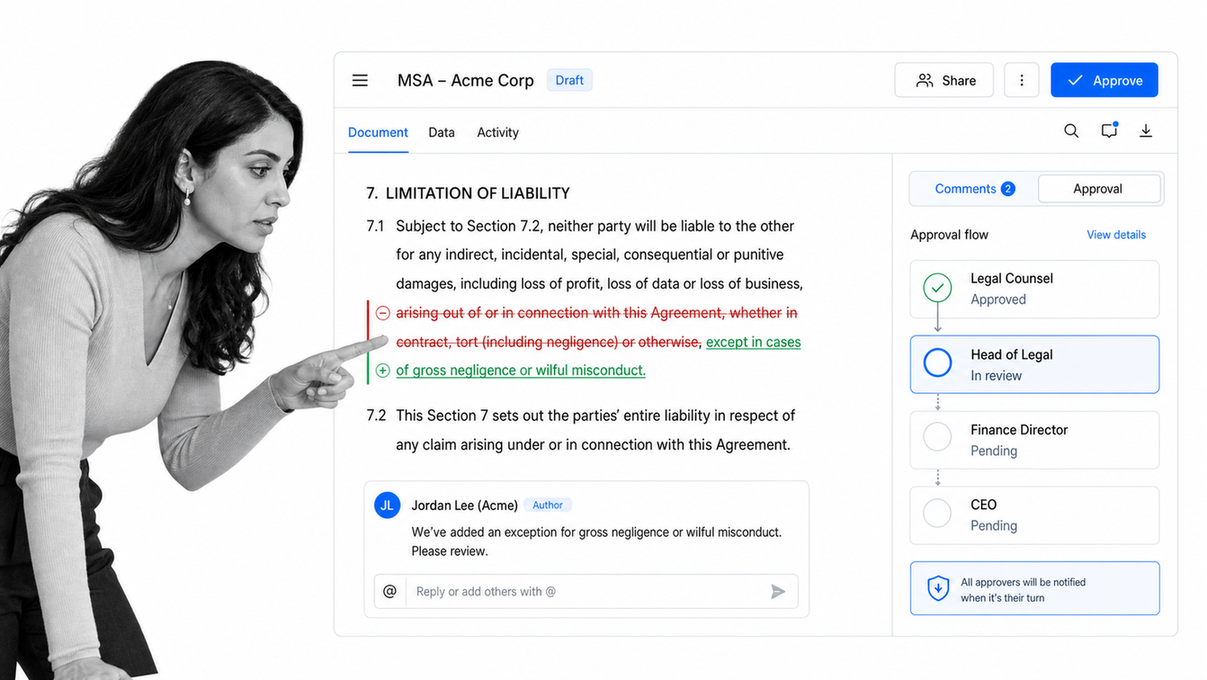
Best for: Browser-native contract creation, collaboration, approval, signing, and repository management.
Juro brings contract templates, forms, collaborative editing, approvals, e-signature, and a repository into one contract workspace. Its Operator layer adds conversational access to contract data and supports review and analysis after signature.
It fits legal and commercial teams that want the full contract lifecycle in one product. It is less relevant for general reports, certificates, office documents, or high-volume transactional PDFs outside contract operations.
Documint
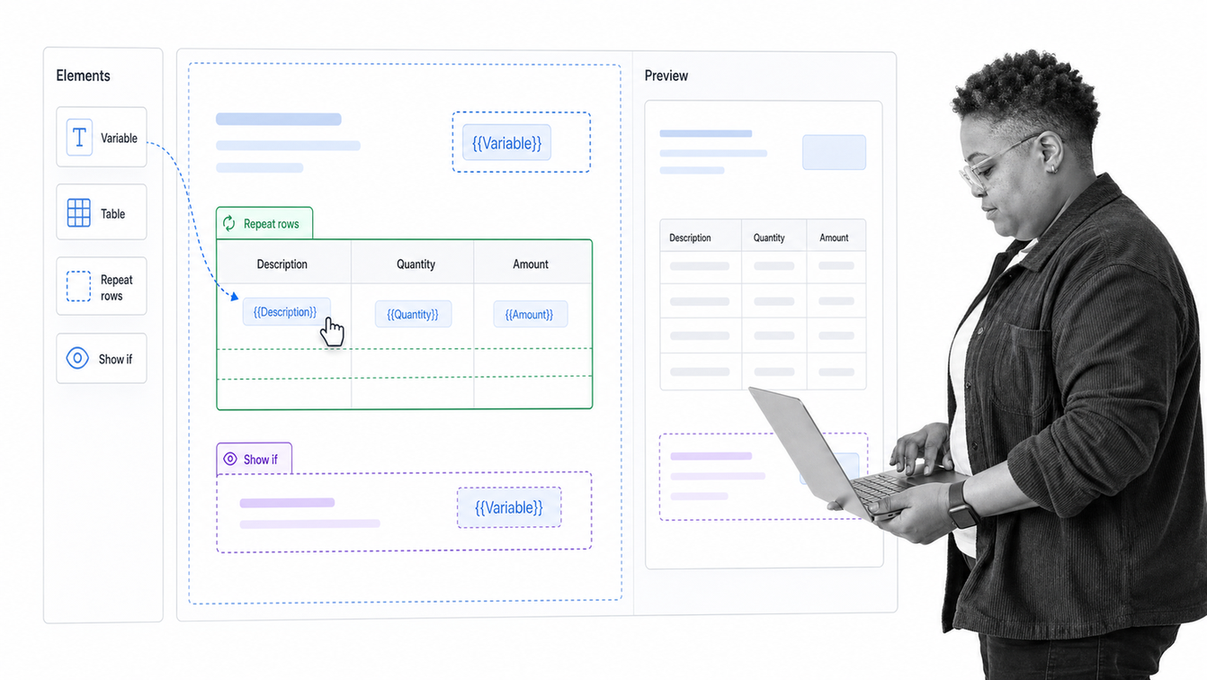
Best for: Operations teams that want an approachable visual template builder for customized PDFs.
Documint provides a drag-and-drop template designer with variables, functions, repeating sections, conditional logic, branding controls, and a live preview. It can merge data from connected applications or a direct API into customized PDFs such as invoices, certificates, proposals, and shipping documents.
Its visual approach lowers the barrier for teams without dedicated developers. Before choosing it, confirm that the available layout controls, data mappings, error handling, and delivery paths match the complexity of your production documents.
Plumsail Documents
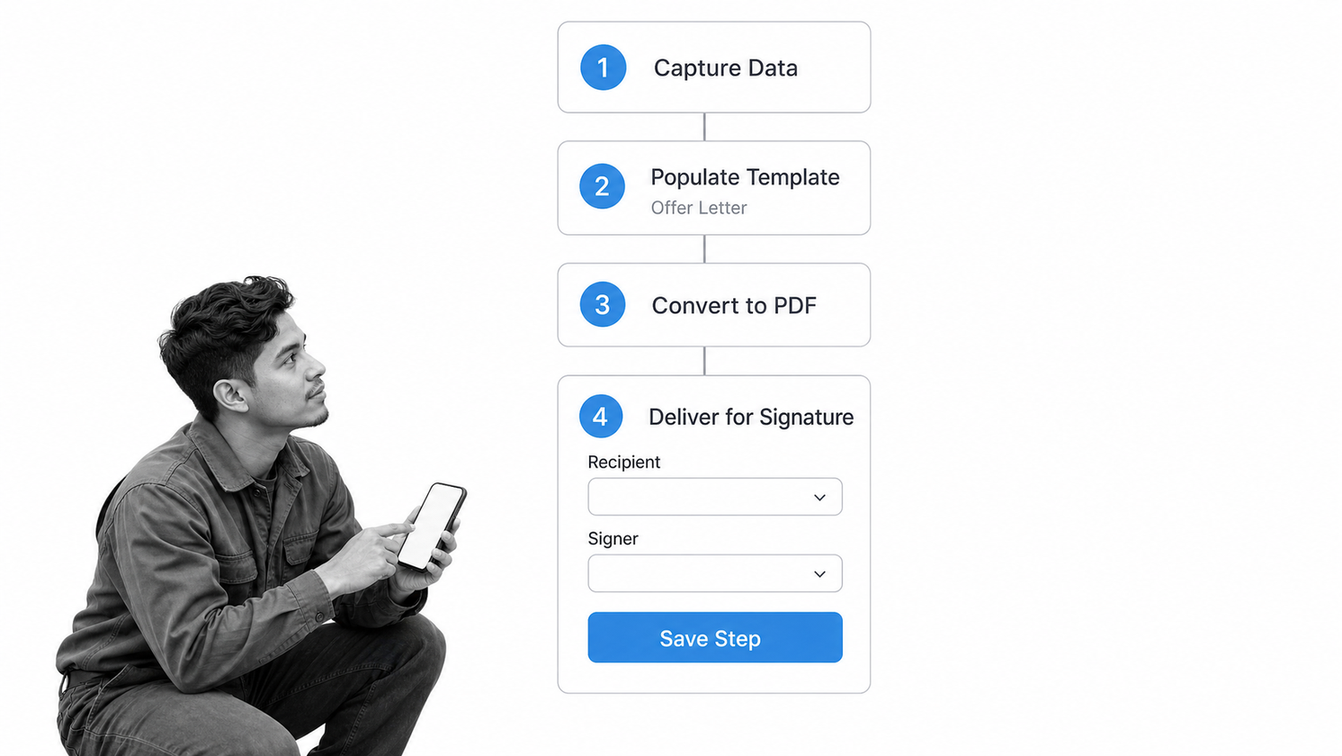
Best for: Template generation connected to Microsoft-oriented automation and common no-code platforms.
Plumsail Documents populates templates, converts outputs, sends files, stores them in cloud systems, or requests e-signatures. Teams can run document processes through its built-in process designer, automation-platform actions, or a REST API.
It is useful when document creation is one component of a broader automation stack. Pay close attention to the chosen template engine, supported actions, authentication model, and process-failure notifications before moving a critical document flow into production.
Anvil
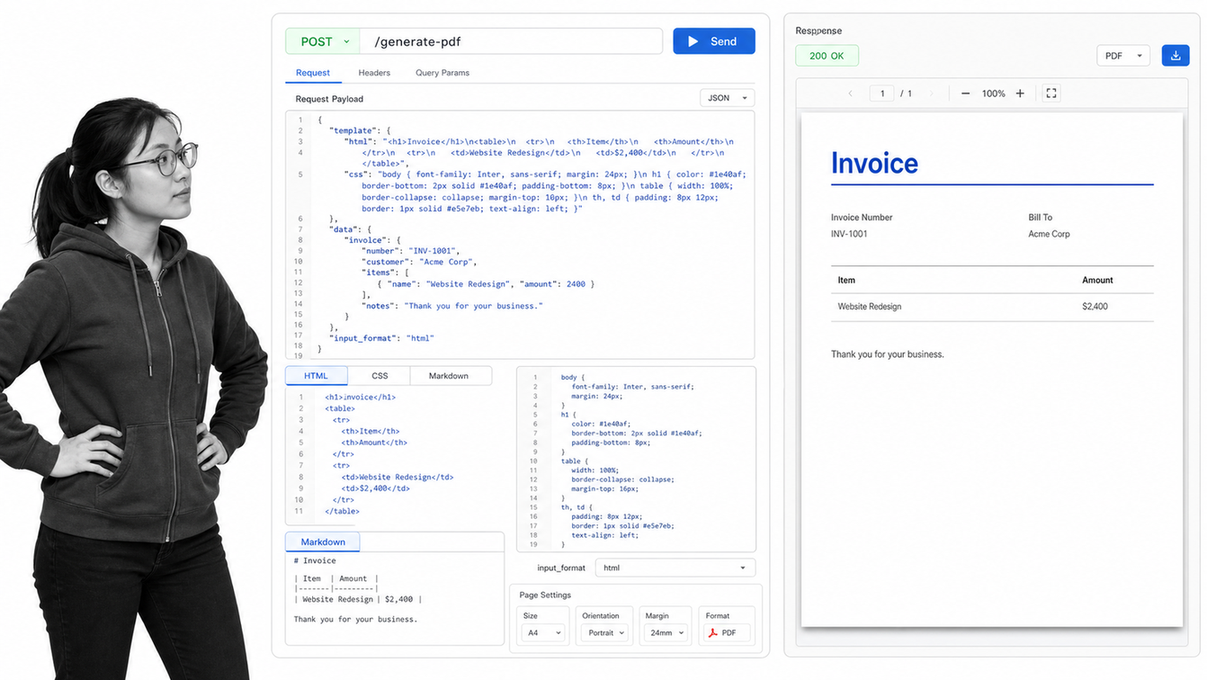
Best for: Developers embedding PDF generation inside a product or custom application.
Anvil exposes PDF generation through an API that accepts HTML and CSS or structured Markdown. Developers can control page settings, fonts, dynamic content, tables, and output behavior while using familiar frontend rendering approaches.
This is a strong fit when the application owns the user experience and the document service should remain behind the scenes. It requires engineering resources and does not replace workflow design, approvals, source-data governance, or template ownership.
Templafy
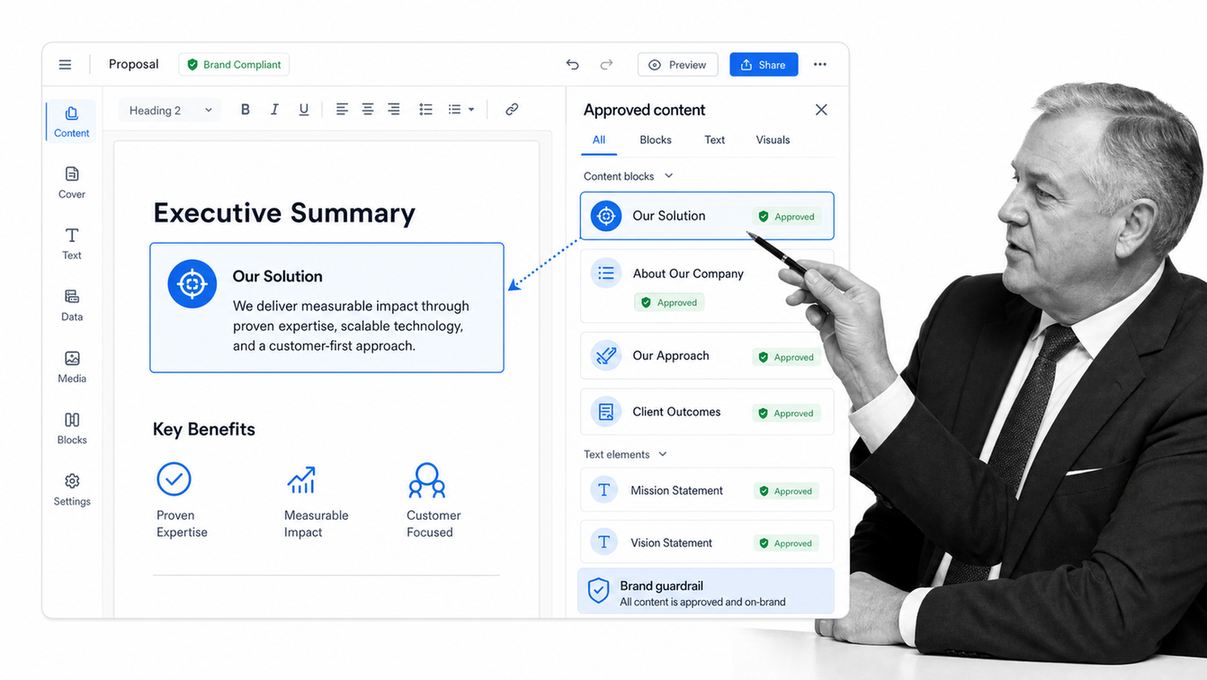
Best for: Enterprise document creation with strict brand, content, and governance requirements.
Templafy focuses on controlled, on-brand document generation using approved company content, organizational context, and rules-based automation. It is designed to meet users inside familiar office, workspace, CRM, and AI-assistant environments while applying enterprise guardrails.
It suits large organizations where template sprawl, brand inconsistency, and ungoverned content create material risk. Smaller teams may find a focused generation product easier to administer if enterprise-wide content governance is not the main problem.
Microsoft Word
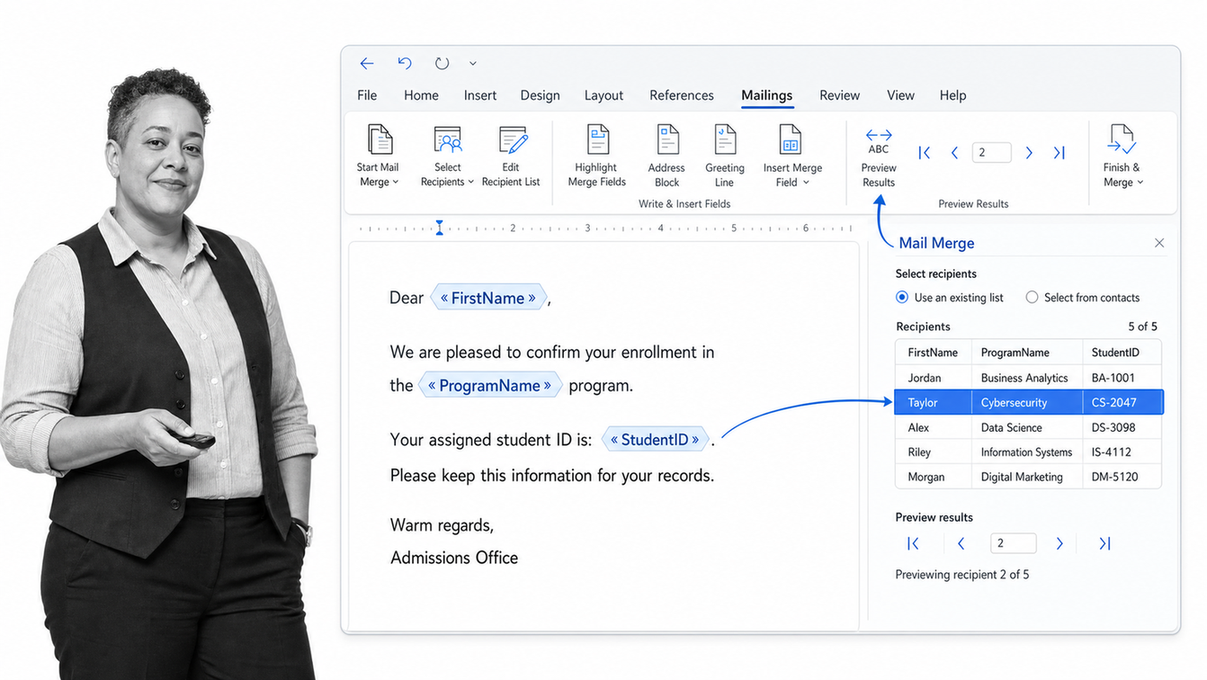
Best for: Familiar office documents and straightforward personalized batches.
Microsoft Word mail merge combines a main document with a list, spreadsheet, or database and inserts merge fields to produce personalized letters, labels, envelopes, or email content. It remains useful when the template is owned by office users and the logic is simple.
Word is not a complete operational control system. As volume and complexity grow, manual file handling, review, delivery, and version management become the limiting factors. Pair it with a defined workflow or move to a purpose-built generation platform when exceptions and approvals multiply.
Google Docs
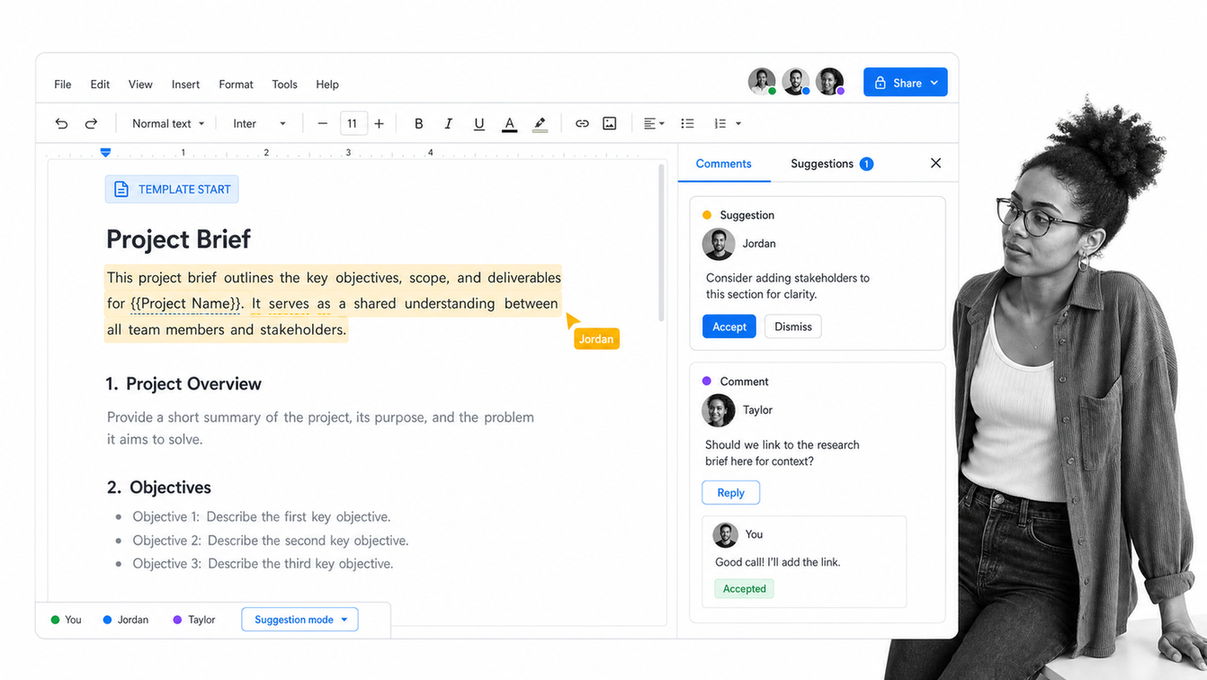
Best for: Collaborative drafting and reusable general-document templates.
Google Docs offers reusable templates and a familiar collaborative editor. It works well for documents that require live input from several people, comments, suggestions, and easy sharing before the final version is produced.
Its native template workflow is a baseline rather than a full document automation system. Repeated data merging, conditional content, high-volume delivery, controlled approvals, and downstream records usually require scripts, add-ons, or connected workflow software.
Adobe Acrobat
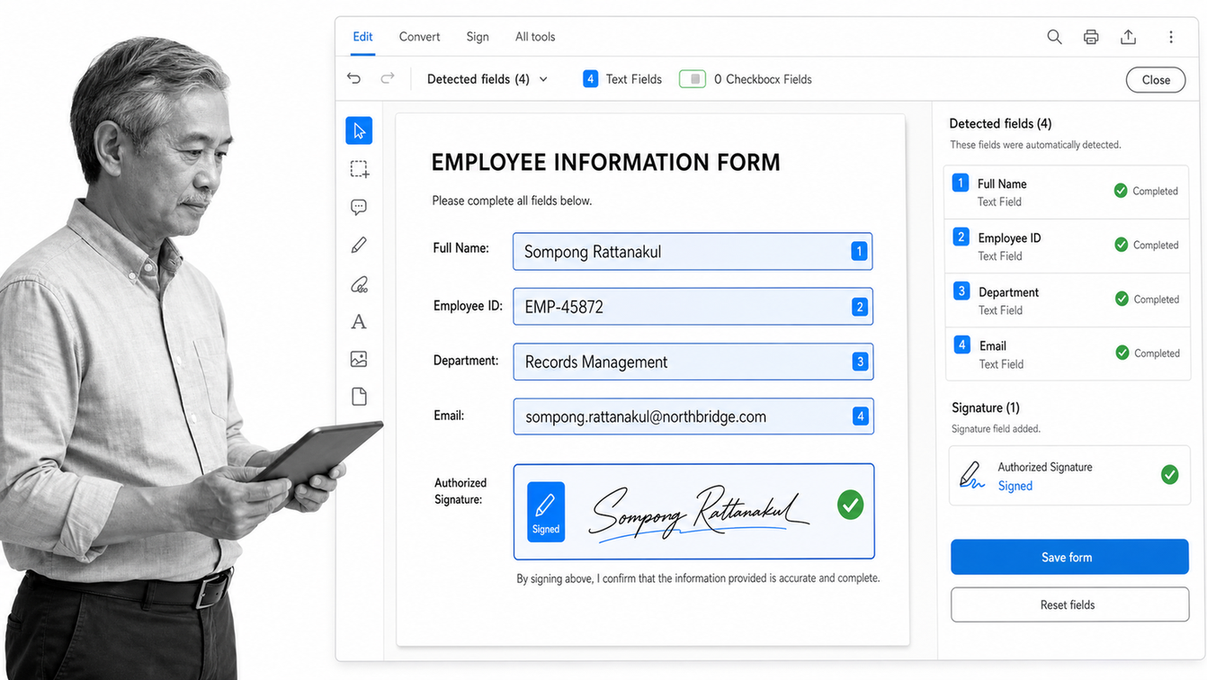
Best for: Fillable PDF forms, PDF conversion, and signature-centered document handling.
Adobe Acrobat can create fillable forms from blank pages, existing office files, or scanned documents. Its web tools support filling, signing, sharing, and saving completed PDF forms, which makes it useful when the final artifact must remain a PDF.
Acrobat is strongest at the PDF layer. For a repeatable business process, connect the form to structured intake, ownership, approval, storage, and follow-up rather than relying on emailed files as the workflow.
Which document generation software fits each job?
| Job | Strong fit | Why it fits |
|---|---|---|
| Controlled recurring operations | Process Street | Connects data, tasks, owners, approvals, automation, and evidence. |
| Sales proposals and signatures | PandaDoc | Combines document creation, reusable content, collaboration, tracking, and signing. |
| No-code back-office generation | Formstack Documents | Populates templates from connected business systems and delivers outputs. |
| CRM-driven commercial documents | Conga Composer | Handles structured source data, conditional content, calculations, and delivery. |
| Complex regulated assembly | HotDocs | Uses guided interviews and sophisticated templates for customized document sets. |
| Contract lifecycle | Juro | Brings creation, collaboration, approval, signing, and repository work together. |
| Visual PDF templates | Documint | Offers a no-code designer with variables, loops, conditions, and previewing. |
| Automation-platform document actions | Plumsail Documents | Supports template processes, delivery, signatures, automation actions, and API access. |
| Embedded PDF generation | Anvil | Provides developer-controlled generation from HTML, CSS, or structured Markdown. |
| Enterprise brand governance | Templafy | Applies approved content and organizational rules in familiar work environments. |
| Simple personalized batches | Microsoft Word | Mail merge connects a familiar document to a structured recipient data source. |
| Collaborative general documents | Google Docs | Supports reusable templates and multi-person browser-based drafting. |
| Fillable and signed PDFs | Adobe Acrobat | Creates, fills, signs, shares, and saves PDF forms. |
How should you compare document generation tools?
Start with the document and the surrounding process
Choose three representative documents: one common, one complex, and one exception-heavy. Map where their data comes from, who reviews them, what can change, where they go, and what evidence must remain. A product demo built around those real cases reveals more than a generic feature checklist.
Test template ownership
Ask who can build and maintain templates after implementation. Legal specialists may accept a powerful authoring environment. Operations teams may need visual tools. Developers may prefer version-controlled code. The wrong authoring model creates a permanent maintenance bottleneck.
Verify data and logic
Confirm support for every required source, field type, repeating group, condition, calculation, locale, and exception. Test missing values and conflicting inputs. A reliable system should fail visibly and route the issue to an owner rather than silently generating an incomplete file.
Evaluate controls, not just output
Review permissions, template versions, approval gates, activity history, retention, and security. For sensitive documents, determine which steps require human review and who can release the final version. AI document management is most valuable when document content remains connected to governance and execution.
Measure the whole operating cost
Include implementation, template migration, administration, testing, training, integration work, exception handling, and future changes. A low-friction tool that operations can maintain may cost less than a technically powerful platform that requires specialist intervention for every update.
How do you implement document generation software?
- Inventory recurring documents. Record volume, owners, source systems, review steps, output formats, and failure risks.
- Prioritize one stable use case. Start with a document that is frequent and rules-based but not the most legally or operationally dangerous item in the business.
- Standardize the template. Remove duplicate versions, identify approved language, define variables, and assign a template owner.
- Define the data contract. Name every field, source, required value, format, and validation rule.
- Build exception paths. Decide what happens when data is missing, a condition conflicts, or an approver rejects the output.
- Add review and release controls. Keep sensitive decisions attached to named roles and captured evidence.
- Test with realistic records. Include edge cases, long values, blank values, unusual characters, repeated rows, and rejected approvals.
- Monitor and maintain. Track failures, turnaround, corrections, template changes, and downstream completion.
Document generation should enter production as part of a controlled workflow automation design. That makes ownership, exceptions, approvals, and evidence explicit from the start.
Why use Process Street for document workflows?
A generated document is often a milestone, not the finished business outcome. An offer letter still needs approval, delivery, signature, onboarding, and recordkeeping. An audit report still needs evidence review, remediation assignments, and closure. A client pack still needs verification, secure delivery, and follow-up.
Process Street coordinates that full sequence. Structured forms collect the inputs. Conditional logic changes the path. Role assignments establish ownership. Approvals control release. Automations connect generation, signature, storage, CRM, and communication tools. The workflow history records what happened and when.
This process-first model also makes AI safer. An AI task can draft or transform content, but the workflow can require source data, limit the task to the right context, send exceptions to a person, and block completion until review is recorded. The result is document automation that remains accountable to the operation it serves.
Document generation software FAQ
What is document generation software?
Document generation software creates formatted business documents from reusable templates, structured data, and rules. It can automate personalized contracts, proposals, reports, letters, forms, certificates, invoices, and other repeated outputs.
What is the difference between document generation and document management?
Document generation creates a new file or browser-native document from templates and data. Document management stores, organizes, secures, retains, and retrieves documents after they exist. Many business processes need both.
Can document generation software use AI?
Yes. AI can draft, summarize, classify, extract, or transform content within a document workflow. Reliable implementations still use approved sources, explicit rules, human review for sensitive decisions, and an audit trail.
What documents can be automated?
Common candidates include proposals, quotes, contracts, offer letters, certificates, invoices, compliance reports, audit summaries, client packs, policy acknowledgments, PDF forms, and recurring management reports.
What should a document generation pilot include?
A useful pilot includes one representative template, real source data, conditional rules, an exception path, a named reviewer, the required delivery destination, and tests for missing or unusual values.
When is a workflow platform better than a standalone document tool?
A workflow platform is the better foundation when the document depends on assigned work, approvals, exceptions, deadlines, evidence, and downstream actions. A specialist generator can still handle the final format while the workflow governs the full process.