Turn every policy into automated workflows with built-in enforcement and audit-ready proof.


Enterprise Quality Management System
An enterprise quality management system is the connected operating framework an organization uses to define quality standards, control how work is performed, capture evidence, resolve quality events, and improve performance across sites, teams, products, and suppliers.
The enterprise part matters. A local quality process can work well while the wider organization still suffers from inconsistent procedures, disconnected records, slow corrective action, and limited visibility. An enterprise QMS creates common governance without erasing the operational detail each team needs.
This guide explains the architecture, capabilities, selection criteria, rollout steps, and measurement model behind enterprise quality management. It also shows how Process Street connects governed documentation with controlled workflow execution and audit-ready proof.
In this article, we cover:
- What is an enterprise quality management system?
- Why enterprise quality management matters
- Core components of an enterprise quality management system
- Enterprise QMS versus related systems
- How to choose an enterprise quality management system
- How to implement an enterprise quality management system
- Enterprise quality management with Process Street
- How to measure and improve enterprise quality
- FAQs
What is an enterprise quality management system?
A quality management system, or QMS, is the collection of policies, processes, responsibilities, records, and improvement practices used to deliver consistent outcomes. An enterprise QMS extends that discipline across the organization and gives leaders one governed way to manage quality-critical work.
From documents to an operating system
A document repository can store policies and procedures, but storage alone does not show whether people followed them. An enterprise quality management system connects the approved instruction to the task, decision, approval, evidence, and exception generated during real work. That connection turns quality from a library into an operating system.
A mature quality system therefore has two linked layers: governance defines what should happen, and execution records what did happen. Both layers need ownership, review, access control, and improvement loops.
QMS, eQMS, and enterprise QMS
QMS describes the management system itself. eQMS usually means the electronic software used to manage all or part of that system. Enterprise QMS emphasizes organizational scope: common controls, shared data, consistent reporting, and coordinated improvement across business units. In practice, buyers often use eQMS and enterprise QMS software interchangeably.
The system boundary
An enterprise QMS should cover the lifecycle of quality work, not every activity in the company. Its boundary normally includes controlled documents, training, audits, nonconformances, complaints, corrective and preventive action, change control, supplier quality, risk, equipment or process checks, and management review. It connects to other systems when those systems own production, customer, laboratory, or financial records.
The ISO quality management principles provide a useful foundation: customer focus, leadership, engagement, process thinking, improvement, evidence-based decisions, and relationship management. The software should reinforce those principles through daily work.
Why enterprise quality management matters
Enterprise quality management matters because quality failures rarely stay inside one department. A supplier issue can create production defects, customer complaints, corrective actions, training changes, and audit findings. If each team manages its portion in a different system, the organization sees fragments instead of the full quality event.
Consistency across sites and teams
Standard processes reduce variation, but enterprise governance should not force every location into an identical workflow when risk and regulation differ. The system needs a controlled core with configurable local paths. Teams can preserve relevant detail while leaders retain common definitions, ownership, evidence, and reporting.
Faster containment and corrective action
A quality event should move quickly from detection to containment, investigation, action, verification, and closure. Disconnected email and spreadsheets slow handoffs and make ownership ambiguous. A governed workflow routes the event, requires evidence, escalates delay, and prevents closure before the required checks are complete.
A structured corrective action process is central because it turns a finding into an owned response, a verified result, and a lesson that can change the wider system.
Audit readiness without reconstruction
Audit preparation becomes expensive when evidence is assembled after the work. An enterprise QMS captures approvals, records, decisions, exceptions, and change history during execution. Reviewers can trace the control from the governing document to the completed work instead of rebuilding the story from inboxes and shared drives.
Quality as continuous learning
Quality management is not only about preventing failure. It is also a system for learning. When nonconformances, complaints, audit findings, process measures, and corrective actions share a common structure, teams can identify recurring patterns and improve the process instead of repeatedly treating isolated symptoms.
The American Society for Quality overview of quality management systems also emphasizes documented processes, procedures, and responsibilities for achieving quality objectives, which is the foundation an enterprise system operationalizes.
Core components of an enterprise quality management system
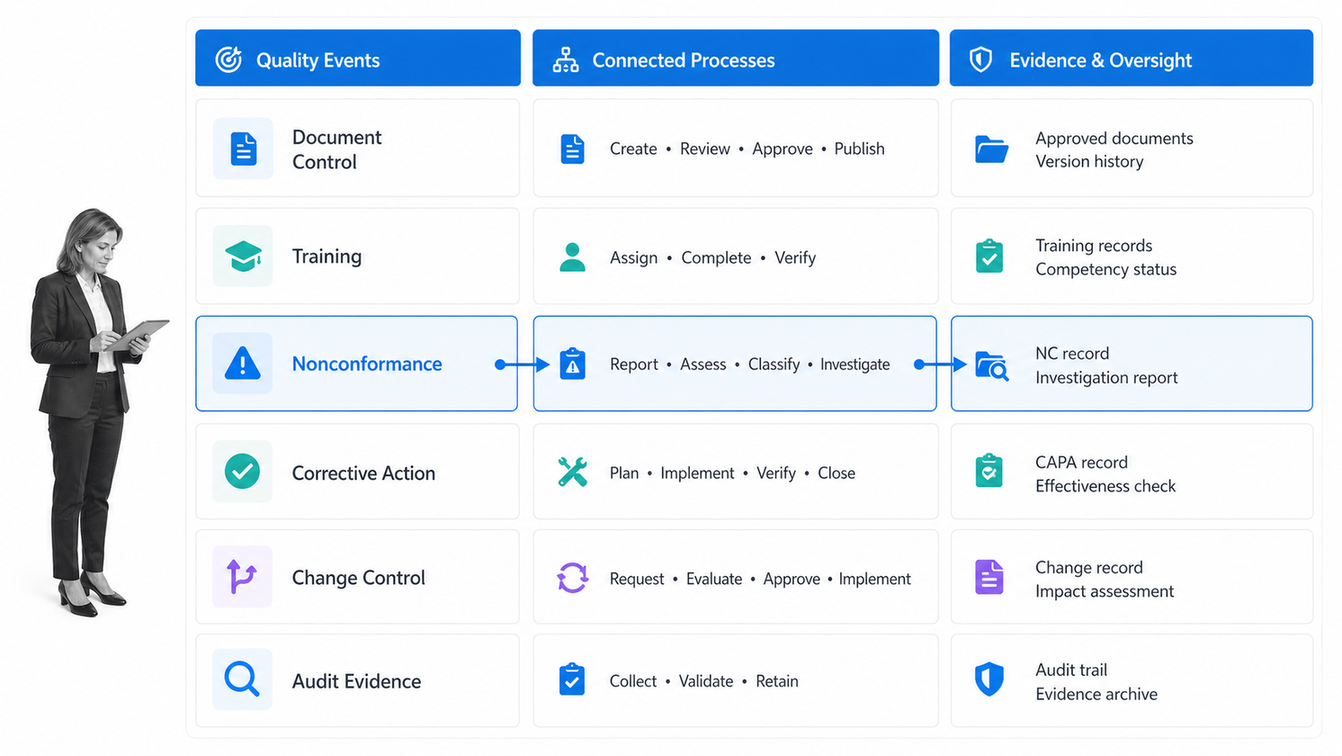
The strongest systems connect a small set of quality capabilities into one closed loop. Each capability has a distinct job, but the value comes from how records and decisions move between them.
Document and policy control
Controlled documents need clear owners, versions, approvals, effective dates, review cycles, access rules, and retirement paths. Employees should see the current instruction at the point of work. When a procedure changes, the system should identify affected training, workflows, controls, and records.
Good standard operating procedure governance makes the approved method understandable and executable, not merely available.
Training and competence
Training records should show which requirement applied, who completed it, what evidence demonstrated competence, and whether retraining was triggered by a change. Completion alone may be insufficient for high-risk work. The system should support acknowledgement, assessment, observation, and role-based qualification where appropriate.
Quality events and nonconformance
Quality event management provides a consistent intake for deviations, defects, complaints, incidents, failed checks, and audit findings. Classification, severity, affected scope, containment, ownership, and due dates should be captured early so the right response starts quickly.
Corrective and preventive action
CAPA connects investigation to durable change. The workflow should support root cause analysis, action planning, approval, implementation, effectiveness checks, and closure. It should also link related events so teams can see whether the same failure mode is recurring across products, processes, suppliers, or locations.
A root cause and corrective action workflow helps teams separate immediate correction from the systemic action that prevents recurrence.
Change control
Quality changes can affect documents, training, equipment, suppliers, validation, customer commitments, and regulatory obligations. Change control makes impact assessment explicit, assigns implementation work, gathers approvals, verifies readiness, and preserves the decision history.
Audit and management review
Audit management plans reviews, records findings, assigns actions, and verifies closure. Management review brings trends, risks, objectives, resources, and effectiveness into a recurring leadership decision process. The system should connect summary metrics to the underlying records so leaders can inspect the evidence behind a trend.
Enterprise QMS versus related systems
Enterprise QMS software overlaps with document management, workflow automation, governance systems, enterprise resource planning, and manufacturing systems. The difference lies in the quality lifecycle and the level of control required.
Enterprise QMS versus document management
Document management controls files, versions, access, and retention. An enterprise QMS uses document control as one part of a broader system that also governs training, quality events, actions, change, audits, and improvement. A repository can answer which procedure is current; the QMS should also show whether that procedure was followed.
Enterprise QMS versus workflow management
A workflow management system can coordinate many kinds of repeatable work. An enterprise QMS applies workflow capabilities to quality-specific governance, records, risk, evidence, and improvement. The right platform combines flexible workflow design with the controls needed for quality-critical execution.
Enterprise QMS versus ERP and MES
Enterprise resource planning systems typically own transactional records such as purchasing, inventory, and finance. Manufacturing execution systems manage production activity. The QMS coordinates quality decisions and evidence around those records. Integration matters because a supplier receipt, production result, or customer complaint may need to trigger a quality workflow without copying data by hand.
Enterprise QMS versus a tool list
A guide to quality management system software helps compare products. An enterprise QMS guide starts one level earlier: it defines the operating model, the connected capabilities, the implementation sequence, and the evidence needed to judge whether any product fits.
Teams focused on inspection and defect handling can also use a guide to quality control software, while keeping those execution tools connected to the wider enterprise governance model.
How to choose an enterprise quality management system
Choose the system by testing it against real quality work. A long feature checklist can hide the practical questions: Can the platform represent your controls, guide users through the right path, preserve evidence, adapt safely, and expose risk before a deadline is missed?
Start with quality scenarios
Select representative scenarios such as a supplier nonconformance, customer complaint, document revision, internal audit finding, and corrective action. Include at least one cross-site process and one exception path. The evaluation should reveal how the system behaves when work is incomplete, rejected, overdue, or reassigned.
Evaluate governance and permissions
Check document approval, version history, role-based access, separation of duties, workflow change control, audit history, retention, and export. Governance should be strong enough for sensitive quality work without making routine changes dependent on a technical specialist.
Test configuration and usability
Quality teams need to adapt workflows as processes and obligations change. Test whether process owners can update forms, logic, assignments, instructions, and reports through a governed method. Also test the frontline experience. A powerful system fails if users cannot understand the next action or enter evidence correctly.
Inspect reporting and traceability
Reports should move from a leadership measure to the underlying site, process, event, action, and evidence. Test whether common definitions are preserved across business units and whether local context remains visible. Traceability should survive reassignment, workflow changes, and record export.
Plan integration around ownership
Decide which system owns each record. The QMS may own the quality event while ERP owns the purchase order and a customer platform owns the complaint. Integrations should create or update work without producing competing sources of truth. Failed integrations also need visible ownership and recovery paths.
How to implement an enterprise quality management system
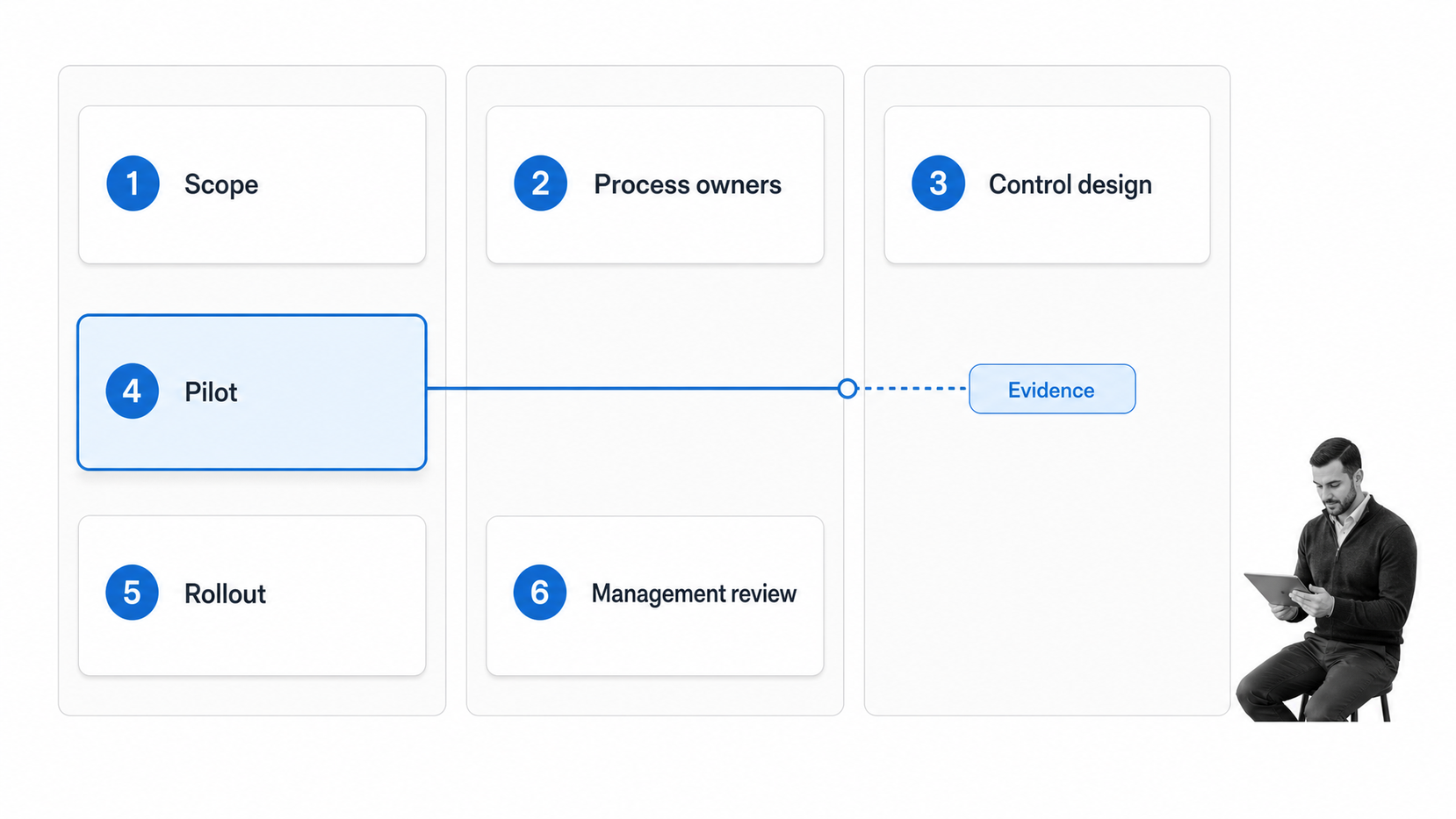
Implementation is a quality transformation, not a software installation. The safest path establishes governance, proves one end-to-end process, learns from actual use, and expands through repeatable rollout waves.
1. Define scope and outcomes
Identify the business units, sites, quality processes, standards, risks, and records in scope. State measurable outcomes such as shorter containment time, fewer overdue actions, better evidence completeness, or faster audit retrieval. Avoid starting with an abstract goal to digitize quality.
2. Assign process ownership
Every quality process needs a business owner, system owner, approver, administrator, and escalation path. Clarify who can change the process, who approves the change, and who monitors performance after launch. Ownership prevents the platform from becoming an ungoverned collection of forms.
3. Standardize before automating
Compare local procedures and decide which elements belong in the enterprise core, which require controlled variation, and which should be retired. Automating unresolved disagreement simply makes inconsistency move faster.
4. Configure one end-to-end pilot
Choose a process that is important enough to matter but bounded enough to learn from. Build the trigger, intake, classification, assignments, due rules, approvals, evidence, exceptions, integrations, reporting, and closure. Pilot with real users and real cases.
5. Validate the operating process
Confirm that instructions are clear, permissions are correct, required evidence is captured, exception paths work, reports match source records, and changes are governed. In regulated environments, align validation depth with the system’s intended use and applicable requirements.
6. Roll out in controlled waves
Expand by process, site, or business unit using a repeatable readiness checklist. Include data migration, training, support, cutover, local configuration, and post-launch review. Keep the enterprise control model stable while allowing approved local variation.
Use a change management workflow to coordinate readiness, communication, approvals, training, and adoption evidence across each rollout wave.
Enterprise quality management with Process Street
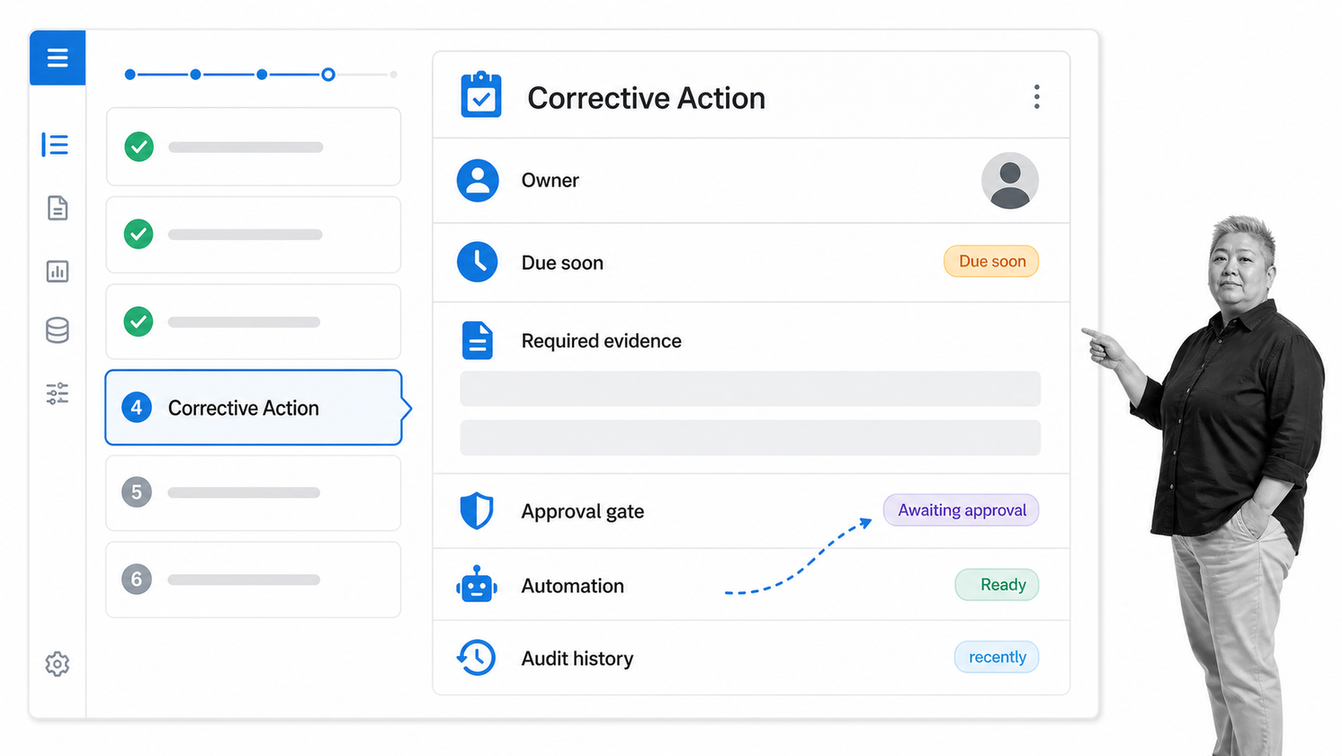
Process Street connects governed process knowledge with executable quality workflows. Teams can document the approved method, run it for each quality event, assign work by role, require evidence, route approvals, automate handoffs, and preserve a complete execution history.
Put procedures where work happens
Quality instructions can sit beside the task they govern. Users see the current procedure, required fields, decision rules, and evidence expectations while completing the work. This reduces the gap between knowing the standard and following it.
Make controls executable
Required fields, conditional logic, approvals, role assignments, due rules, stop points, and permissions help keep work inside the approved path. A corrective action cannot appear complete when mandatory evidence or verification is still missing.
Connect quality work across systems
Process Street has 5,000+ integrations. Quality workflows can start from business events, move approved data, request action, and update systems while the controlled history remains attached to the workflow run.
Create an evidence trail during execution
Files, field values, comments, approvals, task activity, automation results, and exception responses stay connected to the case. Quality and operations leaders can inspect the exact record behind a metric or audit question.
The same execution model supports process improvement: repeated exceptions become evidence for a change, the change is approved and deployed, and the result is measured in later workflow runs.
How to measure and improve enterprise quality
A successful enterprise QMS should improve both control and outcomes. Measure the health of the system, the performance of its processes, and the effectiveness of its improvement actions.
System adoption and control health
Track training completion, active use, workflow abandonment, overdue reviews, unauthorized workarounds, evidence completeness, and the age of controlled documents. These measures show whether the operating system is being used as designed.
Quality process performance
Useful measures include event intake age, containment time, investigation duration, overdue action rate, recurrence, audit finding closure, complaint resolution, change implementation, and effectiveness-check completion. Segment by risk, site, process, supplier, and product when averages hide important variation.
A focused process monitoring model helps leaders distinguish normal variation from the exceptions that require intervention.
Leading and lagging indicators
Lagging indicators show what already failed, such as defects or complaints. Leading indicators reveal weakening control before the outcome appears, such as overdue reviews, missed checks, repeated exceptions, training gaps, or rising time in stage. Use both so the system can respond and prevent.
Management review and improvement
Management review should connect objectives, trends, risks, resources, actions, and decisions. Each decision needs an owner and follow-through. The system improves when leadership can move from a summary signal to the exact records and then convert the learning into a controlled process change.
The NIST Baldrige Performance Excellence Program offers another useful lens for linking leadership, strategy, operations, measurement, and results rather than treating quality as an isolated department.
The FDA quality system regulation resource illustrates why quality controls must be built into the way regulated work is performed and documented. Requirements vary by sector, so organizations should map their applicable obligations into the enterprise control model.
A practical internal audit workflow can then test whether the designed controls are operating, record findings, assign actions, and verify closure in the same governed system.
FAQs
What is an enterprise quality management system?
An enterprise quality management system is the connected framework an organization uses to govern quality policies, processes, responsibilities, records, events, corrective actions, and improvement across sites and teams. It links the approved standard to daily execution and evidence.
What is the difference between QMS and eQMS?
QMS refers to the management system of policies, processes, roles, and records. eQMS usually refers to the electronic software used to manage that system. An enterprise QMS emphasizes consistent governance and reporting across the wider organization.
What processes should an enterprise QMS include?
Common processes include document control, training, audits, nonconformance, complaints, corrective and preventive action, change control, supplier quality, risk, quality checks, and management review. The exact scope should follow the organization’s risks and obligations.
How do you implement an enterprise QMS?
Define scope and outcomes, assign process ownership, standardize the enterprise control model, configure one end-to-end pilot, validate the operating process, and expand in controlled waves. Measure adoption, evidence quality, exceptions, and process outcomes after launch.
How does an enterprise QMS support compliance?
It turns requirements into controlled documents, assigned work, approvals, evidence, exception handling, and traceable records. This helps teams prove that controls were performed while also exposing gaps early enough to correct them.
How can Process Street support enterprise quality management?
Process Street connects governed procedures with executable workflows, required evidence, approvals, automations, and audit history. Teams can standardize quality-critical work while preserving controlled variation for different sites, risks, and use cases.