


Turn every policy into automated workflows with built-in enforcement and audit-ready proof.



Quality Systems
Quality systems are the connected policies, processes, responsibilities, controls, records, and improvement routines an organization uses to deliver consistent products or services. They turn the idea of quality into a managed operating system: requirements enter, controlled work happens, results are checked, evidence is retained, failures trigger correction, and leaders improve the system from what they learn.
A quality system is broader than inspection. Inspection can find a defect at the end. The system is designed to prevent the defect, detect variation early, control decisions, preserve evidence, and stop the same failure from returning. That makes quality part of daily execution instead of a final checkpoint owned by one department.
This guide explains the structure, operation, implementation, measurement, and common examples of quality systems. It also shows how Process Street can turn quality requirements into governed workflows that assign work, control approvals, route exceptions, and create proof as work happens.
In this guide, we are going to cover:
- What are quality systems?
- Quality systems vs. quality assurance and quality control
- Core components of quality systems
- How quality systems work
- How to build a quality system
- How to measure and improve quality systems
- Quality system examples
- Run quality systems in Process Street
- Quality systems FAQs
What are quality systems?
A quality system is the management structure used to plan, operate, verify, and improve work so outputs meet defined requirements. It connects customer needs and applicable standards with process design, competent people, controlled information, operational checks, records, corrective action, and management review.
A direct definition
The practical definition is simple: a quality system makes the expected result, the approved way of producing it, and the evidence of correct execution visible. It answers six questions. What must be true? Which process produces it? Who owns each decision? What could go wrong? What evidence proves the process worked? What happens when the result misses the standard?
The International Organization for Standardization introduction to quality management systems describes a QMS as clearly defined processes and responsibilities that help an organization achieve quality objectives. The emphasis is on a coherent system, not a binder of disconnected procedures.
Quality is a system property
Consistent quality rarely comes from asking individuals to be more careful. It comes from designing reliable inputs, clear specifications, capable processes, usable instructions, appropriate controls, fast feedback, and accountable decisions. People still apply judgment, but the system supplies the conditions that make good judgment repeatable.
The process approach
A quality system treats work as interacting processes. Each process receives inputs, transforms them through defined activities, and produces outputs for another customer or process. When teams manage the connections, they can see how a weak supplier input, ambiguous handoff, outdated instruction, or delayed approval affects the final result.
The closed-loop model
The loop begins with requirements and planning. Work follows the controlled process. Verification compares results with acceptance criteria. Records capture what happened. Nonconformities trigger containment, investigation, corrective action, and effectiveness checks. Performance data and audit findings return to management review, where leaders decide how the system should change.
Quality systems vs. quality assurance and quality control
The terms quality system, quality management, quality assurance, and quality control overlap, but they operate at different levels. Separating them helps teams assign ownership and avoid treating inspection as the whole discipline.
Quality system
The quality system is the complete operating structure. It includes policies, objectives, processes, roles, resources, competence, controlled information, assurance activities, controls, records, audits, corrective action, and improvement. It governs how the organization plans and proves quality.
Quality management
Quality management is the leadership activity that sets direction, allocates resources, reviews performance, and changes the system. It translates customer expectations and strategic priorities into objectives and operating decisions. The system is the structure; management keeps that structure effective.
Quality assurance
Quality assurance is preventive. It builds confidence that processes are capable and controlled. Process qualification, training, document control, supplier approval, internal audits, and change management are common assurance mechanisms because they strengthen the conditions under which work occurs.
Quality control
Quality control verifies outputs and process results against acceptance criteria. Inspection, testing, sampling, review, and statistical monitoring help detect problems. Control data should feed the wider system, where teams investigate causes and improve the process instead of repeatedly sorting defects.
Quality system vs. quality management system
In everyday use, quality system and quality management system often refer to the same coordinated structure. QMS is the more formal term used by standards bodies and regulated industries. The shorter phrase can also describe a narrower set of practices, so define the boundary whenever responsibilities or compliance obligations depend on it. Teams evaluating the technology layer can use a quality management software guide without mistaking software for the complete management system. Larger organizations can also compare the governance needs covered by enterprise quality management software.
Core components of quality systems
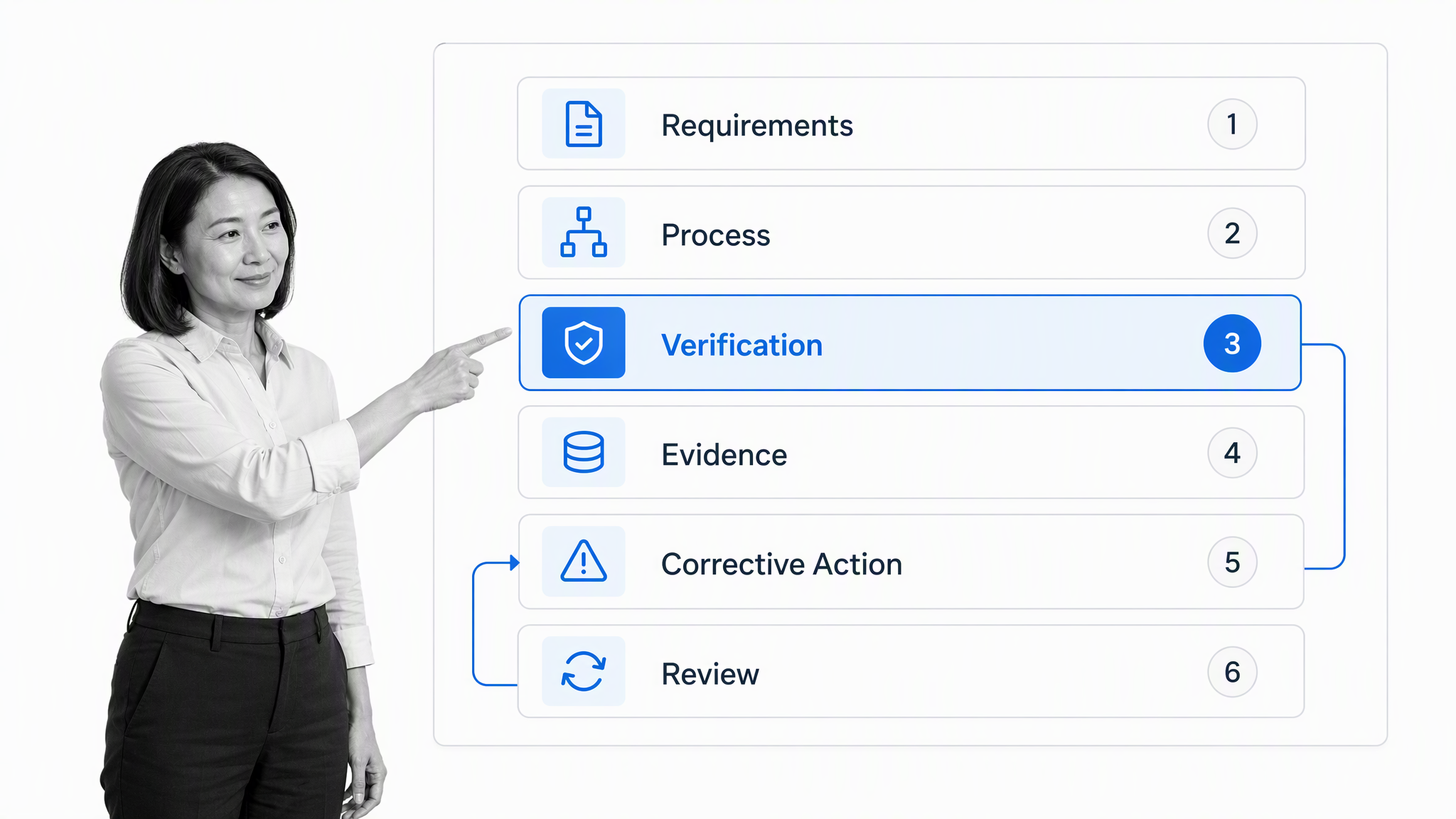
Effective quality systems share a recognizable architecture. The labels vary by industry, but the components below must connect as one operating loop.
1. Quality policy and objectives
The policy states the organization’s quality direction. Objectives turn that direction into measurable commitments, such as reliable delivery, reduced rework, accurate records, controlled releases, or faster closure of corrective actions. Objectives need owners, measures, and review dates or they remain slogans.
2. Requirements and risk
The system translates customer, legal, regulatory, technical, and internal requirements into operating controls. Risk determines the strength of those controls. A low-consequence formatting error and a safety-critical failure should not receive the same approval depth, evidence burden, or escalation path.
3. Process architecture and ownership
Process architecture shows how value moves across functions and where the quality system touches the work. Each important process needs an owner who maintains its design, reviews performance, approves changes, and resolves conflicts between local convenience and system outcomes.
4. Controlled documents and records
Policies, procedures, specifications, forms, and work instructions must be approved, current, available, and protected from unintended change. Records serve a different job: they show what actually happened. A useful document control approach keeps instructions governed while preserving execution evidence. An electronic quality management system can support this structure when governance and execution remain connected.
5. Competence and resources
People need the training, authority, tools, time, and information required to perform controlled work. Competence is more than attendance at training. The organization should define the capability a role needs, verify it where risk warrants, and reassess it when procedures or technology change.
6. Operational controls and verification
Operational controls keep work within agreed conditions. Required fields, validated equipment, calibrated instruments, segregation of duties, acceptance checks, approvals, and release criteria are examples. Verification must happen at points where it can prevent or contain harm, not only after the final output is complete.
7. Nonconformance and corrective action
When an output or process misses a requirement, the system records the nonconformance, contains the immediate risk, decides disposition, investigates cause when appropriate, assigns corrective action, and verifies effectiveness. The corrective action process should close the system gap rather than blame the person who encountered it.
8. Audit, review, and improvement
Audits test whether the system conforms and works. Management review decides whether objectives, resources, risks, controls, and improvement priorities remain suitable. Improvement converts findings, complaints, data, and employee insight into governed changes. The American Society for Quality auditing overview explains how audits provide evidence about system effectiveness.
How quality systems work
Quality systems work through a repeating cycle of definition, controlled execution, verification, response, and learning. Every cycle should preserve enough context to explain both a successful result and an exception.
Define the required result
The process starts with explicit acceptance criteria. Requirements should be testable where possible and linked to the customer or risk they protect. Ambiguous language creates inconsistent decisions, so owners should resolve conflicts before the requirement reaches frontline work.
Control inputs and changes
The system checks that materials, information, suppliers, equipment, software, and approved instructions are suitable. Change control assesses the impact of revisions before they enter use. This prevents one improvement from silently breaking a downstream process or invalidating existing training.
Execute the approved process
Work moves through assigned tasks, decision rules, checks, and handoffs. Standard work handles routine cases. Conditional routes expose legitimate variation without creating unofficial side processes. Critical steps require evidence or approval before the workflow advances.
Verify and release
Verification compares the result with the requirement. The release decision should identify who approved it, which evidence they reviewed, and what exceptions were accepted. When the result fails, the system blocks release or routes the case to an authorized disposition path.
Respond to failures
Immediate correction restores the affected item or service. Corrective action addresses the cause of recurrence. The distinction matters. Replacing a defective part may satisfy the customer today, while a process change, supplier action, training update, or control redesign prevents the same defect tomorrow.
Review performance and improve
Leaders review outcomes, process behavior, complaints, audit findings, nonconformities, supplier performance, corrective action aging, and change results. Improvement priorities should reflect system risk and customer impact, not only the volume of easily counted issues.
How to build a quality system
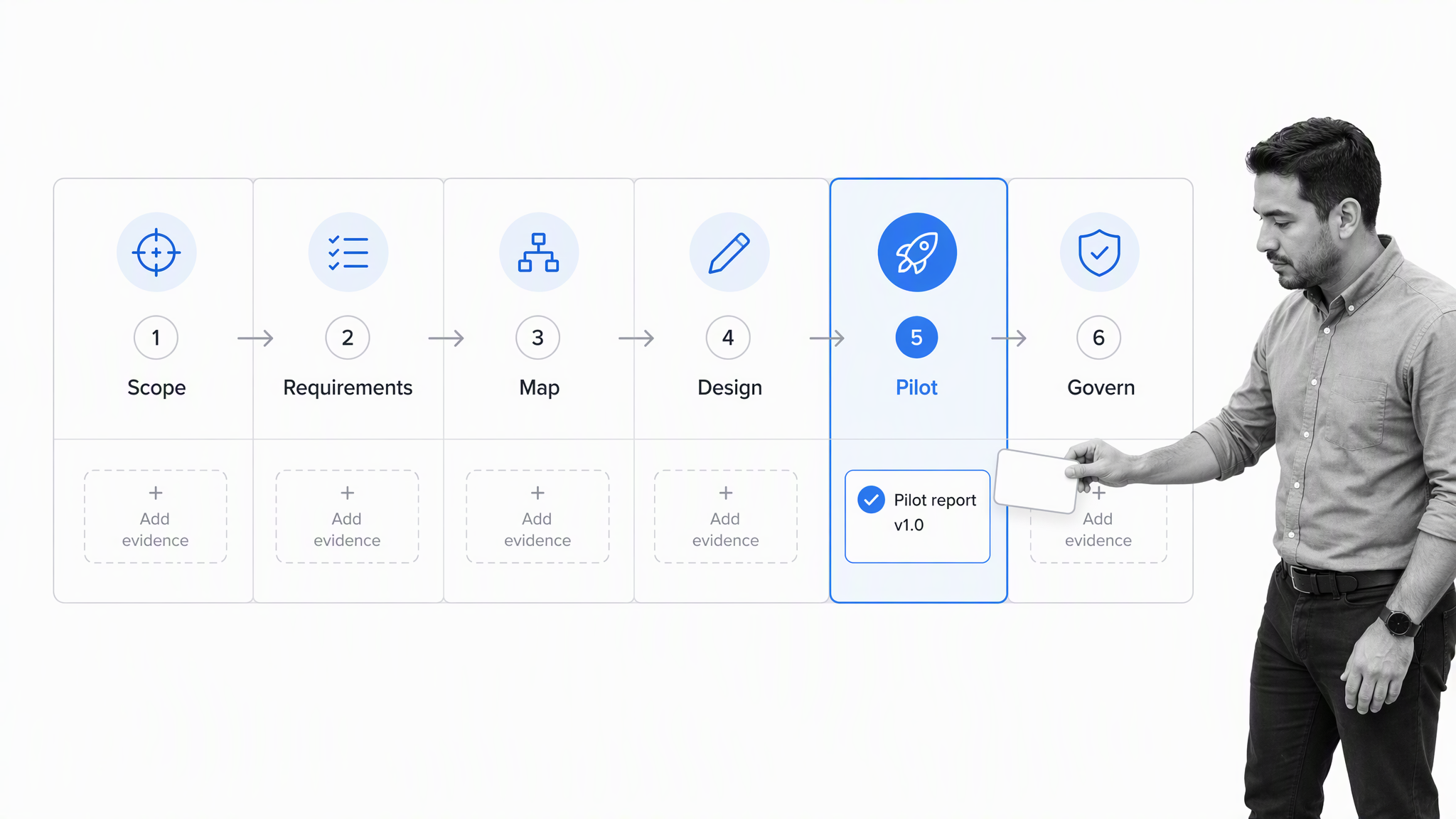
Build the quality system around real work and a clear business boundary. A narrow pilot exposes weak assumptions faster than a company-wide documentation project.
Step 1: Set scope and outcomes
Name the products, services, locations, teams, and processes inside the system. Identify the customer, the result they need, and the risks the system must control. Record exclusions and interfaces so the boundary does not hide a critical supplier or downstream dependency.
Step 2: Translate requirements
Build a requirements register that links each obligation to a process owner, control, evidence source, and review method. Use primary sources for regulated requirements. Avoid copying clauses into procedures without explaining the operational behavior they require. If ISO 9001 is in scope, connect requirements to the operating controls before evaluating ISO 9001 quality management system software.
Step 3: Map current work and gaps
Observe actual execution. Map triggers, owners, systems, decisions, handoffs, records, checks, exceptions, and outputs. Compare the real flow with requirements and desired outcomes. The gap list becomes a prioritized design backlog rather than a generic request for more documentation.
Step 4: Design controlled workflows
Define the standard path, exception routes, evidence, approvals, release criteria, escalation, and change method. Assign one owner to each workflow and one accountable owner to the wider system. Keep controls proportional to risk so the supported path stays usable.
Step 5: Pilot representative cases
Test routine, incomplete, urgent, high-risk, and unusual cases. Watch where people hesitate, duplicate information, bypass the workflow, or cannot find the current instruction. Confirm that records are usable by someone who did not perform the work.
Step 6: Govern, audit, and improve
Launch with a review cadence, change owner, access rules, training method, internal audit plan, and escalation route. Use a quality management workflow to coordinate objectives and review, then connect findings to a corrective action plan with owners and effectiveness checks.
Common implementation mistakes
- Writing procedures before agreeing on the process and outcome.
- Treating certification as the purpose instead of evidence of a working system.
- Making the quality team responsible for every operational control.
- Adding approvals that do not protect a defined risk.
- Closing corrective actions without checking effectiveness.
- Measuring audit completion while ignoring customer and process outcomes.
How to measure and improve quality systems
Measure quality systems at four levels: outcomes, process behavior, control health, and learning. A single defect rate cannot explain whether the system is stable, responsive, or improving. Established quality management tools help teams collect, visualize, prioritize, and test the evidence behind those measures.
Outcome measures
Outcome measures reflect what the customer or requirement protects. Depending on the process, these can include first-pass acceptance, rework, complaints, returns, service errors, release accuracy, on-time delivery, or recurring incidents. Segment results by product, service, location, supplier, and risk class when the mix changes the interpretation.
Process measures
Cycle time, wait time, queue age, throughput, handoff delay, incomplete submissions, and work in progress reveal how the process behaves. Stable flow supports consistent quality because teams are less likely to rush, batch, improvise, or lose context at handoffs.
Control measures
Track missing evidence, failed checks, approval reversals, calibration exceptions, training gaps, document revisions used after withdrawal, and unauthorized changes. A control measure should trigger ownership and response, not merely create a dashboard.
Learning measures
Monitor repeated causes, corrective action age, effectiveness-check results, implemented improvements, and adoption of changed procedures. The Plan-Do-Check-Act cycle offers a practical rhythm for testing changes and comparing the result with the intended objective. The NIST Baldrige Performance Excellence Program also treats measurement, learning, and integrated management as parts of organizational performance rather than isolated reporting exercises.
Use leading and lagging signals
Lagging signals, such as complaints or rejected outputs, show the result after failure. Leading signals, such as overdue maintenance, incomplete training, rising process variation, missing evidence, or aging corrective actions, show weakening conditions earlier. Review both so the system can prevent problems instead of only counting them.
Quality system examples
Manufacturing quality system
Manufacturing systems connect specifications, supplier controls, incoming inspection, production instructions, equipment status, in-process checks, final release, nonconformance, and corrective action. Statistical methods can help distinguish common variation from a special cause that needs investigation.
Service quality system
Service organizations control intake, qualification, handoffs, delivery standards, review, customer communication, complaints, and recovery. Evidence can include completed checklists, approvals, call records, timestamps, case notes, and confirmation that the customer received the agreed outcome.
Healthcare quality system
Healthcare quality systems coordinate clinical and administrative processes, competence, equipment, records, patient safety, incident response, audit, and improvement. The operating principle remains the same: define the required result, control the work, preserve evidence, and learn from exceptions. Teams handling regulated products can use a medical device quality management system guide to connect that principle to product-lifecycle controls.
Software quality system
Software teams can connect requirements, design review, code review, testing, security checks, release approval, incident handling, and post-release learning. The quality record links a released change to the evidence and decision that justified it, while change control protects dependent workflows.
Small business quality system
A small business can begin with a short policy, a handful of critical workflows, clear owners, controlled instructions, a simple issue log, and a monthly review. The system should fit the risk and complexity of the work. It does not need enterprise bureaucracy to establish consistent execution and improvement.
Run quality systems in Process Street
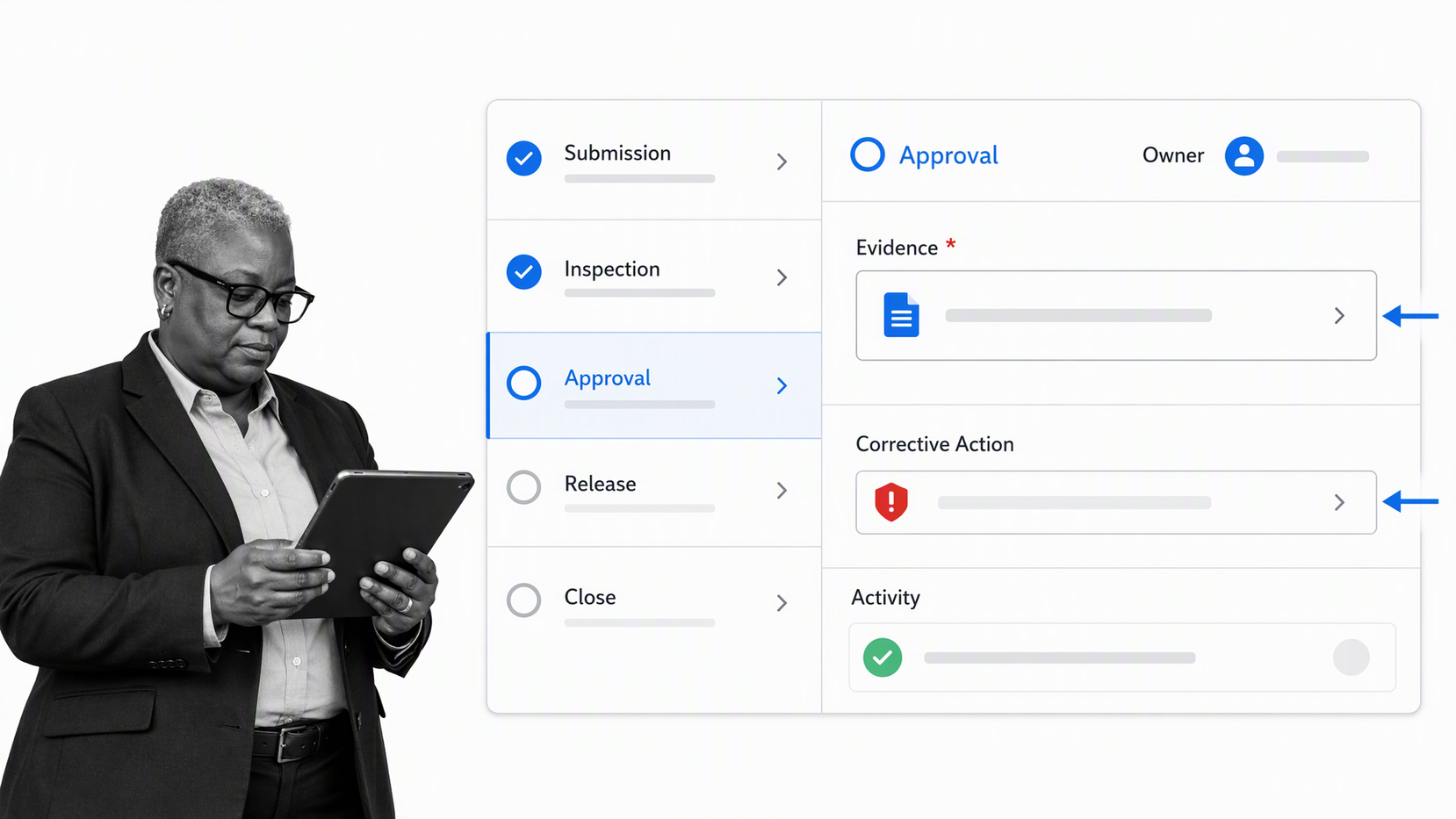
Process Street is an agentic process automation platform for high-stakes operations. It turns quality requirements into workflows that assign work, enforce rules, collect evidence, control decisions, coordinate systems, and preserve an execution history.
Turn procedures into executable work
Tasks, forms, instructions, due dates, and dependencies keep the approved method inside the workflow. Task assignments route each step to the right owner, while required fields prevent completion without the evidence the system needs.
Control decisions and exceptions
Conditional logic routes work by product, severity, location, or risk. Approvals create explicit release and disposition gates. Nonconforming work stays inside the operating record and moves to corrective action instead of disappearing into email.
Connect the quality stack
Process Street has 5,000+ integrations. The workflow can coordinate systems of record, communication tools, document repositories, and operational software while preserving one governed path for decisions and evidence.
Use agents with control and proof
Agents can execute assigned steps and coordinate software, while approval gates keep consequential write actions under human control. The workflow records tasks, decisions, evidence, and exceptions so greater automation does not remove accountability.
Improve from execution history
The workflow dashboard gives owners a cross-run view of active work and status. Execution history helps teams identify recurring delays, rejected approvals, missing evidence, and exception patterns, then update the controlled workflow and verify the effect.
Quality systems FAQs
What are quality systems?
Quality systems are the connected policies, processes, roles, controls, records, audits, and improvement routines used to deliver consistent products or services. They define how quality is planned, executed, verified, evidenced, and improved.
What are the main components of a quality system?
The main components include quality policy and objectives, requirements and risk, process ownership, controlled documents and records, competence and resources, operational controls, nonconformance and corrective action, audit, management review, and improvement.
Is ISO 9001 a quality system?
ISO 9001 is a standard that specifies requirements for a quality management system. An organization builds and operates its own system, then can use ISO 9001 requirements to assess and demonstrate whether that system is consistently managed.
What is the difference between quality assurance and quality control?
Quality assurance is preventive and focuses on the processes and conditions that create confidence in a result. Quality control checks outputs or process results against acceptance criteria. Both sit inside the wider quality system.
How do you build a quality system?
Set the scope and outcomes, translate requirements, map current work, identify gaps, design controlled workflows, pilot representative cases, and launch with governance, audit, and improvement routines. Start with critical work and expand from evidence.
How do you know whether a quality system is effective?
An effective system delivers consistent outcomes, exposes variation and failures early, produces reliable evidence, closes corrective actions, and improves from data. Review customer outcomes, process behavior, control health, audit findings, and effectiveness checks together.