





Femtech uses technology to address women’s health needs, while wellness apps help people understand and improve areas such as stress, sleep, movement, and recovery. For both categories, product-market fit means more than attracting downloads. A product has to solve a specific problem for a defined group well enough that users return, recommend it, and make it part of their lives.
That is difficult in health, where a simple interface often rests on complex evidence, sensitive data, and widely different user needs. The stories of Reeva Misra, founder of Walking on Earth, and Hélène Guillaume, founder of Wild.AI, show how focused experiments, patient product development, and credible outcomes can turn an ambitious idea into a product people value. Their pandemic-era lessons remain useful for anyone building a femtech or wellness app.
- Why femtech and wellness apps need focused evidence
- Introducing Reeva Misra and Hélène Guillaume
- Developing a wellness app
- Developing a femtech platform
- Attracting investor attention as a wellness app
- Attracting investor attention as a femtech platform
- How to find product-market fit
- Femtech product-market-fit FAQ
Focused evidence for femtech and wellness apps
Health products operate where personal need, scientific credibility, and daily behavior meet. A strong idea can still fail if the product asks users to learn too much, arrives at the wrong moment, or cannot show a meaningful benefit. The most reliable starting point is a narrow problem that users already recognize, followed by the smallest experience that can reveal whether the proposed help is useful.
The investment gap also makes evidence unusually important. The World Economic Forum reports that women’s health receives only 6% of private healthcare investment, with 90% of that funding concentrated in cancers and reproductive and maternal health. Founders in less familiar categories must often prove both the need and the business model.
Wellness products face a parallel challenge: a broad promise such as “feel better” is hard to test. The World Health Organization estimates that depression and anxiety cost 12 billion working days and about US$1 trillion in lost productivity each year. The need is real, but an app still has to translate it into a clear use case, a repeatable experience, and a signal of lasting value.
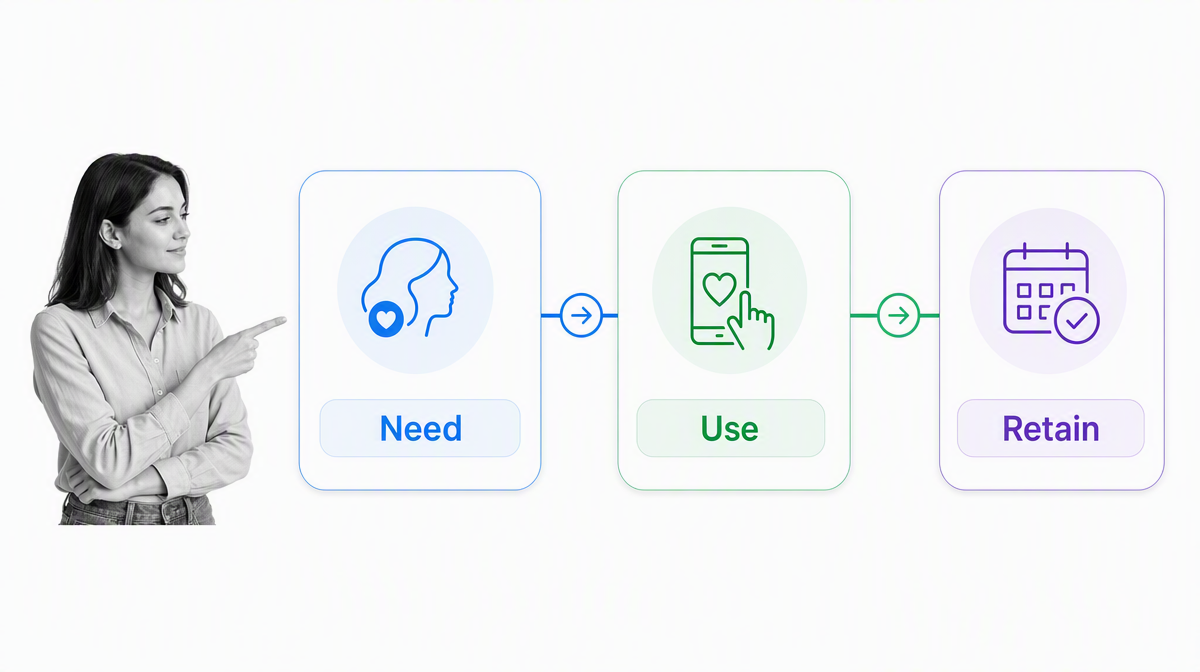
A useful demand loop is simple: identify the need, observe use, and measure retained behavior. Downloads and signups are early signals. Repeated use, completed plans, outcomes, and referrals provide stronger evidence of value.
Meet Reeva Misra & Hélène Guillaume
Reeva Misra and Hélène Guillaume met the Process Street writer in Fuerteventura, the second-largest Canary Island. On paper, they were founders taking on difficult health problems through personalized digital experiences. In person, they were also surfers and yogis whose own habits helped shape how they thought about health, performance, and wellbeing.
Walking on Earth, now branded WONE, focuses on stress intelligence and resilience through physiological and psychological signals, personalized guidance, expert sessions, and an AI performance coach. Wild.AI built cycle-aware training and recovery guidance for women. In 2025, Zepp Health acquired Wild.AI’s core assets and intellectual property, extending that women-specific approach across more life stages.
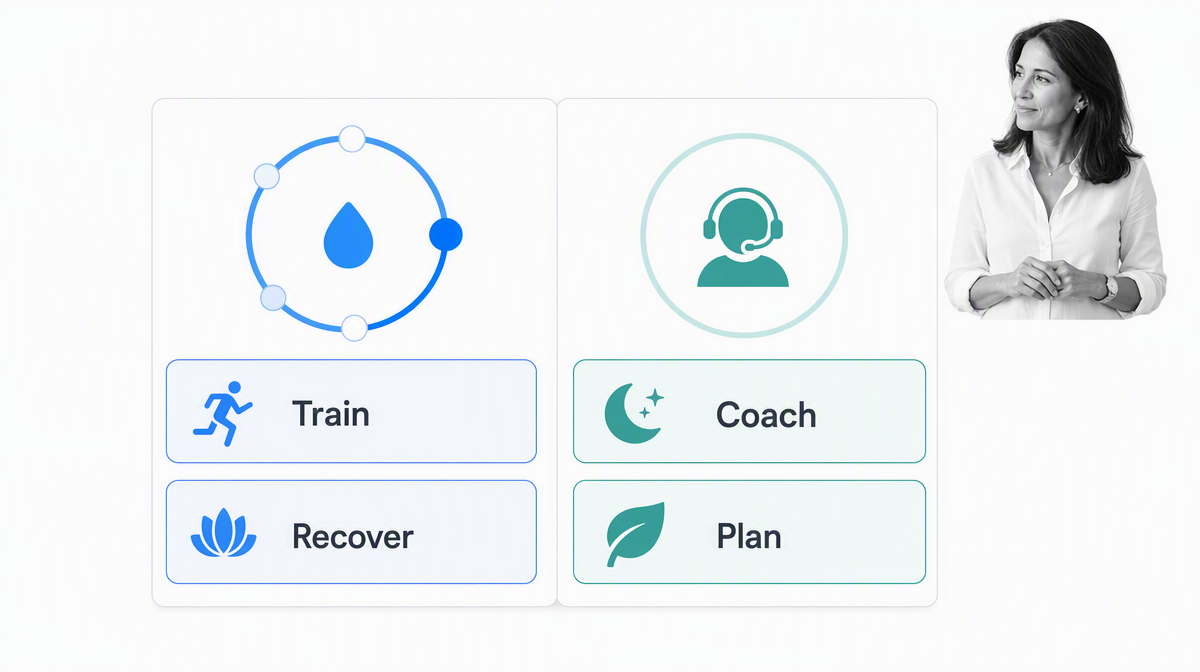
The products address different moments, but both founders faced the same question: how do you make complex health knowledge personal, useful, and simple to use?
Developing a wellness app
Talk me through developing your MVP and bringing your product to market.
Reeva Misra (Walking on Earth):
“We started by creating a website where we brought together the leading practitioners across holistic health. These were people that myself or the Head of Wellbeing had worked with personally. These were all practitioners that you wouldn’t be able to just find easily; they’re the very best, and would only teach in places where you’d have to have extensive experience to find them. We then sent the website around to my network which consisted of a mailing list of a couple of 100 people, this whole process took a week to put together.
The launching of the website was interesting because it allowed us to see what people are searching for in terms of holistic health, preventative health, and wellbeing. By leveraging the initial user data, we uncovered valuable user insight. We found that people don’t know exactly what they want. They know they have certain issues like high stress, anxiety, back pain, or problems sleeping. But they won’t necessarily know what they should be doing to treat it. For example, they might not know the difference between say, an Iyengar yoga session, or a yoga Nidra practice. This informed our future strategy and helped us build out the app in a way that would help us achieve product-market fit.
Now, with the app, we onboard each new user by asking them a series of questions. For example, the first question is, “What brings you here?”. The options are things like back pain, anxieties, and so on. We then harness the user data collected during the onboarding process to create personalized wellbeing plans. These plans recommend specific teachers, practitioners, courses, and content based on people’s individual needs and challenges.
This level of personalization is our unique selling point.”
Reeva’s first test was not a fully built app. It was a curated website sent to a small network. That was enough to uncover the language people used for their problems and the gap between knowing a symptom and knowing which intervention might help. The insight shaped onboarding around needs such as stress, anxiety, back pain, and sleep rather than assuming that users already understood different practices.
This is a strong wellness-app MVP pattern: test the recommendation logic and willingness to follow it before investing in every feature. The hypothesis is not “people want content.” It is “people will share enough context to receive and follow a relevant plan.”
Developing Wild.AI for women-specific training
Talk me through developing your MVP. Did you encounter any challenges?
Hélène Guillaume (Wild.AI):
“The very first MVP we developed was a web app. We tried so many times and failed so many times. It wasn’t as simple as thinking to ourselves, okay we’re going to do this, then doing it, and then a month later having a flawless MVP. It took us a few months to create the first version, then we had to kill it. Then we created another version, and had to kill it again. It took three years to develop something that was good.
The main challenge was getting a real understanding of the problem we were trying to solve and dealing with how we could hone around getting product-market fit. Achieving product-market fit is what took so much time actually.
To get the product right there was a lot of complex research that needed to go into it. But the issue is, as a consumer you don’t want to see that. You want something simple to use, fun, and easy. The biggest challenge was finding a way to keep things simple for the user while maintaining the level of complexity needed behind the scenes for the product to suggest scientifically-backed solutions.”
Wild.AI’s path shows why “minimum viable” does not mean “first version that can ship.” A product can function and still teach the wrong lesson if the underlying problem is not yet understood. Guillaume’s team discarded multiple versions because simplifying the user experience required deeper research, not less.
For femtech founders, this tension is central. Women-specific health products may need to account for cycle phases, life stages, symptoms, training load, recovery, and other personal variables, while presenting only what the user needs in the moment. The way through is to build an iterative development process that connects each release to a specific question, an owner, an observation window, and a decision.
The data should make the next product decision clearer. A repository is not valuable merely because it is large. It becomes useful when consent, provenance, quality, and interpretation are strong enough to support a better recommendation or a more reliable outcome.
Attracting investor attention as a wellness app
Investors need to see how a wellness product turns a widespread problem into a defensible system. For WONE, that meant explaining both the cost of stress and how the platform’s data could improve personalization over time.
How did the pandemic change conversations about stress and investor attention?
Reeva Misra (Walking on Earth):
“We’re essentially living through a stress epidemic, particularly within the startup scene. This means it can sometimes be hard to persuade people and investors that stress is really harmful, both mentally and physically. A typical investor is likely to walk out because they, along with a lot of other people, still think stress is good for you. It’s like we’re tackling the notion that stress is important for success and you need to have stress to be successful.
With our platform, we’re using data and research to debunk this notion. I also think that over the last year, the perception has shifted because of COVID. COVID has shown us that if you’re not in good health then the whole world can come to a standstill. I think people haven’t been able to ignore that fact anymore because all workplaces have been thrown up in the air because of what is essentially a health epidemic.
Also, mental health within the workplace has also been drawn into the spotlight. As an outcome to COVID, roughly 70% of employees say it’s the most stressful time in their career. So a lot of the evidence is now appearing that shows that stress is having really negative effects in the workplace. So I think in terms of investors that has really helped us to attract attention.”
The pandemic made the organizational cost of health disruption hard to ignore. The enduring investment case, however, rests on more than urgency. A founder has to show which group experiences the problem, what behavior signals improvement, how the intervention fits into daily life, and why the learning compounds.
What made the data repository interesting to investors?
Reeva Misra (Walking on Earth):
“I also think the technological and scientific-minded investors are attracted to the unique data repository of wellbeing data that we are building. The data brings together input from top practitioners in holistic health and input from scientists. We then use this data to help refine the predictions that we make for our users. This is often considered really valuable in terms of long-term kind of investment value and output.”
A credible data advantage combines expert knowledge with observable outcomes and clear boundaries. Health data should be collected for an explicit purpose, protected appropriately, and used in ways the user can understand. Responsible data practice is part of product quality.
Wild.AI’s investor case
Femtech founders often have to demonstrate market readiness as well as product readiness. Underinvestment can reflect weak evidence, narrow investor familiarity, or an assumption that women’s health is a niche. Strong metrics replace those assumptions with a visible pattern of demand and retention.
Did you have to wait for the market to mature enough for investors to show interest in femtech?
Hélène Guillaume (Wild.AI):
“Our story has gradually become stronger and stronger and we also have a solid group of metrics now, both of which make the product more appealing to investors.
In recent years, we have also had a really good reaction from the market, something that we didn’t have before. When we first started out, it very much felt as though we were living in the shadows.
There are three things that I think have helped us succeed now. Firstly, the world is now ready for femtech, secondly, we are ready for the market, and finally, we now have a complex database of research that continues to grow.
Somehow the whole world has started to realize that women are also interesting.”
The sharp final line captures a recurring problem: women’s needs were too often excluded from the default design assumptions for research, products, and investment. Product-market fit in femtech therefore includes a second layer of work. The team must prove the product experience while also making the overlooked market legible.
Finding product-market fit in femtech and wellness
The two founder stories point to an evidence loop rather than a single launch moment. Product-market fit becomes clearer as customer language, focused experiments, and retained behavior reinforce one another.
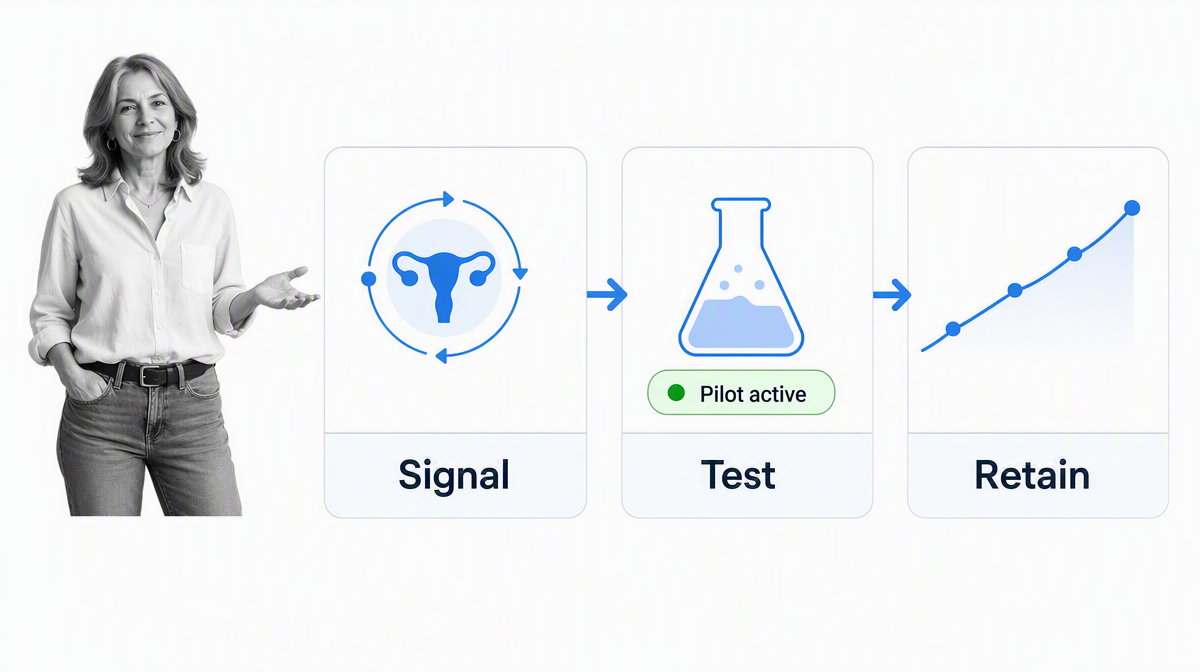
Start with a specific health need
Choose a defined user, context, and problem. “Women’s health” and “wellbeing” are markets, not product hypotheses. Focus instead on a specific use case such as cycle-aware recovery or persistent workplace stress.
Test the riskiest assumption first
Identify what must be true for the product to work. Test demand with a curated service, prototype, or narrow workflow before building a broad platform. Pair each experiment with a decision rule so the team knows whether to continue, change direction, or stop.
Make complexity disappear for the user
Scientific and operational complexity belongs behind the experience. The interface should ask only for information that changes the recommendation and should explain what happens next. Simple does not mean shallow; it means the product carries the burden of interpretation.
Measure retained value
Track signals that show the product has become useful: completion, repeated use, adherence, outcome movement, referrals, and willingness to pay. Segment the evidence carefully. Averages can hide that the product works extremely well for one group and poorly for another.
Turn learning into a repeatable practice
Use a documented go-to-market strategy and controlled workflow to connect research, experiments, approvals, and evidence. Process Street is one Compliance Operations Platform with Docs and Ops capability areas plus built-in AI. Docs can govern assumptions and decision criteria. Ops can run experiments and reviews. Built-in AI can summarize approved evidence inside those controls.
The durable lesson is not to chase a moment. Find a narrow problem, earn the right to personalize, and test whether the product changes behavior in a way users value.
Femtech product-market-fit FAQ
What is femtech?
Femtech is technology designed to address women’s health needs. It includes software, diagnostics, products, and services across areas such as reproductive health, maternal health, menopause, chronic conditions, sexual health, and women-specific performance and recovery.
How do you validate a femtech app idea?
Start with interviews and a narrow test of the highest-risk assumption. Confirm the problem in the user’s language, test whether the proposed experience changes a meaningful behavior, and define what evidence would justify further development.
What metrics indicate product-market fit for a wellness app?
Useful signals include retention, plan completion, repeated use of the core action, reported outcomes, referrals, and willingness to pay. Downloads and registrations show awareness, but they do not establish sustained value.
Why is evidence important in women’s health products?
Evidence helps a team distinguish a plausible claim from a reliable outcome. It also supports trust, responsible personalization, clinical or expert review where appropriate, and a clearer case for investment.
Our solution is powered by AWS and uses these AWS services: Lambda, SQS, API Gateway, S3, CloudFront, Elastic Beanstalk, WAF, ELB, RDS Multi-AZ, EC2 and ElastiCache for Redis.