Turn every policy into automated workflows with built-in enforcement and audit-ready proof.



Hedge Fund Checklists
Hedge fund checklists are repeatable control workflows for the work a fund manager cannot afford to handle from memory: compliance reviews, investor diligence, trading controls, valuation, fund administration, cybersecurity, business continuity, and regulatory filings.
The useful version is not a static PDF that sits in a folder. A useful checklist assigns an owner, defines evidence, routes exceptions, records approvals, and leaves a clean audit trail when a chief compliance officer, investor, administrator, auditor, or regulator asks what happened.
This guide explains what hedge fund checklists should include, how to build them, how to keep them current, and how to run them in Process Street so recurring fund work becomes controlled execution instead of inbox archaeology.
In this article, we are going to cover:
- What hedge fund checklists are
- What hedge fund checklists should cover
- Core hedge fund checklist examples
- How to build hedge fund checklists
- Hedge fund checklist controls and evidence
- Run hedge fund checklists in Process Street
- Hedge fund checklist mistakes
- Hedge fund checklist FAQs
What hedge fund checklists are
A hedge fund checklist is a structured set of recurring tasks, controls, evidence requirements, and approval steps used to run fund operations consistently. It can cover a single event, such as a new investor subscription, or an ongoing cycle, such as an annual compliance review.
The point is not the checkbox. The point is the operating proof behind it. A good checklist makes the expected action explicit, assigns accountability, captures evidence, and shows whether exceptions were escalated before the work was marked complete.
Why hedge fund teams need checklists
Hedge funds sit at the intersection of investment decisions, adviser regulation, fund documents, service-provider dependencies, investor expectations, and operational risk. That creates many small repeatable obligations that can quietly become serious problems when they live in email, spreadsheets, or one person’s head.
- Compliance teams need written policies, annual reviews, attestations, exception logs, and proof that procedures were followed.
- Operations teams need trade breaks, reconciliations, valuation inputs, administrator handoffs, and NAV support to move on time.
- Investor relations teams need subscription, redemption, side-letter, due diligence, and reporting requests to follow the fund documents.
- Technology and security teams need access reviews, cybersecurity checks, vendor reviews, and business continuity tests to be repeatable.
This is why a hedge fund checklist should read like a control workflow, not like a reminder note. It should tell the team what to do, what evidence to collect, who approves, what changes when an exception appears, and where the final record lives.
For regulatory grounding, the SEC’s compliance program rule for investment advisers requires written policies and procedures, annual review, and a designated chief compliance officer. That is a useful baseline for many adviser-run hedge fund checklist programs, even though each firm still needs counsel and compliance expertise to tailor its obligations.
What hedge fund checklists should cover
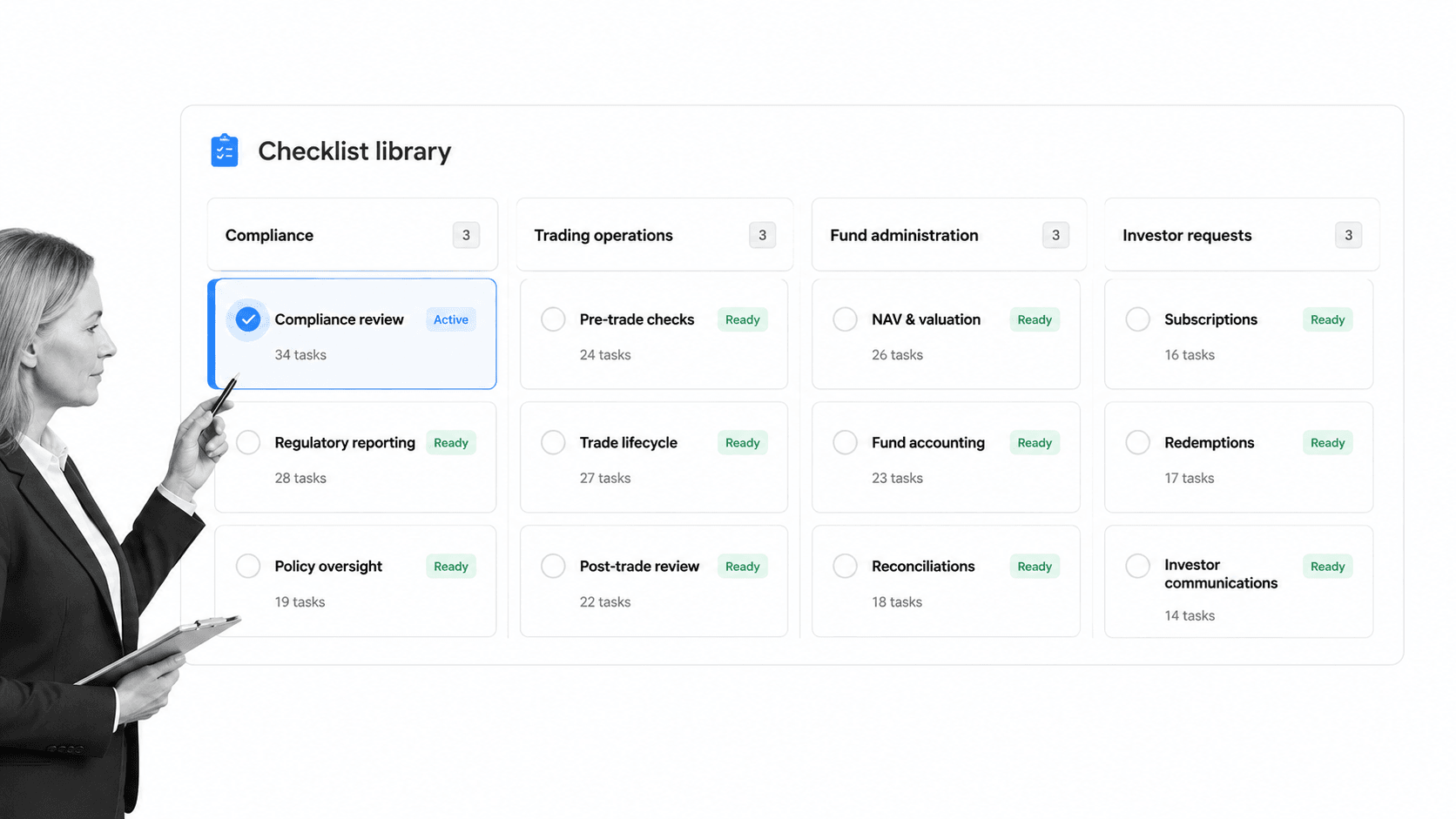
Hedge fund checklists should cover the work where consistency, evidence, and review matter. The exact scope depends on strategy, registration status, fund documents, jurisdictions, service providers, and investor terms, but most programs need a core operating library.
Compliance and regulatory checklists
Compliance checklists translate the firm’s written policies into scheduled execution. They help the CCO test whether the program works in practice, document exceptions, collect employee attestations, and keep filings on track.
- Annual compliance program review, mapped to the firm’s policies and procedures.
- Code of ethics certifications, personal trading review, gifts and entertainment review, and outside business activity attestations.
- Form ADV, Form CRS where applicable, private fund reporting, and other regulatory filing calendars.
- Marketing review, performance advertising review, and investor communication approvals.
- Cybersecurity, vendor due diligence, business continuity, and incident-response review.
Investment operations checklists
Investment operations checklists control the handoffs between portfolio management, trading, operations, administrators, brokers, and valuation inputs. They should make trade lifecycle tasks and exception handling visible before a break becomes a month-end surprise.
- Trade capture, allocation, confirmation, settlement, and break escalation.
- Counterparty onboarding, broker documentation, and account-opening steps.
- Daily cash and position reconciliation with escalation paths for breaks.
- Valuation source review, pricing overrides, hard-to-value asset review, and signoff.
Investor and fund administration checklists
Investor-facing workflows need a clear record because they often touch fund documents, deadlines, transfer restrictions, KYC or AML steps, and administrator inputs. A checklist keeps the work consistent across subscriptions, redemptions, transfers, capital activity, and recurring reporting.
| Checklist area | Typical owner | Evidence to capture |
|---|---|---|
| Subscription review | Investor relations or fund admin | Completed documents, eligibility review, AML or KYC confirmation, acceptance approval |
| Redemption workflow | Investor relations and operations | Notice date, fund terms check, liquidity review, approval, administrator confirmation |
| Monthly or quarterly close | Operations and fund admin | Reconciliation status, valuation support, NAV package, exception notes |
| Investor due diligence request | Investor relations and compliance | Questionnaire version, approved responses, document package, signoff |
Core hedge fund checklist examples
A practical hedge fund checklist library starts with the recurring work that creates the most operational risk when it is missed. Start small, then expand each checklist as exceptions reveal where the process needs tighter controls.
1. Annual compliance review checklist
The annual review checklist should test whether the firm’s policies and procedures are adequate and whether they were implemented effectively. It should not be a once-a-year scramble. Use it as a year-round evidence map, then close the annual cycle with final testing, exception review, and CCO signoff.
- Confirm the current policy inventory and owner for each policy.
- Review material business changes, strategy changes, vendors, systems, products, and personnel changes.
- Test selected controls and document exceptions.
- Review employee attestations and code of ethics records.
- Approve remediation owners and due dates for any gaps.
2. Investor due diligence checklist
Investor due diligence checklists standardize how the firm responds to operational due diligence requests. They help keep documents current, route sensitive answers through the right reviewers, and prevent one-off responses from drifting away from approved language.
3. New fund launch checklist
A new fund launch checklist coordinates legal documents, service-provider setup, bank and brokerage accounts, administrator onboarding, subscription documents, compliance approvals, reporting setup, and internal operating procedures. The checklist should be cross-functional because no single team owns the full launch path.
4. Trade operations checklist
Trade operations checklists should capture daily or periodic tasks such as allocation review, confirmations, settlement, reconciliations, restricted-list checks, and break resolution. The best versions include clear escalation conditions, not just task names.
5. Vendor and service-provider review checklist
Hedge funds depend on administrators, auditors, custodians, brokers, technology vendors, cybersecurity providers, and consultants. A vendor review checklist should capture diligence, contracts, access, data handling, security, business continuity, and periodic review evidence.
How to build hedge fund checklists
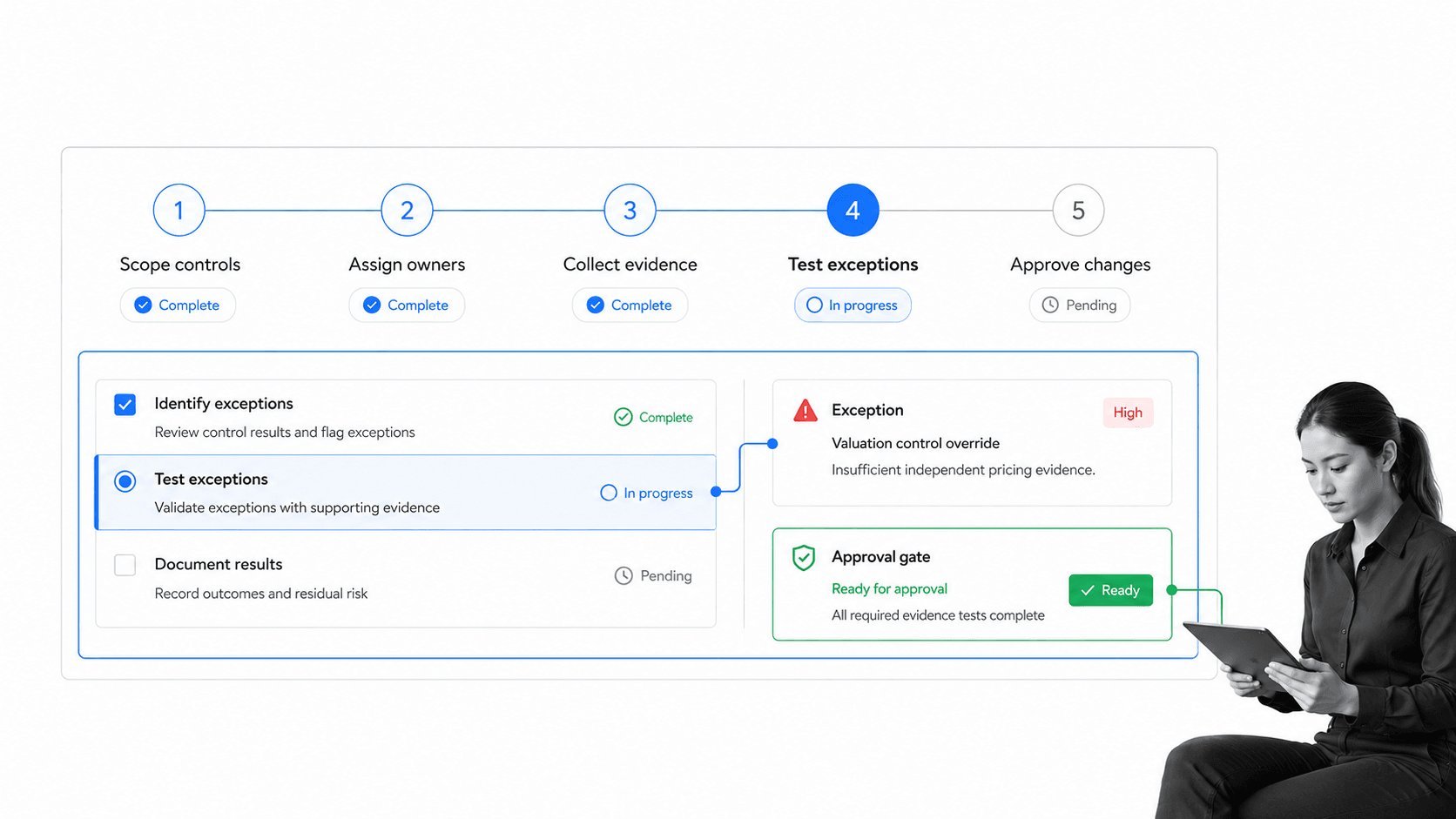
The fastest way to build hedge fund checklists is to work backward from the evidence you would need during an investor diligence request, compliance review, audit, examination, or internal escalation. If the checklist cannot prove the work happened, it is not finished.
- Define the process trigger. Examples include quarter-end close, new investor subscription, annual review, new vendor onboarding, or a trade break.
- Name the accountable owner. Every checklist needs one person responsible for completion, even when several teams contribute.
- Break the work into observable tasks. Avoid vague tasks such as review materials. Use tasks that produce evidence or a decision.
- Attach the policy, fund document, or control requirement that explains why the task exists.
- Specify required evidence. Files, approvals, attestations, notes, screenshots, administrator confirmations, and exception logs should be captured in the workflow.
- Define exception logic. If a task fails, a document is missing, or a threshold is crossed, the workflow should route to the right reviewer.
- Schedule the recurrence. Daily, monthly, quarterly, annual, event-driven, and investor-driven checklists need different timing logic.
- Review and improve the checklist after each cycle. A checklist that never changes is usually not learning from exceptions.
Keep the checklist close to the policy
A hedge fund compliance manual is useful only when the operating team can execute it. Link checklist tasks to the governing policy or procedure so reviewers can see why a step exists, then connect the work to the broader obligations described in Investment Advisers Act operating requirements when adviser rules are in scope.
Use roles instead of names
Names change. Roles scale. Build checklists around roles such as CCO, operations lead, portfolio operations analyst, investor relations owner, administrator contact, and fund counsel. Assign the current person to the role inside the workflow.
Make exceptions visible
Exceptions are where the checklist earns its keep. A missed document, unusual investor term, pricing override, trade break, late attestation, or policy conflict should route to a reviewer instead of hiding inside a comment thread. That same routing discipline applies to operational audit work, where the review record matters as much as the task list.
Hedge fund checklist controls and evidence
The control layer is what separates a reliable hedge fund checklist from a simple task list. Each checklist should define what control is being performed, what proof is required, who reviews it, and what happens when something does not match expectations.
| Control question | Checklist design choice | Why it matters |
|---|---|---|
| Who owns the step? | Assign a role and backup owner | Prevents orphaned compliance and operations tasks |
| What proof is required? | Use required file, form, or text fields | Creates evidence while the work is performed |
| What triggers escalation? | Add conditional routing for exceptions | Stops unusual items from being approved by habit |
| Who approves? | Use approval tasks with reviewer identity | Creates a decision record instead of informal signoff |
| How is the record retained? | Store run history and evidence with the checklist | Makes review and diligence faster |
This evidence-first design also helps with investor due diligence. Industry due diligence questionnaires often ask for governance, operations, service-provider, valuation, compliance, and risk-management evidence. A live checklist program makes those answers easier to support because the record is created during normal work. The same logic underpins hedge fund operational due diligence, where investors need more than polished answers.
For futures, commodity pool operator, or commodity trading advisor activity, the National Futures Association self-examination process is another reminder that annual operational review is not just a best practice. Firms need a repeatable way to inspect their procedures, identify weak spots, and strengthen controls.
Rule 206(4)-7 also states the annual review obligation directly: advisers must review, at least annually, whether their policies and procedures are adequate and effective in implementation. The CFR text for 17 CFR 275.206(4)-7 is a useful citation to keep beside the checklist design, because it keeps the workflow tied to an explicit review standard.
Investor-facing diligence has its own evidence pressure. AIMA’s due diligence questionnaires are built to help investors assess hedge fund managers and help managers review service providers, directors, and fund boards. That structure is a reminder to keep service-provider review, governance, valuation, and operational control evidence close to the work.
Run hedge fund checklists in Process Street
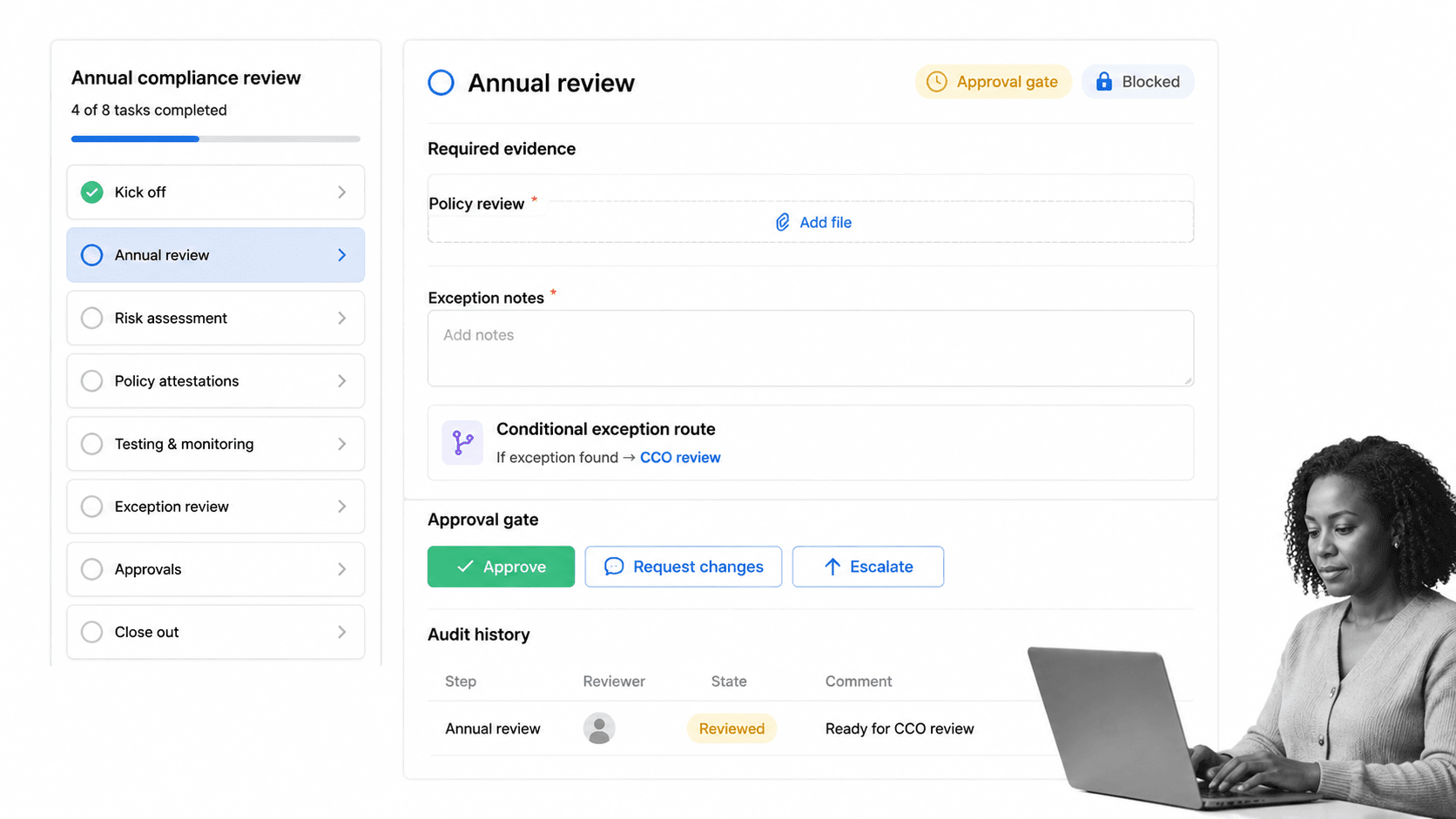
Process Street turns hedge fund checklists into assigned workflow runs. Instead of sending a spreadsheet around the firm, teams can launch the right checklist, assign tasks by role, require evidence, route exceptions, and preserve the audit trail in one place. That makes the same system useful for fund operations, adviser compliance, investor relations, and the kind of structured investment work covered in hedge fund operating models.
- Use recurring workflow runs for monthly close, quarterly investor reporting, annual compliance review, access review, and vendor review.
- Use forms and required fields to capture evidence as each task is completed.
- Use conditional logic to send exceptions to the CCO, operations lead, fund counsel, or administrator contact.
- Use approvals to document signoff before the checklist closes.
- Use integrations to connect checklist activity to the systems where documents, tickets, CRM records, and notifications already live.
Process Street has direct, universal integrations to 5,000+ systems. Need a new one? An AI agent builds it on the fly. That matters for hedge fund operations because the checklist often has to coordinate systems of record, document storage, email, investor CRM, fund administration packages, and reporting tools.
When a checklist becomes the operating path for recurring fund work, it should behave like a runbook: clear trigger, assigned owner, required proof, escalation path, and completion record. That execution shape is the same discipline behind runbook automation, applied to fund operations instead of IT incidents.
When the checklist touches adviser filings, Form ADV preparation needs the same owner, evidence, review, and signoff discipline. When the checklist expands into the full compliance stack, financial services compliance software becomes the system that keeps policy, execution, and proof connected.
Hedge fund checklist mistakes
Most checklist failures are design failures. The team had a list, but the list did not enforce ownership, evidence, escalation, or review. That creates a false sense of control.
- Treating the checklist as a document instead of an executable workflow.
- Using vague tasks that cannot be tested later.
- Letting one person own too much undocumented knowledge.
- Failing to route exceptions to the CCO or appropriate reviewer.
- Forgetting to update the checklist when fund documents, policies, systems, or service providers change.
- Keeping investor due diligence responses separate from the evidence that supports them.
- Failing to track whether recurring controls were actually completed on schedule.
The fix is to make every checklist operational. If a task matters, it gets an owner. If a step creates risk, it gets evidence. If an exception appears, it gets routed. If a reviewer approves, the workflow records who approved and what they saw. The same pattern supports accounting process control, client onboarding checklists, and process template creation when fund work spans finance, investor relations, and operations.
Fund teams that run checklists across systems need tools that support the operating model, which is why hedge fund tools should be evaluated by how well they enforce repeatable work. Private-market operating teams face similar handoffs in private equity processes, where diligence, portfolio operations, reporting, and approvals all need a durable record.
Hedge fund checklist FAQs
What are hedge fund checklists?
Hedge fund checklists are structured workflows used to run recurring fund tasks consistently. They can cover compliance reviews, investor due diligence, subscriptions, redemptions, trading operations, valuation, vendor review, and fund administration handoffs.
What should a hedge fund compliance checklist include?
A hedge fund compliance checklist should include the policy or rule being tested, the assigned owner, required evidence, review steps, exception routing, approval, and record retention. Common areas include annual review, code of ethics, marketing review, filings, cybersecurity, vendor oversight, and employee attestations.
How often should hedge fund checklists be reviewed?
Review cadence depends on the checklist. Some run daily or monthly, while compliance program reviews, access reviews, vendor reviews, and business continuity tests are often scheduled quarterly or annually. The checklist should also be updated whenever policies, fund terms, systems, vendors, or regulatory obligations change.
How do hedge fund checklists support investor due diligence?
Investor due diligence often asks for evidence that controls, service providers, valuation, compliance, cybersecurity, and operations are working. A well-run checklist program creates that evidence during normal work, which makes diligence responses faster and more defensible.
Can hedge fund checklists be automated?
Yes. Hedge fund checklists can be automated by turning them into recurring workflow runs with assigned owners, required fields, file uploads, conditional routing, approvals, reminders, and audit history. Automation is most useful when the checklist needs proof, not just reminders.
What is the difference between a hedge fund checklist and a compliance manual?
A compliance manual explains the firm’s policies and procedures. A hedge fund checklist executes the recurring work required by those policies, captures evidence, routes exceptions, and documents review. The manual defines the standard; the checklist proves the standard was followed.