Turn every policy into automated workflows with built-in enforcement and audit-ready proof.



Hedge Fund Platform
A hedge fund platform is the connected operating environment a fund uses to make investment decisions, process trades, coordinate service providers, manage risk, meet compliance obligations, and produce reliable records. It is not one screen or one database. It is the combination of systems, workflows, controls, data, and ownership that lets the fund operate as one firm.
Investment teams often begin with specialist tools for research, portfolio management, trading, accounting, investor relations, and compliance. Those tools solve important problems, but the work between them still has to move. A platform becomes useful when it makes those handoffs explicit, assigns each action, records the evidence, and routes exceptions before they become operational failures.
This guide explains the layers of the operating stack, how the workflow and control system connects them, what to evaluate, and how to implement the platform without trying to replace every specialist system at once.
In this guide, you will learn:
- What is a hedge fund platform?
- The core layers of the operating stack
- How workflows connect the platform
- Risk, compliance, and evidence
- Data, integrations, and service providers
- How to evaluate a hedge fund platform
- How to implement the platform
- Where Process Street fits
- Frequently asked questions
What is a hedge fund platform?
A hedge fund platform is the operating stack that supports the fund from idea generation through investor reporting. The stack may include a portfolio management system, order management and execution tools, market and reference data, risk analytics, fund accounting, investor records, compliance systems, document storage, and a workflow layer that connects the work.
The platform is broader than trading software
A trading platform helps a team research, stage, route, execute, and monitor orders. That is a critical layer, but a hedge fund also needs processes for allocation review, reconciliation, valuation, expense approval, investor onboarding, regulatory filings, access control, vendor oversight, incident response, and business continuity. A complete platform accounts for the work before and after the trade.
The platform can be assembled or managed
Some managers assemble a best-fit stack and keep ownership of each vendor relationship. Others use a hosted or outsourced platform that combines infrastructure, operations, regulatory support, and service-provider coordination. The right model depends on strategy, instruments, jurisdictions, team capability, control expectations, and the amount of operational work the manager wants to own.
The operating model matters more than the vendor count
A long software list does not create a platform. The test is whether a material event can move through the stack without disappearing between systems. When a trade breaks, a valuation changes, an investor document is missing, or a service provider misses a deadline, the team should know who owns the exception, which evidence is required, who approves the response, and when the issue is closed.
The platform should make accountability visible
Every recurring process needs a trigger, owner, due date, evidence requirement, decision gate, and completion record. This is where a practical hedge fund system differs from a collection of disconnected tools. The system shows how the fund actually works, including the exceptions that do not fit a clean data flow.
The core layers of the operating stack
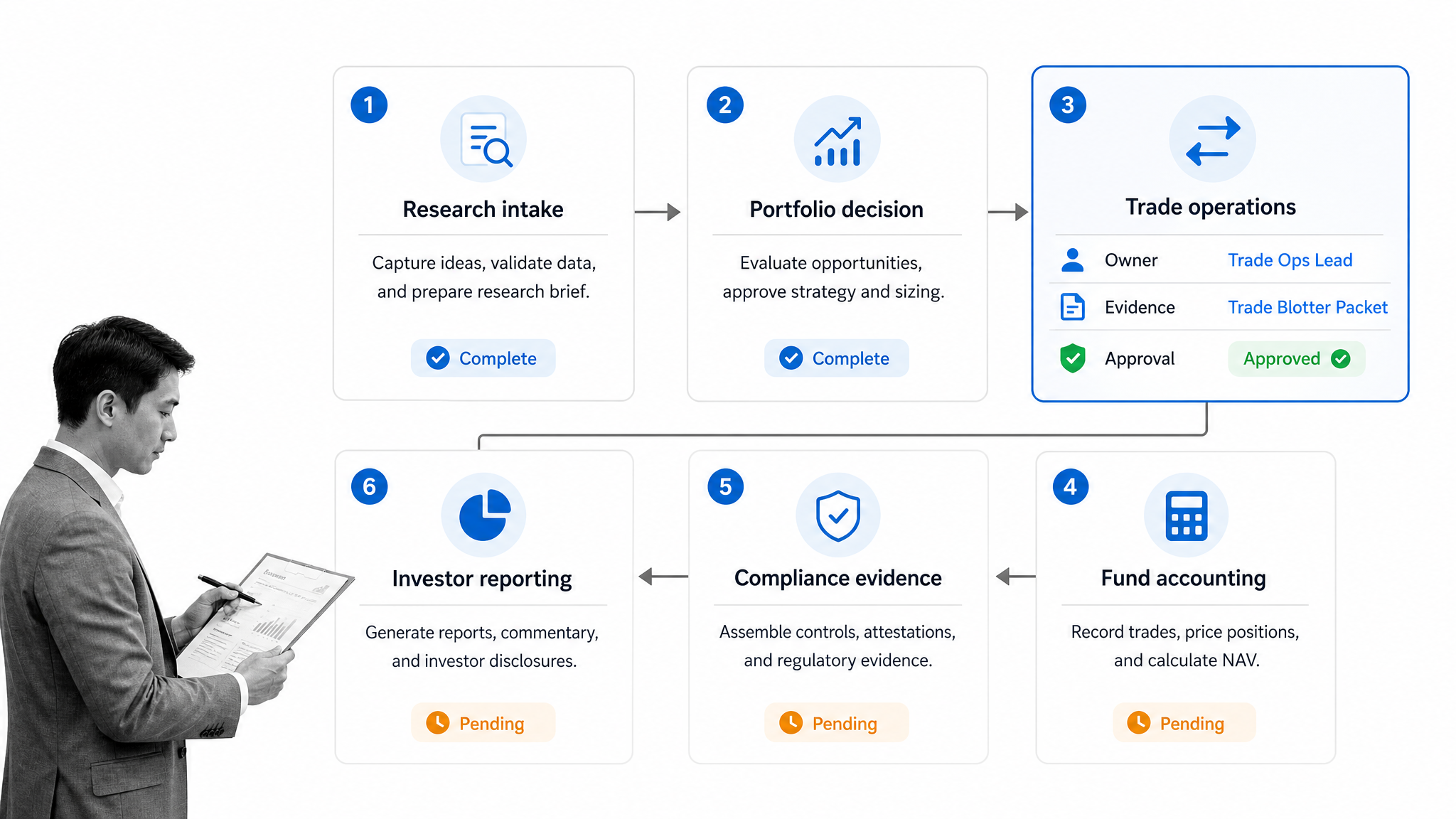
The platform’s layers should match the fund’s operating model. A liquid public markets strategy, a credit strategy, and a multi-strategy platform can share common control principles while needing different data, execution, valuation, and reporting capabilities.
Investment research and decision management
The investment layer captures research, thesis development, position proposals, scenario analysis, and decision history. It should preserve the evidence behind a decision without forcing the team to turn judgment into a rigid score. A structured investment due diligence workflow can assign research work, collect source material, expose open risks, and record the final decision.
Portfolio and trade operations
The portfolio and trading layer covers position data, exposures, cash, orders, executions, allocations, confirmations, settlements, and exceptions. Its job is not only to move trades. It also has to provide a clean handoff to risk, accounting, compliance, counterparties, and management oversight.
Risk and exposure management
The risk layer gives the fund a consistent way to monitor market, liquidity, concentration, counterparty, leverage, operational, and model risks that are relevant to the strategy. The important connection is between a risk signal and the response it triggers. A threshold without an owner or escalation path is only a notification.
A fund can connect its platform design to a broader enterprise risk management discipline so market and investment risks are not isolated from operational, technology, vendor, and compliance risks.
Fund accounting and administration
Fund accounting turns positions, prices, cash, expenses, fees, allocations, and investor activity into books, records, valuations, and statements. The manager may perform the work internally or coordinate with an administrator, but ownership of reviews and exceptions still needs to be explicit. A fund administration process can map account setup, transaction processing, reconciliation, NAV review, reporting, audit, and investor inquiries.
Investor relations and reporting
The investor layer supports onboarding, subscriptions, redemptions, notices, statements, due diligence requests, and ongoing communication. It should connect investor records with the approvals and evidence used to release communications. The platform also needs a clear distinction between authoritative records and working drafts.
Compliance, governance, and document control
The governance layer ties obligations and policies to daily execution. It manages reviews, attestations, filings, conflicts, communications, access, vendor oversight, and exceptions. The SEC private fund adviser overview is a useful starting point for U.S. adviser context, but the exact obligations depend on the manager, fund structure, activities, and jurisdictions.
How workflows connect the operating stack
Specialist systems hold data and perform specialist functions. Workflows connect decisions and responsibilities across those systems. This layer becomes the operating spine of the fund because it answers what happens next when data changes or an exception appears.
Start with material events
Map the events that change exposure, create an obligation, or require a controlled response. Examples include approving a new instrument, executing a trade, allocating a block, resolving a break, striking a valuation, onboarding an investor, releasing a report, changing access, or discovering a control exception.
Separate system actions from human decisions
Systems can move data, calculate fields, and create alerts. People still make decisions about exceptions, estimates, conflicts, disclosures, and risk acceptance. The workflow should place the decision after the required evidence and before the irreversible action, then record who approved the decision and what they reviewed.
Design handoffs around evidence
A handoff is complete when the next owner receives the required context and evidence, not when an email is sent. Trade operations may need execution details and allocation instructions. Accounting may need prices, corporate actions, and reconciliations. Compliance may need communications, approvals, and exception records. Each handoff should define its minimum evidence set.
Route exceptions differently from normal work
Normal work should move quickly. An exception should reveal additional review, evidence, or approval steps based on its type and impact. Conditional logic can route a late confirmation, unusual valuation, restricted instrument, investor eligibility issue, or vendor failure through the right path without forcing every case through the longest workflow.
Use recurring workflows for the operating calendar
Daily reconciliations, monthly closes, quarterly reporting, annual reviews, access recertification, policy reviews, vendor checks, and continuity tests all belong on a recurring operating calendar. The hedge fund workflow templates collection provides starting points that can be adapted to the fund’s roles, strategy, and control environment.
Risk, compliance, and evidence
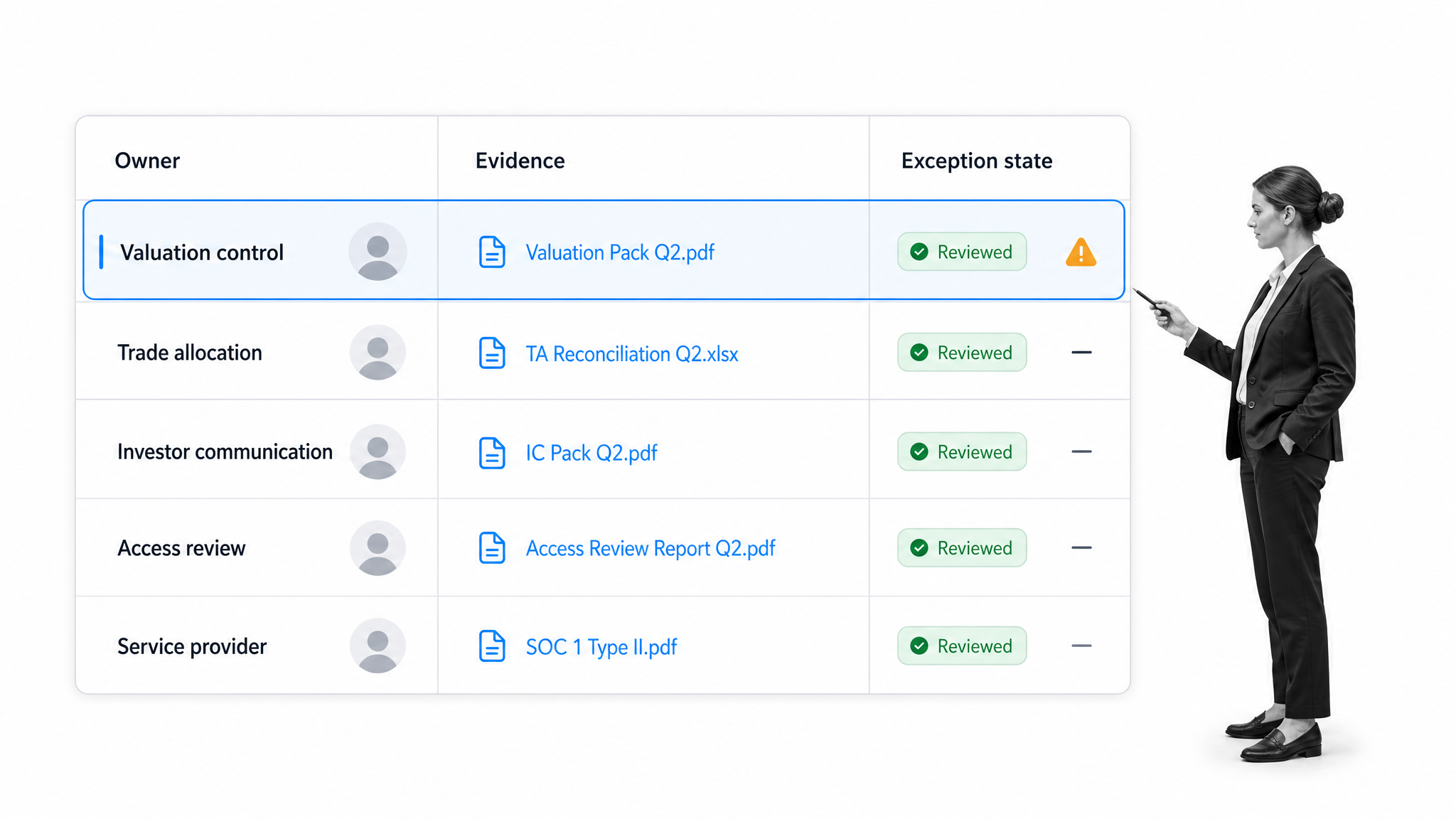
A connected operating stack should link policy, action, evidence, and exception handling. This matters because a control that exists only in a manual cannot prove the control was performed, reviewed, and corrected when necessary.
Translate obligations into controls
Begin with the obligations and commitments that apply to the manager. Translate each one into a control objective, an operating step, an owner, evidence, a review cadence, and an escalation path. Counsel and compliance professionals should determine the exact legal scope. The platform should make the resulting operating requirements executable.
Build a control register that teams can use
A useful control register links each control to its policy, workflow, owner, evidence, exceptions, and review history. It should be small enough to operate and detailed enough to test. A compliance audit workflow can structure document review, interviews, risk assessment, findings, corrective actions, and follow-up.
Test evidence, not completion boxes
A completed task is not sufficient proof when the control requires a reconciliation, approval, record review, or exception analysis. Evidence should show what was reviewed and which result was accepted. The SEC private fund adviser examination observations give managers primary-source context for recurring compliance weaknesses identified in examinations.
Connect risk assessment to remediation
Risk assessment should change the operating plan. High-impact or weakly controlled areas may need more frequent review, stronger approval gates, better evidence, or a specific remediation workflow. An audit risk assessment checklist helps reviewers connect scope, risk areas, internal controls, findings, and management action.
Account for CPO obligations where applicable
Some fund managers operate commodity pools or conduct activities that bring CFTC and NFA requirements into scope. The NFA CPO regulatory obligations resource outlines relevant areas, while the NFA CPO internal controls guidance describes a principles-based internal-control framework for applicable members. The platform should support the control model that legal and compliance teams establish.
Prepare for operational due diligence
Investors and allocators test whether the manager’s operating model is credible. They look beyond policies to ownership, service-provider oversight, valuation, security, business continuity, and evidence that controls actually run. A platform designed for hedge fund operational due diligence can answer those questions from normal execution records instead of a one-time document scramble.
Data, integrations, and service providers
The operating environment usually spans internal systems and external parties. Prime brokers, custodians, administrators, banks, auditors, counsel, data vendors, trading venues, and technology providers may all create or consume information. The platform needs clear ownership for every boundary.
Define authoritative data by domain
Decide which system is authoritative for positions, cash, prices, investor records, legal documents, policies, workflows, and evidence. A platform becomes fragile when the same field is maintained in several places without a reconciliation rule. The operating workflow should reference the source record instead of cloning unnecessary data.
Design reconciliations as controlled workflows
Reconciliation is the bridge between systems. Define the source pair, matching rule, tolerance, reviewer, evidence, and exception path. A break should create a controlled case with an owner and deadline rather than a message that can be lost. This turns data quality into an operating process.
Treat vendor oversight as part of the platform
Outsourcing a function changes who performs the task, not the manager’s need for oversight. The platform should track service commitments, reports, incidents, access, control evidence, review meetings, and unresolved issues. This is especially important when several vendors depend on one another.
Plan for interconnected and systemic risk
A data provider outage can affect valuations. A prime-broker issue can affect positions and liquidity. An administrator delay can affect reporting. Mapping these dependencies helps the manager understand systemic risk at the operating level and design fallbacks for the processes that cannot wait.
Use integrations to move work, not hide it
An integration should trigger the right workflow, pass the required context, and preserve the source reference. It should not make a decision invisible. Process Street has direct, universal integrations to 5,000+ systems. Need a new one? An AI agent builds it on the fly. The operating record still keeps human decisions and exceptions visible.
How to evaluate a hedge fund platform
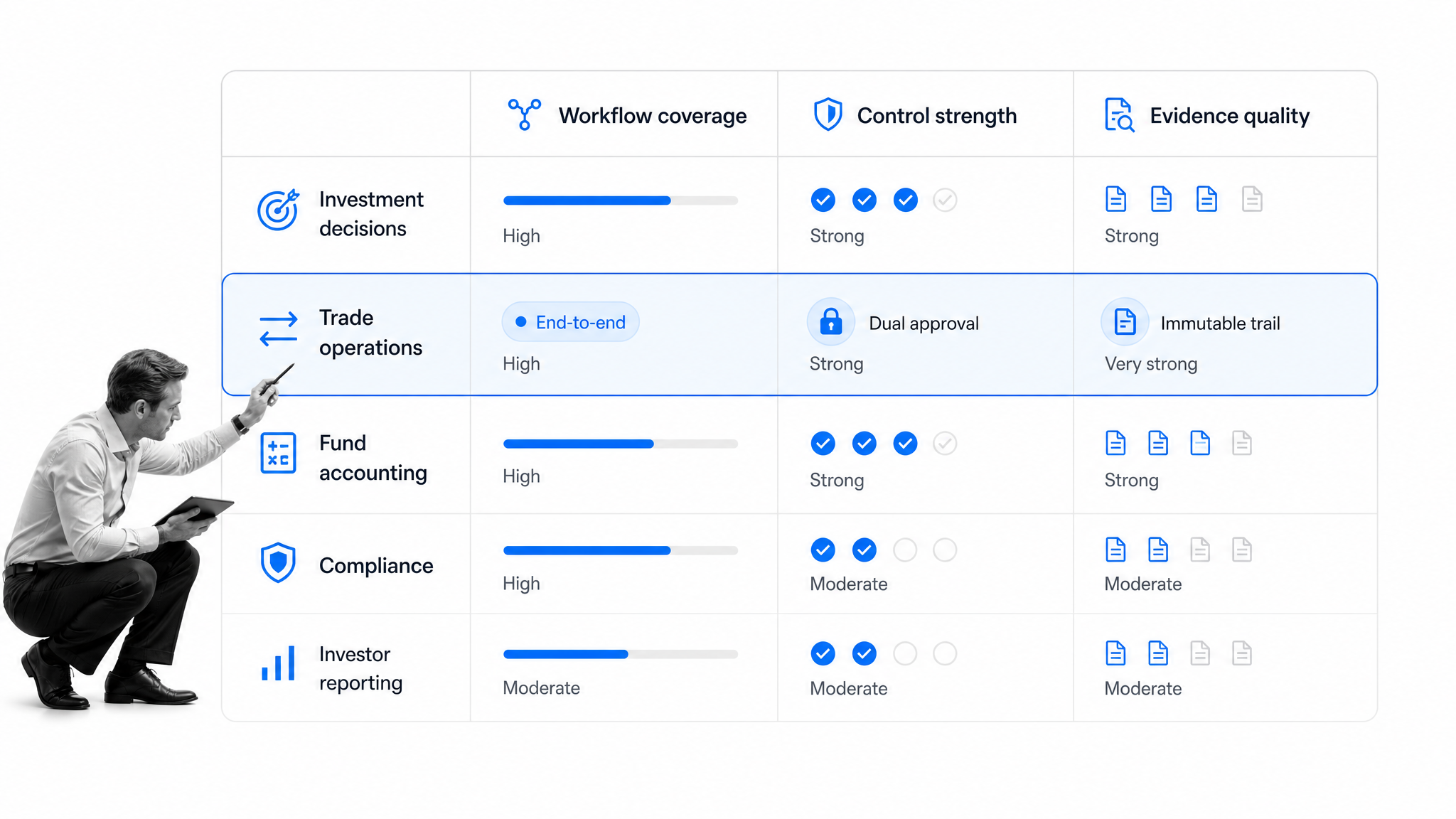
Platform evaluation should begin with the operating model, not a generic feature grid. A fund with complex derivatives, several prime brokers, multiple jurisdictions, or frequent investor activity will expose different failure points than a concentrated long-short fund with a small team.
Map the critical workflows first
List the workflows that must run correctly for the fund to trade, value assets, protect information, communicate with investors, and meet obligations. Rank them by impact and current weakness. The evaluation should demonstrate how each critical workflow runs across systems, people, and service providers.
Test exception handling
Ask vendors to show what happens when the normal case fails. Useful scenarios include a trade break, missing price, late capital activity, failed reconciliation, restricted-list conflict, unusual valuation, incorrect investor document, system outage, and missed service-provider deadline. The platform should show ownership, escalation, evidence, approval, and closure.
Evaluate control strength
Look for role-based access, approval gates, evidence requirements, version history, change records, exception management, and review cadence. Controls should be configurable enough to match risk without requiring a developer for every change. Workflow approvals should sit at the decision point and identify the evidence a reviewer is accepting.
Check interoperability and ownership
The platform should work with the systems the fund already trusts. Evaluate APIs, file exchange, direct connections, identity management, data lineage, failure alerts, retry behavior, and the process for adding a new connection. Clarify who owns each integration and how a failed data flow becomes an operational case.
Inspect auditability
Auditability means more than a timestamp. The record should connect the policy, workflow version, task owner, evidence, reviewer, exception, change, and final decision. Reviewers should be able to reconstruct what happened without combining email, chat, spreadsheets, and memory.
Assess implementation effort
A powerful platform can still fail if the team cannot implement or maintain it. Evaluate migration scope, workflow configuration, data cleanup, testing, training, support, operating ownership, and the effort required to change a process after launch. Start with the smallest set of workflows that proves the model.
Separate specialist depth from operating coverage
No single platform needs to replace every specialist tool. Portfolio construction, execution, risk models, fund accounting, and investor records may remain in purpose-built systems. The evaluation should test whether the operating layer connects those systems into one controlled hedge fund technology environment.
Use total operating risk as the decision lens
Price and feature count matter, but the larger question is which operating failures the platform prevents or makes recoverable. Consider manual handoffs, duplicate data, weak evidence, vendor dependence, hidden exceptions, slow changes, and key-person knowledge. The strongest choice reduces those risks without creating a new concentration of complexity.
How to implement the platform
Implementation works best as a controlled sequence. The goal is to prove that one material workflow can move across the stack with clear ownership and evidence, then expand the model to adjacent processes.
Step 1: Document the current operating model
Map systems, service providers, recurring processes, material decisions, data owners, controls, and known exceptions. Include the unofficial work in spreadsheets, inboxes, and chat. That shadow layer often contains the handoffs the formal architecture misses.
Step 2: Select the first workflow
Choose a workflow that is important, repeated, bounded, and currently painful. A daily reconciliation, valuation review, investor onboarding, monthly close, access review, or compliance attestation can work well. Avoid starting with every process in the fund.
Step 3: Define evidence and decisions
For each step, specify the owner, input, evidence, due date, decision, approver, and exception path. Remove steps that only move information without changing the work. The result should be a clear operating contract between people and systems.
Step 4: Connect source systems
Connect only the data needed for the first workflow. Keep authoritative records in their source systems and pass references into the workflow. Add monitoring so a failed connection creates a visible exception instead of silently dropping the task.
Step 5: Test normal and exception paths
Run the workflow with realistic data. Test the clean case, missing evidence, late work, rejected approval, incorrect data, unavailable service provider, and system outage. Confirm that the team can recover without editing the audit trail or bypassing the control.
Step 6: Train through real work
Training should use the actual workflow and actual roles. Explain why each evidence requirement and approval exists. Give users a clear route for reporting friction. A process that is technically correct but routinely bypassed is not implemented.
Step 7: Measure control and flow
Track completion time, rework, exception volume, missing evidence, approval delays, and recurring break types. The objective is not to eliminate every exception. It is to surface exceptions early, resolve them consistently, and improve the process from execution data.
Step 8: Expand by dependency
Add the workflows that share data, owners, or controls with the first one. Reconciliation can lead to valuation review and monthly close. Investor onboarding can lead to communications and reporting. Access review can lead to vendor oversight and incident response. Expansion by dependency creates a coherent platform.
Step 9: Review the platform as a control environment
Schedule periodic reviews of system ownership, integrations, workflows, evidence, access, vendors, continuity, and unresolved risks. Connect platform changes to the fund’s hedge fund risk management process so growth and strategy changes do not outpace the control environment.
Where Process Street fits in the operating stack
Process Street is a Compliance Operations Platform. It provides the workflow and control layer that connects policies, people, specialist systems, service providers, evidence, and approvals. It does not need to replace the portfolio, trading, accounting, or investor systems that already hold authoritative data.
Turn recurring work into governed workflows
Fund teams can build workflows for research review, trade exceptions, reconciliations, valuation oversight, fund administration, investor onboarding, reporting, access reviews, vendor checks, filings, and continuity tests. Each run assigns work, collects evidence, records decisions, and preserves history.
Put policy beside execution
The platform can link a procedure or control to the workflow that performs it. That makes the operating requirement visible at the moment of execution and gives reviewers a direct path from policy to evidence. It also reduces dependence on a separate manual that users have to remember to open.
Use risk-based routing
Different instruments, investors, jurisdictions, counterparties, and exception types may require different work. Conditional paths can add diligence, review, or approval only when the facts require it. This keeps normal work fast while preserving stronger control for higher-risk cases.
Coordinate service providers without losing accountability
External providers can receive assigned tasks, evidence requests, deadlines, and follow-up while the fund retains one view of the process. The workflow record shows what the provider supplied, what the manager reviewed, which exception remained open, and who approved the final result.
Create proof during normal operations
Evidence is strongest when it is produced as the work happens. The same record can support management oversight, compliance review, audit preparation, and investor due diligence. That is the central value of the workflow layer: execution creates proof by default.
Frequently asked questions
What is a hedge fund platform?
A hedge fund platform is the connected operating environment that supports investment decisions, trading, risk, fund accounting, investor activity, compliance, reporting, and service-provider coordination. It includes specialist systems plus the workflows, controls, data connections, and ownership that make the stack operate as one firm.
What systems are included in the operating platform?
Common layers include research and decision management, portfolio management, order and execution systems, market data, risk analytics, fund accounting, investor records, compliance systems, document control, and workflow automation. The exact stack depends on strategy, instruments, jurisdictions, team size, and the functions handled by service providers.
How is a hedge fund platform different from hedge fund administration software?
Hedge fund administration software focuses on accounting, valuations, investor allocations, statements, and related fund records. The full operating environment is broader. It connects investment, trading, risk, operations, compliance, investor relations, vendors, and management oversight across the full operating model.
What should an emerging manager look for in a fund platform?
An emerging manager should prioritize critical workflow coverage, exception handling, control strength, auditability, interoperability, security, service-provider coordination, and manageable implementation. The platform should support growth without forcing the manager to rebuild the operating model after every new fund, strategy, instrument, or jurisdiction.
How does the operating platform support compliance?
The platform can connect obligations and policies to assigned workflows, evidence requirements, approvals, exceptions, reviews, and change history. Compliance professionals and counsel determine which requirements apply. The platform makes the resulting controls executable and easier to test.
Can Process Street support hedge fund operations?
Yes. Process Street can serve as the workflow and control layer for recurring hedge fund operations. Teams can use it to assign work, collect evidence, apply conditional paths, route approvals, coordinate service providers, and maintain an audit-ready history while keeping specialist data in the systems that own it.