





Every professional needs a clear view of the most important investment banking processes: controlled, repeatable workflows that move a transaction from origination through analysis, valuation, due diligence, approvals, execution, and handoff. They cover work such as mergers and acquisitions, restructuring, equity and debt issuance, research, and strategic advisory.
Clear process ownership helps deal teams coordinate models, pitch materials, reviews, and evidence under tight timelines. The guide below explains the main roles and process families, then provides 80 investment banking process templates that teams can adapt to their mandate, risk controls, and approval structure.
- Key players in investment banking
- Types of investment banks
- Types of investment banking processes
- Investment banking M&A advisory processes
- Investment banking capital raising processes
- Investment banking research processes
- Investment banking strategic advisory processes
- Investment banking valuation service processes
- Other investment banking processes
- Give investment banking process templates a try
Key players in investment banking
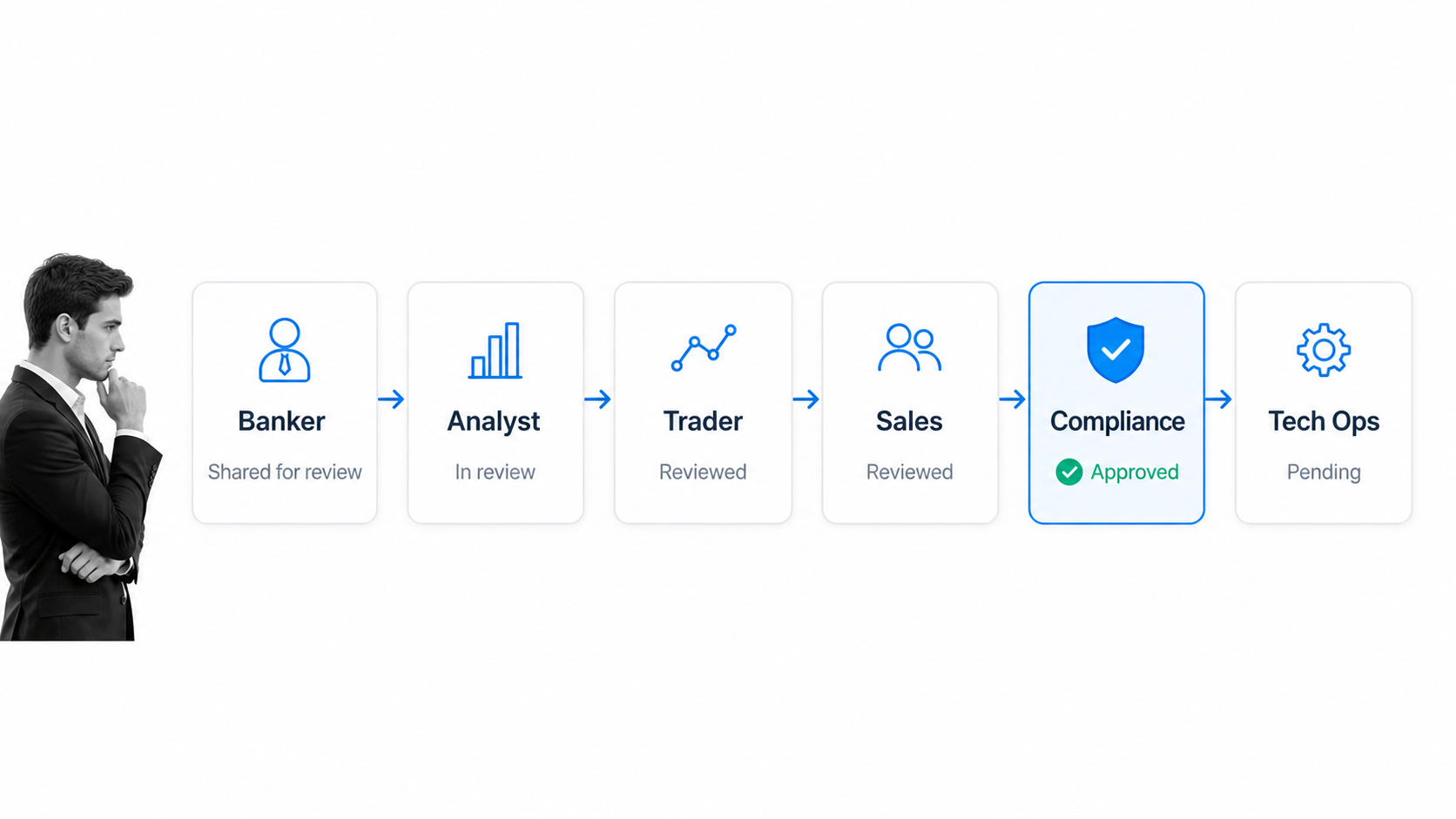
Investment banking is a critical sector of the financial services industry that facilitates capital raising, mergers and acquisitions, large financial transactions, and advisory services for corporations, governments, and financial institutions. The complexity of this industry is echoed in the variety of key players involved, each fulfilling distinct roles essential to the investment banking ecosystem.
Investment bankers
At the forefront are investment bankers, who are responsible for underwriting new debt and equity securities for all types of corporations. They act as intermediaries between issuers of securities and the investing public, guiding clients through the intricacies of the capital markets.
Investment bankers often specialize in a broad range of particular sectors, such as technology, healthcare, or energy, allowing them to provide insightful analysis and strategic advice tailored to specific industries.
Analysts
Supporting investment bankers are analysts who perform extensive research, financial modeling, valuation assessments, and transaction analysis.
They aid in the preparation of investment banking pitchbooks and presentations for potential clients, assembling the data and analysis used in senior review and client discussions. The work requires careful version control because models, market data, and presentation materials often change in parallel under tight deadlines.
Traders
In an investment bank’s sales and trading division, traders execute buy and sell orders for securities on behalf of the bank and its clients. They monitor market conditions and make real-time decisions within the firm’s risk limits.
By managing risk and optimizing trading strategies, traders play a significant role in maintaining the liquidity and efficiency of trading divisions and financial markets.
Salespeople
Sales professionals within investment banks work closely with institutional clients to understand their investment needs and objectives. They play a pivotal role in marketing financial products and services, ranging from equities and fixed income to derivatives and structured products.
Building and maintaining strong relationships with institutional investors and high-net-worth individuals is crucial, as these connections contribute to the bank’s revenue generation.
Compliance officers
Compliance officers maintain policies, advise the business on applicable requirements, and monitor activity for potential breaches. Their work supports the firm’s supervisory system, including controls around communications, conflicts, books and records, and other regulated activity.
They also provide training and escalate exceptions for review. Compliance monitoring is distinct from the independent assurance provided by internal audit. Current supervisory expectations continue to emphasize documented policies, testing, and follow-up, as reflected in FINRA Regulatory Notice 22-10.
Technology and operations teams
The integration of technology in investment banking has led to the rise of specialized technology and operations teams. These professionals create and maintain the systems and infrastructure needed to support trading, analytics, and client management.
As fintech innovations continue to reshape the industry, these teams are important for enhancing efficiency, improving data analytics, and facilitating seamless transactions.
Types of investment banks
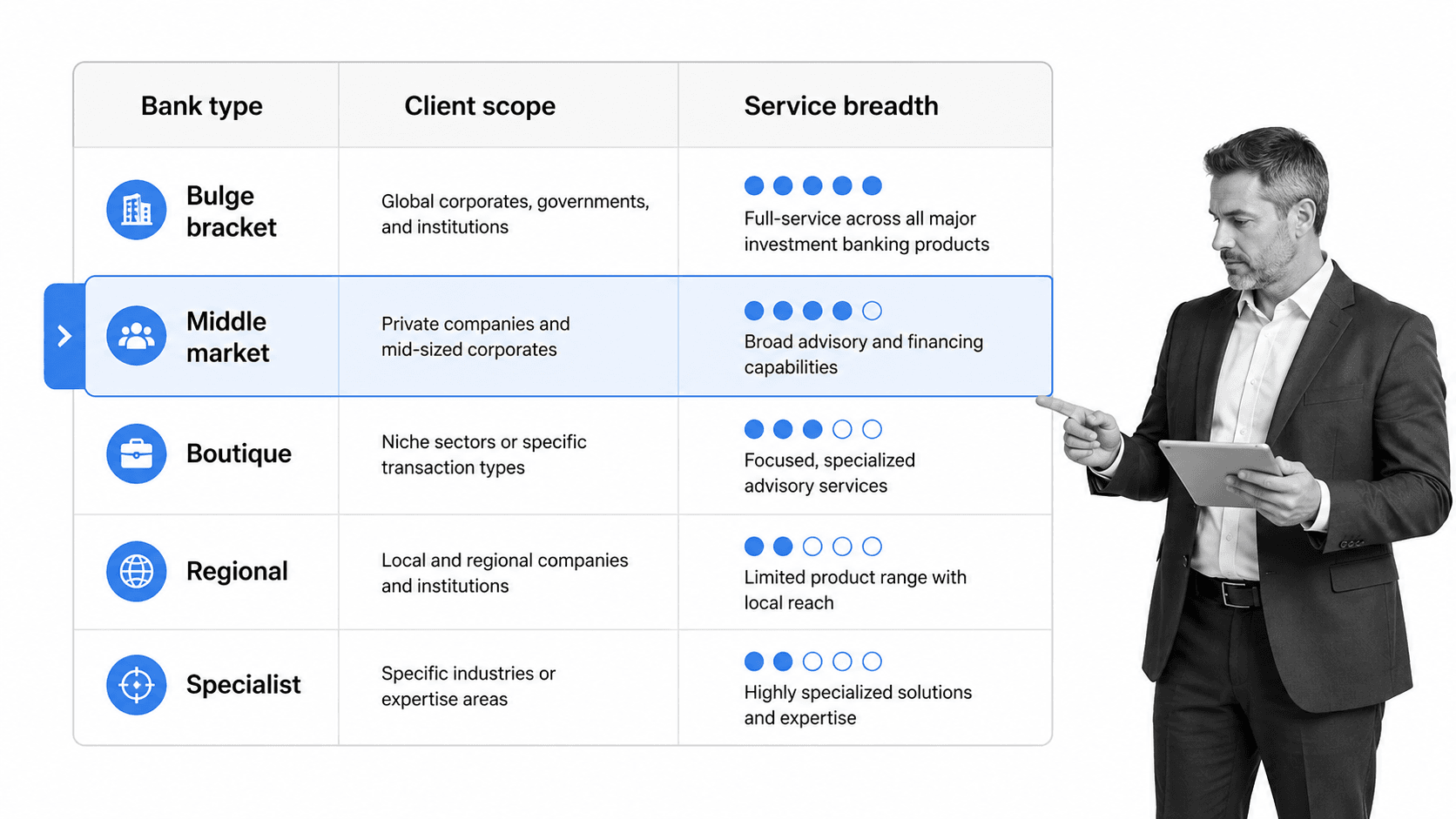
Investment banks are often grouped by client scope, geography, transaction size, and service breadth. The labels overlap, so they are best treated as practical market categories rather than fixed legal classifications.
Bulge bracket banks
Bulge bracket banks are global institutions with broad investment-banking, capital-markets, sales-and-trading, and financing capabilities. They commonly advise large corporations, governments, and institutional clients on complex cross-border transactions. Goldman Sachs, JPMorgan Chase, and Morgan Stanley are widely recognized examples.
Middle-market banks
Middle-market investment banks focus on transactions for mid-sized public and private companies. Their work can include M&A, debt and equity financing, and private placements under exemptions such as Rule 506(b). William Blair and Piper Sandler are established examples, although individual mandates can overlap with larger or more specialized firms.
Boutique investment banks
Boutique firms typically concentrate on advisory work, selected sectors, or specific transaction types. Some are small specialist practices, while elite boutiques such as Lazard, Evercore, and Moelis & Company advise on major M&A and restructuring mandates without offering every service of a diversified global bank.
Regional investment banks
Regional investment banks build coverage around a defined geography and the companies, sponsors, and institutions active there. Their local relationships can support M&A, capital raising, and strategic advice. Stifel and KeyBanc Capital Markets illustrate firms with strong regional coverage, even though their operations extend beyond a single local market.
Specialist investment banks
Specialist investment banks organize expertise around an industry, product, or situation such as healthcare, technology, energy, restructuring, or private capital. The category describes the focus of a team or firm, not necessarily its full business. Houlihan Lokey, for example, is particularly well known for financial restructuring while also operating broader advisory practices.
Types of investment banking processes
Most investment banking deal processes follow a recognizable lifecycle: originate or qualify an opportunity, define the mandate, analyze the business and market, prepare materials, conduct diligence, obtain internal and client approvals, execute the transaction, and complete closing and handoff. Sell-side, buy-side, financing, and restructuring mandates emphasize different stages, but the workflow still depends on controlled inputs, review points, and clear ownership.
Advisory services
Advisory services guide clients through material financial and strategic decisions. The three common process families are:
- Mergers and acquisitions advisory: Bankers identify or assess counterparties, build valuation analyses, coordinate diligence, support negotiations, and help structure the transaction. A sell-side process usually emphasizes positioning, buyer outreach, bids, and confirmatory diligence, while a buy-side process emphasizes target screening, valuation, diligence, and integration considerations.
- Restructuring advisory: Teams analyze liquidity and capital structure, evaluate alternatives, and support negotiations with creditors and other stakeholders. Work may include recapitalization, liability management, asset sales, or formal insolvency proceedings.
- Valuation services: Bankers use methods such as discounted cash flow, comparable-company analysis, and precedent transactions to develop documented valuation estimates or ranges. The RICS discounted cash flow standard is one current reference for consistent DCF assumptions and reporting.
Capital markets activities
Capital markets processes help clients raise funding through securities or syndicated facilities. The main families are:
- Equity capital markets: Teams prepare companies for initial public offerings, follow-on offerings, and private placements, then coordinate structuring, diligence, disclosure, approvals, marketing, pricing, and allocation. Private offerings must follow the applicable exemption and investor requirements.
- Debt capital markets: Banks assess funding needs and market conditions, structure debt instruments, coordinate documentation and ratings work where relevant, and manage marketing, pricing, and settlement.
- Syndication: A lead bank organizes a group of lenders or underwriters, allocates commitments, coordinates documentation, and manages the distribution of a loan or securities offering across participants.
Investment banking M&A advisory processes
Investment banking M&A advisory process templates standardize recurring stages such as opportunity qualification, valuation, due diligence, transaction structuring, internal review, and client approval.
A controlled workflow makes the sequence, evidence, owners, and approval points visible while leaving room for the judgment each transaction requires.
Here is an investment banking M&A advisory processes template pack:
- Investment Banking Healthcare M&A Advisory Process
- Investment Banking Technology M&A Advisory Process
- Investment Banking Financial Services M&A Advisory Process
- Investment Banking Consumer M&A Advisory Process
- Investment Banking Industrials M&A Advisory Process
- Investment Banking Energy M&A Advisory Process
- Investment Banking Media & Telecommunications M&A Advisory Process
- Investment Banking Real Estate M&A Advisory Process
- Investment Banking Life Sciences M&A Advisory Process
- Investment Banking Transportation & Logistics M&A Advisory Process
- Investment Banking Education M&A Advisory Process
- Investment Banking Hospitality M&A Advisory Process
- Investment Banking Agriculture M&A Advisory Process
- Investment Banking Environmental Services M&A Advisory Process
- Investment Banking Retail M&A Advisory Process
Investment banking capital raising processes
Investment banking capital raising process templates organize the steps involved in raising equity or debt for clients. They can govern the preparation and review of pitchbooks, financial models, diligence materials, disclosures, and investor presentations.
Standardization helps teams coordinate dependencies and approvals, maintain a reliable record of work, and communicate consistently as the financing moves toward launch, pricing, and closing.
Here is an investment banking capital raising processes template pack:
- Investment Banking Healthcare Capital Raising Process
- Investment Banking Technology Capital Raising Process
- Investment Banking Financial Services Capital Raising Process
- Investment Banking Consumer Capital Raising Process
- Investment Banking Industrials Capital Raising Process
- Investment Banking Energy Capital Raising Process
- Investment Banking Media & Telecommunications Capital Raising Process
- Investment Banking Real Estate Capital Raising Process
- Investment Banking Life Sciences Capital Raising Process
- Investment Banking Transportation & Logistics Capital Raising Process
- Investment Banking Education Capital Raising Process
- Investment Banking Hospitality Capital Raising Process
- Investment Banking Agriculture Capital Raising Process
- Investment Banking Environmental Services Capital Raising Process
- Investment Banking Retail Capital Raising Process
Investment banking research processes
Investment banking research processes involve analyzing market trends, financial statements, and industry data to produce views on companies, sectors, or economic conditions. The workflow includes sourcing and checking data, financial modeling, drafting, supervisory review, disclosures, publication, and controlled distribution. Research teams also need independence and conflict controls that separate research decisions from investment-banking influence, consistent with FINRA Rule 2241.
Here is an investment banking research processes template pack:
- Investment Banking Healthcare Research Process
- Investment Banking Technology Research Process
- Investment Banking Financial Services Research Process
- Investment Banking Consumer Research Process
- Investment Banking Industrials Research Process
- Investment Banking Energy Research Process
- Investment Banking Media & Telecommunications Research Process
- Investment Banking Real Estate Research Process
- Investment Banking Life Sciences Research Process
- Investment Banking Transportation & Logistics Research Process
- Investment Banking Education Research Process
- Investment Banking Hospitality Research Process
- Investment Banking Agriculture Research Process
- Investment Banking Environmental Services Research Process
- Investment Banking Retail Research Process
Investment banking strategic advisory processes
Investment banking strategic advisory processes involve guiding clients on critical business decisions like mergers, acquisitions, restructuring, and growth strategies. These processes include market analysis, financial modeling, and scenario planning.
By providing tailored, data-driven insights, strategic advisory services help clients navigate complex challenges, optimize their business strategies, and achieve long-term success.
Here is an investment banking strategic advisory processes template:
- Investment Banking Healthcare Strategic Advisory Process
- Investment Banking Technology Strategic Advisory Process
- Investment Banking Financial Services Strategic Advisory Process
- Investment Banking Consumer Strategic Advisory Process
- Investment Banking Industrials Strategic Advisory Process
- Investment Banking Energy Strategic Advisory Process
- Investment Banking Media & Telecommunications Strategic Advisory Process
- Investment Banking Real Estate Strategic Advisory Process
- Investment Banking Life Sciences Strategic Advisory Process
- Investment Banking Transportation & Logistics Strategic Advisory Process
- Investment Banking Education Strategic Advisory Process
- Investment Banking Hospitality Strategic Advisory Process
- Investment Banking Agriculture Strategic Advisory Process
- Investment Banking Environmental Services Strategic Advisory Process
- Investment Banking Retail Strategic Advisory Process
Investment banking valuation service processes
Investment banking valuation service processes involve assessing the financial worth of a company or asset. These processes include:
- Analyzing financial statements
- Applying valuation methods (like discounted cash flow or comparable company analysis)
- Considering market conditions
Documented valuation assumptions, methods, and ranges support review and informed decision-making in mergers, acquisitions, financings, and other strategic transactions.
Here is an investment banking valuation service processes template pack:
- Investment Banking Healthcare Valuation Service Process
- Investment Banking Technology Valuation Service Process
- Investment Banking Financial Services Valuation Service Process
- Investment Banking Consumer Valuation Service Process
- Investment Banking Industrials Valuation Service Process
- Investment Banking Energy Valuation Service Process
- Investment Banking Media & Telecommunications Valuation Service Process
- Investment Banking Real Estate Valuation Service Process
- Investment Banking Life Sciences Valuation Service Process
- Investment Banking Transportation & Logistics Valuation Service Process
- Investment Banking Education Valuation Service Process
- Investment Banking Hospitality Valuation Service Process
- Investment Banking Agriculture Valuation Service Process
- Investment Banking Retail Valuation Service Process
Other investment banking processes
These generalized investment banking process templates cover lending, treasury, trade finance, and securities issuance across industries:
- Investment Banking Corporate Loans Process
- Investment Banking Syndicated Lending Process
- Investment Banking Treasury Services Process
- Investment Banking Trade Finance Process
- Investment Banking Debt Issuance Process
- Investment Banking Equity Issuance Process
Give investment banking process templates a try
The best starting point is one recurring workflow with clear owners, review criteria, required evidence, and escalation paths. Adapt the relevant template to the firm’s mandate, policies, regulatory obligations, and risk appetite, then test it with the people who perform and supervise the work.
Process Street is a single Compliance Operations Platform with Docs and Ops capability areas plus built-in AI. Docs helps teams govern procedures and policies with ownership, approvals, and version history. Ops turns those procedures into assigned, trackable workflows with forms, deadlines, conditional logic, and audit-ready activity records.
Built-in AI can help authorized teams summarize context, route work, surface exceptions, and improve processes within the controls and human review the organization defines. That gives investment banking teams one place to document how work should be done, execute it consistently, and retain the evidence needed for oversight.