





Guest contribution by Maja Kowalska, head of content marketing at Benhauer, where she managed SALESmanago and APPmanago content.
Marketing problems killing campaign performance rarely start in the ad account. They start in the process around marketing campaigns: who owns the customer context, which KPI decides success, and how the handoff gets from marketing to sales.
Problem #1: Generic messaging instead of content personalization
The old spray and pray approach still shows up in modern campaigns. A team exports a list, relies on bulk campaigns, writes one message for everyone, adds a first name token at the beginning of the message, and calls it personalization. Customers notice the difference between useful context and a mail merge.

Personalization now means using behavioral signals responsibly: items watched on the website, education level, social media activity, lifecycle stage, product usage, source, and whether the lead has already talked to sales. Attentive reported in its 2026 personalization research that 64% of shoppers want marketing to be more personalized, which is a useful reminder that generic campaigns are not just lazy. They are easier to ignore.
A quick aside explains why process matters. Piero Manzoni was famous for Merda d’artista. He bought exactly 90 cans numbered them, and they were first valued according to their equivalent weight in gold. Surprise can work. But how many experiments will not? That does not mean every campaign needs a complex AI model. It means every campaign needs a customer context step before copy gets written. The brief should name the audience, approved data sources, behavioral profiles, lifecycle trigger, offer, exclusion rules, and review owner, so the team can track and analyze lead behavior before writing copy. Without that workflow, even a strong marketing automation platform becomes a bulk sender with better buttons.
Cure the process: Build a customer context workflow
Give personalization its own checklist. Start with segment selection, source data, message variant, approval, and launch review. Keep the idea of digital body language, but make it operational: a person clicking a pricing page, attending a webinar, abandoning a cart, or opening three emails should change what happens next.
A documented marketing process makes this repeatable. The goal is not to make marketers less creative. Every piece of content that omits customer context is thrown away and cursed with the spam label. A good personalization process prevents that.
Problem #2: Weak marketing KPIs and campaign measurement
Marketers still get trapped by vanity metrics. Likes, impressions, opens, and clicks can be useful signals, but they are not a KPI system by themselves. A campaign metric only matters if it changes a decision.
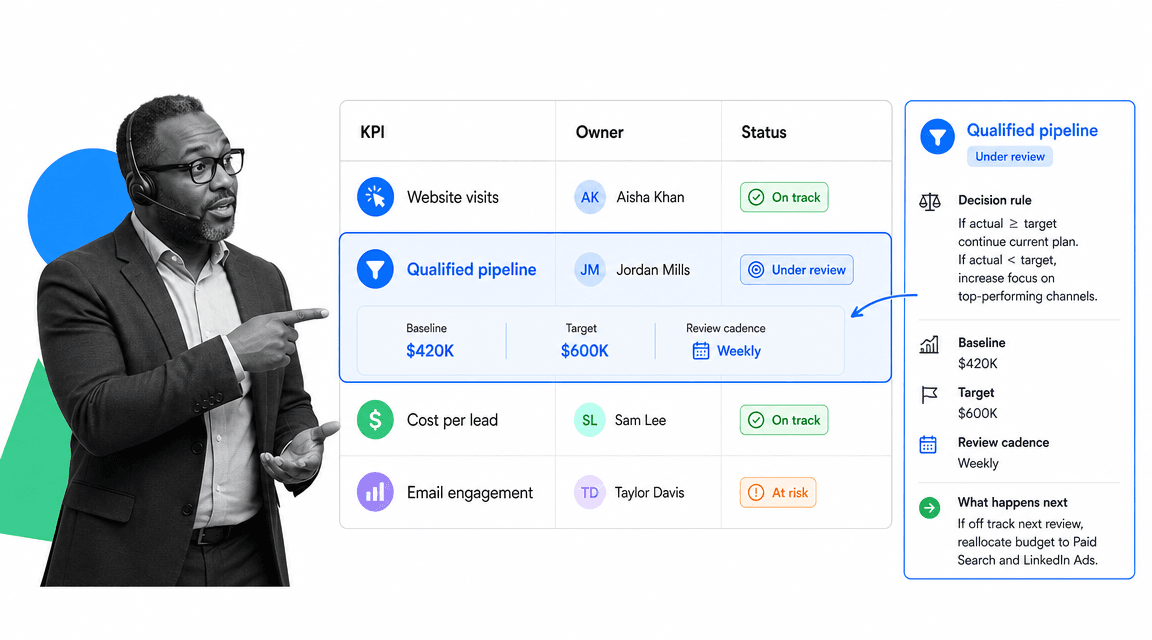
The channel mix has changed, but the measurement failure is the same: many teams ship campaigns without agreeing on the baseline, target, owner, and action rule. A dashboard exists, common answers are neutral or I do not know, and nobody knows which number decides whether the campaign gets more budget, a new audience, a different offer, or a full stop. That is how KPI responsibility disappears and a bunch of buzzwords takes the place of measurable results.
That measurement gap has not disappeared. MarTech summarized IAB and BWG Global research by reporting that 75% of marketers say current measurement systems fall short on speed, accuracy, or trust. The cure is not another spreadsheet. It is a process that defines what success means before the campaign launches.
Cure the process: Assign every KPI a decision
For each campaign, define the KPI, baseline, target, reporting cadence, owner, and next action. Marketers have to be taught that KPIs are not evil taskmasters. They inform the way marketers do their jobs. If the metric is below target, what changes? If it is above target, what scales? If the data is unclear, who investigates?
Use Google Analytics, webinar platform analytic panels, CRM data, marketing automation platforms, social media analytics, and the reporting built into your email or ad tools, but connect them to a recurring review workflow. A good workflow automation software setup turns KPI review into a habit instead of a meeting where everyone argues about the numbers. If you are testing subject lines, offers, or audiences, run the work through an A/B testing workflow template so the test has an owner, hypothesis, metric, and decision point.
Use a growth hacking process like this to run tests and improve your KPIs:
Problem #3: Siloed marketing, sales, and customer data
The lead generation process does not end when someone fills out a form. Freshly acquired leads still need context, nurture, education, qualification, handoff, follow up, and feedback before they are passed to the sales department. If both marketing and sales work in separate systems without a common language, the lead arrives stripped of the story that made them worth talking to. Both departments need common ground before premature sales or weak nurture damage the relationship.
The ROPO effect and multi-screening make this worse. A customer can research online, purchase offline, watch a webinar, read an email, click a retargeting ad, and talk to sales weeks later. Without one relation history record, the company sees fragments instead of a 360 degree customer behavioral profile.

A shared CRM platform helps, especially when teams use tags, funnels, lifecycle stages, and relation history properly. But a CRM stores the record. It does not automatically enforce the handoff process.
Sales needs to know the campaign source, content consumed, objection signals, lead status, education level, owner, SLA, proper actions, and next step. Marketing needs to know which leads converted, which were not ready, which campaigns created noise, which activities helped, and where the nurture path broke. Without that feedback loop, both teams invent their own version of the truth.
Cure the process: Run the handoff in one shared workflow
Create a shared workflow for campaign handoffs. Capture campaign source, lead score, nurture status, sales owner, SLA, first follow up, and feedback. The workflow should make the handoff visible to marketing teams, sales, and customer success, not just the person who exported the list.
Process Street is built for that execution layer. Docs keeps campaign SOPs, audience rules, and approval criteria current. Ops turns those rules into repeatable workflows with forms, assignments, approvals, and automations. Cora can help flag missing context, skipped review steps, or process drift before a campaign ships.
The discreet charm of common software is still real. When teams work from the same execution record, they get a shared language, a corporate Esperanto that makes the proper next action obvious. Just a process everyone can see, run, and improve.
Most marketing problems are not caused by a lack of ideas. They come from manual marketing processes that let context, ownership, measurement, and handoffs fall through the cracks. Fix the workflow, and the campaign has a chance to work.