Turn every policy into automated workflows with built-in enforcement and audit-ready proof.



Operational Risk Management Framework
An operational risk management framework is the system an organization uses to identify, assess, control, monitor, and report risks created by people, processes, systems, third parties, and external events. The framework sets the rules. Daily workflows make those rules real.
The practical goal is not to produce a larger risk register. It is to make operational failure less likely, detect weak controls earlier, limit disruption when an event occurs, and retain evidence that the required response happened. That requires governance, risk appetite, risk and control self-assessment, key risk indicators, incident data, scenario analysis, business continuity, and clear ownership to work as one operating cycle.
This guide explains the complete framework, shows how to build it, and connects operational risk to the workflows where controls are performed.
In this guide
- What is an operational risk management framework?
- What risks does the framework cover?
- Which components belong in the framework?
- How does the operational risk management framework work?
- How do you build an operational risk management framework?
- How does the framework support operational resilience?
- What does the framework look like in practice?
- Which metrics show whether the framework works?
- What causes operational risk frameworks to fail?
- How can Process Street support operational risk management?
- FAQs
What is an operational risk management framework?
An operational risk management framework, often shortened to ORMF, is a coordinated set of governance rules, methods, roles, controls, data, and review routines for managing operational risk. It turns a broad risk policy into repeatable decisions about what can go wrong, how much exposure the organization will accept, which controls reduce that exposure, who owns each action, and when an issue must be escalated.
The Basel Committee treats governance, the risk management environment, information and communication technology, business continuity, and disclosure as integrated parts of an operational risk management framework. Its guidance also places the three lines model inside the framework: business management owns risk, an independent risk function provides oversight and challenge, and internal audit provides independent assurance. The complete guidance is available in the Basel operational risk principles.
The framework should be proportional to the organization. A regional financial institution may need formal committees, risk appetite thresholds, scenario exercises, and loss-event analysis. A growing software company may begin with a smaller set of critical processes, named owners, control tests, incident reviews, and escalation rules. The mechanics can scale, but the essential questions remain the same: What matters? What can fail? What prevents failure? What proves the control worked? What happens when it does not?
What risks does the framework cover?
Operational risk is broader than process error. A useful taxonomy covers the sources of failure and the business consequences. Common categories include:
- People risk: insufficient training, unclear authority, misconduct, fraud, capacity gaps, or concentration of knowledge.
- Process risk: missing steps, weak handoffs, poor segregation of duties, inconsistent approvals, or controls that exist only on paper.
- Technology and data risk: outages, access failures, bad data, system changes, cybersecurity events, or unreliable automation.
- Third-party risk: vendor failure, outsourcing gaps, concentration, weak due diligence, or contract obligations that are not monitored.
- External-event risk: natural hazards, infrastructure disruption, geopolitical events, public-health events, or changes in the operating environment.
- Legal and compliance consequences: breaches, complaints, litigation, audit findings, or failure to meet regulatory and contractual duties.
Cybersecurity and technology risks deserve explicit treatment, but they should connect to the broader operating model. The NIST Cybersecurity Framework gives teams a structure for governing, identifying, protecting, detecting, responding to, and recovering from cyber risk. An ORMF connects those outcomes to business processes, owners, tolerances, continuity plans, and evidence.
Which components belong in an operational risk management framework?
Governance, appetite, and accountability
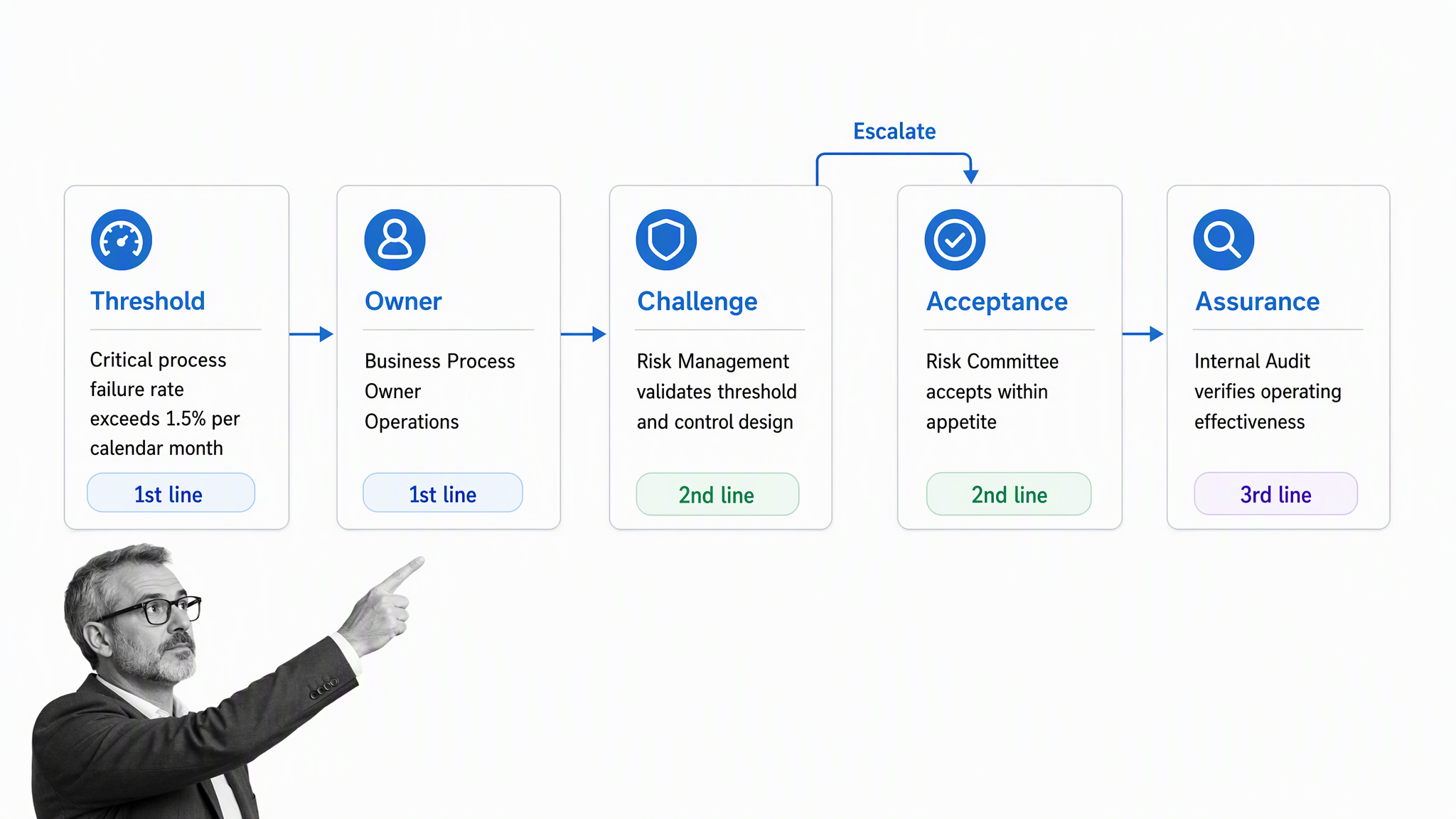
Governance defines who sets risk appetite, who accepts residual risk, who can approve exceptions, and how management and the board receive information. The framework should name owners at three levels: the business owner accountable for the risk, the control owner accountable for performance, and the independent function accountable for oversight and challenge.
Risk appetite becomes useful only when it produces thresholds and decisions. Translate broad statements into tolerances for critical operations, overdue controls, unresolved incidents, repeated exceptions, vendor exposure, downtime, data loss, and remediation age. Every threshold needs an escalation path and an authorized decision maker.
Risk taxonomy and process inventory
A risk taxonomy creates a shared language. A process inventory shows where the risk lives. Use both. Start with critical products, services, and customer outcomes, then map the processes, systems, people, data, facilities, and third parties that support them. This approach prevents the risk register from becoming a list of abstract categories with no operational owner.
Risk and control assessment
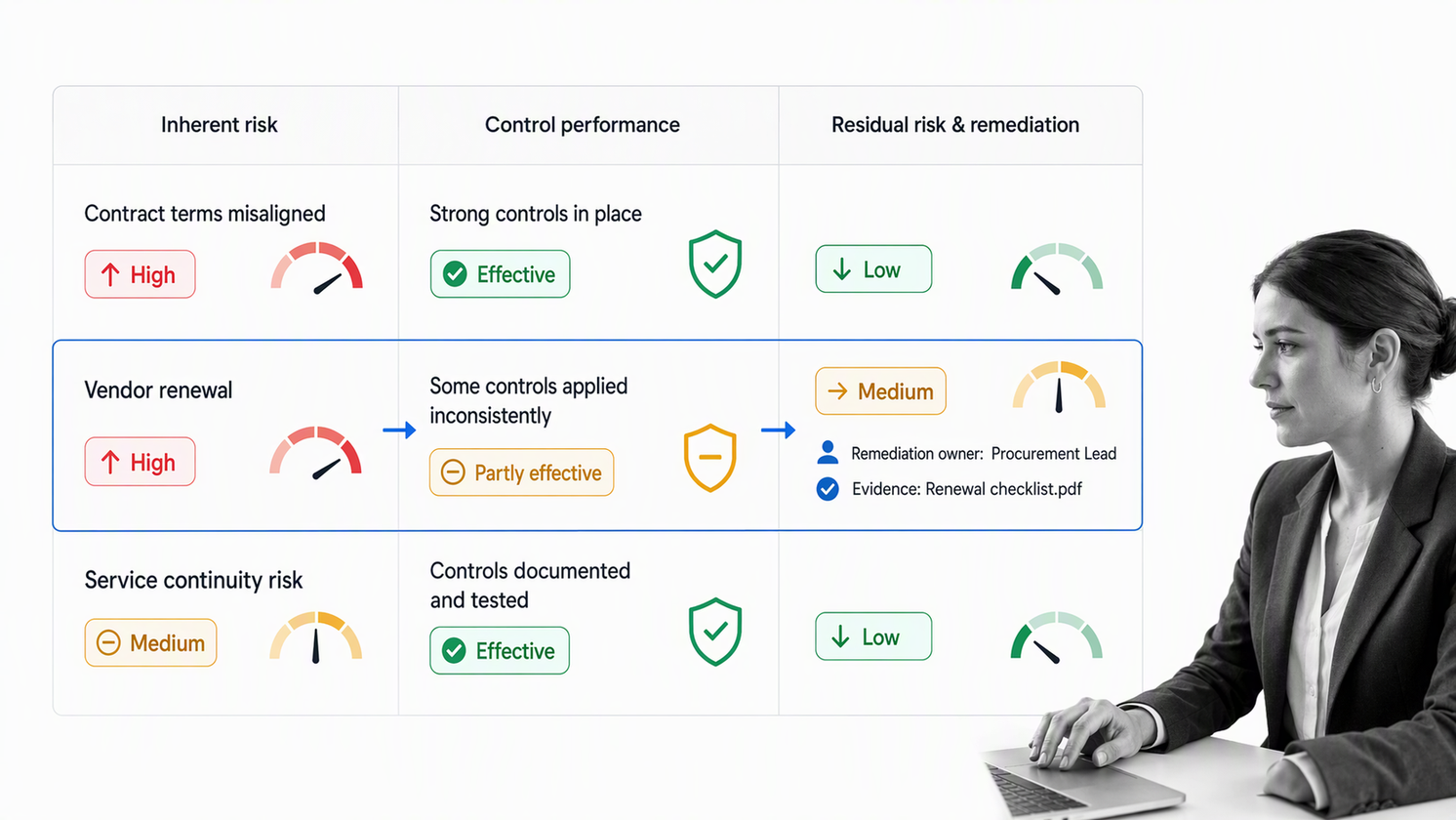
A risk and control self-assessment, or RCSA, evaluates inherent risk, control design, control performance, and residual risk. Each risk statement should describe a cause, an event, and an impact. Each control should state the action, owner, frequency, evidence, and failure response. The assessment should create work, not just a score. High residual risk should lead to remediation, control redesign, acceptance, transfer, or avoidance.
Controls, testing, and evidence
Control design asks whether a control could reduce the risk. Control testing asks whether it actually operated as intended. The evidence standard should be defined before the control runs. Useful evidence includes completed tasks, approvals, submitted fields, timestamps, attached files, system records, exception decisions, and remediation history.
KRIs, incidents, and loss data
Key risk indicators show whether exposure is moving toward an unacceptable level. Incident and loss data show where controls failed or where the organization was fortunate. Use both leading and lagging indicators. Overdue access reviews may be a leading signal. A confirmed access incident is a lagging event. Near misses also matter because they expose weakness without waiting for a loss.
Scenario analysis and operational resilience
Historical data cannot describe every severe event. Scenario analysis tests plausible disruptions, dependency failures, and control breakdowns. Business continuity plans, recovery procedures, communication rules, and tolerance testing should connect directly to the ORMF. The OSFI operational risk and resilience guideline provides a clear example of this integrated approach.
How does the operational risk management framework work?
The framework works as a continuous loop. It should connect risk decisions to operational execution and feed results back into the model.
- Establish context. Define critical outcomes, obligations, dependencies, appetite, and tolerances.
- Identify risk. Map failure modes across processes, people, systems, data, facilities, and third parties.
- Assess risk and controls. Evaluate inherent exposure, control design, actual performance, and residual exposure.
- Treat risk. Strengthen controls, redesign the process, transfer exposure, avoid the activity, or accept the residual risk through the defined authority.
- Monitor and respond. Track KRIs, control results, incidents, losses, exceptions, and remediation.
- Learn and improve. Update the taxonomy, risk assumptions, procedures, controls, thresholds, and continuity plans as the business changes.
This cycle aligns with the principles, framework, and process described by ISO 31000 risk management guidance. The value comes from integration. If assessment, control execution, monitoring, and improvement happen in separate systems with separate owners, the cycle breaks at the handoffs.
How do you build an operational risk management framework?
Start with the operations that carry the greatest customer, regulatory, financial, safety, or continuity consequence. A focused framework that runs is better than an enterprise design that nobody can execute.
1. Define scope and decision rights
Select the business services and critical processes in scope. Define the risk committee, business owners, independent oversight, assurance role, exception authority, and reporting cadence. Document which decisions belong at team, functional, executive, and board level.
2. Set appetite and measurable tolerances
Convert risk appetite into thresholds teams can monitor. Examples include maximum disruption duration, acceptable data loss, overdue high-risk actions, untested controls, unresolved critical incidents, and vendor reviews completed after renewal. Define the trigger, owner, response time, and acceptance authority for every breach.
3. Map processes and write useful risk statements
Map the real workflow, including intake, decisions, handoffs, systems, third parties, exceptions, and evidence. Write each risk as cause, event, and impact. For example: if a material vendor renews before security and financial review is completed, the business may remain dependent on a supplier whose risk exceeds approved tolerance.
A structured risk management process helps keep identification, assessment, response, and monitoring connected.
4. Run the RCSA and challenge the result
Assess inherent risk, identify key controls, evaluate their design, test their performance, and score residual risk. The first line supplies operating evidence. The risk function challenges assumptions and consistency. Assurance tests whether the process and controls can be relied on.
5. Turn controls into executable workflows
Convert recurring controls into assigned work with required inputs, due dates, approvals, conditional routes, evidence requirements, and escalation. The control definition and the execution record should stay connected. This is where workflow automation compliance becomes operational: the compliant path is built into the work instead of checked after completion.
6. Build monitoring, incidents, and remediation into one rhythm
Set thresholds for KRIs and control indicators. Define incident severity, reporting, root-cause analysis, action tracking, and closure evidence. Review repeated exceptions and near misses, not just confirmed losses. Every issue should end with an owner, due date, decision, and proof of closure.
How does the framework support operational resilience?
Operational risk management reduces the likelihood and impact of failure. Operational resilience focuses on keeping critical operations within acceptable tolerance through disruption. The two disciplines should share the same inventory, dependencies, owners, incidents, scenarios, and improvement actions.
Map critical operations and tolerances
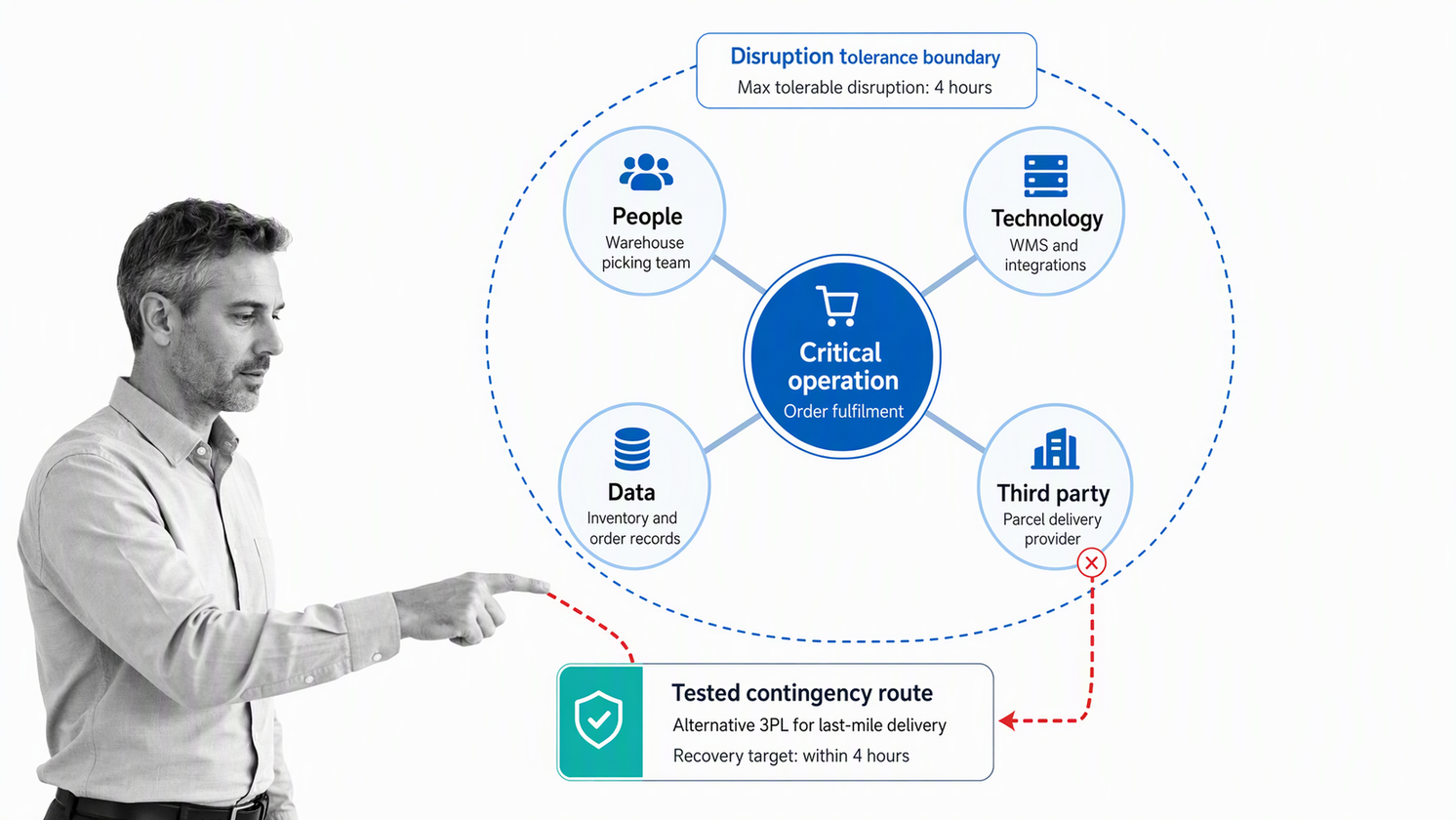
Identify the operations that must continue to protect customers, meet obligations, and preserve the organization. Map the people, technology, data, facilities, and third parties required for each operation. Set tolerances for disruption, data loss, minimum service level, and recovery time. Those tolerances should influence risk appetite, control design, continuity plans, and investment priorities.
Test severe but plausible scenarios
Use scenarios that break more than one dependency. Test a technology outage combined with staff unavailability, a critical vendor failure during peak demand, or a cyber event that affects both production and communication channels. Record decisions, workarounds, bottlenecks, evidence gaps, and remediation. A continuity plan that has not been exercised is still a hypothesis.
What does the framework look like in practice?
Consider a financial services team preparing for a material vendor renewal. The operational risk is that the contract renews without current security, privacy, financial, continuity, and business-owner review. The failure could expose customers, interrupt a critical service, create regulatory issues, or lock the company into an unacceptable dependency.
Vendor renewal control workflow
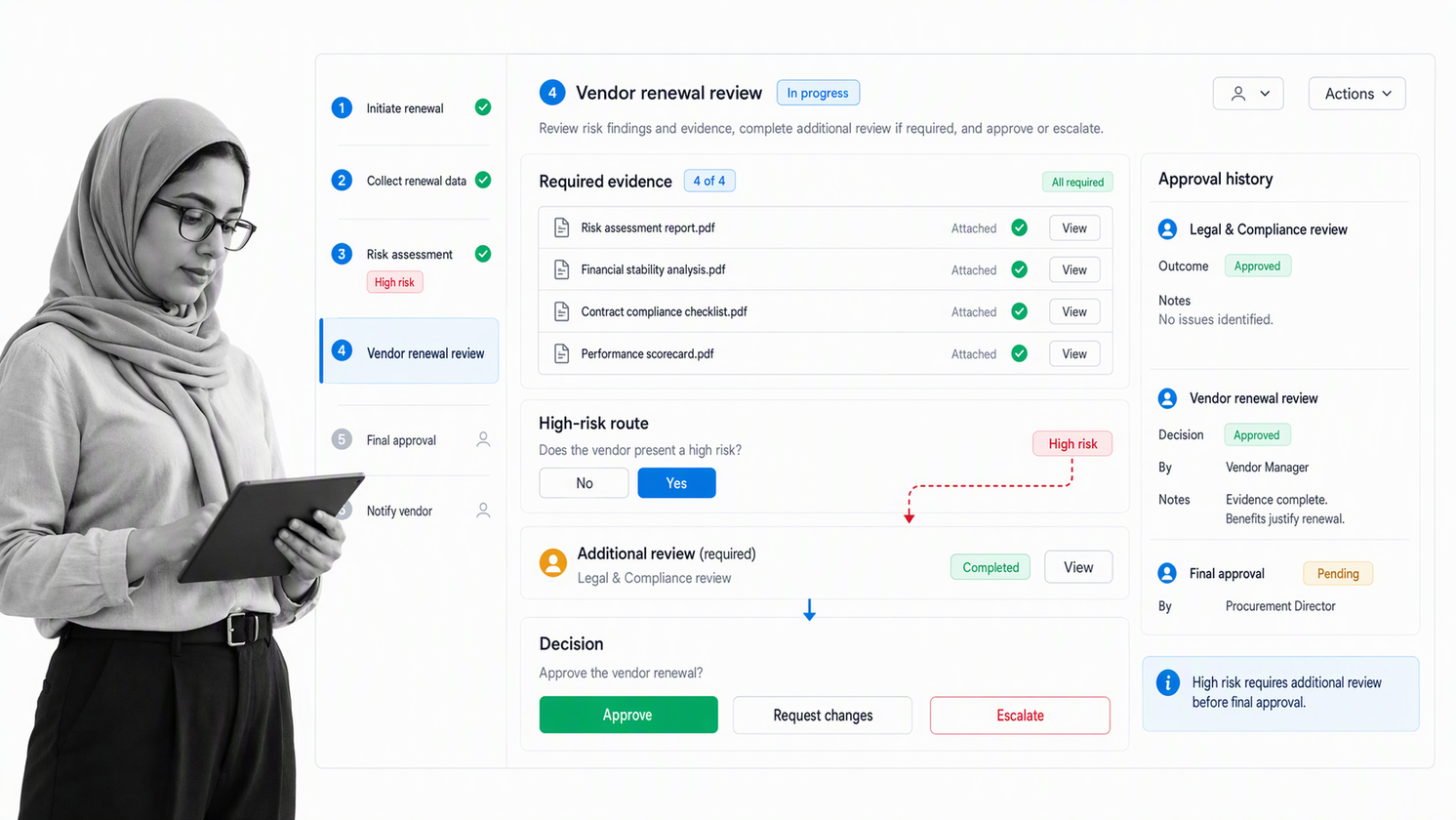
- Risk owner: the executive accountable for the dependent service.
- Control owner: vendor management or procurement.
- Trigger: the renewal window opens for a material vendor.
- Preventive controls: current due diligence, risk-tier confirmation, required reviews, contract checks, and authorized approval before renewal.
- Evidence: completed assessments, reviewer decisions, attachments, exception rationale, timestamps, and approval history.
- KRI: material renewals approaching the decision date without complete review.
- Escalation: unresolved high-risk findings route to risk, compliance, and the business owner before the renewal decision.
- Resilience link: critical vendors map to the operations they support, their alternatives, and tested contingency plans.
A third-party risk management workflow can connect intake, due diligence, review, approval, monitoring, renewal, and offboarding. The same framework pattern applies to access reviews, incident response, complaints, financial close, policy attestations, change management, and business continuity exercises.
Which metrics show whether the framework works?
A healthy framework measures exposure, execution, and learning. Avoid dashboards that report activity without showing whether risk is changing.
- Residual risk above appetite, by critical operation and accountable owner.
- Key controls completed on time with complete evidence.
- Failed tests, repeated exceptions, and reopened remediation actions.
- KRI breaches, time to escalation, and time to return within tolerance.
- Incidents, near misses, losses, root causes, and recurrence.
- Critical operations with current dependency maps and tested continuity plans.
- Material changes assessed before release, acquisition, migration, or vendor transition.
Pair executive indicators with process-level signals. Leaders need to know whether exposure is within appetite. Operators need to know which review is overdue, which control failed, what evidence is missing, and who must act next.
What causes operational risk frameworks to fail?
- The framework is owned only by the risk team, while business owners treat it as reporting work.
- Risk appetite uses vague language that cannot trigger a decision.
- RCSAs become annual surveys with copied scores and no operating evidence.
- Controls describe intent but omit the owner, action, frequency, evidence, and escalation.
- KRIs are selected because data is available, not because the signal supports action.
- Incident, audit, continuity, third-party, and change-management data remain disconnected.
- Remediation closes when a document changes, without proving the new control works.
- The organization automates a weak process and makes failure faster.
The remedy is to keep the framework close to execution. Assess the real process, put controls in the route of work, capture proof during the task, review exceptions, and use evidence to improve the design.
How can Process Street support operational risk management?
Process Street is an agentic process automation platform for high-stakes operations. It turns procedures and controls into executable workflows with owners, structured inputs, due dates, conditional routes, approvals, connected actions, and execution history.
For operational risk teams, the useful shift is from policy reminder to control enforcement. A vendor review can require evidence before approval. A high-risk answer can reveal additional checks. An exception can route to an authorized owner. The workflow run retains assignments, decisions, comments, files, and completion history, so proof is created while work happens.
The Process Street process app guide shows how process definition and live execution records work together. Teams can start with one proof-heavy process, such as vendor renewal, access review, incident response, or policy exception, then expand the same control pattern across related operations.
Execution is the test. Define the risk, place the control in the workflow, monitor the signal, respond to exceptions, and keep the evidence.
FAQs
What is an operational risk management framework?
An operational risk management framework is a coordinated system of governance, roles, methods, controls, data, and review routines for managing risks created by people, processes, systems, third parties, and external events.
What are the main components of an operational risk management framework?
The main components are governance, risk appetite, accountability, a risk taxonomy, process inventory, RCSA, controls, testing, evidence, KRIs, incident and loss data, scenario analysis, operational resilience, reporting, and remediation.
How is operational risk different from enterprise risk management?
Enterprise risk management coordinates the organization’s full risk portfolio and strategy. Operational risk management focuses on failures in daily execution, including people, process, technology, data, third-party, and external-event risk.
How do you build an operational risk management framework?
Define scope and decision rights, set measurable tolerances, map critical processes, write useful risk statements, run an RCSA, turn controls into workflows, and connect KRIs, incidents, remediation, and resilience testing.
What is the difference between a KRI and a KPI?
A key risk indicator signals changing exposure or weakening controls. A key performance indicator measures operating performance. One metric can sometimes inform both, but the decision and threshold should be explicit.
How does operational risk management support resilience?
Operational risk management identifies failure modes and controls. Resilience maps critical operations, dependencies, disruption tolerances, continuity plans, and recovery actions. Connecting them helps the organization prevent failure and continue through disruption.
How can Process Street help with operational risk management?
Process Street turns recurring controls into executable workflows with owners, required inputs, due dates, conditional routes, approvals, evidence, and history. That keeps risk decisions connected to the work and creates proof during execution.