Turn every policy into automated workflows with built-in enforcement and audit-ready proof.



Operations Service

An operations service is a repeatable way to receive, triage, execute, and prove recurring business work. It turns scattered requests into a defined service model with clear intake, owners, service levels, workflows, automation, and evidence.
The term can sound broad because operations work is broad. An operations service might support vendor reviews, access requests, employee onboarding, finance approvals, customer handoffs, document updates, quality checks, or internal service requests. The shared pattern is simple: people know where to ask, what happens next, who owns the work, and how completion is proven.
This guide explains what an operations service is, how it differs from outsourcing, how to design a service catalog, which metrics matter, and how Process Street helps teams run recurring services with control.
In this article, we are going to cover everything you need to know about operations service design and execution, including:
- What an operations service is
- Operations service vs. outsourcing
- How to design an operations service catalog
- How to run an operations service
- How Process Street helps you run an operations service
- Operations service metrics
- Common operations service mistakes
- FAQs
What an operations service is
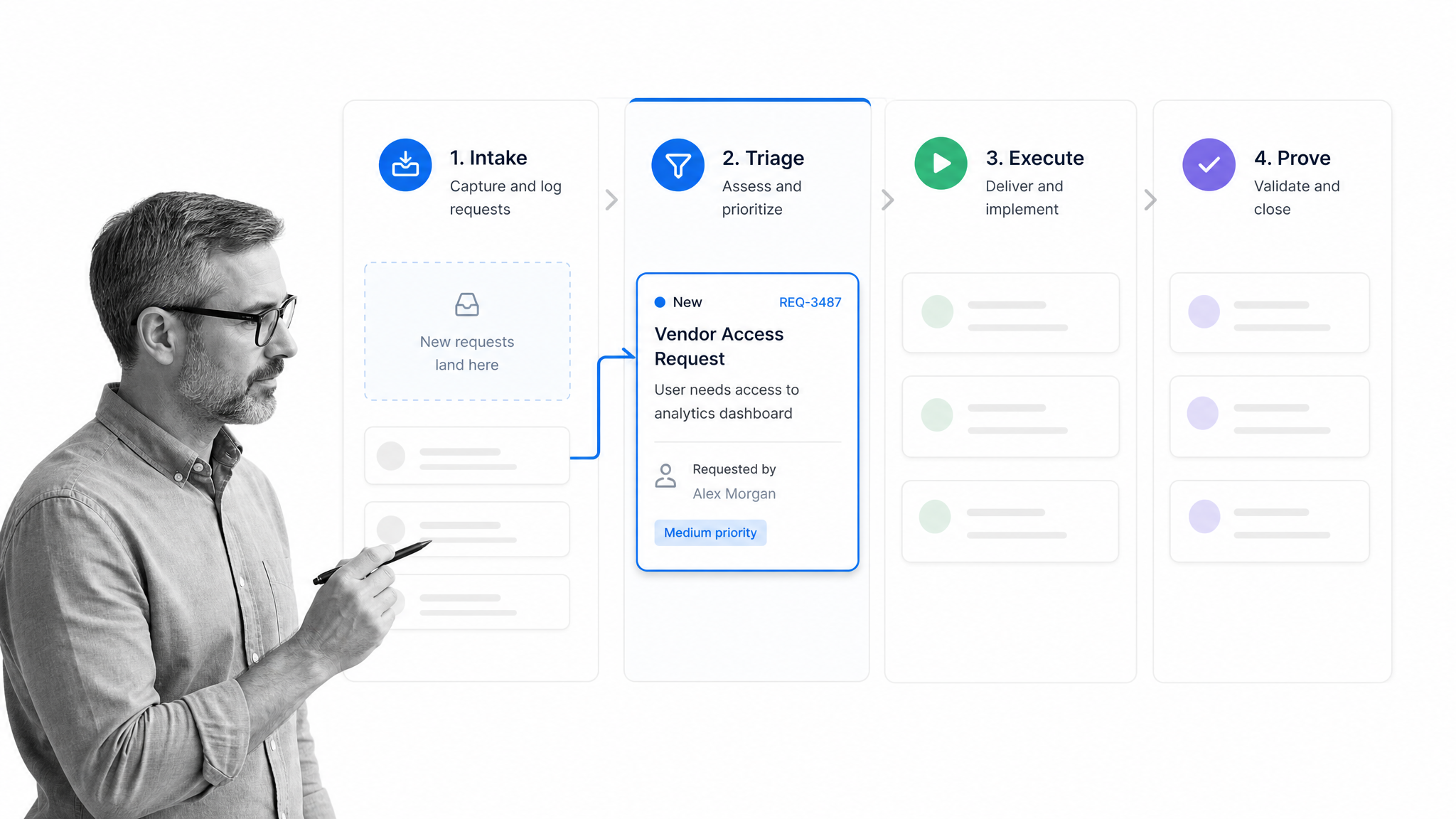
An operations service is the operating layer that helps a team deliver a recurring internal or customer-facing service consistently. It defines what the service covers, how requests enter, how requests are prioritized, what workflow runs, what service level applies, and what record proves completion.
Think of it as the practical system behind day-to-day service delivery. The service may not be sold as a standalone product. It may be an internal capability such as procurement support, document control, onboarding operations, compliance evidence collection, or customer implementation support.
The service has a clear request path
A usable operations service starts with intake. People need one front door for a specific request type, not five channels across chat, email, spreadsheets, and side conversations. The intake path should capture enough context for triage without forcing the requester to understand the full process.
That usually means a form, workflow run, template, or portal that captures the request type, urgency, owner, required attachments, risk level, and expected outcome. A clear business process management model helps the service owner decide where intake ends and controlled execution begins.
The service has a repeatable workflow
Once a request enters the service, the team should not reinvent the response path. A workflow defines the tasks, owners, approvals, conditional branches, due dates, required fields, automations, and evidence expectations. This is where an operations service moves from helpful team behavior to a real operating system.
A workflow management system gives recurring services a place to run. The goal is not just visibility. The workflow should make the right path easier to follow than the informal workaround.
The service creates proof
Proof is what separates a managed service from a loose support channel. For low-risk work, proof might be a completion record and a note. For compliance, finance, security, HR, or customer operations, proof may include files, approvals, form values, comments, audit history, and exception decisions.
That proof matters because operations teams are often asked to reconstruct what happened after the fact. A strong operations service keeps evidence attached to the work while it is happening.
Operations service vs. outsourcing
An operations service is not the same thing as outsourcing. Outsourcing means contracting an external provider to run a business function or process. IBM defines business process outsourcing as hiring external service providers to handle noncore business functions or processes.
An operations service can be internal, external, or hybrid. The important part is the service model: request intake, scope, workflow, ownership, service levels, controls, reporting, and proof. A company can build an internal operations service for employee onboarding, vendor management, customer onboarding, or audit evidence without outsourcing the work.
When the service itself becomes a repeatable business capability, it often starts to look like a business process management service: defined scope, a standard workflow, clear owners, measurable service levels, and a system of record.
Use outsourcing when capacity or specialization is the constraint
Outsourcing can make sense when a provider has scale, specialist expertise, location coverage, or cost structure the internal team cannot match. It can also help when the business wants to convert fixed operating work into variable service capacity.
But outsourcing does not remove the need for operating control. The buyer still needs scope, service levels, escalation paths, evidence, quality checks, and a way to manage exceptions. A strong business process outsourcing model keeps those controls explicit instead of moving the process problem outside the building.
Build an internal operations service when control is the constraint
Internal services are usually better when the work carries sensitive context, compliance risk, customer impact, or frequent judgment calls. The team keeps ownership while still applying service discipline: clear intake, defined workflows, measurable service levels, and documented completion.
That internal model is common in operations, compliance, finance, HR, IT, legal, procurement, customer success, and quality teams. Each group delivers recurring services to the rest of the business, even when nobody uses the word service.
Borrow from service management without limiting the model to IT
IT service management is a useful reference because it connects requests, incidents, changes, assets, and knowledge across a service lifecycle. ITIL is another widely used service management framework, and PeopleCert describes ITIL as a best-practice framework for digital product and service management.
The same service logic works outside IT. A compliance evidence request, vendor onboarding request, policy update, customer implementation handoff, or finance approval can also be designed as an operations service.
How to design an operations service catalog
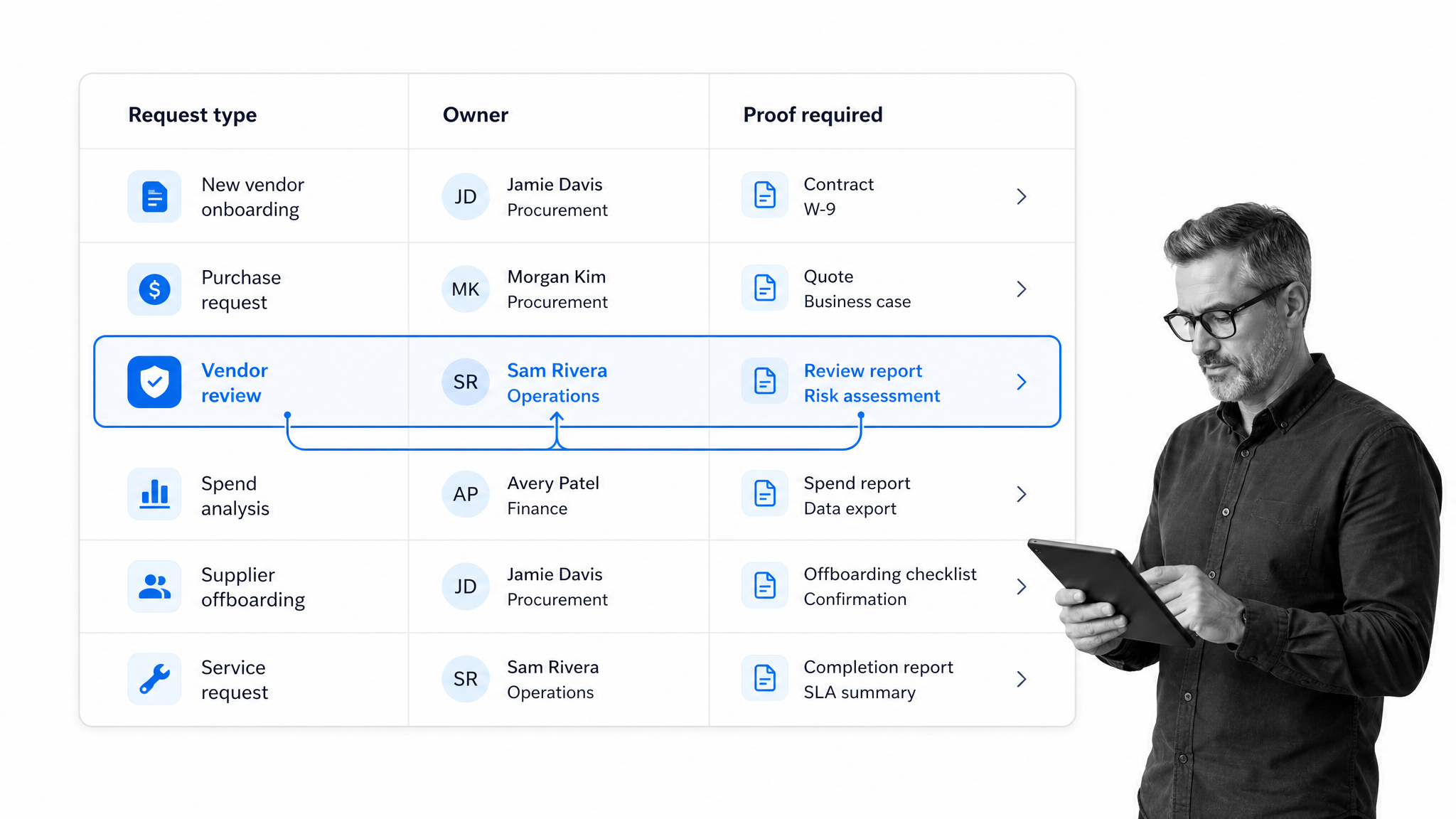
An operations service catalog defines what the service offers and how each request type is handled. It prevents the service from becoming a catch-all inbox where everything is urgent, unclear, and manually routed.
Name each service clearly
A good catalog uses requester language. Vendor review, new hire equipment request, policy approval, customer launch checklist, access removal, and audit evidence request are clearer than broad labels such as operations help or admin support.
Each named service should include a short description, who can request it, what information is required, what workflow runs, who owns the work, and what result the requester should expect.
Define intake requirements
Intake requirements should be strict enough to prevent rework but simple enough that people use the service. Required fields usually include request type, business owner, due date or urgency, affected system or process, required files, risk level, and expected outcome.
Process Street forms can capture structured request data at the start of a workflow. The forms help documentation explains how form fields collect information inside workflow runs.
Set service levels and escalation rules
Service levels tell requesters what to expect and help the operations team prioritize. They do not need to be complex at first. Start with simple targets: acknowledge within one business day, triage high-risk requests first, complete standard requests within the defined window, escalate blocked approvals after a threshold.
The service level should connect to workflow behavior. If a request is high risk, route it differently. If an approval is late, escalate it. If evidence is missing, block completion until the right file is attached.
Define proof requirements
Every service should define what done means. For some services, a completed task and comment are enough. For others, done requires an approval, signed document, completed checklist, uploaded evidence, review note, or system update.
This is where service design meets compliance. If proof is required later, capture it during the workflow. After-the-fact evidence collection is slower and less reliable.
How to run an operations service
Run an operations service by treating it as a living operating system. The service should have an owner, a workflow, a review rhythm, a measurement set, and a process for improving the catalog over time.
Assign a service owner
The service owner is accountable for scope, workflow quality, service levels, reports, escalations, and improvements. This does not mean the owner does every task. It means someone owns the system.
Without an owner, the service becomes a shared inbox. Shared inboxes can hide work, blur accountability, and make it hard to know whether delays are caused by volume, unclear requests, missing approvals, or workflow design.
Build the workflow around decisions
A workflow should not just list tasks. It should guide decisions. Which requests are standard? Which are high risk? Which need approval? Which require evidence? Which should be rejected or sent back for more information?
Conditional paths are especially useful when one service handles several request types. Process Street conditional logic can show or hide steps based on form answers so each request follows the right path.
Use approvals where risk changes hands
Approvals should sit at the points where risk, spend, access, compliance, quality, or customer impact changes hands. They should not be a blanket habit. Too many approvals slow the service; too few make the service hard to trust.
Process Street approvals let teams route work to reviewers inside the workflow, so the decision and its context stay attached to the request.
Review the service regularly
The service owner should review demand, delays, exceptions, requester feedback, proof gaps, and recurring blockers. IBM describes operations management as the design, orchestration, and ongoing optimization of business operations. The key phrase is ongoing optimization.
A service that never changes will drift. Request types change, systems change, owners change, and risk changes. Regular review keeps the catalog current and stops exceptions from becoming the real process.
How Process Street helps you run an operations service
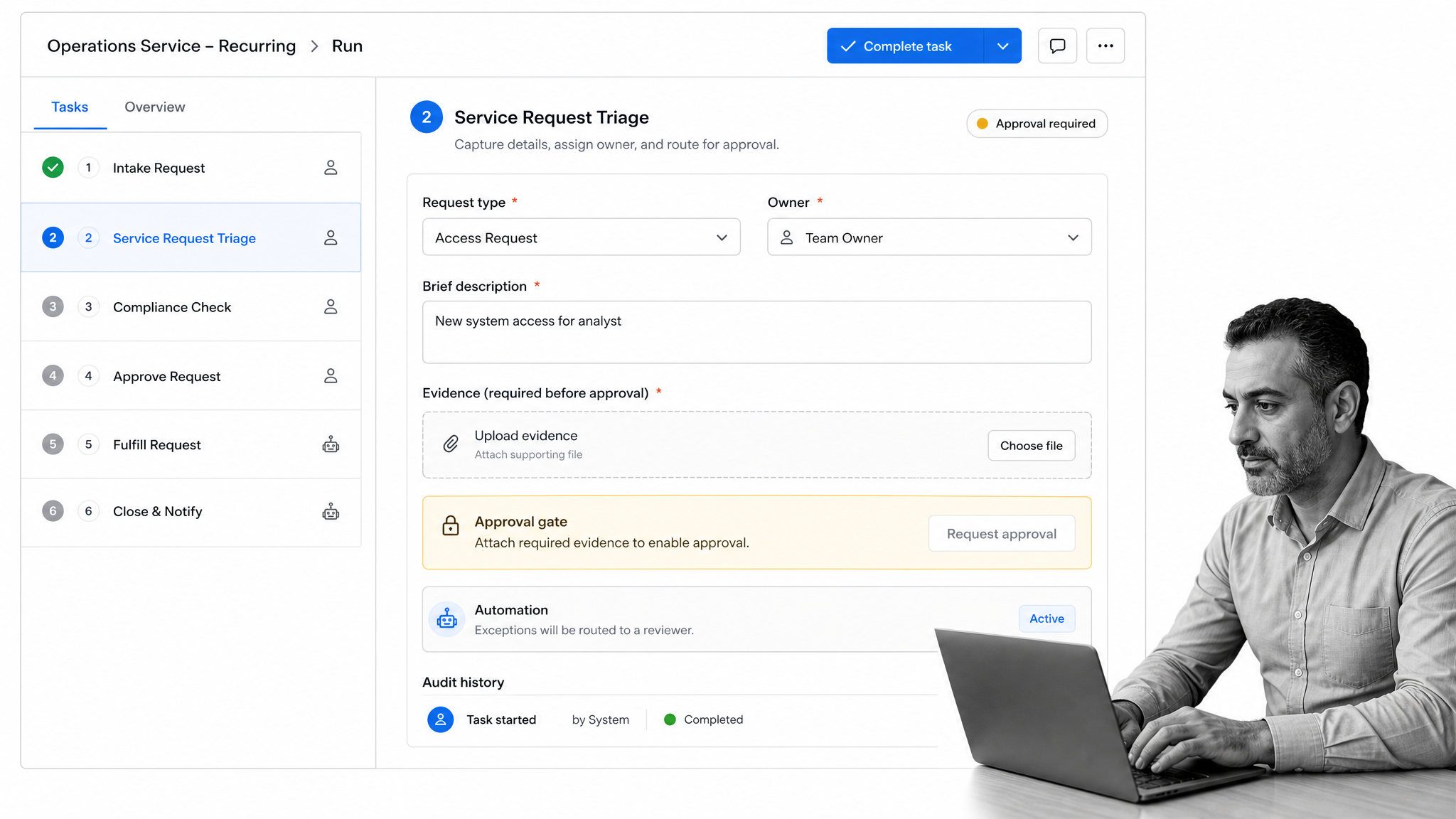
Process Street helps you run an operations service by turning each request type into an executable workflow. The service catalog defines what the team offers. Process Street defines how each request moves from intake to completion.
Turn service requests into workflow runs
Each service request can start a workflow run with the right tasks, owners, form fields, due dates, approvals, automations, and evidence requirements. That gives the operations team a repeatable path while still allowing conditional branches for different request types.
Teams can start with a business process analysis workflow to define the service, then turn the approved path into a repeatable operating workflow.
Keep policies and execution connected
A service often depends on an SOP, policy, checklist, or standard. If that document is separate from the work, people have to remember to follow it. A stronger model connects the standard to the workflow that runs the service.
A standard operating procedure template can define the expected path, while standard operating procedure software helps keep the documented standard tied to execution.
Automate handoffs across the stack
Process Street has direct, universal integrations to 5,000+ systems. Need a new one? An AI agent builds it on the fly. That matters because operations services rarely live in one tool. A request may start in a form, update a CRM, collect a signature, notify a reviewer, store evidence, and update a reporting system.
The Process Street integrations page explains the integration surface. For service design, the practical point is simple: route the work through the systems people already use, but keep the service record in one controlled workflow.
Build improvement into the service
A service should improve as it runs. Recurring delays should update the workflow. Repeated missing fields should update the intake form. Repeated exceptions should update the catalog, owner model, service level, or automation path.
A process improvement tracker and a root cause analysis workflow can turn those signals into assigned improvement work.
Operations service metrics
Operations service metrics should tell the service owner what to fix next. A dashboard that cannot change a workflow, owner model, service level, or automation is reporting noise.
- Request volume: how many requests enter by type, team, customer, or risk level.
- Cycle time: how long each request takes from intake to completion.
- Triage time: how long requests wait before they are accepted, rejected, or routed.
- Service level attainment: how often the service meets its promised response and completion targets.
- Approval aging: where decisions wait and which reviewers become constraints.
- Rework rate: how often requests are sent back because intake, evidence, or execution was incomplete.
- Evidence completion: whether required proof is attached before work is closed.
- Exception rate: how often requests leave the standard path and why.
Measure demand and health together
Demand alone can mislead. A rising request count may mean the service is useful, but it may also mean upstream teams are pushing avoidable work into operations. Pair volume with cycle time, rework, and exception rate so the service owner can see whether demand is healthy.
Track proof as a first-class metric
For compliance, finance, HR, quality, security, and customer-facing services, proof completion should be measured directly. If the work was done but the proof is missing, the service is not fully complete.
Value stream mapping is useful when service owners need to see where work and information slow down. It helps distinguish the actual service constraint from the most visible complaint.
Common operations service mistakes
Most operations service mistakes come from treating the service as an inbox instead of an operating model. The team accepts requests, works hard, and still struggles because scope, intake, owners, and proof are unclear.
Letting scope expand without catalog changes
If every new request becomes part of the service by default, the catalog stops being useful. New service types should be added deliberately with intake rules, workflow paths, owners, service levels, and proof requirements.
Using service levels without workflow enforcement
A service level target is only useful if the workflow can show whether the target is at risk. Put due dates, escalation thresholds, assignments, and review points inside the workflow instead of tracking them after the fact.
Separating documentation from execution
An SOP that lives away from the workflow becomes optional in practice. The service should guide people through the current standard while they work, then preserve the record of what happened.
Improving only after complaints
Requester complaints matter, but they are lagging signals. A mature operations service also looks at missing evidence, repeated exceptions, approval aging, intake quality, and rework before the requester has to complain.
A process improvement rhythm helps service owners turn those signals into workflow changes instead of one-off fixes.
FAQs
What is an operations service?
An operations service is a repeatable model for receiving, triaging, executing, and proving recurring business work. It usually includes intake rules, workflow steps, owners, service levels, automation, reporting, and evidence.
What is the difference between an operations service and outsourcing?
Outsourcing means an external provider handles a business function or process. An operations service can be internal, external, or hybrid; the defining feature is the service model that controls request intake, workflow execution, service levels, and proof.
What should be included in an operations service catalog?
An operations service catalog should include named service types, requester eligibility, intake fields, owners, workflow paths, service levels, escalation rules, proof requirements, and reporting expectations.
How do you run an operations service well?
Run an operations service with one clear owner, one intake path per request type, repeatable workflows, service level targets, approval and escalation rules, automation, and regular reviews of demand, delays, exceptions, and evidence gaps.
What metrics matter for an operations service?
Useful operations service metrics include request volume, cycle time, triage time, service level attainment, approval aging, rework rate, evidence completion, and exception rate. Each metric should connect to a decision or improvement action.
How does Process Street support operations services?
Process Street supports operations services by turning recurring requests into executable workflows with intake forms, owners, required fields, conditional logic, approvals, automations, and audit history. Teams can standardize service delivery while keeping proof attached to the work.