Turn every policy into automated workflows with built-in enforcement and audit-ready proof.



Process Assistant
A process assistant is an AI-enabled role or software layer that improves how recurring work moves through a business. It finds constraints, standardizes the best path, automates repetitive handoffs, measures execution, and turns those signals into better operating decisions.
The goal is not to make a dashboard look busy. The goal is to make work run better. A good process assistant helps teams see where work slows down, why it slows down, who owns the next action, and what evidence proves the fix happened.
This guide explains how process assistants work, which signals matter, how to build the system, and how Process Street helps teams turn improvement into repeatable execution.
In this article, we are going to cover everything you need to know about process assistant systems, including:
- What a process assistant is
- What a process assistant does
- How to choose work for a process assistant
- How to build an process assistant system
- Process Street as your process assistant
- Process assistant metrics that matter
- Common process assistant mistakes
- FAQs
What a process assistant is
An process assistant is the operating layer that turns process knowledge into measurable improvement. In a small team, it may be one operations manager reviewing bottlenecks every week. In a larger company, it may be a system of workflows, alerts, automations, owners, reports, and improvement reviews.
The simplest definition is this: an process assistant helps a team decide what to improve next and then makes sure the improvement is executed. That makes it different from a static SOP, a one-off project plan, or a dashboard that only reports what already happened.
The improver is not just software
Software can support improvement, but the operating model matters more. Someone still needs to define the process, set the standard, decide what good looks like, respond to exceptions, and update the workflow when the data shows a better path.
That is why an process assistant usually combines four pieces: a documented process, an execution workflow, a measurement layer, and a response loop. Remove any one of those pieces and improvement turns into guesswork.
The improver works on recurring operations
Optimization is most valuable when the work repeats. Onboarding, vendor intake, compliance reviews, access requests, quality checks, financial close steps, maintenance work, and customer handoffs all create repeatable signals. If the same process runs every week, every month, or every customer, it can be improved.
A one-time project may need project management tools. A recurring operation needs a system that can enforce the standard, track exceptions, and improve the workflow over time.
The improver connects standards to execution
Many teams already have process documents, but the documents do not control the work. An process assistant closes that gap by connecting the standard to the daily workflow. The instruction, task, owner, field, approval, and evidence requirement all point to the same operating model.
That connection is why process documentation matters. Documentation gives the team a stable standard. Execution shows whether the standard is being followed. Optimization uses the gap between the two to decide what should change.
What a process assistant does
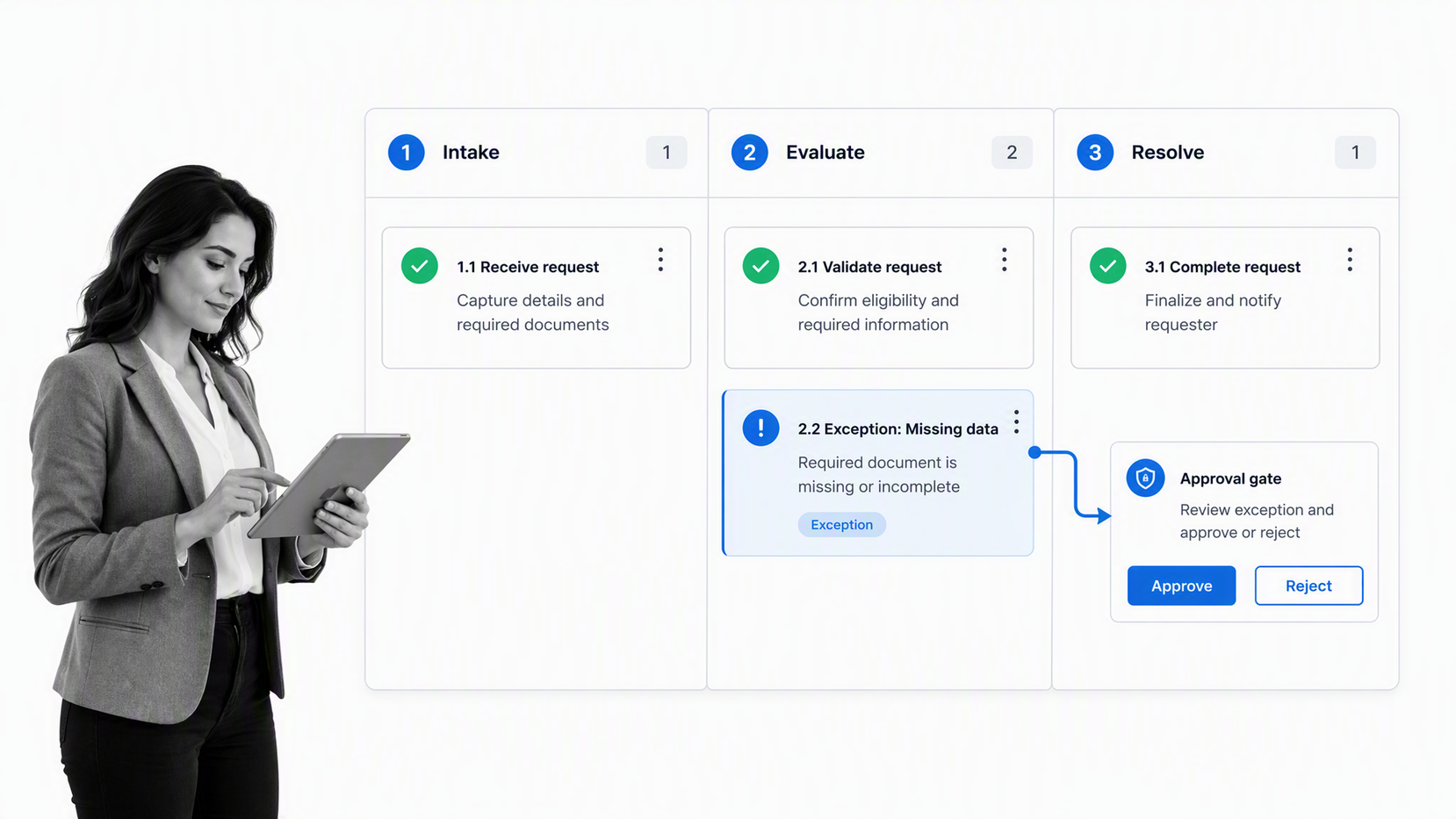
An process assistant does five jobs: define the flow, standardize execution, expose constraints, trigger action, and feed learning back into the process. Each job is simple on its own. The value comes from connecting them into one operating loop.
1. Define the flow
The improver starts by naming the start event, end event, owners, inputs, outputs, and systems involved. A team cannot improve a process it cannot describe. A business process analysis workflow helps teams make the boundary clear before they automate or measure anything.
2. Standardize the path
Once the boundary is clear, the team needs a standard path for normal work. That path includes tasks, owners, required fields, approvals, due dates, exception rules, and evidence. Standardization is what makes comparison possible: if every run is different, the data cannot tell you much.
This is where standard operating procedure software becomes useful. The SOP should not sit apart from execution. It should shape the way work happens.
Standardize what should not vary
Optimization does not mean every step becomes rigid. It means the parts that carry risk, quality, customer impact, or cost are controlled on purpose. A team may still leave room for judgment, but the required inputs, decision criteria, approval gates, and evidence expectations should be clear.
A useful test is whether two people could run the process and produce the same acceptable outcome. If not, the improver has more work to do. The missing piece may be a clearer instruction, a required field, a better template, an automation, or a decision rule that removes ambiguity.
3. Expose constraints
A constraint is the part of the operation that limits throughput, quality, speed, or reliability. It may be an overloaded approver, a missing system integration, a handoff nobody owns, a field people skip, or a control that catches too many errors too late.
External process-improvement methods describe similar ideas. The Lean Enterprise Institute describes value stream mapping as a way to see how work and information flow. NIST AI Risk Management Framework gives teams a practical way to identify, measure, manage, and govern risks when AI participates in the workflow.
4. Trigger action
The improver should not only show that something went wrong. It should trigger a response: assign an owner, route an approval, request missing evidence, notify a reviewer, escalate a delay, or start a corrective action workflow.
This is where workflow automation moves improvement from analysis into execution. A recurring delay can trigger a reminder. A high-risk answer can route to a reviewer. A missing file can block completion. The workflow becomes the response mechanism, not just the measurement surface.
5. Feed learning back into the process
The last step is improvement. Repeated exceptions should update the workflow, the SOP, the automation, or the owner model. Otherwise, the team keeps solving the same problem manually.
How to choose work for a process assistant
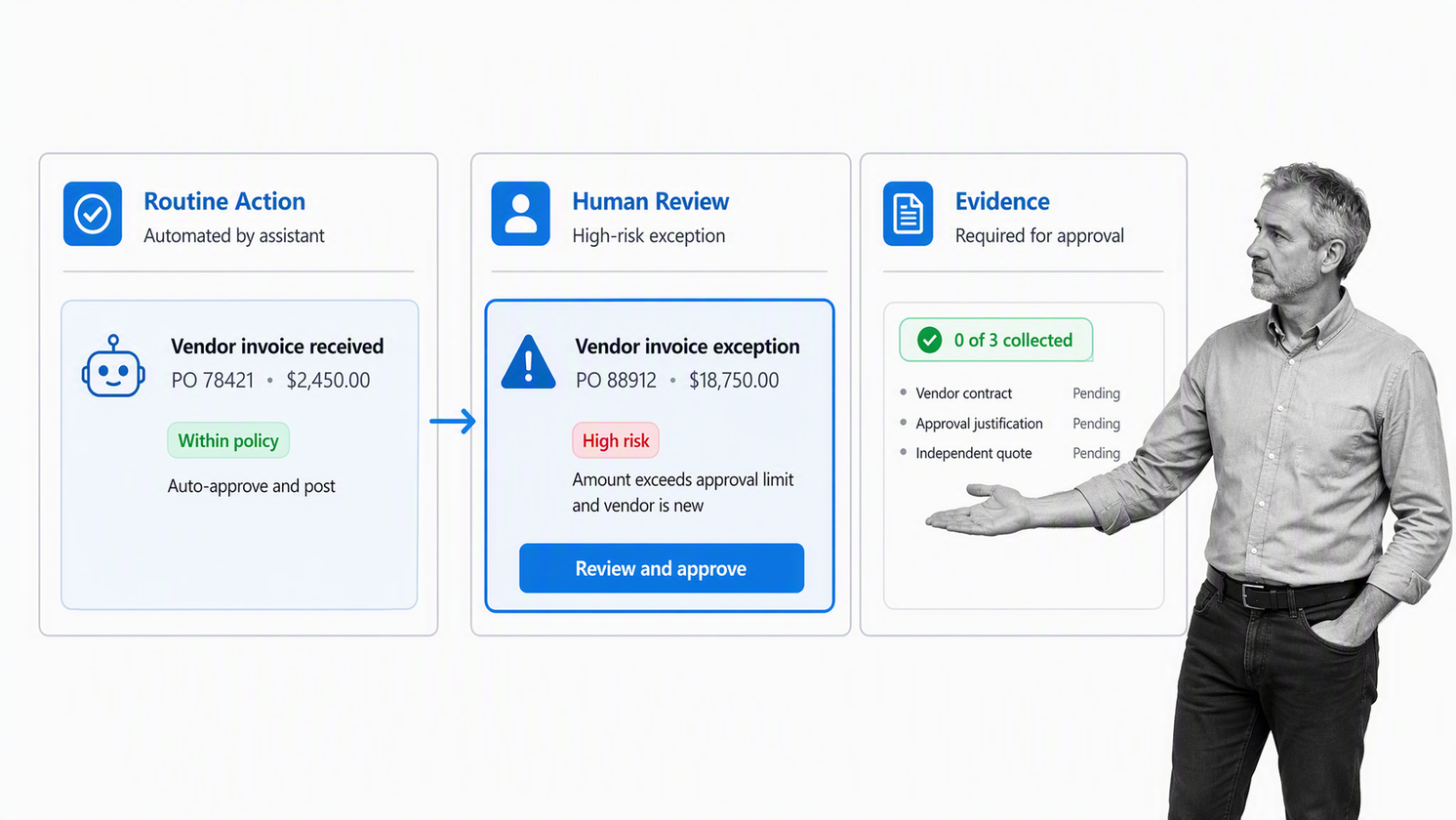
The fastest way to improve operations is usually not to improve everything. It is to find the constraint that limits the system and focus improvement there. That requires a clear way to separate noise from real operational drag.
Look for repeated delays
A single late task may be normal. A step that is late every week is a signal. Track which steps age out, which owners are overloaded, and which handoffs repeatedly wait for clarification.
Look for missing evidence
Missing evidence is one of the strongest signals that a process is not under control. It means the work may have happened, but the organization cannot prove what happened. For compliance, quality, finance, HR, and customer commitments, that gap matters.
A structured audit evidence workflow makes the proof requirement part of execution instead of an after-the-fact scramble.
Look for rework
Rework means the process allowed a weak input, unclear decision, missing review, or avoidable error to move downstream. The improver should identify the upstream step where the problem could have been prevented.
Look for decision queues
Approval delays often reveal the real operating constraint. Sometimes the problem is capacity. Sometimes the approval is unnecessary. Sometimes the reviewer lacks the context needed to decide. An approval workflow helps make that queue visible.
Look for unclear intake
A surprising amount of operational drag starts before the process officially begins. Requests arrive with missing context, unclear priority, weak attachments, or no defined owner. The downstream team then spends time clarifying the work instead of doing it. A strong improver treats intake quality as a process signal, not an administrative detail.
If intake is the constraint, improve the form, required fields, triage rules, and routing logic before changing later steps. A better front door often removes half the exception work that appears downstream.
How to build an process assistant system
Build an process assistant system by connecting documentation, execution, monitoring, and improvement. The system should be simple enough for teams to use every day and strong enough to create proof when the work matters.
Start with one high-value process
Pick a process that repeats often, has clear business impact, and creates visible pain when it breaks. Good candidates include onboarding, vendor reviews, access approvals, incident response, quality checks, customer handoffs, and month-end workflows.
Turn the process into a workflow
A workflow should define tasks, owners, instructions, required fields, due dates, approvals, conditions, and exception paths. This turns the process from a document into a controlled execution path. A workflow management system gives that execution path a place to run.
Add the minimum useful signals
Start with a short signal set: overdue steps, missing required fields, blocked approvals, rework, exceptions, owner changes, and completion quality. Each signal should answer one question: what should someone do next?
Keep the first version deliberately small. A signal set that fits in one weekly review is more useful than a dashboard nobody trusts. Once the team sees which signals change decisions, add detail around the few that matter most.
The IBM overview of business process management describes BPM as a discipline for analyzing, modeling, improving, and monitoring processes. The useful lesson for an process assistant is that monitoring and improvement need to stay connected.
Create a response path
Every signal needs a response. If an approval ages past its threshold, who reviews it? If evidence is missing, who requests it? If a handoff fails, who fixes the workflow? If a field is skipped repeatedly, who updates the instruction?
Write those response rules into the workflow. The process assistant should make the next action obvious before a manager has to intervene. If the same exception still requires a meeting every time, the response path is not clear enough.
Review and improve the process
Run a recurring review of the signals. Keep what improves decisions. Remove what creates noise. Turn recurring issues into corrective actions. A root cause analysis and corrective action workflow helps make that improvement work explicit.
A lightweight process improvement tracker can hold the backlog of fixes that come from process review meetings. Without a tracker, teams notice the same patterns repeatedly but never close the loop.
Process Street as your process assistant
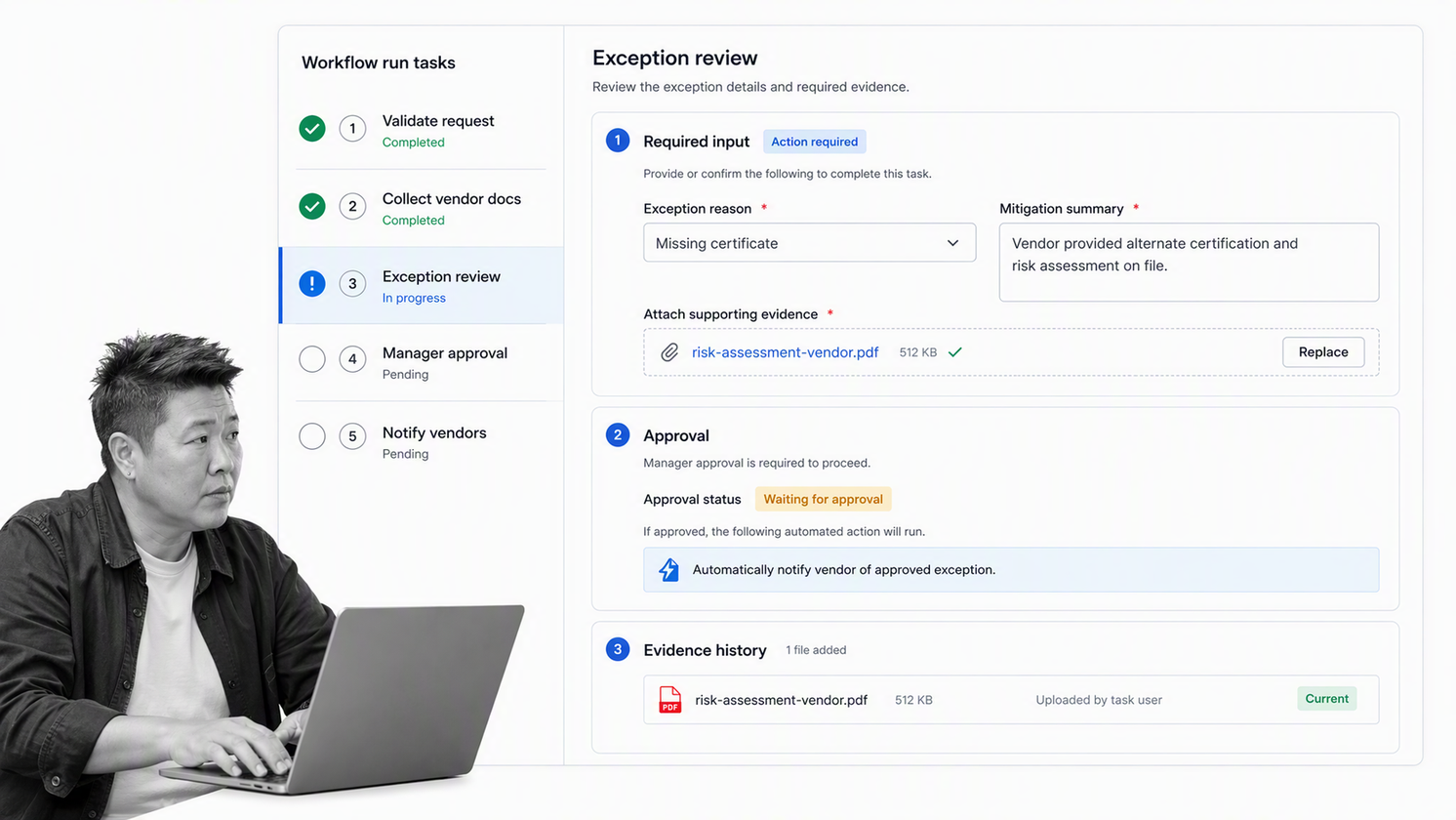
Process Street works as an process assistant when recurring work needs more than visibility. It turns the operating standard into a workflow that assigns owners, collects evidence, routes approvals, triggers automations, and keeps a history of what happened.
Run the improved process
Teams can start from templates, build workflows, assign tasks, add form fields, use conditional logic, and route approvals. That means the guided path becomes the path people actually follow, not a recommendation stored in a separate document.
For teams starting from scratch, a standard operating procedure template can define the standard before the workflow is automated.
Connect improvement to automation
Process Street has direct, universal integrations to 5,000+ systems. Need a new one? An AI agent builds it on the fly. That matters because improvement usually crosses tools: forms, documents, CRMs, file storage, HR systems, finance systems, and communication channels.
The public Process Street integrations page explains the integration surface across API, webhooks, Zapier, Make, Power Automate, and native automations. The practical point is simple: the improved workflow should connect to the systems where work starts and ends.
Keep proof with execution
Approvals, comments, files, form values, task history, and audit trails stay attached to the workflow run. That gives teams a record they can inspect later without rebuilding the story from chat, email, spreadsheets, and memory.
Improve the operating model
Optimization should change the workflow. When the same blocker repeats, update the instructions, fields, automation, owner model, or approval path. A process improvement rhythm keeps the operating system current.
Process assistant metrics that matter
The best process assistant metrics are decision metrics. They help someone act. If a metric cannot change a workflow, owner model, automation, threshold, or resource decision, it may be reporting noise.
- Cycle time: how long the process takes from start to finish.
- Step aging: which steps wait longest before completion.
- Exception rate: how often work leaves the standard path.
- Missing evidence rate: how often required proof is absent.
- Approval aging: how long decisions wait in review.
- Rework rate: how often work returns to an earlier step.
- Throughput: how much work the process completes in a period.
- Completion quality: whether the process ends with the required output and proof.
Avoid measuring only what is easy. A task count may be simple, but it may not tell you whether the work was correct. A stronger process assistant balances speed, quality, risk, and proof.
Use metric pairs
Single metrics create bad incentives. If you measure only speed, people may skip evidence. If you measure only control, the process may become slow. Pair speed metrics with quality metrics, and pair exception counts with resolution metrics. That keeps improvement balanced.
Measure the response, not just the signal
The signal tells you something needs attention. The response tells you whether the operating system can recover. Track how long exceptions stay open, how many require escalation, how often the same root cause returns, and whether the workflow was updated after the issue closed.
For project-shaped improvements, Object Management Group BPMN standard provides a shared notation for mapping activities, events, and decision paths. An improver should do the same inside daily operations.
Common process assistant mistakes
Most process assistant systems fail for predictable reasons. They collect too much data, lack a response path, improve local steps instead of the full process, or separate documentation from execution.
Optimizing the visible problem
The visible problem is not always the constraint. A slow task may be waiting on unclear intake. A late approval may be waiting on missing context. Fix the upstream cause, not just the symptom.
Treating dashboards as action
Dashboards help teams see work, but they do not fix work. Every important signal should connect to an owner, threshold, response workflow, or improvement action.
If a dashboard creates discussion but no workflow change, it is not improvement yet. The next step should be concrete: update a task, change a required field, adjust an approval rule, add an automation, remove a redundant step, or assign a corrective action.
Optimizing without proof
If the process touches compliance, quality, finance, security, HR, or customers, proof matters. The guided path should show who did what, when they did it, what evidence was attached, and what approval path was followed.
Improving once and stopping
Operations change. People change. Systems change. Regulations, customers, and internal priorities change. A real process assistant keeps the process current instead of treating improvement as a one-time cleanup.
FAQs
What is an process assistant?
An process assistant is a person, system, or workflow layer that improves recurring business operations. It identifies constraints, standardizes execution, measures performance, triggers action, and feeds learning back into the process.
What does an process assistant do?
An process assistant defines the process, standardizes how work happens, finds bottlenecks, routes exceptions, measures outcomes, and updates the workflow when the data shows a better path.
Is an process assistant software or a role?
It can be either. In practice, the strongest model combines a role that owns the operating system with software that runs workflows, captures evidence, monitors signals, and automates handoffs.
What processes should an process assistant improve first?
Start with recurring processes that have high volume, high risk, or visible pain when they fail. Good candidates include onboarding, vendor reviews, approvals, compliance checks, quality reviews, access requests, customer handoffs, and month-end work.
What metrics should an process assistant track?
Useful metrics include cycle time, step aging, exception rate, missing evidence rate, approval aging, rework rate, throughput, and completion quality. Each metric should connect to a decision or response action.
How does Process Street work as a process assistant?
Process Street helps process improvement by turning recurring procedures into executable workflows with owners, required fields, approvals, automations, and audit history. Teams can enforce the guided path, monitor exceptions, and keep proof with the work.