






This is a guest post from Deepti Jain, a sales and marketing specialist at AeroLeads.
Social selling is the practice of using social networks to identify the right prospects, understand what they care about, build trust, and start better sales conversations. It is not the same as posting for reach or pushing a pitch into someone's inbox. Good social selling combines listening, helpful engagement, proof, and disciplined follow-up.
The reason it matters is simple: buyers spend a large part of their professional lives online. DataReportal's global digital reports show billions of people using social media, and LinkedIn frames social selling as a way for sales teams to use digital relationships and buyer intelligence instead of relying only on cold outreach. For salespeople, that means social channels are no longer optional background noise. They are where prospects reveal needs, compare options, ask peers for advice, and decide which voices they trust.
Social selling still gets treated like a buzzword, and it still gets a bad reputation in some B2B businesses. Some sales teams are skeptical of leveraging social selling because they imagine vanity posts, vague outreach, and lots of noise. What they miss is the practical side: better leads, clearer ROI, more relevant revenue conversations, and a way to avoid chasing unqualified prospects.
Social selling works best when it is handled like a sales process, not a random posting habit. The seven reasons below explain why it belongs in every modern salesperson's workflow.
1. You can easily identify your target audience

Social platforms make it much easier to see who your ideal buyers are, what they talk about, and which problems keep showing up in their own words. A salesperson can learn a lot before sending the first message: job changes, company announcements, hiring signals, shared connections, comments on industry posts, questions in communities, and the content a prospect chooses to engage with.
That research matters because relevance is what separates a useful first touch from noise. Instead of starting with a generic pitch, a salesperson can build a short target-account view: who the buyer is, what business pressure they are likely under, which trigger event created urgency, and which proof point would be most useful.
Before anything, you need to identify your target audience. After all, it is important to know the leads you are going to engage with. Otherwise, you spend time chasing unqualified leads and coming up empty-handed. Social selling makes it substantially easier to identify the problems prospects are facing, their preferences, the issues inside their business, and whether they are the right fit for your company.
Social selling also helps teams choose where to spend their time. For some markets, LinkedIn will carry most of the signal. For others, X, Reddit, YouTube, industry Slack groups, review sites, or founder communities may reveal more useful context. The important point is not to be everywhere. It is to find the places where your buyers already show intent.
There are countless social media channels available, and not all of them are useful for every team. Different social media platforms cater to a different audience. A B2B brand, for instance, usually has a better chance of success on LinkedIn than on a purely consumer-focused platform. The planning matters as much as the platform.
2. It's easier to engage your audience with social selling

Once you know who your audience is, social selling gives you a natural way to engage before asking for anything. Comment on a thoughtful post. Share a useful resource. Answer a question. Congratulate someone on a relevant milestone. Join the conversation in a way that makes the buyer's work easier.
This is the part many teams get wrong. Social selling is not a shortcut for automated direct messages. It is a trust-building channel. Public engagement helps prospects see how you think, how quickly you understand their context, and whether you can contribute without turning every interaction into a pitch.
That context is especially useful because traditional outbound still depends on timing and relevance. HubSpot's cold-calling research shows that sales calls can still work, but buyers are more likely to respond when outreach is prepared, timely, and connected to a real business reason.
Brands have understood this for years. Wendy's became known for a distinctive social voice because it responded quickly, stayed recognizable, and made people want to interact. A salesperson does not need to copy that tone, but the principle applies: consistent, human engagement is easier to remember than a cold message from a stranger.
Bland social media posts will not be of much help. If a page talks only about its product, how great the company is, and why everyone should buy right now, the target audience will take one look and do a volte-face. On the contrary, when a seller adds personality, a dash of humor and wit, and useful perspective without belittling competitors, the engagement feels more candid and memorable.
Good engagement also creates cleaner follow-up. A message that references a real conversation, a recent post, or a shared business challenge has more context than a template. It feels less like interruption and more like continuation.
3. Better customer service

Social selling is often discussed as a prospecting motion, but it also improves customer service. Customers and prospects talk about problems in public: delayed responses, confusing onboarding, missing features, pricing concerns, implementation blockers, and support experiences. Those conversations can become churn risks, renewal risks, or sales opportunities depending on how quickly the company responds.
For salespeople, this is useful context. A public complaint from a target account might reveal an urgent problem. A customer's positive comment might become social proof for a similar buyer. A recurring question might show that your enablement materials are unclear. A competitor's frustrated user might be ready for a better process.
Closing a huge final deal is not the end of the relationship. After the final purchase, you still have to continue engaging the customer if you want to retain them for longer. A lot of sales representatives fail to follow through here, even though customer service is where trust either compounds or erodes.
The best part of customer service on social media is that other people in your network and your prospect's vertical can see how you solve issues. That visibility creates goodwill and can lead to more leads. It is also a double-edged sword. If a customer posts publicly that they no longer feel cared for, the censure can spread quickly.
The key is to treat public signals respectfully. Social selling should not feel like surveillance. It should feel like paying attention. When a customer asks for help, route it to the right owner. When a prospect raises a question, answer it directly. When a pattern appears, bring it back into the sales, success, or product workflow so the team can act on it.
4. Allows you to build authority in your industry

Authority is built in public long before a sales call. When you consistently share useful perspectives, explain industry changes, answer hard questions, and point people toward practical resources, prospects begin to understand what you know and how you approach problems.
This does not require every salesperson to become a full-time creator. A strong social selling rhythm can be simple: comment on buyer conversations, share one useful insight each week, summarize a customer pattern, explain a common mistake, and connect your point to a concrete next step. Over time, that cadence creates familiarity.
Everyone is using social media these days, from personal contacts to professional buyers, and prospects are already engaging in social buying. If you want to build authority in your industry, you should be present wherever your audience is. Continue to post useful and valuable content, offer solutions, follow the influencers in your domain, and engage your audience with veritable consistency.
That value can show up in many formats: post advisories, offer solutions, add a useful angle to an influencer thread, or give buyers a concise answer they can apply immediately. The format matters less than the habit of being useful before the sales conversation begins.
Consistency is the point. If you abandon your social media accounts for days on end, your tardiness will not work in your favor. Your audience is not going to wait for you to post something valuable. They will turn to one of your competitors. The more interactive and regular you are, the more leads and prospects you can earn through social selling.
Authority also compounds inside the sales process. When a prospect checks your profile after an email or meeting, they should see evidence that you understand their world. A dormant profile with only promotional posts does not help. A profile full of practical, buyer-centered insight does.
5. A platform to show off your social proof

Buyers trust proof from other buyers. Social channels give salespeople a place to collect and share that proof: reviews, testimonials, case studies, customer quotes, webinar clips, analyst mentions, and public customer wins.
This matters because prospects rarely want to hear only what a vendor says about itself. They want evidence from people who have already made the decision. Research from BrightLocal continues to show how strongly reviews influence buyer trust in local and consumer-facing markets, and the same principle carries into B2B decisions: credible third-party proof reduces perceived risk.
When you start selling from scratch, it can take substantial time to gain a foothold and garner followers. Sharing success stories, testimonials, reviews, and case studies on social media can speed up that process because prospects see that past customers are satisfied and have gained value from your services.
There are no two ways about the power of social proof. Buyers are not naively believing what a company or manufacturer has to say about its products. They want unbiased third-party reviews, word-of-mouth signals, customer stories, and other types of social proof before they come to a final decision.
The practical move is to build a small proof library your sales team can use. Tag proof by persona, industry, pain point, objection, and buying stage. A prospect worried about implementation needs different proof than a prospect comparing ROI. Social selling becomes more effective when every post and message can connect a buyer's concern to a relevant customer example.
6. One-up your competitors
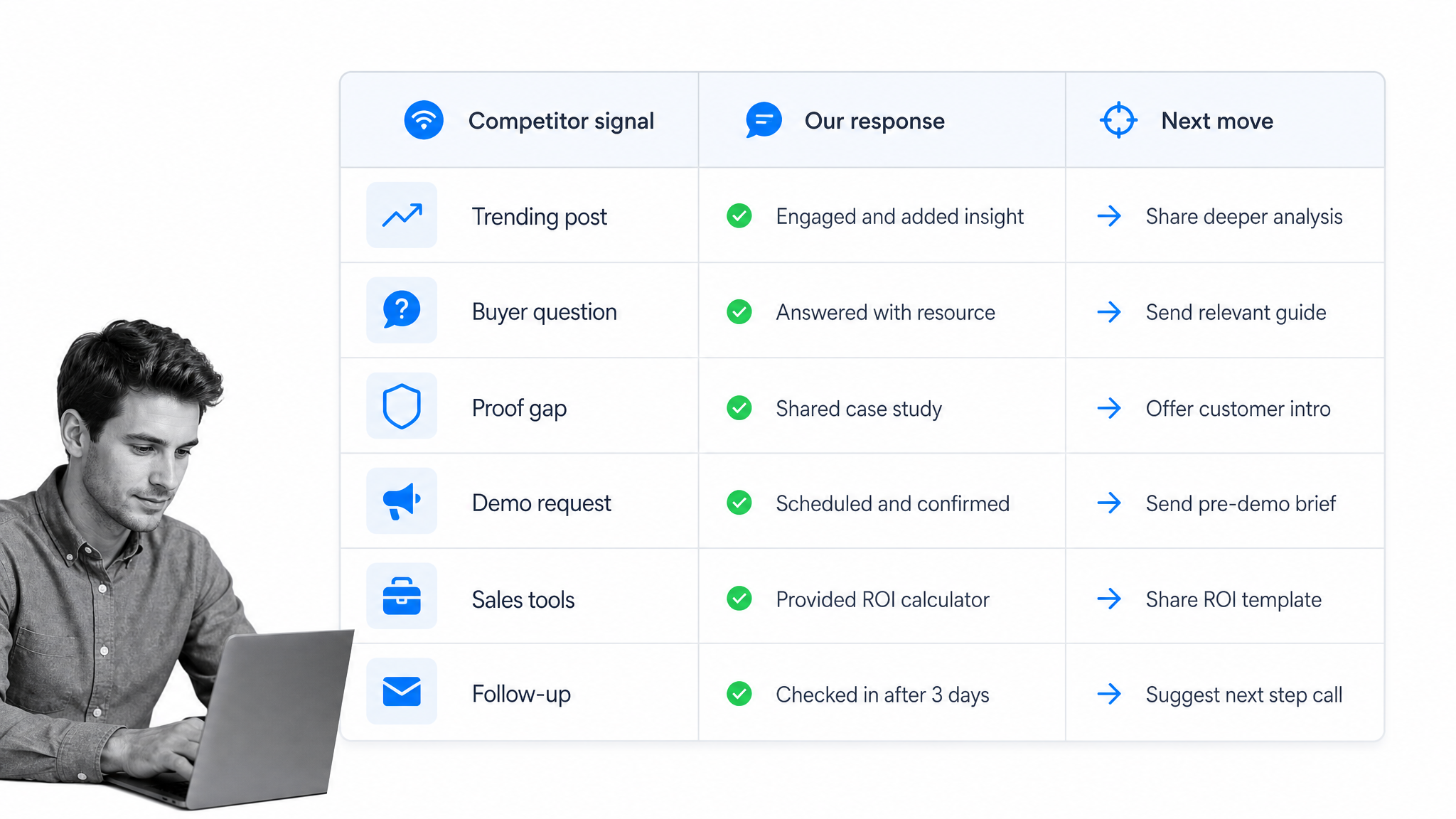
Your competitors are already visible to your buyers. They publish content, comment on industry issues, run webinars, answer questions, and show up in the same networks your prospects use. If your team is absent, the buyer's shortlist may form without you.
Your target audience is on social media, and your competitors are there too. Can you connect the dots? The logic is simple: if you do not engage your audience using social selling, then your competitors will gladly step into that space. Brands in every industry are leveraging social selling today, and the impact is clear enough that it is no longer something a salesperson can afford to ignore.
The Microsoft social selling pilot remains a useful historical reminder of the same principle: when a sales organization connects social activity to a real program, the impact can reach productivity, pipeline, and account engagement instead of staying as a loose marketing activity.
LinkedIn's current social selling material argues that teams using social selling create more opportunities, are more likely to reach quota, and outsell peers who do not use social channels effectively. The exact numbers matter less than the strategic point: social presence creates more chances to be useful before a formal buying process starts.
Social selling also makes competitive intelligence more practical. You can see what competitors emphasize, which objections appear in public replies, what prospects ask after webinars, and where buyers seem underserved. Pair that information with the right sales tools, and your team can turn public signals into cleaner outreach, better account plans, and faster follow-up.
7. You can easily track your prospects' activities

Prospects leave signals as they work: profile changes, new funding announcements, hiring posts, product launches, event attendance, comments on industry issues, review-site activity, and questions in communities. Those signals help salespeople understand when a conversation may be timely.
Older social selling advice sometimes described this as spying on your target audience. That framing came out wrong then, and it is even less useful now. The better version is simple: monitor public response from your target audience so you can determine what they think of your services, what problems they are facing, what communication medium they prefer, and when you can genuinely help.
The best teams track those signals ethically and operationally. They do not scrape private information or pretend to know more than they should. They monitor public activity, connect it to account context, and decide whether the next action is useful. Sometimes the next action is a thoughtful comment. Sometimes it is a resource. Sometimes it is a task for customer success or account management. Sometimes it is no action at all.
If someone mentions you in a bad review, you can resolve the issue before it gets out of hand. If a prospect posts about a difficulty that your services can solve, you can engage them with a useful answer and show how you can help out. That is the line between creepy monitoring and responsible social selling.
This is where process matters. A signal is only valuable if someone owns the next step. Without a workflow, social selling becomes a pile of interesting observations. With a workflow, it becomes repeatable account intelligence.
Social selling: Summing it all up
Social selling helps salespeople do the work buyers already expect: understand the customer, show up with context, build credibility, respond quickly, and prove value with evidence. It does not replace prospecting, discovery, or relationship management. It makes those motions sharper.
For teams, the challenge is consistency. A few active sellers can create momentum, but a durable program needs shared standards: which signals to watch, how to qualify them, what to say, when to escalate, where proof lives, and how follow-up gets tracked.
Do not give up after trying your hand at social selling for a couple of months. There is no guarantee you will witness exceptional results in the initial months. It may take more time than expected. In the end, the effort is worth it when the team remains consistent and continues to provide engaging content to social followers.
Process Street helps sales and customer teams turn that standard into an operating rhythm. Docs keeps the social selling playbook governed and easy to improve. Ops turns research, outreach, review, and follow-up into assigned workflows. Built-in AI helps teams monitor execution and spot places where the process can improve. The result is a social selling motion that is useful, compliant, and repeatable.