Turn every policy into automated workflows with built-in enforcement and audit-ready proof.



Vulnerability Management
Vulnerability management is the continuous process of finding, prioritizing, fixing, verifying, and documenting security weaknesses before they become incidents. It is not a one-time scan. It is an operating system for turning exposed risk into assigned work, completed fixes, and proof.
The practical goal is simple: know what is exposed, know what matters most, route the fix to the right owner, verify the remediation, and keep evidence that the work happened. Without that execution layer, even a strong scan report becomes another backlog nobody trusts.
This guide explains how vulnerability management works, how it differs from assessment and patching, what to prioritize, and how Process Street helps teams turn remediation into repeatable, auditable execution.
We will cover:
- What vulnerability management means
- Why vulnerability management matters
- What vulnerability management includes
- Vulnerability management versus vulnerability assessment
- How to build a vulnerability management process
- Vulnerability management with Process Street
- How to keep improving vulnerability management
- FAQs
What vulnerability management means
Vulnerability management means running a closed-loop process for security weaknesses across systems, software, networks, cloud services, endpoints, applications, and third-party dependencies. The loop starts with discovery, but it only creates value when findings are triaged, assigned, fixed, verified, and recorded.
NIST describes patch and vulnerability management as a program discipline, not just a tool choice. CISA also treats vulnerability management as a mission to reduce the prevalence and impact of exploitable conditions across enterprises and technologies. The common thread is execution: security teams need a repeatable way to convert risk signals into controlled action.
A vulnerability is a workflow trigger
A vulnerability should trigger a workflow, not a panic thread. The workflow should answer who owns the asset, whether the issue is exploitable, what business process depends on it, what fix is available, what deadline applies, what evidence proves closure, and who accepts residual risk if a fix cannot happen immediately.
The management part matters most
Many teams have scanners. Fewer have management. A scanner can identify a weakness, but management is the operating model that decides what happens next. That includes asset ownership, risk ranking, exception handling, remediation tracking, retesting, approvals, and audit-ready evidence.
- Discovery finds known weaknesses.
- Prioritization separates urgent exposure from background noise.
- Remediation assigns and completes the fix.
- Verification confirms the risk changed.
- Evidence proves the process was followed.
This is why vulnerability management belongs next to security audit workflows, incident response planning, and enterprise risk management. It is where technical exposure becomes operational accountability.
Why vulnerability management matters
Vulnerability management matters because attackers do not wait for annual reviews, clean spreadsheets, or perfect ownership maps. New vulnerabilities appear constantly, assets change, dependencies drift, and remediation work competes with every other engineering and operations priority.
It reduces exploitable risk
CISA maintains the Known Exploited Vulnerabilities catalog to help organizations identify vulnerabilities that are already being exploited. That changes the prioritization model. Severity alone is not enough. A lower-severity issue on an exposed critical asset can matter more than a high-severity issue buried inside a disconnected system.
It protects operations from backlog theater
Security backlogs can look productive while risk stays unchanged. Teams close easy tickets, defer hard fixes, and lose sight of whether the most exposed assets are actually safer. Vulnerability management keeps attention on outcomes: reduced exposure, completed remediation, accepted exceptions, and verified closure.
It creates evidence for compliance
Regulated teams need more than a claim that vulnerabilities were reviewed. They need evidence of intake, triage, ownership, remediation, approval, and verification. A related IT audit checklist can help structure reviews, but live vulnerability management needs a workflow that records decisions as they happen.
It keeps security tied to business impact
Good vulnerability management does not chase every CVE with equal urgency. It maps findings to assets, data sensitivity, customer impact, regulatory exposure, exploitability, compensating controls, and operational constraints. The question is not only how bad the vulnerability is. The question is what could happen here, in this business, if it remains open. That makes the discipline a practical extension of enterprise risk management, not a separate security backlog.
What vulnerability management includes

A strong vulnerability management process includes more than scanning and patching. The core system connects asset context, threat context, ownership, remediation work, and evidence.
Asset inventory
You cannot prioritize what you cannot see. Asset inventory connects each finding to a system, service, owner, business process, data class, and exposure level. The inventory does not need to be perfect before work starts, but every remediation workflow should improve it.
Vulnerability intake
Findings may come from scanners, penetration tests, code analysis, bug bounty reports, vendor advisories, cloud posture tools, endpoint tools, or internal audits. Intake normalizes those sources so the team can compare risk consistently.
Risk-based prioritization
Prioritization should consider severity, exploitability, active exploitation, external exposure, asset criticality, compensating controls, data sensitivity, and business process impact. OWASP’s vulnerability management guidance frames the discipline as a lifecycle, which is useful because prioritization needs to happen repeatedly as context changes. Teams comparing tooling can use risk management tools as a broader category lens, but vulnerability work still needs its own execution workflow.
Remediation workflow
Remediation translates risk into assigned work. It should include the fix owner, due date, required action, testing requirement, exception path, approval path, and evidence requirement. If a fix is not possible, the workflow should capture compensating controls and risk acceptance.
Verification and evidence
Closing a ticket is not the same as fixing the vulnerability. Verification checks whether the exposure changed. Evidence proves what was changed, who approved it, and when it was verified. That record becomes critical during audits, incident reviews, and control testing.
Vulnerability management versus vulnerability assessment
Vulnerability assessment is a point-in-time activity that identifies and evaluates weaknesses. Vulnerability management is the ongoing operating model that turns those findings into prioritized work, confirmed fixes, and retained evidence.
Assessment answers what exists
An assessment helps you understand what vulnerabilities are present and how severe they appear. It is useful for discovery, benchmarking, audits, and program planning. But assessment alone does not guarantee remediation.
Management answers what happens next
Management adds ownership, routing, deadlines, remediation status, verification, and reporting. It is the difference between a report that says a weakness exists and a workflow that proves the weakness was handled.
Patch management is one response path
Patch management is a major part of vulnerability management, but not every vulnerability is solved by a patch. Some require configuration changes, dependency upgrades, compensating controls, vendor escalation, network segmentation, access changes, code fixes, or formal risk acceptance. NIST SP 800-40 Rev. 4 frames software vulnerability response as broader than patch deployment, which is the right lens for operational teams.
For teams documenting the surrounding security system, cybersecurity posture assessment workflows and NIST cloud security audit workflows help connect vulnerability management to asset inventory, risk assessment, and incident readiness.
How to build a vulnerability management process
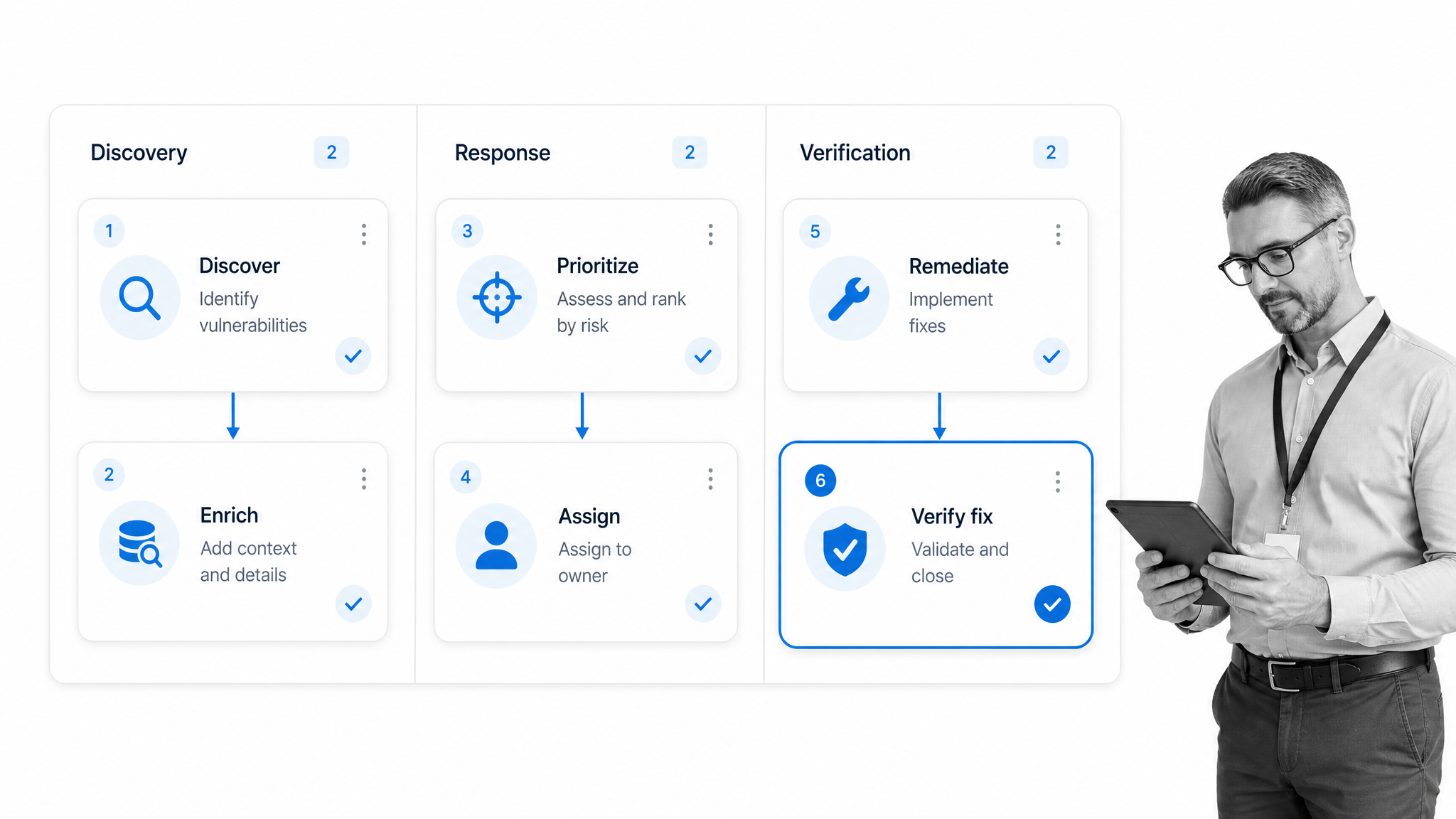
Start with one closed loop. Do not try to build a perfect enterprise program in one pass. Pick a high-risk asset group, a clear intake source, and a remediation workflow that can prove every finding is handled.
1. Define scope and ownership
Choose the systems, teams, and vulnerability sources in scope. Assign ownership for assets, triage, remediation, verification, and exceptions. If ownership is unclear, vulnerability management becomes a queue instead of a control system.
2. Normalize intake
Create a standard intake record with source, asset, vulnerability identifier when available, severity, exploitability, exposure, affected service, owner, remediation guidance, due date, and evidence requirement. Keep it simple enough that teams will use it.
3. Prioritize by risk, not just score
Use severity scores as inputs, not final decisions. Add context: is it exposed to the internet, listed in KEV, tied to sensitive data, affecting a critical business process, or blocked by a compensating control? This prevents teams from spending all their time on tidy but low-impact work. The same logic appears in operational risk management frameworks, where impact and likelihood matter more than isolated scores.
4. Route remediation work
Every finding should move to an owner with a clear next action. A patch management process can handle software updates, while configuration, access, code, and vendor issues may need separate response paths.
5. Verify and close
Verification should be explicit. Retest, confirm the configuration, review the code change, check the scanner result, validate the compensating control, or document the risk acceptance. Do not let the same person who performed the remediation silently close high-risk work without review. For internet-facing systems, server security checklists can give remediation owners a concrete control surface to validate.
6. Review patterns
Repeated vulnerability patterns point to deeper process issues: weak change control, unmanaged assets, poor dependency hygiene, slow approvals, or missing ownership. A root cause analysis and corrective action workflow helps turn repeated findings into permanent fixes.
Vulnerability management with Process Street
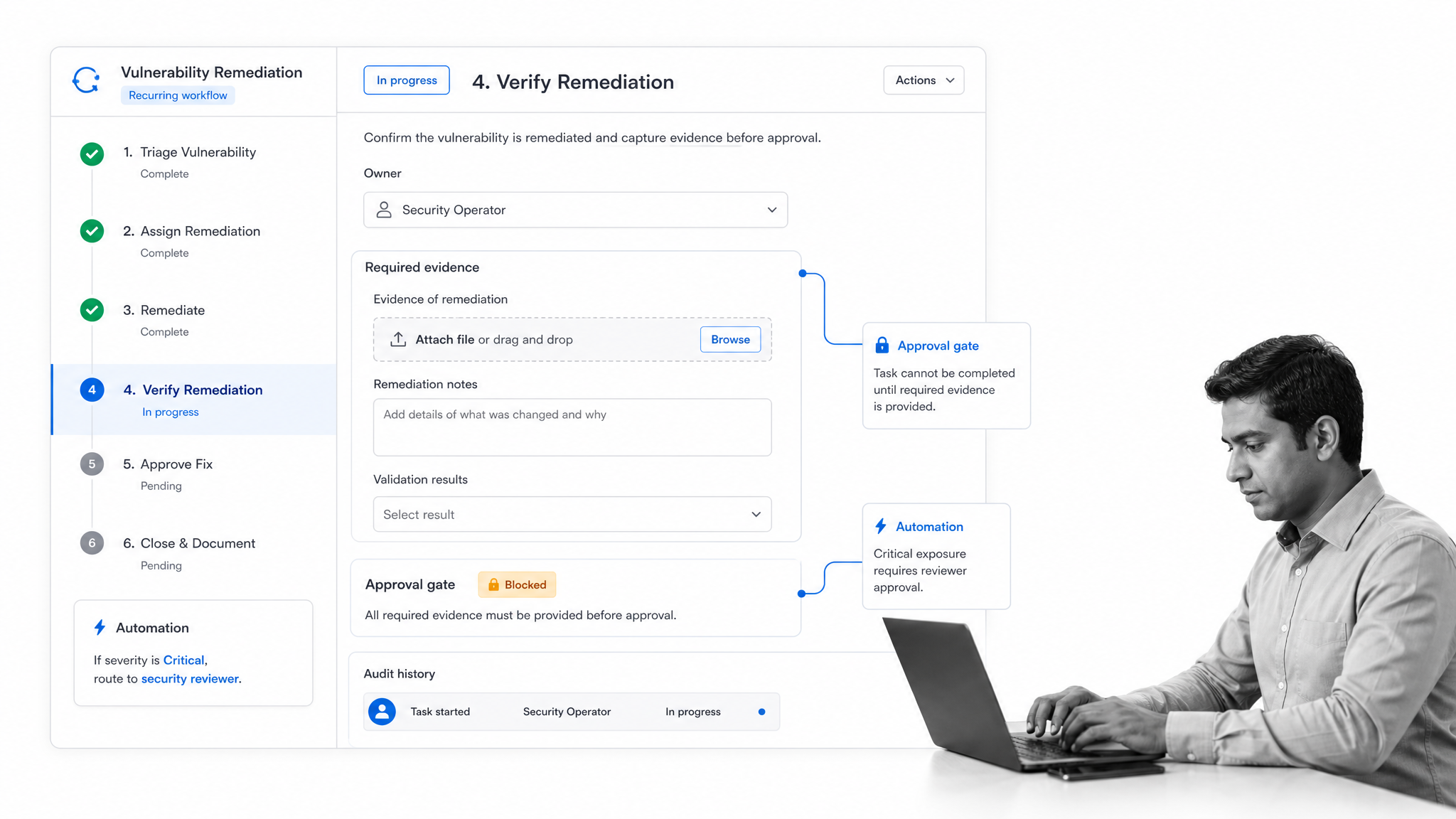
Process Street turns vulnerability management into an executable workflow. Instead of tracking findings in a spreadsheet, discussing exceptions in chat, and storing evidence in scattered folders, teams can run the remediation process where owners, required fields, approvals, automations, and audit history live together.
Assign every finding
A vulnerability workflow can require an owner, affected asset, severity, exploitability context, remediation action, due date, and verification step before work moves forward. That keeps the process from depending on memory or informal follow-up.
Block weak closure
Required fields, approvals, stop tasks, conditional logic, and role assignments can prevent high-risk remediation from closing before evidence is attached or a reviewer signs off. The system enforces the standard instead of merely describing it.
Keep exceptions visible
Vulnerability programs break down when exceptions become private side deals. A team may accept temporary risk because a patch needs a maintenance window, a vendor has not shipped a fix, or a compensating control is already in place. That can be reasonable, but the decision needs a visible owner, expiration date, approval trail, and follow-up task. Otherwise the exception becomes a hidden backlog item that survives long after the original constraint is gone.
In Process Street, exception handling can sit inside the same workflow as remediation. Conditional paths can route critical exceptions to security or compliance review, require the business owner to document why the risk is accepted, and trigger a scheduled review before the exception expires. The outcome is not just a closed task. It is a documented decision with proof of who accepted the risk, what control reduced exposure, and when the issue must come back for review.
Automate the handoffs
Process Street has direct, universal integrations to 5,000+ systems. Need a new one? An AI agent builds it on the fly. That lets vulnerability workflows connect to the tools where findings, tickets, assets, approvals, and evidence already live while keeping Process Street as the controlled execution layer. The same workflow model supports compliance automation software use cases where proof and approvals matter as much as task completion.
Keep proof with the workflow
Approvals, comments, file uploads, field values, task history, and audit trails stay attached to the workflow run. That matters when a customer, auditor, regulator, or executive asks what happened to a specific exposure and who approved the outcome.
For broader security operations, a security incident response workflow and recurring IT security processes pair naturally with vulnerability management because remediation evidence often becomes part of incident review and recovery.
How to keep improving vulnerability management
A vulnerability management process should improve as the organization learns. The first version may focus on getting findings assigned and closed. The stronger version reduces recurring exposure, shortens verification cycles, and improves the controls that prevent vulnerabilities from returning.
Tune prioritization
Review whether your prioritization logic reflects real risk. If the team is closing many low-impact findings while critical exposed systems wait, the model is wrong. Add exploitability, KEV status, business criticality, and exposure to the decision path.
Measure remediation quality
Track more than closure volume. Useful measures include time to assign, time to remediate by risk tier, verification failure rate, reopen rate, exception volume, missing evidence rate, and repeated vulnerability patterns by asset group.
Reduce alert fatigue
Too many findings with no context create fatigue. Group duplicates, suppress noise with clear rules, and escalate only what needs action. Low-risk findings can still be tracked, but high-risk exposure needs a stronger response path.
Use retrospectives to remove repeat causes
The strongest vulnerability management teams do not treat every finding as a one-off ticket. They look for repeat causes. If the same dependency keeps returning, the fix may belong in procurement or build policy. If the same business unit misses deadlines, the issue may be unclear ownership. If verification fails often, the remediation instructions may be too vague or the evidence standard may be unclear.
A monthly retrospective gives security, IT, compliance, and system owners a practical review loop. Look at the vulnerabilities that reopened, the exceptions that expired, the assets with repeated exposure, and the approvals that waited too long. Then update the workflow, the template, or the control so the next run is tighter. Vulnerability management gets stronger when lessons change the operating system, not when they stay in meeting notes.
Audit the process
Periodically review whether the workflow still matches the environment. Asset owners change, tools change, threats change, and evidence requirements change. A system security audit workflow can help validate whether vulnerability management is still connected to the broader control environment, especially when third-party exposure also feeds into a third-party risk management workflow.
External guidance is consistent on the direction of travel: NIST treats vulnerability management as a program, CISA focuses on reducing exploitable conditions, and OWASP frames the work as a lifecycle. The operational lesson is the same: findings need a repeatable path to action and proof.
FAQs
What is vulnerability management?
Vulnerability management is the continuous process of finding, prioritizing, fixing, verifying, and documenting security weaknesses across systems, applications, cloud services, endpoints, and dependencies. The goal is to reduce exploitable risk through repeatable execution, not just produce scan reports.
What are the steps in vulnerability management?
The common steps are asset discovery, vulnerability intake, risk-based prioritization, remediation assignment, fix implementation, verification, evidence capture, and recurring improvement. Mature programs also include exception handling, risk acceptance, and root cause analysis.
How is vulnerability management different from vulnerability assessment?
A vulnerability assessment identifies and evaluates weaknesses at a point in time. Vulnerability management is the ongoing workflow that routes findings to owners, tracks remediation, verifies closure, and keeps evidence that the process was followed.
What should vulnerability management prioritize first?
Prioritize vulnerabilities with active exploitation, external exposure, high asset criticality, sensitive data access, weak compensating controls, or major business process impact. Severity scores help, but they should be combined with exploitability and business context.
How does Process Street support vulnerability management?
Process Street supports vulnerability management by turning remediation into executable workflows with owners, required fields, approvals, automations, evidence capture, and audit history. Teams can assign findings, block weak closure, verify remediation, and keep proof with the work.
What evidence should a vulnerability management process keep?
Keep the original finding, affected asset, risk context, owner, remediation action, approval or exception decision, verification result, completion date, and supporting files or comments. This evidence helps with audits, customer reviews, incident analysis, and continuous improvement.