


An incident response plan is the documented framework a team uses to prepare for, detect, contain, eradicate, recover from, and learn from a cybersecurity incident. It defines who makes decisions, which actions happen first, how evidence is protected, and when legal, compliance, customer, or law-enforcement notifications are required.
An efficient incident response plan, including a practical incident response checklist, gives responders a system they can run under pressure. The 17-step checklist in this guide provides a repeatable starting point in Process Street, while leaving room for system-specific playbooks, severity rules, and escalation paths.
The plan should cover the full incident response lifecycle. Current NIST SP 800-61 Revision 3 guidance treats incident response as part of cybersecurity risk management across Govern, Identify, Protect, Detect, Respond, and Recover. Preparation and improvement happen continuously, not only after an alert fires.
You also need the right tools around the plan. Monitoring, service management, communication, evidence collection, and workflow systems each have a role. This guide to incident management tools can help you map the wider response stack without turning the plan itself into a list of products.
Use the embedded workflow as a baseline, then adapt it to your environment, threat model, legal obligations, and response team.
Open the full incident response checklist in a new tab
How to get the best results from this incident response checklist
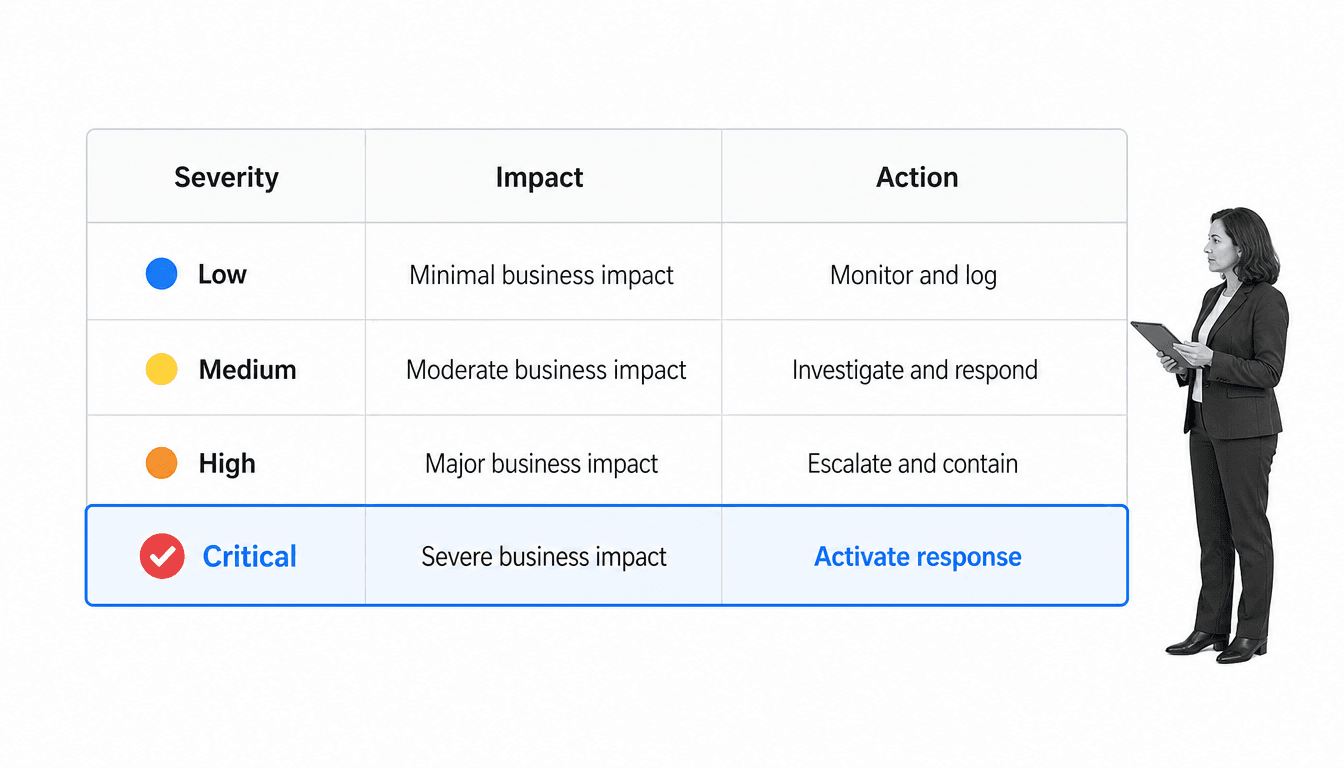
A checklist is not a substitute for judgment. It is the control surface that makes sure judgment is applied consistently. Before an incident occurs, define the severity levels, response roles, decision authority, communication channels, evidence requirements, escalation thresholds, and external notification rules that responders will need.
Start by separating the plan from the playbooks. The incident response plan sets the operating model: who is responsible, how incidents are classified, and how the organization coordinates. A playbook covers a specific scenario, such as ransomware, compromised credentials, data exfiltration, a cloud account takeover, or a lost device. The checklist connects the two by routing each incident to the right actions.
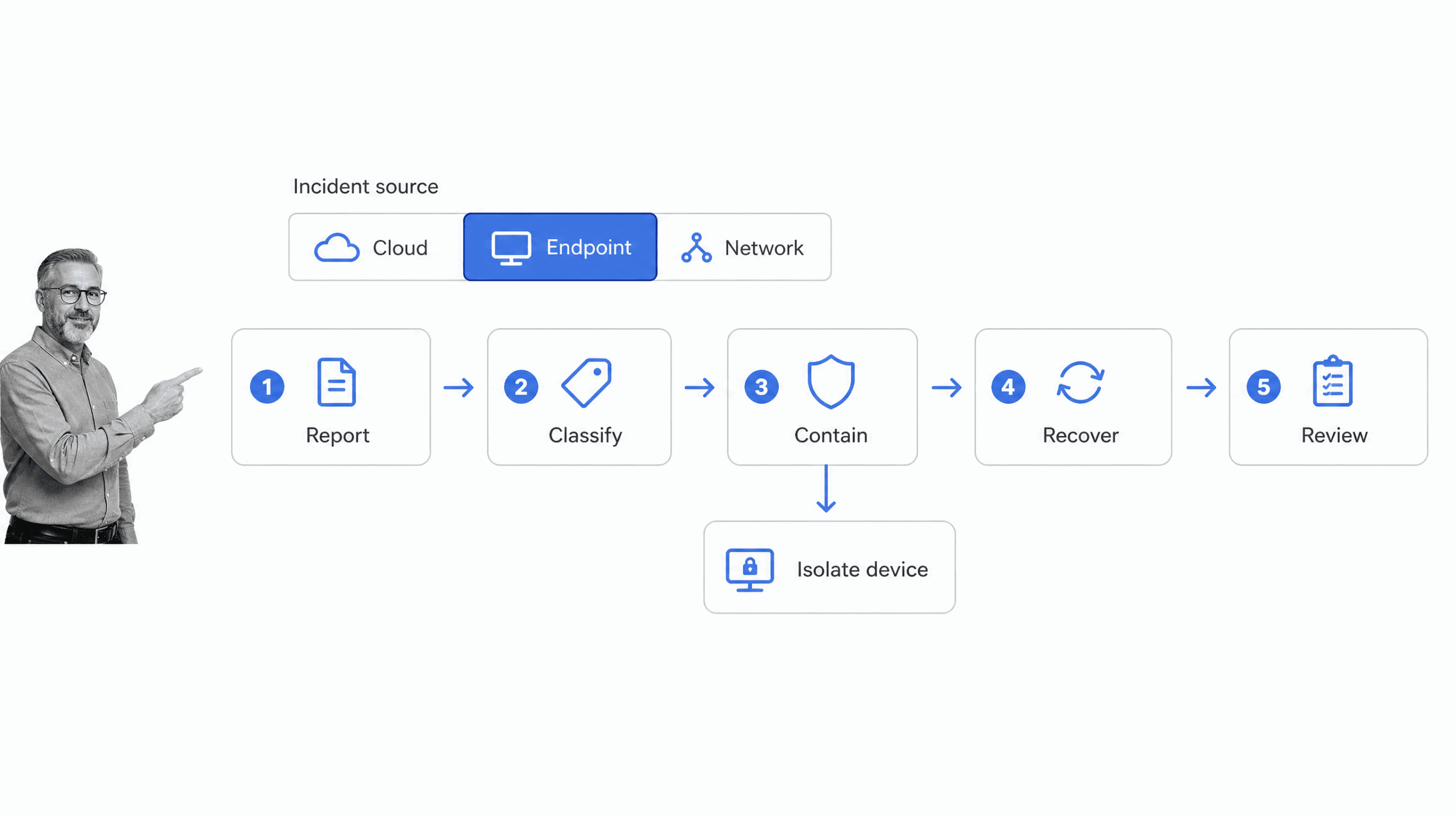
Conditional logic keeps that workflow focused. If the incident source is an endpoint, the run can surface device-isolation and forensic-preservation tasks. A cloud incident can show identity, access, token, and logging checks instead. Responders see the work that matters without searching through a single oversized procedure.
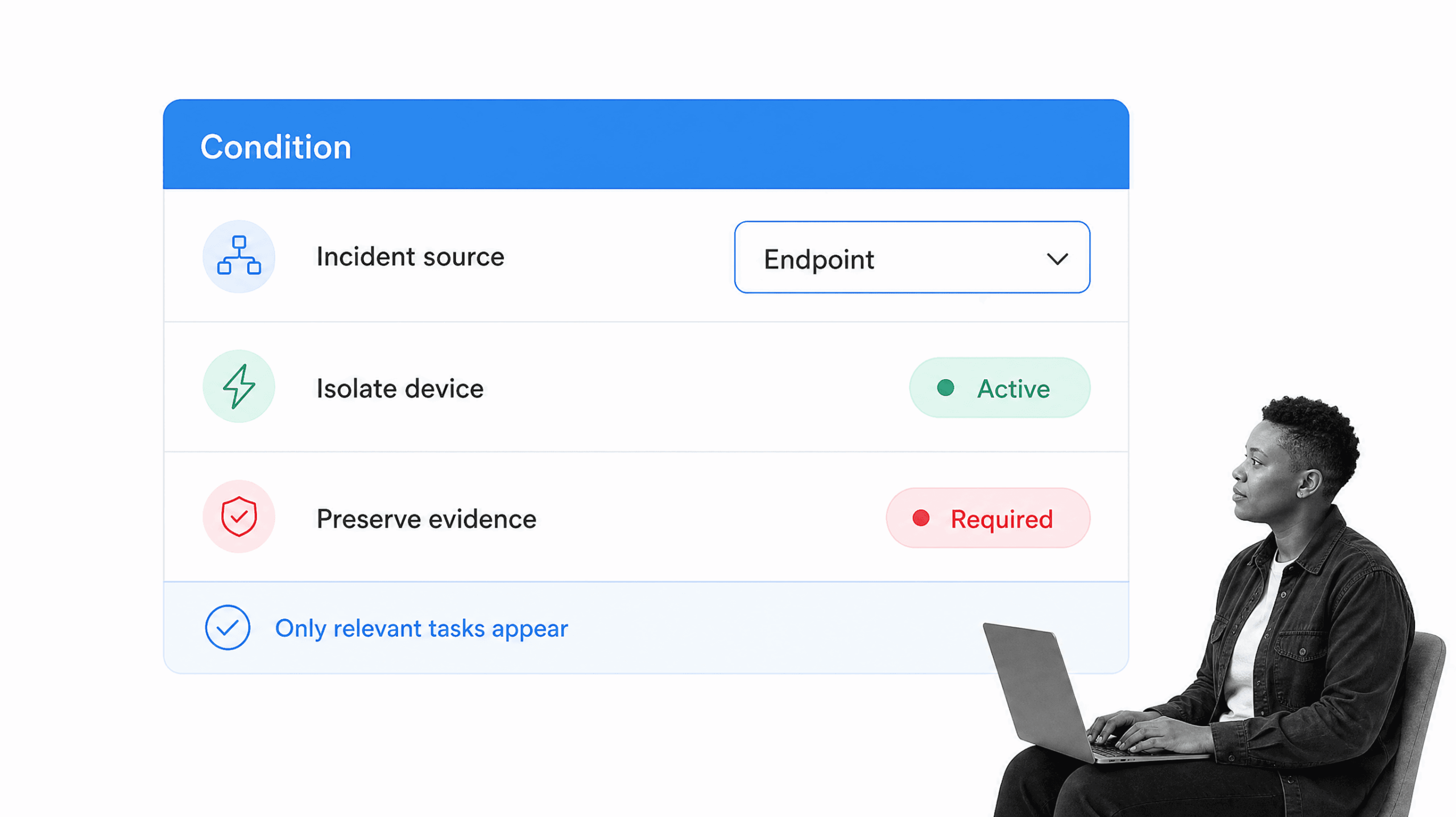
The condition should also carry governance. Record the incident source, severity, affected systems, required evidence, task owner, deadline, and approval path. If the facts change, responders can update the run and expose the next set of actions without losing the audit trail.
Process Street is a single Compliance Operations Platform. Docs capabilities keep incident procedures governed, reviewed, and approved. Ops capabilities turn those procedures into workflows with owners, escalation paths, evidence capture, approvals, and audit trails. Built-in AI helps teams create and improve the workflow without separating documentation from execution.
Process Street also has direct, universal integrations to 5,000+ systems. Need a new one? An AI agent builds it on the fly. That means a SIEM, EDR, service desk, monitoring tool, or ticketing event can start the incident response workflow and pass in the initial facts, while the response remains controlled in one auditable run. See the current Process Street integration framework for details.
Test the plan before you need it. CISA’s incident response plan guidance recommends clarifying roles, maintaining contact lists, reviewing the plan with legal counsel, and conducting tabletop exercises. Use each exercise to find missing access, unclear decisions, stale contacts, and tasks that cannot be completed within the expected response time.
The IT incident response plan, broken down
The exact incident response plan steps vary with your architecture and the nature of the attack. The following structure gives you a repeatable incident response workflow that can be expanded into scenario-specific playbooks. It preserves the four operational jobs responders must complete: diagnose, communicate, control damage, and recover.
Surface-level diagnostics
How do you surface an incident? It may begin with a monitoring alert, suspicious log activity, an employee report, a customer complaint, or a third-party notification. Establish more than one reporting path and make it clear how the IT or security team receives, validates, and prioritizes a potential incident.
Capture enough information to act without delaying containment:
- Summarize the incident, including its suspected scope and affected systems.
- Identify which applications, data stores, identities, and business processes depend on the affected infrastructure.
- Record applicable legal, regulatory, contractual, or notification obligations.
- Map possible ingress and egress points for the affected environment.
- Record the current theories for how the initial compromise occurred.
- Determine whether the affected infrastructure creates risk for customers, partners, or other organizations.
Classify the incident by impact and urgency, but treat the classification as provisional. Scope can change as new evidence appears. Record what is known, what is assumed, who validated it, and when the assessment changed.
Communication with the triage team
Once the minimum information required to investigate is gathered, activate the incident response team. A clear incident manager should own coordination, the clock, decisions, and stakeholder updates. Technical responders can then focus on investigation and containment without also managing every communication channel.
Use the workflow to assign roles, capture emergency contacts, and route approved notifications. Define an out-of-band communication option in case email, chat, identity, or document systems are affected. Keep internal operational updates separate from legal, customer, regulator, law-enforcement, and public communications, because each audience may require different review and timing.
A source-system event can start the workflow automatically and populate the initial evidence. The response team still validates the alert before escalating. Automation should remove avoidable handoffs, not make an unverified alert responsible for high-impact decisions.
Damage control
The proper containment procedure for each incident type should be available in a tested runbook. Common actions include isolating affected systems, disabling compromised identities, preserving volatile evidence, capturing forensic images, blocking malicious infrastructure, protecting clean backups, and removing malware. Sequence matters. A rushed fix can destroy evidence or allow the attacker to move elsewhere.
“Will you remember how to do these things 6 months from now? I find myself having to re-invent a process from scratch if I haven’t done it in a few months (or sometimes just a few days!). Not only do I re-invent the process, I repeat all my old mistakes and learn from them again. What a waste of time.” Tom Limoncelli
Containment is often iterative. A temporary action may stop immediate damage while a longer-term remediation is prepared. Document why each action was chosen, who approved it, which evidence was preserved, and what conditions allow the organization to move into eradication and recovery.
Analysis and recovery
Analysis and recovery should be methodical and evidence-led. In a malware case, special equipment may be required. Security practitioner Lenny Zeltser recommends using an isolated laboratory system and breaks the malware analysis process into practical areas:
- Examine static properties and metadata.
- Perform behavioral analysis by observing interactions with the environment.
- Use static code analysis to understand the specimen’s internal logic.
- Use dynamic code analysis to investigate behavior that is difficult to infer statically.
- Unpack the specimen on an isolated lab system when necessary.
- Perform memory forensics on the infected lab system.
Recovery is more than bringing a service back online. Validate that the threat has been removed, credentials and persistence mechanisms have been addressed, restored systems are monitored, business owners accept the residual risk, and normal operations can resume safely. Define the success criteria before the incident so the decision does not depend on pressure in the moment.
Finish with a post-incident review. Build a timeline, identify which controls worked, document the root causes and contributing conditions, assign corrective actions, and update the plan, playbooks, training, monitoring, and workflow. NIST’s current model makes this feedback explicit: lessons learned improve preparation and cybersecurity risk management before the next incident.
Aftermath analysis should compare the actual incident with the assumptions in the plan, confirm that emergency contact names and email addresses are current, and identify any account or access changes that remain. Teams should be able to customize the workflow, add other staff when specialist review is required, and preserve a complete record of what changed.
Incident response depends on related IT runbooks. Useful supporting workflows include Information Security Incident Response, Network Security Audit, Firewall Audit, Patch Management, Client Data Backup Best Practices, Privileged Password Management, IT Service Call Process, and Vendor Management: Supplier Evaluation. Depending on the environment, the supporting process library may also cover monthly, quarterly, and yearly website maintenance; server maintenance and server security; SQL Server audit checks; network administrator daily tasks; VPN configuration; Apache and email server security; penetration testing; scheduled maintenance notifications; computer and inventory management; virtual private server setup; IT support and helpdesk management; and vendor contract negotiation. These are separate processes, but their owners, escalation paths, evidence, and recovery dependencies should be mapped before an incident.
Incident response plan FAQs
What should an incident response plan include?
An incident response plan should define scope, severity levels, response roles, decision authority, reporting paths, communication channels, evidence handling, legal and notification obligations, containment and recovery criteria, and the post-incident review process. Scenario-specific playbooks should sit beneath the plan.
What is the difference between an incident response plan and a playbook?
The plan defines the organization-wide operating model for incident response. A playbook gives responders detailed actions for a specific incident type, system, or threat. The plan stays relatively stable, while playbooks change as systems, threats, and controls change.
How often should an incident response plan be tested?
Run tabletop exercises on a regular schedule and after material changes to systems, vendors, team responsibilities, or legal obligations. Review contact details and access more frequently. Every real incident and exercise should produce assigned improvements to the plan and playbooks.
Who should be on an incident response team?
The core team usually includes an incident manager, security and IT responders, system owners, and communications support. Legal, privacy, compliance, human resources, customer support, vendors, insurers, executives, and law enforcement may join depending on the incident.
What happens after an incident is contained?
After containment, responders eradicate the threat, validate recovery, monitor for recurrence, complete required notifications, preserve evidence, and run a post-incident review. The review should create owned corrective actions and update the workflow before it is used again.