Turn every policy into automated workflows with built-in enforcement and audit-ready proof.



What Is Agentic AI?
What is agentic AI? Agentic AI is artificial intelligence that can pursue a goal, make a plan, use tools, take actions, and adapt from feedback with limited human supervision. Instead of only generating an answer, agentic AI moves work forward inside defined constraints.
That shift matters because most business value does not come from another paragraph of text. It comes from getting the right task done, in the right system, with the right evidence, approval, and control.
This guide explains what agentic AI is, how it works, how it differs from generative AI, where it fits in business operations, and how to make AI agents useful without losing human control.
In this article, we are going to cover:
- What is agentic AI?
- What is agentic AI in practice?
- How agentic AI works
- Agentic AI versus generative AI
- Where agentic AI fits in business operations
- Risks and guardrails for agentic AI
- How Process Street makes agentic AI operational
- FAQs
What is agentic AI?
Agentic AI is AI designed to act toward a goal, not just respond to a prompt. A standard generative AI tool produces text, images, code, or summaries. Agentic AI adds planning, tool use, memory, decision logic, and action.
IBM describes agentic AI as systems that can accomplish goals with limited supervision, while Google Cloud agentic AI architecture guidance frames an agent as an application that reasons with tools and acts toward a goal. The practical definition is simple: agentic AI can do work, not only describe work.
A plain-language definition
Agentic AI is a software system that receives an objective, breaks it into steps, chooses tools, executes actions, checks results, and continues until the goal is complete or until a guardrail requires human review.
For example, a non-agentic AI assistant might summarize a vendor risk policy. An agentic AI system could read a new vendor intake, check missing evidence, open the right workflow, request documents, flag a high-risk exception, and wait for approval before release.
Why the word agentic matters
The word agentic points to agency: the ability to choose and act within boundaries. In business software, that means the AI has access to tools, data, workflows, and decision rules. It can coordinate steps rather than answer one isolated question.
That is why agentic AI sits close to workflow automation software, process automation, and governed execution systems. The agent needs somewhere reliable to act, especially when the pattern starts to look like an AI coworker operating inside daily team workflows.
What is agentic AI in practice?
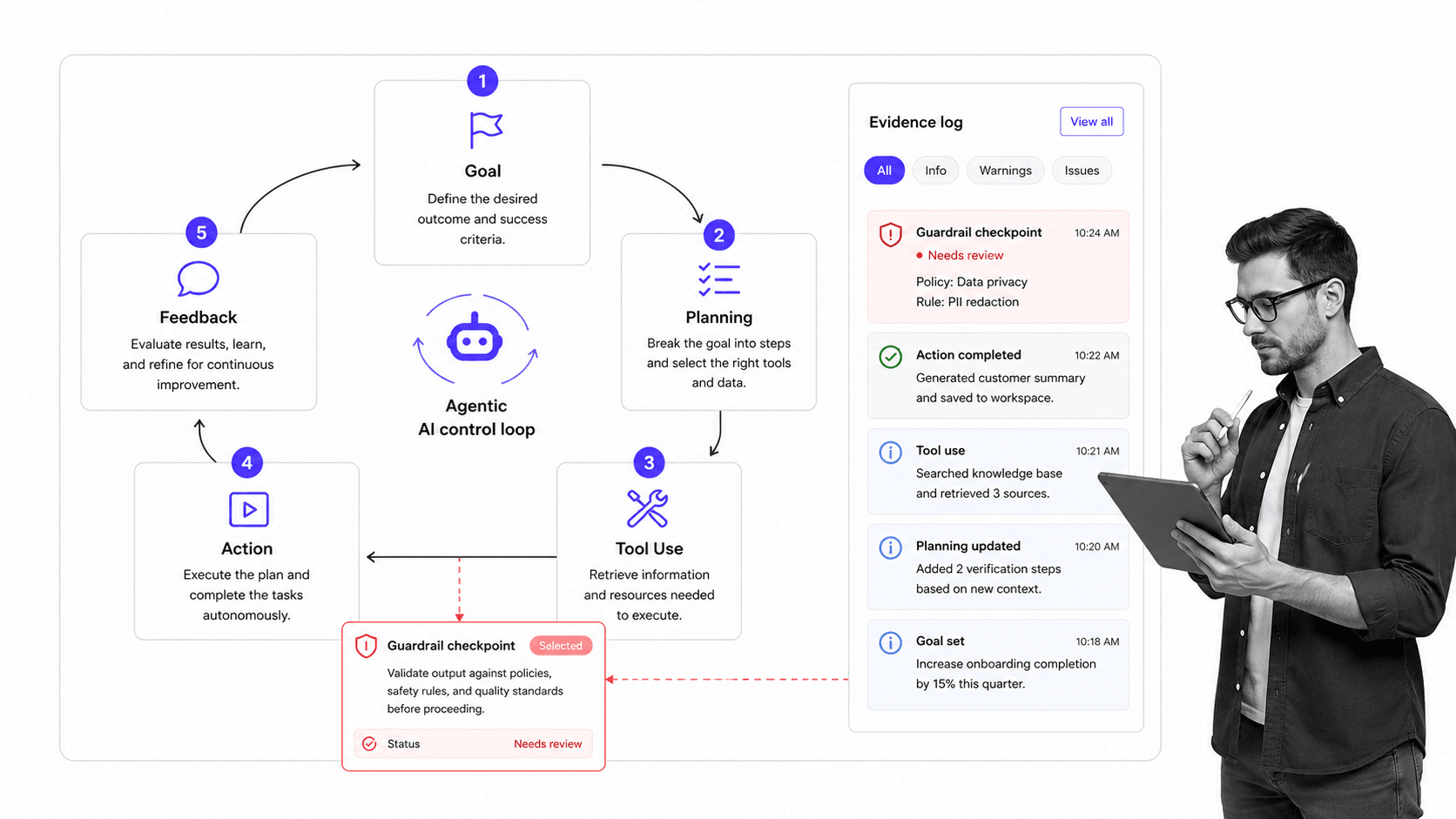
AI becomes agentic when it has four capabilities: a goal, a planning loop, tool access, and feedback. Without those pieces, the system may be useful, but it is closer to a copilot than an agent.
Goal-directed behavior
An agent needs a goal clear enough to evaluate progress. Vague prompts produce vague action. Useful goals specify the outcome, constraints, risk boundaries, and what counts as done.
Planning and decomposition
Agentic AI breaks work into steps. It can decide that a request requires research, data lookup, validation, drafting, system update, approval, and notification. The agent may re-plan when a tool fails or when the next step depends on new evidence.
Tool use
Tool use is what turns an AI model into an operational actor. Tools can include browsers, databases, SaaS APIs, workflow systems, code editors, email, document stores, calendars, or internal apps. The agent uses those tools to change the state of work.
Feedback and memory
A useful agent checks what happened after it acts. It needs short-term state, sometimes persistent memory, and a way to compare the result with the goal. Without feedback, it cannot tell whether it has completed the work or created a new problem.
The higher the agent’s access, the more the workflow needs explicit control points. That is the lesson behind AI agents with real access: real access requires real review, not just better prompting.
How agentic AI works
Agentic AI works through an operating loop: understand the goal, plan the work, choose a tool, act, observe the result, and either continue or escalate. The loop can be simple for narrow tasks or complex for multi-step business processes.
1. The goal is set
The user, workflow, or system gives the agent an objective. Good agent goals include boundaries. For example: classify this vendor, collect missing documents, route any high-risk item for approval, and do not finalize the record until a human signs off.
2. The agent builds a plan
The agent decomposes the goal into smaller actions. It may need to gather context, inspect prior work, check a policy, choose a workflow, assign a task, generate a response, or update a system.
3. The agent uses tools
The agent uses approved tools to execute each step. In a governed environment, tool permissions matter. A read-only lookup is low risk. Updating customer data, sending email, approving spend, or changing a compliance record needs stricter controls.
That control layer is where compliance operations and compliance management software become important. The agent should act inside a process that records owners, actions, approvals, exceptions, and evidence.
4. The system checks results
The agent observes what changed and compares it with the goal. If the result is incomplete, it continues. If the result is risky, uncertain, or outside its permission boundary, it escalates to a person.
Agentic AI versus generative AI
Generative AI creates outputs. Agentic AI uses outputs as part of an action loop. The distinction is not always clean because many agentic systems use generative models as their reasoning engine, but the job is different.
Generative AI answers
Generative AI is useful for writing, summarizing, brainstorming, coding, classifying, extracting, and explaining. It responds to a prompt and produces an output. The user then decides what to do with that output.
Agentic AI acts
Agentic AI takes responsibility for part of the execution path. It may search, compare, update, create, assign, notify, and check. The human still owns accountability, but the AI carries more of the work between intention and completed action.
A quick comparison
- Generative AI: Drafts a vendor-risk summary from uploaded documents.
- Agentic AI: Opens the vendor review workflow, checks missing evidence, drafts the summary, routes exceptions, and waits for approval.
- Generative AI: Explains a policy.
- Agentic AI: Checks whether an active workflow is following that policy.
- Generative AI: Suggests next steps.
- Agentic AI: Creates the next task and assigns it to the right owner.
MIT Sloan explanation of agentic AI makes a similar distinction between individual agents and broader multi-agent orchestration. In practice, most business teams use the terms loosely, so the better question is not the label. It is what the system is allowed to do.
Where agentic AI fits in business operations
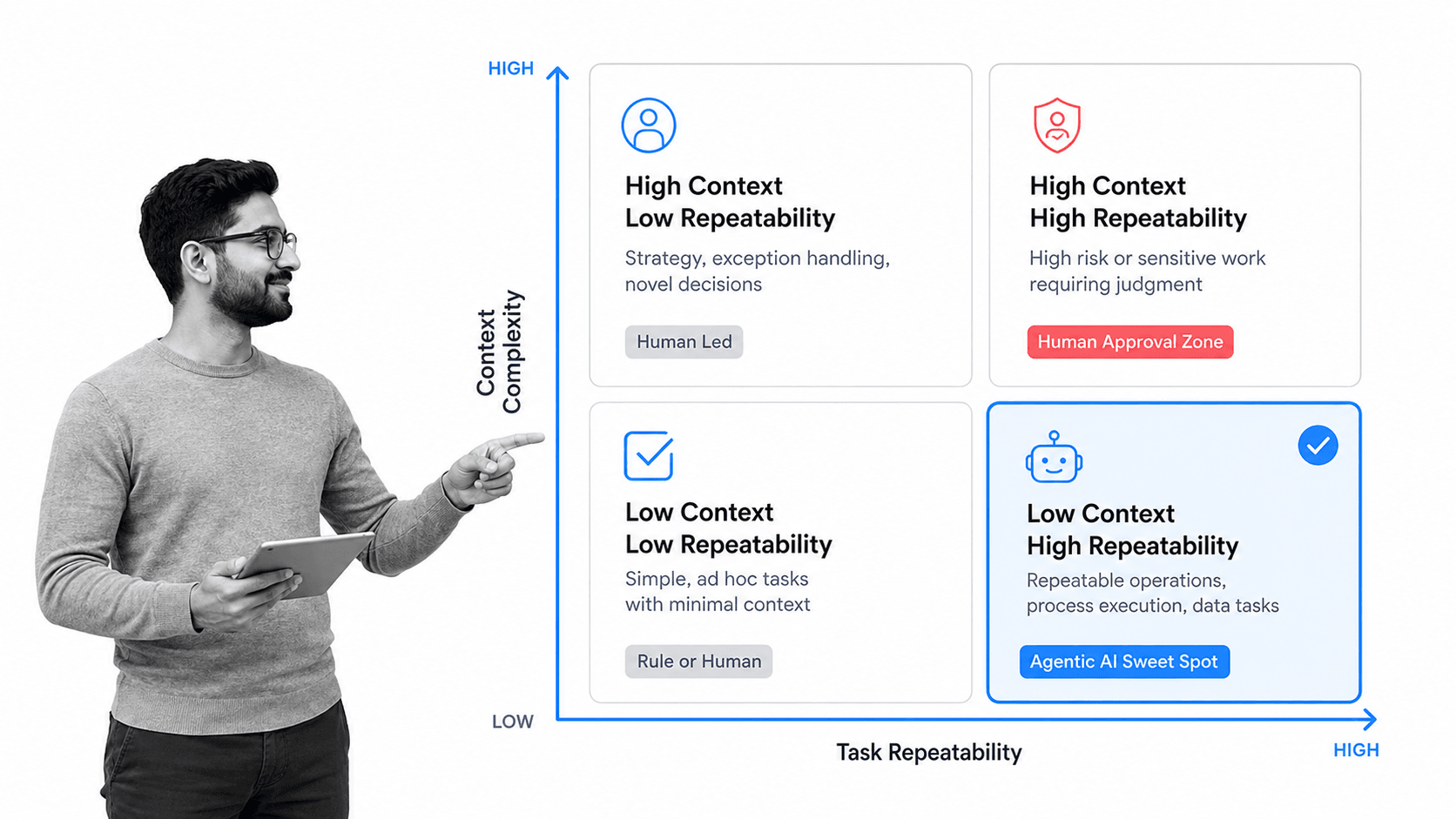
Agentic AI fits best where work is repeatable, high-context, tool-heavy, and expensive to coordinate manually. It is weakest where decisions are ambiguous, irreversible, emotionally sensitive, legally constrained, or poorly defined.
Strong use cases
- Compliance evidence collection: Find missing documents, request updates, route exceptions, and log proof.
- Customer onboarding: Launch the right workflow, collect forms, update systems, and escalate blocked steps.
- Employee onboarding: Coordinate IT, HR, policy acknowledgments, training, and approvals.
- Vendor management: Check risk inputs, request documentation, and route high-risk vendors for review.
- Incident response: Gather facts, assign owners, start response checklists, and preserve timelines.
- Recurring operations: Run repeated processes where the steps are known but the context changes each time.
Teams already using business process automation, standard operating procedure software, or the internal audit checklist can treat agentic AI as an execution layer on top of structured procedures.
For risk-heavy workflows, a starting point like a risk management process template helps teams define the review path before adding autonomy.
Weak use cases
Agentic AI is a poor fit when the process is not understood, the data is unreliable, the permission model is vague, or the organization cannot say who is accountable when the agent is wrong.
If a human cannot describe the desired workflow, the agent will usually automate confusion. The best agentic AI deployments start with a strong process spine, then add autonomy where the process can absorb it.
Risks and guardrails for agentic AI
The main risks of agentic AI come from action, not conversation. A bad answer is a quality problem. A bad action can change records, send messages, expose data, skip approvals, or create a compliance failure.
Tool-use risk
Every tool expands what the agent can do. A browser tool, database tool, email tool, or workflow tool should have scoped permissions. The agent should get the minimum access required for the job.
Delegation risk
Agentic systems can chain tasks across tools or other agents. That creates delegation risk: who asked for the action, which agent performed it, what tool was used, and which human approved the step?
The Cloud Security Alliance agentic AI profile builds on the NIST AI Risk Management Framework and focuses on governance for autonomous AI deployments. That direction matches the operational reality: autonomy needs controls.
Evidence risk
If the agent acts but does not leave evidence, the business cannot prove what happened. Audit history, approvals, timestamps, source records, and exception notes should be captured by default.
Human approval gates
The answer is not to ban agents from meaningful work. The answer is to place approval gates at the right points: high-risk decisions, external communication, regulated actions, financial approvals, data deletion, and anything with legal or customer impact.
The NIST AI governance playbook points to practical governance actions around roles, risk controls, monitoring, and review. The same discipline applies to operations: know what the agent can do, know what it cannot do, and record the evidence.
How Process Street makes agentic AI operational
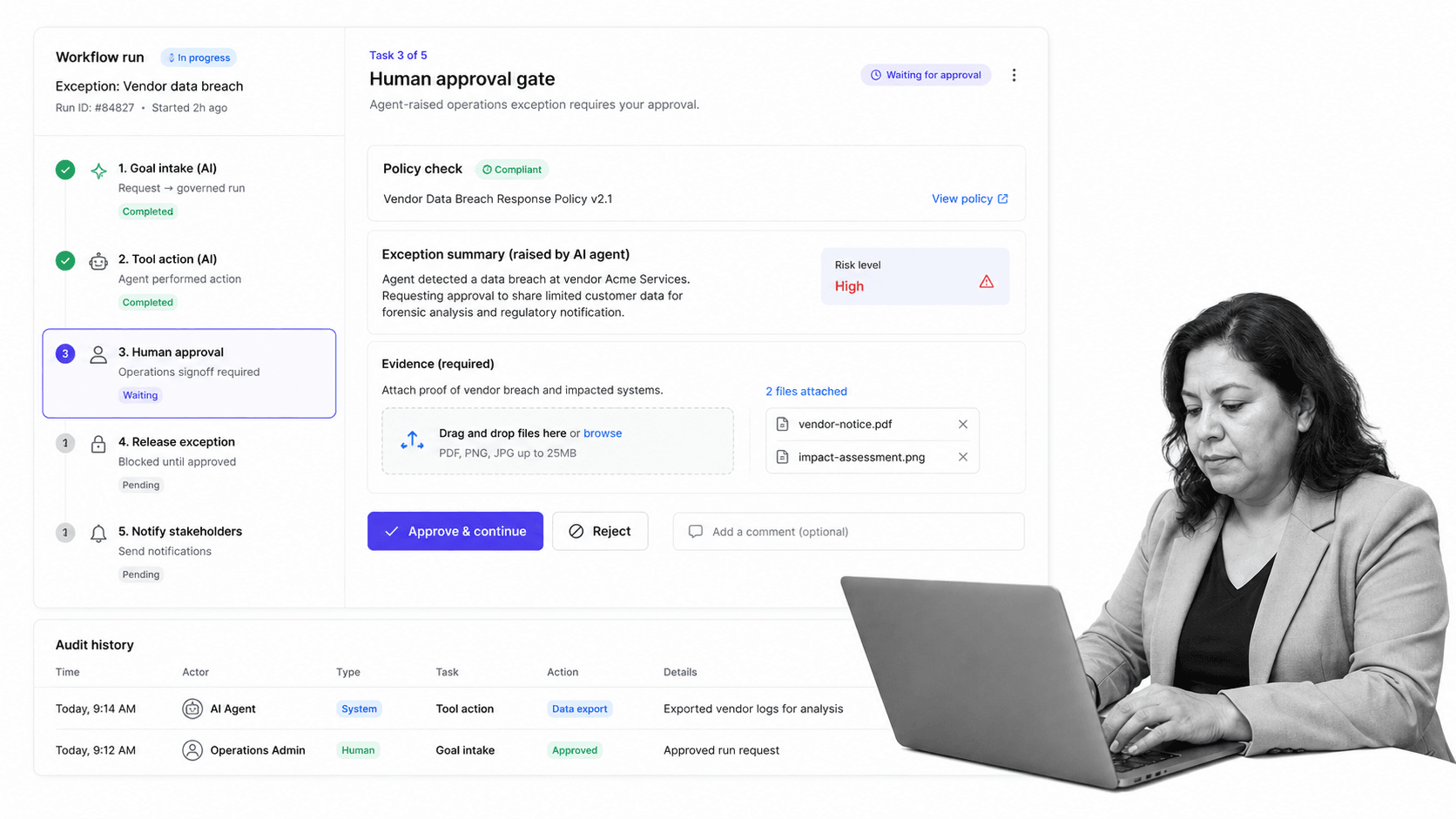
Process Street makes agentic AI operational by giving agents a governed workflow environment: tasks, owners, approvals, evidence, audit history, integrations, and clear escalation paths.
That matters because agentic AI should not float above the business as an unsupervised chat layer. It should run inside the same processes people already trust for compliance, operations, quality, onboarding, and customer work.
Give agents a process spine
A workflow gives the agent a known path: what to do first, what evidence to collect, who owns each step, when to escalate, and what counts as complete. The agent can handle variation, but the process keeps the work legible.
Use approvals for sensitive action
With Approvals, sensitive steps can require a human decision before the workflow continues. This keeps agentic AI useful without giving it unchecked authority.
Connect work across systems
Process Street has direct, universal integrations to 5,000+ systems. Need a new one? An AI agent builds it on the fly. That lets agentic workflows connect the systems where work actually happens while keeping the control surface in one place.
Preserve proof by default
Every agent action should leave a record. Process Street turns that requirement into normal workflow behavior: task history, assigned owners, uploaded evidence, approvals, comments, due dates, and completion data.
Templates such as the risk management process template and features such as Workflow Run Links make it easier to turn a recurring request into a governed run instead of a one-off chat.
FAQs
What is agentic AI?
Agentic AI is artificial intelligence that can pursue a goal, plan steps, use tools, take actions, and adapt from feedback with limited human supervision. It differs from ordinary generative AI because it moves work forward rather than only producing an answer.
How does agentic AI work?
Agentic AI works through a loop: understand the goal, plan the work, choose tools, act, observe the result, and continue or escalate. The strongest implementations also include permission limits, human approval gates, and evidence capture.
What is the difference between agentic AI and generative AI?
Generative AI creates outputs such as text, code, summaries, or images. Agentic AI uses those capabilities inside an action loop, so it can complete tasks across tools and systems under defined guardrails.
What are examples of agentic AI in business?
Business examples include vendor review agents, onboarding agents, compliance evidence agents, incident response agents, customer support resolution agents, and operations agents that launch workflows, collect inputs, update systems, and route exceptions.
What are the risks of agentic AI?
The biggest risks are incorrect actions, excessive permissions, weak audit trails, poor data quality, unclear accountability, and skipped human review. The fix is not less structure. It is clearer workflows, scoped tools, approval gates, and evidence by default.
How does Process Street support agentic AI?
Process Street supports agentic AI by giving agents a governed workflow environment. Agents can act inside structured processes with tasks, approvals, evidence collection, audit history, and integrations, while humans keep control over sensitive decisions.