





I gave my AI agents real access to my systems for a month. Not a sandbox, not a demo. Actual access to the tools I run my company on. Here is what actually broke, and what I learned building the guardrails that made giving AI agents real access safe.
The first surprise was what did not break. The model. The model was almost never the problem. It read context well, it reasoned through messy inputs, it drafted work that was genuinely useful. If you had told me a year ago that the language model would be the easy part, I would not have believed you. But that is where we are.
Reading is safe. Doing is where it breaks.
What broke was the moment an agent moved from reading to doing.
Reading is safe. An agent can scan an inbox, summarize a thread, pull a record, cross-reference a document, and the worst case is a wrong summary you can ignore. The danger starts at the first irreversible action. The email that sends. The record that updates. The file that gets deleted. The message that goes to a customer. The things you cannot take back. This is the same line that separates a helpful assistant from a true AI coworker you can actually hand work to.
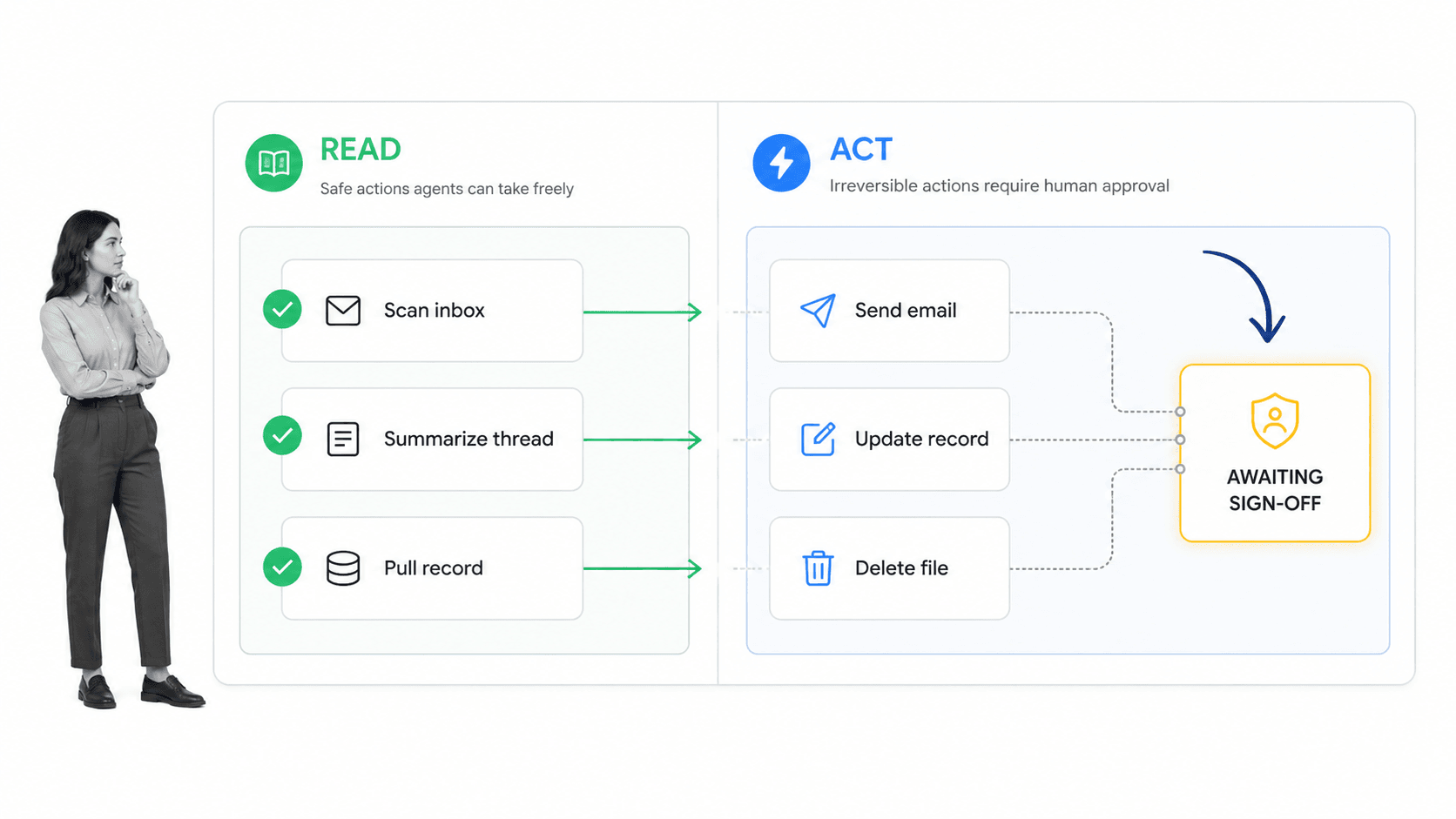
For a while I tried to fix this the way most people do. With smarter prompts. More instructions, more guardrails written in natural language, more “always confirm before you” and “never do X.” That was the wrong instinct. A prompt is a suggestion, not a boundary. The fix was not a better answer. It was a structural line the agent could not cross on its own.
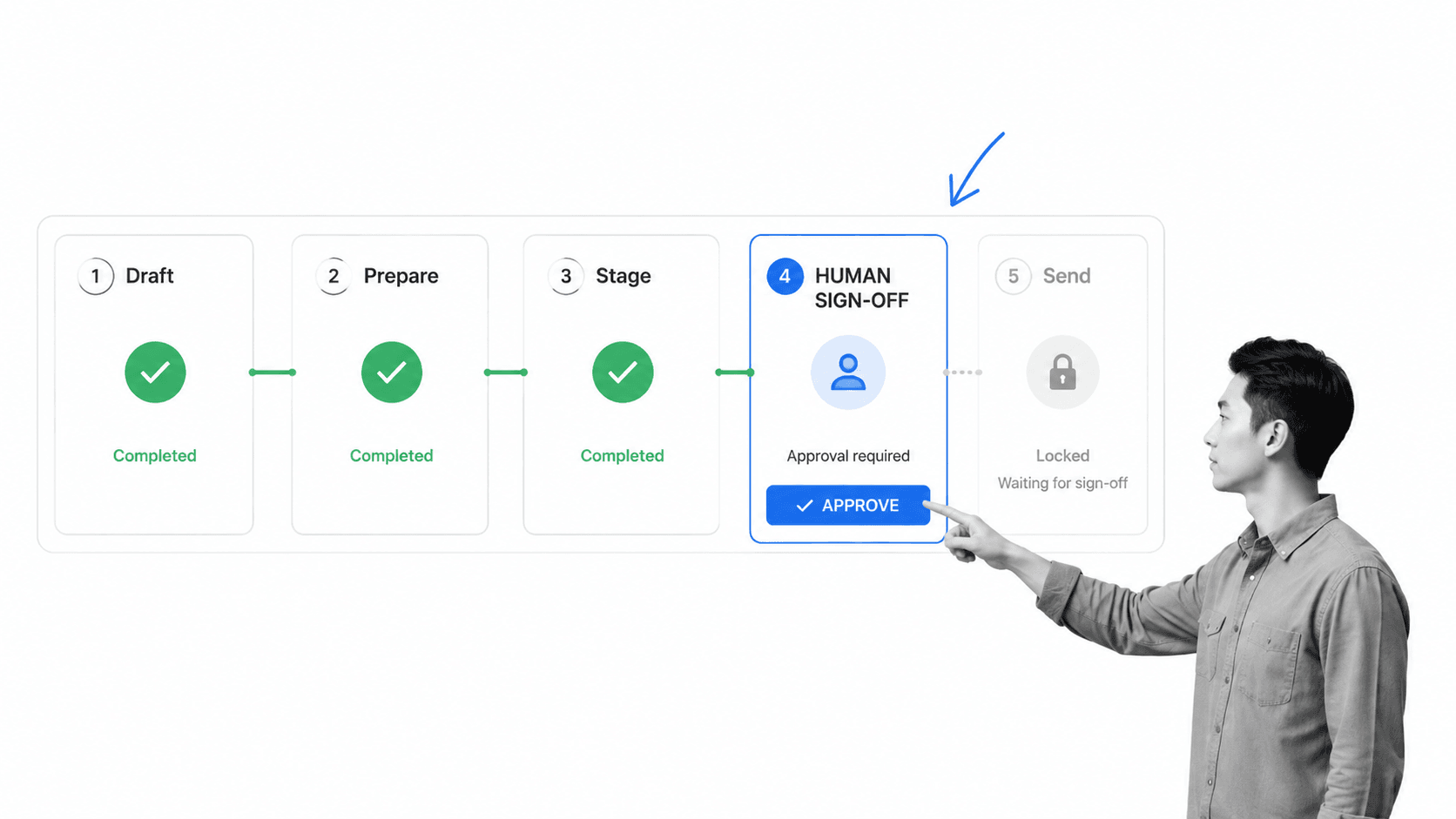
So I put an approval gate on every irreversible action. The agent does all the work right up to the edge. It drafts the email, prepares the update, stages the change. Then it stops and waits for a human to sign off before anything goes out the door. The work happens autonomously. The commitment does not. If you have ever set up approval tasks in a real workflow, this will feel familiar, because it is the same idea applied to an agent.
Trust comes from knowing where it stops
Two things changed once the gate was in place.
The first is that I started trusting it. Not because it became suddenly, always right. It did not. I trusted it because I always knew exactly where it would pause. Trust in an autonomous system does not come from the system being perfect. It comes from knowing the precise place it will stop and ask. A teammate you trust is not one who never makes a judgment call you would have made differently. It is one who knows which decisions are theirs and which ones are yours.
The second is that it got predictable. And predictability beat perfection every single time. A brilliant agent that might do anything is more frightening than a competent one that always does the same thing in the same place. Predictability is what lets you actually delegate, because you can reason about the worst case.
The lesson I keep coming back to is that the unlock is not more autonomy. It is bounded autonomy. An agent that knows where to stop is worth far more than one that can do everything. The whole industry is racing to make agents that can do more. The harder and more valuable problem is making agents that know where not to.
Agents need the same infrastructure human teams need
This is not a new idea. It is the same spine real operations have always run on. Every well-run company already works this way. Documented steps that anyone can follow, plus a human sign-off at the points that carry real consequence. A purchase over a threshold gets approved, the way a purchase order workflow routes a request to a manager before money moves. A contract gets reviewed before it is signed. A release gets a final check before it ships. We did not invent approval gates for AI. We just rediscovered that agents need the exact same operational infrastructure that human teams have always needed: a clear process, and a defined place where a person stays in the loop.
That is the part most people skip. They focus on the intelligence and ignore the infrastructure. But an agent without documented processes is improvising, and an agent without gates is unsupervised. Neither is something you want touching your real systems. The intelligence is necessary. It is not sufficient.
This is exactly what we are building at Process Street. The operational layer that lets AI act, not just chat, with the documented processes and the approval gates that make acting safe. Agents that do the work, inside the same systems your team already trusts, stopping at the points where a human needs to decide. It is the difference between a chatbot that talks about your policy and an AI compliance agent that operates inside it and proves the work was done.
If you are experimenting with giving agents real access, my advice is simple. Start with read. Map every irreversible action. Put a gate in front of each one. Then widen the gate slowly, only where the agent has earned it. You will end up trusting it more, not less, precisely because you built in the place where it stops.
The future of useful AI is not an agent that can do anything. It is an agent that knows exactly where to stop.