Operations Technology: A Complete Guide
Operations technology is the connected set of software and systems a company uses to run, automate, and govern its day-to-day operations. It is the toolset that turns how work should happen into how work actually happens, covering everything from documented procedures and workflow automation to reporting, integrations, and the AI layer that now sits on top of all of it.
The phrase gets used two different ways, and the difference matters. In industrial settings, “operational technology” refers to the hardware and control systems that run physical machinery on a factory floor or a power grid. In the broader business world, operations technology means the stack of applications that operations, compliance, finance, and quality teams rely on to coordinate work across people and tools. This guide focuses on that second meaning: the operating stack behind modern business operations.
Get the stack right and work moves faster, mistakes get caught earlier, and you can prove what happened when an auditor or a customer asks. Get it wrong and you end up with disconnected tools, manual handoffs, and process knowledge trapped in a few people’s heads. Below is a practical map of what operations technology includes, how the layers fit together, how to build and evaluate a stack, and where AI is taking it next.
In this article, we cover everything you need to know about operations technology, including:
- What is operations technology?
- Operations technology vs operational technology and IT
- The core layers of an operations technology stack
- Key categories of operations technology
- How to build an operations technology stack
- How to evaluate operations technology
- How AI is reshaping operations technology
- Operations technology, governance, and compliance
- FAQs
What is operations technology?
Operations technology is the layer of tools that coordinates how a business executes repeatable work. It answers three questions at once: what is supposed to happen, whether it actually happened, and how you would prove it. A mature operations technology stack captures procedures, drives the tasks that carry them out, connects the systems where the work lives, and produces a record that leadership and auditors can trust.
Think of the operations team at a mid-sized insurer. Underwriting reviews, vendor onboarding, claims handoffs, and quarterly access reviews all follow defined steps. Operations technology is what keeps those steps consistent across dozens of people, surfaces a stalled task before it becomes a missed deadline, and updates the systems of record automatically instead of relying on someone to remember. Without it, the same procedures live in scattered documents, email threads, and spreadsheets, which is where process drift and audit surprises come from.
The category has grown well beyond simple task lists. A modern stack blends document governance, workflow management software, integrations that reach into every other business system, analytics, and increasingly a built-in AI layer that watches execution and flags risk. The through-line is execution: operations technology is judged less by how well it stores information and more by whether it makes the right work happen by default.
Operations technology vs operational technology and IT
Three terms sit close together and get confused constantly. Separating them makes it much easier to know which vendors, teams, and risks you are actually dealing with.
Operational technology (OT)
Operational technology, usually abbreviated OT, is the hardware and software that directly monitors and controls physical equipment: programmable logic controllers, SCADA systems, industrial sensors, and the machinery on a production line. Industry analysts define it as technology that detects or causes change by directly monitoring physical devices and processes. If you work in manufacturing, energy, utilities, or transportation, OT security is a serious discipline of its own. The United States government publishes detailed guidance on protecting these environments, such as the NIST guide to operational technology security.
Information technology (IT)
Information technology manages data: the servers, networks, applications, and endpoints that store, process, and move information across a business. As industrial systems get connected to corporate networks, IT and OT increasingly overlap, a shift analysts describe as IT and OT convergence. Vendors like IBM and Splunk publish primers that walk through the distinction in depth.
Operations technology (business operations)
Operations technology, the subject of this guide, sits above both. It is the business software that runs the operational work of the company: process documentation, workflow automation, approvals, integrations, and reporting. Where OT controls machines and IT manages data, operations technology coordinates people and procedures. A quality manager mapping an ISO 9001 process is working in operations technology. A plant engineer tuning a control system is working in OT. Both matter, and in connected businesses they feed each other, but they are governed and bought very differently.
The core layers of an operations technology stack
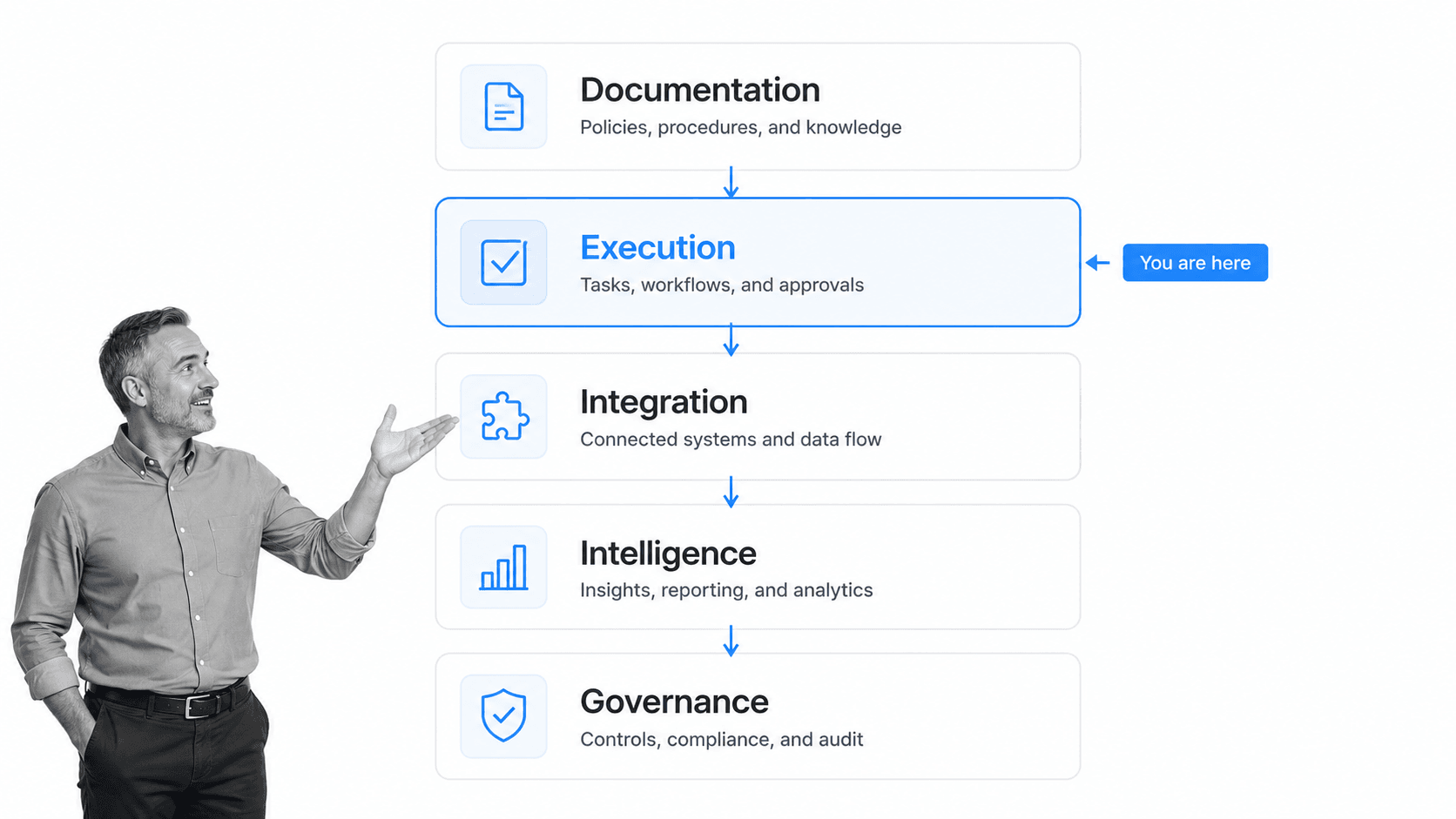
A well-designed operations technology stack is not a pile of apps. It is a set of layers that build on each other, so that documentation drives execution, execution produces data, and data feeds improvement. Five layers show up in almost every strong stack.
1. The documentation layer
Everything starts with a governed source of truth for how work should be done. This is where policies, standard operating procedures, and controls are authored, versioned, and approved. A documentation layer that is disconnected from execution rots quickly, which is why the strongest stacks link documents directly to the workflows that use them.
2. The execution layer
The execution layer turns procedures into running workflows. Tasks get assigned, deadlines get tracked, work escalates when it stalls, and conditional logic routes each case down the right path. This is the heart of operations technology because it is where a documented standard becomes enforced behavior rather than a suggestion. Tools in this layer range from workflow management systems to case management and project coordination platforms.
3. The integration layer
Operations rarely happen inside one tool. The integration layer connects the operations stack to systems of record such as your CRM, ERP, HR platform, and e-signature provider, so that completing a task updates the right record without a manual copy and paste. Modern operations platforms offer thousands of direct connections plus API access, and the best of them can now assemble new integrations on the fly.
4. The intelligence and reporting layer
Execution generates data, and this layer turns it into insight: dashboards of task status, cycle-time reports, bottleneck detection, and audit-ready logs. Increasingly this is also where a built-in AI layer lives, monitoring activity and surfacing risks or missed steps in real time rather than during an annual review.
5. The governance and control layer
The final layer ties everything back to accountability: role-based access, approval and certification cycles, retention rules, and the audit trail that proves each control operated. In regulated industries this layer is not optional, and it is the reason many teams choose an operations platform with governance built in rather than bolting compliance onto a general workflow tool.
Key categories of operations technology
Within those layers, operations technology spans several recognizable software categories. Most companies run a few of these, and the goal is for them to work together rather than compete for ownership of the same process.
- Business process management and workflow automation. The engines that model, run, and monitor repeatable processes. Learn more in this overview of what a workflow is and how it is managed.
- Document and knowledge management. Governed repositories for SOPs, policies, and process documentation that stay current as the business changes.
- Compliance and quality management. Systems that operationalize frameworks and standards, from a quality management system to a compliance management platform.
- Enterprise resource planning and systems of record. The financial, HR, and supply-chain backbones that operations workflows read from and write to.
- Industry-specific operations software. Vertical tools such as manufacturing management software, job management software, and energy management software tuned to a single sector’s operations.
- Integration and automation platforms. The connective tissue that keeps data flowing between everything above.
The categories a given company needs depend on its industry and risk profile. A software firm may lean on workflow automation and integrations, while a healthcare or financial services operation will weight compliance, quality, and governance far more heavily.
How to build an operations technology stack
Building an operations technology stack is a sequence, not a shopping spree. Buying tools before you understand your processes is the fastest way to end up with expensive software nobody uses. These steps keep the effort grounded in real work.
Step 1: Map your critical processes
Start by listing the operational processes that carry the most risk or consume the most time: onboarding, approvals, audits, incident handling, and the recurring reviews that keep the business compliant. Document how each one runs today, including the steps that only live in someone’s memory. Ready-made business process templates can accelerate this without starting from a blank page.
Step 2: Standardize before you automate
Automating a broken process just makes the mess run faster. Turn each mapped process into a clear standard operating procedure first, agree on the correct path, then decide what to automate. This is also the moment to retire steps that no longer serve a purpose.
Step 3: Choose an execution core
Pick the platform that will run your workflows as the center of the stack. Whether the first use case is employee onboarding, vendor management, or customer onboarding, choose a core that enforces steps, supports conditional logic, and produces an audit trail by default. Everything else in the stack should connect to it.
Step 4: Connect your systems of record
Wire the execution core into the tools where data already lives so work updates records automatically. The fewer manual copies between systems, the fewer errors and the less time lost to reconciliation. Prioritize the integrations that touch your highest-volume processes first.
Step 5: Add oversight and iterate
Layer on reporting and AI monitoring so you can see where work stalls, then feed those insights back into your procedures. A good operations technology program improves continuously, tightening the process every cycle instead of only during an audit. Adopting in phases, one department at a time, keeps the rollout manageable and builds internal proof before you scale.
How to evaluate operations technology
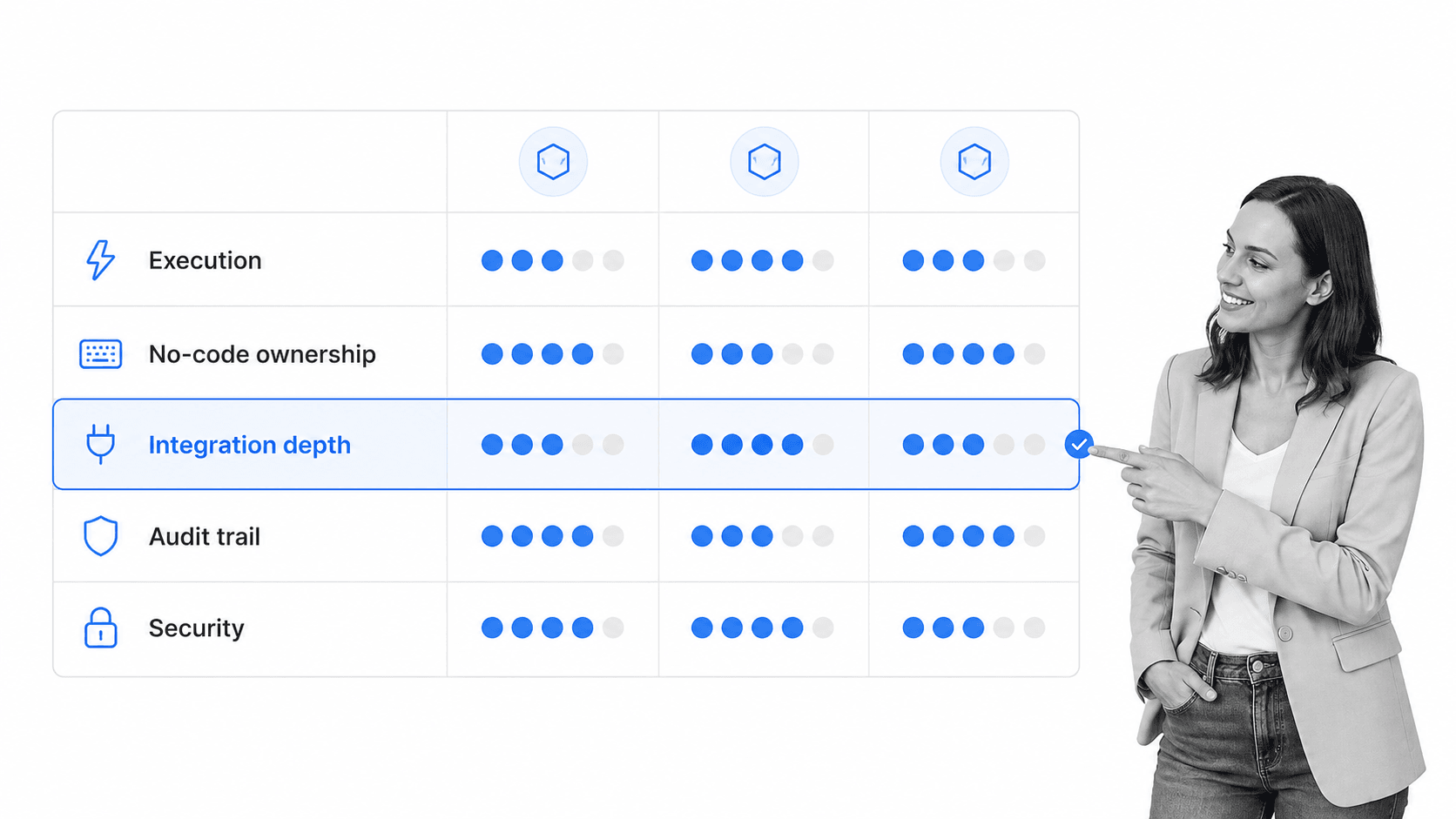
Once you know what you need, evaluating operations technology comes down to a handful of criteria that separate tools that get adopted from shelfware. Weight them against your own risk profile before you compare vendors.
- Execution, not just documentation. Does the tool actually drive and enforce work, or does it only store information? Favor platforms where a completed task reinforces the correct procedure.
- No-code ownership. Can the operations team build and change workflows without waiting on IT? A stack that needs a developer for every edit will fall behind the business.
- Integration depth. How many systems does it connect to natively, and how easily can it reach the rest? Integrations are where an operations stack earns or loses its value.
- Audit trail and access control. Does every action leave a record, and can you enforce role-based permissions? In regulated settings this is non-negotiable.
- Security and certifications. Look for SOC 2 Type II, ISO 27001, HIPAA where relevant, and single sign-on with provisioning support.
- Time to value. How quickly can a team get a real process live? Tools that take months of consulting to deploy rarely deliver on the promise.
- AI capability. Is intelligence built into execution, or is it a bolted-on chatbot? The difference shapes how much the tool will help you over the next few years.
Scoring vendors against a shared list like this, rather than reacting to demos, keeps the decision anchored to the operations problems you actually have.
How AI is reshaping operations technology
AI is the biggest shift in operations technology in years, and it is changing what the stack can do at every layer. The move is away from tools that simply record work toward tools that help perform and govern it.
From documenting work to generating it
Instead of authoring every procedure by hand, teams can now generate draft workflows from a screen recording, a demo, or an unstructured document, then refine them. That collapses the time between identifying a process and having a running, enforceable version of it.
From reporting on risk to catching it live
A built-in AI layer can monitor execution as it happens, flag a skipped step or a stalled approval, and suggest an update when a regulation or a policy changes. This turns oversight from a periodic audit into a continuous safeguard, which is a meaningful change for any team that lives with compliance risk.
From integrations to agentic execution
The frontier is agentic computer orchestration: AI agents that operate real software the way a person would, moving through browsers, email, and internal tools to carry out multi-step work rather than only calling an API. Structured processes give those agents a reliable source of truth to act inside, which is why strong operations technology is becoming the foundation that makes business AI dependable rather than unpredictable.
Operations technology, governance, and compliance
For many organizations, the real payoff of operations technology is not speed, it is proof. When procedures are enforced at the point of execution and every action leaves a record, compliance stops being a fire drill and becomes a byproduct of how work already gets done.
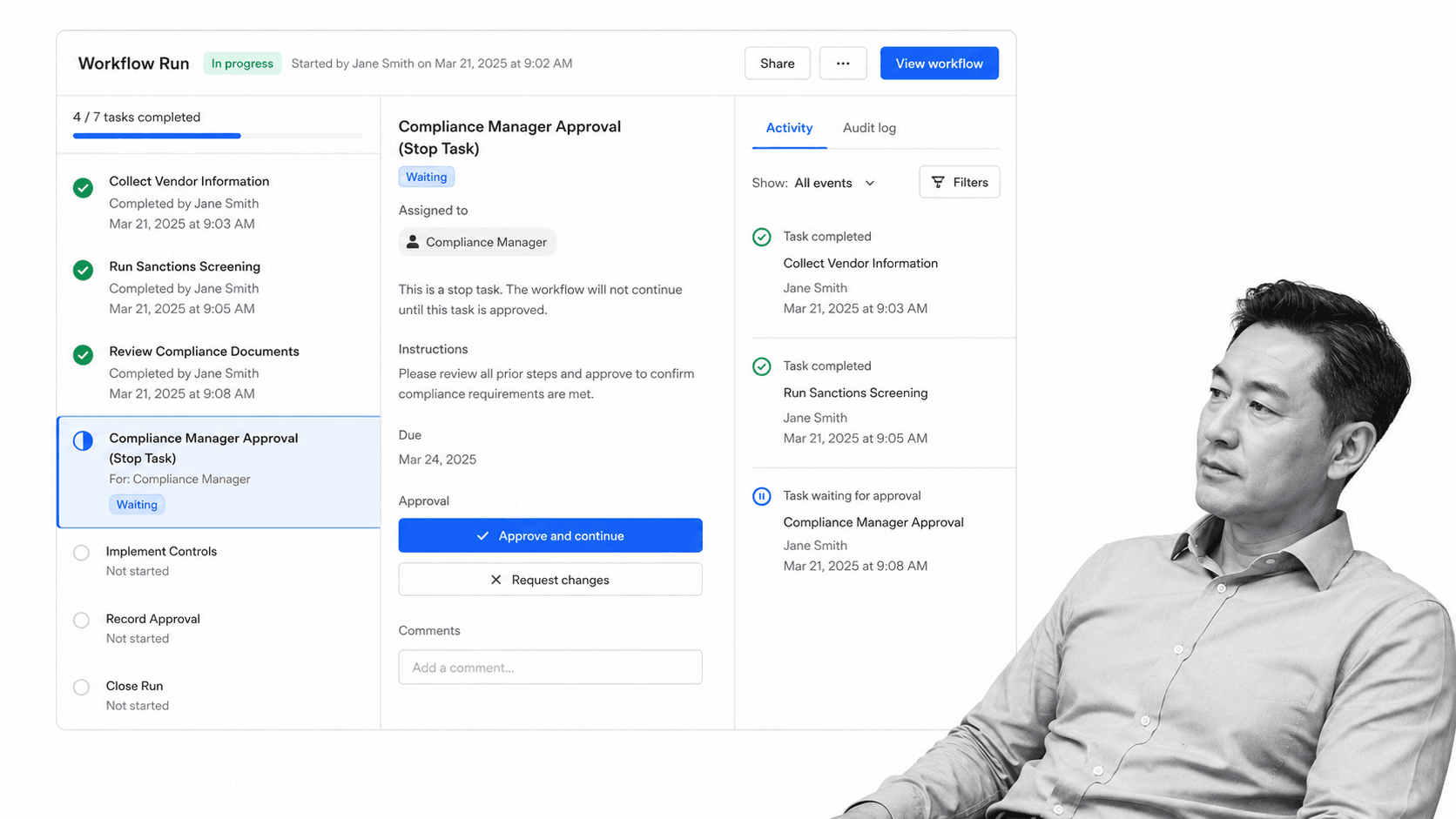
This is the design philosophy behind Process Street, a compliance operations platform that unifies governed documentation, workflow execution, and built-in AI in one system. Docs holds the approved procedures, Ops runs them as automated and auditable workflows, and the AI layer monitors activity to catch risk before it becomes a finding. Because compliance is built into execution rather than bolted on afterward, teams execute correctly by default without memorizing every requirement, and the audit trail is always current.
The practical value shows up across regulated functions. A compliance team can enforce a control every time a workflow runs, an operations leader can see exactly where a process stands, and a quality manager can keep an ISO program continuously audit-ready. If your operations carry consequences when steps are missed, the governance layer is where operations technology pays for itself. You can browse ready-to-run quality management templates or explore the product documentation to see how the pieces fit together.
FAQs
What is operations technology?
Operations technology is the connected set of software and systems a business uses to run, automate, and govern its day-to-day operations. It spans process documentation, workflow automation, integrations, reporting, and the AI layer that monitors execution, coordinating how work happens across people and tools.
What is the difference between operations technology and operational technology?
Operational technology (OT) is the hardware and control systems that run physical machinery, such as SCADA systems and industrial sensors. Operations technology, in the business sense, is the software stack that coordinates people and procedures, including workflow automation, document governance, and reporting. OT controls machines, while operations technology runs business operations.
What tools are part of an operations technology stack?
A typical operations technology stack includes document and knowledge management, workflow automation and business process management, compliance and quality management, systems of record such as ERP and HR platforms, integration and automation tools, and analytics. The strongest stacks connect these layers so documentation drives execution and execution produces auditable data.
How do you build an operations technology stack?
Start by mapping your highest-risk and highest-volume processes, standardize each one into a clear procedure, then choose an execution platform to run your workflows as the core of the stack. Connect that core to your systems of record, add reporting and AI oversight, and adopt in phases one department at a time so each rollout builds proof before you scale.
How is AI changing operations technology?
AI is moving operations technology from recording work to helping perform and govern it. Teams can generate draft workflows from recordings or documents, a built-in AI layer can monitor execution and flag risk in real time, and agentic systems are beginning to operate real software to carry out multi-step work. Structured processes give that AI a reliable source of truth to act within.
Why does operations technology matter for compliance?
When operations technology enforces procedures at the point of execution and records every action, compliance becomes a byproduct of normal work rather than a separate scramble before an audit. Controls run every time a workflow runs, the audit trail stays current, and risk gets caught earlier, which is why regulated teams increasingly choose platforms with governance built in.