Turn every policy into automated workflows with built-in enforcement and audit-ready proof.



Everything You Need to Know About Customer Onboarding

Customer onboarding is the structured process that turns a new buyer into a confident, active customer. It covers the handoff from sales, kickoff, setup, training, first value, feedback, and the ongoing checks that keep the customer moving toward the outcome they bought the product to achieve.
Good onboarding is not a welcome email and a help center link. It is an operating system for the first stage of the customer relationship. The customer knows what happens next, your team knows who owns each step, and every promise made during sales is translated into an executable plan.
For SaaS, services, agencies, and high-touch B2B teams, the goal is simple: reduce confusion, shorten time to value, and create a repeatable path from purchase to adoption. A clear customer success onboarding process also protects retention because the customer sees progress before doubt has time to build.
- What is customer onboarding?
- Why customer onboarding matters
- Customer onboarding best practices
- How to build a customer onboarding process that scales
- Customer onboarding software
- Customer onboarding metrics to track
- Common customer onboarding mistakes to avoid
- Customer onboarding FAQs
What is customer onboarding?
Customer onboarding is the process of helping a new customer learn the product, configure the right setup, understand the value path, and reach their first meaningful result. It begins before kickoff, continues through implementation and training, and ends only when the customer can use the product with confidence.
The exact shape depends on the business. A self-serve SaaS company might focus on in-app setup, lifecycle emails, and activation prompts. An enterprise team might need a kickoff call, stakeholder mapping, security review, configuration tasks, admin training, and executive check-ins. A service business might use onboarding to collect client information, confirm scope, assign owners, and launch recurring delivery.
The common thread is sequence. Customer onboarding turns a messy handoff into a governed path. It connects sales context, customer goals, product setup, training, support, and success milestones into one process that can be repeated and improved. That sequence matters because customers rarely fail all at once. They lose momentum step by step when the path is unclear or ownership is ambiguous across multiple internal teams.
Why customer onboarding matters
A customer buys because they expect a result. Onboarding is where that expectation is either confirmed or weakened. If the first experience is slow, unclear, or generic, the customer starts questioning the purchase before the product has a chance to prove itself.
Effective onboarding improves customer engagement because customers know what to do next. It also improves internal accountability because sales, implementation, support, and customer success are working from the same plan instead of separate notes and inbox threads.
- Faster time to value because customers get guided toward the first useful outcome instead of exploring randomly.
- Fewer support escalations because setup, training, and knowledge base resources are introduced at the right moment.
- Cleaner handoffs because sales context, goals, risks, and promised outcomes are captured before kickoff.
- Higher retention because customers can see progress against the goals that made them buy.
- Better process improvement because the team can identify delays, skipped steps, and recurring blockers.
The biggest onboarding mistakes are rarely dramatic. They are small gaps: an owner is not assigned, the customer repeats information they already gave sales, the kickoff lacks a success definition, or the customer receives training before the product is configured. A documented process prevents those gaps from becoming the customer experience.
Customer onboarding best practices
Strong customer onboarding is practical. It gives the customer enough guidance to move forward, enough context to understand why each step matters, and enough structure that your internal team does not improvise the journey every time.
Understand the customer’s desired outcome
Start with the outcome the customer cares about, not the feature set your team wants to explain. Capture the customer’s goals, pain points, current process, stakeholders, risks, and deadline before kickoff. The goal is to understand what success means in the customer’s words.
This information should not live only in call notes. Put it into the onboarding workflow where the customer success manager, implementation owner, support team, and account owner can all use it.
Set expectations before the handoff
The onboarding process should clarify timeline, owner responsibilities, required inputs, meeting cadence, and what the customer needs to complete before each milestone. Clear expectations reduce anxiety because the customer can see the path ahead.
This is especially important when several teams are involved. Sales may know the business problem. Implementation may know the setup. Customer success may own adoption. Onboarding connects those handoffs so the customer does not feel passed around.
Personalize the first value path
Customers do not need every feature on day one. They need the shortest credible path to a result that proves the product can help them. Use customer goals to decide which feature, workflow, template, report, or training path should come first.
A customer who needs executive reporting should not start with advanced admin settings. A customer who needs repeatable client delivery should not begin with a generic product tour. The onboarding path should match the job they hired the product to do.
Keep communication consistent
Use a consistent mix of welcome email, kickoff agenda, follow-up notes, in-app messages, and shared task lists. A good welcome email confirms the customer made the right decision, then points them to the next concrete step.
The best communication is not more communication. It is communication tied to progress. Every message should answer one of three questions: what happened, what happens next, or what action is needed from the customer.
Use feedback to improve the system
Every onboarding cycle should generate learning. Ask customers where they felt confused, where they waited too long, and which resources were most useful. Feed that learning into your customer feedback system and update the onboarding process when the same issue appears more than once.
Feedback should change the workflow, not just sit in a survey report. If customers consistently miss a setup step, add an approval, automated reminder, or clearer task. If they ask the same question every kickoff, add that answer earlier in the journey.
How to build a customer onboarding process that scales
A scalable onboarding process is specific enough to guide the team but flexible enough to adapt to different customers. Build the default path first, then branch it by segment, complexity, product line, or service tier.
1. Capture goals before kickoff
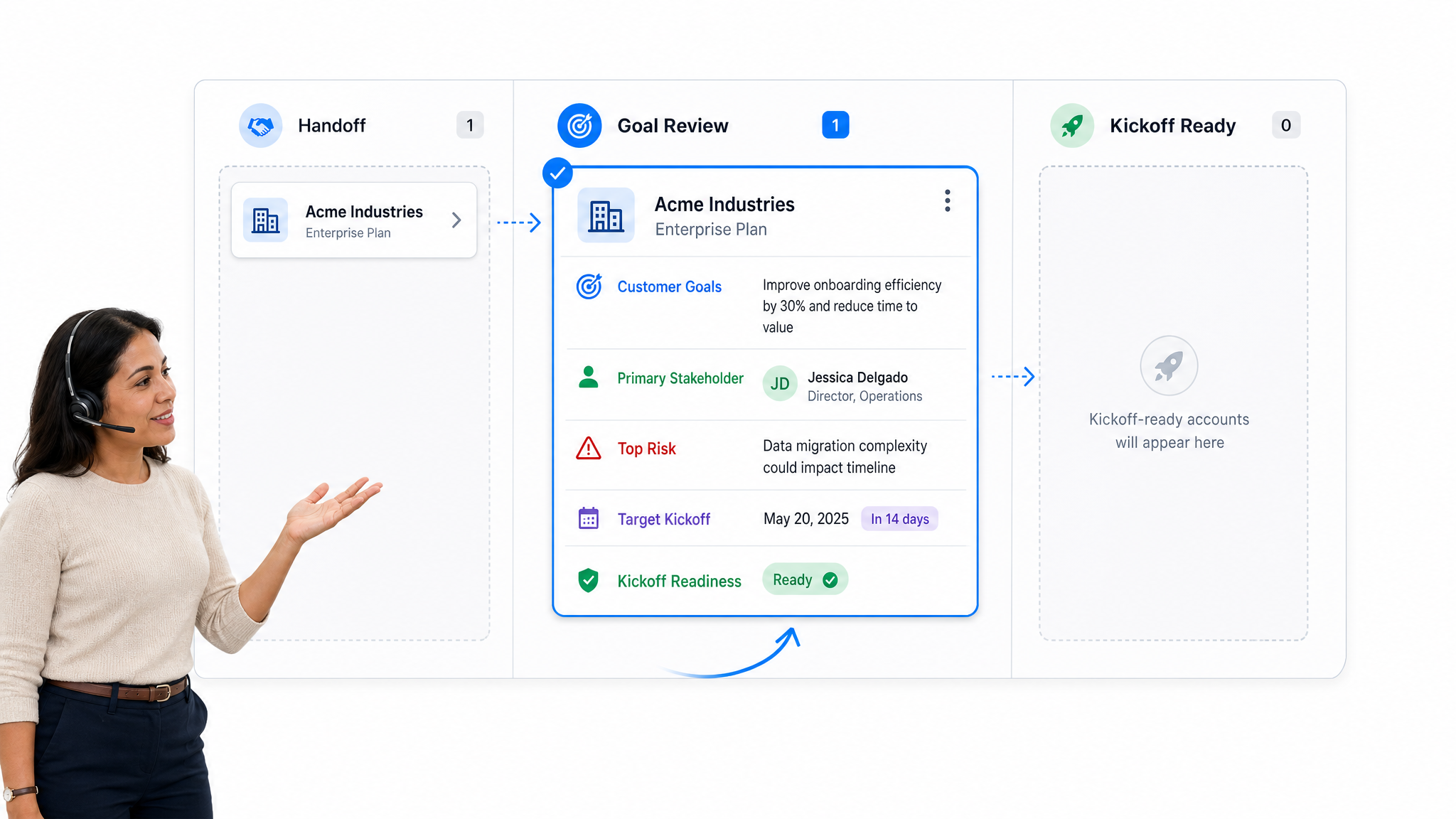
Collect the customer’s goals, current workflow, success criteria, stakeholders, integrations, deadlines, and known risks before the first onboarding call. If sales has already captured this information, transfer it into the onboarding workflow instead of asking the customer to repeat it.
This is the first place where the customer feels whether your company is coordinated. A clean pre-kickoff handoff shows that your team listened during sales and is ready to act.
2. Send a welcome email with clear next steps
Send a welcome email immediately after purchase or contract signature. Keep it short. Confirm the next meeting or setup step, name the primary owner, list anything the customer needs to prepare, and link to the shared onboarding plan if one exists.
3. Run a kickoff that defines success
Use the kickoff to align on goals, roles, timeline, and the first value milestone. Avoid turning the call into a full product tour. The customer should leave knowing who owns what, which outcome comes first, and how progress will be measured.
4. Build the onboarding workflow
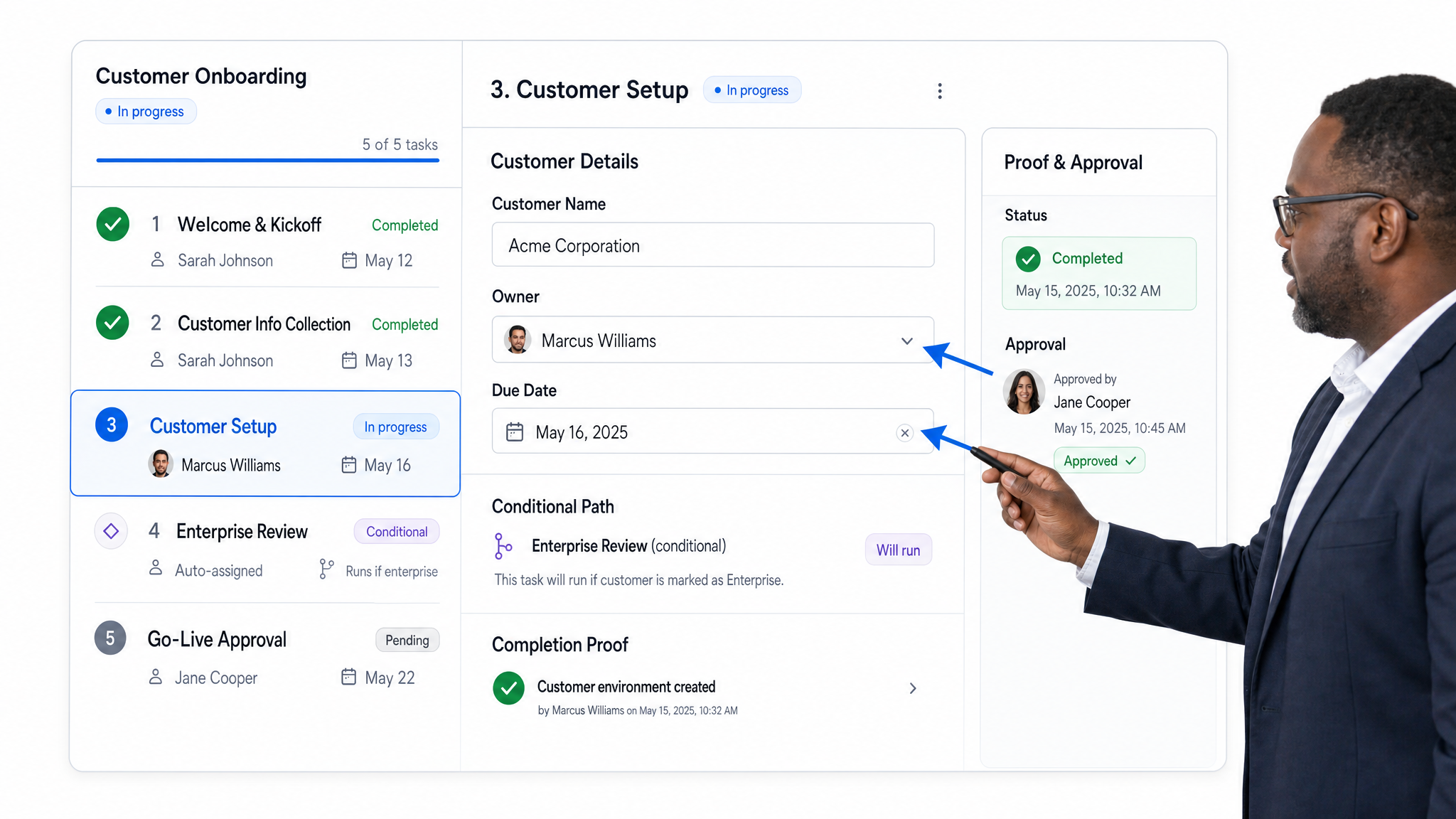
Document the process as an executable workflow, not a static checklist. A good workflow assigns owners, sets due dates, collects information, routes approvals, and records completion. Process Street can turn onboarding steps into repeatable workflow templates that run each time a new customer starts.
Use conditional logic to keep the path relevant. Enterprise customers might need security review, procurement steps, or admin training. Smaller customers might skip those tasks and move directly into setup and first value. Conditional logic lets the process adapt without creating a separate checklist for every scenario.
5. Guide users through first value
First value is the first outcome that proves the product can help. Define it clearly. For a workflow product, it might be a live onboarding workflow run. For a reporting product, it might be the first dashboard an executive uses. For a service business, it might be the first approved deliverable.
Training should serve this milestone. Teach the features and concepts the customer needs right now, then introduce advanced use cases after adoption begins.
6. Train admins and owners
Customer onboarding often fails when only one champion understands the setup. Train the admins, owners, and recurring users who will keep the process alive after the implementation team steps back. Give them documentation, role-specific guidance, and a clear escalation path.
7. Review progress before handoff
Before moving the customer into the ongoing customer success motion, review what was completed, what remains open, which risks surfaced, and which goals were achieved. This handoff prevents customer success from inheriting a vague account with hidden blockers.
8. Celebrate milestones and ask for feedback
Customer milestones help people see progress. Celebrate meaningful wins such as completed setup, first workflow run, first report, first project launch, or first team adoption target. Then ask what would make the process better. That feedback becomes the input for the next version of the onboarding workflow.
Customer onboarding software
Customer onboarding software helps teams run the same high-quality process every time. The right tool captures information, assigns owners, automates reminders, stores resources, tracks progress, and creates a record of what happened. It also gives managers a consistent way to see whether every new customer is moving through the right stages without relying on status meetings or scattered spreadsheets.
Some teams use product adoption tools for in-app guides. Others use customer success platforms for account health, learning tools for training, or project management tools for task tracking. Those tools can help, but they often leave the actual onboarding process split across systems.
Process Street is useful when onboarding needs to become an auditable operating process. You can document the procedure, run each customer through the right workflow, automate follow-ups, collect approvals, and monitor execution from one place. That makes it a strong fit for customer onboarding, client onboarding, implementation, compliance-heavy setup, and recurring service delivery.
For a practical starting point, use the high-touch client onboarding template, then adapt the workflow to your own customer segments, handoff rules, milestones, and review cadence. You can also create a free account and start building the process directly in Process Street: try it free.
Customer onboarding metrics to track
Metrics make onboarding manageable. They show whether customers are reaching value, where they stall, and which parts of the process need attention. Track a small set of metrics that connect directly to customer progress.
Track activation and time to value
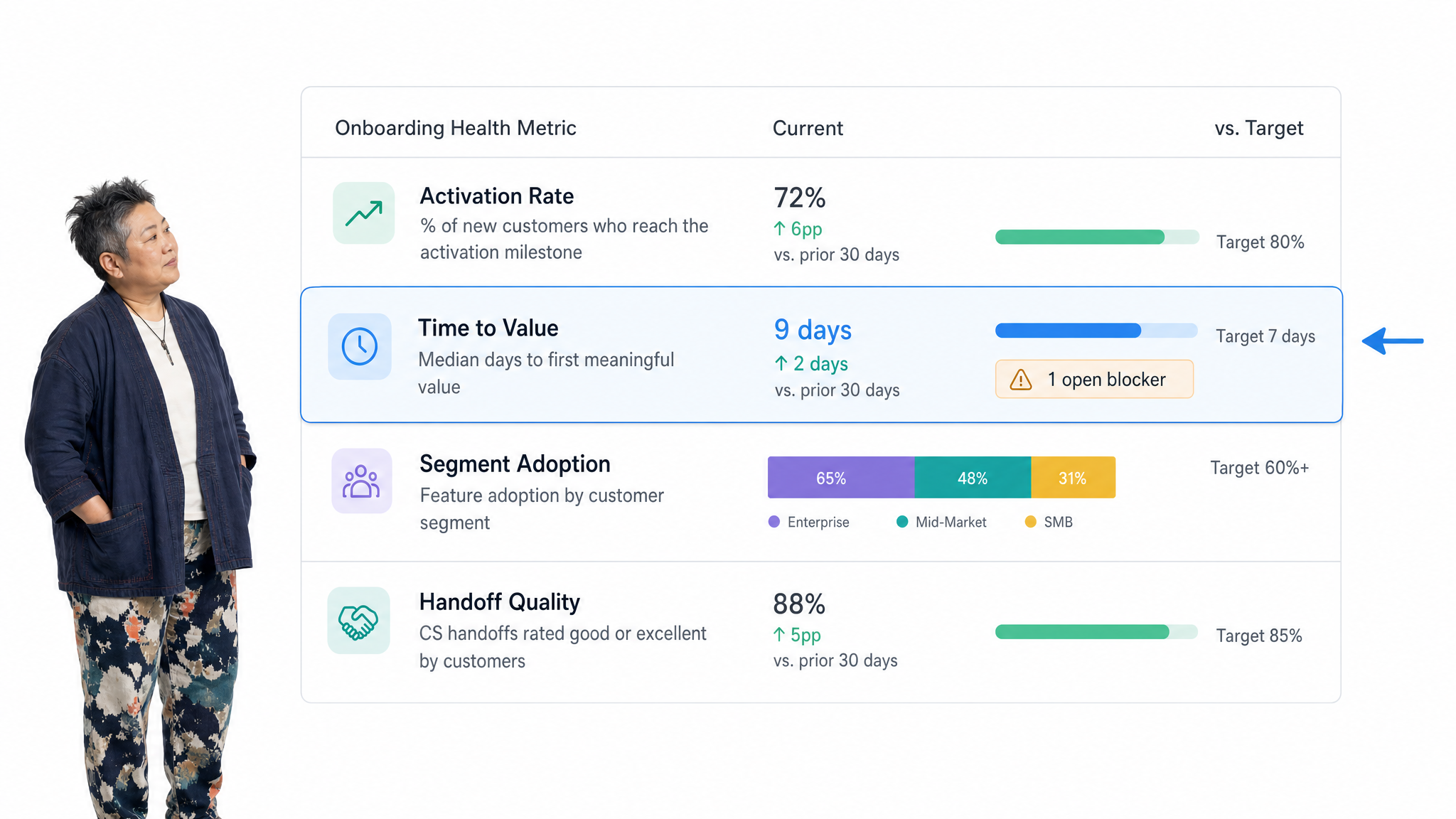
Activation measures whether the customer completed the action that shows meaningful product use. Time to value measures how long it took to reach the first useful outcome. Together, they reveal whether onboarding is helping customers move from setup to value quickly enough.
Watch adoption by segment
Different customers need different onboarding paths. Track adoption by segment, plan, company size, use case, or onboarding complexity. Segment-level metrics show whether one group needs clearer training, stronger kickoff expectations, or a different workflow branch.
Review handoff quality
Handoff quality measures whether sales, implementation, support, and customer success have the context they need. Missed notes, unclear goals, and incomplete setup tasks are process problems. Use reports and analytics to spot incomplete work, delayed tasks, and recurring blockers.
Do not track metrics only for reporting. Use them to improve the onboarding workflow. If a milestone consistently slips, inspect the step. If customers skip a training resource, change the timing or format. If one segment activates faster than another, look for the difference in process design.
Common customer onboarding mistakes to avoid
Most onboarding problems come from missing ownership, weak sequencing, or unclear success criteria. The customer may still like the product, but the journey feels harder than it needs to feel.
Do not make the customer repeat themselves
If the customer explained their goals during sales, that context should appear in the onboarding plan. Asking the same discovery questions again makes the handoff feel sloppy and forces the customer to rebuild trust with a new team.
Do not train before the setup is ready
Training works best when the customer can practice inside a relevant environment. If users are taught against a blank account, missing data, or an unfinished configuration, the session becomes abstract. Complete the minimum setup first, then train against the workflow the customer will actually use.
Do not treat launch as the finish line
Launch matters, but adoption is the real test. Schedule a post-launch review while the customer still remembers the onboarding experience. Review open questions, usage patterns, unresolved blockers, and the next milestone. That review turns onboarding from a project into a customer success motion.
Customer onboarding FAQs
What is customer onboarding?
Customer onboarding is the process of guiding a new customer from purchase to confident product use. It includes handoff, kickoff, setup, training, first value, feedback, and the transition into ongoing customer success.
What are the main steps in customer onboarding?
The main steps are capturing customer goals, sending a welcome email, running kickoff, building the onboarding workflow, guiding users to first value, training owners, reviewing progress, and collecting feedback.
Why is customer onboarding important?
Customer onboarding is important because it shapes the first customer experience after purchase. A strong process reduces confusion, shortens time to value, improves engagement, and gives internal teams a repeatable way to deliver on sales promises.
What should customer onboarding software include?
Customer onboarding software should include workflow templates, task ownership, forms, reminders, approvals, documentation, conditional paths, reporting, and integrations with the systems your customer success and implementation teams use.
How do you measure customer onboarding success?
Measure customer onboarding success with activation rate, time to value, milestone completion, task delays, training completion, support volume during onboarding, customer feedback, and the quality of the handoff into ongoing customer success.
How long should customer onboarding take?
Customer onboarding should take as long as the customer needs to reach first value. Simple self-serve products may take minutes or days. High-touch B2B implementations may take weeks. The key is to define milestones and keep progress visible.
Build onboarding as a repeatable operating process
Customer onboarding works when it is treated as a real process, not a loose collection of emails, calls, and help articles. The customer should know what comes next. Your team should know who owns each step. The business should have proof that the process happened.
Turn the customer journey into an executable workflow, review the metrics, and keep improving the path to value. That is how onboarding becomes more than a first impression. It becomes the system that protects adoption, retention, and long-term customer success.