Turn every policy into automated workflows with built-in enforcement and audit-ready proof.



Best Enterprise GRC Platforms
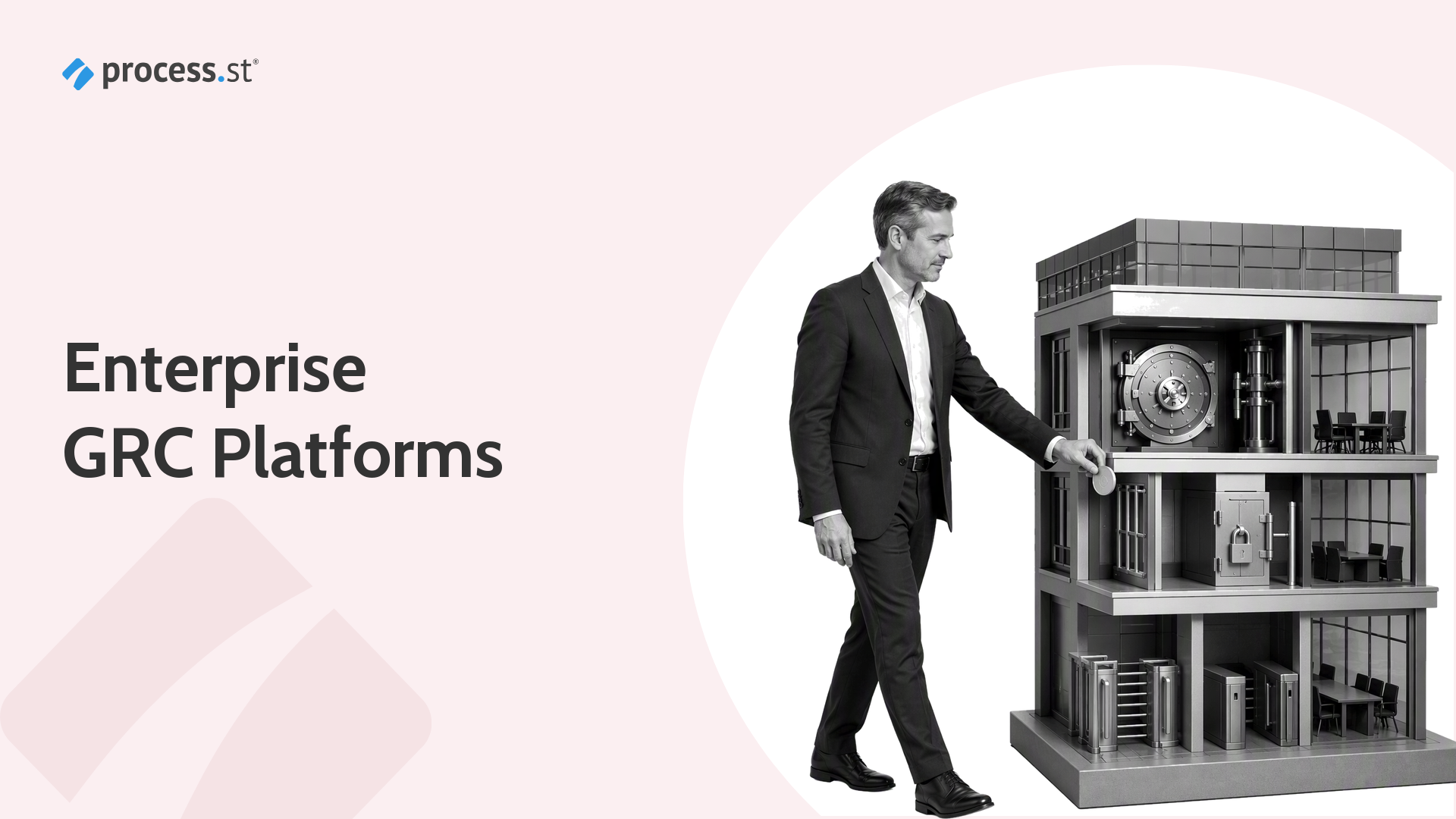
The best enterprise GRC platforms give leaders one governed way to connect risks, obligations, controls, policies, evidence, issues, audits, and remediation across a large organization. The strongest choice is not the product with the longest feature list. It is the platform that fits your risk model, operating systems, control owners, assurance teams, and capacity to administer change.
This comparison covers seven credible approaches. Process Street ranks first when the core problem is enforcing controls inside high-stakes operational work. ServiceNow, MetricStream, OneTrust, Archer Evolv, LogicGate Risk Cloud, and Optro fit enterprises that need different combinations of integrated risk data, regulatory lineage, security compliance, configurable GRC applications, and audit coordination.
Use the table to create a shortlist, then test each candidate with one real control from risk identification through evidence, approval, exception handling, remediation, and assurance. That pilot reveals more than a polished demonstration because it exposes the handoffs between the central GRC team and the people who perform the work.
In this article, you will learn:
- What is an enterprise GRC platform?
- Best enterprise GRC platforms at a glance
- Process Street
- ServiceNow Integrated Risk Management
- MetricStream Connected GRC
- OneTrust Tech Risk and Compliance
- Archer Evolv
- LogicGate Risk Cloud
- Optro
- How to choose the best enterprise GRC platforms
- Enterprise GRC implementation plan
- FAQs
What is an enterprise GRC platform?
An enterprise GRC platform is software for coordinating governance, risk, and compliance across business units, regions, frameworks, and assurance functions. It gives the organization a shared model for risks, obligations, controls, policies, owners, evidence, issues, audits, and reports. Enterprise products also need scalable permissions, configurable workflows, integration with systems of record, traceable change history, and reporting for executives and boards.
The record layer and the execution layer
A classic GRC system is strongest at the record layer: taxonomies, registers, mappings, assessments, findings, and reporting. The execution layer governs what people actually do. The distinction between compliance operations and GRC matters because a control record can look healthy while the underlying procedure is skipped, approved without evidence, or handled in email.
What makes a platform enterprise-grade
Enterprise scale introduces more than user volume. A platform must manage delegated administration, several lines of defense, shared controls across frameworks, regional variations, policy ownership, evidence retention, business continuity, third parties, and changes to the risk model itself. It also has to preserve an understandable audit trail when records, workflows, or control mappings change.
Where this page differs from a general GRC tools roundup
A general guide to what GRC software does explains the category. This list is narrower. It focuses on platforms that can support enterprise-wide coordination and compares the operating model each one favors. That makes it useful for shortlist design, pilot planning, and cross-functional buying decisions.
Best enterprise GRC platforms at a glance
The table states the clearest use case for each platform. Pricing is described only at the level each vendor currently makes public. Every feature summary comes from the first-party product source recorded for this page.
| Tool | Best for | Standout feature | Pricing |
|---|---|---|---|
| Process Street | High-stakes enterprises that need controls enforced during daily execution | Agentic process automation with approvals, evidence capture, and execution history | Custom quote |
| ServiceNow Integrated Risk Management | Enterprises connecting risk and compliance to ServiceNow workflows and data | Unified risk data, automated control testing, remediation routing, and audit evidence | Contact sales |
| MetricStream Connected GRC | Large organizations coordinating risk, compliance, audit, cyber, and third-party programs | Connected GRC data with risk intelligence, compliance automation, and continuous controls | Contact sales |
| OneTrust Tech Risk and Compliance | Security and risk teams linking technology risk, compliance, incidents, and policies | Compliance scoping, evidence tasks, risk mapping, issue remediation, and policy approvals | Contact sales |
| Archer Evolv | Complex regulated enterprises that need traceable regulatory and risk lineage | Regulatory intelligence linked to obligations, controls, policies, and assurance evidence | Contact sales |
| LogicGate Risk Cloud | Enterprises that need configurable no-code GRC applications and workflows | Purpose-built GRC applications, workflow automation, evidence monitoring, and analytics | Contact sales |
| Optro | Enterprises connecting compliance, controls, risk, and internal audit | Multi-framework compliance with control effectiveness, remediation, and audit workstreams | Contact sales |
1. Process Street
Best for: High-stakes enterprises that need controls enforced during daily execution.
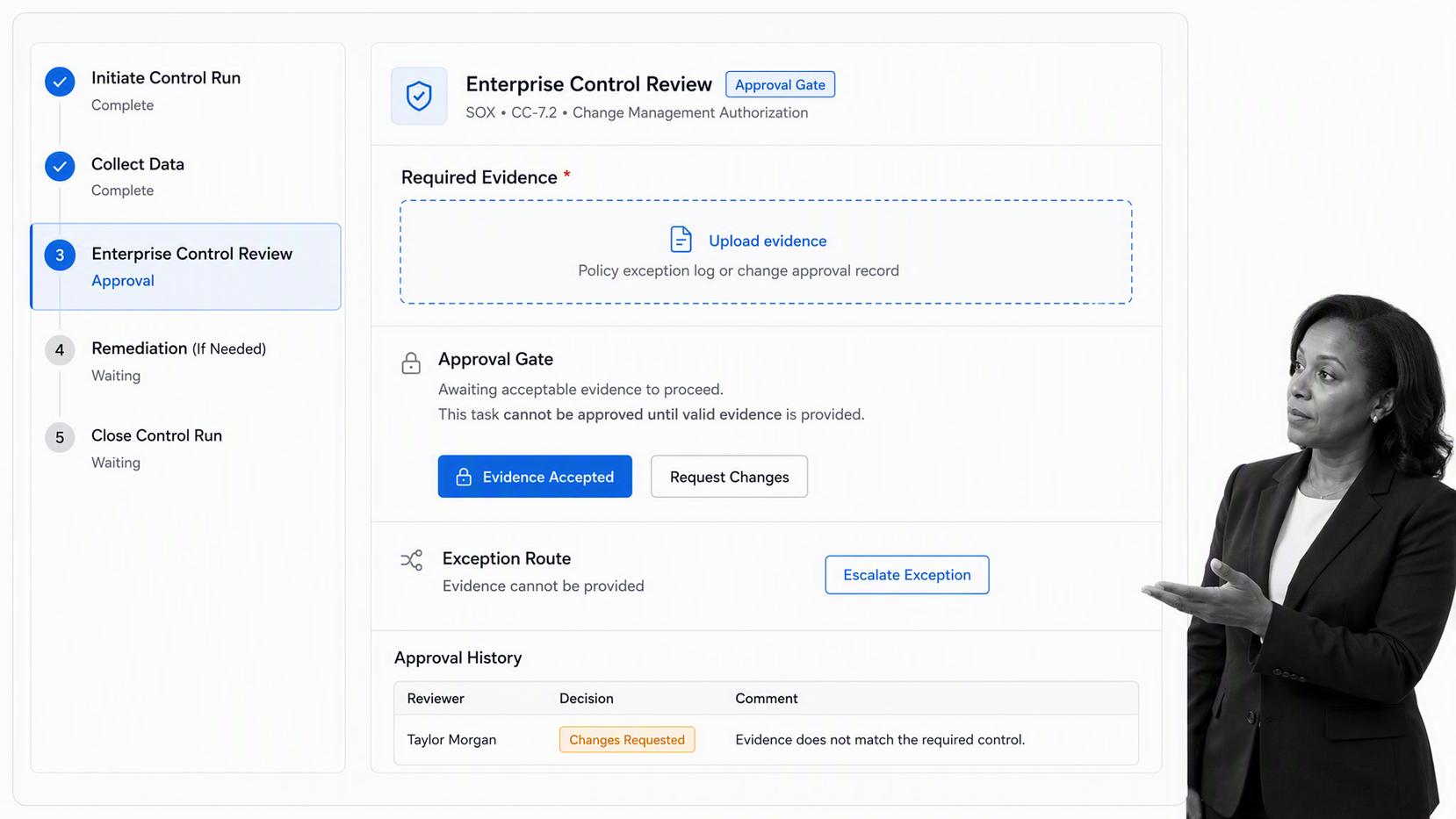
Process Street is the best fit when an enterprise already knows its risks and controls but struggles to make the required work happen consistently. The platform turns a procedure into an executable workflow with assigned roles, required form fields, conditional paths, stop tasks, approvals, schedules, permissions, and an operating history.
Where Process Street fits
That execution focus matters for controls that live outside the central GRC team. Vendor onboarding, access reviews, policy changes, incident response, quality checks, investigations, corrective actions, and audit requests all depend on people completing steps in the right order. Process Street keeps the control close to the work instead of asking occasional users to maintain a complex risk database.
What to test in a pilot
The approval history records decisions and supporting changes. Conditional logic can add review depth when a risk response, jurisdiction, business unit, or exception requires it. The workflow remains simple for the normal path while high-risk cases receive more control.
Choose Process Street when evidence quality and execution discipline are the bottlenecks. A team can begin with a compliance audit workflow or an enterprise regulatory checklist, then tailor the owners, fields, approvals, and escalation paths to the real control environment.
2. ServiceNow Integrated Risk Management
Best for: Enterprises connecting risk and compliance to ServiceNow workflows and data.
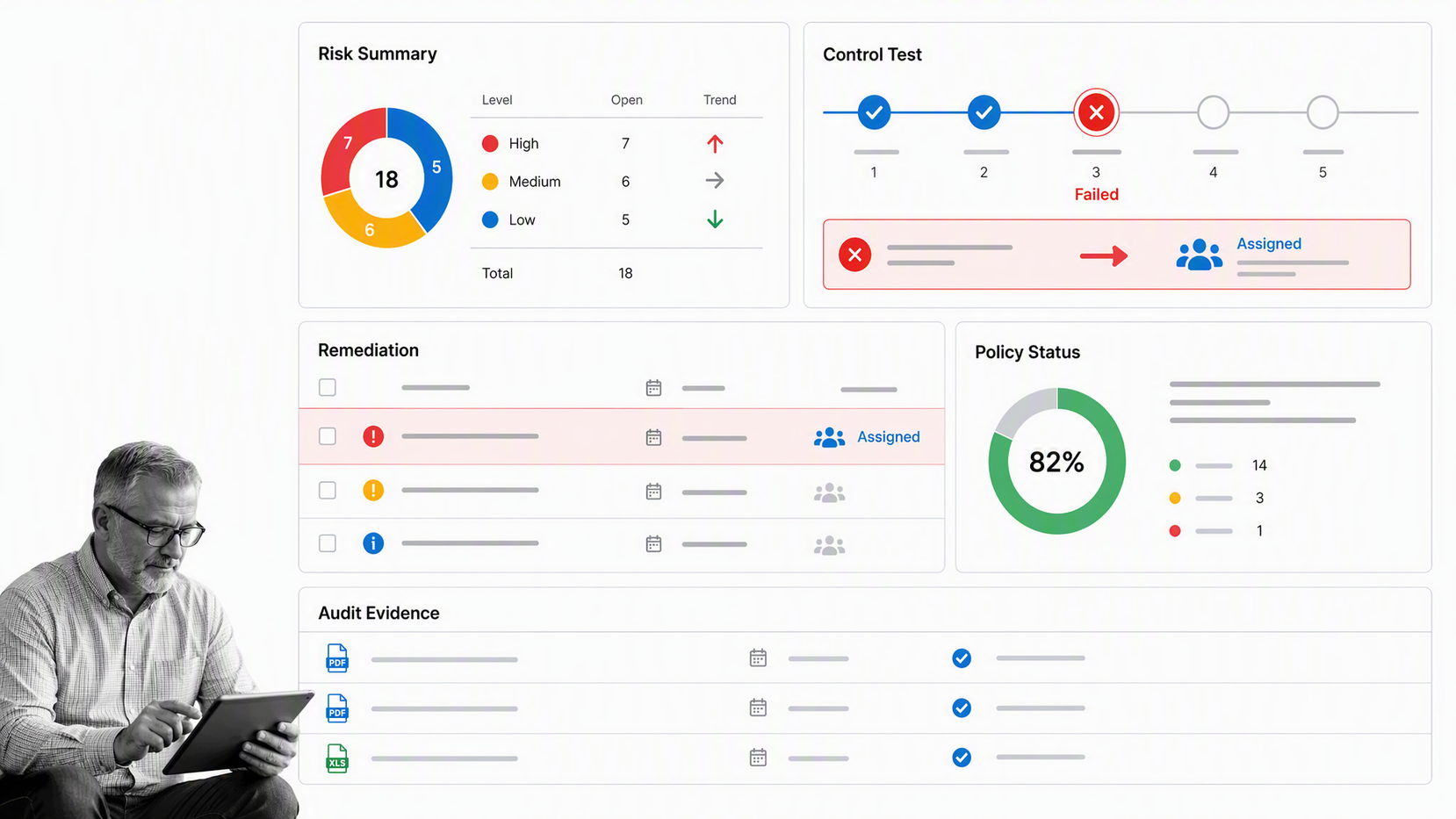
ServiceNow Integrated Risk Management is suited to enterprises that want risk and compliance connected to the broader ServiceNow platform. Its first-party product description emphasizes a cohesive view across IT, cyber, compliance, and business operations, with control assessment, emerging-risk monitoring, remediation routing, workflow automation, and centralized audit evidence.
Where ServiceNow Integrated Risk Management fits
The platform is especially relevant when ServiceNow already carries service, security, asset, or operational data. Risk teams can link assessments and controls to records and workflows that operational teams already use. That can reduce duplicate intake and give remediation work a clearer owner outside the GRC function.
What to test in a pilot
The tradeoff is platform scope. Buyers should decide whether they are implementing a focused risk product or expanding a wider ServiceNow operating model. Test data ownership, role design, configuration governance, reporting performance, and the effort required to keep mappings and workflows understandable as more domains join.
Review the current ServiceNow Integrated Risk Management overview and run a pilot that crosses a control test, failed result, remediation assignment, and audit evidence request. The value should appear in the connected operating path, not only in the dashboard.
3. MetricStream Connected GRC
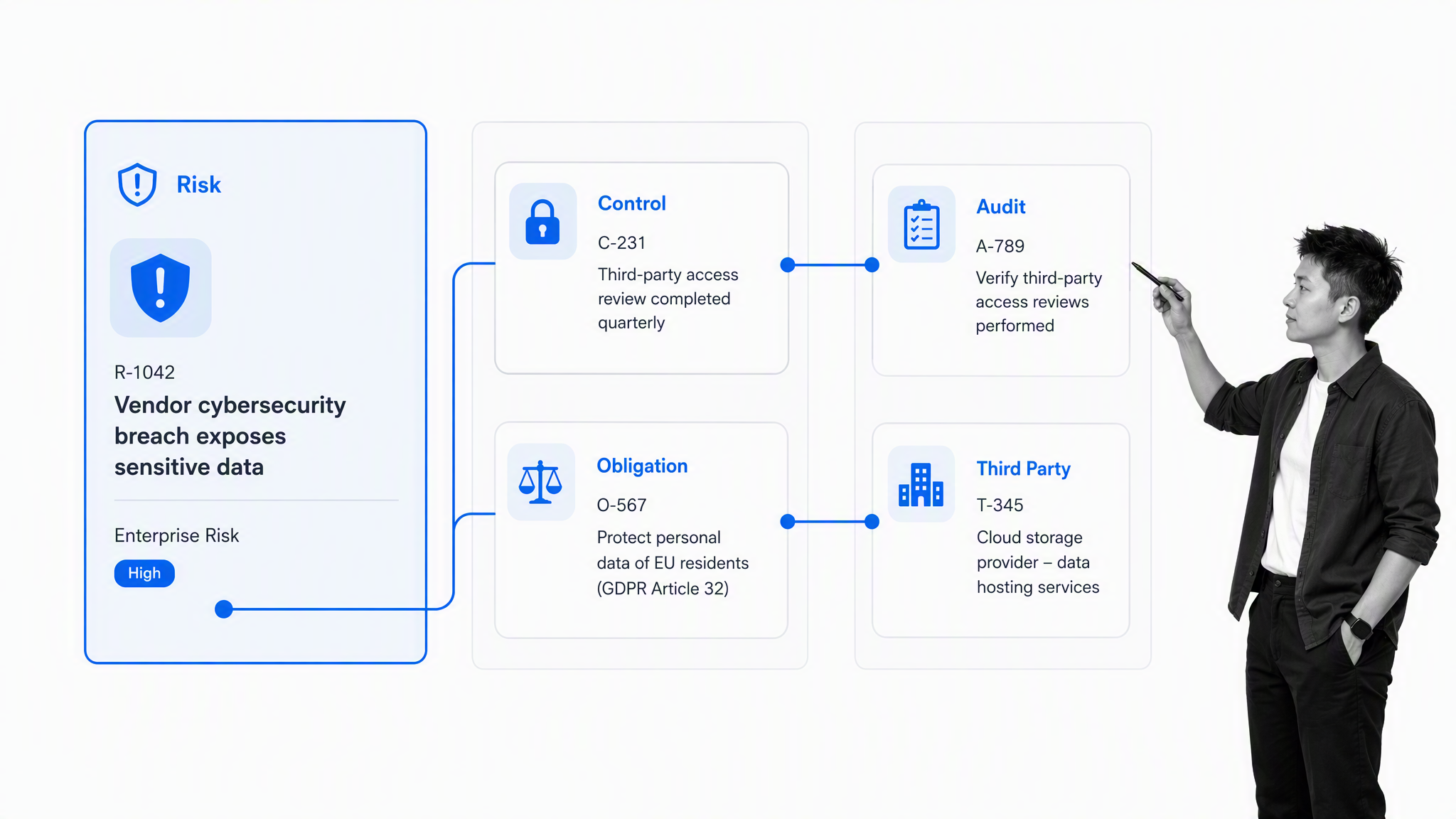
Best for: Large organizations coordinating risk, compliance, audit, cyber, and third-party programs.
MetricStream Connected GRC is designed for organizations coordinating several GRC domains on a shared platform. Its published product scope spans enterprise and operational risk, regulatory compliance, internal audit and controls, cyber GRC, third-party risk, resilience, and sustainability.
Where MetricStream Connected GRC fits
That breadth suits a federated enterprise where specialist teams need their own processes but leadership still needs a connected view. Risk, compliance, audit, cyber, and third-party records can share relationships instead of being rebuilt in separate systems, which supports more consistent reporting and control reuse.
What to test in a pilot
Breadth also increases implementation risk. A program can spend months perfecting a taxonomy while control owners continue to work in email and spreadsheets. Buyers should stage the rollout around decisions and outcomes, define which data is authoritative, and resist launching every module before one end-to-end risk process is stable.
The MetricStream Connected GRC overview describes its connected approach to risk, compliance, audit, cyber, third-party, and resilience programs. Use that breadth as a design input, then keep the first deployment narrow enough to govern well.
4. OneTrust Tech Risk and Compliance
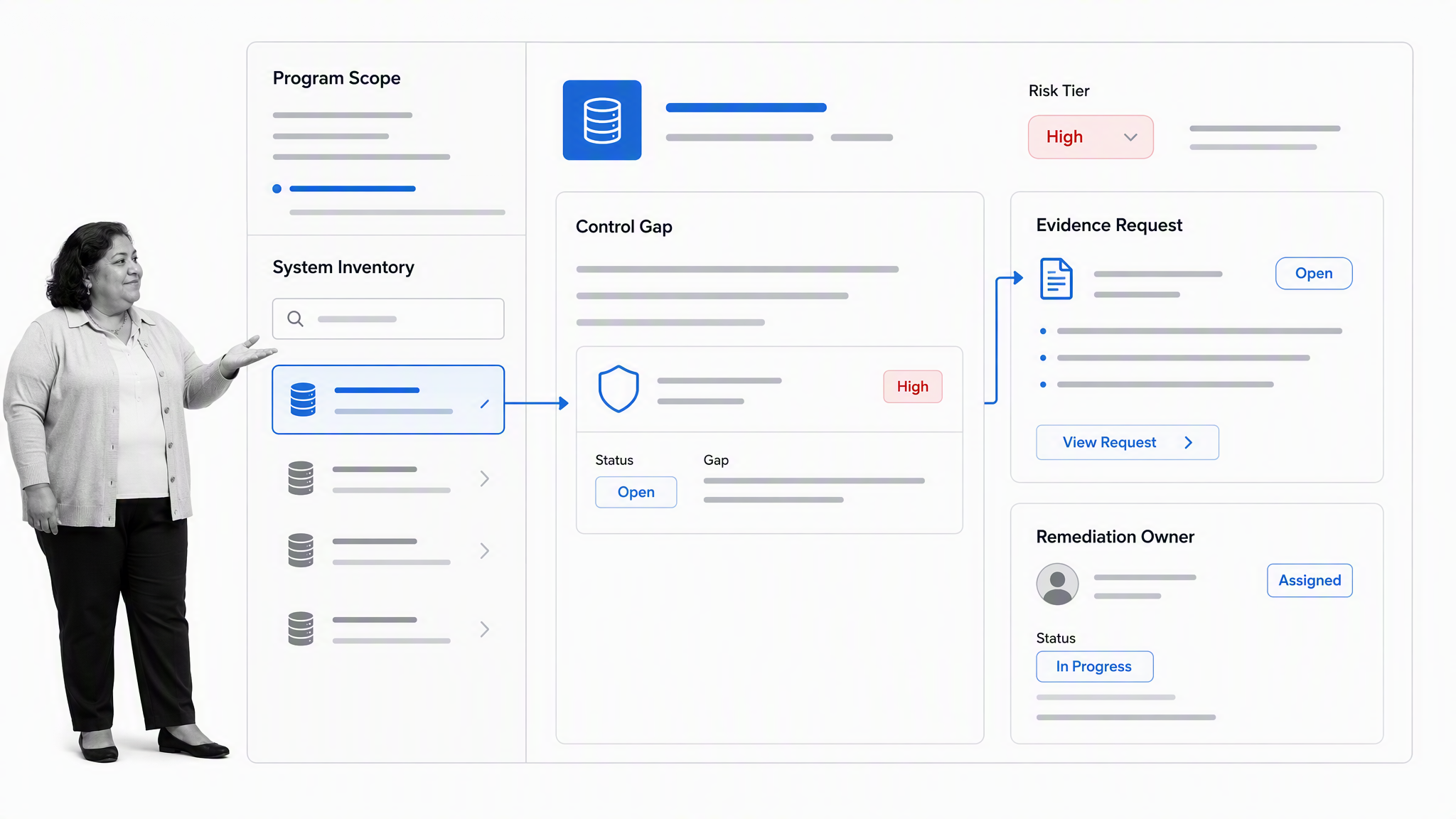
Best for: Security and risk teams linking technology risk, compliance, incidents, and policies.
OneTrust Tech Risk and Compliance fits teams whose GRC program is anchored in technology risk, security compliance, control evidence, incidents, and policy management. Its product surface covers scoping, control libraries, evidence tasks, risk mapping, remediation, issues, incidents, and policy approvals.
Where OneTrust Tech Risk and Compliance fits
The platform is useful when InfoSec and technology teams need to translate frameworks into measurable tasks and connect systems, data, risks, and issues. The scoping layer helps define which requirements apply, while evidence and remediation workflows create an operating route from identified gap to completed response.
What to test in a pilot
Buyers should verify the boundary between technology risk and enterprise-wide GRC. If financial, operational, quality, legal, or business continuity risks are central, test the model with those domains rather than assuming a security-led structure will generalize. Also inspect how shared controls preserve context across different assurance programs.
The current OneTrust Tech Risk and Compliance overview describes compliance scoping, evidence work, risk awareness, issue remediation, and policy management. Build the pilot around a real technology service and its dependent controls.
5. Archer Evolv
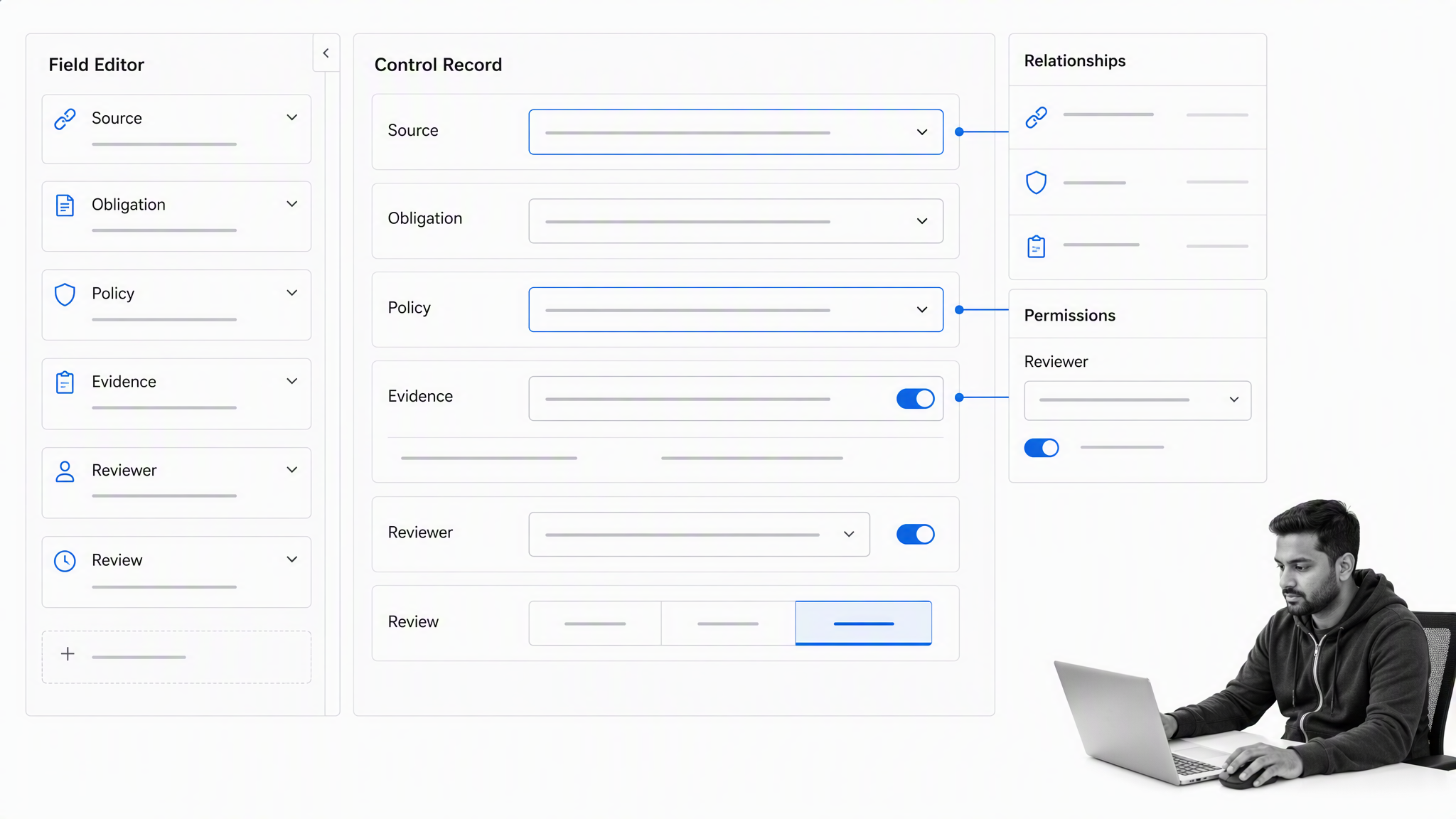
Best for: Complex regulated enterprises that need traceable regulatory and risk lineage.
Archer Evolv is positioned for complex regulatory environments that need lineage from authoritative source through obligation, control, policy, and assurance evidence. Its current portfolio connects compliance, risk, and intelligence on a shared model and audit plane.
Where Archer Evolv fits
The lineage focus is valuable when regulatory change creates a governance problem of its own. Teams need to know which obligation changed, which controls and policies depend on it, who must respond, and what evidence proves the organization adapted. Archer Evolv makes that chain the center of the platform story.
What to test in a pilot
Enterprises should test how much regulatory intelligence they need and how it will interact with existing GRC investments. The vendor states that Archer Evolv can deploy on its own or extend an existing Archer installation. That creates different migration, integration, and administration questions for new buyers and established Archer teams.
The official Archer Evolv platform overview describes the shared Compliance, Risk, and Intelligence portfolio. Use one material regulatory change in the pilot and trace it through impact assessment, control response, policy alignment, work assignment, and assurance evidence.
6. LogicGate Risk Cloud
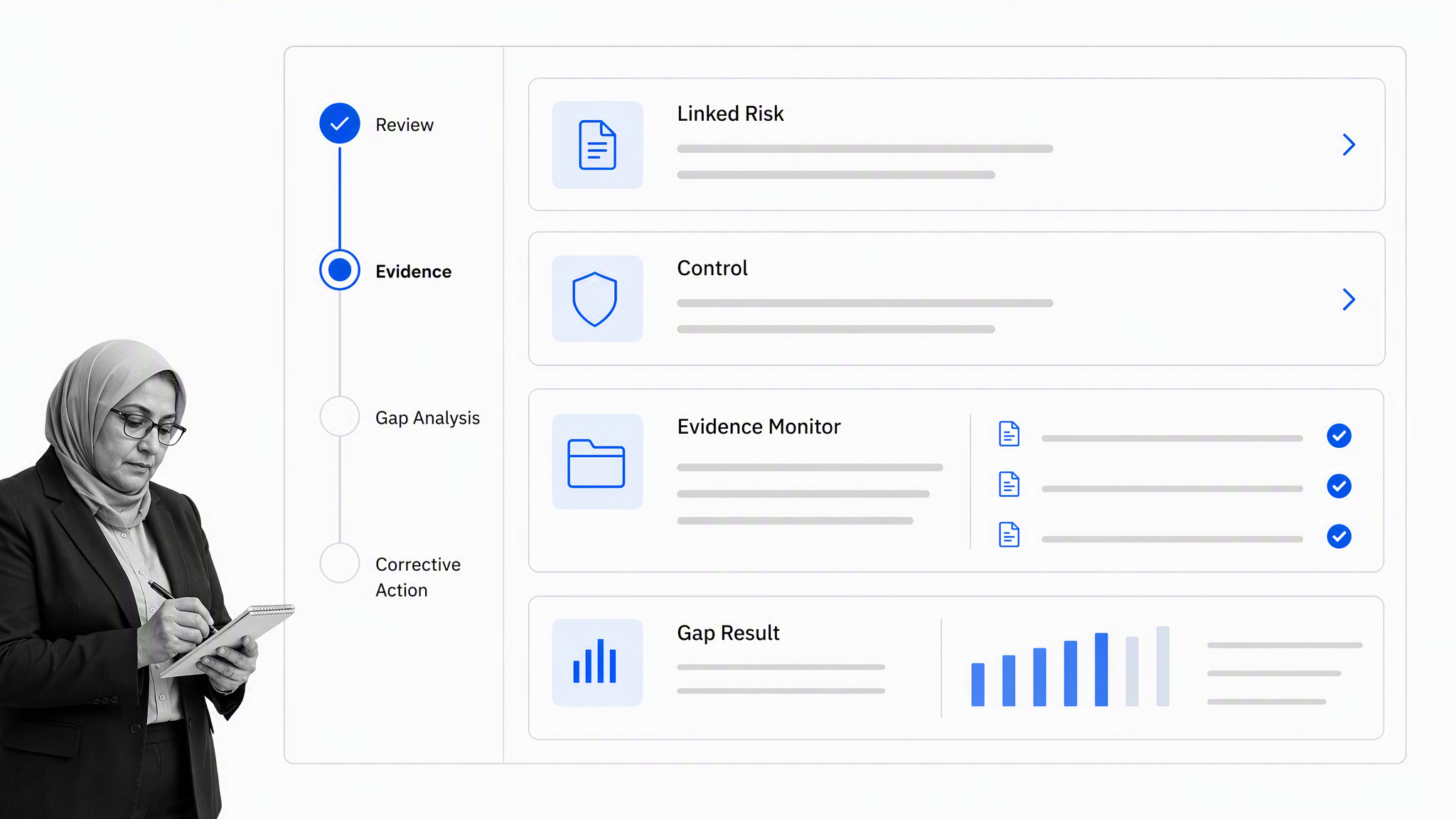
Best for: Enterprises that need configurable no-code GRC applications and workflows.
LogicGate Risk Cloud suits enterprises that need GRC workflows configured around their own operating model. The platform combines purpose-built applications with no-code workflow design, connected risk and control data, automated evidence monitoring, gap analysis, reporting, and analytics.
Where LogicGate Risk Cloud fits
The application model is useful when standard software feels too rigid but a custom internal system would be expensive to build and maintain. Teams can shape stages, forms, assignments, calculations, relationships, and reports for programs such as enterprise risk, cyber risk, third-party risk, policy management, regulatory compliance, controls compliance, and internal audit.
What to test in a pilot
Configuration freedom needs its own control system. Buyers should define who can change applications, how changes are reviewed, which calculations are approved, how test data is separated from production, and how reporting stays consistent across business units. A no-code platform can still become hard to govern when every team designs independently.
The LogicGate Risk Cloud platform page documents its applications, workflow automation, evidence monitoring, analytics, assessments, gap analysis, and integration model. Pilot one configurable process and measure both user fit and ongoing administration effort.
7. Optro
Best for: Enterprises connecting compliance, controls, risk, and internal audit.
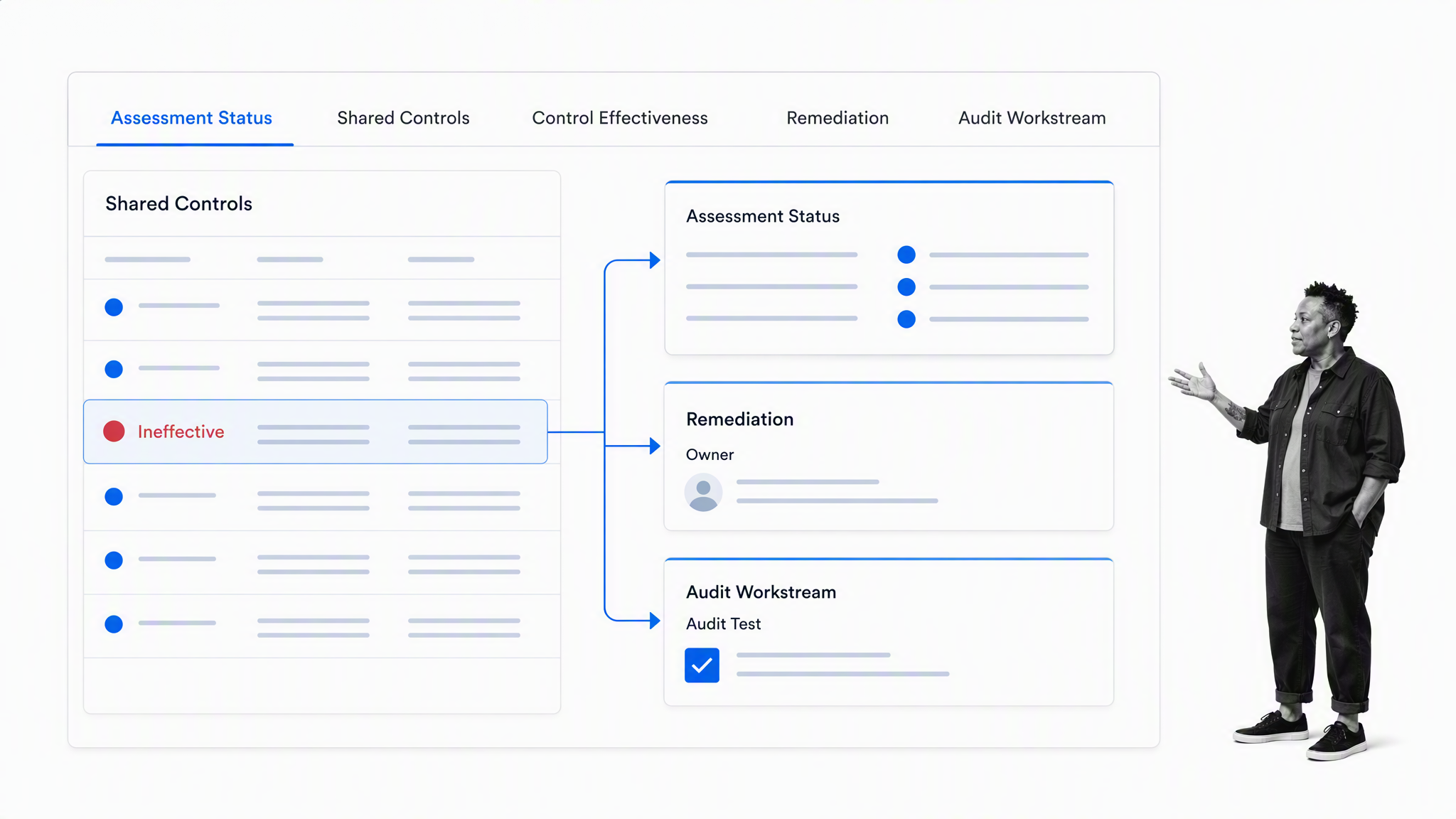
Optro fits enterprises that want compliance, controls, enterprise risk, information security, and internal audit connected in a modern assurance environment. Its compliance management product emphasizes multi-framework coordination, centralized controls, automation, control effectiveness, remediation, and insight across the program.
Where Optro fits
The platform is particularly relevant when internal audit and controls teams are important buyers. A shared control can support several requirements, while effectiveness results and remediation records connect compliance status to assurance work rather than leaving each framework as an isolated checklist.
What to test in a pilot
Buyers should inspect how the platform handles operational evidence outside cybersecurity systems. Test manual and automated evidence, rejected artifacts, ownership changes, control exceptions, retesting, and the handoff from compliance teams to internal audit. The product should preserve the context of each decision, not only the final status.
The Optro compliance management overview describes multi-framework compliance, centralized controls, automation, effectiveness, remediation, and connected risk. Use a shared control with several framework mappings to test whether reuse stays clear and defensible.
How to choose the best enterprise GRC platforms
Start with the operating problem
Separate the problems of record, intelligence, and execution. If your primary need is a shared risk and control model, prioritize GRC depth. If the gap is enterprise-wide risk oversight, compare the options against a practical enterprise risk management software framework. If the gap is people skipping controlled work, prioritize workflow depth and evidence at the point of execution.
Map the domains and owners
List the risk domains, regulatory programs, assurance teams, business units, regions, system owners, control owners, auditors, and executive consumers that the platform must support. Decide which records are global, which can vary locally, and which system remains authoritative for each data type. This prevents the GRC platform from becoming a second, inconsistent copy of operational data.
Score one end-to-end use case
Run a real scenario through the pilot: identify a risk, connect an obligation, map a control, request evidence, reject weak evidence, route an exception, approve remediation, retest the control, and prepare assurance output. A risk management process gives the buying team a concrete sequence to evaluate.
Evaluate administration as a product
Measure the work required to create a record type, change a workflow, update a framework, modify a calculation, add a business unit, adjust permissions, and explain a report. The platform will evolve for years. Administration that depends on a small group of consultants or undocumented configuration choices becomes a long-term risk.
Test evidence and auditability
Evidence should carry source, owner, timestamp, control relationship, review state, exception context, and retention. The system should also preserve who changed a control, policy, workflow, or mapping. Use an internal audit workflow to test whether an assurance reviewer can follow the history without reconstructing it from email.
Check integration architecture
Enterprise GRC depends on data from identity, security, finance, HR, procurement, service management, and operational systems. Process Street workflows can coordinate human and system work around those records. Process Street has direct, universal integrations to 5,000+ systems. Need a new one? An AI agent builds it on the fly.
Enterprise GRC implementation plan
Define the minimum enterprise model
Agree on the smallest shared vocabulary for risks, obligations, controls, policies, issues, evidence, owners, and assurance. Avoid importing every legacy field. A useful model supports decisions and traceability. An exhaustive model often produces unused fields, inconsistent definitions, and difficult reporting.
Choose a bounded first program
Select a program with meaningful risk, active owners, visible evidence, and executive sponsorship. Third-party risk, access reviews, regulatory change, internal audit, or policy governance can work. A vendor risk assessment workflow is a useful pilot because it crosses intake, risk scoring, evidence, approval, remediation, and monitoring.
Build the happy path and exception path
The normal route demonstrates usability. The exception route demonstrates control. Configure missing evidence, rejected approval, overdue ownership, risk acceptance, control failure, remediation, retesting, and closure before launch. Document which decisions require human approval and which automation can proceed safely.
Migrate active obligations before archives
Prioritize live risks, active controls, current policies, open findings, and upcoming audits. Historical archives can follow under a retention plan. Migrating every old record first delays value and makes teams validate stale data before they have learned how the new model works.
Measure control operation after launch
Track overdue assessments, weak evidence, rejected approvals, open exceptions, remediation aging, repeated findings, policy review completion, and control test results. A disciplined compliance risk management process uses those signals to improve the operating model instead of treating implementation as a one-time software project.
Expand by connected decisions
Add domains where shared data or shared decisions create value. A failed vendor control can affect enterprise risk. A regulatory change can trigger a policy update and control test. An audit finding can launch corrective action. The audit management software guide helps buyers decide how much assurance work belongs inside the same platform.
FAQs
What is an enterprise GRC platform?
An enterprise GRC platform coordinates governance, risk, and compliance across business units, regions, frameworks, and assurance teams. It connects risks, obligations, controls, policies, evidence, issues, audits, remediation, permissions, workflows, and reporting in a shared operating model.
What are the best enterprise GRC platforms?
The best enterprise GRC platforms depend on the operating problem. Process Street is strongest for enforcing controls inside high-stakes operational work, while ServiceNow, MetricStream, OneTrust, Archer Evolv, LogicGate Risk Cloud, and Optro fit different integrated risk, regulatory, security, configurable workflow, and assurance models.
How do you choose an enterprise GRC platform?
Define the risk domains, control owners, systems of record, assurance teams, and administrative capacity first. Then run one real control through risk identification, evidence, approval, exception, remediation, retesting, and audit output before creating a shortlist.
What is the difference between GRC and integrated risk management?
GRC is the broader governance, risk, and compliance framework. Integrated risk management emphasizes connected risk data, workflows, and decisions across domains such as IT, cyber, compliance, operations, and third parties. Vendors often use the terms differently, so compare the actual data model and workflows.
How long does enterprise GRC implementation take?
The timeline depends on scope, data quality, integrations, configuration, and governance. A bounded pilot can prove one end-to-end process quickly, while a multi-domain rollout takes longer because the organization must align taxonomies, owners, controls, permissions, evidence, and reporting.
Can a workflow platform support enterprise GRC?
Yes, when the primary need is controlled execution, evidence capture, approvals, exceptions, and audit history around established risks and controls. Some enterprises pair a GRC system of record with a workflow execution layer so central risk data and frontline work stay connected.