Turn every policy into automated workflows with built-in enforcement and audit-ready proof.



Compliance Risk Management
Compliance risk management is the operating system for finding, assessing, controlling, monitoring, and proving how your organization handles the risk of noncompliance. It connects obligations to owners, controls, evidence, exceptions, and remediation.
The point is not to collect policies. The point is to stop regulatory, contractual, customer, financial, security, safety, quality, and internal-policy failures before they turn into findings, penalties, lost trust, or operational disruption.
This guide explains how compliance risk management works, how to build a practical risk process, and how Process Street helps teams make risk control part of daily execution.
We will cover:
- What compliance risk management is
- Why compliance risk management matters
- How to identify compliance risks
- How to assess and prioritize compliance risk
- How to control and monitor compliance risk
- How to build a compliance risk management process
- How Process Street helps with compliance risk management
- FAQs
What compliance risk management is
Compliance risk management is a repeatable process for identifying where the business could fail to meet laws, regulations, standards, contracts, customer obligations, or internal policies, then reducing that exposure through controls, monitoring, and corrective action.
Compliance risk is execution risk
A compliance risk usually begins as a gap between what should happen and what actually happens. A policy might be approved but ignored. A control might exist but never be tested. A remediation owner might be assigned but never asked for proof. A vendor might pass onboarding once and then drift outside the required standard.
That is why compliance risk management sits between risk management and compliance operations. Risk management helps you decide what could go wrong and how severe it would be. Compliance operations turns that decision into assigned work, evidence, reviews, escalation, and audit history.
A practical definition
In practical terms, compliance risk management asks six questions: what obligations apply, where could the business fall short, how severe would the impact be, what control reduces the exposure, who owns the control, and what evidence proves the control worked.
What belongs in scope
The scope can include regulatory requirements, customer commitments, privacy controls, security obligations, financial reporting controls, safety rules, HR policies, vendor requirements, quality standards, environmental obligations, and internal operating procedures.
What does not belong in the risk register
Do not turn the register into a dumping ground for every task the compliance team owns. A risk entry should describe an exposure that can be assessed, controlled, monitored, and remediated. Routine administration, one-off reminders, and vague concerns belong in operating workflows until they reveal a repeatable risk pattern.
Teams often manage these concerns through broader GRC tools. The risk still has to reach the execution layer, where owners complete the controls and attach proof.
Why compliance risk management matters
Compliance failures are rarely caused by one missing document. They usually come from drift: unclear ownership, stale policies, informal approvals, untested controls, undocumented exceptions, and evidence that cannot be reconstructed when a reviewer asks for it.
It reduces audit scramble
A strong compliance risk program turns compliance audits into a review of work that already happened, not a last-minute hunt for files. The evidence trail is built as each workflow runs.
It improves risk-based prioritization
Not every compliance risk deserves the same attention. High-impact, high-likelihood, customer-facing, regulated, or repeat-finding risks need tighter controls and more frequent monitoring. Low-risk items may only need periodic review.
It makes accountability visible
Compliance risk management should answer who owns the obligation, who performs the control, who reviews the evidence, who approves exceptions, and who closes remediation. Without that chain, the compliance team becomes the reminder system.
It supports regulatory expectations
The Federal Reserve guidance on compliance risk management programs emphasizes testing controls and remediating deficiencies identified through testing. The operating lesson is simple: monitoring is not enough if no one validates controls and fixes gaps.
It creates a stronger improvement loop
The DOJ compliance guidance looks at whether a program is tested, reviewed, and improved. Compliance risk management should make that loop visible in workflows, findings, decisions, and updates.
It keeps compliance tied to business change
Compliance risk changes when teams launch products, enter new markets, adopt new systems, change vendors, reorganize departments, or accept new customer commitments. A good process catches those changes early and routes them into the right control review instead of waiting for the next annual policy cycle.
How to identify compliance risks
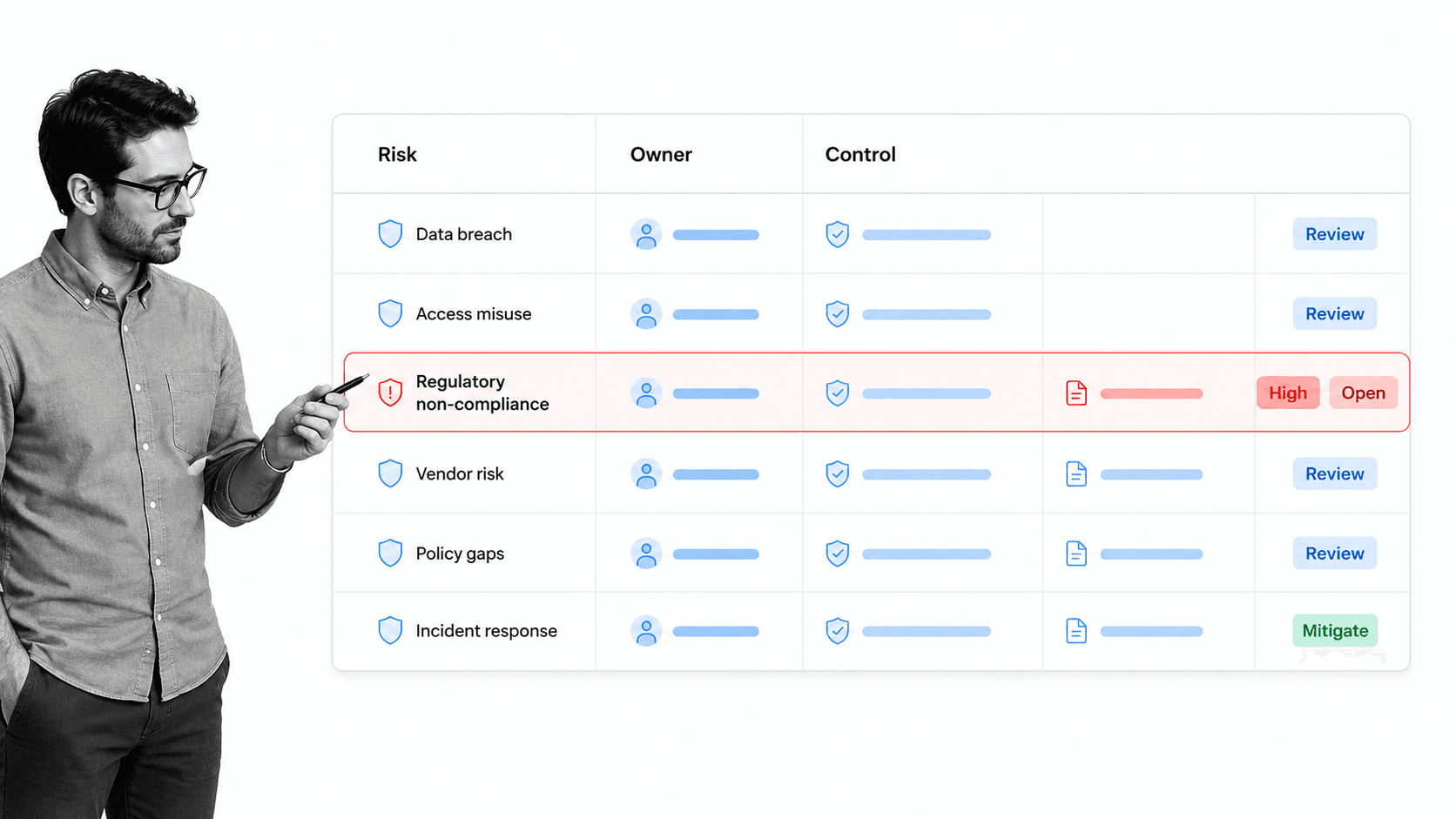
You identify compliance risks by mapping obligations to real business activity. Start with what the organization must do, then look for the points where the work can drift, fail, skip a review, miss evidence, or create an unapproved exception.
Start with obligations
Build an obligation inventory from laws, regulations, standards, contracts, customer requirements, internal policies, audit findings, board commitments, security frameworks, and operational procedures. Each obligation should have a plain-language requirement and a business owner.
Map obligations to processes
A risk is easier to control when it is tied to a process. Map each obligation to the workflow where it should be enforced. If no workflow exists, that is a risk signal by itself.
Find control gaps
Look for places where the current process lacks an owner, required evidence, approval gate, test step, escalation path, or remediation workflow. These gaps connect naturally to internal controls, because controls are the mechanism that turn requirements into consistent behavior.
Use incidents and findings
Past incidents, audit findings, customer complaints, vendor failures, training misses, missed deadlines, and policy exceptions are strong signals. They show where the organization already experienced risk, not just where risk could exist in theory.
Separate risk from noise
A useful risk register is specific. Avoid entries like compliance issue or policy problem. Name the obligation, process, failure mode, owner, control, evidence source, and likely impact.
Interview the people who run the work
The best risk signals often come from operators, not policy owners. Ask the people running the process where work gets delayed, where approvals happen outside the system, where evidence is hard to find, and where exceptions are common. Those friction points show where compliance risk can become operational reality.
- Obligation: the rule, policy, standard, or commitment that applies.
- Process: where the obligation is performed in daily work.
- Failure mode: how the process could fall short.
- Control: the check that prevents, detects, or corrects the failure.
- Evidence: the record that proves the control worked.
- Owner: the person accountable for action and remediation.
Templates such as the Compliance Risk Assessment Template and Risk Assessment Template help turn this inventory into structured review work.
How to assess and prioritize compliance risk
After risks are identified, assess them consistently. The goal is not to create a perfect score. The goal is to decide which risks need stronger controls, faster remediation, more frequent testing, or executive attention.
Assess likelihood
Likelihood asks how often the failure could happen. Inputs may include process complexity, manual handoffs, policy age, control test history, owner turnover, system changes, vendor dependency, and volume of transactions.
Assess impact
Impact asks what happens if the risk becomes real. Consider regulatory exposure, customer impact, operational disruption, financial loss, contractual consequences, security exposure, reputational damage, and audit severity.
Rate control strength
A high inherent risk can become manageable if controls are strong and evidence is reliable. A moderate risk can become urgent if the control is manual, untested, or owned by no one.
Prioritize by action required
Group risks by what should happen next: accept, monitor, improve, escalate, remediate, or redesign the process. Priority should drive work, not sit as a score in a spreadsheet.
Document the reasoning
Risk ratings should include a short rationale. That makes decisions easier to defend during a compliance audit and easier to revisit when the business changes.
Set review triggers
Some risks need scheduled review. Others need event-based review. Trigger a reassessment after a control failure, major incident, new regulation, system migration, vendor change, leadership change, product launch, or repeat customer concern. That keeps the rating current instead of frozen at the last annual review.
For formal risk methods, ISO 31000 provides guidance on managing risk, while NIST risk management guidance organizes risk work around framing, assessing, responding, and monitoring.
How to control and monitor compliance risk
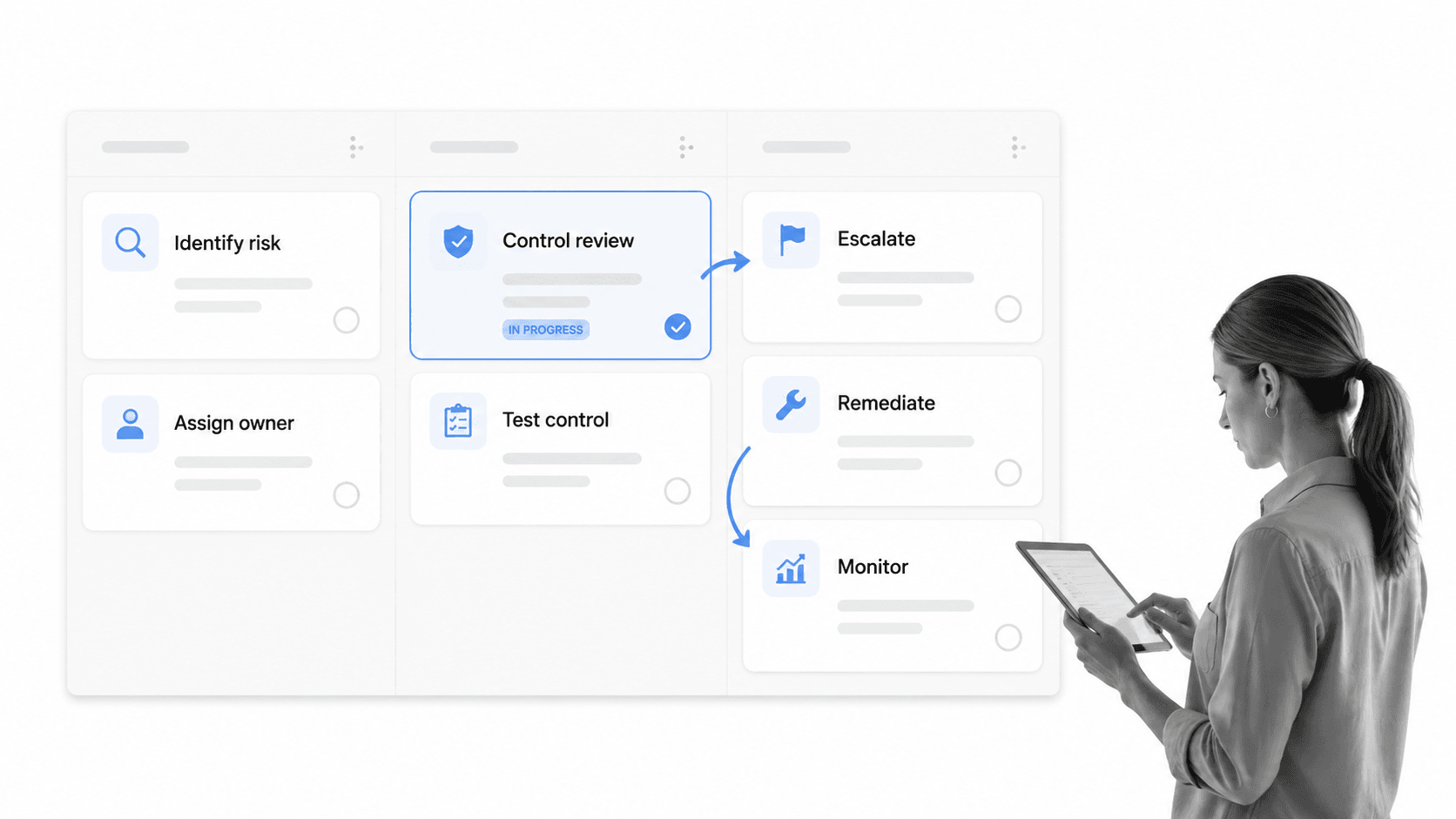
Controls and monitoring turn a risk register into an operating system. A control defines what should happen. Monitoring checks whether it is happening. Remediation fixes the gaps that monitoring finds.
Assign controls to real owners
Every control should have an accountable owner, reviewer, evidence source, frequency, and escalation path. If ownership is shared by everyone, ownership belongs to no one.
Make evidence mandatory
Controls need proof. Evidence might be a completed workflow, uploaded file, system export, approval, access review, policy acknowledgment, test result, remediation note, or audit trail. A control without evidence cannot support a risk decision.
Test controls on a risk-based cadence
High-risk controls should be tested more often than low-risk controls. Testing should confirm whether the control operated, whether the evidence is complete, and whether exceptions followed the approved path.
Route exceptions quickly
An exception is not a failure if it is visible, approved, mitigated, and documented. It becomes a failure when it hides in email or depends on someone remembering to follow up.
Monitor for change
Compliance risk changes when regulations, products, vendors, systems, policies, people, or customer commitments change. NIST continuous monitoring guidance frames monitoring as ongoing awareness that supports risk decisions.
Connect monitoring to remediation
Monitoring only matters if it triggers action. When a control fails, the process should assign remediation, request evidence, route approval, and retain history. That is the difference between passive compliance monitoring software and an operating workflow that drives closure.
Keep accepted risk visible
Some compliance risks are accepted for a period of time because the cost or disruption of immediate remediation is too high. Accepted risk should still have an owner, expiration date, review cadence, and approval record. Otherwise acceptance becomes avoidance.
How to build a compliance risk management process
A compliance risk management process should be simple enough to run every month and strong enough to support an audit. The best version is not a giant annual exercise. It is a recurring workflow.
1. Define the risk universe
List the obligation areas that matter to the business: privacy, security, financial controls, safety, HR, vendor management, customer commitments, quality, environmental standards, licensing, or industry-specific regulation.
2. Create the risk register
For each risk, capture the obligation, process, failure mode, owner, inherent rating, control, evidence source, residual rating, status, and next action. Keep the register narrow enough that owners can maintain it.
3. Build recurring review workflows
Use a recurring workflow to review high-risk items, request evidence, test controls, approve exceptions, and assign remediation. The Risk Management Process template is a practical starting point for turning assessment into repeatable action.
4. Add approval gates
Built-in approvals help block closure until the right reviewer checks the evidence. Conditional logic can route high-risk exceptions differently from routine low-risk reviews.
5. Report only what leadership can act on
A useful compliance risk report highlights top risks, overdue remediation, failed controls, accepted exceptions, owner bottlenecks, trend changes, and decisions needed. It should not bury leaders in raw register data.
6. Feed findings back into operations
Each recurring issue should trigger a workflow improvement, policy change, owner training, automation, or control redesign. This is where compliance risk management connects to compliance operations: the program gets stronger as work happens.
7. Keep the process current
Review the process after audits, incidents, product changes, regulatory changes, vendor changes, and recurring exceptions. A stale process creates false confidence.
8. Archive decisions with context
Every closed risk review should leave a trail of the decision, evidence, reviewer, exceptions, and next review date. This gives future owners the context they need when the same risk appears again and helps auditors understand why the organization acted the way it did. Context prevents repeat confusion.
That archive also protects continuity when owners change. A new compliance lead can see the risk rating, control history, accepted exceptions, and next review trigger without rebuilding the program from memory.
How Process Street helps with compliance risk management
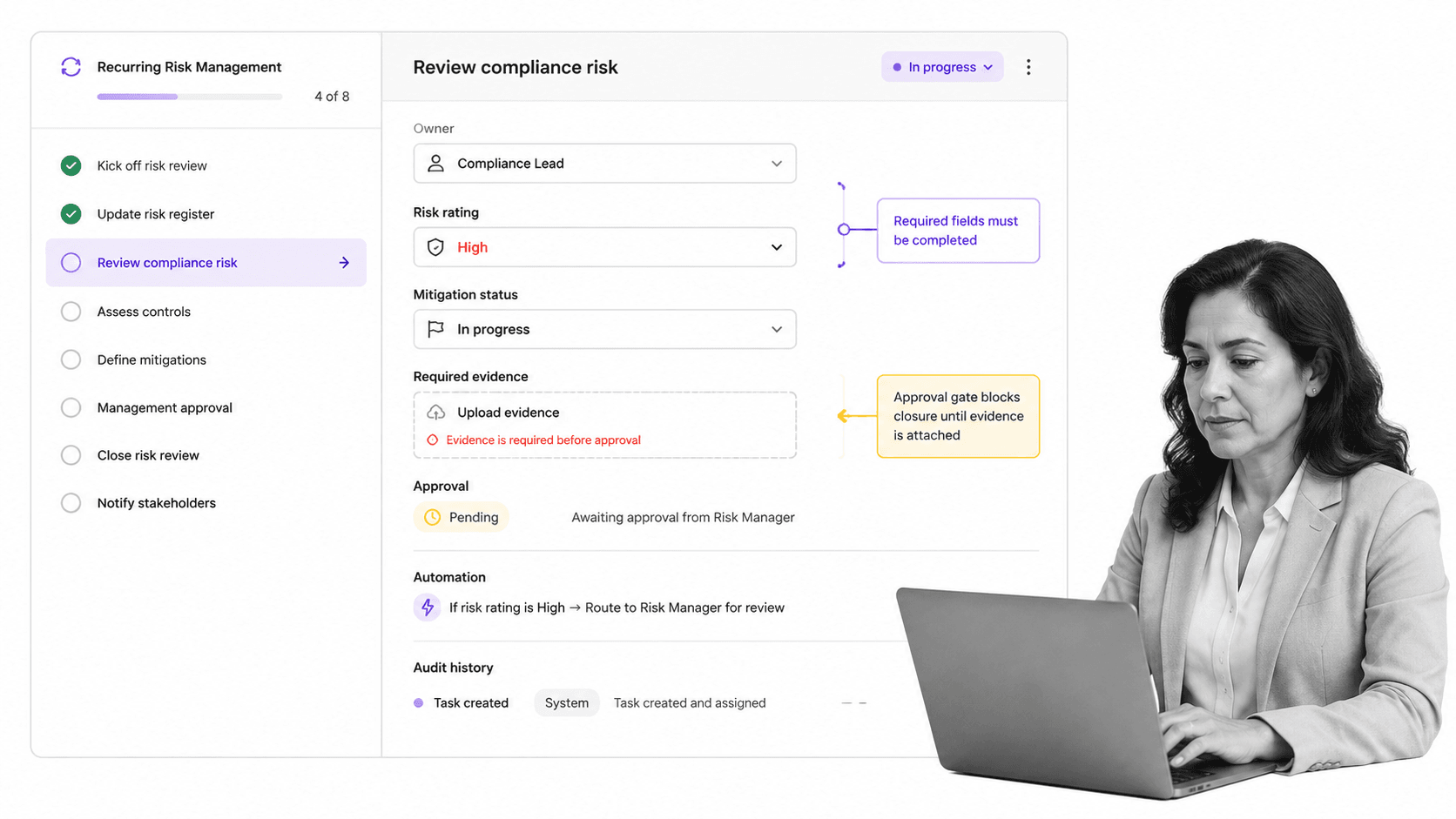
Process Street helps teams run compliance risk management as assigned, evidence-backed work. Instead of leaving risks in a spreadsheet, teams can turn each review, control test, exception, approval, and remediation step into a workflow.
Turn risk reviews into workflows
A recurring compliance risk workflow can assign owners, request evidence, capture risk ratings, route approvals, escalate exceptions, and preserve a record of each review cycle.
Keep evidence beside the control
Evidence belongs next to the task it proves. Process Street workflows can capture required uploads, form fields, comments, approvals, and decision history so reviewers do not have to search across disconnected systems.
Route exceptions automatically
If a risk is rated high, a control fails, or evidence is missing, the workflow can route the item to the right reviewer. That gives the team a controlled path before the issue becomes a finding.
Connect risk work across the stack
Process Street has direct, universal integrations to 5,000+ systems. Need a new one? An AI agent builds it on the fly. That lets risk workflows connect with the systems where evidence, tasks, incidents, policies, approvals, and records already live.
Support AI-driven compliance
As compliance programs mature, AI can help flag risk, suggest workflow updates, and surface recurring control issues. That is the same operating logic behind AI-driven compliance and the digital compliance officer model.
Make the status trustworthy
The broader category of compliance management software can organize a program. Process Street adds the execution layer: tasks done, evidence attached, approvals recorded, exceptions routed, and history preserved.
FAQs
What is compliance risk management?
Compliance risk management is the process of identifying, assessing, controlling, monitoring, and proving how an organization handles the risk of failing to meet laws, regulations, standards, contracts, or internal policies. It connects obligations to owners, controls, evidence, exceptions, and remediation.
What is an example of compliance risk?
A common compliance risk is a required approval that depends on email instead of a controlled workflow. If the approval is missed or cannot be proven later, the business may face an audit finding, customer concern, or regulatory issue.
What is the difference between risk management and compliance management?
Risk management looks broadly at what could harm the organization and how severe it would be. Compliance management focuses on meeting specific rules, standards, contracts, and policies. Compliance risk management connects the two by prioritizing compliance obligations based on risk.
How do you identify compliance risks?
Identify compliance risks by mapping obligations to real workflows, then looking for failure points such as unclear ownership, missing evidence, untested controls, informal approvals, stale policies, and unresolved exceptions.
How do you monitor compliance risk?
Monitor compliance risk through recurring control testing, evidence review, exception tracking, risk-rating updates, owner follow-up, and remediation workflows. Monitoring should trigger action, not just report status.
How does Process Street help with compliance risk management?
Process Street helps teams turn compliance risk management into recurring workflows with owners, required evidence, approvals, exception routing, automations, and audit history. That makes risk control part of daily operations instead of a separate reporting exercise.