Turn every policy into automated workflows with built-in enforcement and audit-ready proof.



Compliance Operations vs GRC

Compliance operations vs GRC is a comparison between two related but different ways of managing risk, policy, controls, and proof. GRC sets the governance, risk, and compliance operating context. Compliance operations turns that context into assigned work, monitored execution, evidence, and follow-up.
The simplest distinction is this: GRC decides what the organization must govern, measure, and report. Compliance operations makes sure the right work happens on time and leaves a defensible record. One is the control system. The other is the operating muscle.
This guide explains where the two models overlap, where they differ, and how a Process Street Compliance Operations Platform can help teams connect policy to execution without forcing every operating team to live inside a traditional GRC tool.
In this article, we are going to cover everything you need to know about compliance operations vs GRC, including:
- What compliance operations vs GRC means
- Compliance operations vs GRC: the practical difference
- When you need GRC, compliance operations, or both
- How to connect GRC strategy to compliance operations
- Where Process Street fits
- Common mistakes when comparing compliance operations and GRC
- FAQs
What compliance operations vs GRC means
GRC stands for governance, risk, and compliance. OCEG describes GRC as a capability that helps an organization reliably achieve objectives, address uncertainty, and act with integrity. That makes GRC broader than compliance alone. It includes the policies, risk appetite, oversight model, reporting structure, and assurance activities that help leaders know whether the business is acting within its obligations. See the OCEG definition of GRC for the source framework.
Compliance operations is narrower and more execution-focused. It is the day-to-day system for turning obligations into repeatable work. A mature compliance operations function defines owners, due dates, task steps, approvals, evidence requirements, escalation paths, and audit trails. For a deeper category explainer, see what is compliance operations.
The short version
- GRC answers: What must we govern, what risks matter, what obligations apply, and how do leaders oversee them?
- Compliance operations answers: Who does the work, when is it due, what evidence proves it happened, and what happens when it fails?
- GRC is strongest when it connects risk, policy, and reporting. Compliance operations is strongest when it connects requirements to execution and proof.
This is why the two should not compete. A GRC program without operations can become policy theater. A compliance operations program without GRC can become a busy checklist machine with no clear risk logic. The strongest model uses GRC to set direction and compliance operations to make that direction executable. Standards such as ISO 37301 reinforce this need for a managed, evaluated, and improved compliance system, not a one-time documentation exercise.
Compliance operations vs GRC: the practical difference
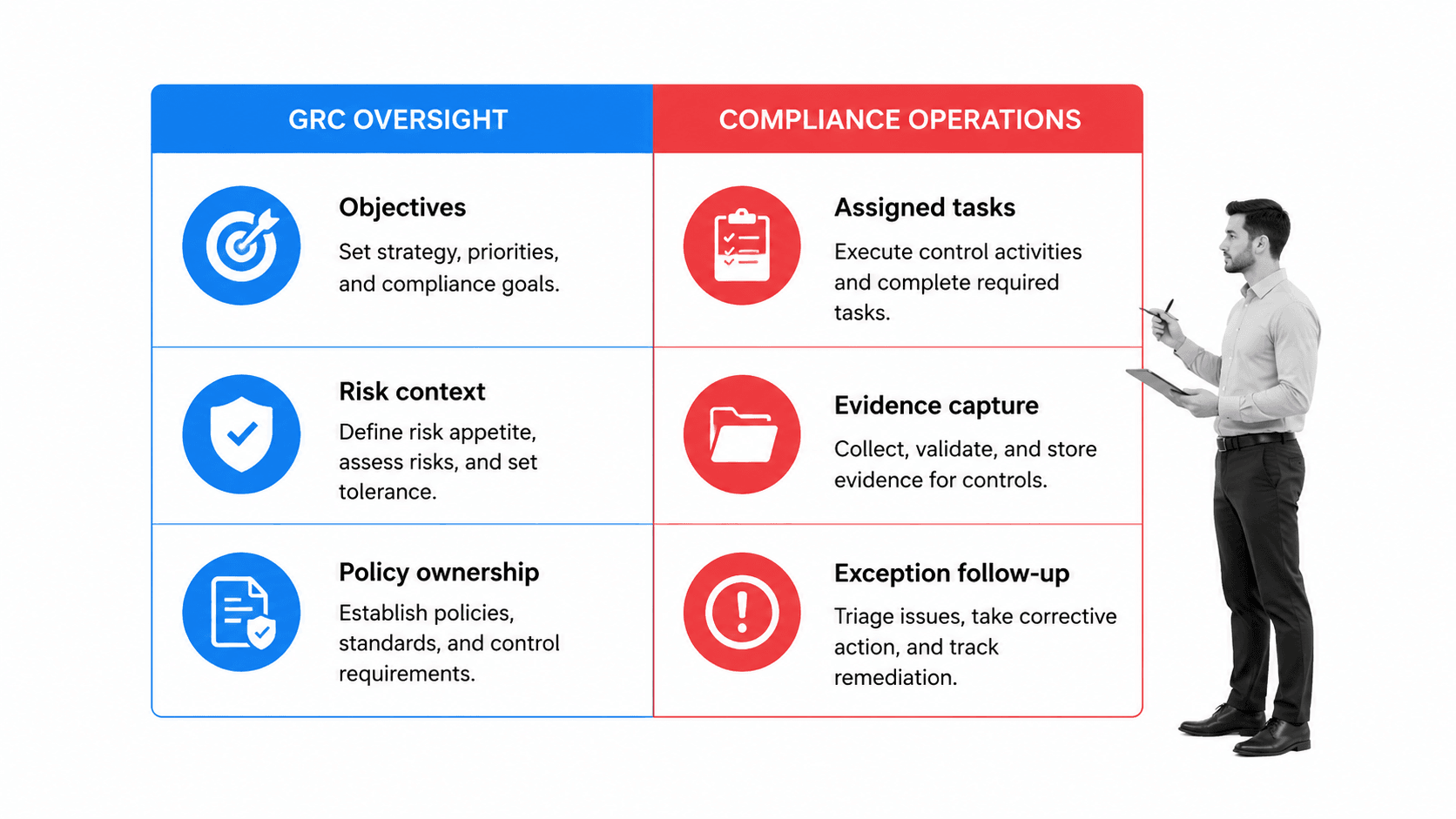
The practical difference shows up in the work surface. GRC teams usually own the operating model: policies, risk taxonomy, control libraries, framework mapping, board reporting, regulatory interpretation, and assurance. Compliance operations teams own the execution system: workflows, assignments, evidence capture, control performance, exception queues, and handoffs with operating teams.
GRC is the oversight layer
A GRC program gives the organization a shared way to manage governance, risk, and compliance. It connects enterprise objectives with risk treatment and compliance obligations. That may include risk assessments, control design, policy governance, audit coordination, and reporting. In cybersecurity and privacy contexts, the NIST Risk Management Framework is a useful example of a structured process for integrating risk management into system activity.
Compliance operations is the execution layer
Compliance operations is where the control actually runs. Someone reviews access. Someone collects vendor evidence. Someone approves a policy change. Someone remediates an exception. Those actions need structure, accountability, and a record. Templates such as a compliance audit checklist, process compliance audit checklist, and risk assessment checklist are useful starting points because they turn broad requirements into executable steps.
The comparison table
- Strategy: GRC sets policy, risk appetite, and control expectations. Compliance operations assigns work against those expectations.
- Evidence: GRC defines what proof matters. Compliance operations captures, validates, stores, and retrieves that proof.
- Exceptions: GRC decides escalation rules. Compliance operations routes the issue, tracks remediation, and closes the loop.
- Reporting: GRC reports posture and risk. Compliance operations reports execution status, overdue work, and evidence gaps.
When you need GRC, compliance operations, or both
You need GRC when the organization has multiple obligations, stakeholders, frameworks, and risk categories that need coordination. If compliance, audit, security, legal, finance, and operations all maintain separate definitions of risk and control, GRC gives the business a shared language.
You need compliance operations when the issue is not the framework, but the follow-through. If teams know what the policy says but still miss reviews, skip approvals, lose evidence, or scramble before audits, the operating layer is weak. That is where workflow automation compliance and automated compliance monitoring matter.
Signs GRC is the priority
- Risk categories are inconsistent across departments.
- Controls are duplicated across frameworks but not mapped cleanly.
- Leadership lacks a clear view of regulatory, operational, and third-party risk.
- Audit, compliance, security, and legal teams use different source data.
Signs compliance operations is the priority
- The policy exists, but teams do not follow it consistently.
- Control owners are unclear or change without notification.
- Evidence is spread across email, folders, screenshots, and spreadsheets.
- Exceptions are discovered late, often right before an audit or customer review.
In practice, most regulated teams need both. GRC frames the obligation. Compliance operations makes it happen. A compliance checklist can help a team start executing, while GRC keeps that checklist aligned to risk, policy, and reporting requirements.
How to connect GRC strategy to compliance operations

The connection works best when you treat every requirement as a workflow candidate. A requirement should not remain a sentence in a policy if it depends on humans doing the same thing every month, quarter, onboarding cycle, vendor review, or audit period. It should become assigned work with proof.
The goal is not to force every employee to think in GRC language. The goal is to translate governance into work people can complete, review, and improve without losing the connection to risk.
1. Translate obligations into control activities
Start with the requirement, then define the control activity that proves it is being met. For example, “review access quarterly” becomes a workflow with scope, owner, user list, reviewer, approval rule, evidence upload, and exception handling.
2. Assign ownership where the work happens
Control ownership should not live only in a spreadsheet. Assignments need to reach the people doing the work. Process Street task assignments help route work to the right person or group when a workflow runs, so execution does not depend on manual chasing.
3. Capture evidence during execution
Evidence is strongest when it is captured as a byproduct of the work. That is the difference between proof created during execution and proof reconstructed later. Pages such as compliance as proof of control explain why compliance teams should design workflows so proof accumulates as tasks are completed.
4. Close exceptions before they become findings
Every control process needs an exception path. If access is not removed, evidence is incomplete, or an approval is rejected, the workflow should assign follow-up, set a due date, notify the right owner, and keep the exception visible until closure.
Where Process Street fits
Process Street is not a replacement for every enterprise GRC system. It is the operational layer that makes compliance work run. Teams use it to document procedures, execute recurring workflows, assign owners, collect evidence, route approvals, and keep a clear activity trail. That is especially useful when a GRC program needs better execution across departments that do not want to live inside a heavy GRC interface.
This matters in workflows such as vendor reviews, access recertification, policy approvals, audit preparation, incident follow-up, and third-party risk. For example, a third-party risk management workflow can operationalize vendor due diligence, while compliance automation software can help teams scale repeatable compliance work.
For teams evaluating software, GRC tools and compliance management software may both appear in the shortlist. The useful question is not which label sounds more complete. The useful question is where your failure mode sits: strategy, execution, evidence, or exception management.
Common mistakes when comparing compliance operations and GRC
Mistake 1: Treating GRC as only compliance
GRC includes compliance, but it also includes governance and risk. If a team uses GRC as a synonym for regulatory checklists, it misses the broader job: connecting objectives, uncertainty, controls, and integrity.
Mistake 2: Treating operations as low-level admin
Execution is where compliance succeeds or fails. COSO frames internal control around operations, reporting, and compliance objectives, which is a useful reminder that controls only matter when they operate in real business activity. See COSO internal control guidance for the broader control context.
Mistake 3: Buying software before naming the failure mode
A GRC platform may improve taxonomy, reporting, and risk mapping. A compliance operations platform may improve assignments, control execution, evidence, and follow-up. If you do not know which gap is hurting you, the tool selection will drift toward features instead of outcomes.
Mistake 4: Reconstructing proof after the fact
The Department of Justice has emphasized evaluating whether a compliance program works in practice, not just whether it exists on paper. That is a useful operating standard for any team: design compliance so proof is created during the work. See the DOJ announcement on evaluating corporate compliance programs at Justice.gov.
For audit-heavy work, resources such as internal audit basics and how to run a security audit can help teams understand what auditors expect. Compliance operations then turns those expectations into repeatable execution.
FAQs
What is the difference between compliance operations and GRC?
GRC is the broader governance, risk, and compliance capability that sets oversight, risk context, policies, and reporting. Compliance operations is the execution layer that turns those expectations into assigned work, evidence, approvals, and exception handling.
Is compliance operations part of GRC?
Compliance operations can sit inside a GRC program, but it has a distinct job. GRC defines what must be governed and measured. Compliance operations makes sure the daily work happens and creates proof that it happened.
Do I need GRC software or compliance operations software?
You need GRC software if your main gap is risk mapping, policy governance, control libraries, or executive reporting. You need compliance operations software if your main gap is missed tasks, unclear ownership, scattered evidence, and manual follow-up.
Why does compliance operations matter if we already have policies?
Policies do not enforce themselves. Compliance operations gives each policy an execution path with owners, due dates, tasks, approvals, evidence, and escalation so the organization can prove the policy was followed.
How does Process Street support compliance operations vs GRC?
Process Street supports the compliance operations side by turning policies and control requirements into workflows that run. It helps teams assign work, capture evidence, route approvals, monitor completion, and maintain a clear audit trail while GRC remains the broader oversight model.