Turn every policy into automated workflows with built-in enforcement and audit-ready proof.



Venture Capital Technology
Venture capital technology is the connected set of systems, data controls, and automated workflows a VC firm uses to source opportunities, evaluate investments, operate funds, monitor portfolio companies, and report to limited partners. The value does not come from owning more software. It comes from making information and decisions move through the firm with clear ownership and evidence.
A useful technology stack gives investment and operations teams one dependable path from first contact to final reporting. It reduces duplicate data entry, exposes stalled work, protects sensitive information, and makes each approval easier to reconstruct. That operating discipline becomes more important as deal volume, portfolio complexity, and regulatory obligations grow.
This guide explains the layers of a VC technology stack, how they support the investment lifecycle, how to connect data safely, and how to implement the stack without forcing every team into one monolithic platform.
In this article, you will learn about:
- What is venture capital technology?
- The core layers of a venture capital technology stack
- How technology supports the venture capital lifecycle
- Data architecture and integrations
- Security, compliance, and governance
- How to choose venture capital technology
- How to implement a VC technology stack
- Venture capital technology with Process Street
- How to measure and improve the stack
- Venture capital technology FAQs
What is venture capital technology?
A system for decisions, not just a collection of tools
A venture firm may use a CRM, virtual data room, research database, portfolio reporting platform, accounting system, and document repository. Those products become a technology system only when the firm defines how records, responsibilities, and decisions move between them. Otherwise, the stack is a set of disconnected places where people copy the same company name and still disagree about status.
The operating model should answer simple questions at every stage: Which system owns this record? Who must act next? What evidence is required? What decision was made? Which downstream record must change? Good technology makes those answers visible without requiring a partner to chase updates across chat threads and spreadsheets.
The outcomes a VC stack should produce
- A consistent pipeline from sourcing through investment committee review.
- Traceable diligence findings, approvals, conflicts, and exceptions.
- Reliable portfolio and fund data that can support investor reporting.
- Access controls and retention rules suited to confidential company information.
- Reusable operating knowledge that does not disappear when a team member leaves.
The stack should fit the firm’s actual venture capital investment process, including its stage focus, committee structure, ownership model, and reporting obligations. Technology should reinforce that process rather than replace judgment with rigid automation.
The design also needs to reflect the firm’s position across venture capital stages. A seed-focused manager may optimize for relationship context and rapid learning, while a later-stage investor may require deeper financial validation, more formal committee controls, and a broader portfolio reporting model.
The core layers of a venture capital technology stack
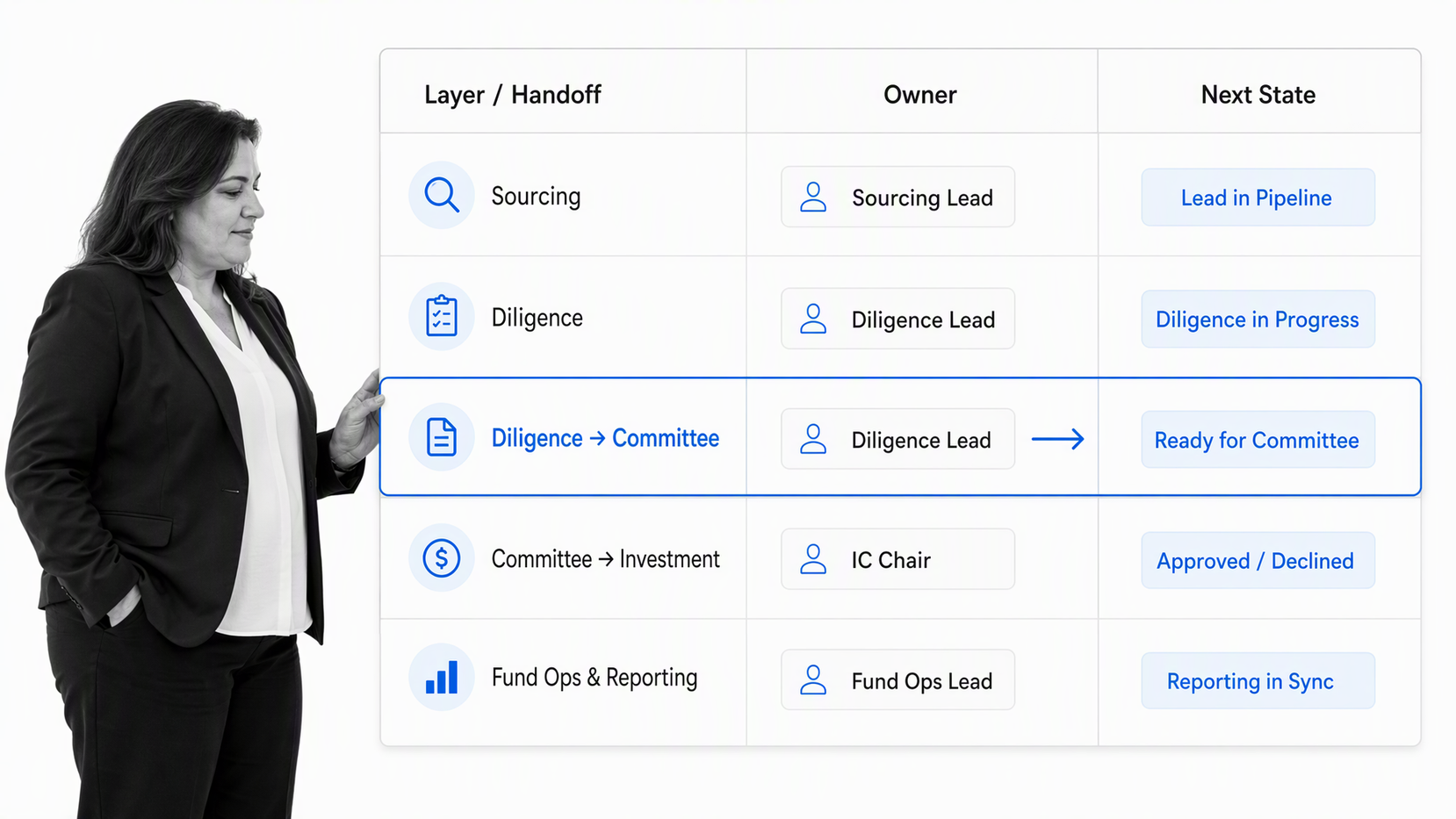
Sourcing and relationship management
The first layer captures founders, companies, co-investors, referrals, meetings, and market theses. Its job is to preserve relationship context while keeping the active pipeline usable. A strong design separates a contact record from an opportunity record, defines ownership, and prevents every introduction from becoming an unqualified deal.
Research and due diligence
Diligence technology organizes requests, documents, analysis, expert input, risks, and follow-up questions. The system should support different depth by investment stage. An early-stage venture capital due diligence workflow may emphasize team, market, product, and early evidence, while a growth-stage due diligence workflow may require deeper financial, security, legal, and operational validation.
Investment committee and decision records
Decision technology should do more than store the final memo. It should show whether the required evidence is complete, surface unresolved risks, record conflicts, route the proposal to the right reviewers, and preserve the approval outcome. The record should make it possible to understand not only what the firm decided, but why it decided it.
Fund operations and investor reporting
Fund operations systems manage entities, capital activity, valuations, expenses, allocations, documents, and limited partner communications. Standard structures such as the ILPA Reporting Template and ILPA capital call and distribution template can inform consistent outputs, but the firm still needs controlled workflows for preparation, review, approval, and distribution.
Portfolio monitoring and value creation
Portfolio technology collects operating updates, financial data, ownership changes, risk signals, board materials, and support requests. The goal is not to demand every possible metric. It is to define a focused set that supports reserve decisions, reporting, risk review, and useful engagement with each company.
How technology supports the venture capital lifecycle
From source to qualified opportunity
Automation can enrich a new record, detect duplicates, assign an owner, and request missing information. Human review still determines whether the opportunity matches the thesis. The important design choice is to keep enrichment separate from qualification so an automated data match is never mistaken for investment conviction.
From diligence to investment committee
A controlled handoff confirms that required work is complete before the committee reviews the opportunity. The workflow can check that legal, financial, commercial, technical, and reference work has an owner and a recorded outcome. Exceptions can remain possible, but they should be explicit, approved, and visible in the decision record.
The NVCA model legal documents provide a useful industry reference for financing documents. They do not remove the need for counsel or firm-specific review, and the technology stack should never present a template as legal approval.
From closing to portfolio operations
Closing should trigger a coordinated transition, not a manual scramble. The firm can create portfolio records, confirm ownership data, schedule reporting, assign relationship roles, capture governance obligations, and establish secure access. A defined handoff prevents important commitments from remaining trapped in the deal team’s notes.
From portfolio data to LP communication
Reporting requires controlled aggregation. Source values need a clear period, owner, definition, and review state before they enter an investor output. When a value changes, the team should be able to trace the revision to its source instead of reconciling multiple spreadsheet versions after the fact.
A reusable investment committee meeting process can clarify preparation, review, voting, minutes, and follow-up responsibilities. The firm should adapt the control points to its own governance documents and legal advice.
Data architecture and integrations
Choose a system of record for each domain
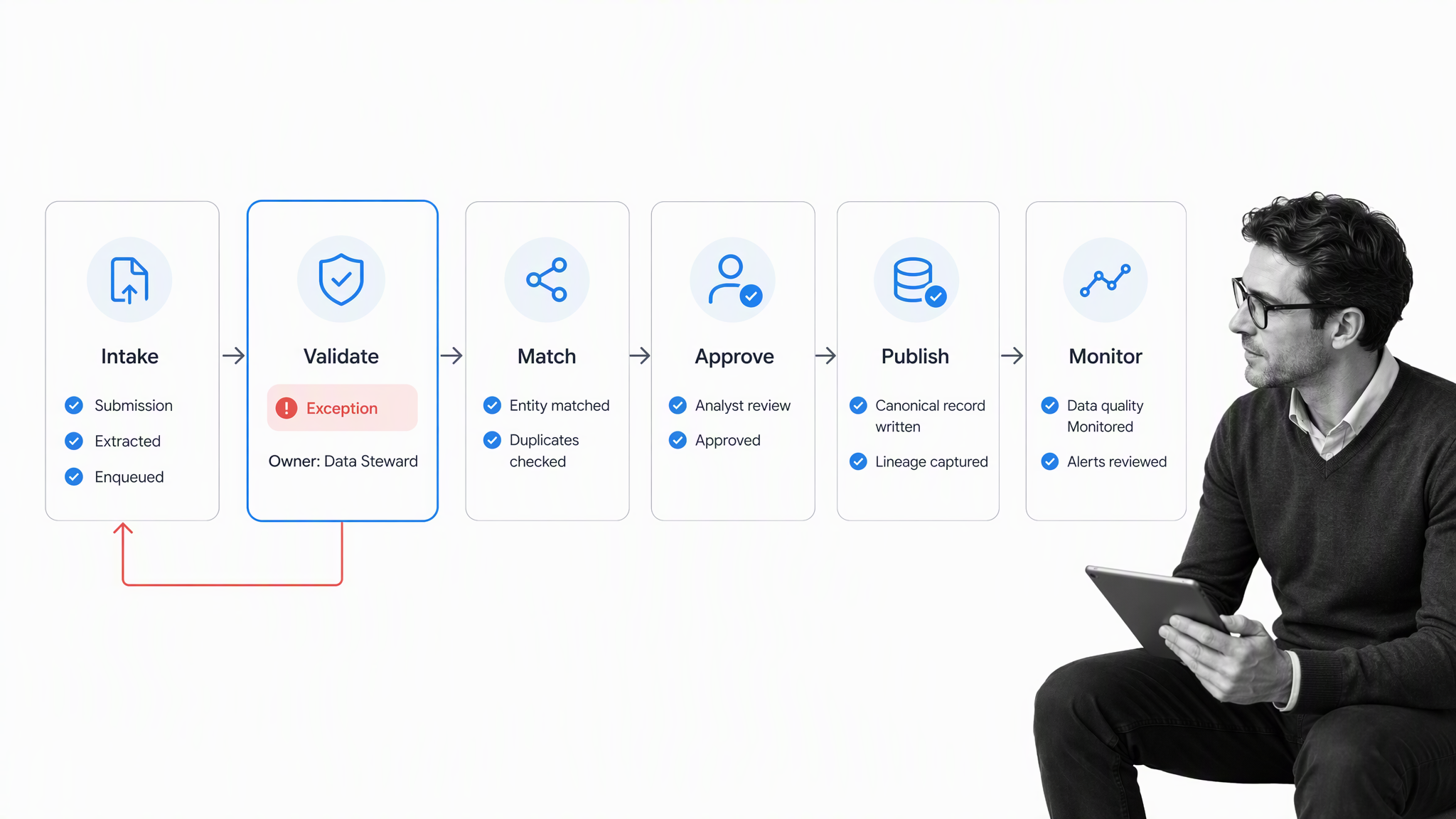
A canonical record is the approved version of a company, fund, investor, contact, security, or reporting value. It does not mean every data point lives in one database. It means each important domain has a named owner, an authoritative system, and a rule for how downstream systems receive changes.
Design integrations around events
Event-based integration is easier to govern than constant uncontrolled synchronization. Examples include a deal entering formal diligence, a committee approval being recorded, a transaction closing, a portfolio submission passing validation, or a capital notice receiving approval. Each event can trigger a narrow exchange with defined inputs, outputs, and failure handling.
Validate before promoting data
New information should pass field, format, ownership, and reasonableness checks before it becomes canonical. Validation queues need an owner and a return path. Silently dropping a failed record is worse than a manual process because the missing data looks complete to everyone downstream.
Public company and filing research can use structured sources such as the SEC developer resources for EDGAR data. External data should retain its source and retrieval context so analysts can distinguish a primary filing from a derived data point.
Security, compliance, and governance
Protect confidential deal and investor information
VC systems hold sensitive founder data, cap tables, financial statements, legal documents, investor information, and internal assessments. Apply least-privilege access, multifactor authentication, secure sharing, encryption, logging, and timely offboarding. Separate broad relationship access from restricted diligence and fund records.
Govern automation and AI
Automation should have a named owner, a defined purpose, approved inputs, and a failure path. AI-generated summaries and classifications require source links and human review when they influence investment, compliance, or investor communication. Do not send confidential material to an unapproved model simply because the interface is convenient.
Build evidence into the workflow
The NIST Cybersecurity Framework 2.0 offers outcome-based guidance for managing cybersecurity risk. A firm can map relevant outcomes to its own controls, owners, evidence, and review cadence. The practical objective is to prove that controls operate, not merely that a policy exists.
For regulatory work, connect assigned controls to the firm’s venture capital regulatory filings and retention obligations. Counsel and compliance owners should determine which rules apply to the specific manager, funds, investors, and jurisdictions.
How to choose venture capital technology
Start with operating requirements
Document the decisions, records, handoffs, approvals, and evidence the firm needs before comparing products. Separate mandatory controls from preferences. This prevents a polished demonstration from winning because it looks familiar while leaving the hardest operating gaps unresolved.
- Lifecycle coverage: which stages and handoffs the system supports.
- Data ownership: where canonical records live and how duplicates are handled.
- Workflow control: assignments, approvals, dependencies, exceptions, and audit history.
- Integration fit: reliable ways to exchange data with the rest of the stack.
- Security fit: identity, permissions, logging, retention, and vendor risk controls.
- Adoption fit: whether the system matches the daily work of partners, investors, and operators.
Evaluate the full cost of operation
License price is only one component. Include implementation, migration, integration, administration, training, change management, support, and the continuing cost of data cleanup. A structured venture capital software evaluation should also test exit options and data portability.
Use realistic scenarios
Ask each candidate system to demonstrate the firm’s real work: qualifying a referral, escalating a diligence exception, preparing a committee packet, onboarding a new investment, correcting a portfolio value, and approving an LP communication. Scenario testing reveals whether the product supports the operating model or requires constant workarounds.
How to implement a VC technology stack
Map the current state
Inventory systems, spreadsheets, shared drives, integrations, owners, and recurring manual work. Identify where teams re-enter data, wait for answers, reconcile versions, or lose evidence. The map should include unofficial tools because those often carry critical steps that the formal architecture overlooks.
Define the future state in small releases
Prioritize one high-value journey instead of replacing the entire stack at once. A firm might begin with diligence-to-committee control, portfolio reporting intake, or fund communication approvals. Give the release a clear owner, entry criteria, exit criteria, and measures of success.
Clean and migrate deliberately
Migration is a governance project. Define which records move, which fields remain authoritative, how duplicates are resolved, what history is retained, and who signs off. Keep reconciliation evidence so the team can prove that critical records arrived accurately.
Train through real work
Role-based training should use live operating scenarios rather than feature tours. Partners need fast review and decision paths. Investment teams need reliable capture and diligence work. Operations teams need administration, exception handling, reporting, and recovery procedures.
Teams can reinforce adoption with an investment management workflow that makes the expected sequence visible. Short office hours and a clear support channel help users surface edge cases before they create shadow processes.
Create an ownership model
Assign a business owner, technical owner, data steward, security reviewer, and administrator for each major system. A clear venture capital manager operating model helps prevent decisions from falling between investment and operations teams.
Venture capital technology with Process Street
Orchestrate work across the stack
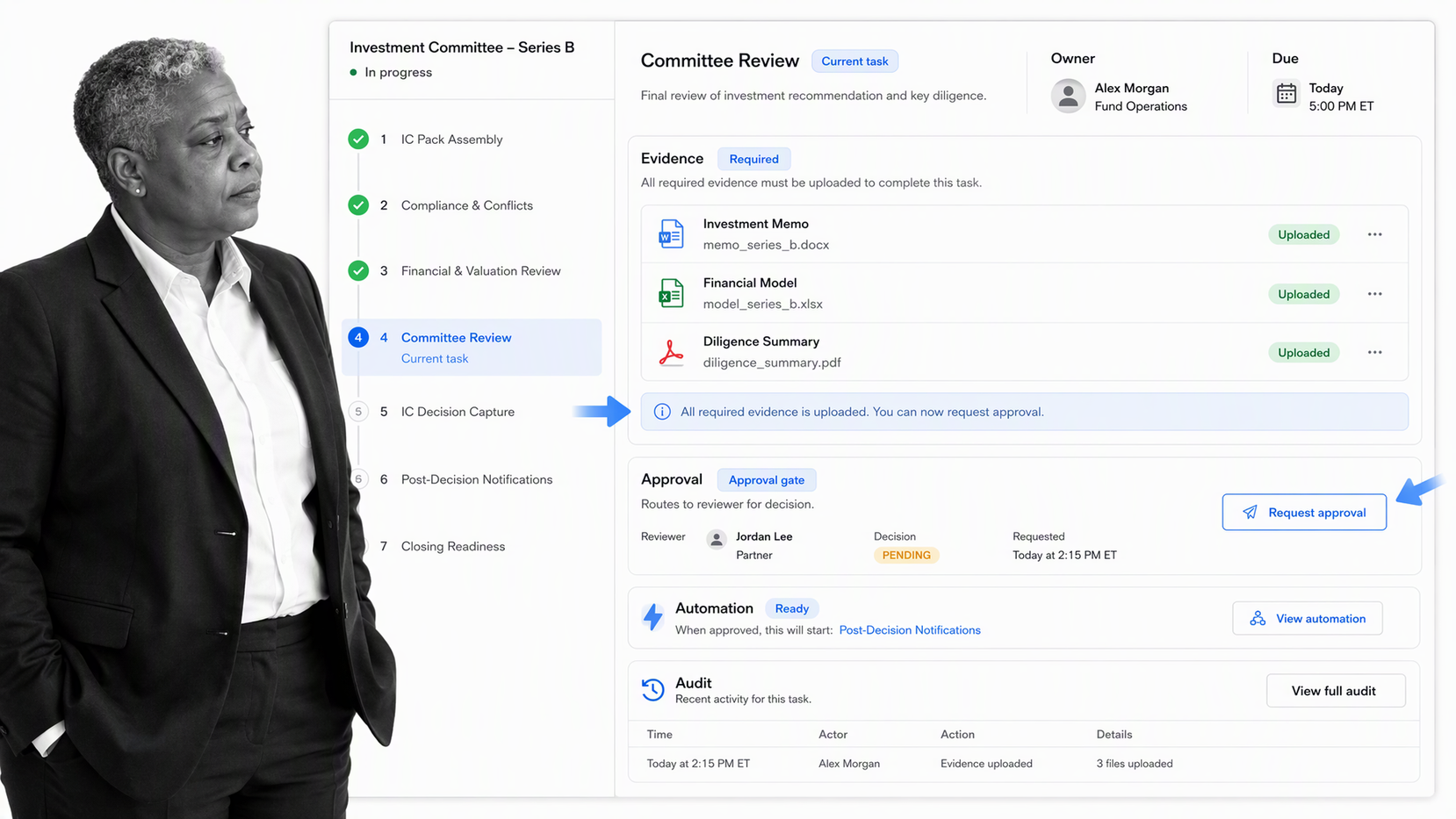
Process Street can sit across specialized venture systems as the controlled execution layer for recurring work. Teams can assign tasks, collect structured information, require evidence, route approvals, apply conditional logic, trigger automations, and preserve an audit history without replacing every underlying system of record.
That makes the platform useful for diligence coordination, committee preparation, investment onboarding, portfolio reporting intake, valuation review, regulatory preparation, and investor communication approvals. The workflow becomes the place where people and systems coordinate, while specialized databases continue to hold the records they manage best.
Turn policies into executable controls
A written policy can be translated into a workflow with owners, required fields, due dates, evidence, and approval gates. Teams can start with a venture capital workflow template or an investment management template and adapt it to the firm’s governance model.
Connect systems without hiding accountability
Process Street has direct, universal integrations to more than 5,000 systems, and an AI agent can build a new integration on the fly. Integrations can move approved data and trigger downstream work, while assignments and approval records keep human accountability visible.
A venture capital example
In the Tribe Capital and AWS case study, Tribe Capital used Process Street and AWS services to standardize post-sourcing venture workflows, halve due diligence time, and more than double active-deal throughput. The lesson is not that every firm should copy one architecture. It is that controlled workflow and connected infrastructure can increase capacity without making the investment process opaque.
How to measure and improve the stack
Measure flow, quality, and control
Measure whether work moves more reliably, not only whether people log in. Useful indicators include stage aging, time to complete diligence, exception volume, approval cycle time, duplicate records, validation failure rate, reporting rework, overdue controls, and integration errors. Pair speed with quality so a faster process does not hide weaker review.
Review the architecture on a cadence
Review the stack quarterly and after major fund, strategy, regulatory, or team changes. Retire redundant tools, repair failing integrations, refresh permissions, update data definitions, and prioritize the next workflow improvement. Keep a decision log so the architecture evolves intentionally instead of accumulating exceptions.
The right venture capital management software remains useful because the firm continuously improves the operating design around it. Technology is infrastructure for judgment and accountability, not a substitute for either one.
Venture capital technology FAQs
What is venture capital technology?
Venture capital technology is the connected software, data architecture, automation, and workflow control a VC firm uses across sourcing, diligence, investment decisions, fund operations, portfolio monitoring, compliance, and investor reporting. A useful stack defines ownership and handoffs instead of simply collecting tools.
What belongs in a venture capital technology stack?
A typical stack includes relationship and deal management, research and diligence, document management, investment committee workflows, fund administration, portfolio monitoring, investor reporting, analytics, identity, security, and integration capabilities. The exact design depends on the firm’s strategy and operating model.
How does venture capital technology support due diligence?
It coordinates requests, evidence, analysis, risks, reviewers, deadlines, and approval gates in one traceable process. It can automate reminders and data movement, but investment judgment and material exceptions should remain under accountable human review.
How should a VC firm integrate its technology stack?
Choose a system of record for each data domain, connect systems around meaningful business events, validate information before it becomes canonical, and monitor failures. Avoid uncontrolled two-way synchronization that makes ownership and correction paths unclear.
What security controls should venture capital firms apply to technology?
Use least-privilege access, multifactor authentication, encryption, secure sharing, logging, retention rules, vendor risk review, tested recovery, and prompt offboarding. Confidential deal, founder, fund, and investor information should only enter approved systems and AI services.
How can Process Street support venture capital operations?
Process Street can orchestrate recurring venture workflows with assignments, structured data, conditional routing, approvals, evidence, integrations, automation, and audit history. It can coordinate work across specialized systems without requiring the firm to replace each system of record.