Turn every policy into automated workflows with built-in enforcement and audit-ready proof.



Venture Capital Software

Venture capital software helps VC firms source companies, manage relationships, run diligence, coordinate investment committee decisions, monitor portfolio companies, report to LPs, and keep fund operations under control.
The hard part is that no single tool owns the whole job for every firm. A seed fund may care most about founder relationships and deal flow. A larger platform team may need portfolio monitoring, investor updates, fund administration, compliance evidence, and repeatable workflows.
This guide compares venture capital software across the operating jobs that matter most: relationship intelligence, deal workflow, due diligence, portfolio monitoring, investor relations, fund operations, and controlled execution.
In this article, we are going to cover:
- What a VC operating stack needs to cover
- How to choose the right VC stack
- 1. Process Street
- 2. Affinity
- 3. Edda
- 4. Altvia
- 5. Dynamo
- 6. Visible
- Venture capital software comparison
- Venture capital software FAQs
What a VC operating stack needs to cover
Good venture capital software starts with the shape of the firm. A thesis-driven early-stage fund, a multi-stage platform team, a corporate venture group, and an emerging manager do not run the same operating model. The software stack should match how the team finds companies, evaluates risk, wins allocations, supports portfolio companies, and reports performance.
Deal flow is only one part of the system. The broader venture capital investment process includes sourcing, screening, diligence, investment committee review, closing, portfolio support, follow-on decisions, and exits. Each step creates information that later teams need.
Deal sourcing and CRM
VC is a relationship business, so many firms begin with a CRM. The system should capture founders, co-investors, scouts, operators, advisors, LPs, and portfolio relationships. The best VC CRMs add context from email, calendar, introductions, and prior firm activity so the team can see why a relationship matters.
Due diligence and IC workflow
Diligence needs more than a shared folder. The team needs a consistent route for deck review, market research, founder references, technical risk, financial model review, legal review, and investment committee approval. A repeatable due diligence workflow prevents each deal from becoming a custom project.
Portfolio monitoring and LP reporting
After investment, the operating load shifts. Firms need KPI collection, board material tracking, founder updates, valuation support, reserve planning, and LP reporting. Portfolio monitoring software helps if it collects information without turning every founder relationship into admin work.
Fund operations and compliance
Fund operations include capital calls, document collection, regulatory filings, investor communications, vendor management, and audit evidence. Topics like venture capital regulatory filings matter because VC firms are not just picking companies. They are running regulated financial operations.
How to choose the right VC stack
Choose venture capital software by deciding which operating job is most broken. Buying a full platform when the real issue is inconsistent approvals creates shelfware. Buying a point CRM when the real issue is fund operations leaves the team with a cleaner contact list and the same execution gaps.
Map the workflow before the tool
Write down how a deal moves from first signal to final decision. Include who owns each step, which information is required, where approvals happen, and what evidence the firm needs later. This makes software evaluation concrete.
Separate systems of record from systems of action
A CRM can be the relationship record. A fund administration tool can be the finance record. A data room can be the document store. The missing layer is often the system of action: the workflow that tells the team what to do next and proves it happened. That is where a workflow management system becomes useful.
Plan for AI, but keep controls
AI is changing venture work quickly: deck summarization, market research, memo drafts, portfolio signal extraction, and LP reporting can all move faster. The question is not whether AI appears in the stack. The question is whether the firm can govern the workflow around the AI output.
When AI affects decisions, the firm needs approval paths, source evidence, exception review, and audit history. That is why adjacent ideas like operational risk management framework belong in the software conversation.
1. Process Street
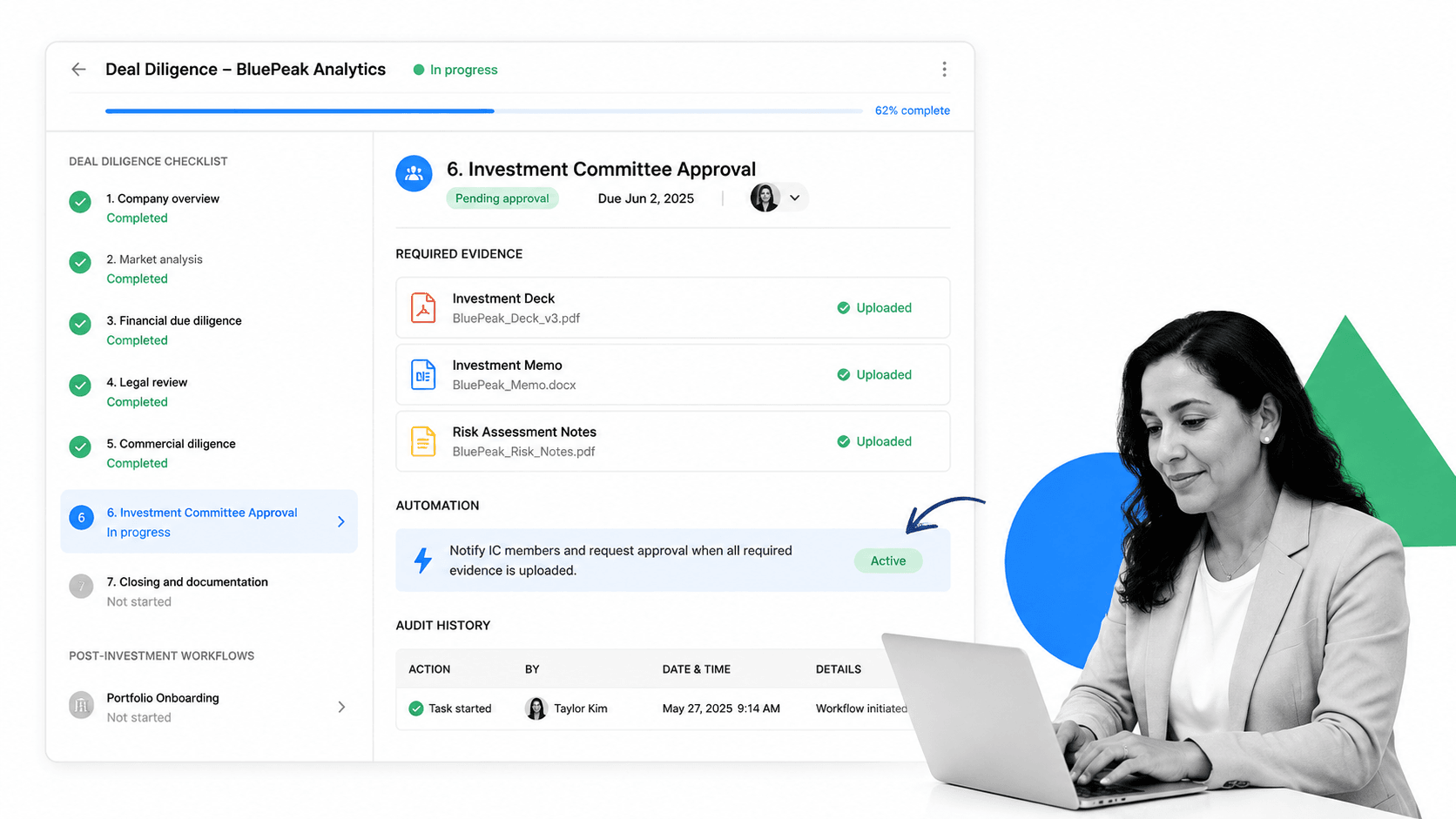
Process Street is best for VC operating workflows, diligence checklists, approvals, portfolio operations, and audit-ready execution. It belongs in a venture capital software shortlist when that job is central to the firm’s operating model.
Process Street is a Compliance Operations Platform for teams that need work to happen the same way every time. For VC firms, that means turning diligence, investment committee review, portfolio support, regulatory tasks, and fund operations into workflows with owners, approvals, required fields, and audit history.
Process Street is especially useful when the firm already has a CRM, data room, fund admin platform, or portfolio monitoring tool, but the process around those tools is still manual. Conditional routes, approvals, conditional logic, and evidence fields make the next step explicit.
Process Street has direct, universal integrations to 5,000+ systems. Need a new one? An AI agent builds it on the fly. That matters for VC teams because the workflow can coordinate records across CRM, document storage, portfolio reporting, finance, email, and collaboration tools without forcing every team into one monolithic system.
- Best fit: operating partners, platform teams, compliance-sensitive fund operations, and firms that want repeatable diligence.
- Watch for: it is not a replacement for a fund administrator or market intelligence database.
- Useful starting points include a due diligence checklist template and an investment checklist template.
Where Process Street fits in the stack
Process Street should be evaluated as part of the full venture operating system. If it owns the record, decide what workflow acts on that record. If it owns the workflow, decide which system remains the source of truth. If it owns reporting, decide how the data gets collected and approved.
2. Affinity
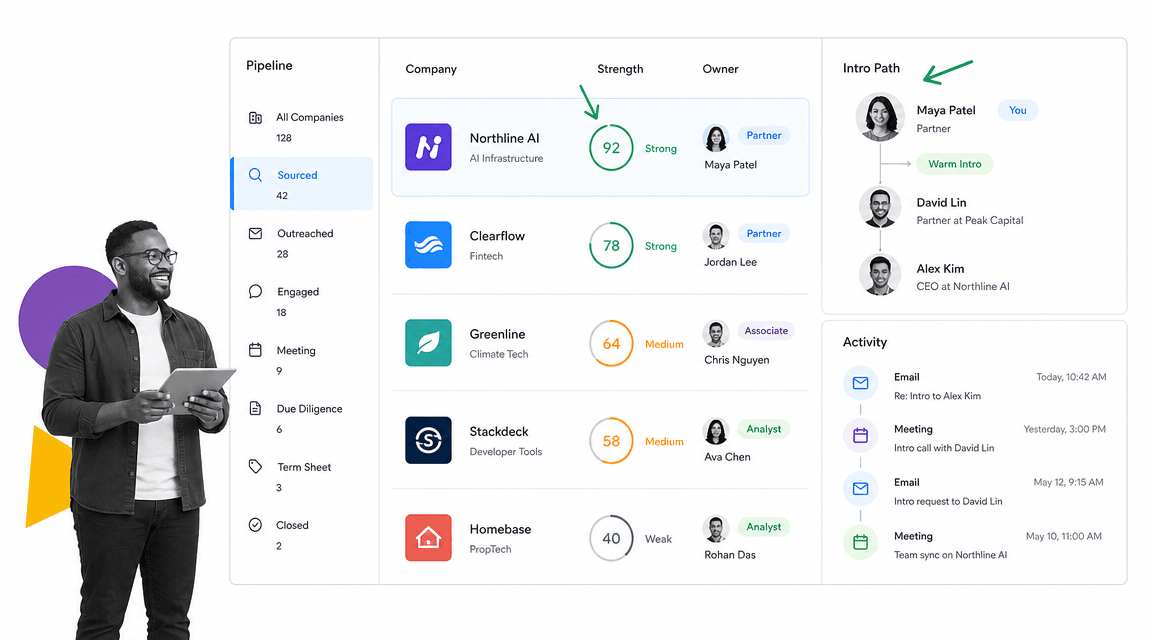
Affinity is best for relationship intelligence, sourcing, warm introductions, and deal team collaboration. It belongs in a venture capital software shortlist when that job is central to the firm’s operating model.
The official Affinity venture capital CRM positioning emphasizes relationship intelligence, sourcing, warm introductions, and deal team collaboration. That makes Affinity strongest when the team wants a dedicated product surface for that part of the VC stack.
Look for fit around relationship intelligence for sourcing, automated activity capture, deal flow CRM views. The right buyer is usually the person who feels the pain every week, not the person who owns the broadest software budget.
- Best fit: relationship intelligence, sourcing, warm introductions, and deal team collaboration.
- Watch for: integration depth, data portability, and whether the system supports the exact workflow your firm uses.
- Evaluation question: does this tool reduce partner and associate admin, or does it simply create another place to maintain data?
Where Affinity fits in the stack
Affinity should be evaluated as part of the full venture operating system. If it owns the record, decide what workflow acts on that record. If it owns the workflow, decide which system remains the source of truth. If it owns reporting, decide how the data gets collected and approved.
3. Edda
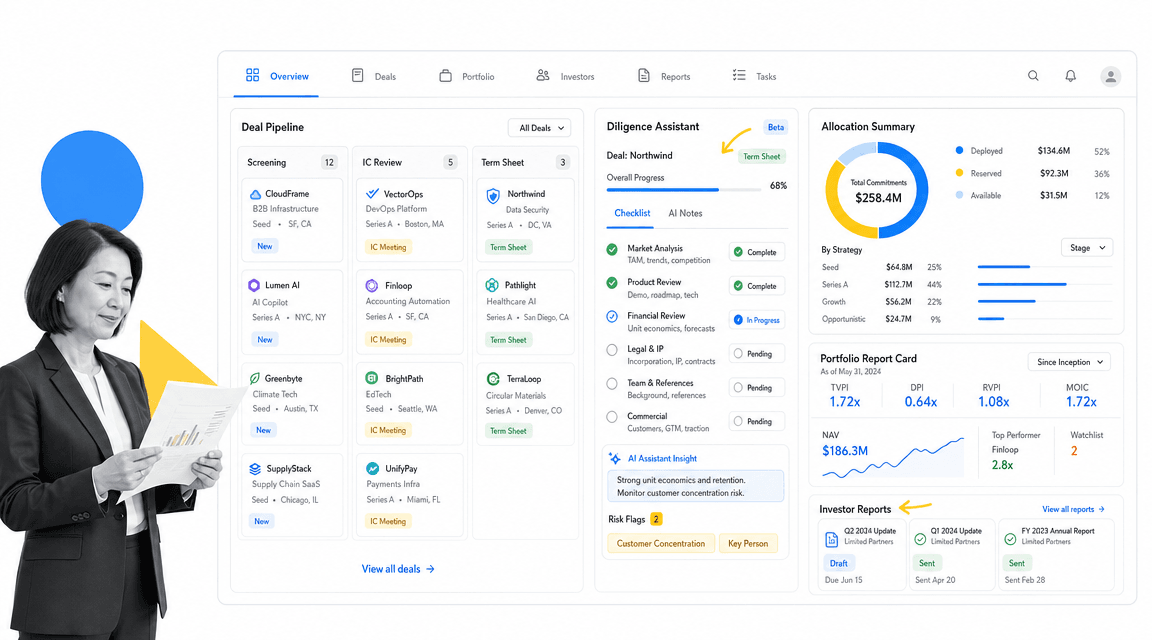
Edda is best for firms that want deal flow, portfolio monitoring, allocations, and investor reporting in one investment platform. It belongs in a venture capital software shortlist when that job is central to the firm’s operating model.
The official Edda deal flow and portfolio management positioning emphasizes firms that want deal flow, portfolio monitoring, allocations, and investor reporting in one investment platform. That makes Edda strongest when the team wants a dedicated product surface for that part of the VC stack.
Look for fit around end-to-end deal flow management, portfolio and allocation tracking, AI-assisted diligence support. The right buyer is usually the person who feels the pain every week, not the person who owns the broadest software budget.
- Best fit: firms that want deal flow, portfolio monitoring, allocations, and investor reporting in one investment platform.
- Watch for: integration depth, data portability, and whether the system supports the exact workflow your firm uses.
- Evaluation question: does this tool reduce partner and associate admin, or does it simply create another place to maintain data?
Where Edda fits in the stack
Edda should be evaluated as part of the full venture operating system. If it owns the record, decide what workflow acts on that record. If it owns the workflow, decide which system remains the source of truth. If it owns reporting, decide how the data gets collected and approved.
4. Altvia
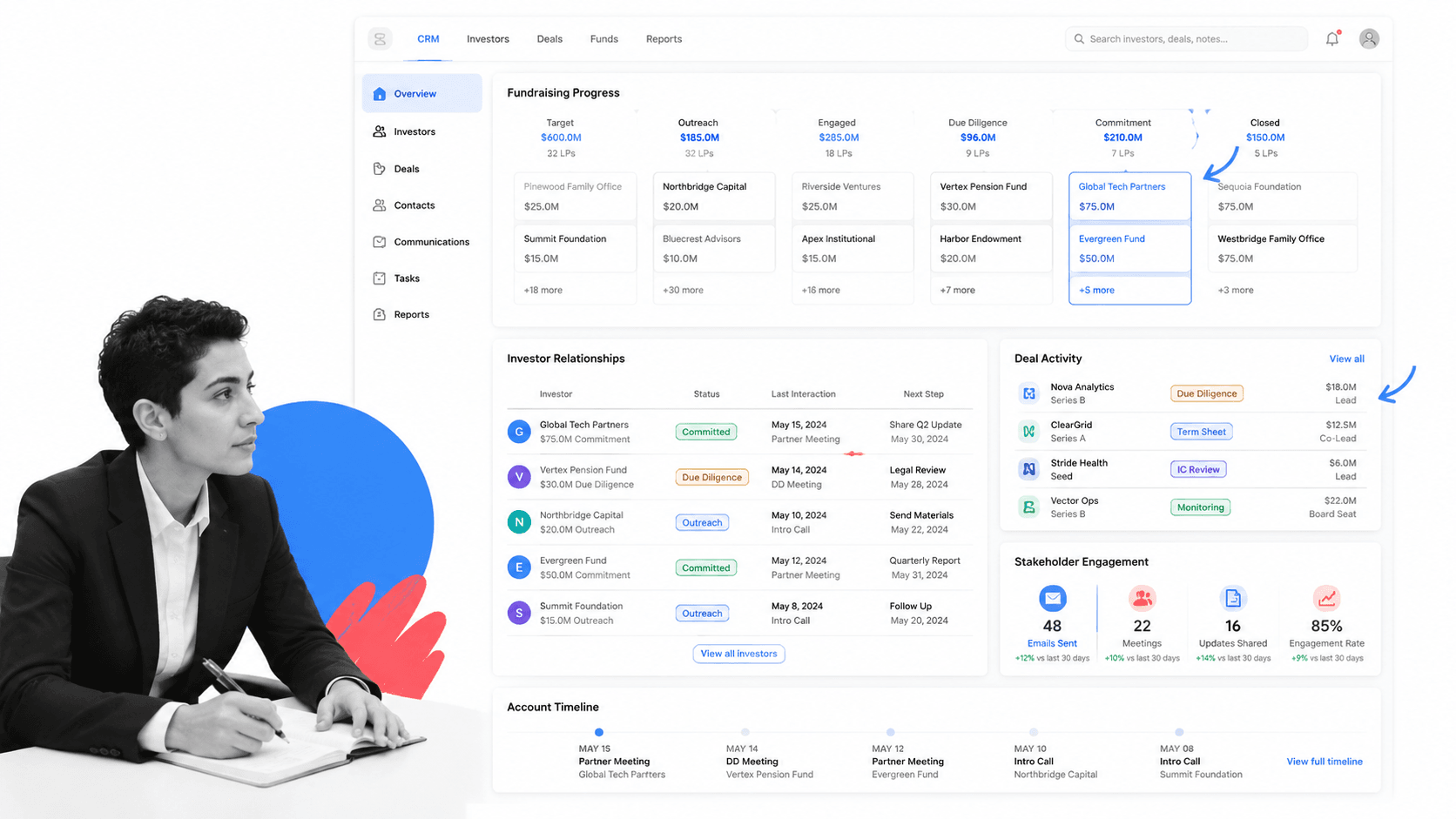
Altvia is best for private capital teams that need fundraising, investor relations, deal activity, and stakeholder records in one CRM-centered system. It belongs in a venture capital software shortlist when that job is central to the firm’s operating model.
The official Altvia private capital software positioning emphasizes private capital teams that need fundraising, investor relations, deal activity, and stakeholder records in one CRM-centered system. That makes Altvia strongest when the team wants a dedicated product surface for that part of the VC stack.
Look for fit around private capital CRM, fundraising and investor relations workflows, deal and stakeholder data organization. The right buyer is usually the person who feels the pain every week, not the person who owns the broadest software budget.
- Best fit: private capital teams that need fundraising, investor relations, deal activity, and stakeholder records in one CRM-centered system.
- Watch for: integration depth, data portability, and whether the system supports the exact workflow your firm uses.
- Evaluation question: does this tool reduce partner and associate admin, or does it simply create another place to maintain data?
Where Altvia fits in the stack
Altvia should be evaluated as part of the full venture operating system. If it owns the record, decide what workflow acts on that record. If it owns the workflow, decide which system remains the source of truth. If it owns reporting, decide how the data gets collected and approved.
5. Dynamo
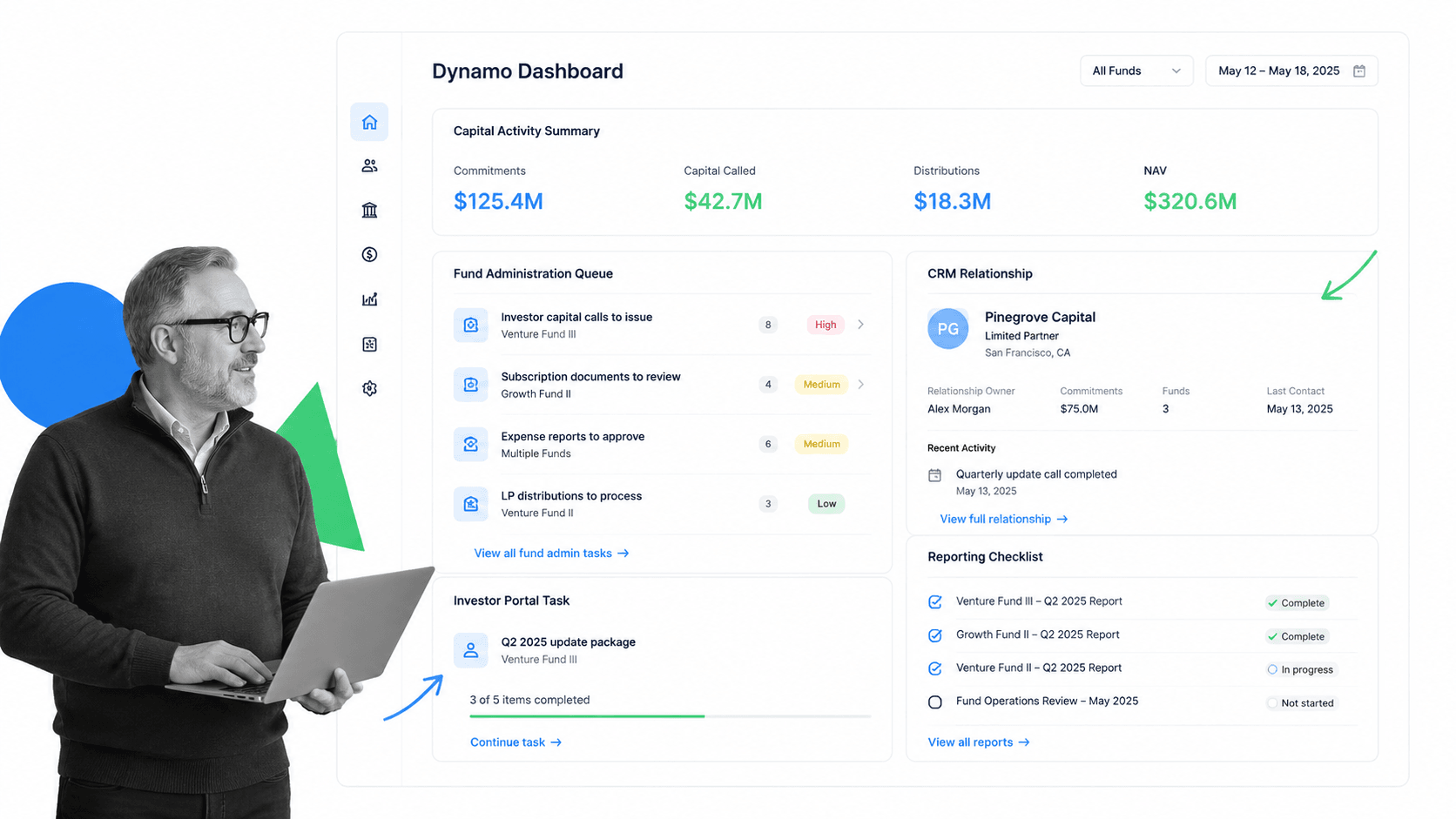
Dynamo is best for multi-asset investment firms that want CRM, fund administration services, investor relations, and reporting depth. It belongs in a venture capital software shortlist when that job is central to the firm’s operating model.
The official Dynamo venture capital software positioning emphasizes multi-asset investment firms that want CRM, fund administration services, investor relations, and reporting depth. That makes Dynamo strongest when the team wants a dedicated product surface for that part of the VC stack.
Look for fit around alternative investment CRM, fund administration services, investor relations workflows. The right buyer is usually the person who feels the pain every week, not the person who owns the broadest software budget.
- Best fit: multi-asset investment firms that want CRM, fund administration services, investor relations, and reporting depth.
- Watch for: integration depth, data portability, and whether the system supports the exact workflow your firm uses.
- Evaluation question: does this tool reduce partner and associate admin, or does it simply create another place to maintain data?
Where Dynamo fits in the stack
Dynamo should be evaluated as part of the full venture operating system. If it owns the record, decide what workflow acts on that record. If it owns the workflow, decide which system remains the source of truth. If it owns reporting, decide how the data gets collected and approved.
6. Visible
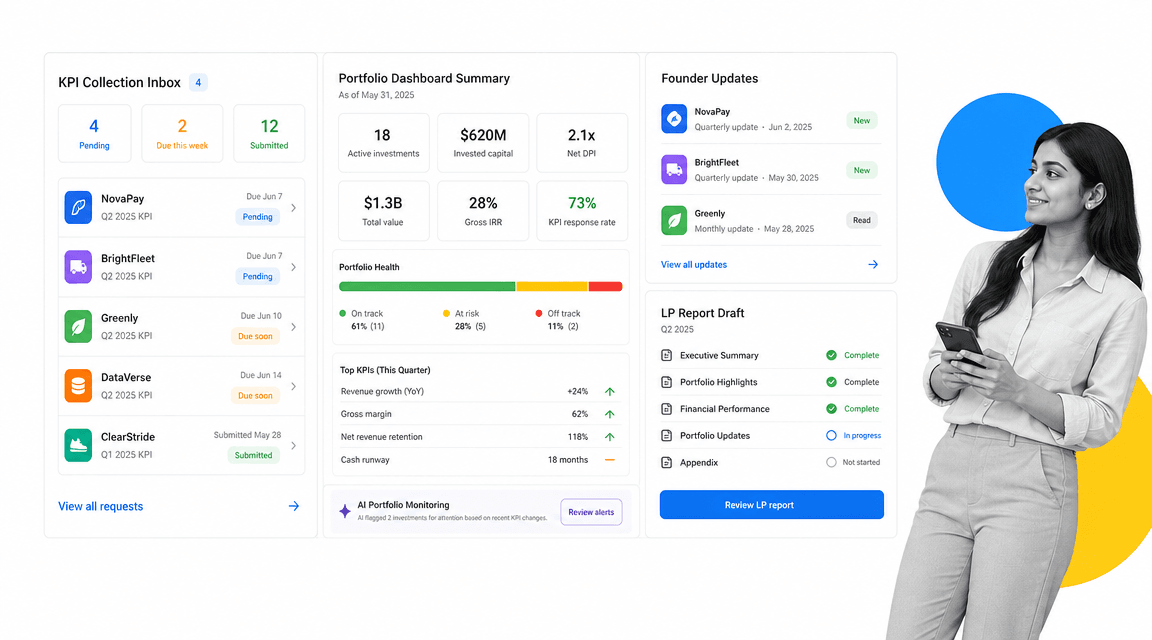
Visible is best for portfolio monitoring, founder updates, KPI collection, investor communication, and LP reporting. It belongs in a venture capital software shortlist when that job is central to the firm’s operating model.
The official Visible portfolio monitoring positioning emphasizes portfolio monitoring, founder updates, KPI collection, investor communication, and LP reporting. That makes Visible strongest when the team wants a dedicated product surface for that part of the VC stack.
Look for fit around portfolio monitoring, investor updates, KPI collection. The right buyer is usually the person who feels the pain every week, not the person who owns the broadest software budget.
- Best fit: portfolio monitoring, founder updates, KPI collection, investor communication, and LP reporting.
- Watch for: integration depth, data portability, and whether the system supports the exact workflow your firm uses.
- Evaluation question: does this tool reduce partner and associate admin, or does it simply create another place to maintain data?
Where Visible fits in the stack
Visible should be evaluated as part of the full venture operating system. If it owns the record, decide what workflow acts on that record. If it owns the workflow, decide which system remains the source of truth. If it owns reporting, decide how the data gets collected and approved.
Venture capital software comparison
The strongest venture capital software stack is usually modular. A firm may use one tool for CRM, another for fund administration, another for portfolio monitoring, and a workflow layer to connect the decisions between them.
For deal sourcing
Prioritize CRM depth, relationship intelligence, email and calendar capture, founder pipeline views, and clear ownership. Affinity, Edda, Altvia, and Dynamo can all appear in this conversation, depending on whether the firm wants a VC-specific CRM or a broader private capital platform.
For diligence and approvals
Prioritize repeatability, required evidence, investment committee gates, exception paths, and audit history. This is where workflow software and templates like due diligence checklist template help the team avoid custom one-off reviews.
For portfolio monitoring
Prioritize founder-friendly KPI collection, clean portfolio dashboards, support for board and LP reporting, and a low-friction experience for portfolio companies. Visible and Carta are common examples in this part of the stack.
For fund operations
Prioritize capital account accuracy, LP communication, document workflows, tax and audit coordination, compliance evidence, and reporting. Fund operations connect closely to financial compliance software and financial process automation because the same controls affect finance execution.
The final decision should come back to control. If a tool gives the firm cleaner information but leaves approvals, evidence, and follow-through in email, the operating risk remains. If the stack creates a clear process record, the firm can move faster while keeping proof. That is the practical value of compliance as proof of control.
Venture capital software FAQs
What is venture capital software?
Venture capital software is software used by VC firms to manage relationships, deal flow, diligence, investment committee decisions, portfolio monitoring, investor relations, LP reporting, fund operations, and compliance workflows.
What is the best venture capital software?
The best venture capital software depends on the operating job. Affinity is strong for relationship intelligence, Visible is strong for portfolio monitoring, Dynamo and Altvia serve private capital operations, Edda covers deal flow and portfolio workflows, and Process Street controls repeatable execution across the stack.
What software do VC firms use for deal flow?
VC firms commonly use venture-focused CRMs, relationship intelligence tools, investment platforms, spreadsheets, and workflow systems for deal flow. The best setup tracks source, owner, stage, next step, diligence status, and decision history.
How should a VC firm choose venture capital software?
Start by mapping the workflow that is breaking down: sourcing, diligence, approvals, portfolio monitoring, LP reporting, or fund operations. Then choose software that controls that workflow, integrates with the rest of the stack, and creates durable records.
Does venture capital software replace a CRM?
Sometimes, but not always. Some venture capital software includes CRM features, while other tools focus on portfolio monitoring, fund administration, reporting, or workflow execution. Many firms use a CRM as the relationship record and a workflow platform to manage the actions around it.
How can Process Street support venture capital operations?
Process Street helps VC firms turn repeatable work into controlled workflows. Teams can run diligence checklists, investment committee approvals, portfolio onboarding, compliance tasks, LP reporting prep, and operational reviews with required fields, conditional logic, approvals, automations, and audit history.