Turn every policy into automated workflows with built-in enforcement and audit-ready proof.


Healthcare Service
A healthcare service is an organized activity that promotes health, prevents illness, diagnoses a condition, delivers treatment, supports recovery, or helps a person manage ongoing needs. The service may be clinical, administrative, diagnostic, rehabilitative, preventive, emergency, public-health, or community-based, but it always turns people, expertise, resources, and processes into an outcome for a patient or population.
Strong healthcare services are accessible, coordinated, safe, timely, equitable, and measurable. They do more than place a qualified professional in front of a patient. They make intake clear, route work to the right team, protect information, manage handoffs, respond to exceptions, follow up, and learn from results.
This guide explains what a healthcare service is, the main service types, how service delivery works, how quality and access are measured, how workflows and governance reduce risk, and how teams can improve service operations without losing human judgment.
In this article, we are going to cover:
- What a healthcare service is
- Types of healthcare services
- How healthcare service delivery works
- Healthcare service quality and access
- Healthcare service workflows and handoffs
- Healthcare service governance and compliance
- How to improve a healthcare service
- Run healthcare services in Process Street
- FAQs
What a healthcare service is
A healthcare service is the unit of value a patient or community receives from the wider health system. A vaccination clinic, primary-care appointment, diagnostic test, surgery, medication review, home-health visit, mental-health consultation, rehabilitation program, and emergency response are all services. Each has a defined purpose, a population, an entry point, an operating path, and an expected result.
Service, provider, and system are different
A provider is the person or organization that delivers care. A healthcare system is the broader network of organizations, financing, information, governance, technology, and services. The service is the actual work delivered within that network. Keeping those ideas separate helps teams improve a patient experience without pretending one service controls the whole system.
Every service has an operating model
Even a simple appointment depends on demand, eligibility, scheduling, information, staff, space, equipment, supplies, decision rules, documentation, and follow-up. If any dependency is unclear, patients experience the gap as delay, repetition, uncertainty, or lost continuity. A service definition therefore needs to describe both the clinical promise and the operational path.
The patient sees one experience
Departments may divide work into intake, nursing, diagnostics, pharmacy, billing, quality, and records. The patient experiences one service. A good design coordinates those internal parts so people do not have to carry information between teams, repeat their story, or discover after the visit that another action was required.
A useful service description names who the service is for, the need it addresses, how people enter, the activities included, the expected result, the responsible owner, the information and resources required, and the conditions that trigger escalation or follow-up.
Types of healthcare services
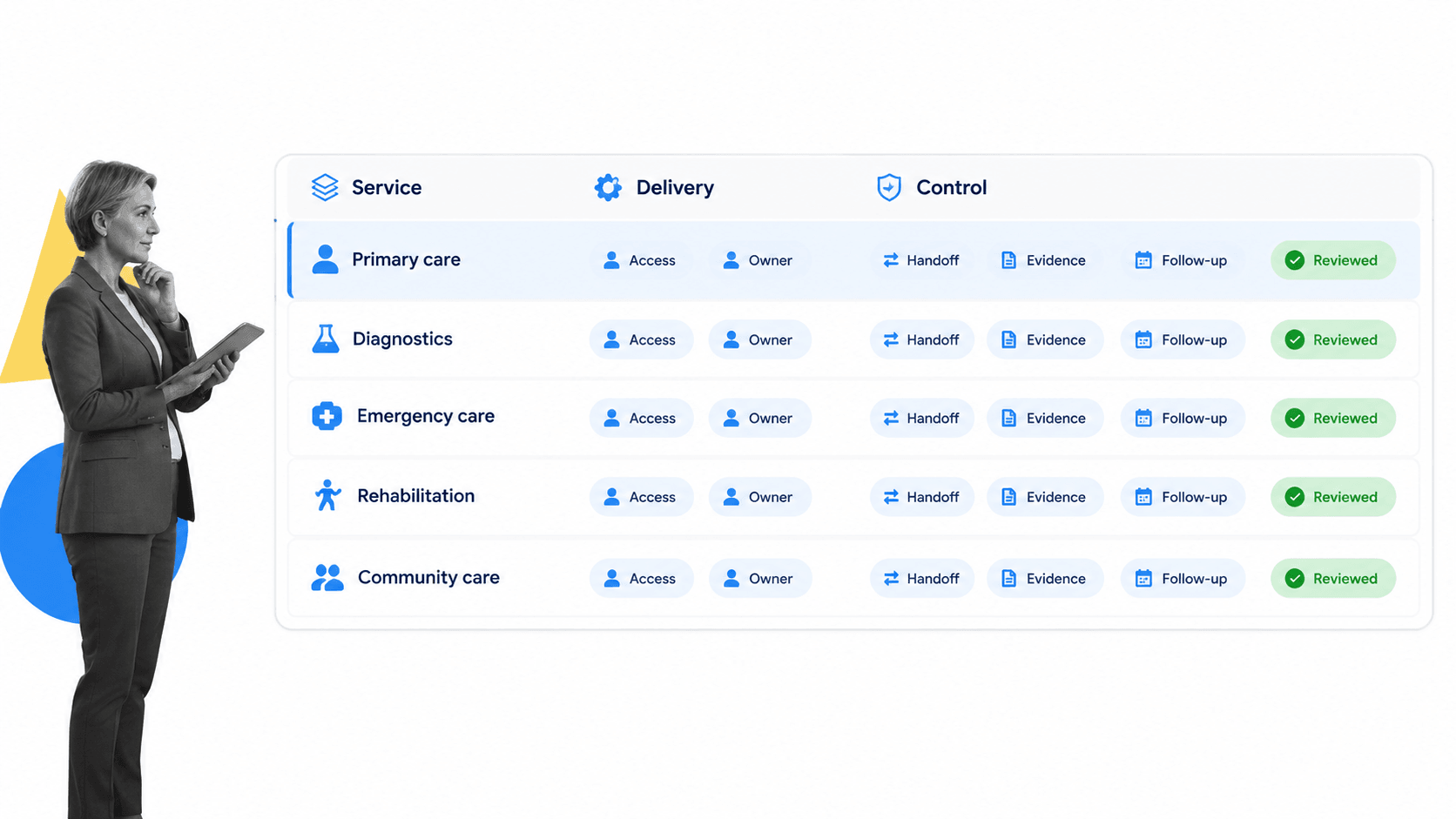
Healthcare services span the full path from prevention to long-term support. Categories overlap, but they help leaders define ownership, capacity, access, evidence, and quality expectations.
Preventive and public-health services
Prevention includes immunization, screening, health education, surveillance, risk reduction, and population programs. The CDC 10 Essential Public Health Services describe activities communities should undertake, including assessing health, investigating hazards, communicating, strengthening partnerships, enabling access, building the workforce, and improving public-health functions.
Primary and ambulatory care
Primary care manages common health needs, prevention, ongoing conditions, referrals, and continuity. Ambulatory services also include specialty clinics, urgent care, outpatient procedures, and virtual care. Their quality depends on access, accurate assessment, closed-loop referrals, medication information, and reliable follow-up.
Diagnostic and treatment services
Laboratory, imaging, pharmacy, procedure, surgical, and inpatient services turn clinical decisions into diagnosis and treatment. These services require correct orders, patient identification, readiness checks, result communication, equipment reliability, supply control, documentation, and escalation when findings or conditions change.
Emergency and critical services
Emergency, trauma, intensive-care, crisis, and urgent-response services operate under time pressure. Triage, staffing, capacity, communication, handoffs, transport, supply readiness, escalation, and contingency plans need clear triggers because ambiguity consumes time when risk is highest.
Rehabilitation, home, and long-term support
Rehabilitation, home health, palliative care, long-term care, and community support help people recover, adapt, or manage ongoing needs. Success often depends on coordination between clinicians, patients, caregivers, equipment suppliers, pharmacies, community organizations, and follow-up teams.
Administrative services such as scheduling, records, credentialing, claims support, access management, and facilities work also shape care. They are not separate from service quality when their delays or errors affect access, safety, continuity, or trust.
How healthcare service delivery works
Healthcare service delivery converts a need into an assessed, completed, documented, and followed-up episode of work. The details vary by setting, but the operating pattern is consistent.
A clear service boundary also helps leaders distinguish the patient outcome from the individual tasks, systems, and teams that support it.
Demand enters through a defined channel
A request may arrive through self-scheduling, referral, emergency presentation, public-health outreach, a clinician order, a payer authorization, or an automated trigger. The entry point should clarify urgency, eligibility, location, information needs, accessibility needs, and the next accountable owner.
Assessment determines the path
Assessment turns the initial request into a service plan. It may include triage, history, eligibility, risk screening, consent, safety checks, or readiness verification. Decision rules should support consistent action while preserving professional judgment for unusual or high-risk cases.
Delivery coordinates people and resources
The service itself brings together staff, space, supplies, information, equipment, technology, and time. Reliable healthcare infrastructure and suitable healthcare technology support the work, but they create value only when the operating process assigns ownership and makes exceptions visible.
Documentation and results close the clinical loop
A completed activity is not always a completed service. Results may need interpretation, communication, approval, coding, medication changes, referral, discharge instructions, or another appointment. Closure criteria should state what evidence confirms the patient and the next team received what they need.
Follow-up checks the outcome
Follow-up can confirm recovery, adherence, access, symptom change, test completion, or another handoff. A closed-loop service verifies the next action instead of assuming that sending a message, order, or referral completed the work.
Healthcare service quality and access
Healthcare service quality describes how reliably a service produces the intended result while protecting safety, experience, equity, and resources. Access describes whether the right person can receive that service at the right time and place.
Measure outcomes and processes
The CMS healthcare quality measures explain that quality measures can quantify processes, outcomes, patient perceptions, and organizational structures associated with care. Service teams need outcome measures, process measures that show whether the delivery model was followed, and balancing measures that expose unintended effects.
Track access as a pathway
Access is more than appointment availability. It includes awareness, eligibility, language, disability support, transportation, digital access, scheduling, wait time, affordability, navigation, and the ability to complete the next step. Measure where people stop, wait, repeat work, or require manual rescue.
Listen to service users and staff
Patient feedback shows whether the service felt understandable, respectful, coordinated, and responsive. Staff feedback exposes workarounds, missing information, duplicate documentation, unsafe workload, and tools that do not fit the task. Both views help explain why a measure moved.
Turn signals into action
A dashboard does not improve a service by itself. Measures, complaints, incidents, delays, and audit findings need thresholds, owners, investigation paths, corrective actions, and verification. A governed healthcare software can help teams connect signals to accountable improvement work.
Choose a small number of measures that reflect the service promise. A referral service might track time to first contact, complete information at handoff, appointment completion, high-risk escalation, patient understanding, and confirmed follow-up.
Healthcare service workflows and handoffs
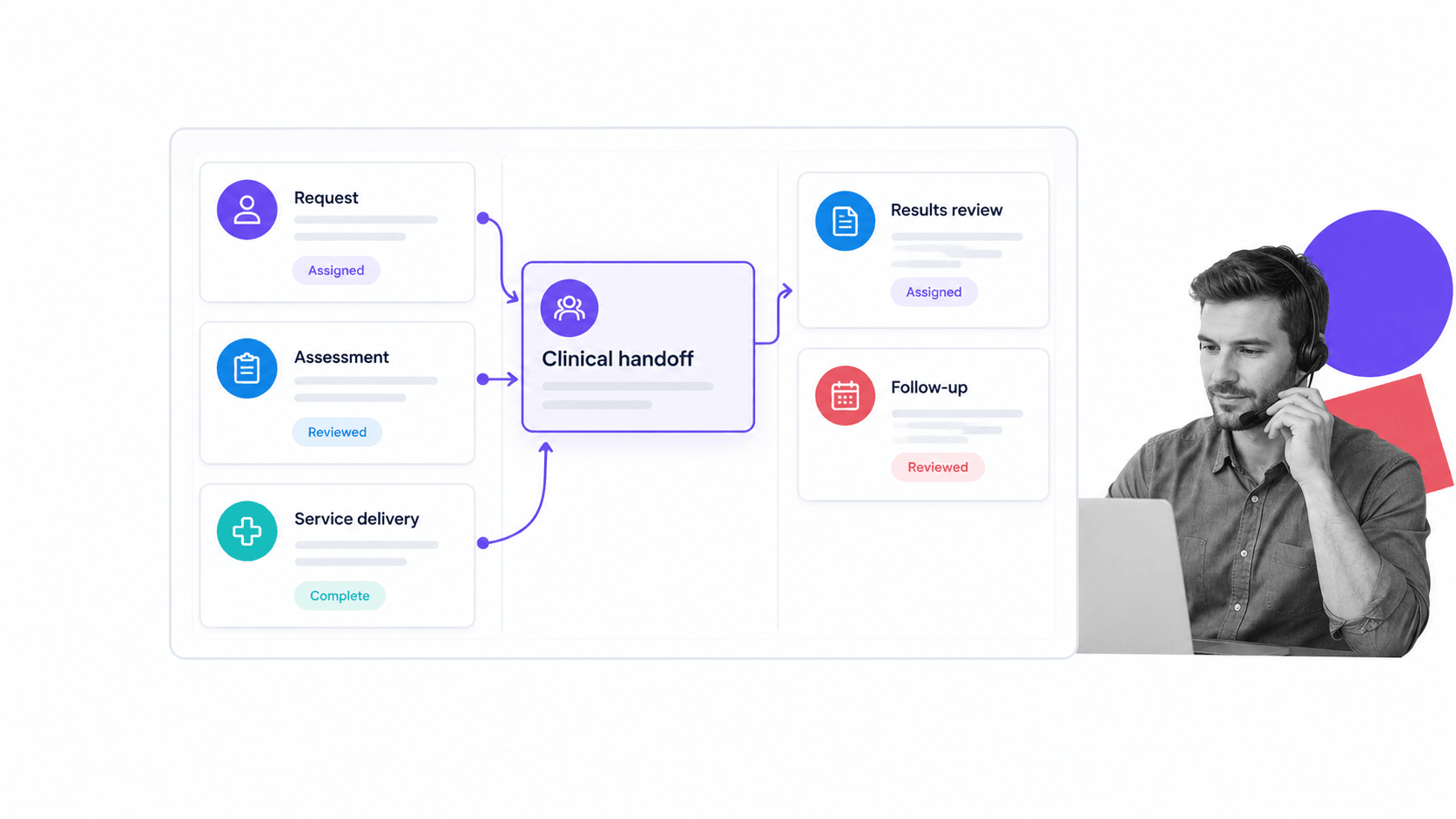
Healthcare service workflows make the delivery model visible. They connect the trigger, tasks, decisions, owners, information, evidence, handoffs, exceptions, and completion criteria that turn a service promise into consistent work.
Map the work as it happens
The AHRQ healthcare workflow mapping guidance explains that workflow mapping can clarify responsibilities and support redesign. Map the real flow, including phone calls, queues, spreadsheets, repeated data entry, informal checks, and workarounds. A polished policy map that omits actual work cannot guide improvement.
Give every handoff an owner
A handoff is not complete when one team sends something. It is complete when the next team receives the required information, accepts ownership, acts, and confirms the result. Clear healthcare workflow design names the sending owner, receiving owner, evidence, response window, and escalation path.
Define exception paths
Services encounter missing information, failed contact, unavailable capacity, abnormal results, privacy questions, authorization gaps, and clinical changes. A workflow should route those cases to the right judgment rather than forcing staff to invent a side process under pressure.
Keep the workflow usable
Control does not require showing every field to every person. conditional logic can reveal tasks based on service type, risk, location, or response, while required fields preserve the evidence needed for safe completion. The correct path should be easier than the workaround.
Review the workflow with the people who deliver and receive the service. They can identify where instructions conflict with reality, where ownership is ambiguous, and where a technically complete step still leaves the next person without what they need.
Healthcare service governance and compliance
Healthcare service governance defines who can set standards, change the service, accept risk, review performance, approve exceptions, and require corrective action. It keeps local execution aligned with clinical, privacy, safety, quality, and organizational obligations.
Name the service owner
The service owner is accountable for purpose, scope, capacity, quality, access, review, improvement, and controlled change. Clinical, operational, technology, privacy, quality, and finance roles may share decisions, but one accountable owner should coordinate the full service model.
Control information appropriately
The HHS HIPAA Security Rule guidance requires appropriate administrative, physical, and technical safeguards for electronic protected health information. Service workflows that use sensitive information should define appropriate access, required evidence, secure handling, audit history, incident response, and periodic review.
Approve material decisions
Service changes, risk acceptance, exception closure, return to service, and major corrective actions may need formal review. workflow approvals keep the decision beside its evidence so approval does not become a disconnected email or meeting memory.
Maintain an assurance trail
A strong HIPAA compliance audit checklist links a requirement to the control, owner, completed work, evidence, exception, and review. The HHS Security Rule safeguards summary describes safeguards, responsibilities, access management, and documentation expectations that become more reliable when they are embedded in recurring work.
Governance should support learning, not only inspection. When staff surface a recurring workaround or near miss, the review process should improve the service design and verify that the change reached daily execution.
How to improve a healthcare service
Improving a healthcare service means changing the operating model so patients receive a better result with less delay, confusion, risk, or avoidable effort. Sustainable improvement connects service design, workflow, information, ownership, measurement, and learning.
Step 1: Define the service promise
State who the service is for, the need it addresses, the result it should deliver, and what safe completion means. A precise promise prevents teams from optimizing internal activity that does not improve the patient or population outcome.
Step 2: Map the current journey
Document entry points, tasks, roles, decisions, systems, evidence, queues, handoffs, exceptions, and follow-up. A detailed healthcare process exposes delays and duplicate work that top-level service descriptions miss.
Step 3: Find the highest-leverage gap
Look for a change that improves several parts of the service at once: one clear owner, complete intake information, an earlier risk screen, a closed-loop handoff, a simpler approval, or a recurring review that turns known failure into action.
Step 4: Test in a bounded setting
Pilot the change with one site, team, service line, or patient group. Track the intended outcome, process adoption, and unintended effects. Ask staff and service users what changed in practice, not only whether the project plan was completed.
Step 5: Standardize and monitor
Once the change works, turn it into a governed healthcare solution with assigned owners, evidence, decisions, approvals, and review. Use healthcare automation for repeatable coordination, while keeping qualified human judgment where the service requires it.
Improvement is complete only when the new method survives ordinary workload, shift changes, staff turnover, unusual cases, and measurement over time. Otherwise it is still a temporary project.
Run healthcare services in Process Street
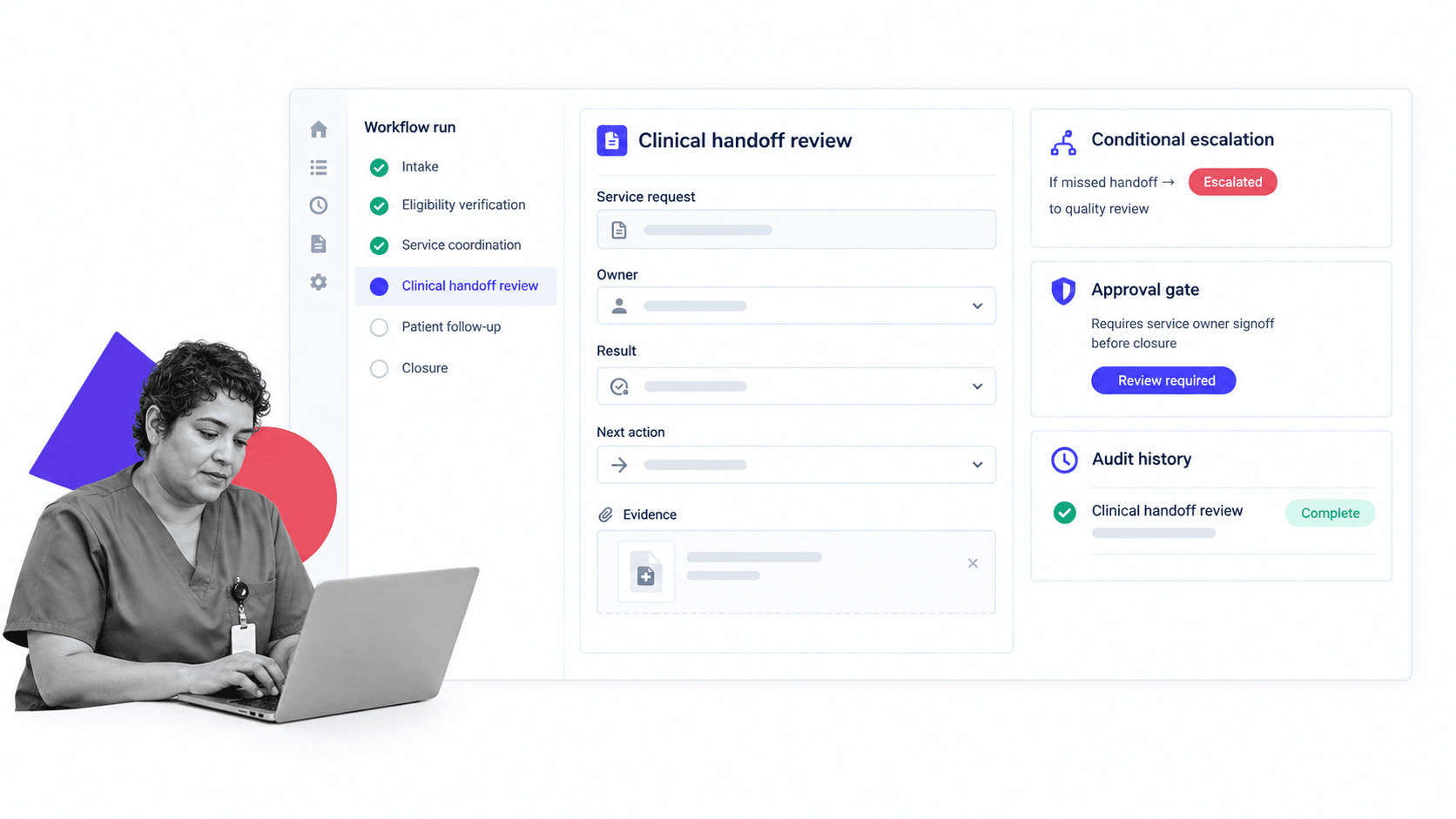
Healthcare services in Process Street become workflows that connect service standards to assigned work. Teams can run intake, referral coordination, service reviews, incident response, access checks, clinical audits, corrective actions, policy reviews, and follow-up through one governed execution layer.
Turn service standards into tasks
A service model can launch the same core workflow across sites while allowing controlled variation for specialty, location, risk, and role. Required fields and evidence create consistency. Owners and response windows create accountability. Conditional paths adapt the work when a case needs additional review.
Use approvals for consequential decisions
Approval gates can hold service changes, exceptions, escalations, corrective actions, and closure until the appropriate owner has reviewed the supporting evidence. The decision remains part of the operating record.
Connect tools around the service
Process Street has 5,000+ integrations. Healthcare teams can keep specialized clinical, financial, scheduling, communication, and data systems in place while coordinating the human and automated work between them.
Create one evidence trail
Each workflow run records tasks, owners, fields, files, comments, decisions, approvals, exceptions, and completion state. Teams can inspect one service episode during a review or aggregate records to find recurring delays, handoff failures, and improvement opportunities.
Scale without hiding variation
A common workflow makes the service comparable across teams and locations. Controlled conditional paths preserve legitimate variation, while shared evidence and review criteria make it easier to identify where performance differs and why.
FAQs
What is a healthcare service?
A healthcare service is an organized activity that promotes health, prevents illness, diagnoses a condition, delivers treatment, supports recovery, or helps a person manage ongoing needs. It combines professional expertise, resources, information, and an operating process to produce an outcome for a patient or population.
What are the main types of healthcare services?
Common types include preventive and public-health services, primary and ambulatory care, diagnostics, pharmacy, emergency care, hospital treatment, mental-health care, rehabilitation, home health, long-term care, and community support. Administrative services also shape access and continuity.
How is a healthcare service delivered?
Service delivery usually moves from request or referral through assessment, planning, delivery, documentation, handoff, and follow-up. Clear owners, decision rules, information access, evidence, and escalation paths help the service remain coordinated and safe.
How do you measure healthcare service quality?
Measure outcomes, delivery processes, patient experience, access, safety, equity, timeliness, and resource use. Pair each measure with an owner, threshold, investigation path, corrective action, and verification step so measurement leads to improvement.
How can healthcare services improve handoffs?
Define the sending owner, receiving owner, required information, response window, acceptance step, completion evidence, and escalation path. A handoff is complete only when the next team can act and the result is confirmed.
How can Process Street support healthcare services?
Process Street can turn service standards into assigned workflows with required evidence, conditional routing, approvals, integrations, escalation, and audit history. That helps healthcare teams coordinate recurring operational, quality, compliance, and follow-up work across roles and locations.