Turn every policy into automated workflows with built-in enforcement and audit-ready proof.



Healthcare Infrastructure

Healthcare infrastructure is the physical, digital, operational, and organizational foundation that allows healthcare services to function. It includes facilities, utilities, medical environments, technology, communications, supply chains, workforce support, governance, and the workflows that connect them.
A hospital can have modern equipment and still have weak infrastructure if power is unreliable, maintenance is reactive, data cannot move between systems, supplies are not traceable, or nobody owns the response to a failed control. Infrastructure is not a collection of assets. It is the system that keeps care available, safe, and recoverable.
This guide explains the major layers of healthcare infrastructure, how physical and digital foundations work together, what resilience looks like, how to assess gaps, and how to turn infrastructure standards into recurring operational work.
In this article, we are going to cover:
- What healthcare infrastructure is
- Core healthcare infrastructure components
- Physical healthcare infrastructure
- Digital healthcare infrastructure
- Operational healthcare infrastructure
- Healthcare infrastructure resilience
- How to assess healthcare infrastructure
- Run healthcare infrastructure workflows in Process Street
- FAQs
What healthcare infrastructure is
Healthcare infrastructure is the set of structures and supporting systems needed to deliver health services. WHO primary healthcare infrastructure guidance describes the physical layer as buildings, non-medical equipment, utilities, waste systems, transport, and logistics. In practice, healthcare organizations also depend on digital systems, trained people, reliable supplies, governance, and repeatable operating processes.
Infrastructure is broader than the building
The facility is visible, but much of the infrastructure that keeps it useful is hidden. Electrical distribution, backup power, water, ventilation, communications, sterilization support, access control, waste handling, network connectivity, equipment maintenance, and supply replenishment all have to work before a clinical team can deliver care reliably.
The broader view aligns with the WHO health system building blocks, which connect service delivery with workforce, information, medical products and technologies, financing, and leadership. A strong facility cannot compensate for a broken information flow or an unmanaged supply chain.
Infrastructure creates the conditions for care
Infrastructure does not diagnose a patient or make a clinical decision. It creates the conditions in which those decisions can be made and acted on. A treatment room needs safe utilities. A referral needs communication and scheduling systems. A medication process needs storage, traceability, and controls. A continuity plan needs owners, tested backups, and evidence.
Infrastructure is a connected operating system
Thinking in layers prevents teams from treating every failure as an isolated maintenance ticket. A workflow management system can connect the asset, the responsible team, the response path, the evidence, and the review. That turns infrastructure from a static inventory into an operating system for dependable care.
Core healthcare infrastructure components
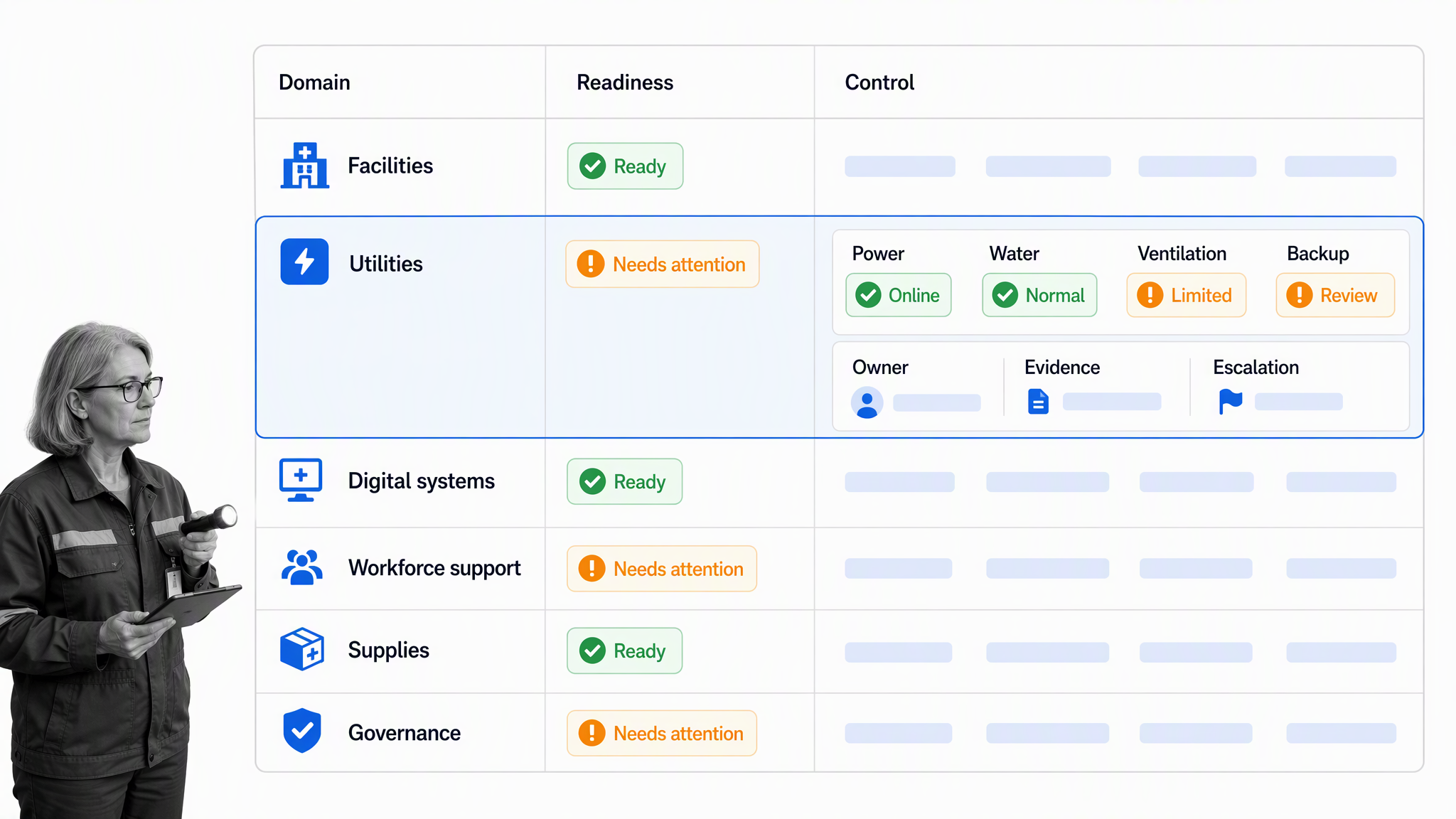
Healthcare infrastructure works as a stack. Each layer supports the others, and a weakness in one layer can interrupt the full service. A useful infrastructure model covers at least six connected domains.
Facilities and utilities
This domain includes buildings, treatment spaces, laboratories, pharmacies, storage, water, sanitation, electricity, backup generation, ventilation, fire systems, transport access, and waste disposal. Reliability matters more than appearance. Critical services need capacity, redundancy, maintenance, and tested recovery procedures.
Clinical equipment and technical services
Medical equipment needs more than procurement. It needs safe installation, calibration, preventive maintenance, compatible utilities, trained users, spare parts, service records, and a plan for downtime. The infrastructure question is whether the equipment can be used safely through its full lifecycle.
Digital and communications systems
Digital infrastructure includes networks, identity, devices, core applications, interoperability, cybersecurity, data storage, backup, recovery, and support. It is the foundation beneath healthcare technology, not a separate modernization project.
Workforce and operational support
Facilities engineers, biomedical teams, IT, security, supply-chain staff, infection prevention, quality, compliance, and clinical leaders all carry infrastructure responsibilities. Role clarity, training, coverage, and escalation paths determine whether technical capacity becomes reliable service.
Supplies, logistics, and vendor capacity
Infrastructure also includes the flow of medicines, gases, consumables, sterile supplies, replacement parts, and contracted services. Strong healthcare resource management connects demand, inventory, supplier risk, receiving, storage, replenishment, and contingency sourcing.
Governance and financing
Every layer needs priorities, standards, ownership, budgets, lifecycle planning, risk acceptance, and performance review. Without governance, organizations defer maintenance, accumulate incompatible systems, and discover dependencies only during a failure.
Connections between infrastructure domains
The boundaries between domains deserve the same attention as the assets themselves. A new imaging device may require electrical capacity, network access, identity controls, shielding, cooling, staff training, service contracts, consumables, and an outage procedure. If each team plans only its own component, the organization can buy a capable asset without creating a dependable clinical service.
For every material change, identify the affected domains, sequence their readiness checks, name one accountable coordinator, and define the evidence required before go-live. This cross-domain review helps teams catch hidden constraints early and prevents a technical installation from being mistaken for operational readiness.
Physical healthcare infrastructure
Physical healthcare infrastructure is the built and mechanical foundation of care. WHO hospital infrastructure guidance notes that hospitals depend on reliable spaces, water, energy, telecommunications, technologies, and supplies, with redundancy for disasters and crises.
Plan around services and patient flow
Space should follow the service model. Patient arrival, triage, treatment, diagnostics, medication, transfer, discharge, staff circulation, clean supplies, contaminated materials, and emergency access create different flows. Poorly designed intersections add delay and safety risk even when each room works in isolation.
Treat utilities as clinical dependencies
Power, water, ventilation, medical gases, temperature control, communications, and waste systems support clinical activity directly. Teams should identify which services depend on each utility, what failure looks like, how quickly the impact becomes unsafe, and which backup restores an acceptable level of care.
Manage assets through their lifecycle
An asset register is only the starting point. Effective infrastructure management connects condition, criticality, maintenance schedule, inspection evidence, failure history, parts, vendor support, replacement horizon, and service impact. High-risk assets should have clearer controls and faster escalation than low-impact fixtures.
Design for accessibility and human use
Infrastructure has to work for patients, visitors, clinicians, technicians, and support staff. Accessibility, wayfinding, infection control, ergonomics, privacy, noise, lighting, and safe maintenance access affect whether a technically compliant space works in daily use.
A recurring clinical audit workflow can connect facility conditions to corrective actions and confirm that an identified problem actually reached closure.
Digital healthcare infrastructure
Digital healthcare infrastructure is the technical foundation that lets information move safely between people, devices, applications, and organizations. The WHO Global Digital Health Monitor evaluates digital-health maturity across governance, strategy, policy, services, infrastructure, standards, interoperability, and workforce.
Build a reliable base before adding applications
Networks, device management, identity, authentication, access control, logging, backup, recovery, support, and change management are foundational. Adding more applications to an unstable base increases complexity without improving reliability.
Make interoperability an operating capability
Healthcare integration is not complete when two systems can exchange data once. Sustainable healthcare integration needs ownership, monitoring, error handling, mapping changes, access review, and a response when a connection stops or sends incomplete information.
Connect monitoring to action
Dashboards can show uptime, queue depth, device status, security alerts, or interface failures. Useful healthcare monitoring also creates an assigned response, an escalation threshold, and a closure record. A signal without an operating path becomes another screen people learn to ignore.
Protect information throughout the workflow
HHS HIPAA Security Rule guidance explains the administrative, physical, and technical safeguards required for electronic protected health information. Infrastructure teams should connect access, configuration, backup, vendor, incident, and recovery controls to the workflows where those controls are performed and reviewed.
Good healthcare analytics can then show trends across those records without replacing the evidence that supports them.
Operational healthcare infrastructure
Operational infrastructure is the system of ownership, routines, controls, and records that keeps physical and digital assets dependable. This layer is often the difference between infrastructure that exists and infrastructure that performs.
Define the control cycle
Every critical infrastructure domain needs a control cycle: inspect, test, maintain, document, approve, escalate, repair, verify, and improve. The frequency and evidence should match the risk. A backup power test needs a different control cycle from a low-risk room inspection.
Make ownership unambiguous
For each control, name the accountable owner, the person or team performing the work, the reviewer, the response time, and the escalation path. Shared responsibility without a named owner usually means the task waits until somebody notices the gap.
Use evidence that proves the control
Completion should require meaningful evidence: an inspection result, measurement, photograph, maintenance record, vendor report, approval, exception decision, or restored-service confirmation. A checked box without context may prove activity, but it rarely proves the infrastructure is ready.
Connect exceptions to corrective work
A failed inspection should not end with a note. It should create a corrective action, assign an owner, set a response window, collect repair evidence, require review, and update the risk picture. compliance management software is strongest when compliance signals change the work that happens next.
This is where healthcare workflow software and healthcare automation support infrastructure teams. They turn standards and recurring checks into routed work instead of adding another static procedure document.
Healthcare infrastructure resilience
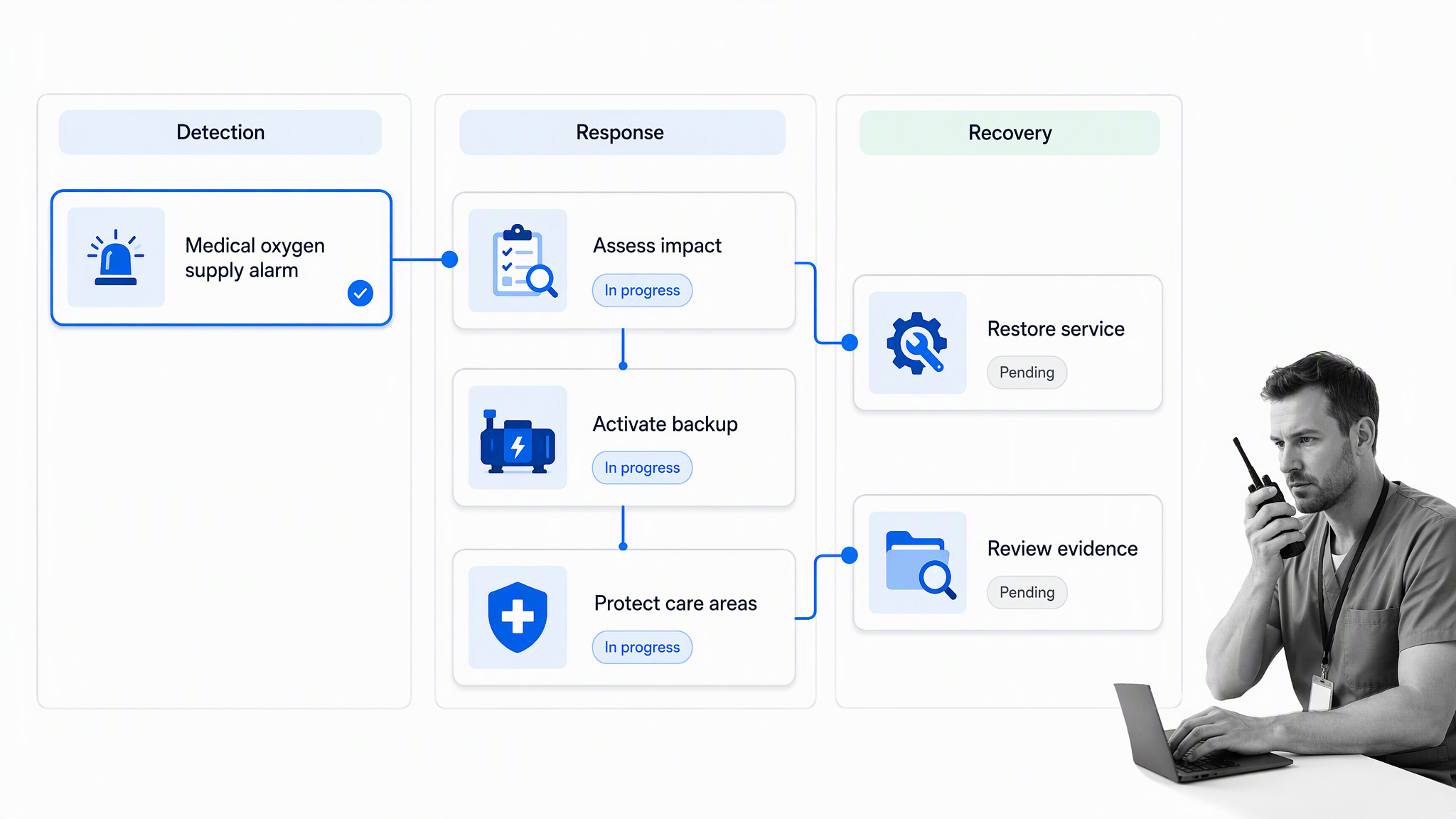
Healthcare infrastructure resilience is the ability to anticipate disruption, continue priority services, recover safely, and learn from the event. Resilience is not the same as having a backup. The backup has to be available, tested, understood, and connected to a response plan.
Identify critical services and dependencies
Start with the service that must continue, then map what it depends on. Emergency care may depend on power, medical gases, water, network access, communications, staffing, supplies, transport, and external vendors. This service-first view exposes dependencies that asset lists miss.
Define acceptable degradation
Not every service can run normally during disruption. Decide which services continue, which move to an alternate mode, which pause, and what conditions trigger transfer or closure. These decisions need clinical, operational, facilities, IT, and leadership input before the incident.
Test the response, not only the equipment
A generator test does not prove that a department can continue operating. Exercises should test detection, notification, decision rights, backup activation, patient protection, supplier coordination, documentation, restoration, and after-action review.
Maintain continuity as recurring work
CMS emergency preparedness guidance requires covered providers and suppliers to plan for hazards, communication, policies, and testing. A business continuity software can keep those recurring activities visible and connect exercises to corrective actions.
After each test or event, capture what failed, what worked, which workaround was used, and what needs to change. Resilience improves when evidence feeds the next control cycle.
How to assess healthcare infrastructure
A healthcare infrastructure assessment should show whether each critical service has the capacity, controls, evidence, and recovery path it needs. Avoid a one-time checklist that produces a long issue list without priorities or owners.
Step 1: Set the scope around a service
Choose a facility, service line, care setting, or infrastructure domain. Define the operating outcome the assessment is protecting. A scope such as reliable surgical services produces a clearer dependency map than a vague review of all facilities.
Step 2: Map assets and dependencies
List the spaces, utilities, equipment, applications, interfaces, supplies, roles, vendors, and policies required for the service. Record upstream and downstream dependencies, including hidden single points of failure.
Step 3: Test controls and evidence
For each critical dependency, ask what control reduces the risk, who performs it, how often it runs, what evidence proves it, who reviews exceptions, and what happens after failure. Sample real records instead of accepting a policy statement as proof.
Step 4: Prioritize by service impact
Rank gaps by the care impact, likelihood, time to harm, detectability, recovery difficulty, and availability of a safe workaround. A small defect with immediate service impact may outrank a larger project with a strong temporary control.
Step 5: Convert findings into governed actions
Assign owners, deadlines, evidence, review, and closure criteria. Use a medical checklist app for recurring field checks and connect material gaps to capital planning, maintenance, technology roadmaps, vendor management, and continuity exercises.
Run healthcare infrastructure workflows in Process Street
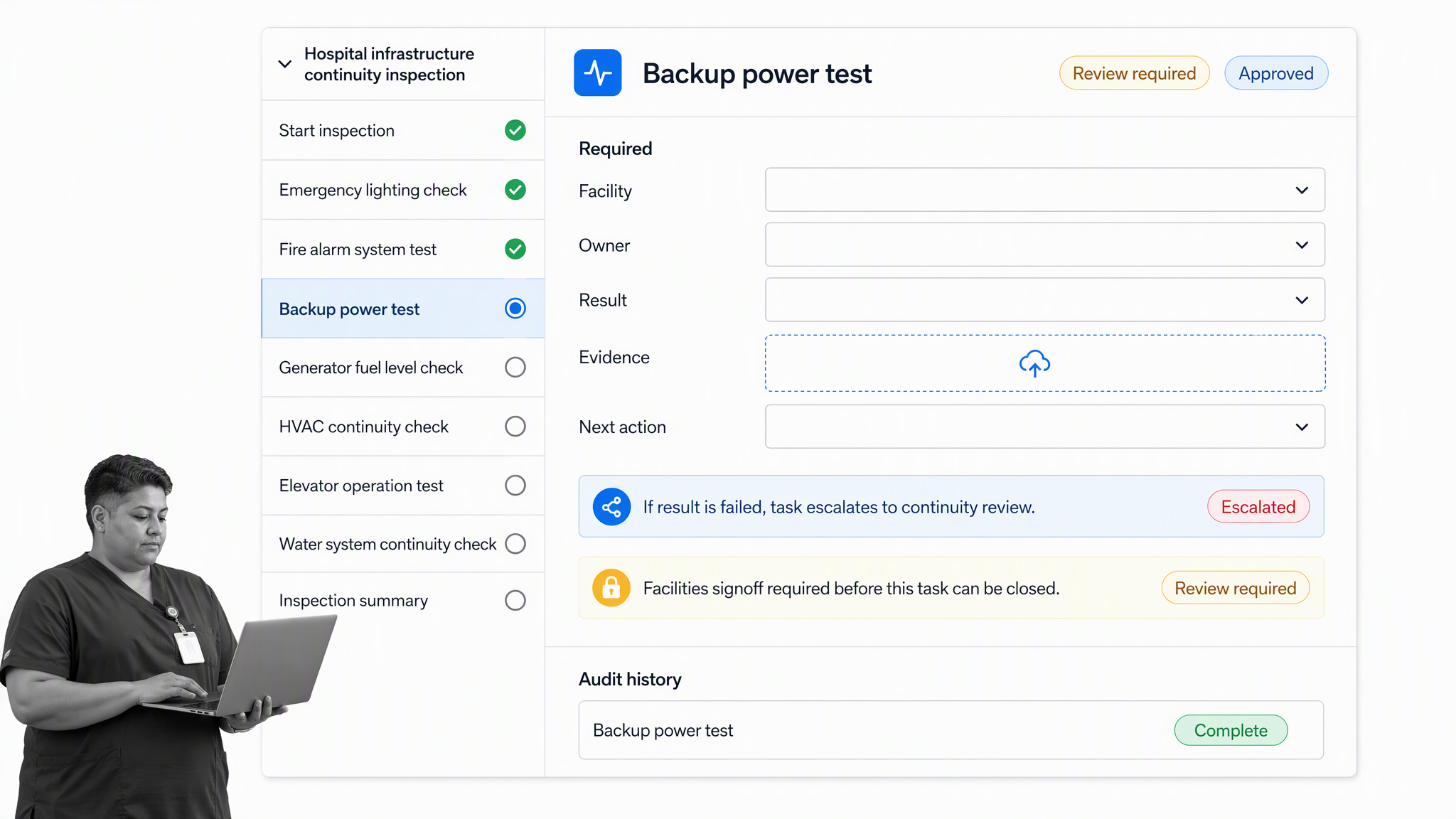
Healthcare infrastructure in Process Street becomes a set of workflows that teams can run, review, and improve. A facilities inspection, backup power test, device maintenance cycle, access review, supply contingency check, or incident response can start from a schedule or trigger and move through assigned tasks, evidence, decisions, approvals, and escalation.
Turn infrastructure standards into recurring execution
Build the control once, then run it on the required cadence. Required fields and evidence make the result consistent. Assignments and due dates make ownership visible. Conditional paths adapt the workflow when a test fails, an asset is critical, or a service cannot use the normal recovery route.
Use approvals for material decisions
A failed continuity test, deferred repair, access exception, or return-to-service decision may require review. workflow approvals keep the decision inside the workflow with the supporting evidence instead of separating approval from the operational record.
Connect infrastructure systems to the work layer
Process Street has direct, universal integrations to 5,000+ systems. Need a new one? An AI agent builds it on the fly. That lets infrastructure workflows receive signals from forms, monitoring systems, asset tools, service desks, spreadsheets, communication platforms, and systems of record, then route the required response.
Create one evidence trail
Each workflow run captures the tasks, owners, fields, files, comments, decisions, approvals, exceptions, and completion state for that control cycle. Teams can inspect individual records during an audit or aggregate them to find repeated failure patterns.
A connected healthcare platform should not replace specialized clinical, facility, or IT systems. It should coordinate the work across them and prove that the required response happened.
FAQs
What is healthcare infrastructure?
Healthcare infrastructure is the physical, digital, operational, and organizational foundation that enables care delivery. It includes facilities, utilities, equipment environments, networks, applications, communications, supplies, workforce support, governance, and the workflows that keep those parts reliable.
What are the main components of healthcare infrastructure?
The main components are facilities and utilities, clinical equipment support, digital and communications systems, workforce and operational support, supply and logistics capacity, and governance. These components have to work as one system because a failure in one layer can interrupt the service built on top of it.
Why is digital infrastructure important in healthcare?
Digital infrastructure supports secure information flow, identity, communication, clinical applications, interoperability, monitoring, backup, and recovery. It helps teams coordinate care and operations, but it only works reliably when technical controls are connected to clear ownership and response workflows.
How do you assess healthcare infrastructure?
Start with a critical service, map its physical, digital, supply, workforce, and vendor dependencies, then test the controls and evidence for each one. Prioritize gaps by care impact, likelihood, time to harm, detectability, recovery difficulty, and the safety of available workarounds.
What makes healthcare infrastructure resilient?
Resilient healthcare infrastructure has redundancy, tested continuity procedures, clear decision rights, trained teams, reliable communications, alternative supply routes, evidence-based recovery criteria, and a process for learning after tests and incidents. A backup that has not been tested is not a complete resilience strategy.
How can Process Street support healthcare infrastructure operations?
Process Street can turn recurring infrastructure controls into assigned workflows with required fields, evidence, conditional paths, approvals, escalation, integrations, and audit history. It helps facilities, IT, quality, compliance, supply, and clinical operations teams coordinate the work that keeps infrastructure ready.