Turn every policy into automated workflows with built-in enforcement and audit-ready proof.


Healthcare Product
A healthcare product is a physical, digital, or combined offering designed to prevent, diagnose, monitor, treat, coordinate, or support health-related work. The term can cover a regulated medical device, a healthcare software product, a consumer health product, or an operational product that helps a care team deliver services reliably.
The category is broad, but the operating challenge is consistent. A healthcare product has an intended use, a defined user, a risk profile, evidence requirements, quality controls, and a lifecycle that continues after launch. Good product work makes those elements explicit and keeps them connected as the product changes.
This guide explains the main healthcare product categories, the product lifecycle, core requirements, quality and risk controls, launch operations, and the workflow system needed to keep decisions, approvals, and evidence aligned.
In this article, we are going to cover:
- What is a healthcare product?
- Healthcare product categories
- The healthcare product lifecycle
- Healthcare product requirements
- Healthcare product quality and risk controls
- Healthcare product launch and operations
- Manage healthcare product work in Process Street
- How to choose a healthcare product operating system
- FAQs
What is a healthcare product?
A healthcare product is any designed offering that creates a health-related outcome or supports the work required to create that outcome. Some products interact directly with patients. Others help clinicians, administrators, manufacturers, laboratories, payers, or quality teams make the right decision and complete the right action.
Start with intended use
The most useful definition begins with intended use: what the product is supposed to do, who uses it, under which conditions, and what result it should produce. A blood pressure monitor, patient scheduling application, home-care kit, clinical decision support tool, and medication reconciliation workflow are all healthcare products, but they create different risks and require different proof.
For medical devices, FDA medical device classification guidance explains that classification depends on intended use, indications for use, risk, and the controls needed to assure safety and effectiveness. Even when a product is not a regulated device, intended use still anchors product requirements and testing.
Separate the product from the service around it
A product is the repeatable offering. A service is the human activity delivered around it. The two can be tightly connected. A remote monitoring product may include a device, an application, alerts, clinician review, patient education, and support. Product teams need to define which parts are fixed, which parts depend on professional judgment, and how information moves between them.
Treat operational workflows as part of the product experience
A product can be technically sound and still fail users when intake, onboarding, training, escalation, complaint handling, or follow-up breaks down. A structured patient intake checklist shows how operational steps shape the experience around a clinical or administrative product.
That is why healthcare product management extends beyond the interface or device. It includes the work required to introduce the product safely, support it consistently, observe its performance, and improve it without losing control.
Healthcare product categories
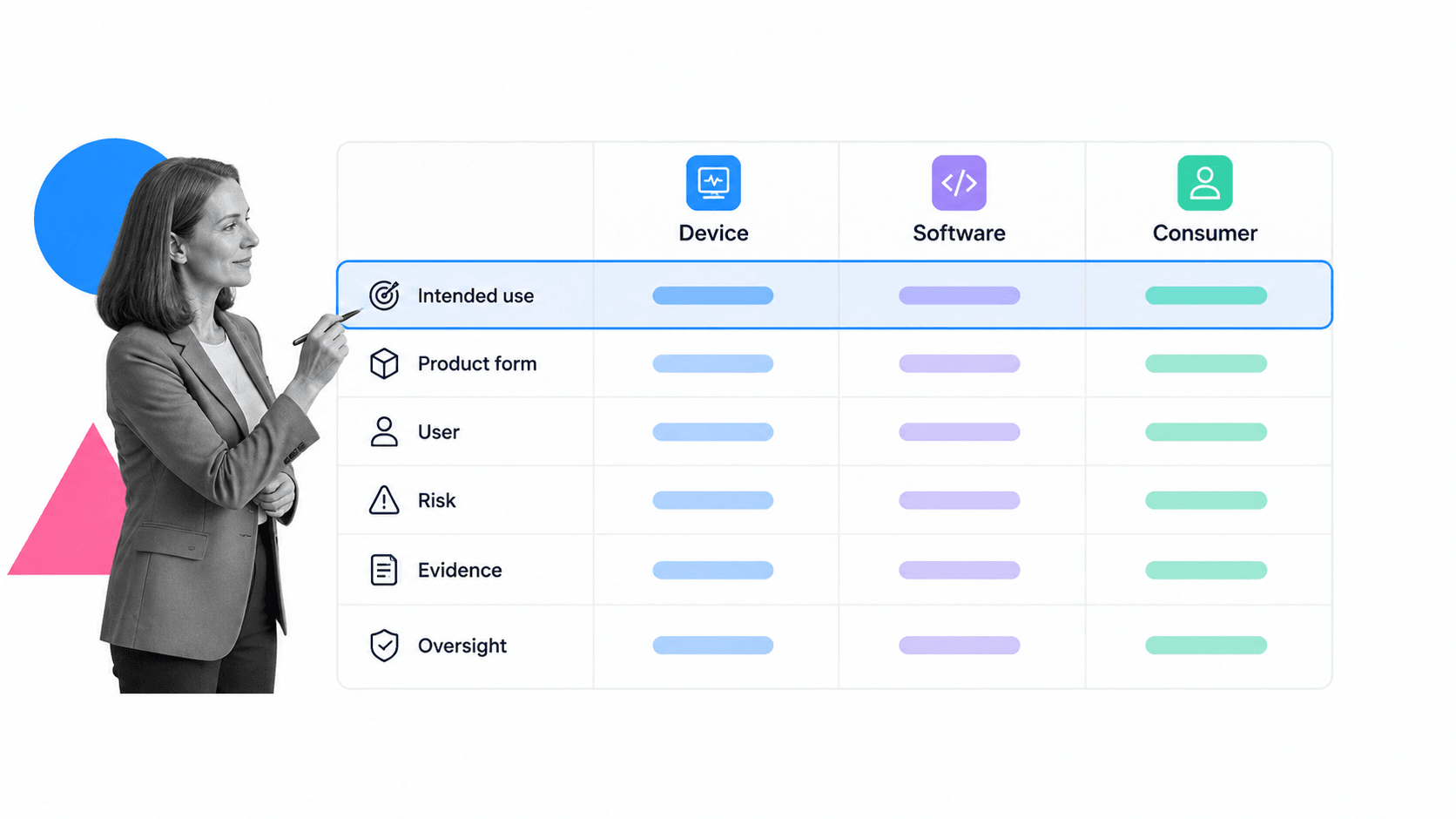
Healthcare product categories overlap, so teams should classify by intended use and risk before choosing a development process. The product form matters, but the consequence of failure matters more.
Medical devices and diagnostics
Medical devices range from simple physical products to complex implanted systems and diagnostic equipment. The FDA uses three device classes, and FDA device development and marketing guidance describes how classification informs the regulatory controls and premarket path that may apply.
A device team needs traceable design inputs, risk controls, verification and validation evidence, supplier controls, labeling review, complaint handling, and change management. The exact burden depends on the device and market, so regulatory expertise should enter the work early.
Healthcare software products
Healthcare software can support scheduling, care coordination, documentation, patient engagement, analytics, quality, or clinical decisions. The critical questions are whether the software influences care, handles sensitive information, creates or modifies clinical data, or becomes part of a regulated device function.
Operational software also needs reliable handoffs. patient management software and healthcare case management software show two adjacent categories where product configuration, workflow design, permissions, and evidence can directly affect staff and patient experience.
Consumer health products
Consumer health products include wellness tools, over-the-counter products, home monitoring equipment, education products, and self-service applications. Their usability burden is high because users may have limited training, different levels of health literacy, and little tolerance for unclear setup or feedback.
Care-enabling operational products
Some healthcare products organize work rather than deliver a clinical intervention. Intake systems, referral workflows, quality review programs, incident processes, and policy execution systems help care organizations coordinate people, decisions, and evidence. These products still need an explicit user, outcome, risk model, and operating owner.
The healthcare product lifecycle
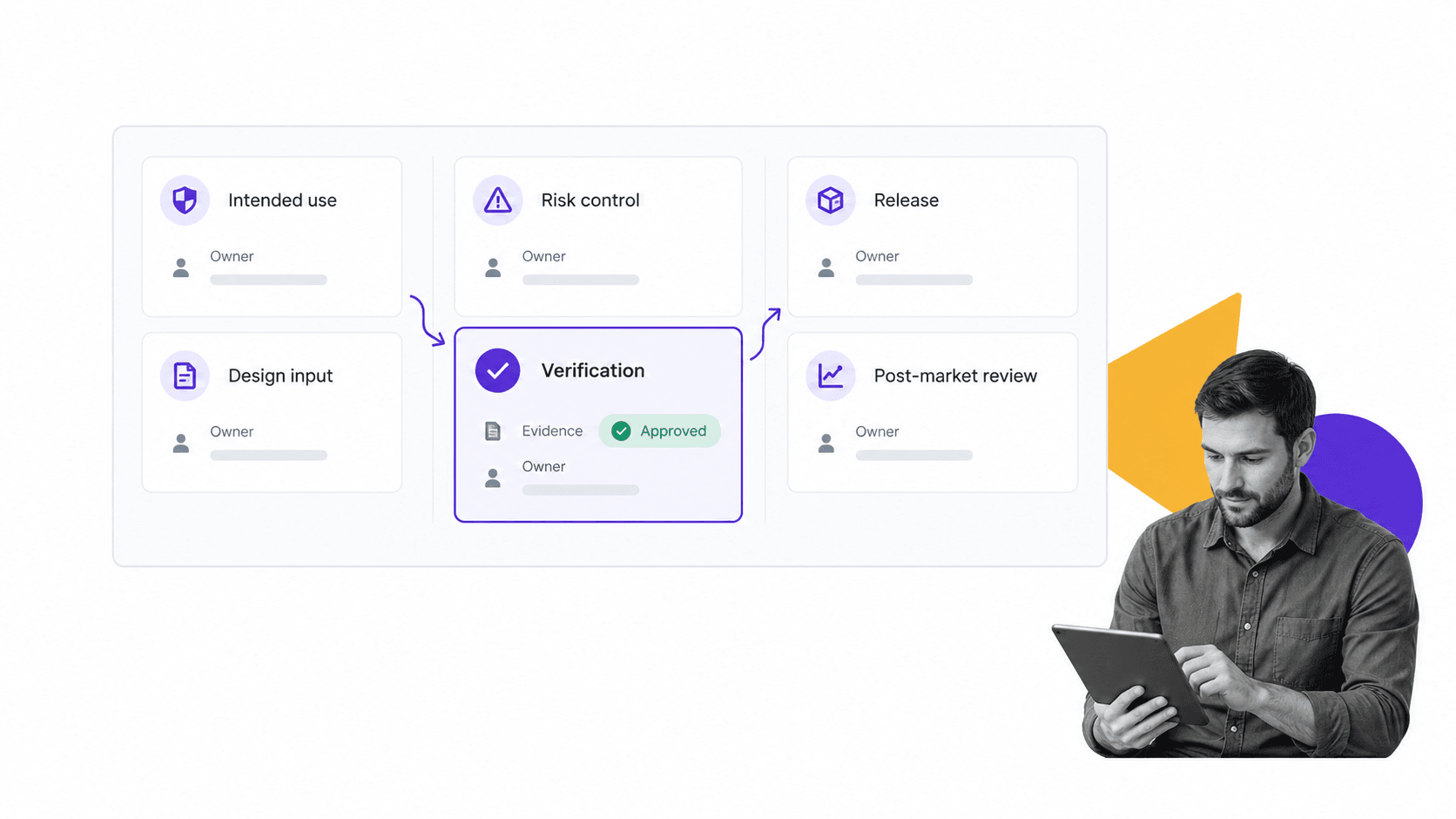
The healthcare product lifecycle connects discovery, design, evidence, release, and monitored use. Treating each phase as a separate project creates gaps. The better model is one traceable operating system where decisions and evidence continue forward.
1. Define the problem and intended outcome
Begin with the user problem, care setting, desired outcome, and failure consequence. Interview the people who experience the problem and the people who carry the operational burden. A compelling idea is not yet a product requirement.
2. Translate needs into requirements
Requirements make the intended use testable. Define functional behavior, performance limits, usability needs, privacy constraints, integration assumptions, training needs, evidence expectations, and acceptance criteria. Each requirement should have an owner and a method of verification.
3. Design and control risk
Product design turns requirements into a usable system. Risk work identifies foreseeable hazards, failure modes, misuse, workflow gaps, and operational dependencies. Controls should change the design or operating process, not simply add warnings after decisions are complete.
4. Verify and validate
Verification asks whether the team built the product according to its requirements. Validation asks whether the resulting product meets user needs and intended use in the expected environment. Both need planned protocols, results, deviations, review, and approval.
A repeatable medical device quality system template can keep design, clinical, quality, and regulatory evidence connected, while a focused medical device quality control process can structure inspection, testing, corrective action, and final disposition.
5. Release and monitor
Release is a controlled decision, not the end of product work. The team needs production or deployment readiness, training, support, access controls, incident routes, complaint handling, performance monitoring, and a defined way to evaluate changes after real-world use.
Healthcare product requirements
Healthcare product requirements should create a shared contract between product, clinical, design, engineering, quality, compliance, security, and operations teams. They make the product testable and prevent late surprises.
User and clinical requirements
Describe the user, care setting, task, decision, constraint, and outcome. Include accessibility, health literacy, environmental conditions, training, response time, and the limits of professional judgment. A requirement such as ‘easy to use’ is too vague. State the observable behavior that proves usability.
Data and privacy requirements
If the product creates, receives, maintains, or transmits electronic protected health information, privacy and security obligations must shape the design and operation. HHS HIPAA Security Rule guidance describes administrative, physical, and technical safeguards for ePHI.
A practical HIPAA Privacy Rule checklist or HIPAA compliance checklist can turn policy topics into assigned reviews, evidence collection, remediation, and approval. The product team should still involve qualified privacy, security, and legal owners for applicability decisions.
Integration and interoperability requirements
Specify which system owns each record, what event moves data, how identity is matched, how errors are handled, and what happens when a connection is unavailable. An integration is not complete when data moves once. It is complete when failures, retries, duplicates, permissions, and audit evidence are controlled.
Operational and support requirements
Define onboarding, training, escalation, maintenance, service levels, incident response, complaint intake, and change communication. These requirements protect the product in real use, where staff turnover, incomplete data, workarounds, and unusual cases expose gaps that testing may not show.
Healthcare product quality and risk controls
Healthcare product quality is the ability to meet intended requirements consistently while controlling risk. Quality is not a final inspection step. It is a management system for decisions, records, suppliers, changes, failures, and learning.
Use risk to scale control
Not every decision needs the same review. A copy change and a safety-critical design change should not follow identical paths. Risk-based routing lets low-risk work move efficiently while high-risk changes trigger added evidence, qualified review, and formal approval.
Maintain traceability
Traceability connects user needs to product requirements, design outputs, risk controls, tests, results, approvals, and released versions. It makes gaps visible and reduces the time spent reconstructing why a decision was made.
Control changes and deviations
Changes should state the reason, affected requirements, risk impact, required testing, training impact, rollout plan, and approvers. Deviations need the same discipline: what happened, immediate containment, impact assessment, investigation, corrective action, and effectiveness review.
Align the quality system with applicable regulation
For FDA-regulated finished devices, the FDA Quality Management System Regulation became effective on February 2, 2026 and incorporates ISO 13485:2016 by reference as the foundational quality management framework. Applicability depends on the product and market, so teams should document the rule set that governs each product.
The operating principle is durable even when a particular rule changes: every requirement needs an owner, every control needs evidence, and every material change needs review.
Healthcare product launch and operations
A healthcare product launch joins the product and the operating system around it. Teams need confidence that users can adopt the product, support can respond, quality can investigate, security can monitor, and leaders can see whether the product works as intended.
Build a release readiness gate
Create one release record that collects product version, approved requirements, verification and validation results, open risks, labeling or instructions, training status, supplier status, support readiness, data controls, rollback plans, and final approval. Missing evidence should block release rather than become a follow-up promise.
Prepare users and operators
Training should match the user’s role and the product’s risk. Show the normal path, exceptions, prohibited actions, escalation route, and what evidence users must capture. Track acknowledgment and competency where the product or policy requires it.
Monitor signals after launch
Useful signals include incidents, complaints, near misses, support themes, failed handoffs, incomplete records, overrides, abandonment, performance drift, and recurring exceptions. Each signal needs a threshold, owner, review window, and path into corrective action or product improvement.
Close incidents with learning
An incident management checklist can structure containment, evidence, classification, response, validation, root cause, and policy updates. Closing the ticket is not enough. The team should confirm that the product, process, or training change reduced the risk.
Manage healthcare product work in Process Street
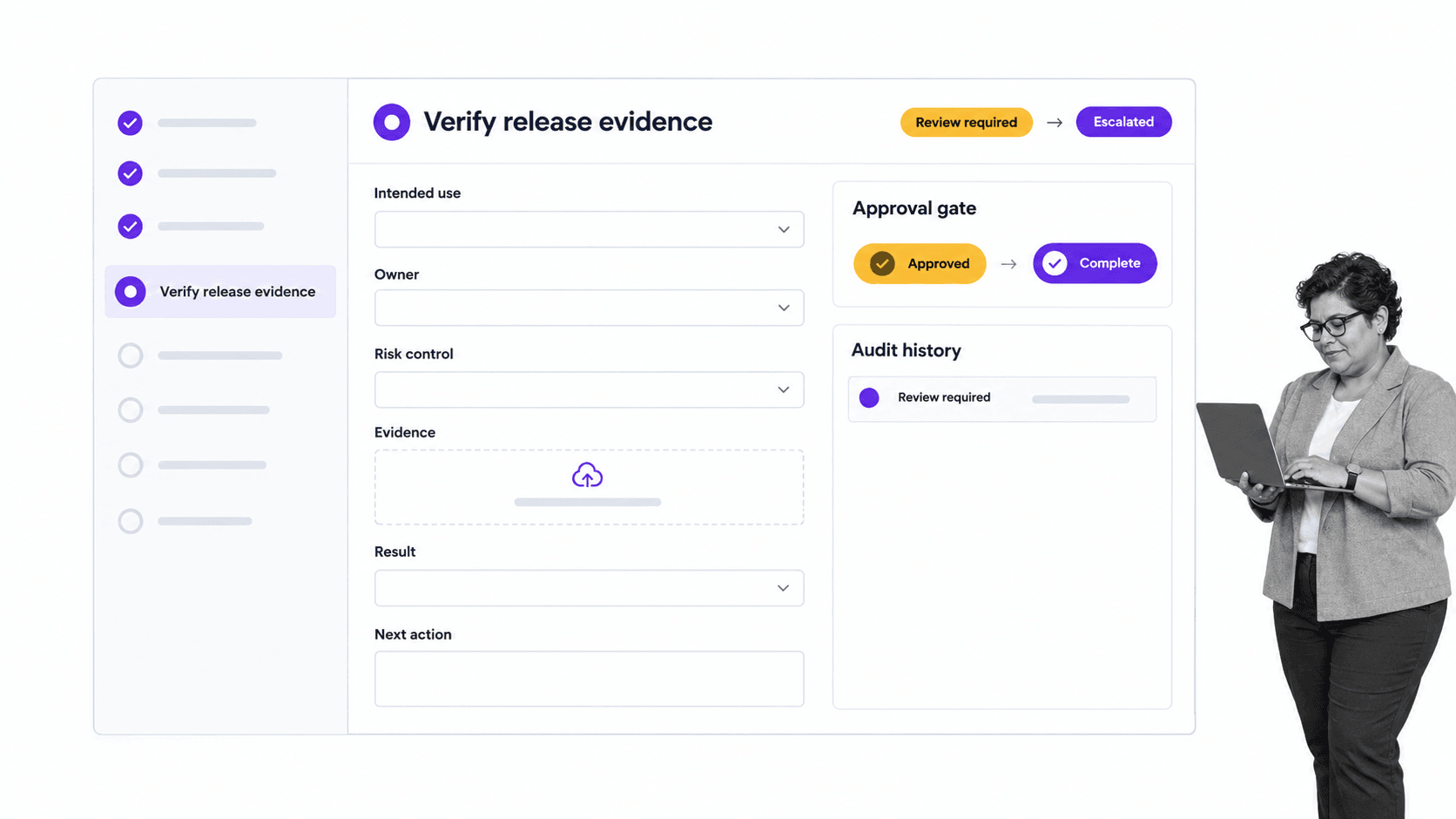
Managing healthcare product work in Process Street means turning requirements, quality controls, approvals, and operating procedures into workflows people actually run. Each product record can route tasks to the right owner, require evidence, branch by risk, and preserve an audit trail.
Process Street is an agentic process automation platform and is HIPAA compliant. It is useful for healthcare product teams that need product, quality, compliance, clinical, security, and operations work to follow one controlled path without depending on memory or side spreadsheets.
Run lifecycle gates as workflows
Discovery review, requirements approval, design review, verification readiness, validation review, release readiness, complaint investigation, corrective action, and change control can each run as a reusable workflow. Required fields and stop points keep evidence attached to the decision.
Route work by product and risk
Use conditional logic to show the right tasks for product category, market, risk level, data type, or change impact. High-risk work can require added reviewers and evidence without burdening every routine task.
Make approval explicit
Use workflow approvals to assign review to qualified owners and prevent a workflow from closing before approval. The resulting record shows what was reviewed, the decision, and any comments or rework.
Connect the product operating stack
Process Street has 5,000+ integrations. That lets teams connect forms, records systems, ticketing, analytics, communication, and document tools to the workflow while keeping responsibilities and control evidence visible.
The healthcare operations case study shows how structured execution can materially reduce preparation work in a healthcare operation. The exact workflow differs by product, but the principle is the same: make the required work visible, owned, and provable.
How to choose a healthcare product operating system
Choose a healthcare product operating system by testing whether it can control the lifecycle, not just store documents or display tasks. The system should help teams move from intended use to released product and monitored operation without losing traceability.
Evaluate workflow depth
Look for assignments, required fields, due dates, conditional paths, approvals, stop points, recurring work, comments, file evidence, and API or integration support. The platform should make the correct path easier than the workaround.
Evaluate governance
Test permissions, change history, version control, review ownership, audit export, retention, and the ability to separate builders, operators, and approvers. Ask whether an auditor or quality leader could reconstruct a decision without interviewing the whole team.
Pilot one consequential workflow
Use a release gate, complaint investigation, supplier qualification, or change control workflow. Run realistic exceptions, missing evidence, rework, and escalations. The pilot should prove that the system handles the difficult path, not only the happy path.
Plan for continuous improvement
Connect product operations with HIPAA compliance automation so recurring privacy and security work becomes scheduled, assigned, and reviewable. Product improvement should change both the product and the controlled workflow that supports it.
The goal is one healthcare product operating model where requirements, decisions, evidence, release, and learning stay connected throughout the lifecycle. Review that model on a fixed cadence, and record why each control changes.
FAQs
What is a healthcare product?
A healthcare product is a physical, digital, or combined offering designed to prevent, diagnose, monitor, treat, coordinate, or support health-related work. It has an intended use, defined users, requirements, risks, evidence, and an operating lifecycle.
What are examples of healthcare products?
Examples include medical devices, diagnostics, healthcare software, patient engagement applications, home monitoring products, consumer wellness products, and operational systems for intake, referrals, quality, incidents, or compliance. The category depends on intended use and risk, not only the product form.
What are the stages of the healthcare product lifecycle?
The lifecycle typically includes problem definition, intended use, requirements, design, risk control, verification, validation, release, training, monitoring, complaint handling, change control, and retirement. Regulated products may require additional market-specific steps and evidence.
How do healthcare product teams manage quality?
Teams manage quality by controlling requirements, risks, suppliers, tests, records, changes, deviations, complaints, corrective actions, and approvals. Quality works best as part of daily execution rather than a final inspection exercise.
How does HIPAA affect a healthcare product?
HIPAA applicability depends on the organizations, data, and activities involved. Products that handle ePHI for covered entities or business associates need administrative, physical, and technical safeguards, supported by clear ownership and evidence. Qualified privacy and legal owners should confirm applicability.
Can Process Street manage healthcare product workflows?
Yes. Process Street can run requirements reviews, risk assessments, verification gates, release approvals, complaint investigations, corrective actions, and change controls as assigned workflows. Conditional logic, approvals, evidence fields, integrations, and audit history help teams keep work controlled and provable.